
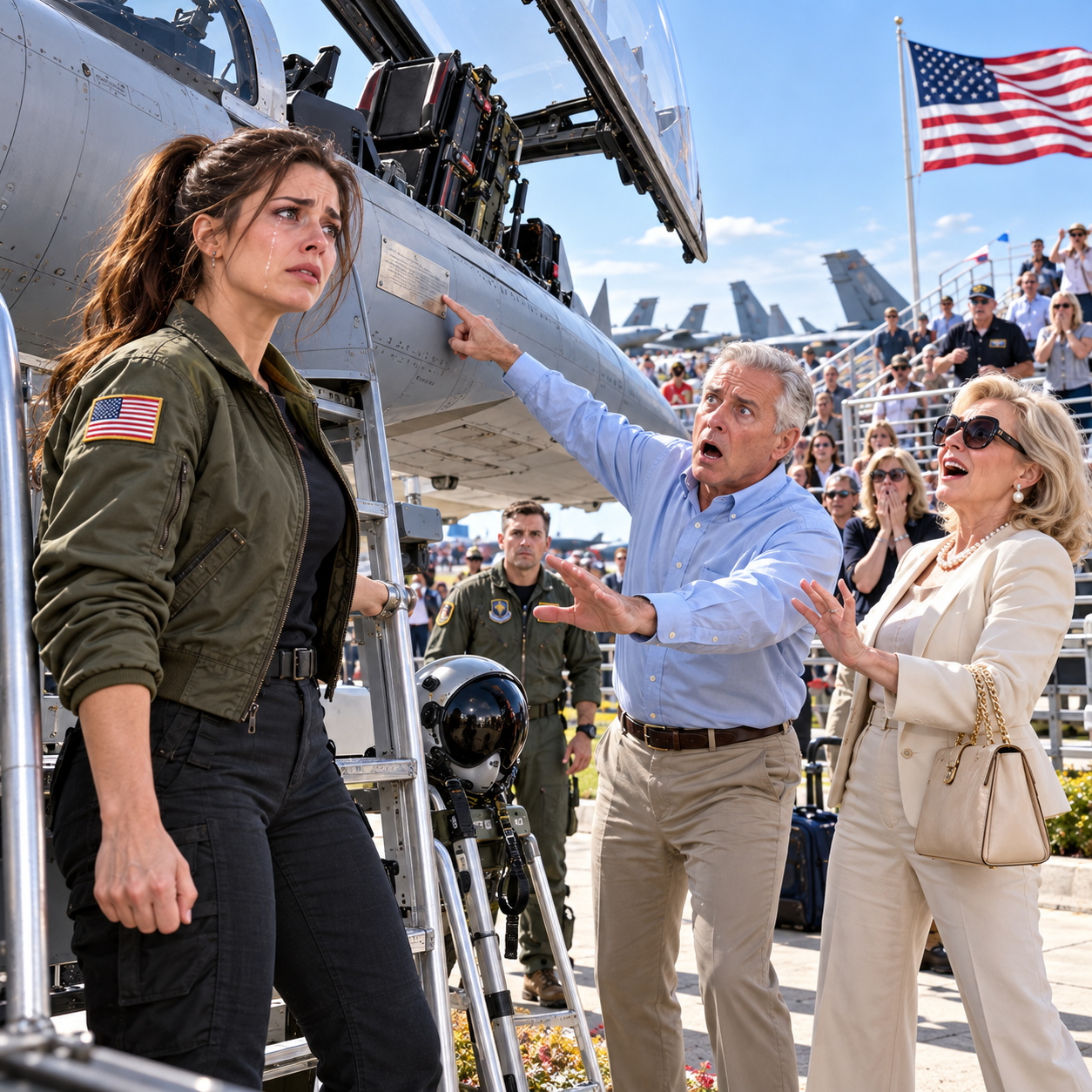
Dad Was At The Air Show, In The Family Section. My Stepmom Said, Loud Enough For The Bleachers: “Let’s Be Honest. She Just Fuels The Jets. Somebody Has To.” Dad Nodded Along. I Said, “Not Here, Denise.” We Walked The Static Line. Ten Steps. Dad Stopped Under The Canopy. Read The Rail. Read It Again. Denise Laughed. “What, Honey?” “Denise. Don’t Say Another Word.”
At my father’s 66 birthday air show, my stepmother stood in front of our entire family and announced, “Willa just pumps gas into airplanes. Don’t make her sound important.” My father laughed, just as he had for most of my adult life. I didn’t argue. I simply followed them toward the fighter jets on display. Ten steps later, he looked beneath an F-16’s raised canopy and stopped breathing normally. By the following evening, a sealed envelope hidden for thirteen years would explain why he’d never known his own daughter.
## Part 1
The little fighter jet on my kitchen windowsill cost six dollars in 1995. Its paint is scratched, its left wingtip has worn down to silver metal, and somebody at the factory decided an F-16 should have a bright gold windshield. Every morning, sunlight comes through the pine trees behind my house in Sumter, South Carolina, and catches that ridiculous gold canopy. I sometimes stand there holding my coffee, watching the shadow of a toy airplane stretch across the counter, remembering how close I came to spending the rest of my life believing my father had thrown it away.
My name is Willa Calder. I’m thirty-eight years old, and I’ve spent almost twenty years in the United States Air Force, although my family would have described those years rather differently. For most of my adult life, I was the girl who filled airplanes with fuel, the daughter who never quite accomplished anything worth discussing at Sunday dinner. I didn’t correct them, even when their little jokes followed me across thirteen Christmases, a dozen birthdays, and more family gatherings than I care to remember. People sometimes mistake silence for weakness, but mine had begun as something else entirely: the exhausted decision to stop asking my father to notice me.
I grew up outside Rome, Georgia, in a redbrick house with white shutters and a backyard that sloped toward a narrow creek. My father, Thomas Calder, owned a heating and air-conditioning business and could repair almost anything with a motor, provided nobody expected him to discuss how he felt while doing it. My mother, Evelyn, worked at a dental office downtown, made excellent peach cobbler, and possessed the kind of laugh that escaped her before she could decide whether something was actually funny. She was the first person who ever told me that wanting something extraordinary wasn’t the same as being foolish.
Every June, we attended an air show at the regional airport. Mom packed lemonade in a blue cooler, wrapped sandwiches in wax paper, and insisted we leave before seven because she wanted our favorite place against the chain-link fence west of the control tower. Dad came whenever work allowed, usually wearing a sun-faded baseball cap and pretending the entire outing was something he tolerated for our benefit. He would eventually betray himself by asking detailed questions about an aircraft’s engine, and Mom would laugh because he was just as interested as we were. Those mornings were the happiest I remember from childhood, when our family seemed as permanent as the Georgia hills beyond the runway.
The first F-16 I ever saw flew over that fence when I was seven. I remember the air trembling against my ribs, the impossible speed, and my mother’s fingers closing around mine as the airplane climbed into the white summer sky. After the demonstration, she bought me the little die-cast jet from a souvenir stand that smelled of sunscreen and kettle corn. I carried it home in both hands, afraid the wings would break if I put it in my pocket. That night, while I flew it over my blanket, I asked her what kind of people became fighter pilots.
“Ordinary people who worked very hard,” she answered, sitting on the edge of my bed. “People who decided they weren’t going to let someone else choose their future.”
“Could I be one?”
She looked at me as though I’d asked whether I was allowed to have another glass of water. “Of course you could, sweetheart. You’d have to work for it, but there’s nothing wrong with wanting the sky.”
Dad stood in the doorway listening, a screwdriver sticking out of his shirt pocket. “Just remember airplanes are expensive,” he said. “You might want a backup plan.” Mom gave him a look, and he smiled before coming over to make the little jet dive toward my pillow. I didn’t recognize the difference between their answers until years later. My mother heard a dream and wanted to protect it; my father heard a risk and wanted to protect me from disappointment.
By eleven, I could identify most of the aircraft that visited our airport, and by fourteen, I’d filled two notebooks with drawings of instrument panels and flight-control systems. Mom borrowed aviation books from the library and helped me find science programs, while Dad paid for the occasional model kit and told neighbors I was going through my airplane phase. I didn’t mind the phrase then because his voice still held affection when he said it. Sometimes he’d come into my bedroom and find the little F-16 sitting crooked on my bookshelf after Mom had picked it up and rubbed its left wingtip with her thumb. He’d straighten it carefully, as if a tiny airplane needed to be parked properly.
Our last air show together happened in June 2003, when I was fifteen. A thunderstorm delayed the afternoon demonstration, and we spent nearly an hour beneath a vendor tent listening to rain hammer the canvas while Dad complained about his damp shoes. Mom bought three paper cups of lemonade even though we’d brought our own, simply because the elderly vendor looked worried about losing business. When the clouds finally opened, an aircraft swept across the runway with sunlight flashing along its wings, and Mom grabbed my arm so excitedly that she spilled lemonade down my sleeve. I complained, and she laughed, and afterward we took a photograph beside the fence.
In that picture, my mother’s hair is blowing into her mouth, and I’m squinting beneath the brim of an oversized Air Force cap. Dad took it with a disposable camera, although Mom insisted he take another because he’d cut off part of the aircraft behind us. We had the photograph developed at a drugstore the following week, and she framed it for my bedroom wall. I remember thinking it was a terrible picture of me, but she loved it. I would spend the next twenty-two years wishing I’d let her take a hundred more.
In July 2004, Mom collapsed while preparing dinner. She had been cutting peaches when she complained of a sudden headache, gripped the counter, and sank to the kitchen floor. I called for help while Dad was repairing an air-conditioning unit several miles away, and I remember the dispatcher asking questions in a calm voice as the kitchen clock ticked above the refrigerator. At the hospital, a doctor explained that a ruptured aneurysm had caused catastrophic bleeding in her brain. Two days later, Dad and I stood beside her bed and said goodbye to the woman who had been the center of our family.
People brought casseroles and sympathy cards, and our church organized meals for nearly a month. When those stopped, the house became painfully quiet, except for the television Dad left running in the living room without watching it. He returned to work, ate dinner standing at the counter, and slept with his bedroom door closed. Whenever I mentioned Mom, he found a reason to leave, sometimes sitting in his truck in the driveway until long after dark. I was sixteen, grieving the same loss, but somehow I became responsible for making sure my father never had to acknowledge it.
One afternoon, I came home from school and discovered that my aviation books, framed photograph, and little fighter jet were missing from my room. Dad was in the garage replacing a belt on a lawn mower, and when I asked where he’d put them, he kept his eyes on the engine. “I couldn’t keep seeing that stuff,” he said. “Your mother was everywhere, Willa, and I just needed one room where she wasn’t.” I asked whether he’d thrown everything away, but he only rubbed his forehead and told me not to make the afternoon harder than it already was. I went back inside without another word, convinced the last physical reminders of my mother’s faith in me had disappeared into the trash.
Two years later, when I told Dad I’d enlisted in the Air Force, he didn’t shout or forbid me to go. He simply sat at the kitchen table with the enlistment paperwork and asked whether I was certain there weren’t safer careers available closer to home. I told him I’d scored well on the entrance tests and had been offered a position in aircraft fuel systems. His expression relaxed for the first time that evening, and he said, “Well, at least that sounds practical.” I mistook his relief for pride because I desperately wanted it to be pride.
I left Georgia believing that if I worked hard enough, my father might eventually look at me and see something other than the daughter who reminded him of his dead wife. I didn’t know then that while I was preparing to build a life around airplanes, someone else was preparing to move into our house. And she would learn very quickly how to make my father’s silence work in her favor.
## Part 2
The Air Force taught me that fuel isn’t simply something you pour into a tank. It is a volatile, carefully managed system of measurements, procedures, and responsibilities that leaves almost no room for improvisation. At technical training in Texas, I learned about contamination testing, pressure limits, grounding procedures, and the consequences of overlooking one small entry on a checklist. I enjoyed the precision, partly because machines didn’t pretend everything was fine when something was wrong. A faulty gauge gave you a problem to solve, not a decade of silence to interpret.
My first permanent assignment brought me to Shaw Air Force Base in South Carolina, where F-16s lined the flight line beneath concrete shelters. I worked early mornings, late nights, and weekends that seemed designed specifically to conflict with everyone else’s holidays. During cold-weather launches, the fuel equipment felt like ice through my gloves; during August afternoons, heat rose from the pavement until the distant aircraft shimmered. I learned to recognize experienced crew chiefs by the way they moved, never rushing a checklist even when everyone was impatient. The work mattered, and I became good at it, but every time an F-16 climbed away from the runway, I felt the same longing that had started beside a fence in Georgia.
One morning, a pilot named Major Everett Halbrook caught me watching a departing formation. He was a lean man with graying temples and reading glasses he constantly misplaced, usually because he’d tucked them into his flight-suit pocket. He stood beside me for a moment, following the aircraft into the distance, then asked, “Calder, why do you look disappointed every time one of those jets takes off?” I told him the truth before I had time to make it sound sensible. “Because I’m always standing on the wrong side of the ladder, sir.”
He looked at my name tape and then at the disappearing aircraft. “What are you doing about that?”
I explained that I was taking college classes at night, but I wasn’t certain someone with my background could become a pilot. Halbrook asked about my grades, my entrance scores, and my long-term plans, then told me to stop guessing about requirements I could research. Before leaving, he pointed toward the aircraft shelters and said, “Those pilots aren’t a different species, Airman Calder. Start acting like the seat is something you can earn.” It wasn’t a promise, and he never suggested the path would be easy. That mattered because I had already spent enough time around people who mistook encouragement for giving somebody false hope.
For the next four years, my life narrowed to fueling aircraft, studying, and sleeping whenever the schedule allowed. I rented a small apartment near the base, where my kitchen table became a permanent arrangement of textbooks, coffee mugs, and handwritten study notes. I finished my degree while advancing through the enlisted ranks, and Halbrook helped me understand the demanding selection process for officer training and pilot qualification. Some nights, I drove home exhausted enough to sit in my parked car for ten minutes before climbing the stairs. On those nights, I remembered my mother telling me that wanting the sky wasn’t foolish, and I went inside to study another chapter.
Meanwhile, Dad married a woman named Marjorie Pike.
She was a widow from his church, twelve years younger than him, with carefully curled blond hair and an impressive ability to organize other people’s lives. She had two adult children, Grant and Lacey, and ran the office of a local insurance agency. When I met her, she was friendly, efficient, and apparently determined to restore every household routine Dad had abandoned after Mom’s death. Within six months, there were new curtains, freshly painted kitchen cabinets, and framed photographs of Marjorie’s children hanging in spaces where pictures of my mother had once been. I wanted Dad to be happy, so I told myself that change wasn’t the same as erasure.
At their wedding reception in October 2008, Marjorie introduced me to a group of women from church. “This is Tom’s daughter, Willa,” she announced, squeezing my elbow. “She’s in the Air Force, but don’t be too impressed. She just fills up the airplanes.” The women chuckled, and one asked whether I got an employee discount at regular gas stations. I explained politely that military aviation fueling was a specialized operation, but Marjorie waved away the distinction. “She’s always been our practical little girl,” she said, although we’d known each other for less than a year.
That introduction became the foundation of my new identity within the family. Grant, who worked in insurance sales and considered himself unusually knowledgeable about every subject, called me “Pump Number Seven” after discovering the nickname made his mother laugh. At Thanksgiving, someone would ask whether I’d learned how to fly yet, and he’d answer, “Sure, she drives the gas truck real fast.” Lacey sometimes looked uncomfortable, but she rarely challenged him, and Dad generally stared at his plate. I began treating family gatherings like unpleasant appointments: show up, remain courteous, avoid unnecessary discussion, and leave before anyone started asking why I was so sensitive.
There were exceptions that kept me hopeful. Dad still called on my birthday, sent money for Christmas, and occasionally asked whether my apartment needed repairs. One spring, when my car wouldn’t start, he spent half an hour talking me through the electrical system by telephone, sounding so much like my childhood father that I cried after hanging up. I convinced myself that his affection was still there, buried beneath grief and discomfort. What I didn’t understand was that a parent can care about a child in small practical ways while refusing the larger responsibility of knowing who that child is.
In November 2011, I came home for Thanksgiving with news I’d been preparing to share for weeks. I had completed my officer-training application and hoped, if selected and medically qualified, to compete for a pilot-training opportunity. Marjorie had invited fifteen relatives, and the dining room smelled of roasted turkey, cinnamon, and the scented candles she always placed too close to the serving dishes. I waited until dessert because I wanted Dad to hear the news when everyone was relaxed. When I explained my plans, the conversation stopped long enough for me to feel every pair of eyes at the table.
Marjorie recovered first. “Oh, honey,” she said, putting down her fork. “There’s nothing wrong with ambition, but you have a good job already. Don’t get ideas above your station.”
Grant snorted into his iced tea. “Next she’ll tell us NASA called.”
I looked toward Dad, expecting him to defend me or at least ask one question. Instead, he laughed softly and said, “Well, Willa’s always had a big imagination.” Marjorie smiled with satisfaction and steered the conversation toward Grant’s recent promotion, while I sat there holding a forkful of pumpkin pie I suddenly couldn’t swallow. No one asked about the selection process, my degree, or the years I’d spent preparing.
The next morning, I drove back to South Carolina before sunrise. At a gas station outside Augusta, I stopped for coffee and found myself staring at my reflection in the dark glass of a vending machine, wondering why one careless sentence could still make me feel sixteen years old. I called Halbrook when I got home and told him what had happened, expecting him to offer some reassuring speech about families. Instead, he asked whether I’d withdrawn my application.
“No, sir.”
“Then what’s the problem?”
I told him I wanted my father to believe I could do it. Halbrook was quiet for a moment before answering, “Calder, you cannot make somebody proud by giving them control of your ceiling. Let the selection board judge your qualifications.” Six months later, I received orders to officer training. I placed the acceptance letter on my kitchen table, called my closest friends, and celebrated with cheap pizza. Then I reached for my phone to call Dad, remembered his laugh at Thanksgiving, and put it facedown without dialing.
## Part 3
Officer Training School at Maxwell Air Force Base was the beginning of a different life, although I couldn’t appreciate it at the time because I was too busy trying not to make mistakes. After years as an enlisted airman, I had to learn a new kind of leadership while competing with candidates whose backgrounds seemed much more impressive than mine. I graduated in 2012 and received my commission with a feeling that was less like triumph than relief after a long, difficult climb. Halbrook attended the ceremony, congratulated me without embarrassing speeches, and told me that the next stage would be harder. I believed him.
I mentioned my commissioning to Dad during a Sunday telephone call. He was distracted by something happening at church and asked whether becoming an officer meant I could stop working overnight shifts. I explained that I would be leaving for pilot training, and he said, “Good for you, honey,” with the same tone he’d used when I told him I’d replaced my car tires. In the background, Marjorie asked who was calling, and I heard him answer, “It’s Willa. She’s heading off to another school.” He never repeated the word “pilot,” and I didn’t press him.
Undergraduate pilot training in Mississippi nearly broke me. The days began before sunrise with weather briefings, flight planning, and hours of preparation for lessons that sometimes lasted less than an hour. I learned to handle the T-6 trainer, moved on to the demanding T-38 track, and spent countless nights replaying every imperfect maneuver in my head. There were students who struggled with instrument flying, others who couldn’t manage the workload, and days when I wondered whether I’d finally reached the edge of my own ability. But for the first time, my effort was measured against something concrete, and improvement mattered more than anybody’s opinion of where I belonged.
In October 2013, I earned my Air Force pilot wings.
Three weeks before graduation, I mailed Dad an invitation printed on thick cream-colored paper with the ceremony details embossed across the front. Inside, I wrote a personal note explaining how much it would mean if he came, how I’d reserved him a seat, and how I wished Mom could have seen the day. I sealed the envelope carefully and drove it to the post office myself because I wanted it to arrive without getting lost among the advertisements that filled the base mailboxes. For two days afterward, I checked my phone constantly, expecting him to call with questions about the drive to Mississippi.
He didn’t.
Eventually, I called the house and Marjorie answered. I told her about graduation and asked whether Dad had received my letter, explaining that I would be flying military aircraft professionally once I completed the rest of my training. She was quiet for a moment, then said he was out on a service call and she’d make sure he heard everything. “He has a lot on his mind right now, sweetie,” she added. “Don’t be disappointed if he can’t get away.” I told her I understood, although what I understood was that my milestone had already become an inconvenience.
On graduation morning, the auditorium filled with parents, spouses, children, and relatives carrying cameras. One classmate’s family arrived wearing matching shirts; another had grandparents who’d driven fourteen hours to be there. I kept glancing toward the entrance while adjusting the collar of my dress uniform, watching people hurry down the aisle toward waiting seats. Dad’s chair remained empty when the ceremony began, and it was still empty when my name was called. Halbrook, by then a lieutenant colonel, stepped forward to pin my silver wings on me, and his hands were steady enough for both of us.
Afterward, he walked with me outside into the October sunshine. Families clustered across the lawn for photographs while children begged to touch the little silver wings on their parents’ uniforms. Halbrook asked whether I wanted him to take my picture beside the sign, and I agreed because I couldn’t think of a good reason not to have one. As he lowered the camera, he looked at me for a long moment and said, “Your mother would have taken the first seat in the room.” I turned away before he could see my face because he was right, and that truth hurt worse than the empty chair.
I waited another week for Dad to call. When he didn’t, I made a decision that seemed reasonable at twenty-five and became more difficult to undo with every passing year. I would stop volunteering information about my career, stop trying to turn his attention toward things he clearly didn’t want to discuss, and stop arriving at family gatherings with achievements I hoped would finally make me worth noticing. I had explained myself in an invitation, in telephone conversations, and at a Thanksgiving table full of witnesses. If that wasn’t enough, I decided, nothing else would be.
I completed advanced fighter training and eventually returned to Shaw, the same base where I’d driven fuel trucks. When some senior maintenance personnel recognized me, word spread quickly that the new fighter pilot had once worked on the fueling crew. During a squadron gathering, the other pilots gave me the call sign “Gauge,” partly because of my previous specialty and partly because I’d become known for noticing small discrepancies during preparation. I loved it, although I pretended to complain like everyone else. The name connected the work I’d done on the ground to the responsibility I’d earned in the cockpit, and I never once felt ashamed of either.
My career progressed through demanding assignments, deployments, promotions, and increasingly complicated responsibilities. By 2026, I was a major serving as an assistant director of operations, helping prepare younger pilots while continuing to fly the F-16. I had a house near Shaw, friends who understood why I’d disappear for weeks at a time, and a life that felt full even without a husband or children of my own. I had experienced difficult days and made mistakes I took seriously, but nothing had ever made me regret pursuing the career I’d wanted since childhood.
At home in Georgia, none of that seemed to exist. Marjorie continued introducing me as the family member who refueled military airplanes, and Grant still made jokes about the gas station whenever he thought the room needed entertainment. Once, at Christmas, I overheard Dad telling a neighbor that I was “doing pretty well in aircraft maintenance,” and I stood in the hallway with a plate of cookies, wondering how someone could know so little about his own daughter. I could have corrected him then. Instead, I stepped back into the kitchen, set down the cookies, and booked my return flight for the following morning.
In May 2026, Dad called me on a Wednesday evening while I was folding laundry. He told me he would turn sixty-six in June, and Marjorie had arranged a family outing to an air show near Rome to celebrate. He said everyone would be there, including Grant’s children, and asked whether I could come. I began preparing my usual polite excuse about work commitments, but he interrupted me with something he hadn’t said in years. “I’d really like to spend the day with you, Willa. Just you being there would mean something.”
I stood beside the dryer holding a warm towel, surprised by how badly I wanted to believe him. So I agreed to drive down for the weekend, promising to arrive Friday evening and leave Sunday afternoon. After we hung up, I checked the air show’s public schedule and noticed two F-16s from Shaw were listed among the static displays. I recognized the aircraft type, of course, but thought little more of it; our base supported public events regularly, and I was on leave.
What I didn’t know was that a last-minute maintenance substitution had changed which aircraft would appear. One of the F-16s being prepared for transport to Georgia was a jet I had flown repeatedly, with my name still painted beneath the canopy. And by the time I learned that, my family would already be standing in front of it.
## Part 4
I arrived at my father’s house shortly after seven on Friday evening, just as the sun was disappearing behind the oak trees. The brick ranch looked almost the same from the driveway, although Marjorie had replaced Mom’s flower beds with carefully arranged shrubs and installed an enormous decorative wreath on the front door. Dad met me on the porch wearing work pants and a faded gray shirt, his hair thinner and whiter than when I’d last visited. He hugged me awkwardly, patted my shoulder twice, and carried my overnight bag inside. For a few seconds, with the smell of fresh-cut grass drifting through the screen door, I almost believed we could have a normal weekend.
Marjorie had prepared a birthday dinner with enough food for twice the number of people expected. She talked while she served, explaining the air show’s parking arrangements, the matching family shirts she’d ordered, and the birthday cake waiting in the refrigerator. When she asked whether I was still working with aircraft fuel, I answered, “I’m still with the fighter wing.” She nodded without curiosity and told Grant’s oldest boy, Parker, that his aunt would probably know where to find the cheapest gasoline in South Carolina. I laughed politely because Parker was eleven and looked embarrassed, but I noticed Dad didn’t even raise his eyes.
Later that night, I wandered into the room that had once been my bedroom. The walls were beige instead of pale blue, and a folded treadmill stood beneath the window where my bookshelf used to be. A framed photograph of Marjorie’s grandchildren occupied the dresser, while an unopened package of printer paper sat on the desk where I’d studied algebra beside diagrams of fighter jets. I looked for some trace of my childhood and found nothing, not even the small holes left by the nails that had held my pictures. When Dad appeared in the doorway and asked if I needed another pillow, I almost asked what had happened to Mom’s photograph, but the question had become too old and painful to start casually.
Saturday morning arrived hot and bright, and Marjorie distributed royal-blue shirts printed with “THOMAS CALDER’S 66TH—FAMILY FLIGHT CREW.” She insisted everyone wear one because she’d paid extra for the design and wanted good photographs. I pulled mine over a tank top and followed the others outside, where Grant was already loading folding chairs into his SUV while his two sons argued about which aircraft would be the loudest. Dad stood beside his pickup checking the tire pressure even though we were traveling less than twenty miles. When I told him the tires looked fine, he smiled and said, “Can’t help myself,” sounding briefly like the man who’d once fixed my bicycle chain after midnight.
There were ten of us altogether: Dad, Marjorie, Grant and his wife, their two boys, Lacey, Marjorie’s older sister, a cousin visiting from Alabama, and me. Marjorie had reserved a section of aluminum bleachers near the center of the airfield, where she taped a birthday banner to the railing and began arranging sandwiches, sunscreen, and paper plates with military precision. The air smelled of grass, frying dough, hot asphalt, and aviation fuel, and I could hear a vintage propeller aircraft making practice passes beyond the control tower. As we walked toward the seats, we passed the old chain-link fence, and I ran my fingertips along it without thinking. I could almost feel my mother’s hand resting over mine.
The morning proceeded comfortably enough until the announcer invited visitors to explore the aircraft on static display. Parker and his younger brother, Miles, were immediately on their feet, begging Dad to take them to see the fighter jets. Dad agreed, and Marjorie began collecting the empty water bottles while instructing everyone to stay together for a family picture. Grant joked that I should inspect the fuel tanks while we were there, and his wife gave him an irritated look. I ignored him because I was studying the display map and wondering which aircraft the organizers had arranged along the north ramp.
We were descending the bleachers when Parker asked whether I knew how fighter jets worked. Before I could answer, Marjorie turned toward the rows of families still seated behind us and raised her voice. “Oh, don’t get too excited about Aunt Willa’s military career, sweetheart. She just fuels the jets. Somebody has to do the simple jobs.”
Several people laughed, including a woman I didn’t recognize who had been sitting beside Marjorie’s sister. Grant bent his arm like a gas-station hose and said, “Premium or regular, Willa?” Miles giggled because everyone else was laughing, while Parker looked from his father to me, apparently uncertain whether he was supposed to join in. I felt the familiar heat climbing up my neck, but the worst part wasn’t the joke itself. It was seeing Dad smile and nod, accepting yet another public reduction of my life without the slightest hesitation.
“Marjorie,” I said quietly, “that’s enough.”
She widened her eyes with practiced innocence. “Goodness, honey, we’re only teasing. Nobody’s insulting you.”
I considered telling her what I actually did, but I was standing among strangers on a metal staircase at my father’s birthday celebration. My rank wasn’t a weapon to be drawn whenever a relative decided to act foolishly, and I had no interest in turning the day into a public argument. Instead, I picked up my water bottle and followed the family toward the aircraft displays, reminding myself that I could drive home that evening if necessary. Then I saw the insignia on the tail of the nearest F-16, and the familiar knot in my stomach changed into something sharper.
Two Fighting Falcons stood at the far end of the display line, their gray fuselages reflecting the harsh Georgia sunlight. Visitors waited behind safety ropes while ground crew members answered questions and allowed families to pose beside a boarding ladder. I recognized the squadron markings on both aircraft, then noticed a small repaired section of paint near the forward fuselage of the closer jet. I’d watched a technician work on that repair less than two weeks earlier, complaining about the stubborn finish. I slowed instinctively, suddenly understanding which airplane I was looking at.
My family kept moving, unaware that I had stopped speaking. Dad walked ahead with Marjorie’s arm linked through his, and Grant’s boys hurried toward the rope line, where a young pilot was holding his helmet for a child to examine. I counted the steps almost without meaning to, as though moving closer would somehow change what was painted on the airplane. Three steps, six steps, nine, then ten, and Dad stopped beside the cockpit because Miles had dropped his souvenir program. He bent to retrieve it, straightened, and happened to glance at the black lettering beneath the open canopy.
The inscription read: “MAJ WILLA ‘GAUGE’ CALDER — PILOT.”
Dad looked at it once, then leaned closer and read it again. His mouth opened slightly, and the birthday program slipped from his hand onto the asphalt. Marjorie asked what was wrong, but he didn’t answer; he simply stared at the painted name as if it belonged to somebody who had died. I had seen him look that way only once before, in a hospital corridor during the summer my mother never came home.
Marjorie followed his gaze and gave a small, uncertain laugh. “Well, isn’t that something? Another Willa Calder.”
Before anyone could respond, Staff Sergeant Alina Serrano stepped out from beside the landing gear, recognized me, and straightened immediately. “Major Calder! Ma’am, I didn’t know you were coming today.”
Captain Micah Voss, standing beside the second aircraft, turned at the sound of my name. He grinned, walked toward us, and said, “Gauge, there you are. We were starting to think you’d abandoned your favorite airplane.”
The smiles around us began to disappear. Dad slowly turned his head toward me, his eyes moving from my face to the canopy and back again. Then Marjorie asked the one question I’d spent thirteen years refusing to answer.
“Willa, why are these people calling you Major?”
## Part 5
I could have answered Marjorie immediately, but Dad was looking at me with an expression I didn’t know how to interpret. His eyes were wet, his face had gone pale, and for the first time since Mom died, he appeared completely unable to hide behind another person’s words. Around us, families continued moving along the display line while children pointed at the aircraft and cameras clicked. The world hadn’t stopped, despite the fact that something fundamental had just shifted inside our family. I looked at Marjorie and answered in the plainest language I could manage.
“Because that’s my rank. I’m a major in the Air Force, and I fly the F-16.”
Grant laughed once, a short, disbelieving sound. “Wait. You’re saying you actually fly this thing?”
“Yes.”
“But you work with fuel.”
“I used to. I was an enlisted fuels specialist before I became an officer.”
Captain Voss glanced between us, realizing he’d walked into something uncomfortable, and retreated toward his aircraft after giving me a sympathetic nod. Sergeant Serrano remained beside the ladder, maintaining the professional composure she used whenever a visitor asked a question that should have been answered by common sense. She explained to Parker that pilots’ names were traditionally displayed on aircraft assigned to them, although the airplanes belonged to the Air Force. Parker studied the lettering for another moment before looking at me with undisguised admiration. “Aunt Willa, have you really flown this exact jet?” he asked, and I felt a sudden ache at the simple curiosity his grandparents had never shown.
“I have,” I told him. “Many times.”
Dad reached toward the canopy rail without touching it, then withdrew his hand. “Willa,” he said quietly, “how long?”
“Since 2013.”
He looked down at the pavement. Marjorie began speaking quickly about a possible misunderstanding, suggesting that perhaps military job titles were complicated and that everyone had simply been using the wrong terminology. Grant’s wife told him to stop interrupting, while Lacey stood beside the rope with one hand over her mouth. I watched Dad’s shoulders fold inward as the dates settled into place. Thirteen years of missed conversations had become visible on a few inches of painted metal.
He walked toward a ground-support cart positioned away from the public walkway and sat down carefully. I followed, asking whether he needed water, but he shook his head without looking up. Marjorie hovered nearby, insisting we ought to continue the birthday celebration because the boys were becoming restless. Dad finally lifted his face toward her and spoke in a voice so controlled that it frightened me more than shouting would have. “Marjorie, please stop talking. I need to hear my daughter.”
She stared at him, then walked away toward a shaded display tent.
We sat together while the next demonstration began overhead. The sound of a propeller aircraft passed across the ramp, followed by an announcer describing maneuvers neither of us was watching. Dad kept glancing at the lettering beneath the canopy, as though it might change if he looked away too long. At last, he asked why I hadn’t told him I became a pilot. I’d rehearsed my answer during long flights, imagining myself calm and articulate, but the real words came out tired and painfully ordinary.
“I did tell you, Dad. I mailed you an invitation to my graduation. I called the house when you didn’t respond.”
He frowned. “I never got an invitation.”
“I sent it from Columbus, Mississippi, in October 2013. There was a handwritten letter inside.”
“I would remember something like that.”
I looked at him and felt an old anger moving beneath the sadness. “You didn’t remember what I told you about officer training, either. Or the fact that I was preparing for pilot selection. I tried to tell you at Thanksgiving, and everybody laughed.” His eyes dropped to his hands, and I watched him press his palms together, searching for an answer that didn’t exist. I could have explained every professional milestone since 2013, but none of those facts would have changed what had happened in that auditorium. The missing seat remained the most important detail.
Dad eventually asked who had answered the telephone when I called about graduation. I didn’t respond immediately because I had begun suspecting the answer mattered in a way neither of us had understood. He waited, his expression growing more troubled, until I finally said, “Marjorie.” Then he turned toward the display tent where she stood talking to her sister, holding her tote bag against her stomach. I knew that look from childhood; it was the expression he wore when he’d traced an electrical problem backward through a system and finally found the broken connection.
By midafternoon, our family had scattered across the airfield. Grant took his boys to look at a helicopter, and Lacey approached me with two bottles of cold water, apologizing for laughing earlier. She admitted that she’d accepted her mother’s descriptions of my career without questioning them because I never volunteered details, and I told her that explained her ignorance but didn’t entirely excuse her participation. She nodded, looking uncomfortable, and asked whether I would ever consider explaining my work to her nephews. I told her they were welcome to ask me anything, but I wasn’t interested in performing my accomplishments as proof that I deserved respect.
An announcer later mentioned that one of the F-16s on display was associated with a Georgia-born pilot who had begun her military career supporting aircraft operations before earning her wings. I heard part of the announcement while standing near a vendor tent, but the engine noise swallowed the rest. A few people recognized my name and approached to thank me for my service, which felt almost absurd after the morning I’d endured. One elderly man told me his granddaughter wanted to become an Air Force pilot, and I spent several minutes explaining the importance of school, preparation, and finding reliable mentors. When he walked away, I realized I’d offered that stranger’s family more information about my life than I’d given my own relatives in a decade.
I telephoned Halbrook from a quiet stretch of pavement behind the hangars. He’d retired several years earlier and was living in Tennessee, spending more time fishing than he had ever managed during his military career. I told him about the air show, Marjorie’s joke, the aircraft identification, and the way Dad had sat beneath my name for nearly an hour. Halbrook listened without interrupting, except to ask whether I’d been treated respectfully by my fellow airmen. When I finished, he said something I didn’t want to hear.
“Willa, I think you were waiting for your father to come looking for the truth, and he was waiting for someone else to tell him what he wanted to believe.”
“That doesn’t excuse him.”
“No. It doesn’t. But silence can become a habit on both sides, even when one person started it. The question now is what you intend to do with the truth.”
I looked toward the display area, where Dad was standing alone beside the empty birthday chairs. I told Halbrook I didn’t know, and he said that was an acceptable answer for one afternoon. Then he suggested I stop trying to calculate how Dad ought to feel and decide what I needed instead. I returned to the family gathering and sat beside my father without discussing the aircraft again. We remained there until the show ended, watching the last demonstration disappear behind a bank of afternoon clouds.
The drive home was so quiet that I could hear the cooler shifting in the trunk each time Dad turned. Marjorie sat beside him with her arms crossed, while Grant followed in his own vehicle and Lacey stared through the backseat window. At the house, Dad walked directly into the garage without touching the birthday cake Marjorie had left on the kitchen counter. She followed him a few minutes later, and I heard their voices rise behind the closed door. I went upstairs, changed out of the blue family shirt, and began packing because I could no longer imagine sleeping peacefully in that house.
Shortly after nine, someone knocked on my bedroom door. Dad stood in the hallway holding an old address book, his face lined with exhaustion. He asked me to repeat the month and year of my graduation, then wrote the details on the back of a grocery receipt as though he were trying to establish a timeline. When I told him again that I’d called the house, he looked toward the master bedroom at the end of the hall. “Marjorie keeps a box with all our family mail,” he said slowly. “She says it’s because she likes remembering important occasions.”
His voice became unsteady. “I think I need to see what’s in that box.”
## Part 6
I heard Dad moving around upstairs long after the other bedrooms had gone quiet. A closet door opened and closed several times, followed by the scrape of boxes being pulled across a wooden shelf. I sat on the edge of my bed with my overnight bag beside me, listening to the old ceiling fan click every few rotations. At some point, Marjorie began speaking in an urgent whisper, and Dad answered loudly enough for me to understand one sentence. “You had no right to decide that for me.”
He appeared in my doorway shortly before eleven, carrying a cream-colored envelope that looked familiar even from across the room. My handwriting was on the front, and the postmark showed Columbus, Mississippi, October 2013. A dark crease ran along one corner, but the flap was intact, the stamp was undisturbed, and I knew before he said anything that the envelope had never been opened. I took it carefully because thirteen years hadn’t made it feel any less personal. For a moment, I was twenty-five again, standing outside a post office with an invitation and the foolish certainty that a father would want to see his daughter receive her wings.
“It was in her keepsake box,” Dad said. “Under some Christmas cards and pictures of Grant’s wedding. She kept it all this time.”
I turned the envelope over, staring at the seal. “Did she tell you why?”
He nodded slowly. “She said she was afraid it would upset me.”
I looked up at him, but he seemed unable to continue. We stood in the doorway while the air conditioner clicked on behind us, filling the silence with a mechanical hum. Finally, Dad said he’d asked whether Marjorie had known it was a graduation invitation, and she’d admitted that she had. He’d asked whether she remembered my telephone call, and she said she probably did. Then he’d asked whether she’d told him, and after a long silence, she’d answered no.
“She said I wasn’t doing well back then,” he whispered. “She said bringing up your mother and the airplanes would have sent me backward.”
I almost laughed, but there was nothing funny about it. “It was my graduation, Dad. It wasn’t about Mom or Marjorie or whether you were having a difficult week.”
“I know.”
“You had a daughter earning her wings. She made that into something dangerous to you.”
He sat on the edge of the guest bed, bending forward with his elbows on his knees. For once, he didn’t try to explain away his inaction or suggest we were both responsible for some vague misunderstanding. He said he’d been wrong to laugh at Thanksgiving and wrong to accept Marjorie’s descriptions of my career without asking questions. Then he admitted something even more painful: when he’d heard I was going to military schools, part of him had been relieved to imagine I was simply progressing through an ordinary technical career. He’d believed that meant there was less chance of losing me.
I wanted to tell him that ignoring a person doesn’t keep them safe. I wanted to ask how many accomplishments he would have missed if I hadn’t happened to stand beside that airplane. Instead, I looked at the envelope, knowing it held words written by a younger version of myself who still believed her father’s attention could be earned through one sufficiently important achievement. Dad reached toward my hand, but I stepped back. He lowered his arm immediately, and the hurt in his eyes didn’t change my mind.
“I believe you didn’t see the invitation,” I told him. “But you let yourself stop seeing me long before Marjorie hid it.”
He covered his face with one hand, and I walked past him into the hallway. I didn’t slam the door or make another speech. I simply gathered my belongings, carried them downstairs, and told Dad I was going to a motel for the rest of my leave. Marjorie stood in the kitchen doorway, her eyes red, but she didn’t offer to explain herself. Dad asked whether I would call him before leaving Georgia, and I said I wasn’t ready to promise that. Then I drove through the quiet streets to a small motel near the bypass, placed the unopened envelope on the nightstand, and lay awake listening to the ice machine rattle outside my door.
By Sunday morning, I had slept perhaps three hours. My phone contained messages from Lacey and a missed call from Grant, but I didn’t have the energy to deal with either one immediately. Lacey wrote that Dad had spent the night in his truck, refusing to return to the bedroom he shared with her mother. She said Marjorie was telling relatives that the entire problem was an innocent mistake, while Grant argued that everyone should stop discussing something that happened thirteen years earlier. I stared at that message for a long time, wondering whether he would feel the same if someone had hidden an invitation to an important moment in his own child’s life.
At eleven, Marjorie’s white SUV pulled into the motel parking lot. I saw her through the curtains, wearing a pale green church dress and carrying her handbag with both hands. She climbed out, looked toward the second-floor walkway, and called my name when I opened the door. I went outside rather than invite her into the room, and she stopped at the bottom of the stairs, squinting against the sunlight. For several seconds, neither of us spoke.
“Your father slept in his truck again,” she said at last. “I suppose you’re pleased about that.”
“No.”
“He’s sixty-six years old, Willa. He has a heart condition we’re managing, and you’ve turned his birthday into something awful.”
I held the railing and looked down at her. “Marjorie, you hid an invitation to my graduation and let him believe I was still doing the same job thirteen years later. Why would you think I caused this?”
She adjusted the strap of her purse. “You didn’t understand what he was like after Evelyn died. Every time you came home, he would disappear into himself for days. He couldn’t look at you without seeing her.”
“I was her daughter. I was grieving, too.”
“Of course you were, but I was the one who had to live with him afterward.” Her voice tightened, and for the first time I saw the resentment beneath her orderly manners. She admitted that she’d been afraid Dad would retreat from their marriage if he began attending aviation events and remembering his old family life. Keeping me in a familiar, unthreatening role had made things easier for her, and eventually she’d convinced herself it was easier for everyone. She spoke as though managing another person’s memories were simply another household responsibility.
“You weren’t protecting him,” I said. “You were protecting the life you wanted, and you decided mine was expendable.”
Her eyes filled, but I didn’t feel the urge to comfort her. She said she hadn’t intended the situation to continue for so long, then asked whether I could at least tell Dad she hadn’t acted out of hatred. I told her intentions didn’t cancel consequences, and I wasn’t interested in defending her choices to the person she’d concealed them from. She remained at the stairs for another minute, waiting for the conversation to become less uncomfortable. When it didn’t, she returned to her SUV and drove away.
I spent the afternoon answering a message from my squadron commander, Lieutenant Colonel Natalie Rusk. Severe weather was expected to move through the Carolinas on Monday, and a scheduling change had left the air-show detachment short of qualified pilots to return both F-16s to Shaw. Since I was already in Georgia and current on the aircraft, she asked whether I would be willing to shorten my leave and fly one home. I agreed after confirming the necessary authorization and coordination had been arranged, then called Captain Voss to review the return plan. We would depart early enough to avoid the approaching weather and give the ground crew sufficient time to secure everything before the airport resumed normal operations.
Flight planning steadied me. I reviewed the forecast, fuel requirements, departure procedures, and communication plan, and the work offered the familiar relief of facts that could be checked instead of feelings that had to be interpreted. By evening, my flight suit hung neatly in the motel closet, my alarm was set for four-thirty, and the envelope still lay untouched beside the bed. I could leave without another conversation, and perhaps that would be the cleanest ending. Then, shortly after eight, someone knocked at the door.
Dad stood beneath the yellow walkway light, holding a small object wrapped in a faded blue handkerchief. He looked as though he’d aged several years since the air show, but his eyes were clearer than they’d been the night before. Without asking to come in, he unfolded the cloth and revealed a battered gray F-16 with a red stripe on its tail and a ridiculous gold canopy. The left wingtip had been rubbed down to bare metal.
“I didn’t throw it away, Willa,” he said. “I’ve kept it beside my bed for twenty-two years.”
## Part 7
I knew the airplane immediately. The cheap gold paint had faded around the edges, and there was a tiny indentation beneath the right wing from the time I’d dropped it on our kitchen floor. Dad held it between his fingers as carefully as if the little metal aircraft might break, his thumb resting beside the worn patch Mom had made. I had imagined finding that toy in a landfill, or perhaps in the forgotten corner of a thrift store, but never in my father’s hands. For a moment, the motel parking lot disappeared, and I could almost hear my mother’s laughter coming from the kitchen of our old house.
“I put it in my nightstand after the funeral,” Dad explained. “The picture of you and your mother went in there, too. When Marjorie bought new bedroom furniture, I moved everything into the bottom drawer. I couldn’t bear to look at it, but I couldn’t throw it away either.”
I took the airplane, surprised by its weight. He looked past me toward the motel room and asked whether he could come inside for a few minutes, promising not to stay if I wanted him to leave. I stepped aside, and he entered without touching anything, sitting in an upholstered chair near the window while I remained on the edge of the bed. The air conditioner rattled between us, and somewhere outside, a truck reversed through the parking lot with a steady electronic beeping. It was the sort of ordinary background noise that makes an important conversation feel almost unreal.
Dad began speaking slowly, staring at the carpet as though the words were written there. He told me that after Mom died, every time he looked at me, he saw her eyes, her expression, and the particular way she tilted her head when someone said something she found ridiculous. Instead of comforting him, those similarities reminded him of everything he’d lost, and he’d begun avoiding me because he couldn’t manage his grief. Marjorie had noticed and gradually learned that conversations about my childhood, flying, or my mother’s interests made him withdraw. Rather than encourage him to face those feelings, she’d made my achievements seem unimportant, giving him an excuse not to confront what they meant.
“But I helped her do it,” Dad admitted, pressing his hands together. “That’s what you need to understand. I let her make you small because it was easier for me to believe you weren’t doing anything that mattered very much. If you were just working around airplanes, I didn’t have to worry about you flying one.”
I stared at him, hearing the confession I’d needed for years and discovering it didn’t make me feel better. He said he’d understood, sitting beneath my name at the air show, that he had repeated the worst mistake of his life: he’d lost one person he loved and responded by emotionally abandoning another. He didn’t blame Marjorie for everything, even though she’d hidden the invitation and encouraged his ignorance. He admitted that he’d spent years avoiding questions because he feared answers he couldn’t control. I respected that honesty, but respect wasn’t the same as forgiveness.
I told him about my graduation ceremony, including the reserved chair, the families arriving with cameras, and Halbrook stepping forward to pin my wings on my uniform. Dad listened without interrupting, his eyes fixed on the little airplane in my lap. I explained how I’d waited for his telephone call afterward and eventually accepted that it wasn’t coming. Then I told him about the promotions, the difficult deployments, the people I’d learned to trust, and the years of professional work he’d missed because no one at his dinner table believed my life was worth understanding.
When I finished, Dad was crying quietly. He wiped his cheeks with his sleeve, looking embarrassed, and said he wished he could go back to the day Mom died and do everything differently. I believed him, but the woman I’d become couldn’t be returned to the teenager he’d stopped seeing. There were years of loneliness, accomplishments, mistakes, friendships, and experiences he hadn’t witnessed, and no apology could manufacture those memories. I told him I wasn’t going to pretend the past had been repaired simply because he finally understood what he’d done.
“What can I do now?” he asked.
I looked toward the window, where the parking-lot lights reflected off the glass. For most of my life, I’d wanted Dad to find the correct words, something profound enough to make his absence understandable. Sitting across from him, I realized that words weren’t going to be enough, and another promise about doing better would be meaningless until it cost him some effort. I told him I was flying my aircraft back to Shaw the following morning and needed to arrive at the airport before sunrise. Then I explained where he could safely watch the departure from the public viewing area outside the old chain-link fence.
“You remember where Mom used to take me?”
He nodded. “West of the control tower.”
“Be there at six-fifteen. You don’t need to bring anybody, and you don’t need to say anything. Just be there when I leave.”
He looked at me for a long time, then nodded again. When he stood, I walked him to the door and watched him cross the parking lot toward his white work truck. He climbed into the cab but sat there without starting the engine, his silhouette motionless behind the windshield. I returned to the room, placed the toy beside my flight bag, and looked at the unopened invitation one final time. Then I slipped it into a folder, deciding I would read it someday when remembering the younger woman who wrote it no longer felt quite so painful.
My alarm rang at four-thirty, although I’d been awake for nearly an hour. I showered, dressed in my flight suit, and packed the toy securely in a zipped compartment of my bag. By five-fifteen, I was at the airport, where the deserted vendor tents moved gently in the morning breeze and floodlights painted long silver reflections across the aircraft. Sergeant Serrano was already inspecting the jet, and Captain Voss arrived carrying breakfast sandwiches he’d purchased at an all-night convenience store. We reviewed the flight plan, completed the required checks, and prepared for engine start while the eastern sky slowly changed from black to gray.
At six-ten, I looked toward the public viewing lot beyond the fence. It appeared empty, and I told myself Dad might have decided he couldn’t face another uncomfortable morning. I understood the temptation because disappearing was what he’d always done when emotion became difficult. Serrano climbed the ladder to help with my final cockpit preparations, checked my equipment, and paused with one hand resting beside my painted name. “Major, there’s a white pickup parked in the visitor lot,” she said. “I noticed it when I came out earlier.”
I turned my head and saw it through the faint morning haze. The familiar company lettering was visible on the truck’s door, but the windows were dark, and I couldn’t tell whether anyone was inside. I thanked her, finished the checklist, and watched her climb down before the canopy closed above me. The cockpit settled into its familiar enclosed quiet, and my attention moved toward instruments, communications, and the procedures I knew by heart. I couldn’t afford to let a family argument interfere with an aircraft departure, no matter how much I wanted to see someone waiting by that fence.
The engine started normally, and the airplane came alive beneath me. At six-seventeen, while preparing to taxi, I glanced toward the visitor lot and noticed movement beside the pickup. Dad had stepped out wearing his dark work jacket over the royal-blue birthday shirt, the ridiculous words “FAMILY FLIGHT CREW” still visible across his chest. He walked toward the fence without hurrying, then stopped at the exact place where Mom and I used to stand. I couldn’t see his expression clearly from that distance, but I watched him put his left hand against the chain-link wire.
As I taxied toward the runway behind Captain Voss, I passed Sergeant Serrano standing beside the cleared aircraft parking spot. She raised her hand in a crisp salute, and I returned it, continuing along the marked taxiway. Beyond the runway boundary, Dad watched the exchange and slowly lifted his own right hand to his forehead. His elbow was too low, his fingers were spread, and he stood awkwardly beside the fence like a man imitating something he’d only seen in photographs. In his other hand, pressed against his chest, he held a small framed picture.
It was the photograph Mom had kept beside my bedroom door: the two of us kneeling at that same fence when I was seven years old. I recognized the faded blue frame and the bright patch of sky behind our heads. My throat tightened, but I kept my eyes on the taxiway and answered the tower when instructed. There was no room for distraction, so I carried that image quietly while completing the departure checks. A few minutes later, Captain Voss took off ahead of me, and I rolled into position on the runway.
When the tower cleared me for departure, I advanced the throttle and felt the familiar surge of power. The aircraft accelerated, the runway markings blurred, and the ground dropped away beneath me as I climbed into the pale Georgia sky. Through the approved departure route, I passed over the airfield and turned toward South Carolina, catching one last glimpse of the fence and the tiny figure standing beyond it. I couldn’t know whether Dad was crying or smiling, but I knew he hadn’t turned away.
For the first time since my mother’s funeral, my father had come to watch me leave.
## Part 8
I landed at Shaw that morning with an approaching weather front building over the western horizon. The flight itself had been routine, which was exactly how I wanted it, and the ground crew met me with their usual efficient movements and brief exchanges. Sergeant Serrano checked the aircraft while I completed my paperwork, and by the time I returned to my office, the story of the air show had already reached several people in the squadron. Captain Voss had been discreet, but he couldn’t prevent the maintenance team from noticing that my father had stood beside the aircraft looking as though he’d discovered an entirely new person. I thanked everyone for their professionalism and made it clear I didn’t want the family incident turned into squadron entertainment.
That evening, Dad called while I was eating leftover pasta at my kitchen counter. He asked whether I’d landed safely, then hesitated before asking if the weather had been difficult. We spoke for nearly fifteen minutes about the flight, his drive home, and the photograph he’d brought to the fence. He told me he’d found it in the same drawer as the toy, tucked inside an old envelope with several birthday cards Mom had written. I listened without offering to visit Georgia again, and when he asked whether he could call the following week, I said yes.
He began calling every Sunday.
The first conversations were awkward enough that I sometimes sat beside the phone for several minutes before answering. Dad asked basic questions about aircraft systems, flight schedules, and what my rank involved, occasionally revealing misunderstandings that would have been funny if they hadn’t been so painful. I corrected him without making jokes at his expense because I knew what that felt like. He started writing down things I told him, including the names of my closest friends, important dates, and the difference between the technical work I’d done as an enlisted airman and my responsibilities as a pilot.
One Sunday, he admitted he’d been reading about officer training and realized how much effort I’d invested before earning my commission. Another week, he asked about Halbrook and whether he could write the retired officer a letter to thank him for attending my graduation. I told him that would be his decision, not something I needed to arrange. A month later, Halbrook called to say he’d received a handwritten letter from Thomas Calder, along with a photograph of the little toy airplane. He didn’t share the contents, but his voice softened when he said, “Your father seems to be discovering that some debts can’t be paid with a check.”
Marjorie wrote to me in August. Her letter arrived in a white envelope with her careful handwriting across the front, and I left it unopened on the kitchen counter for three days. When I finally read it, she acknowledged that she’d deliberately withheld the graduation invitation because she feared Dad would become absorbed in memories of his first wife. She admitted that she’d enjoyed being the person who organized his life, and that she’d begun treating my achievements as threats to her place in the family. She apologized for the years of jokes and for allowing her children to repeat them, without asking me to excuse what she’d done.
I appreciated that she had finally stopped calling it an innocent mistake. Still, an apology couldn’t restore the graduation she’d kept my father from attending, and I had no desire to become close to her simply because she felt ashamed. I sent a brief reply acknowledging her letter and explaining that I wasn’t ready to rebuild a relationship. She didn’t write again, and I was grateful for the silence. Some boundaries don’t require anger to remain necessary.
Dad and Marjorie began attending marriage counseling later that summer. I knew because he told me, not because I’d asked, and I made it clear that their marriage was their responsibility. He admitted that part of him had spent years hiding behind Marjorie’s efficiency, allowing her to manage uncomfortable relationships because it meant he didn’t have to face them himself. He’d begun challenging that pattern, and the arguments weren’t pleasant, but he was no longer willing to pretend avoiding conflict was the same as keeping peace. I wished him well without promising that his progress would automatically change my feelings.
Grant’s response was considerably less impressive. He called one evening to say everyone had misunderstood the jokes and that he hadn’t intended any disrespect, then asked whether I could arrange a special tour of the base for his sons. I told him that military installations had rules for visitors, and I wasn’t going to request special treatment to smooth over our family history. He complained that I was holding a grudge, and I answered that he was welcome to apologize without attaching a favor to it. We haven’t spoken much since, and I’m comfortable with that.
Lacey was different. She sent a longer message acknowledging the specific moments she’d laughed along instead of speaking up, including the afternoon at the bleachers. She didn’t claim ignorance excused her behavior, and she didn’t expect me to make her feel better about admitting it. Over the following months, we exchanged occasional messages about ordinary things—work, books, her plans to return to college—and discovered that we could speak without Marjorie directing the conversation. We weren’t suddenly sisters, but for the first time, there was room for an honest relationship to exist.
In September, Dad drove to Shaw for a squadron family event. He arrived carrying a small insulated cooler, wearing clean jeans and a navy-blue cap with the squadron insignia. Sergeant Serrano greeted him beside the hangar and spent nearly twenty minutes explaining how her maintenance team prepared aircraft for safe operations. Dad listened closely, asking questions about hydraulic systems, inspections, and the training required to become a crew chief. He seemed particularly interested in the people whose names rarely appeared in newspaper photographs or at public ceremonies, and I recognized the mechanic he’d always been beneath the man who had avoided my life.
When a young lieutenant mentioned that I’d started my Air Force career in fuels, Dad smiled with unmistakable pride. “She did,” he said. “And from what I understand, that isn’t an easy job, either.”
I stood a few feet away, pretending to examine a display board while listening. Hearing him acknowledge my old work mattered almost as much as hearing him discuss my current position. He was finally beginning to understand that being a pilot hadn’t made the years I spent fueling aircraft insignificant. Those years had taught me discipline, patience, and respect for everyone whose work made a safe departure possible. Marjorie’s jokes had always been cruel partly because they treated honest work as something humiliating, and Dad was no longer repeating that mistake.
Later, I found him standing beneath the wing of a parked F-16, studying the painted names on the fuselage. He asked whether he could see the cockpit, and I arranged for him to view it from the approved visitor area with a crew member present. He leaned closer to examine the instruments, looking fascinated and slightly overwhelmed by the number of displays and controls. When he stepped back, he rubbed his forehead and said, “I used to think fixing an air conditioner was complicated.” I laughed, and for a brief moment, our conversation felt like something that could have happened when I was fifteen.
Before leaving, he handed me an envelope containing copies of photographs he’d found while sorting through the old house. There were pictures from air shows, school science fairs, and a birthday party where Mom had baked a cake shaped like an airplane. One photograph showed Dad lifting me onto his shoulders so I could see over a crowd near the airport fence. He looked younger than I remembered, with dark hair and a broad smile, and I was pointing toward something outside the frame. I studied it for a long time, realizing that whatever had happened after Mom’s death, there had once been years when my father was genuinely present.
That discovery didn’t erase the years he wasn’t.
We sat together outside the hangar before he left, watching ground vehicles move between the buildings. Dad told me he didn’t expect us to recover everything we’d lost, and he understood if I never wanted to spend another Christmas in the house he shared with Marjorie. He said he’d been attending individual counseling as well, trying to understand why grief had turned him into someone who avoided the people he still loved. I told him I was glad he was doing the work, but I couldn’t promise what our relationship would become. He accepted that without arguing, and we spent the next half hour discussing the best route home.
By October, our Sunday telephone calls had become familiar, although not effortless. Sometimes Dad forgot details I’d explained, and sometimes I felt anger rise unexpectedly when he asked a question whose answer he’d already missed years earlier. When that happened, I stopped the conversation rather than pretend everything was fine. He learned to accept those pauses without treating them as rejection, and I learned that allowing someone another chance didn’t require acting as though the first chance hadn’t mattered. We were building a relationship between two adults rather than attempting to reconstruct the father and daughter we had been before Mom died.
One evening, he called after finding a box of my old school notebooks in the garage. Inside was a drawing I’d made at thirteen of an F-16 cockpit, complete with labels copied from a library book. He wanted to know whether I’d gotten the details right, and I laughed when he described the awkward shape of my control stick and the impossible arrangement of the gauges. Then he said he’d read the dedication I’d written beneath the drawing.
“To Mom, because she says I can,” he read softly.
I remembered writing those words at my bedroom desk while Mom folded laundry beside me. I’d nearly forgotten the drawing existed, but I could picture the notebook’s blue cover and the pencil smudge along the edge of the page. Dad asked if he could send it to me, and I told him yes. When the package arrived the following week, I placed the drawing in a new frame beside the photograph of Mom and me at the airport fence. The little die-cast fighter jet sat between them on the windowsill, its worn silver wingtip catching the afternoon light.
I still haven’t forgiven Marjorie, and I don’t believe I owe her a reconciliation simply because she’s capable of regret. Dad and I are doing better, but I haven’t given him complete forgiveness either. Some absences remain permanent, and some conversations arrive too late to change the person who needed them years earlier. I’ve stopped believing that a dramatic discovery can repair a lifetime of neglect; the name painted beneath an airplane canopy revealed the truth, but the quieter decisions afterward were what mattered.
Last Sunday, Dad called while I was making coffee. He asked how my week had gone, listened while I described a difficult training schedule, and remembered to ask whether Serrano’s maintenance team had resolved an equipment problem I’d mentioned previously. Then he told me he’d been back to the old airfield fence, where someone had replaced a damaged section of chain link without changing the rest. He said he’d stood in our old spot for a while, watching a small private airplane prepare for departure.
“I kept thinking about your mother,” he said. “She would’ve been so proud of you.”
I watched the morning sunshine move across the tiny gold canopy on my windowsill. “I know, Dad.”
He was quiet before adding, “I wish I’d known sooner what you were becoming.”
I looked at the toy Mom had bought me when I was seven, the airplane she’d held by its wingtip while telling me that ordinary people could do extraordinary things. Then I thought about my father’s crooked salute, the photograph pressed against his chest, and the thirteen years neither of us could recover. “You could have,” I said gently. “But I’m glad you’re trying to know me now.”
We stayed on the telephone a little longer, talking about nothing particularly important. Outside, the pine trees shifted in the breeze, and a distant aircraft crossed the clear Carolina sky. My father was finally learning who his daughter had become, but the most important part of my story wasn’t that he saw my name on a fighter jet.
It was that I had earned the right to put it there long before anyone in my family knew to look.
And even when they didn’t see me, I had never stopped flying.
THE END!
Disclaimer: Our stories are inspired by real-life events but are carefully rewritten for entertainment. Any resemblance to actual people or situations is purely coincidental.


