
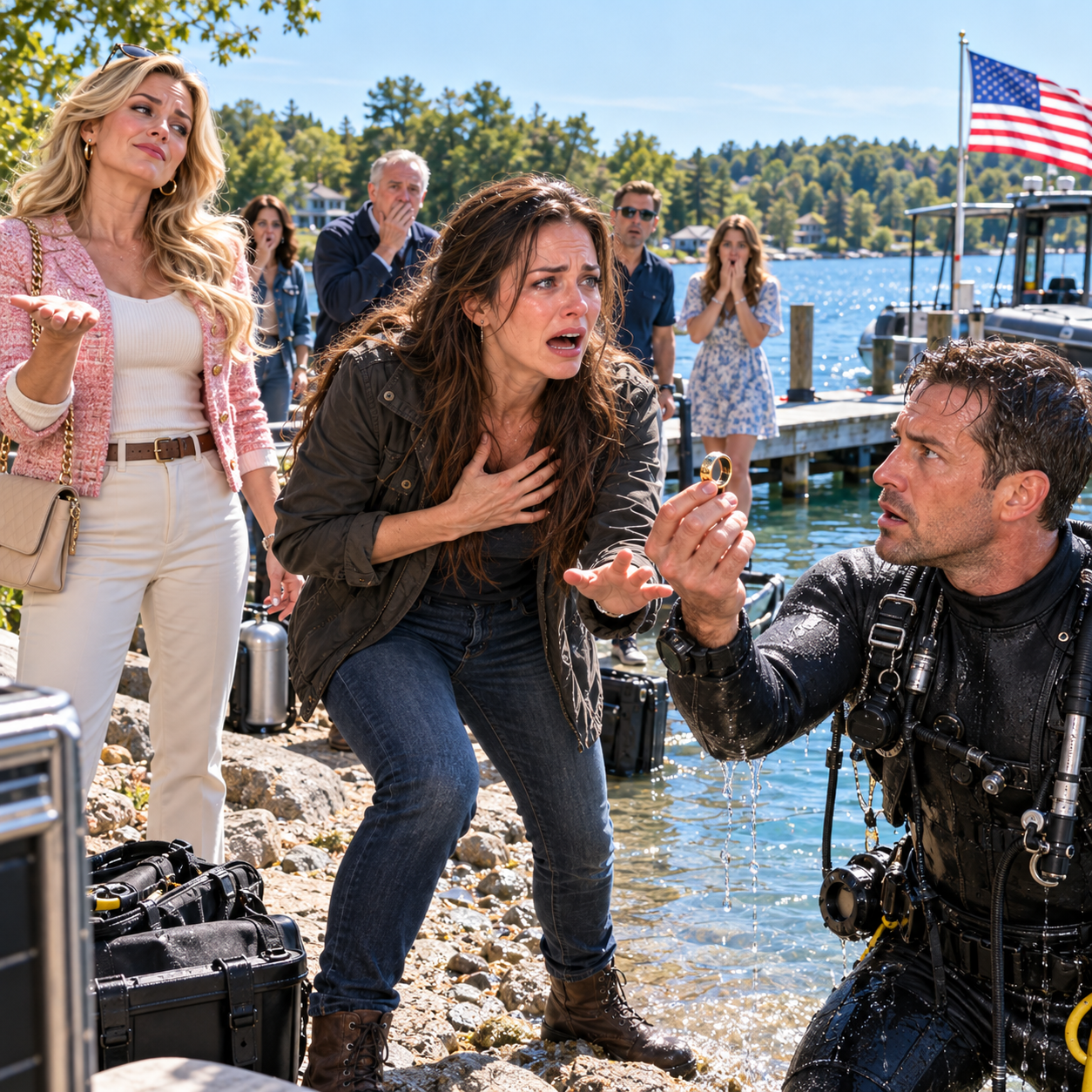
“It’s Just Scrap Metal!” My Sister Shouted, Throwing My Military Ring Into The Lake. A Navy Diver Found It And Froze At The Inscription: “Seven Down. Six Home.” “I Was The Sixth,” He Said. “She Went Back For The Seventh.” My Sister Smirked. “She Failed.” The Diver Shook His Head. “Then Who Has Been Sending His Mother Letters?”
My sister called my military ring worthless scrap metal before throwing it into forty feet of freezing lake water. Our relatives laughed, and my father looked away, just as he had whenever she humiliated me. I didn’t argue or ask anyone to defend me. I simply walked toward the dock. Thirty minutes later, a Navy diver surfaced holding my ring, read its inscription, and went pale. Then he asked a question that made me realize my sister knew something about a dead sailor she should never have known.
## Part 1
The morning my sister threw my Navy ring into Bellwater Lake, I found a white envelope tucked beneath the windshield wiper of my rental car. There was no return address, only my name written in the narrow, deliberate handwriting I recognized from years of military paperwork. Inside was a photocopy of an equipment inspection certificate dated six years earlier, with a single sentence written across the bottom: “Ask your sister why this number disappeared.”
I stood in the gravel driveway of my father’s lake house, listening to a sprinkler click across the hydrangeas, and read the sentence three times. The certificate carried the logo of Fenwick Maritime Logistics, the company my father had built from two leased trucks into a regional transportation business serving ports along the East Coast. The document itself meant very little without its accompanying inspection records, but I recognized the equipment number immediately. I had seen it before, on a terrible night when six men came home and a seventh didn’t.
My name is Nell Fenwick, and at thirty-four, I had become exceptionally good at keeping my civilian life separate from the years I spent in the Navy. I lived outside Norfolk, worked as an independent maritime safety consultant, and maintained a small apartment where the loudest sound was usually my neighbor’s elderly beagle. Most people who knew me thought my military career had consisted of inventory reports and occasional inspections. I had never bothered correcting them, partly because explaining the truth meant remembering things I preferred to leave alone.
My older sister, Tamsin, had a different opinion about my silence. At thirty-seven, she considered every subject an opportunity to establish who was more successful, more capable, and more deserving of our father’s approval. She had spent thirteen years climbing through Fenwick Maritime Logistics, first as a sales coordinator, then a regional director, and finally as managing director when our father reduced his responsibilities after a heart procedure. She treated that promotion as proof that everything our family possessed would eventually belong to her.
Our father, Orson Fenwick, had invited thirty-two relatives, employees, and family friends to his lake estate for the company’s annual summer gathering. The house occupied six wooded acres overlooking a steep shoreline, with broad cedar decks, a private dock, and a boathouse larger than my apartment. When I was little, the place smelled of sunscreen, grilled corn, and wet towels abandoned beside the kitchen door. Now it smelled of expensive landscaping, catered food, and the particular anxiety people develop when their boss invites them to relax.
I slipped the envelope into my jacket before anyone saw it and walked toward the house. Through the open patio doors, I could hear Tamsin explaining an acquisition to three board members who had probably arrived hoping for breakfast. Her fiancé, Drew Saville, stood beside her in a linen shirt, nodding whenever she mentioned market expansion or operational efficiency. Drew had a pleasant face, a carefully maintained beard, and the unfortunate habit of treating whatever Tamsin wanted as an established fact.
“Nell, you made it,” my father said when I entered the kitchen. He was leaning against the counter with a cup of black coffee, looking thinner than he had at Christmas, and his expression softened when he noticed my overnight bag. Then his eyes moved toward the patio, where Tamsin’s laughter rose above the conversation. “She’s been under a lot of pressure lately, so let’s try to have a peaceful weekend.”
That was how my father always introduced the subject of my sister. Peace meant letting Tamsin have the last word, ignoring the occasional insult, and accepting that her temper was apparently a natural disaster no one could reasonably prevent. I kissed his cheek, set my bag beside the stairs, and asked whether the housekeeper still kept extra coffee filters in the lower cabinet. He looked relieved that I hadn’t challenged him.
By eleven, the deck was crowded with employees holding paper plates and relatives admiring the catered brunch. Tamsin moved among them in white linen trousers and an expensive blue blouse, wearing a diamond bracelet that caught the sunlight whenever she gestured. Drew followed with a tablet containing presentation slides, even though my father had specifically said there would be no business meeting. I settled at a small table beside the railing, where I could see the water without becoming part of the performance.
My silver ring rested beside my coffee mug. It was heavy, scratched along one edge, and entirely ordinary to anyone who didn’t know why it had been made. Seven small marks had once been cut into the inside of the band, beneath an inscription that years of wear had nearly erased. I had removed it because my fingers were swollen from the drive, and I was rubbing the indentation it left when Tamsin noticed.
“Please tell me you’re not still wearing that thing,” she said, picking it up before I could reach for it. Her voice carried far enough that two accountants stopped talking and turned toward us. “You have an actual jewelry box somewhere, Nell, or is this your entire collection?”
“Put it down, Tamsin.”
She held it closer to her sunglasses, turning it between her fingers. “Still pretending you were some kind of war hero? You worked in supply administration, for heaven’s sake.”
“I asked you to put it down.”
Drew laughed quietly, and I watched his expression change when he realized I wasn’t smiling. Across the table, our cousin Becca lowered her fork, while my father’s longtime operations director suddenly became fascinated by his phone. Nobody defended me. I hadn’t expected them to, but there was still something unpleasant about watching people calculate whether kindness would inconvenience them.
Tamsin leaned toward me, lowering her voice just enough to make the next words feel personal. “Dad’s been trying to bring you into the company for years, but you keep turning him down because you’re afraid of a real job. Then you show up wearing this thing like the rest of us are supposed to salute.”
“That’s enough,” my father called from the patio doors, although he made no effort to come closer.
Tamsin glanced at him, then smiled with the bright, practiced expression she used whenever she was about to do something cruel and expected everyone to forgive it. “Oh, relax. It’s just worthless scrap metal.”
She drew back her arm and threw my ring over the railing.
For one strange second, I could see it turning against the pale blue sky, catching the sunlight like a coin tossed into a fountain. Then it struck the lake beyond the dock with a sound so small I almost missed it beneath the conversations around me. The water closed over it, leaving a few widening circles that disappeared against the pilings. Tamsin folded her arms and waited for me to cry.
I stood, pushed my chair beneath the table, and walked toward the stone steps leading down to the shoreline. Behind me, someone murmured that she had gone too far, while Tamsin insisted I was being dramatic about an object that probably cost twenty dollars. I barely heard them. From the lowest terrace, I could see a dark inflatable rescue boat moving along the marked public training lane two hundred yards offshore.
Bellwater Lake hosted a joint underwater recovery exercise every summer, involving county rescue personnel and visiting Navy divers from Virginia. My father had complained about the temporary buoys that morning, but I had noticed the boats immediately. One carried a side-scan sonar unit, while another had divers preparing equipment near the stern. I waited until the first boat turned toward our cove, then raised my arms and gave the standard visual signals requesting assistance.
The operator reduced speed and approached the outer edge of our dock. A broad-shouldered man in a dry suit lifted his mask and asked whether anyone was in danger. I explained that a small metal object had been deliberately thrown near the forty-foot shoreline drop-off, gave him its approximate entry point, and asked whether their recovery team could help when training permitted. He considered the request, checked with his supervisor over the radio, and agreed to use it as a short practice search.
Tamsin had followed me down the stairs, with Drew and several relatives close behind. “Are you seriously asking the Navy to find your jewelry?” she demanded, her sandals striking the wooden planks. “These people have better things to do than indulge you.”
The diver ignored her while he and another crew member confirmed the water depth. Before pulling his hood into place, he looked at me again, studying my face with an expression I couldn’t identify. “Have we worked together before, ma’am?” he asked.
“Possibly,” I replied.
He seemed ready to ask another question, but the boat operator called for him to check his equipment. A moment later, he rolled backward into the lake and disappeared beneath the surface, leaving a scattering of bubbles beside the dock. I watched the dark water settle, wondering whether the anonymous envelope in my jacket had reached me by coincidence. Then Tamsin stepped beside me and whispered, “You should have stayed away from the company records, Nell.”
I turned toward her. I had never told anyone in my family that I had been looking at the company’s records.
## Part 2
For several seconds, I couldn’t decide which disturbed me more: that Tamsin knew about the documents, or that she had chosen this particular moment to mention them. She stood with one hand on her hip, apparently confident that the noise of the idling rescue boat would keep our conversation private. Drew waited several feet behind her, his attention shifting between us and the divers’ equipment. I reached into my jacket and touched the folded inspection certificate without removing it.
“What records?” I asked.
Tamsin gave me a look of exaggerated patience. “Please don’t insult me. You requested archived documents through a former employee, and somebody forwarded your inquiry to legal. If you have concerns about company operations, you can bring them to the managing director instead of sneaking around.”
I hadn’t requested anything through a former employee. Three weeks earlier, I had asked our independent accountant for copies of annual shareholder reports that I was legally entitled to receive. Whoever sent the inspection certificate knew about another investigation, one I hadn’t begun, and my sister’s assumption told me that someone had already been asking uncomfortable questions. I kept my expression neutral and asked why she was monitoring routine shareholder correspondence.
“Because we’re preparing a major transaction,” she snapped. “Some of us have responsibilities beyond collecting military nostalgia.”
The boat operator called out a position reading, saving me from answering. Below us, the water was dark green where the sunlight reached the shallows and nearly black beneath the dock. Tamsin’s reflection trembled between the pilings, distorted every time the boat’s wake touched the shore. I found myself remembering another body of water, another radio, and the awful silence that followed a voice I had been trying desperately to reach.
The diver remained below for twelve minutes before a line tightened and a gloved hand appeared beside the ladder. His partner helped him onto the lower platform, where he removed his breathing gear and opened his palm. Resting against the black fabric was my silver ring, coated with fine lake sediment. I took one step forward, but he held it closer to the sunlight to verify the markings before handing it over.
He rubbed the inner band with his thumb and stopped moving.
“Seven down,” he said quietly. “Six home.”
His shoulders stiffened. He looked at the marks beneath the inscription, then turned the ring again as though checking whether he had imagined them. When he finally raised his head, the recognition in his face was unmistakable. I knew him before he spoke, although six years had added silver to his hair and deepened the scar beneath his jaw.
“Lieutenant Fenwick?”
“Hello, Everett.”
Chief Petty Officer Everett Shaw stared at me, holding the ring so tightly that the knuckles beneath his wet gloves turned pale. We had last seen each other in a naval hospital, where he was learning to walk again after a complicated leg injury. I remembered bringing him a cup of coffee he couldn’t drink because his hands shook too badly. He remembered me carrying him toward a rescue basket when the emergency lights went out.
“I was the sixth,” he told the people gathered on the dock, his voice rougher than I remembered. “The sixth person they brought out.”
Tamsin let out a short, disbelieving laugh. “I’m sorry, what exactly is happening here?”
Everett looked at her without answering. He took off his gloves, exposing an old white scar that ran across his left wrist, and returned his attention to me. “We thought you’d moved overseas. Nobody from the detachment had heard anything since you left Norfolk.”
“I needed some distance.”
He nodded once, and the understanding in that small gesture nearly undid me. Then he looked at the ring again and asked whether I had kept the original inscription. I told him I had never changed a thing. His expression shifted from surprise to something heavier, something connected to a question I suspected he had carried for years.
Tamsin stepped between us. “My sister worked behind a desk. Whatever story she’s told you, you should know that she left the service after an operation went wrong.”
Everett slowly turned toward her. “Which operation?”
“The one where they lost that sailor. Micah Rell.”
I heard the boat’s engine drop into a lower idle. Drew looked toward Tamsin, confused, while my father appeared at the top of the stairs with his cane in one hand. I had never spoken Micah’s full name in that house. His identity had not been secret forever, but I had deliberately kept the circumstances of his death separate from my family.
Everett’s face changed. “How do you know about Micah?”
Tamsin hesitated, then lifted her chin. “There are records, Chief. My sister wasn’t exactly decorated for what happened.”
“Your sister entered an unstable compartment after six people had been pulled out,” Everett said. “She stayed connected to Micah after the access route collapsed, even when we were ordered to withdraw. The official review did not find that she abandoned anybody.”
My father had reached the dock by then, and the relatives behind him were listening without attempting to hide it. Tamsin opened her mouth, but Everett continued before she could speak. “Micah’s mother has been receiving letters for five years. Every month, without a single missed delivery, someone sends her a personal account of something her son remembered or wanted her to know.”
I felt my throat tighten.
Everett looked back at me. “There’s also a private support trust. It helped her keep her home after she lost her husband’s income and later needed additional care. Some of us contributed when we could, but we never knew who arranged the rest.”
“That’s a private matter,” I said.
“It was,” he replied gently. “Until a routine review of veterans’ charitable disbursements identified an administrative account connected to Fenwick Maritime Logistics. The trust’s actual owner was concealed from the public reports, which was perfectly ordinary, but the account reference was unusual enough that someone asked our association whether we knew anything about it.”
Tamsin stopped moving.
I watched her grip Drew’s forearm. Her fingers tightened around his sleeve until he looked down at her hand, and she released him immediately. The expression on her face was no longer simple embarrassment. She was calculating, searching for a way to end the conversation before Everett said anything else.
“That account belongs to the company,” she declared. “Nobody here has permission to discuss it.”
“No,” I said. “The company administers some of the payments, but the money isn’t company property.”
My father closed his eyes. He knew about the trust, although I had never told him the full reason I established it. Years earlier, he had helped me find an attorney familiar with long-term family support arrangements, then stepped aside when I insisted on providing the initial funding myself. He had promised me that the arrangement would remain independent of the business and untouched by its executives.
Tamsin stared at him. “You knew?”
He opened his eyes without answering.
“You’ve been keeping money somewhere I couldn’t access,” she continued, her voice rising. “While I’ve been trying to put together an acquisition that could secure the company’s future?”
“That money was never available for your acquisition,” I said.
She laughed, but the sound came out thin. “You think a little monthly charity makes you important? You still couldn’t bring Micah Rell home.”
Everett flinched, and I felt a familiar pressure beneath my ribs. For six years, I had replayed the final minutes of that mission, wondering whether one different decision might have changed the outcome. I could withstand my sister’s insults about my career, my clothes, and my apartment. Hearing her use Micah’s death as an argument about money was something else entirely.
Everett placed the ring in my hand. “Micah wasn’t forgotten,” he said, his voice trembling slightly. “His mother told us the letters were the reason she made it through the first winter.”
I closed my fingers around the silver band. It was cold enough from the lake to make my skin ache, and I welcomed the sensation because it gave me something tangible to concentrate on. My father asked everyone to return to the house, but Tamsin refused to move. She was staring at my hand as though the ring itself had become dangerous.
Then Drew spoke for the first time since the diver surfaced. “Tamsin, isn’t Micah Rell the name you asked me to remove from the acquisition disclosure schedule?”
The question landed harder than any accusation.
My sister turned toward him so quickly that her sunglasses slipped from her hair and struck the dock. Drew stared back at her, plainly realizing he had revealed something he wasn’t supposed to know. I looked from his frightened expression to my father’s suddenly gray face, and the anonymous envelope in my pocket seemed to grow heavier.
Because if Micah’s name appeared in a corporate acquisition schedule, the connection between his death and my father’s company was much deeper than I had ever been told.
## Part 3
My father asked everyone to leave the dock, but nobody seemed willing to move until he raised his voice. The guests climbed the stairs in uncomfortable silence, followed by Drew, who kept trying to catch Tamsin’s eye. Everett’s team still had an exercise to finish, and he couldn’t abandon his assignment because of a family dispute. Before returning to the boat, he gave me his contact information and quietly asked whether I would be willing to speak with him after the training concluded.
“I owe you a conversation,” I told him.
“You don’t owe me anything, Nell.”
His eyes went to the ring, now resting against my palm. “But there are some things about that night I’d like to understand before either of us gets any older.”
I watched him climb aboard the rescue boat, then slipped the ring onto my finger. Behind me, Tamsin was telling our father that Drew had misunderstood the disclosure schedule, while Drew insisted he had only repeated the instructions she gave him. Their argument carried over the water, sharp and ugly against the soft sounds of the lake. I left them arguing and returned to my car, where I locked the doors and unfolded the anonymous inspection certificate.
The number was printed in a small box near the bottom: FM-417C. Beneath it were handwritten initials, an approval date, and a classification indicating that a particular marine lifting assembly had passed its required load inspection. Nothing about the document should have frightened me. Yet I remembered that same number appearing on a shipping manifest during the worst night of my life.
In November 2020, I was a Navy salvage officer attached to a recovery detachment supporting operations aboard a damaged auxiliary vessel in the Gulf of Aden. A machinery-space fire had spread into a lower service compartment, forcing the crew to isolate power while emergency teams stabilized the vessel. Seven sailors and specialists had entered a partially flooded section to help secure the damaged systems. Then a structural support failed, trapping all seven behind a corridor filled with twisted equipment and rising water.
I was stationed at the rescue control point when the first distress call arrived. My job was to coordinate the divers, monitor their remaining air, and determine whether the damaged structure could be approached without putting more lives at risk. I remember the smell of hot insulation, the red glow of emergency lights, and the terrible metallic sounds traveling through the hull. I remember six voices reporting that they were still alive, followed by a seventh who sounded almost embarrassed to be asking for help.
That voice belonged to Petty Officer Micah Rell.
Micah was twenty-six, a quiet man from Dayton, Ohio, who carried photographs of his mother inside a waterproof notebook. He loved terrible diner coffee, kept a folded grocery list in his pocket, and complained that nobody outside his family understood how to make proper biscuits. Before the operation, we had spoken for perhaps fifteen minutes while waiting for our equipment. It hadn’t been enough time for friendship, but it was enough for me to remember his laugh.
The first two sailors came out with minor injuries. The next three required assistance through a narrow access point, where shifting steel made every movement dangerous. Everett was the sixth, and his leg had been badly injured when part of the compartment collapsed. I helped maneuver his stretcher into the recovery basket while another diver reported that Micah remained trapped beyond a damaged bulkhead.
We had a possible route to him, but moving the collapsed material required equipment that wasn’t responding correctly. A replacement lifting assembly had developed problems under load, forcing the recovery team to stop and reassess the available options. By the time we identified another method, the structure had shifted again and closed the passage. I volunteered to make one last approach, carrying an emergency communications line and enough air to reach the outer section.
I never reached Micah.
A second collapse forced me against the bulkhead, and the command team ordered everyone out before the damaged compartment failed completely. Micah remained on the other side, connected to us by a communications line that continued working after every practical route had closed. For twenty-two minutes, I listened while he talked about his mother, his childhood, and the things he wanted someone to tell her. His voice was steady at first, then tired, and eventually so quiet that I pressed my headset against my ear to catch every word.
I had spent six years trying not to remember what came after that.
A knock against my car window brought me back to the present. My father stood outside, holding the cane he had bought after his surgery, his expression drawn. I lowered the window halfway, and he glanced toward the document resting on my lap. He didn’t ask where I had found it.
“We need to talk somewhere private,” he said.
“Did you know Tamsin was removing Micah’s name from a company document?”
His fingers tightened around the cane. “I knew there had been questions about an old equipment shipment. I didn’t know she intended to change the acquisition paperwork.”
“That’s not what I asked.”
He looked toward the house, where catering staff were quietly carrying trays inside. “Nell, there are things that happened during the company’s expansion that I should have explained to you years ago.”
I waited for him to continue, but he didn’t. My father had always believed that difficult conversations became easier if everyone involved had enough time to calm down. When I was seventeen, he had used that reasoning to avoid discussing why Tamsin had taken money from my college account without permission. At twenty-four, he had used it when she publicly accused me of joining the Navy because I couldn’t succeed anywhere else.
“Then start explaining,” I said.
He pulled a handkerchief from his pocket and wiped his forehead. “The equipment was purchased through one of our subcontractors. Your sister was overseeing those accounts, but I was still the chief executive. Whatever happened with that shipment, the responsibility wasn’t hers alone.”
His admission was so carefully worded that I felt the old, familiar distance opening between us. He was telling me just enough to make silence seem reasonable, hoping I would understand the pressures involved in running a large company. I looked at the inspection certificate again, thinking of Micah’s mother sitting in her kitchen with a stack of letters she had read until the paper softened.
“Did that equipment go to the vessel where Micah died?”
My father lowered his eyes.
That was enough.
I stepped out of the car, folded the certificate, and told him I was leaving. He asked me not to make any decisions while I was upset, which almost made me laugh because I had never felt less impulsive. I was thinking about shipping records, inspection procedures, corporate liability, and the difference between an unfortunate mechanical failure and a preventable mistake. My military training had taught me that facts mattered most when emotions made them difficult to face.
Before driving away, I called the attorney who helped establish Micah’s mother’s support trust. Hollis Dane was a practical woman with a blunt voice and very little patience for unnecessary drama, which was why I liked her. I told her that someone inside Fenwick Maritime Logistics might have been examining administrative records connected to the trust. She promised to review the recent access history and call me once she knew whether anything had been changed.
Then I drove toward my apartment, stopping only for gas and a coffee I barely tasted. By the time I reached Norfolk, I had decided to examine every document I was entitled to see as a shareholder, regardless of what it meant for my relationship with my father. The anonymous envelope lay on my passenger seat, its contents sliding against the upholstery whenever I turned a corner. I kept wondering who had sent it and why they had chosen the morning of Tamsin’s celebration.
At nine that evening, Hollis called.
“Your sister tried to amend the trust’s administrative instructions on Tuesday,” she said. “The bank rejected the request because she isn’t an authorized trustee, but she submitted a corporate resolution claiming the underlying funds were part of a company-controlled reserve.”
“Did she move any money?”
“No. The independent bank controls prevented that, but there’s something else.”
I stopped walking across my kitchen.
Hollis took a breath before continuing. “She attached a document to support her request. It’s dated three months after the operation in which Micah Rell died, and it carries what appears to be your father’s signature.”
I leaned against the counter, suddenly remembering his careful words beside my car.
For six years, I had believed my father helped establish the trust because he finally understood what Micah’s death had cost me. Now I needed to know whether he had been helping me honor a promise or trying to contain something he already knew was wrong.
## Part 4
Hollis sent me a secure copy of the document the following morning. It was a four-page internal memorandum describing a reserve established to address obligations connected to an equipment shipment delivered in 2020. My father’s signature appeared on the last page, alongside a statement that the company had fulfilled all applicable inspection requirements. Someone had highlighted a paragraph allowing the company to recover unused reserve funds after any outstanding obligations were resolved.
The language was broad enough to be confusing if read without context. My support trust, however, was neither an equipment reserve nor a corporate account, and the memorandum contained no legal provision giving Fenwick Maritime Logistics control over it. I had established the trust through an independent bank using money from my civilian consulting contract and dividends attached to the shares my mother left me. Our company accountant had helped process some payments during the early years, but that administrative arrangement didn’t change who owned the funds.
“Your sister appears to be treating two entirely separate arrangements as though they’re the same,” Hollis said during our call. “That doesn’t mean the bank agrees with her interpretation, and it certainly doesn’t authorize her to touch your trust. What concerns me is why she would make the argument at all.”
“She’s trying to finance an acquisition.”
“Then she should obtain proper financing. She cannot use someone else’s restricted assets because the balance looks convenient.”
Hollis recommended that I move the remaining payment administration away from the company immediately. She also reminded me that my eighteen-percent ownership interest entitled me to certain financial information, although access to detailed operational records would require following the company’s governance procedures. I asked her to request an independent review of the disputed memorandum and the shipment referenced in the anonymous certificate. She agreed, provided I understood that the findings might involve people I loved.
I looked at the ring resting beside my laptop. “That’s no longer the part I’m worried about.”
By noon, I had three missed calls from my father, eleven messages from Tamsin, and an email from Drew asking whether we could speak privately. I ignored the first two and called Drew, who answered from what sounded like a parking garage. He told me Tamsin hadn’t slept, that she believed I was deliberately undermining a transaction she had negotiated for eighteen months, and that he wanted me to understand how much pressure she was under. His explanation sounded rehearsed until I asked about Micah’s name.
There was a long silence.
“The acquisition team identified an unresolved equipment matter during due diligence,” he admitted. “It involved an inspection certificate from 2020 and correspondence with a Navy contractor. Tamsin told me the issue had been closed and shouldn’t be presented as an active liability.”
“Was Micah named in the correspondence?”
“Only in the supporting documents. There was a reference to an incident review, and someone had attached a partial casualty summary.”
“Why did she ask you to remove it?”
Drew breathed out slowly. “She said the buyer might misunderstand the connection and demand a reduction in the purchase price. I assumed our attorneys had approved the wording.”
I asked him for copies of anything he had personally received, making clear that he should not access documents beyond his authority. He promised to preserve his existing correspondence and speak with the company’s counsel before sharing it. Then he said something I hadn’t expected: Tamsin had been worried about the old shipment for months, long before the acquisition negotiations became serious. She had ordered several storage rooms cleared and sent contractors to retrieve archived boxes from a former maintenance facility outside Portsmouth.
After hanging up, I searched the company’s public records for the facility address. It had belonged to a marine equipment service business called Harborline Technical Services, a subcontractor Fenwick Maritime Logistics had used during its rapid expansion. Harborline had closed four years earlier after losing several major contracts. Its former quality supervisor was a woman named Odette Keene, and her name appeared on the inspection certificate directly beneath the approval box.
I was still studying the document when an unfamiliar number called.
“Is this Nell Fenwick?” a woman asked.
“Speaking.”
“My name is Odette Keene. I sent you that envelope.”
I sat down at the kitchen table. Her voice was low and strained, and I could hear traffic moving behind her. She told me she had worked at Harborline for nearly nine years, including the period when the disputed equipment passed through its facility. She had also been responsible for maintaining inspection records before management changed the procedures. When she learned that Fenwick Maritime Logistics was preparing for an acquisition, she tried to contact the company’s independent directors.
“They told me to submit my concerns through management,” she said. “Two days later, someone from your sister’s office called and asked why I was digging up old complaints.”
“Why contact me?”
“Because I remembered your name from the military incident report. I recognized it again when the shareholder notices went out.”
I asked whether she could prove the certificate had been altered. Odette hesitated, then told me she had retained personal copies of several documents after leaving the company because she disagreed with how the equipment inspections had been recorded. She wouldn’t send them electronically, and she refused to discuss their contents while standing in a public parking lot. We agreed to meet the next afternoon at a quiet diner halfway between Norfolk and Richmond.
After the call, I sat staring at the kitchen window while rain moved across the glass. I had spent years trying to accept that Micah’s death belonged to a category of losses no amount of effort could prevent. The official operational review concluded that the unstable structure had made further entry unreasonably dangerous, and I had accepted that finding because I knew exactly how close the rescuers came to losing their own lives. A faulty lifting assembly had always troubled me, but no one had suggested that its documentation might conceal an earlier warning.
That evening, Everett called as promised. He had finished the training exercise, driven back toward his temporary quarters, and found several messages from former members of our detachment. News of our encounter had already reached people who remembered the rescue, although he assured me that no one was discussing sensitive operational details publicly. I told him about the certificate and asked whether he remembered the lifting assembly.
“Of course,” he said. “We lost time trying to get it working properly.”
“Do you remember where it came from?”
“Not exactly. The equipment arrived through the contractor supply chain, and I was more interested in getting out of that compartment alive.”
I understood, but the answer left me uneasy. Everett had been injured, exhausted, and barely conscious during much of the recovery. I was asking him to remember shipping information from the worst day of his life, information that had never been his responsibility. When I apologized, he stopped me and asked whether I had finally spoken to Micah’s mother.
“I write to her,” I said.
“That’s not what I asked.”
I watched the rain gather at the bottom of the window. Over the years, I had sent Ione Rell more than sixty handwritten letters, each containing a memory Micah had shared during his final conversation. I had told her who I was and why I wanted to help, but I had visited only twice, both times briefly. Seeing her always brought back the unbearable feeling that I had arrived with everything except the person she wanted most.
Everett listened without interrupting, then said, “She doesn’t blame you, Nell. She told me that herself.”
I wanted to believe him, but forgiveness from other people had never been the problem. The problem was the way my mind returned to that damaged compartment whenever I closed my eyes, searching for another route, another tool, another choice. I thanked him for calling and promised to share whatever could be appropriately discussed once the document review was underway. He offered to help through official channels if investigators needed his account.
The next afternoon, I reached the diner twenty minutes early and chose a booth where I could see both entrances. Odette arrived carrying a canvas grocery bag and wearing a plain gray jacket, her hair pulled into a loose braid. She looked tired, and her hands shook slightly as she set a thick manila folder on the table. After ordering tea, she asked me to promise that I wouldn’t confront my sister until I understood what the documents showed.
I told her I couldn’t promise silence, but I could promise to handle the information carefully.
Odette opened the folder and removed a handwritten inspection log, a supplier warning, and three photographs of metal lifting components laid out on a workshop bench. She explained that the original load-test documentation had been incomplete and that her department requested additional testing before the equipment entered service. Someone in procurement had overridden that hold after a delivery deadline became urgent. The replacement parts were subsequently certified using paperwork that referred to tests conducted on a different assembly.
“Who approved the override?” I asked.
Odette slid a signed authorization sheet across the table.
At the bottom, beneath a date from October 2020, was Tamsin’s signature. Beside it was a handwritten instruction: “Release shipment as scheduled. Supporting certification to follow.”
Odette watched my expression and lowered her voice. “There’s one more thing you need to understand. We didn’t send just one of those assemblies overseas.”
She turned the final page toward me, revealing three destination codes. One matched the support network servicing the vessel where Micah had died, and the other two belonged to ships that had continued operating for years.
## Part 5
I took photographs of the documents with Odette’s permission, then asked her to explain the difference between an incomplete inspection and an unsafe component. She leaned forward, drawing a rough diagram on a paper napkin while the waitress refilled our coffee. The assemblies were designed to transfer lifting force through a series of controlled connections, and their certifications specified the conditions under which they could safely operate. A missing test did not automatically mean a component would fail, but substituting one component’s results for another meant nobody could honestly confirm its limits.
“Could that have caused what happened to Micah?” I asked.
Odette put down her pen. “I don’t know, Nell. Anyone who tells you they can determine that from these papers alone is giving you an answer they haven’t earned.”
Her honesty mattered more than reassurance would have. She showed me an email from a Harborline technician who had questioned the substituted paperwork, followed by a management response directing him to release the shipment while additional verification was arranged. The verification was never attached to the completed file. Three days later, the equipment left the warehouse under Fenwick Maritime Logistics’ shipping documents.
I studied Tamsin’s signature again. She had been thirty-one then, already overseeing procurement decisions worth millions of dollars, and my father frequently praised her ability to solve problems without waiting for permission. I remembered her arriving at Christmas dinner that year with a new luxury watch and complaining that government clients expected impossible delivery schedules. At the time, I had been too exhausted and emotionally withdrawn to care what she was talking about. Now I wondered whether she had been describing the very shipment that later occupied my nightmares.
Odette gave me the name of the technician who raised the warning, along with a forwarding address for the independent maritime inspector who had reviewed Harborline’s procedures before it closed. I promised not to expose her personally without discussing the appropriate reporting protections with counsel. She appeared relieved, then admitted that she had spent years deciding whether she should have spoken up sooner. Her daughter had been in college, her husband was recovering from an injury, and losing her position would have been financially devastating.
“I kept telling myself the paperwork would eventually be corrected,” she said.
I understood the temptation to believe that problems disappeared when a responsible person promised to handle them. My father had built an entire household around that idea, and Tamsin had learned to exploit it before either of us was old enough to drive. I paid for our meals, thanked Odette, and watched her walk toward an old sedan parked beside the diner. She looked smaller once the folder was no longer in her hands.
Back in Norfolk, Hollis helped me organize the documents and identify where a formal safety concern could be reported. Because the equipment had been distributed through different operators, we couldn’t simply announce that every component was defective. We needed to establish serial numbers, installation histories, and whether any assembly remained in service. Hollis contacted an independent maritime engineering firm and requested an initial technical assessment while I prepared a written statement describing what I knew from the 2020 operation.
Two days later, a representative from one of the affected vessel operators confirmed that its maintenance department had already raised questions about a similar component. The operator had removed the assembly from service after identifying inconsistent markings during a scheduled overhaul. Its engineers retained the part because the paperwork did not match the physical configuration. Their concerns had been communicated to the original supplier more than a year earlier.
That detail changed everything.
The company was no longer facing only an old documentation dispute connected to my military experience. Someone had received a later warning indicating that an affected assembly was still circulating with questionable records, yet the acquisition paperwork described the matter as fully resolved. If Tamsin had known about the warning and omitted it, her own decisions were creating consequences far beyond our family. The issue could affect employees, vessel crews, insurance arrangements, and people who had trusted our company to provide accurate technical information.
I called my father from Hollis’s conference room and asked him to arrange a meeting with the independent directors. He offered to discuss the matter privately first, insisting that Tamsin deserved an opportunity to explain. I told him she would have that opportunity during a proper review, with counsel present and the original documents preserved. He sounded disappointed, as though my insistence on ordinary accountability represented an unnecessary attack on family loyalty.
“Nell, this business supports nearly six hundred people,” he said.
“Then we owe those people accurate information.”
“You don’t understand how complicated this can become.”
“I understand exactly why we shouldn’t handle it over dinner.”
He said nothing for several seconds. Then he agreed to contact the board’s outside counsel, provided I didn’t circulate unverified accusations. I made the same commitment I had already given Hollis: I would distinguish established facts from suspicions. The conversation ended without either of us mentioning Tamsin’s behavior at the lake, which seemed fitting. My ring had started the confrontation, but it was no longer the most important object in the room.
That evening, Everett drove down from his assignment to meet me at a waterfront restaurant near the shipyard. He arrived in civilian clothes, walking with a slight stiffness that became more noticeable when he was tired. We ordered sandwiches and sat near a window overlooking the harbor, where tugboats moved between larger vessels under the orange glow of dockside lights. For a while, we discussed ordinary things: his wife, their two daughters, my apartment, and how the years had changed people we once knew.
Eventually, he asked about the documents.
I explained the concerns without giving him material he wasn’t authorized to receive, then told him that an independent review would determine whether the equipment issue affected the original rescue. He listened carefully, his expression becoming distant when I described the lifting assembly. I expected him to ask whether Micah might have survived if the equipment had worked differently. Instead, he asked whether I had started sleeping again.
“Some nights,” I admitted.
“Nell, you spent years carrying a question that belonged to an entire operation. Don’t let new information turn it into a sentence against yourself.”
I looked down at my hands. His words were kind, but I knew that kindness couldn’t answer the technical questions now before us. I told him I wasn’t looking for someone to blame simply because Micah had died. I wanted to know whether warnings had been ignored and whether the people responsible had been given a fair account of what happened. Everett nodded and said that was a question worth pursuing.
When I returned home, three messages were waiting from Tamsin. The first accused me of embarrassing the family, the second claimed I was jeopardizing employees’ livelihoods, and the third contained a photograph of a handwritten letter I had sent Ione Rell three years earlier. I recognized my own words describing Micah’s childhood bicycle, the one he had repaired with his father until its red paint was more patch than original finish.
The photograph made my stomach turn.
I called Tamsin immediately, and she answered on the first ring. “How did you get that letter?” I demanded.
She sounded almost pleased that I had finally reacted. “You really think you’re the only person who knows how to obtain old correspondence? The company has records of the support payments and related communications.”
“Those letters were private.”
“Then maybe you shouldn’t have involved company administration in your personal projects.”
I closed my eyes, forcing myself to speak carefully. Tamsin had access to some payment records because of her position, but she had no legitimate business reason to possess a personal letter sent directly to Micah’s mother. I asked whether she had contacted Ione or requested information from someone who had access to her correspondence. Tamsin refused to answer and warned me that people might interpret my financial support as an attempt to influence how the old incident was remembered.
I ended the call before my anger made me careless. Then I contacted Hollis, forwarded the messages, and asked her to preserve them as part of the ongoing review. She advised me not to engage Tamsin directly again and began preparing a formal request to establish how the letter had been obtained. I sat awake long after midnight, staring at the photograph on my phone and remembering how Ione had thanked me for describing the bicycle.
The following morning, my phone rang just after seven. The caller introduced herself as Darlene Rutledge, a volunteer with the veterans’ family support network that helped Micah’s mother manage correspondence. She explained that Ione had asked her to call because an unfamiliar woman had recently visited, claiming to be connected to the company responsible for Micah’s family assistance. The visitor had asked detailed questions about my letters and whether Ione believed the money represented compensation for something that happened overseas.
I felt the floor shift beneath me.
Then Darlene added, “Mrs. Rell kept the visitor’s business card, Nell. The name on it was Tamsin Fenwick.”
## Part 6
I drove to Dayton that weekend after arranging the visit through Darlene. Ione Rell lived in a modest brick house on a quiet street where maple trees formed a canopy over the sidewalks. There were flowerpots on the porch, a faded wind chime beside the door, and a small American flag tucked into the corner of the garden. I had visited twice before, but both occasions had been brief, and neither had required me to explain why my own family was interested in her son’s death.
Ione opened the door before I reached the bell. She was seventy, with silver hair pinned loosely behind her ears and a face that reminded me of Micah whenever she smiled. She hugged me without hesitation, holding on long enough that I felt the muscles in my shoulders begin to loosen. Then she invited me into the kitchen, where a plate of biscuits sat beneath a clean dish towel.
“Micah said you made these better than anyone,” I told her.
“He said that because he was a sensible boy who wanted to stay fed.”
We sat at the table beside a window overlooking her backyard. Ione brought out a wooden box containing my letters, arranged in chronological order with the envelopes still attached. Some had been read so often that the folds were nearly transparent. On top was the first note I sent in February 2021, written after I learned that Ione had been struggling to pay the mortgage while adjusting to life without her son.
I had explained who I was and told her I wanted to share the memories Micah entrusted to me during our last conversation. I had not written as though the words came directly from him, nor had I pretended to know things he never told me. Each letter contained one small piece of his life, followed by something I wanted his mother to understand about the courage and humor he showed that night. The final line always included the childhood nickname he mentioned with a laugh: “Your Biscuit Boy.”
“I know why you kept writing,” Ione said, touching the box. “But I never wanted you to think you owed me your whole life.”
I looked toward the backyard. A bird feeder hung beside the fence, and two sparrows were fighting over a place to perch. I told her that Tamsin had discovered the financial arrangement and might have approached her under misleading pretenses. I also explained that old equipment records had raised questions about the circumstances of the operation, although qualified investigators would need to determine what those questions meant.
Ione listened carefully, then reached for her glasses.
“Your sister came here on a Wednesday afternoon,” she said. “She was very polite at first. She wanted to know whether you had ever told me something different from what the Navy reported.”
“What did you say?”
“I told her you had never blamed anyone else, including yourself, for what happened. Then she asked whether I’d be willing to sign a statement saying the support payments were voluntary and unrelated to any company responsibility.”
I felt anger rise through my chest.
Ione continued before I could interrupt. “I said I couldn’t make a statement about matters I didn’t understand. She became impatient and suggested that future assistance might be reviewed if the company changed ownership. That’s when I asked her to leave.”
She took a business card from beneath the letter box and pushed it across the table. Tamsin’s name was printed beside the company’s logo, accompanied by a direct telephone number. On the reverse was a handwritten note referring to an acquisition review and an appointment with outside counsel. I photographed both sides and thanked Ione for keeping it.
We spent the next hour talking about Micah instead of my sister. Ione showed me photographs from his high school graduation, a fishing trip with his father, and a disastrous attempt to bake a birthday cake when he was fourteen. She remembered the way he called every Sunday evening and how he hated leaving dirty dishes in the sink. The ordinary details filled the kitchen with a life I had known only in fragments.
Eventually, she asked what I remembered about the final conversation.
I had rehearsed that answer hundreds of times, usually while staring at my bedroom ceiling in the middle of the night. Now, sitting across from his mother, I found the words surprisingly difficult to begin. I told her how Micah initially tried to report useful information about the damaged compartment, even after we had explained that the route was no longer accessible. Then, when he understood the situation, he asked whether someone could stay on the line.
“I stayed,” I said.
“I know.”
“He talked about the bicycle. He asked me to tell you about the little diner where you used to take him after school, and the way you always ordered coffee before looking at the menu.”
Ione smiled through her tears. She reached across the table and held my hand, but I had to look away before I could continue. I told her Micah had asked whether she would be lonely and had made me promise to remind her that she still had people who cared about her. He had not spent those minutes begging me to perform an impossible rescue. He had spent them trying to make sure someone he loved would be all right.
“He was frightened,” I whispered.
“Of course he was.”
“I couldn’t get to him.”
Ione squeezed my hand. “Nell, he knew you were there. That’s what you gave him when there was nothing else left to give.”
I drove home carrying a small photograph of Micah beside his bicycle, which Ione insisted I keep. She also gave me permission to share a factual account of Tamsin’s visit with the independent investigators. Before I left, she made one request that surprised me. She wanted to continue receiving letters, but only if writing them brought me comfort rather than keeping me trapped in the same twenty-two minutes.
Back in Virginia, the independent directors convened a special meeting with outside counsel and the maritime engineers. Odette’s documents had been preserved, the affected vessel operators had been notified through the appropriate channels, and the acquisition negotiations were temporarily suspended pending review. Tamsin attended with her attorney, insisting that the old equipment issue had been disclosed to senior management years earlier. She argued that any discrepancies resulted from incomplete subcontractor records, not decisions she made alone.
My father sat at the far end of the conference table, looking older than he had at the lake. When an engineer explained that the original certificates could not be reconciled with the serial numbers on the equipment, he rubbed his forehead and requested a break. I watched him leave the room, then followed him into the hallway. He stopped beside a vending machine, his cane trembling slightly against the carpet.
“How long have you known?” I asked.
He stared at the floor. “I received a warning after the Navy’s initial review. Someone said the equipment records needed additional verification.”
“And what did you do?”
“I asked Tamsin to handle it. She told me the subcontractor had supplied the missing documentation.”
“Did you verify that?”
His silence answered me.
I stood there looking at the man who taught me to tie knots, change a tire, and keep every promise I made. He had been generous with money, practical with advice, and strangely incapable of confronting cruelty inside his own home. For years, I had mistaken that weakness for harmlessness. Now I saw how easily it could become something that affected people who had never met our family.
“Nell, I didn’t know the full circumstances of Micah’s death,” he said.
“But you knew there was a warning.”
“Yes.”
“And you signed a memorandum saying the inspection requirements had been fulfilled.”
His shoulders sagged. “Tamsin told me they had.”
I looked through the conference room window at my sister, who was speaking urgently to her attorney. I wondered whether she had ever intended to correct the records or whether she had convinced herself that a problem stopped existing once a document said it was resolved. Then I turned back to my father and told him that he needed to give the independent investigators his complete account.
He reached for my arm. “Please don’t let this destroy everything I built.”
I stepped away before his hand touched me.
“What you built isn’t more important than the people who trusted it.”
When I returned to the meeting, the board’s outside counsel had received another document from the former Harborline inspector. It was a retained copy of an equipment review dated six weeks after Micah’s death, and it described a failed attempt to reproduce the original certification results. Attached was an acknowledgment showing that both my father and Tamsin had received the warning.
Then counsel turned to the final page.
Beneath a recommendation to notify affected operators immediately was a handwritten instruction in my father’s unmistakable handwriting: “Hold external distribution pending executive review.”
## Part 7
For the first time in my life, I watched my father sit through an accusation without immediately trying to resolve it through personal influence. The outside counsel asked him to explain the handwritten instruction, and he admitted that he had requested a delay while management reviewed the implications of the equipment report. He insisted that he expected the review to be completed within days, but he couldn’t produce evidence that the warning had ever been distributed. Across the table, Tamsin stared at him with an expression I had never seen before: she looked genuinely afraid.
“Dad, you told me you would take responsibility for that decision,” she said.
My father lifted his head. “I am taking responsibility.”
“No, you’re letting them make it sound like I concealed the entire thing.”
The board chair, a retired transportation executive named Vera Noland, interrupted before their argument went further. She reminded everyone that the meeting was an independent review of corporate conduct, not a family dispute, and that each participant would have an opportunity to provide relevant evidence. Then she asked Tamsin a direct question. Had she received the later operator warning indicating that the inspection records still could not be reconciled?
Tamsin glanced at her attorney.
“Yes,” she answered.
“Did you disclose that warning in the acquisition due diligence materials?”
“Not in the initial schedule.”
“Why not?”
Tamsin pressed her lips together. “Because I believed the technical question had been resolved.”
Vera asked who had confirmed that resolution. Tamsin named a former maintenance director, but counsel produced an email showing that the director had requested further information before giving any final opinion. When asked whether she had received that email, Tamsin admitted that she had. She then argued that the acquisition was essential to protecting employees and that a delayed transaction could endanger the company’s financial stability.
I knew she believed at least part of what she was saying. Tamsin had spent years expanding the business, taking calls at midnight, visiting terminals in terrible weather, and negotiating contracts that kept people employed. She wasn’t incompetent, and she hadn’t reached her position through charm alone. But somewhere along the way, she had begun treating her own judgment as a substitute for the checks that were supposed to protect everyone else.
The directors voted to suspend Tamsin’s executive authority while the investigation continued. My father agreed to step aside from his position as board chair pending a separate examination of his involvement. An experienced outside executive was appointed to oversee daily operations, with instructions to protect payroll, preserve records, and coordinate the equipment review. The acquisition remained on hold, but the company would continue operating under tighter supervision.
Tamsin pushed back her chair so abruptly that it struck the wall.
“You’re choosing Nell over me,” she said to our father.
He looked at her with exhausted eyes. “This isn’t about choosing between my daughters.”
“It always has been,” she replied.
Then she turned toward me. “You finally found a way to punish me for being the daughter who stayed.”
I wanted to answer, but I realized that nothing I said would change her understanding of the situation. She believed devotion meant remaining inside the family business, absorbing its demands, and eventually claiming the rewards she considered earned. My decision to serve in the Navy had always looked like rejection to her. Now my insistence on examining her decisions felt like another rejection, even though the people affected extended far beyond either of us.
“I didn’t make those decisions for you,” I said.
Her expression hardened. “You think you’re better than everyone because you wore a uniform.”
“No. I think you should have reported an unresolved safety warning.”
The simplicity of the answer seemed to anger her more than anything else I could have said. She gathered her papers, refused to look at Drew, and left with her attorney. Nobody followed her. I remained seated while the directors discussed document preservation, independent technical testing, and the possibility of additional notifications to affected operators.
The consequences arrived gradually rather than in one dramatic announcement. Within a month, the prospective buyer withdrew its offer, citing the unresolved inspection matters and discrepancies in the disclosure materials. The company’s lenders requested additional reporting, and several customers postponed new work until they understood whether their equipment was affected. Instead of celebrating a major acquisition, Fenwick Maritime Logistics spent the remainder of the summer reviewing old records and contacting operators who deserved accurate information.
Employees were frightened, and some were angry. I attended a meeting with department managers where a terminal supervisor asked whether the board understood that ordinary workers had families depending on their paychecks. I told him I did, and that was precisely why the company could not continue building decisions around incomplete records. The independent management team arranged temporary financing against existing receivables and postponed nonessential expansion projects. It wasn’t painless, but it gave employees a better chance than pretending nothing was wrong until the problem grew larger.
The engineering review took longer.
Several affected components had been replaced years earlier, while others remained in storage or service records without enough information to identify them conclusively. Investigators compared manufacturer specifications, inspection logs, maintenance histories, and testimony from people involved in the 2020 shipment. The results established serious weaknesses in the certification process and showed that some assemblies had been released without the required supporting evidence. Determining exactly how those weaknesses affected the damaged vessel during our rescue operation was far more difficult.
Everett provided his account through the appropriate review process. I submitted my contemporaneous notes and identified the operational recordings that might help investigators reconstruct the rescue timeline. I was allowed to review a properly released transcript covering my communications with the command team and Micah, although some technical material remained restricted. Reading those words after six years was harder than I expected.
I remembered Micah asking about his mother, describing the bicycle, and joking about biscuits. The transcript confirmed those memories, but it also showed how frequently I had tried to bring the conversation back to possible rescue options. I had asked about air pockets, structural movement, and whether he could reach a secondary access point. Again and again, Micah had answered my questions, even as his voice became weaker.
Then I reached a line I had nearly forgotten.
“Lieutenant, you have to get yourself out of there.”
I stared at it for a long time.
The following exchange showed that I had still been searching for a way through the damaged bulkhead, despite repeated warnings that the structure was shifting. Micah had understood that the people trying to reach him were placing themselves in danger. He had asked me to stop risking another life when the available route was no longer safe.
I closed the transcript and sat quietly in my apartment, listening to rain strike the balcony railing. For years, the story I told myself had ended with the moment I failed to reach him. I had forgotten that Micah made a choice too, one that mattered even though it couldn’t save him. He wanted someone to survive and carry his words home.
Two months later, the company’s independent review concluded that Tamsin had authorized incomplete certification paperwork, failed to ensure that later warnings were properly addressed, and approved acquisition disclosures that omitted unresolved concerns. The board voted to remove her permanently from executive management and referred relevant findings to the authorities responsible for reviewing the equipment and corporate records. My father’s failure to follow up on the original warning was documented separately, and he resigned his remaining board position.
The findings did not establish that a properly certified assembly would certainly have saved Micah. The collapse had created multiple hazards, and the damaged access route might have remained impossible to clear even with functioning equipment. I accepted that uncertainty because inventing certainty would not honor him. What mattered was that the warnings had deserved attention long before our family gathered at the lake.
That evening, my father came to my apartment without calling first. He carried a small cardboard box containing photographs from my childhood and a framed picture of my mother standing beside the first truck he had purchased. He said he wanted me to have them because the lake house might eventually need to be sold. When I invited him inside, he looked around my modest living room as though seeing it for the first time.
“I should have believed you when you said the military meant something to you,” he said.
“It did.”
“I should have stopped your sister.”
“Yes.”
He looked down at his hands. “I suppose I’ve spent years hoping that if I kept everyone comfortable, nothing would break.”
I thought about the workers who had spent months wondering whether their jobs were safe, the vessel operators who had relied on paperwork they couldn’t verify, and the family in Ohio who had buried a son. Then I looked at the man who had once taught me that doing the right thing mattered most when nobody was watching. I told him I believed he regretted what happened, but regret didn’t erase the decisions he had made.
He nodded without arguing.
When he left, I placed my mother’s photograph on the bookshelf and opened an envelope that had arrived earlier that afternoon. It was from Ione Rell, written on pale blue stationery. Her message contained no mention of the investigation, the company, or my sister.
She had written only that Micah’s birthday was approaching and that she intended to make his favorite dinner.
At the bottom, she added, “I’d like you to come, Nell. Not because you owe us anything, but because I think it’s time you stopped visiting only when there’s something to apologize for.”
## Part 8
Six months after my sister threw my ring into Bellwater Lake, I returned to Dayton with a bakery box on the passenger seat and no prepared apology in my pocket. The afternoon was cold enough to leave frost along the shaded edges of the road, and the sky had the pale, exhausted color of early winter. Ione answered the door wearing a red cardigan, greeted me with a hug, and immediately complained that I had brought dessert when she already had enough food for an entire neighborhood. I followed her into the kitchen, where the familiar smell of warm biscuits made me unexpectedly happy.
Everett and his wife, Lacey, arrived an hour later with their daughters. Two other members of the old rescue detachment joined us, along with a retired Navy medic who had known Micah before his final deployment. We ate roasted chicken, green beans, mashed potatoes, and the cinnamon cake Ione always made for his birthday. Someone told a story about Micah accidentally putting salt in a coffee pot, and for the first time, I listened to everyone laugh without feeling that the laughter betrayed the dead.
After dinner, Ione brought out a photograph album. Everett’s youngest daughter asked why Micah was wearing a ridiculous orange hat in one picture, and Ione explained that he had lost a bet during a family vacation. We spent nearly an hour looking through photographs that had nothing to do with uniforms, deployments, or the night he died. I realized how much of Micah’s life I had allowed that final night to obscure.
When the guests began leaving, I helped Ione wash dishes while Everett stacked chairs in the dining room. She asked about the support trust, and I told her that its funds were secure and that the final administrative connection to Fenwick Maritime Logistics had been removed. The independent bank would continue managing the account according to the original terms, and she would receive regular statements without having to rely on anyone in my family. She appeared relieved, but she was more interested in whether I had been taking care of myself.
“I’m working less,” I told her.
“Good.”
“And sleeping more.”
“Even better.”
She dried a plate and studied me for a moment. “Are you happy, Nell?”
The question surprised me because I hadn’t spent much time considering it. I was no longer waking up every morning expecting another legal letter or another accusation from Tamsin. My consulting business had recovered after several difficult months, and I had begun volunteering with a maritime safety education program for younger technicians. I had friends I could call without discussing the past, a place that felt like home, and enough space in my life to make decisions that belonged entirely to me.
“I’m getting there,” I answered.
Ione smiled. “That’s all anybody can do.”
The investigation had changed my family in ways no one could disguise. My father sold the lake estate to reduce his personal financial commitments and moved into a smaller house near Richmond. He continued cooperating with the ongoing regulatory review, and his resignation from the company ended a career that had once defined his entire identity. He wrote to me occasionally, usually about ordinary matters, and I answered when I wanted to.
I didn’t hate him. There were memories from my childhood that remained precious, and I could acknowledge the work he had done to support our family. But I no longer trusted him with decisions that might affect my life, and I had stopped asking him to become the father I needed. His apologies belonged to him; my future did not have to depend on accepting them.
Tamsin’s situation was more complicated.
Her removal from management ended the acquisition she had expected to secure her position, and the independent review documented decisions she had spent years defending. She remained a shareholder, but her authority over operations was gone, and she was no longer permitted access to confidential records unrelated to her ownership rights. The company’s insurers and regulators continued examining the consequences of the equipment documentation, while her attorneys disputed portions of the findings. Any further legal consequences would depend on evidence and formal proceedings, not on my anger.
Drew postponed their wedding during the investigation. Several months later, he ended their engagement, explaining in a letter that he could no longer build a marriage around conversations in which he was expected to ignore facts he had personally witnessed. Tamsin blamed me for that decision too. I didn’t respond because I knew how little control I had over her willingness to take responsibility for her own relationships.
One evening in February, she appeared outside my apartment building.
I saw her through the lobby window before she noticed me. She wore a dark coat, carried an expensive handbag, and looked tired in a way I had never associated with my sister. For a moment, I considered turning around and taking the back stairs. Then I remembered that avoiding a difficult conversation was one of the habits I had spent my adult life trying not to inherit.
I stepped outside and asked what she wanted.
She stared at the ring on my finger. “You still wear it.”
“Yes.”
“I suppose you enjoy the reminder.”
I looked at her carefully. She seemed to expect a familiar argument, one in which she could accuse me of using the past against her and I would struggle to defend myself. Instead, I told her the ring reminded me of people whose lives mattered, including someone who didn’t survive. Its meaning had existed long before she decided to throw it away.
Tamsin shifted her bag from one shoulder to the other.
“I was angry that day,” she said.
“I know.”
“I didn’t think they’d actually find it.”
“I know that too.”
She looked toward the parking lot, where a delivery driver was carrying groceries through the side entrance. Then she said she had spent years feeling that our father expected her to keep the company running while I received sympathy for leaving. She believed she had sacrificed her own opportunities to preserve a business that everyone assumed would someday support the family. When the old equipment questions threatened the acquisition, she had convinced herself that resolving them quietly was the only responsible choice.
I listened because the explanation mattered, even though it couldn’t excuse her decisions.
“You could have asked for help,” I said.
“You would’ve enjoyed seeing me fail.”
“No, Tamsin. I wanted the equipment checked and the records corrected. Those things didn’t require you to lose everything.”
Her eyes filled, and she looked furious about it. She accused me of not understanding what it felt like to have every achievement questioned by people who had never done her job. I thought of all the years she had dismissed mine, but I didn’t remind her. We were finally standing in a conversation where neither of us had the power to rewrite what happened.
“I’m sorry about your ring,” she said eventually.
I waited.
“And the things I said about your service.”
“Thank you.”
She seemed disappointed that I didn’t offer anything more. After a moment, she asked whether we could ever be sisters again, and I understood that she wanted forgiveness to function like a door she could walk through once she had found the correct words. I told her I hoped she would build a life that didn’t require diminishing other people, but I wasn’t interested in rebuilding our relationship. Too much had happened, and the damage hadn’t begun or ended at the lake.
She wiped her face with the back of her hand. “So that’s it?”
“That’s what I’ve decided.”
For once, Tamsin didn’t try to win the conversation. She walked to her car, placed her handbag on the passenger seat, and sat behind the wheel for several minutes before driving away. I felt sad watching her leave, but sadness was different from regret. I had spent too many years confusing compassion with the obligation to accept mistreatment.
Spring came slowly that year.
Fenwick Maritime Logistics remained in operation under new leadership, although the company was smaller and more cautious than it had been during Tamsin’s expansion. The independent directors replaced several outdated approval procedures, strengthened equipment documentation requirements, and established a process allowing employees to report safety concerns without relying exclusively on their immediate managers. Some customers never returned, while others resumed business after receiving the documentation they had requested. The company survived, but it would never again be treated as an extension of one family’s personal authority.
I eventually sold most of my ownership interest through a carefully structured agreement reviewed by independent advisers. A portion of the proceeds was added to the support trust, while the remainder allowed me to expand my own maritime safety practice without depending on family dividends. I retained no management position and declined an invitation to join the restructured board. After everything that happened, independence mattered more to me than influence.
The expanded trust also supported a small educational program created with Ione’s approval. It provided assistance to families of maritime rescue personnel and helped young technicians receive additional training in equipment inspection and safety documentation. We named it the Micah Rell Memorial Fund, with a board that included people who understood the practical responsibilities of the work. The program was modest, but it paid for real courses, real equipment, and real opportunities.
Ione attended its first gathering in Norfolk.
She stood beside a photograph of her son, wearing the same red cardigan she had worn at his birthday dinner. When someone asked her what she hoped people would remember about Micah, she didn’t talk about the rescue or the circumstances of his death. She said he was the kind of person who noticed when someone was sitting alone and made room at the table. Then she laughed and added that he also had terrible taste in music.
The audience smiled, and I felt something settle inside me.
Everett found me afterward near the waterfront, where fishing boats moved through the late-afternoon sunlight. He was holding two paper cups of coffee, and he handed me one without asking how I liked it. We leaned against the railing and watched a crew secure a vessel beside the pier. For several minutes, neither of us mentioned the memorial gathering.
Eventually, he asked whether I had read the final technical review.
I told him I had. The investigators confirmed that the lifting assembly’s records were inadequate and that the equipment had not performed as expected during the rescue. They also confirmed that the structural damage created hazards that might have prevented recovery regardless of the equipment available. The findings identified failures in oversight and documentation without claiming to know an outcome that could never be tested.
“It doesn’t answer every question,” Everett said.
“No.”
“Does that bother you?”
“Sometimes.”
He nodded, understanding better than anyone why uncertainty could remain painful even after the facts were examined honestly. We stood together until the coffee cooled, listening to water striking the concrete pilings below us. Then he asked whether I still wrote to Ione every month. I told him I did, although the letters had changed.
I no longer wrote only about Micah’s final conversation. I told her about the harbor, the people I met, the classes I taught, and the ridiculous things that happened when young technicians discovered how much patience their work required. She wrote back about her garden, her neighbors, and the photographs she was slowly organizing. Somewhere along the way, our correspondence had become a friendship instead of a duty.
That summer, I visited Bellwater Lake one final time.
The house had new owners, but the public access road still led to a small overlook above the water. I parked beneath the trees and walked toward the shoreline, carrying a thermos of coffee and a photograph from the memorial gathering. The lake was calm, with sunlight moving across its surface in shifting patches that reminded me of the day Tamsin threw my ring away.
I took the silver band from my finger and examined the worn inscription.
“Seven down. Six home.”
For years, those words had seemed like a verdict on everything I couldn’t change. Six people survived, one didn’t, and no amount of reflection could make the numbers different. Now I understood that the inscription didn’t demand that I spend the rest of my life proving I had done enough. It asked me to remember seven people whose lives had intersected during one terrible night, and to carry that memory with care.
I slipped the ring back onto my finger.
My phone vibrated with a message from Ione. She had sent a photograph of her garden, where the first flowers of summer were opening beside the porch. Beneath the picture, she had written, “Micah would have loved this weather. Come visit when you can.”
I smiled and typed a reply, promising to bring the coffee she liked.
Then I walked back toward my car, thinking about the class I was teaching on Monday, the friends coming over for dinner, and the small repairs I needed to finish in my apartment. There were still difficult days, unanswered questions, and memories that hurt when I least expected them. But there were also ordinary mornings, meaningful work, and people whose affection came without conditions.
My sister had thrown the ring into the lake because she wanted to make me feel small in front of our family. Her decision instead began a chain of questions that exposed years of ignored warnings, ended her control over the company, and forced my father to confront the cost of his silence. None of that brought Micah back, and none of it made the past worth what it had taken from us. What it gave me was the freedom to stop protecting a family reputation at the expense of the truth.
I started the engine and lowered the window. Warm air moved through the car, carrying the smell of pine trees and lake water, and somewhere beyond the overlook a boat motor started with a familiar low rumble. I glanced once toward the shoreline before turning onto the road.
I hadn’t recovered every person I tried to save, and I hadn’t preserved the family I once hoped would love me without requiring me to disappear. But I had kept my promise to Micah, and I had finally learned to extend that same care to myself.
This time, when I drove away from Bellwater Lake, I wasn’t leaving anything behind that I needed to go back for.
THE END!
Disclaimer: Our stories are inspired by real-life events but are carefully rewritten for entertainment. Any resemblance to actual people or situations is purely coincidental.


