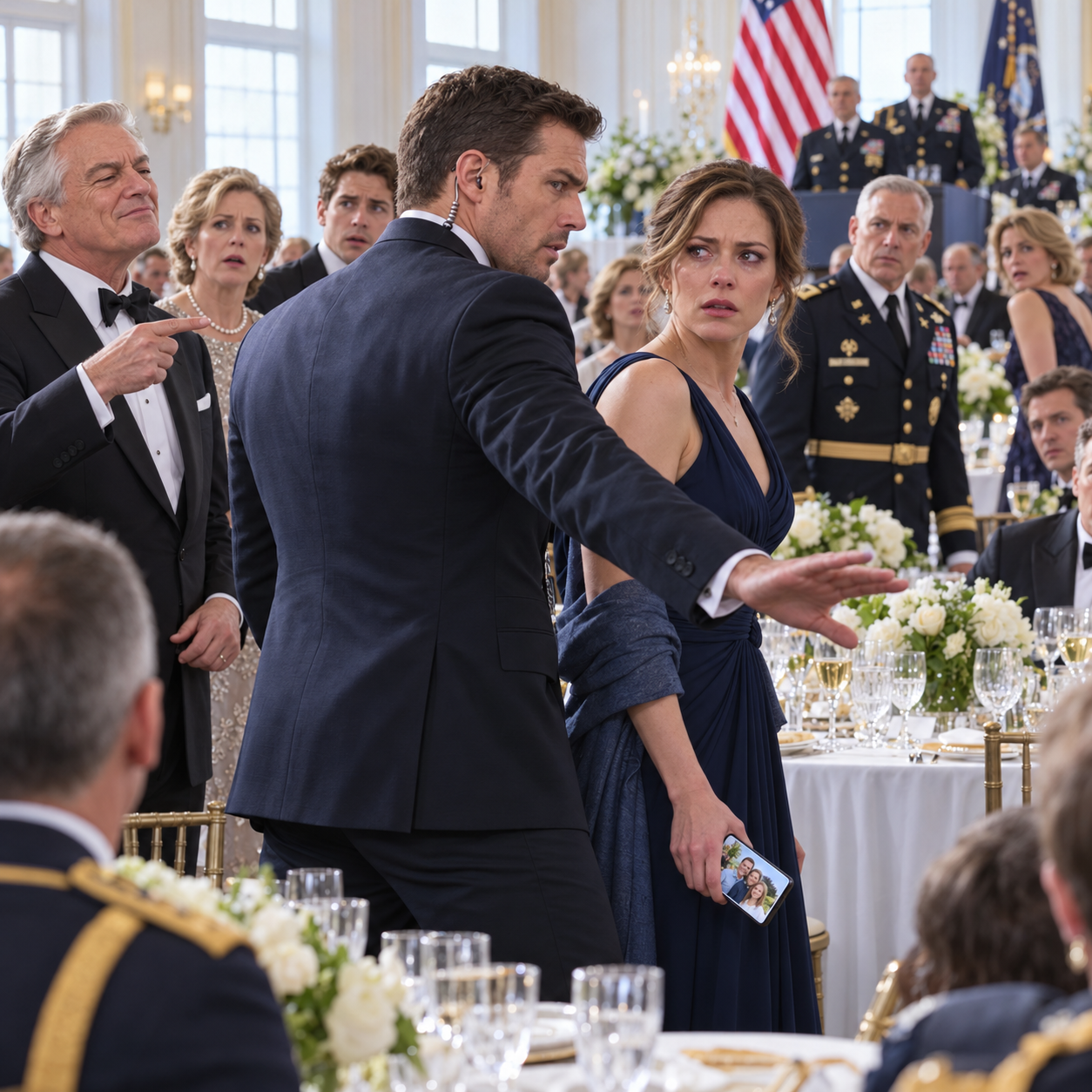
“My Daughter’s A Babysitter,” Dad Snickered At The General’s Dinner. The Security Chief Recognized My Face From An Undercover Evacuation And Quietly Moved Between Me And The Crowd. “We Were Told Your Cover Was Compromised,” He Said. I Looked At The Family Photo My Father Had Posted That Morning. “Then Why Did He Tag My Location?”
My father laughed when the general asked about me. “She’s just the babysitter,” he announced, waving me aside while his business partners chuckled. I stayed silent until the security chief crossed the ballroom, stopped in front of me, and saluted. My father’s smile disappeared. Three weeks later, I discovered something that made his humiliation seem insignificant: a photograph he’d posted outside my apartment had helped expose a military operation. But the photograph wasn’t the only thing someone had been hiding.
## Part 1
My father had always believed that a person’s worth could be measured by the importance of the people who returned their phone calls. He kept framed photographs of himself with senators in his office, memorized the names of generals he’d met once, and introduced his employees by their job titles before mentioning their actual names. By that standard, I had been disappointing him for most of my adult life.
At thirty-one, I was still the daughter who drove a seven-year-old Honda, wore inexpensive clothes, and disappeared for weeks without providing satisfactory explanations. My father, Graham Mercer, liked to tell people I worked as a freelance babysitter, although I’d never actually confirmed that description. Years earlier, when I mentioned helping care for a colleague’s children during a temporary assignment, he’d decided he’d finally identified my profession, and I’d discovered that allowing him to believe it was easier than correcting him.
The real explanation was considerably more complicated. I was Captain Leah Mercer, an officer in the United States Army assigned to sensitive personnel-recovery operations, and much of my work involved places and people I couldn’t discuss with anyone outside authorized channels. My family knew I’d enlisted after college, but my father had convinced himself I’d left military service years earlier because I refused to discuss my assignments or provide him with photographs he could show his friends.
“There’s nothing shameful about honest work,” he frequently announced, usually immediately before saying something that suggested he found my supposed work deeply shameful.
On the afternoon of the defense leadership dinner, he called three times before I answered. I’d been staying in a temporary apartment outside Washington, D.C., waiting for instructions following a difficult assignment, and sleep had become something I measured in scattered hours. My left shoulder still ached when the weather changed, and the sound of a motorcycle accelerating outside my building could send my pulse racing before I remembered where I was.
“You’re coming tonight,” my father said without greeting. “I reserved a place for you, and your mother says you don’t have other plans.”
“I didn’t tell Mom that.”
“Leah, it’s one dinner. General Whitcomb is hosting, and half the defense contracting community will be there. It would be nice if you showed some interest in what your father has accomplished.”
I looked at the small suitcase beside my bed. Three weeks earlier, I’d left another apartment under circumstances I was still trying to understand, and I’d spent every day since wondering whether a security failure had been accidental or deliberate. My supervisors had authorized limited personal activities while an internal review continued, provided I followed strict communication and travel restrictions.
“All right,” I said. “But I’m leaving early.”
My father treated that concession like a victory.
The Grand Horizon Hotel occupied an expensive stretch of waterfront property in Alexandria, Virginia, its entrance lined with polished cars and men in dark suits talking quietly into phones. Inside, enormous chandeliers reflected in the marble floor, and waiters moved between carefully arranged tables carrying crystal glasses and silver trays. I wore a navy-blue dress I’d bought at a department store, plain black flats, and the small silver earrings my grandmother had given me when I graduated from college.
My father inspected me when I arrived. His tuxedo was tailored, his watch probably cost more than my car, and a small American flag pin sat precisely on his lapel. He looked at my shoes, then at my empty wrists, and his expression tightened.
“You could have made an effort,” he said.
“I did.”
“Just don’t start talking about whatever odd jobs you’ve been doing lately. These people handle serious national responsibilities.”
My mother, Elaine, stood beside him in an elegant cream dress. She gave me an apologetic smile but said nothing, which was her usual contribution when my father decided to humiliate someone. My younger brother, Owen, was already inside entertaining clients from Meridian Response Logistics, the transportation company our father had built from a regional trucking operation into a major government contractor.
I hadn’t seen Owen in nearly six months. He was twenty-nine, held the title of vice president of finance, and had developed our father’s habit of checking his phone while other people were speaking. Unlike me, he’d accepted the version of success our father offered without much resistance.
Inside the ballroom, I noticed the security arrangements before I noticed the decorations. That wasn’t unusual for me anymore, although I tried not to let my attention settle on anything long enough to make it obvious. The familiar rhythm of watching people enter and leave helped quiet the restlessness that had followed me home from my last assignment.
General Daniel Whitcomb was standing near the head table when we approached. A four-star officer with close-cropped silver hair, he looked tired beneath his formal composure, and his expression suggested he’d already endured several hours of conversations about procurement forecasts. My father straightened his back and extended his hand with such enthusiasm that I almost felt embarrassed for him.
“General, Graham Mercer. Meridian Response Logistics. We met at the transportation summit in Arlington.”
“Of course, Mr. Mercer,” the general replied pleasantly.
My father introduced my mother, then gestured toward me as if remembering he’d brought an umbrella.
“And this is my daughter, Leah.”
The general smiled. “It’s nice to meet you. Are you involved in the family business?”
I opened my mouth, but my father answered first.
“Oh, good heavens, no. She’s the babysitter.”
Several people turned toward us. My father laughed, delighted with himself, and continued before anyone else could respond.
“Good with folding laundry and keeping toddlers entertained, but put her in a room discussing military logistics and she’s hopelessly out of her depth. We thought bringing her might broaden her horizons.”
An older executive gave an uncomfortable chuckle. Someone else looked down at his plate, and my mother adjusted the bracelet on her wrist without meeting my eyes. The general’s smile faded slightly, but my father interpreted the silence as permission to continue.
“Leah has never been particularly ambitious. Fortunately, her brother inherited the business instincts.”
I felt the old familiar pressure behind my ribs, the sensation I’d experienced at Christmas dinners and graduation parties since childhood. But after everything I’d seen during the previous month, I couldn’t summon the embarrassment my father expected. I was more interested in the man standing several yards behind General Whitcomb, whose expression had changed the instant he looked at me.
He was tall, broad-shouldered, and dressed in a dark suit with a discreet security identification badge clipped near his belt. A pale scar crossed the edge of his jaw, and his right hand had gone completely still around the folder he was carrying. I recognized him a second later.
Marcus Keene.
The last time I’d seen Marcus, he’d been bleeding through a field dressing while helping evacuate wounded personnel from a damaged transport vehicle overseas. We’d spoken only briefly afterward, and I hadn’t known he’d retired from active service and joined the general’s protective security staff.
He moved toward us immediately.
My father saw him approaching and smiled. “Ah, Chief Keene. Is there something you need?”
Marcus barely acknowledged him. He stopped in front of me, brought himself to attention, and raised his right hand in a crisp salute that turned every nearby conversation into silence.
“Captain Mercer,” he said. “I was told you were missing.”
I stood and returned his salute, suddenly aware of my father’s astonished face.
Marcus lowered his hand and leaned closer. “Ma’am, we need to speak privately. Immediately.”
His expression was no longer simply surprised.
It was frightened.
## Part 2
For several seconds, the only sound at our table was a waiter collecting a glass from the floor after someone knocked it over. My father looked from Marcus to me, searching for the explanation that would restore his understanding of the evening. I knew that expression well; it was the same one he wore when a conversation stopped following the script he’d prepared.
“Captain?” he repeated. “Marcus, I think you’ve confused my daughter with someone else.”
“No, sir,” Marcus replied.
General Whitcomb stepped closer, his attention moving between us. “Chief, is there a problem?”
“Potentially, General. I’d appreciate a private room.”
My father reached for my arm. “Leah, would you please explain what ridiculous misunderstanding you’ve gotten yourself involved in?”
I moved before his fingers touched me. “Don’t.”
The word came out quietly, but my father dropped his hand. He had never heard that particular tone from me before, and I could see him trying to decide whether to respond with anger or authority. Marcus glanced toward two members of the general’s security team and gave a small signal.
Within a minute, we were walking toward a private conference suite beyond the ballroom. My father insisted on following, and General Whitcomb permitted him to enter after warning that the conversation could not involve operational details. My mother remained outside with Owen, who had arrived just in time to witness the last moments of the spectacle.
The conference room smelled faintly of coffee and furniture polish. A wall of windows overlooked the waterfront, while an enormous screen displayed the hotel’s logo above a long walnut table. Marcus closed the door and remained standing.
“Captain Mercer,” he began, “three weeks ago, an emergency notification was circulated concerning your detachment. We were informed that your previous location had been compromised and that several personnel remained unaccounted for.”
General Whitcomb’s expression hardened. “Was that information current?”
“Apparently not, sir.”
“It wasn’t,” I said. “Everyone from my immediate team has been accounted for, although two are still recovering. My status hasn’t been fully distributed because the investigation remains active.”
Marcus closed his eyes briefly. I realized he’d probably spent those three weeks assuming I’d been killed, and the realization hurt more than I’d expected. He’d been part of the group we’d helped extract several years earlier, and I’d never forgotten his determination to stay with the wounded when the evacuation became difficult.
“I’m sorry you weren’t informed,” I said.
He nodded once. “I’m glad you’re alive.”
My father was gripping the back of a chair. “Would somebody please tell me what she’s talking about? Leah left the Army years ago.”
“I didn’t,” I answered.
“You told us you were living in Seattle.”
“I said I couldn’t discuss where I was working.”
“That’s the same thing.”
“No, Dad. It isn’t.”
General Whitcomb glanced at Marcus. “Does this involve the compromised location?”
Marcus hesitated before answering. “I was briefed on part of the initial findings because the security review included information affecting defense contractors attending this event. Something I’ve just seen makes me concerned there’s a connection.”
He asked permission to show me a photograph on his secured tablet. It depicted the entrance to a narrow brick duplex I’d occupied for several weeks during a temporary stateside assignment, a building selected precisely because it looked ordinary. There were no military markings, no visible security personnel, and nothing outside to distinguish it from the surrounding residential properties.
I recognized the flowerpot beside the front steps.
Then I recognized the man smiling beside it.
My father.
The photograph had been copied from a public social media post published twenty-one days earlier. He stood beside the building in an expensive coat, one hand holding a coffee cup, with a caption explaining that he’d stopped to visit his hardworking daughter at her modest rental property. The post included a location tag identifying the street.
My stomach tightened.
“Where did you get that?” I asked.
Marcus studied my expression. “You’re confirming the address?”
I nodded.
My father leaned toward the screen and brightened. “Oh, that! My marketing team loved that photograph. It performed extremely well. People appreciate a businessman who remembers where he came from.”
“You posted my address,” I said.
“Don’t exaggerate, Leah. I posted a picture.”
“I specifically asked you never to put my location online.”
“You’ve always been excessively private.”
I turned the tablet slightly so he could see the location tag beneath the photograph. “You didn’t just take a picture. You told thousands of strangers exactly where I’d been staying.”
His smile weakened. “There was nothing secret about that apartment. You were renting it like anyone else.”
Marcus interrupted. “Mr. Mercer, whether you knew its function is a separate question from whether you disclosed its location. The photograph is relevant to an ongoing investigation.”
My father began protesting again, but my mind had already returned to the night we’d evacuated that building. I’d been reviewing reports with Lieutenant Elena Ortiz when she noticed someone had been repeatedly observing the property. The warning came through established channels shortly afterward, and we’d moved before dawn, leaving behind food in the refrigerator and paperwork we’d been scheduled to complete.
At the time, I’d assumed the compromise originated somewhere inside the systems we used for our work. I’d spent three sleepless weeks replaying conversations, questioning routine decisions, and wondering whether I’d endangered people because I’d missed something obvious. Now my father’s cheerful photograph sat on the screen between us.
General Whitcomb asked whether we had documented the original public posting and alerted the proper investigators. Marcus confirmed that the material had been preserved and that the review remained preliminary. The general then asked my father to identify everyone who’d managed the account.
“My assistant handles most of that,” Dad replied quickly. “I don’t personally operate every social media platform.”
“You approved the photograph?” Marcus asked.
“Of course. It was a perfectly harmless family picture.”
“Who added the location?”
“I don’t know.”
He said it too quickly, without looking at the image again.
That bothered me almost as much as the picture itself. My father loved taking credit for small successes, and he rarely surrendered ownership of something that had attracted attention. Yet he now seemed eager to distance himself from a post he’d apparently celebrated for weeks.
General Whitcomb instructed his staff to notify the appropriate security and contracting officials and preserve records associated with the company’s interactions with the event. He did not pronounce my father guilty of anything, but he made clear that the concerns would be referred for review. My father’s face reddened when Marcus explained that investigators might request interviews and business records.
“This is absurd,” he said. “My company employs four hundred people. We’re competing for a major federal logistics contract, and you’re treating an innocent photograph like espionage.”
“Nobody has made that accusation,” Marcus answered.
My father turned to me. “Leah, tell them you aren’t blaming me.”
I looked at the photograph again. I remembered my teammate Elena trembling with exhaustion during our hurried move, and a young specialist named Theo Bradley trying to walk despite a badly injured knee. We had spent hours fearing someone had been left behind.
“I don’t know everything that happened,” I said. “But I’m not going to lie to make you comfortable.”
Dad stared at me as if I’d struck him.
Marcus waited until my father had been escorted to a separate room for an administrative interview before showing me another document. It was a preliminary record prepared by the security investigators, and he’d received authorization to confirm one detail with me.
The record contained an unsettling timeline. The photograph had gone online shortly before our location was compromised, but someone associated with Meridian Response Logistics had accessed a separate document containing that same address several days earlier.
I stared at the date.
My father hadn’t simply stumbled upon my apartment.
Someone inside his company had known where to find me before he arrived.
## Part 3
I left the Grand Horizon Hotel shortly after eleven, wearing the same navy dress my father had criticized earlier that evening. The ballroom was still full of people drinking champagne and discussing government contracts, but several executives had quietly removed themselves from my father’s table. For a man who measured friendship in invitations and handshakes, their sudden absence would probably hurt more than anything I’d said.
Marcus walked me to the hotel’s side entrance. The temperature had dropped, and the waterfront lights shimmered across the dark Potomac while a valet pulled cars beneath the covered driveway. He offered me his coat, but I declined, grateful for the cold air against my face.
“You’re certain your people are safe?” he asked.
“As certain as anyone can be until the review is finished.”
“And Bradley?”
“Recovering. He’ll probably complain about physical therapy for another six months.”
Marcus smiled briefly. Then his expression settled into something more serious.
“Leah, the photograph may not have been the original leak. Whoever accessed that company document had information they shouldn’t have possessed, and your father’s post may have confirmed something another person was already looking for.”
“Do you think someone used him?”
“I think you should let the investigators answer that.”
He handed me a business card containing the contact information for Special Agent Celia Grant, who was coordinating part of the investigation through the Defense Criminal Investigative Service. Marcus emphasized that I should not conduct my own inquiry into protected information, and I understood his caution. My personal connection to the contractor made it especially important that I remain a witness rather than attempt to become an investigator.
Still, I had questions that no classified report could answer.
My father called before I’d reached my car.
“Do you understand what you’ve done?” he demanded.
I stopped beneath a streetlamp. “I didn’t post the photograph, Dad.”
“General Whitcomb’s staff is requesting information about my company. Owen says our attorneys are already being contacted, and people at the dinner were staring at me like I was some kind of criminal.”
“Then cooperate with the review.”
“That’s easy for you to say. You’ve never built anything.”
I’d heard that sentence in different forms since I was eighteen. He said it when I joined the Army instead of studying finance, when I missed Owen’s engagement party, and when I refused the administrative position he’d once offered me. Whatever happened, his accomplishments were permanent proof of virtue, while mine were temporary inconveniences.
“How did you find my apartment?” I asked.
Silence.
“Dad?”
“I drove there. How else would I find it?”
“Who gave you the address?”
“Owen handled the arrangements.”
“And how did Owen get it?”
“I don’t keep track of every little thing my son does.”
He hung up.
The next morning, I attended a scheduled medical appointment at a military facility. The doctor examined my shoulder, checked the progress of an old injury, and asked the usual questions about sleep, concentration, and intrusive memories. I answered more candidly than I normally would have because the evening had reminded me how exhausted I was from keeping separate pieces of my life from colliding.
Afterward, I called Elena Ortiz.
She answered on the third ring. “Please tell me this isn’t another mandatory wellness questionnaire.”
“It’s worse. My father apparently helped advertise our previous address.”
For a moment, she said nothing.
Then she asked me to explain.
I described the photograph and its location tag without discussing anything beyond information already cleared for me to share with her. Elena listened quietly, occasionally asking a short question that made me realize how many details I still didn’t know.
“Did anyone tell you about the delivery discrepancies?” she asked when I finished.
“What discrepancies?”
“Remember those routine supply deliveries that kept arriving incomplete? Medical equipment, replacement batteries, basic facility supplies. We filed reports because the paperwork said everything had been delivered.”
I remembered. At the time, I’d assumed the discrepancies were ordinary administrative errors, the kind that occurred when different organizations handled overlapping responsibilities. Our team had eventually stopped depending on certain scheduled deliveries because we couldn’t trust the paperwork.
“Some of those shipments passed through a company called Meridian,” Elena said.
I sat down on a bench outside the medical building.
“You’re sure?”
“I recognized the name when I saw the contracting information during the review. Leah, I didn’t realize it was your father’s business until yesterday.”
That changed the shape of my concern. An embarrassing social media post was one thing, and a contractor improperly handling sensitive information was another. But if the same company had been reporting deliveries that never arrived, the investigators might be dealing with something far older than my father’s photograph.
I contacted Agent Grant that afternoon.
She had a calm, measured voice and didn’t interrupt while I explained my conversation with Elena. When I finished, she asked me to document what I personally remembered and identify the reports I’d previously filed through official channels.
“Are you investigating Meridian for fraud?” I asked.
“We’re reviewing several possible violations,” she answered. “I can’t discuss the scope of an active investigation.”
“Does my father know?”
“I can’t speak to what Mr. Mercer has been told.”
Her restraint frustrated me, but I respected it. I’d spent years asking civilians not to speculate about my work, and I wasn’t entitled to different rules simply because this investigation involved my family.
That evening, my mother arrived at my temporary apartment carrying a paper bag from my favorite bakery. She’d brought blueberry muffins, the kind she used to buy when I was a child and she’d come into my bedroom after an argument with Dad. The gesture was so familiar that I almost laughed.
“Your father didn’t sleep last night,” she announced as I opened the door.
“Neither did I.”
“He’s terribly embarrassed.”
“Mom, people could have been hurt.”
She stepped inside and set the bag on my kitchen counter. “He didn’t understand what you were doing.”
“He understood that I asked him not to publish my address.”
“He’s proud of his family. Sometimes he gets carried away.”
I looked at her. “He called me a babysitter in front of a room full of strangers.”
“You know how your father jokes.”
“That’s the problem. I do.”
Mom lowered her eyes. For thirty years, she’d acted as though keeping peace in our house required everyone else to absorb whatever my father said. When I was thirteen, he’d laughed at a science competition I’d lost; when I was twenty-two, he’d refused to attend my commissioning ceremony because Owen had a business reception the same weekend. Every time, she’d explained his behavior until the explanation became another way of asking me to accept it.
She reached into her purse and pulled out a folded sheet of paper.
“Owen asked me to give you this. He says he doesn’t want his name involved.”
The page was a printed email dated four days before my father’s photograph. It contained a request from Meridian’s chief operating officer, Randall Price, asking Owen to confirm a residential address for what he described as a family outreach visit.
My old apartment appeared beneath the message.
But another sentence caught my attention.
“Please ensure the occupant’s authorization remains attached to the publicity file.”
I read it twice.
“Mom, did you ever sign anything giving Dad permission to use pictures of my home?”
She shook her head.
I turned the page over.
Stapled to the back was a photocopied consent form bearing my full name and a signature that looked almost exactly like mine.
I had never seen the document before.
## Part 4
I photographed the papers and contacted Agent Grant before doing anything else. She asked me to preserve the originals exactly as I’d received them, avoid confronting anyone about their contents, and bring them to a scheduled interview the following morning. I agreed, although staying silent became considerably harder after I realized someone had apparently been using my signature to authorize decisions I knew nothing about.
The signature wasn’t a perfect forgery. Whoever copied it had reproduced the long first stroke of my last name but had missed the small upward turn I always made in the final letter. It was the kind of mistake most people wouldn’t notice, particularly if they believed the document had already passed through a company’s legal department.
My mother watched me examine the page.
“Maybe Owen misunderstood what it was,” she offered.
“Somebody signed my name.”
“Your father would never intentionally put you in danger.”
I looked up. “You keep saying what he would never do instead of asking what he actually did.”
She folded her hands in her lap. Outside, a delivery truck idled near the curb, and somebody in the neighboring apartment was playing music loudly enough that I could hear the bass through the wall. The ordinary sounds made our conversation feel more disturbing.
“Randall Price handles complicated business matters,” she finally said. “Your father trusts him completely.”
“How long has Randall worked for Meridian?”
“Almost eight years.”
I remembered meeting him at a Christmas party long ago. He was thin, carefully dressed, and had the unnerving habit of looking past whoever was speaking to see whether someone more important had entered the room. My father called him indispensable, which usually meant the person handled things he didn’t want to understand.
“Why did Owen give you this instead of calling me?” I asked.
“He said the company was keeping records for its attorneys, and some people were frightened.”
“Who?”
She hesitated. “There was a woman in quality assurance. Nina Flores. She left last spring.”
“Why?”
“I don’t know.”
Mom’s hesitation told me she knew more, but I refused to drag the information out of her. Instead, I thanked her for bringing the paperwork and told her I’d be giving it to the investigators. She looked alarmed, as though she’d expected me to keep the family problem inside the family.
“Leah, your father’s company supports hundreds of families.”
“Then he should want the truth established.”
She left the muffins untouched.
Agent Grant interviewed me the next morning in a plain federal office where the carpet smelled recently cleaned and the coffee tasted as though someone had forgotten to replace it. She examined the document, asked where it came from, and carefully distinguished between what I knew firsthand and what I’d learned from my mother. When I showed her several older examples of my signature, she arranged to have the documents reviewed through appropriate channels.
“Does this mean somebody deliberately exposed the apartment?” I asked.
“Not necessarily. A forged authorization can be used to conceal many different things, including a decision someone knew wasn’t properly approved.”
“What about Randall Price?”
“He’s someone we’re interested in speaking with.”
I left the interview realizing that Agent Grant probably knew much more than she was authorized to tell me. It was the first time in years I’d been on the civilian side of an investigation, and I didn’t enjoy the helplessness. I could follow instructions and provide evidence, but I couldn’t force the answers to arrive sooner.
Three days later, I received a call from an unfamiliar number.
“Captain Mercer? My name is Nina Flores. Your brother told me you might be willing to listen.”
I stopped walking.
Nina explained that she’d previously supervised shipment-quality compliance at Meridian. She’d seen reports about the dinner and the subsequent investigation, and she’d been deciding whether to contact me for several days. She sounded nervous, but her sentences were precise and direct.
“I’ve already spoken with federal investigators,” she said. “There are things I want you to understand about your father’s company.”
We met at a busy coffee shop in Arlington, where she arrived carrying an old canvas messenger bag and wearing a gray cardigan over a white blouse. She was in her forties, with tired eyes and hands that trembled slightly when she reached for her cup. She chose a table near the window and waited until the server had walked away before speaking.
“Your father probably thinks Randall Price saved his business,” she began.
“Isn’t that what everyone says?”
“Randall made the numbers look better. That’s not always the same thing.”
Nina described how Meridian had expanded into federal emergency medical transportation contracts during a period of rapid growth. The company handled deliveries through several subcontractors, including shipments requiring verified temperature controls and documented receipt. When equipment failed or deliveries arrived late, employees were supposed to report the discrepancy rather than certify that everything had gone according to plan.
According to Nina, those rules gradually became suggestions.
A damaged refrigeration unit might disappear from a performance report. A shipment delivered a day late might be entered under its original scheduled date. Employees who objected were told that government paperwork was unnecessarily complicated and that the company couldn’t survive if every minor inconvenience resulted in penalties.
“At first, I thought Randall was cutting corners,” she said. “Then I saw the same corrections appearing across unrelated contracts.”
She told me about emergency medical supplies intended for a regional hospital network during severe winter storms. A subcontractor had failed to maintain required handling conditions, and some supplies had to be discarded. Meridian’s records, however, allegedly showed a complete and successful delivery.
“Did my father know?” I asked.
“I sent the report to him.”
“Personally?”
“With my name on it. I requested a meeting.”
Nina opened her bag and removed a folder, then stopped herself before passing it over.
“I can’t give you copies of every company record. My attorney told me to provide the original evidence to investigators and let them handle it. But there’s something personal I can tell you.”
She looked at me carefully.
“Your father called me into his office after I reported the shipment problems. He said he’d spent thirty years building a company and wasn’t going to let one employee destroy it over what he called clerical disagreements.”
“Then what happened?”
“Randall offered me a promotion if I’d withdraw my concerns. When I refused, they eliminated my position.”
Her voice remained steady, but I noticed the effort it cost her. She’d lost her health insurance while caring for her elderly mother, and the termination had made finding another compliance job difficult. Meridian’s lawyers had challenged her complaints, portraying her as a disgruntled employee who misunderstood normal business practices.
“Why didn’t you give up?” I asked.
“Because the supplies weren’t going to paperwork. They were going to people.”
For the first time that week, I felt something other than anger toward my father. I felt ashamed that I’d allowed his contempt to convince me his world had nothing to do with mine. Our worlds had been connected all along, through the same contracts, the same shipments, and people whose names he never bothered to learn.
Nina reached into her bag again and produced a business card.
“This was Randall’s outside consultant,” she said. “He called himself a government access specialist.”
The card belonged to a man named Julian Cross, president of Cross Strategic Advisory. Beneath his company name was an address in Virginia and a business email that I’d never seen before. Yet the name immediately bothered me.
Three weeks earlier, during the evacuation of our apartment, our preliminary security briefing had mentioned an external consultant associated with one of the affected contracting networks.
I’d forgotten the name until that moment.
I looked at Nina. “Did Julian Cross ever ask about residential properties?”
“Yes,” she said slowly. “He wanted addresses tied to special-handling deliveries. Randall said they were needed for a service review.”
“Did you question it?”
“I did. That’s part of why I was fired.”
She hesitated, then added, “Captain, Julian wasn’t looking for transportation efficiency. He was asking which deliveries went to places that weren’t identified by their real organizational names.”
My coffee had gone cold.
I’d spent three weeks assuming the photograph exposed an otherwise secure location.
Now I understood that someone might have used the photograph to confirm information taken from Meridian’s own records.
## Part 5
By the following Monday, my father’s humiliation had become a public-relations problem, and Randall Price had decided that I was the most convenient solution. A short statement appeared on Meridian’s corporate website expressing concern about inaccurate speculation surrounding a private family incident. It said the company had never knowingly mishandled sensitive military information and suggested that an unnamed family member had failed to communicate the confidential nature of a residential address.
I read the statement twice before I understood what bothered me most. My father wasn’t denying that he’d posted the photograph. He was implying that the responsibility belonged to me because I hadn’t explained why he shouldn’t have done it.
He’d turned my silence into his defense.
Several local business reporters began contacting me. One described my father as a respected entrepreneur caught in an unfortunate misunderstanding, while another asked whether my previously undisclosed military position had created an undisclosed conflict involving Meridian’s federal contracts. I referred every inquiry to the appropriate public affairs office and declined to discuss operational matters.
That evening, my father called from a number I didn’t recognize.
“I need you to sign something,” he said.
“No.”
“You haven’t even heard what it is.”
“I read your statement.”
He sighed heavily. “Randall wrote that. We’re trying to prevent a misunderstanding from destroying the business.”
“You could start by telling the truth.”
“The truth is that you deliberately kept your father in the dark.”
“You knew I didn’t want photographs of my home online.”
“Because you’re secretive about everything! How was I supposed to know you were still in the Army?”
“You weren’t supposed to know. You were supposed to respect my request.”
He let out an irritated breath. I heard papers rustling and someone speaking quietly in the background, and I realized he was probably sitting beside his lawyers. Even now, he seemed incapable of talking to me without an audience when something important was at stake.
“The statement simply confirms that you never explained any security restrictions,” he said. “That’s accurate.”
“It leaves out the fact that you were explicitly told not to publish my location.”
“Leah, don’t be difficult.”
I almost laughed. That phrase had followed me through childhood more faithfully than any expression of encouragement. Whenever I disagreed with my father, I was difficult; whenever Owen disagreed, he was demonstrating leadership.
“Send your statement to Agent Grant,” I said. “I’m not signing it.”
I ended the call.
The next morning, I learned that Meridian’s executive committee had placed several federal business-development activities on hold while contracting officials reviewed the available information. It wasn’t the sweeping punishment my father feared, and the company remained operational, but pending negotiations were now subject to greater scrutiny. Government agencies wanted documentation establishing how Meridian protected sensitive delivery information and whether its performance certifications could be trusted.
My father hated unanswered questions almost as much as he hated losing control.
Owen contacted me that afternoon. He asked whether we could meet somewhere private, and I agreed to a quiet diner outside Fairfax, provided he understood I would not keep relevant information from investigators. He arrived in an expensive jacket without a tie, looking younger and more frightened than he had in years.
“People are resigning,” he said before we’d ordered.
“Who?”
“Compliance staff. A contracts manager. Two people from Randall’s office.”
“Are they resigning because they did something wrong?”
“Some of them are scared of being blamed for things they tried to stop.”
That sounded familiar.
Owen pushed his water glass aside. “Leah, the company has an internal system for tracking deliveries, contractor expenses, and vendor locations. Randall gave Julian Cross access to selected reports when we started preparing the new federal bid.”
“Was that permitted?”
“Not the way they did it.”
He explained that certain addresses had been provided to Meridian for legitimate deliveries under contracts that imposed restrictions on further disclosure. Those addresses weren’t necessarily classified by themselves, but they still required careful handling because careless association with particular projects could reveal information the government had intended to protect.
“Randall said Julian needed the records to analyze our service territory,” Owen continued. “I asked about the restrictions, and he told me legal had cleared everything.”
“Did legal clear it?”
Owen stared at the table.
“I never checked.”
I watched my brother rub his forehead with both hands. He’d spent years accepting our father’s praise for his business judgment, yet when a questionable decision had crossed his desk, he’d apparently preferred someone else’s reassurance to his own responsibility.
“How did Dad get my address?” I asked.
“Julian found it in the vendor records.”
“And you gave it to Dad?”
“Yes.”
“Why?”
Owen swallowed. “Dad wanted to visit you before the gala. He said he was tired of people asking where you lived and why you never brought anyone home. Julian mentioned that he’d seen a residential address with your name associated with a delivery record.”
“Did either of you consider that strange?”
“I did. Randall said you’d probably ordered supplies through one of our subcontractors.”
I thought about the temporary apartment, the routine deliveries, and the reports Elena had mentioned. Someone had taken an address from business records and used it for a personal visit without asking me. Then my father had photographed the location and broadcast it for attention.
“Who prepared the consent form?” I asked.
“Randall’s marketing staff.”
“Did Dad approve the picture?”
Owen nodded.
“Did he know there was a location tag?”
“Yes.”
My throat tightened.
“He told them it made the post more authentic,” Owen said. “He wanted people to see that he wasn’t ashamed of having a daughter who lived modestly.”
I stared at him. My father had spent years telling jokes about my supposedly unsuccessful life, then turned my ordinary-looking apartment into a public demonstration of his humility. He’d exposed me not because he was proud of me, but because he thought displaying my inadequacy made him appear generous.
Owen reached across the table.
“Leah, I didn’t know what you were doing there.”
I moved my hand away. “You knew it wasn’t your information to share.”
He didn’t argue.
For the next several minutes, he told me about the pressure inside Meridian. Randall had pushed everyone to secure the new federal contract, and our father had become increasingly obsessed with winning it. After several profitable years, rising debt and failed expansion projects had left the company more vulnerable than its glossy annual reports suggested.
“If we don’t get the contract, Dad’s going to have serious problems,” Owen admitted.
“Financial problems?”
“More than that.”
He glanced toward the windows before continuing.
“Some of our revenue is tied to disputed invoices. Randall says the numbers can be reconciled, but auditors have started asking questions.”
“Have you told investigators?”
“Not yet.”
“Then you need to.”
Owen’s face tightened. “If I do that, Dad will never forgive me.”
I sat back in my chair.
For years, I’d mistaken Owen’s compliance for confidence. Now I realized he had been living beneath our father’s approval as carefully as I’d once lived beneath his criticism. The difference was that Owen had made decisions affecting other people’s safety to protect that approval.
“I can’t make that choice for you,” I said. “But Nina Flores lost her job because she refused to approve records she believed were false.”
He looked startled. “You’ve met Nina?”
“Yes.”
Owen stared down at his untouched food. Then he reached into his jacket and placed a sealed envelope on the table.
“I copied a few documents before the attorneys told us to preserve everything,” he said. “I’ve kept the originals untouched since the legal hold. I wanted to understand what I’d signed.”
I didn’t open the envelope. I told him to give it directly to Agent Grant and to explain exactly how he’d obtained it. He hesitated, then agreed to arrange the meeting.
Before we left, Owen said something I hadn’t expected.
“There’s one more thing about Randall.”
“What?”
“He’s been telling Dad that someone from your unit used Meridian’s records to create the security problem.”
I frowned. “Based on what?”
“A memo he says came from a government contact.”
Owen lowered his voice.
“Leah, Randall is preparing to accuse you of causing the breach yourself.”
## Part 6
The accusation arrived two days later in the form of a letter from Meridian’s outside counsel. It alleged that unidentified military personnel might have improperly used civilian contractor resources, creating confusion about the status of certain delivery locations. The letter avoided naming me directly, but attached correspondence made it obvious that Randall intended to redirect suspicion toward the people who’d lived at the compromised apartment.
Agent Grant contacted me before anyone in my family could turn it into another argument.
“Your father’s attorneys have submitted material,” she said. “We need to clarify some details concerning your communications with the company.”
I agreed to an interview, but I also asked whether the allegations could affect my military status. She explained that the relevant authorities would examine the claims through established procedures and that I shouldn’t assume the letter had any evidentiary value simply because it appeared on legal stationery.
That reassurance helped, although it couldn’t erase the feeling of betrayal.
My father had once told me that family meant having someone who would defend you even when the world turned against you. Apparently, he’d meant that everyone in the family was required to defend him. When the consequences of his own decisions became inconvenient, he was willing to let strangers question my conduct to save his company.
I attended the interview the following morning. Agent Grant sat across from me with another investigator and asked about my communications with Meridian, my father’s visits, and any company services I remembered receiving. I answered each question carefully, distinguishing between personal recollection and information I’d learned after the gala.
At the end, Agent Grant closed her notebook.
“Your brother contacted us,” she said.
I looked up.
“He has agreed to cooperate and has retained independent counsel. That’s all I can tell you about his involvement.”
For the first time since the dinner, I felt a small measure of relief.
Owen had made mistakes, some of them serious. But at least he was finally doing something other than waiting for our father to decide what the family should believe.
Later that week, I received permission to visit Theo Bradley at the rehabilitation center where he was recovering. He greeted me from a chair beside a window, wearing athletic shorts and a T-shirt bearing the name of his favorite baseball team. His right knee was supported by a brace, and a stack of crossword puzzles sat beside his bed.
“Captain,” he announced, “I’ve been informed I’m an uncooperative patient.”
“I’m shocked.”
“The physical therapist says I argue too much.”
“She sounds observant.”
He grinned, and for several minutes we talked about baseball, bad hospital food, and the trouble he was having convincing his mother to stop calling six times a day. Then he asked about the investigation.
“I heard something about your dad’s company,” he said.
I sat beside him. “It’s complicated.”
He studied me. “You look like you’re carrying all of it.”
I didn’t answer immediately.
Theo had been one of the youngest members of our detachment. He’d volunteered for difficult assignments, remembered everyone’s coffee preferences, and had once spent an entire evening helping a newly assigned specialist find a lost wedding ring. During our evacuation, he’d continued assisting others even after injuring his knee.
“I keep thinking about that apartment,” I admitted. “About what could have happened if we’d moved later.”
“But we didn’t.”
“That doesn’t mean I stopped wondering.”
He set his crossword puzzle aside.
“Captain, you taught us to report a problem when we found one, not pretend we could control everything that happened afterward. That’s what we did.”
I looked down at my hands.
“You didn’t put that picture online,” he continued. “You didn’t falsify anybody’s paperwork. You’re allowed to be angry without taking responsibility for their choices.”
His words stayed with me after I left.
The next significant development came from an unexpected source. My mother called late one evening and asked whether she could see me without my father knowing. We met at the small public garden near her favorite church, where the autumn leaves had begun collecting along the paths.
She looked exhausted. Her carefully styled hair had come loose around her face, and she carried a brown envelope that had clearly been opened and closed several times. When she sat beside me, she stared at the pond for nearly a minute before speaking.
“Your father has been lying about the compliance reports,” she said.
I waited.
“Last year, I heard him arguing with Randall about some medical shipments. Graham said the company couldn’t afford another official complaint.”
“What did Randall say?”
“He said everything had already been handled.”
She handed me the envelope.
Inside was a copy of a letter Nina Flores had sent my father several months before she lost her job. The letter identified repeated discrepancies in transportation records and warned that continuing to certify unverified deliveries could endanger recipients and violate federal contract requirements. Beneath the letter was a brief handwritten note from my father.
“Discussed with Randall. Proceed with existing reporting process until review completed.”
The words looked harmless until I noticed the date.
It was two weeks before Meridian had submitted another batch of performance certifications.
“Where did you get this?” I asked.
“Graham left a copy in his home office. I found it when I was looking for the insurance paperwork.”
“Did you know about it before?”
Mom nodded slowly.
“I knew there were complaints. I didn’t understand how serious they were.”
“Did you ask?”
She closed her eyes.
“No.”
That was the first completely honest answer I’d heard from her in years.
She told me she’d spent most of her marriage convincing herself that business decisions belonged to my father and that interfering would only create another argument. Whenever an employee complained or a supplier threatened legal action, Graham reassured her that successful companies always attracted critics. She’d accepted his explanation because challenging it meant questioning the comfortable life she’d helped him build.
“And when he made fun of me?” I asked.
Her face crumpled.
“I should have stopped him.”
“Why didn’t you?”
“Because when he was angry with you, he wasn’t angry with anyone else.”
The admission was so quiet that I almost missed it.
I remembered hundreds of moments suddenly arranged into a pattern: my mother smiling nervously while Dad mocked my clothes, my mother changing the subject when he questioned my intelligence, my mother telling me afterward that he’d been under pressure. She hadn’t simply been helpless. She’d allowed me to become the person who absorbed his cruelty because it made life easier for everyone else.
“I love you,” she whispered.
“I know you do.”
“Can you forgive me?”
I looked across the pond. A small boy was throwing leaves into the water while his grandmother watched from a nearby bench, laughing whenever the wind blew them back toward him. It was such an ordinary, uncomplicated moment that I felt a sudden ache for the childhood I’d spent trying to earn approval.
“I’m not ready to do that,” I said.
Mom began crying quietly.
I didn’t comfort her, although part of me desperately wanted to. For once, I let her experience the consequences of the truth without immediately trying to make them disappear.
Before leaving, I told her to preserve the documents and speak directly with investigators. She agreed, and the next morning Agent Grant confirmed that an interview had been arranged.
Two weeks later, the investigation produced its first public development. Federal contracting officials issued a formal notice concerning Meridian’s eligibility for certain new government awards while allegations of improper information handling and inaccurate certifications were examined. The company continued operating existing contracts under heightened oversight, but the announcement sent investors and business partners scrambling for answers.
My father called me eighteen times that afternoon.
I didn’t answer.
That evening, Marcus Keene contacted me through an authorized channel and asked whether we could speak about an important clarification from the security review. After confirming I was permitted to receive the information, he explained that investigators had found evidence suggesting my father’s photograph had been used as corroboration for location data obtained earlier.
“Julian Cross?” I asked.
“He’s part of the inquiry,” Marcus replied. “But the critical point is that the public post gave outside parties an independent reason to trust information that should never have circulated.”
I pressed my fingers against my forehead.
“And the consent form?”
“Investigators are examining how it was prepared and approved.”
I thanked him, preparing to end the call, but Marcus continued.
“Leah, there’s something else. The records indicate your father received a warning before the photograph was published.”
I stopped breathing for a moment.
“An employee specifically questioned whether that address should appear in promotional material,” Marcus said. “The message was forwarded to his office.”
I waited.
“He replied that the post should go ahead.”
For weeks, I’d wondered whether my father’s carelessness had been manipulated by people who understood the risks better than he did.
Now I knew he’d been offered a chance to stop.
And he’d chosen the photograph anyway.
## Part 7
Six months after the dinner, my father appeared at a federal administrative proceeding wearing the same expression he’d carried into every difficult business negotiation of his life. His lawyer sat beside him, stacks of documents covered the table, and several government officials were present to review the company’s contracting responsibility and compliance failures. The proceeding wasn’t a criminal trial, and sensitive details concerning my former assignment remained outside the public discussion.
I’d been asked to provide a statement about the unauthorized publication of my residential location. I wasn’t there to discuss military operations or determine anyone’s guilt, and I understood that the people conducting the review would consider evidence far beyond my personal experience. Still, stepping into that building felt like crossing an invisible boundary between the daughter my father believed he owned and the adult he’d never bothered to understand.
He saw me before I took my seat.
“Leah.”
I stopped.
He looked thinner. His hair had gone almost completely gray around his temples, and the expensive suit hung a little loosely across his shoulders. For an instant, I remembered the father who’d taught me to ride a bicycle, holding the back of the seat until I was steady enough to continue alone.
“Can we talk?” he asked.
“Not here.”
“Please. Five minutes.”
His lawyer touched his elbow, but Dad ignored him.
“I never wanted any of this to happen.”
I studied his face. He seemed genuinely distressed, and perhaps he was. Yet he had spent months responding to the consequences of his actions by blaming employees, consultants, government officials, and finally his own daughter.
“You had several chances to prevent it,” I said.
His mouth tightened.
“I was trying to protect what I built.”
“I know.”
I walked past him.
During the proceeding, the government’s representatives summarized concerns involving Meridian’s internal controls, restricted contractor information, and potentially inaccurate performance reports. They described disputed medical deliveries and company certifications that did not match underlying records. My father’s attorneys challenged several conclusions and argued that executive management had relied on compliance professionals to provide accurate information.
Then Nina Flores testified.
She wore a plain black jacket and spoke carefully, occasionally consulting dates she’d written in a small notebook. She described raising concerns about missing delivery verification, being instructed to revise reports, and ultimately losing her position after refusing to withdraw her objections. Her account was supported by documents she’d preserved and provided to investigators.
When asked whether she’d personally warned the company’s chief executive, she answered without hesitation.
“Yes.”
“And what was his response?”
“He told me the company couldn’t allow minor administrative complaints to threaten its future.”
My father stared at the table.
Nina explained that she’d never claimed every questionable record proved intentional fraud. Her concern was that the company had continued certifying successful performance even after employees identified discrepancies that needed investigation. Watching her speak, I understood why she’d been willing to risk her career: she believed that a signature should mean the person signing had verified what the document said.
Owen appeared later.
He’d taken leave from Meridian and was working with independent legal counsel. He acknowledged authorizing Julian Cross to review internal vendor information after Randall Price represented that the access was approved, but he also admitted failing to verify that assurance. He’d since provided investigators with relevant records and explained the company’s reporting practices.
My father looked at him with an expression I’d never seen before.
It wasn’t anger.
It was the bewilderment of a man discovering that loyalty could end somewhere other than his own convenience.
Owen’s voice trembled when he described how he’d obtained my residential address from company records. He acknowledged passing it to our father and failing to question why a delivery system contained information about his sister. When he finished, he looked toward me, but I kept my expression neutral.
I loved my brother. That didn’t mean I could pretend his decisions hadn’t mattered.
The most difficult portion of the proceeding came when an investigator described the internal discussion surrounding my father’s social media post. The preserved correspondence showed that a member of Meridian’s communications team had raised concerns about publishing a residential location obtained through company records. The employee asked whether consent had been verified and whether the address was appropriate for public promotion.
My father had replied that the photograph involved his own daughter and that he accepted responsibility for posting it.
He’d added one sentence that stayed with me long after I left the room.
“She’s overly cautious about everything. This will be fine.”
The words sounded so much like him that I could hear his voice without anyone reading them aloud.
An investigator then described evidence indicating that the purported consent form had been generated within the company’s communications workflow. Randall Price’s office had approved its inclusion despite discrepancies in the signature, and my father had authorized the campaign without independently confirming that I’d agreed. The document had helped create the appearance that an unauthorized use of contractor information was simply an ordinary family photograph.
The connection to the wider security problem had not been fully publicized, but the government had established that Meridian’s controls were inadequate and that sensitive customer information had been improperly handled. Investigators were separately examining whether Julian Cross and others had deliberately disclosed protected information to outside parties. My father’s carelessness was only part of the chain, but it was a part he could no longer deny.
When he was questioned, his lawyer advised him to answer carefully.
Dad acknowledged approving the photograph.
He acknowledged knowing that I disliked having my location shared.
He acknowledged receiving the employee’s warning.
“Did you verify your daughter’s consent before authorizing the publication?” one official asked.
He looked toward me.
“No.”
“Why not?”
My father swallowed.
“Because I didn’t think it was necessary.”
There it was.
Not a complicated conspiracy or an elaborate justification.
He hadn’t thought my consent was necessary.
For a long moment, I felt as though someone had finally translated my entire childhood into a single sentence.
The proceeding continued for hours. Meridian’s representatives presented corrective-action plans, while government officials questioned whether those plans were credible given the company’s history. Several disputed certifications had already been referred for separate investigation, and Randall Price had been removed from his position pending the outcome of those inquiries.
No dramatic judgment came from the hearing room that afternoon. Instead, there were formal notices, further document requests, and decisions to be made under federal contracting rules. I found that strangely reassuring; consequences didn’t have to arrive accompanied by shouting to be meaningful.
Outside, reporters waited along the sidewalk.
My father’s attorney guided him toward a vehicle, but he broke away when he saw me standing near the entrance. He approached slowly, his hands empty, no longer wearing the practiced smile he’d used at the gala.
“Leah, I know you’re angry.”
“Yes.”
“I never imagined you were doing the kind of work you do.”
“That isn’t the problem.”
“I should have been proud of you.”
“You should have respected me before you knew what my rank was.”
He looked down.
“I suppose I thought you’d come home eventually. Join the company. Let me help you build a proper life.”
“I already had one.”
“I see that now.”
I wanted those words to mean something. Part of me still remembered waiting at twenty-two for him to show up at my commissioning ceremony, scanning the auditorium while my classmates posed for photographs with their families. But I’d learned that recognizing someone’s worth after discovering their importance was not the same as loving them when they had nothing to offer you.
“Dad, your employees warned you about the shipments. I warned you about my privacy. Nina warned you about the reports. You ignored all of us.”
He nodded, tears gathering in his eyes.
“I was wrong.”
“Yes, you were.”
He reached for my hand, but I stepped back.
For the first time in my life, I wasn’t afraid of what he would say next.
“I don’t want a relationship with you,” I told him. “Not because of one photograph or one horrible dinner. Because those things showed me how you’ve treated people for years, and what you were willing to sacrifice to avoid admitting it.”
He began crying.
I stood there long enough to make sure he’d heard me, then turned toward the waiting car that would take me back to work.
Six months earlier, I might have mistaken his tears for the beginning of a different father.
Now I understood that remorse could be sincere without creating an obligation to forgive.
## Part 8
The legal consequences continued long after the news cameras stopped appearing outside Meridian’s offices. Federal contracting authorities ultimately took action restricting the company’s eligibility for new awards, while separate civil and criminal investigations examined the false certifications and improper handling of information. Randall Price and Julian Cross faced proceedings connected to their own conduct, and several former employees were called to provide evidence.
My father resigned as Meridian’s chief executive before the board completed its restructuring. The company sold several divisions, closed two regional offices, and negotiated arrangements intended to preserve essential services while addressing outstanding liabilities. The process was painful for employees who had done nothing wrong, and I refused to celebrate their uncertainty simply because my father was finally facing consequences.
Eighteen months after the gala, my father entered a guilty plea in federal court to charges arising from his role in approving materially false contract-related certifications. The resulting sentence included financial penalties, restitution obligations, and a period of supervised release, with additional contracting restrictions handled through the appropriate administrative processes. Other individuals received separate resolutions, and some allegations remained contested long after the main proceedings ended.
I didn’t attend his sentencing.
Owen called afterward and told me what had happened. He’d left Meridian permanently, taken a less impressive position at a regional accounting firm, and begun the slow process of rebuilding a career that wasn’t dependent on our father’s reputation. His voice sounded different now, less polished and more uncertain, but uncertainty suited him better than the confidence he’d once borrowed from Dad.
“He’s asked about you,” Owen said.
“I assumed he would.”
“He wanted to know whether you received his letters.”
“I did.”
There had been eleven by then.
The first apologized for the dinner. The second explained why he had believed I was wasting my life, as though the explanation made the humiliation smaller. The third reminded me of family vacations and childhood Christmas mornings, and several later letters expressed genuine regret for specific decisions he’d made.
I read each one because I wanted to understand whether he’d begun recognizing the people he’d harmed. But I didn’t answer, and the fact that his later apologies sounded more sincere didn’t change my decision. Some relationships can be repaired with honesty and effort; others leave behind damage that makes distance the healthiest choice.
Owen was quiet for a moment.
“Do you think you’ll ever talk to him again?”
“I don’t know what the future holds,” I said. “But I’m not planning my life around that possibility.”
He accepted the answer.
Our relationship was different now. We spoke occasionally, sometimes about ordinary things like work, the weather, or our grandmother’s old recipes. I hadn’t forgotten his part in what happened, and he didn’t ask me to pretend otherwise.
During one conversation, he told me he’d begun volunteering with a nonprofit that helped small organizations improve financial oversight. I thought that was a useful way to spend his time, although I also knew charitable work didn’t erase past decisions. He seemed to understand that distinction better than he once had.
My mother moved into a small townhouse after she and my father separated. For the first time in decades, she managed her own finances, chose her own furniture, and made plans without consulting him. She began seeing a counselor and eventually wrote me a letter that contained no request for forgiveness.
Instead, she described several memories of my childhood.
She remembered the afternoon I won a school science competition and my father dismissed the achievement because the prize was a small plastic trophy. She remembered the night I came home from a military training exercise exhausted and sunburned, only to hear Dad announce that Owen had secured an important internship. She remembered watching me grow quieter over the years and convincing herself that my independence meant I wasn’t being hurt.
At the end, she wrote, “I taught you that keeping everyone else comfortable mattered more than defending yourself. I’m sorry I did that.”
I cried when I read it.
It was the first apology she’d offered without asking me to make her feel better afterward.
We eventually began meeting for coffee once every few months. I kept the conversations limited and left whenever she tried to revisit subjects I wasn’t ready to discuss. She respected those boundaries, and the relationship became something smaller and more honest than the one we’d pretended to have before.
My professional life changed too.
After completing the required medical evaluations and returning to duty, I spent several months assisting with training and readiness programs for personnel assigned to sensitive recovery missions. The work was different from what I’d done in the field, but I discovered that teaching younger service members how to make sound decisions under pressure could be just as meaningful as participating in an operation myself.
I particularly enjoyed working with people who’d been told they weren’t suited for demanding assignments.
One young lieutenant arrived convinced she didn’t belong because she’d struggled during an early evaluation. She apologized constantly, compared herself to everyone around her, and looked startled whenever I asked for her opinion. After several weeks, I realized I recognized something painfully familiar in the way she approached authority.
During a training review, I asked her to explain a decision she’d made.
She hesitated. “I thought the plan was wrong, ma’am, but the other officers seemed confident.”
“What did the evidence tell you?”
“That we should reconsider.”
“Then why didn’t you say so?”
She looked embarrassed. “I didn’t want to sound difficult.”
I sat back in my chair.
The word landed harder than she could have imagined.
“Being difficult and being correct aren’t mutually exclusive,” I told her. “If you have a professional concern, you need to raise it. Respectful disagreement can protect people.”
She nodded slowly.
Over the following months, I watched her become more confident. She learned to trust her preparation, ask questions when information was incomplete, and accept responsibility without assuming responsibility for everything. Seeing her progress gave me a satisfaction I couldn’t have explained to my father, even if we’d still been speaking.
Elena Ortiz remained one of my closest friends. She recovered from the exhausting months following our relocation and eventually accepted a new assignment that allowed her to spend more time with her family. Theo Bradley completed his rehabilitation, returned to limited duty, and later sent me a photograph of himself finishing a charity race.
He was standing beside Marcus Keene in the photograph.
Both men were laughing.
I pinned it to the small corkboard above my kitchen desk, beside a photograph of my grandmother and a postcard from Elena. There were no framed awards, no photographs of important politicians, and no expensive objects intended to impress visitors. I liked being able to look around my home and recognize the people who’d earned a place in my life.
My apartment wasn’t large. It had an unreliable dishwasher, a balcony just wide enough for two chairs, and a kitchen window that caught the morning sunlight. I bought a secondhand wooden table, filled the shelves with books, and finally replaced the curtains I’d been carrying from one temporary assignment to another.
The first Thanksgiving after the investigations concluded, I invited Elena, Theo, Marcus, and several friends who couldn’t travel home. We ate too much, argued cheerfully about football, and spent twenty minutes trying to figure out why the oven wasn’t heating properly. Theo announced that he could repair almost anything, then discovered the appliance simply hadn’t been switched on.
Everyone laughed until their faces hurt.
At one point, I stood in the kitchen holding a serving dish while voices rose from the dining room. Nobody was competing to impress a general, no one was measuring another person’s worth by the price of a watch, and nobody needed to make someone else feel small to become the center of attention. It was the kind of evening I’d once believed all families experienced naturally.
Elena appeared beside me.
“You okay?”
I looked toward the table.
“Yeah,” I said. “I really am.”
A few weeks later, one final letter arrived from my father. It was shorter than the others, handwritten on ordinary paper rather than his company stationery. He wrote that he’d spent much of his life confusing respect with status and success with control, and that he was beginning to understand how badly he’d failed the people closest to him.
He ended by saying he hoped I was happy.
I sat with the letter for a long time.
Then I folded it, placed it with the others, and put the box on the upper shelf of my closet. I didn’t throw it away, but I didn’t respond either. His regret belonged to him, just as the life I was building belonged to me.
On a clear Saturday morning the following spring, I drove to a military cemetery outside Washington for a ceremony honoring several service members whose work had touched my career. The sun was bright, the grass was freshly cut, and a steady breeze moved through the rows of white headstones. I wore my dress uniform and stood with colleagues I’d known through difficult years, listening as families remembered people they loved.
Afterward, Marcus joined me near the parking area.
“Any regrets about leaving field operations?” he asked.
“Sometimes I miss parts of it.”
“That’s not quite an answer.”
I smiled. “I’m still figuring out what comes next.”
He nodded.
“That’s allowed, Captain.”
We stood quietly for a moment, watching a family walk toward the cemetery entrance with flowers in their hands. I thought about my father’s gala, the photograph, the investigation, and the years I’d spent feeling that I needed to accomplish something extraordinary before he’d consider me worth knowing.
In the end, his public humiliation hadn’t been my victory.
My victory was that his decisions had finally become his responsibility rather than mine.
I had spent my life learning how to endure uncertainty, protect people, and move forward when circumstances changed. What I hadn’t learned until much later was that I could choose who deserved access to my time, my trust, and my love.
Marcus extended his hand.
“Take care of yourself, Leah.”
“You too.”
I walked toward my car, feeling the spring air against my face. My phone buzzed with a message from Elena asking whether I wanted to join her family for dinner the following weekend. I smiled and answered that I’d bring dessert.
Then I started the engine and drove home.
For most of my life, my father had called me a disappointment because I wasn’t living according to his expectations. He’d needed an important man to salute me before he could imagine that I might have accomplished something worthwhile. But the life I’d built had never required his approval, and the people who truly knew me had never needed an introduction from a general.
I couldn’t change the father I’d had, the warnings he’d ignored, or the people who’d paid for his decisions.
I could choose what happened next.
And for the first time, that was enough.
THE END!
Disclaimer: Our stories are inspired by real-life events but are carefully rewritten for entertainment. Any resemblance to actual people or situations is purely coincidental.