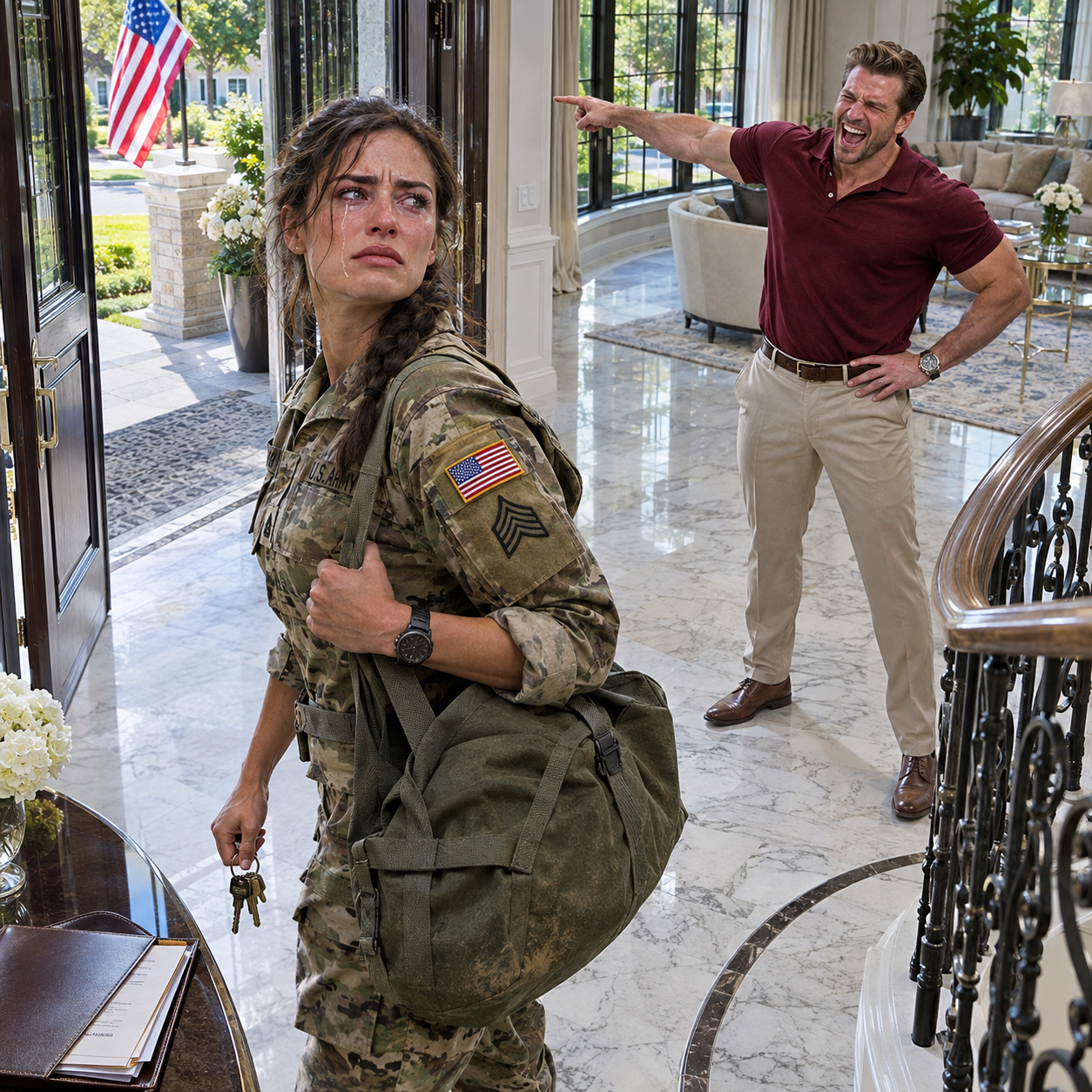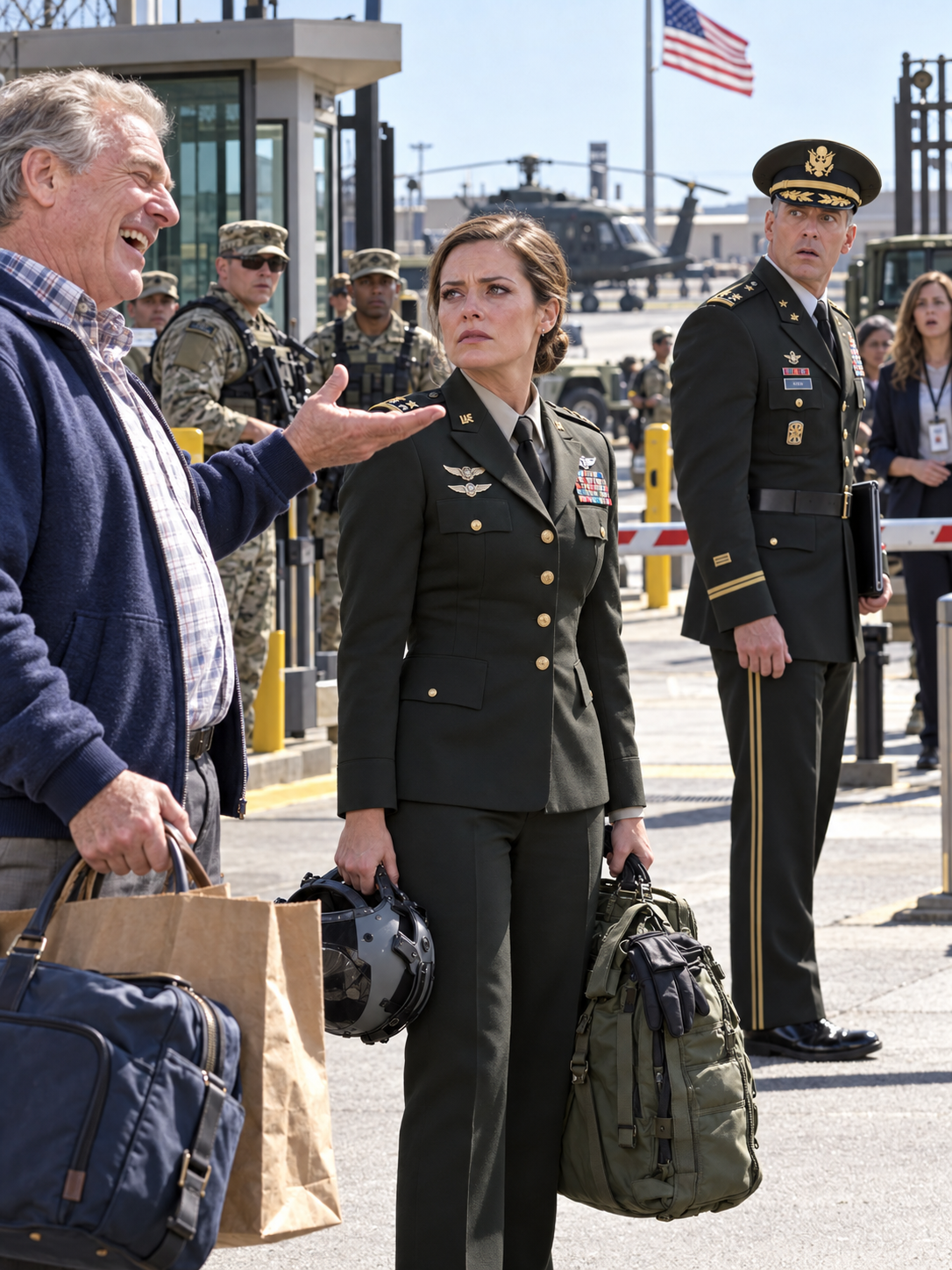
For 40 years, my father called me his runner, his good pair of hands, the daughter who carried bags and handled errands without complaint. I let him, even after I became an Army officer and learned to fly toward wounded soldiers when everyone else was trying to get away. Then one morning at a military gate, Dad laughed and called me his “little lap dog” in front of everyone. A colonel heard him, turned around, and went completely still.
### Part 1
The garage always smelled like cold metal, motor oil, and coffee that had been sitting too long in my father’s dented thermos.
I was eleven the first time I understood that being useful could feel almost exactly like being loved.
Dad was under his old pickup with both boots sticking out from beneath the bumper. I lay beside him on the freezing concrete, holding a work light in one hand while the socket set sat open against my knee.
“Ten millimeter.”
I handed it over before he finished the sentence.
“Rag.”
Already in my other hand.
Dad gave a satisfied grunt as a rusted bolt finally moved.
“You’re my right hand, Mara.”
My name is Mara Whitaker, and I carried that sentence around for years like something precious.
My father, Grant Whitaker, had spent most of his adult life in the Army. He had risen through the enlisted ranks the hard way, and even after retirement, he judged people by what they could visibly control. A platoon. A truck. A workshop. A frightened room.
Or a daughter who knew which wrench came next.
He wasn’t a monster. That would have made everything simpler.
Dad could be funny. Loyal. Generous with neighbors. Fiercely protective of my mother, Evelyn. He taught my older brother Caleb and me how to change a tire before either of us could legally drive.
But Dad liked the world divided into shapes he understood.
Caleb was his son.
Mom was his wife.
And I was his helper.
When I was fifteen, our furnace died during a January cold snap while Dad was away. The house became so cold that Mom wore her winter coat inside.
I took the manual downstairs.
Three hours later, the heat came back on.
When Dad returned, Mom met him at the door practically glowing.
“Mara fixed the furnace.”
Dad went downstairs, inspected everything, then came back up.
“She did a good job following the manual.”
That was it.
Not, “My fifteen-year-old diagnosed a mechanical problem under pressure.”
Not, “She kept her head.”
I had followed instructions correctly.
That version of me fit his world.
Three years later, I told him I wanted to fly.
We were eating meatloaf at the kitchen table. I had rehearsed the sentence all afternoon.
“I’m going Army aviation.”
Dad actually chuckled.
“The Army needs people who carry the load too, Mara. Nothing wrong with being a good pair of hands.”
“I know.”
“Don’t get ideas above your hands.”
Mom looked at him.
I looked at my plate.
Then I said, “Okay, Dad.”
The next morning, I continued with my plans anyway.
That became the pattern of my adult life.
I stopped arguing with him and simply climbed.
I earned my commission at twenty-two. Mom cried through half the ceremony.
Dad shook my hand afterward.
“Well, look at that,” he said.
For one stupid second, my chest opened.
Then he added, “Guess I’m moving the garden shed myself now.”
I laughed.
Everyone did.
I was good at laughing when something hurt.
Flight school came next.
The first time I sat in a Black Hawk and felt the vibration through the frame, I knew I had found the place where the world made sense to me.
Later I volunteered for medical evacuation work.
That meant flying toward people having the worst day of their lives.
You learned to read weather, terrain, voices over the radio, the tremor beneath someone’s calm words.
You learned that panic wastes time.
You learned that steady hands matter most when everyone else has stopped believing there is a way out.
My father had helped make me good at that.
The irony took me years to appreciate.
He had raised me to anticipate needs so well that I became extraordinary at it.
I knew what frightened people needed before they asked.
I knew when a crew member’s silence meant concentration and when it meant trouble.
I knew how to bring order into confusion.
But at home, that same instinct kept me trapped.
Dad needed a ride? I drove.
The gutters needed cleaning? I climbed the ladder.
A fence board cracked? I brought tools.
Caleb once joked that I could command soldiers all week and still show up Saturday morning because Dad needed somebody to hold the other end of a tape measure.
He meant it affectionately.
That almost made it worse.
By 2010, I was twenty-seven and a captain.
That winter, I was deployed far from home in a place I rarely discuss.
One afternoon, a call came in for wounded personnel trapped in terrain no aircraft crew wanted to linger over.
Eleven men needed extraction.
We went.
I remember dust turning the air brown.
I remember the aircraft shuddering.
I remember voices in my headset coming too quickly.
I remember forcing my breathing slower while we held position long enough for every wounded man to be loaded.
All eleven came out alive.
A few days later, I called home from a plywood building using a connection that cut every few sentences.
Dad answered.
For reasons I still can’t explain, I wanted him to hear something in my voice.
Maybe I wanted him to ask, “What have you been doing over there?”
Instead, he said, “When are you coming home?”
“I don’t know yet.”
“Gutters need doing before winter.”
I stared at the wall.
Three days earlier, eleven men had depended on my crew keeping an aircraft steady in a place that wanted us gone.
My father was asking about leaves in a gutter.
“Okay,” I said.
Then he told me about a problem with the shed.
When the call ended, I remained sitting there with the phone in my hand.
That was the first night I allowed myself to think something I had spent years avoiding.
Maybe Dad didn’t misunderstand me.
Maybe he had simply never been interested enough to find out.
I still cleaned the gutters when I came home.
Of course I did.
Years passed in deployments, moves, promotions, training exercises, funerals, homecomings, and family dinners where my career somehow remained a vague “helicopter thing.”
I made major.
Dad told relatives I “handled paperwork.”
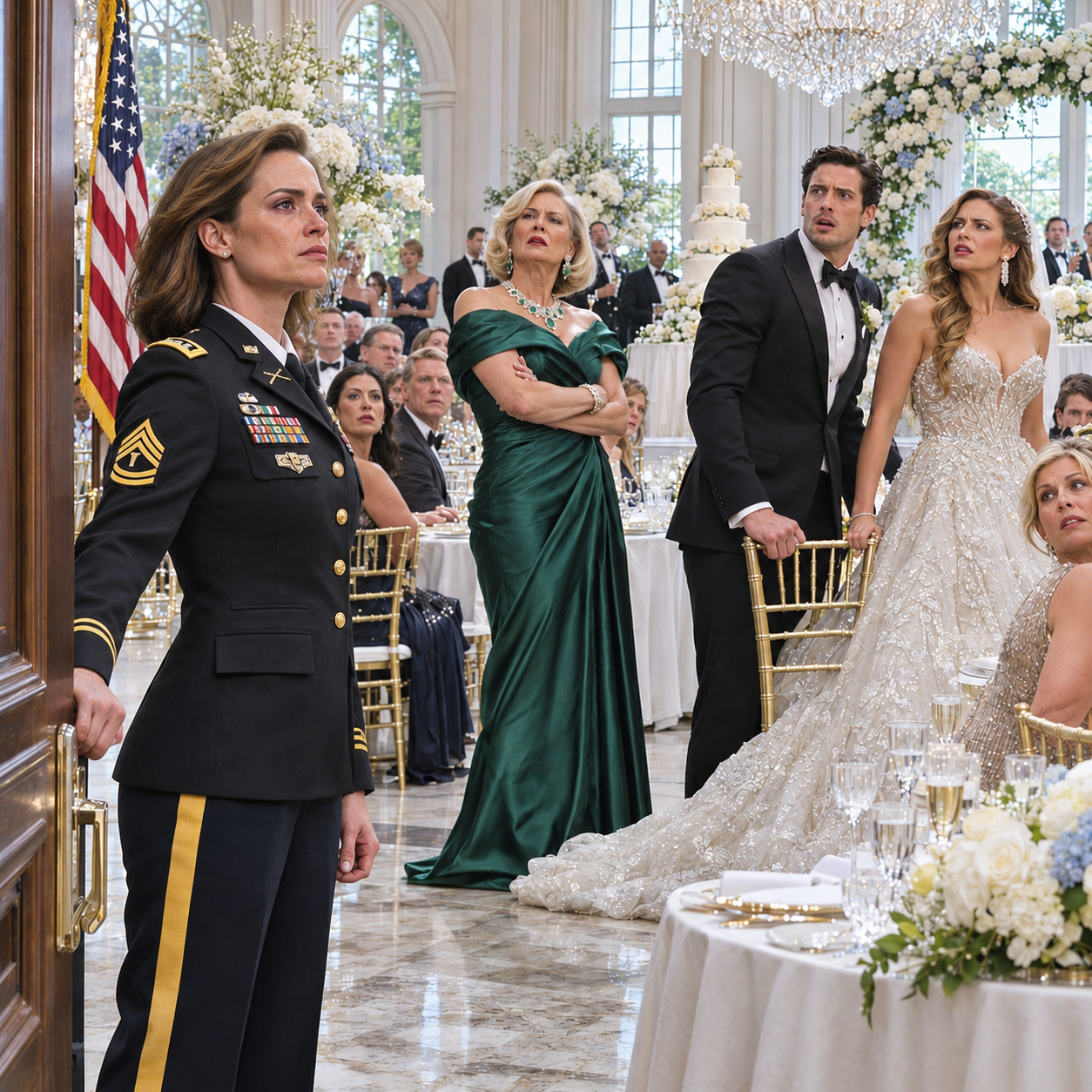
At Caleb’s wedding, I crossed half the country after a training rotation, changed clothes in a gas station restroom, and reached the church with my hair still damp.
During his toast, Dad raised his glass toward me.
“And Mara made it. She’s always flying somewhere doing those helicopter errands.”
Everyone laughed.
I raised my champagne too.
That old practiced smile appeared automatically.
Later, Caleb found me outside near the parked cars.
“You know Dad’s proud of you.”
I watched a moth batter itself against a parking-lot light.
“He has a strange way of showing it.”
“He doesn’t know how to say things.”
For years, I accepted that explanation.
Then my mother became ill.
I was thirty-nine by then, a lieutenant colonel, and I came home immediately.
For two weeks I coordinated appointments, read charts, asked questions, sat beside Mom in the middle of the night, and kept Dad from unraveling.
One afternoon, a nurse asked who should be called if anything changed.
Dad pointed at me.
“Mara’s my runner. Best one I ever had. She’ll fetch whatever you need.”
The nurse glanced at me.
I smiled tightly.
Later, I heard Dad on the phone with my aunt.
“Mara? She’s my little lap dog. Always has been. Good kid. Best pair of hands in the family.”
Lap dog.
I stood outside the hospital room holding two cups of coffee and felt something inside me finally stop reaching.
Not break.
Stop reaching.
For thirty-nine years, I had thought there might be some achievement large enough to force my father to revise me.
Suddenly I understood there wasn’t.
A promotion wouldn’t do it.
A command wouldn’t.
A medal wouldn’t.
Saving eleven lives hadn’t.
The problem wasn’t the size of what I accomplished.
The problem was the size of the box Dad had built for me before I was old enough to understand I was inside it.
That night, while Mom slept, I made myself a promise.
I would keep loving my father.
I would even keep helping him.
But I was done auditioning for the right to be seen.
I had no idea that four years later, at an ordinary Army gate, someone from that valley would hear my father call me his lap dog.
And unlike me, he would not let the words pass quietly.
### Part 2
By the spring of 2026, I was forty-three and commanding a battalion.
My family knew almost none of what that meant.
That was partly Dad’s fault.
Eventually, it became partly mine.
I had grown tired of explaining myself to people committed to misunderstanding me, so I simply stopped giving them material.
Mom knew I was doing well.
Caleb knew I had been promoted several times.
Dad knew I wore a uniform and flew aircraft.
Beyond that, his mental picture of me had barely changed since the garage.
Dad had retired from active service years earlier, but he had taken a part-time facilities job on an Army installation near my parents’ home.
He loved that job.
He loved driving through the gate.
Loved being around soldiers.
Loved when someone recognized him.
It gave him a small piece of the world he understood best.
I was home on leave when his truck went into the shop.
“Mara, give me a ride tomorrow?”
“Sure.”
Helping him had never been the problem.
The meaning he assigned to my help was.
That morning was bright and clear. Hard white sunlight flashed across windshields while we drove toward the installation.
I was already in uniform because I planned to visit my own headquarters later.
Dad talked almost continuously.
“The guards all know me.”
“I’m sure.”
“Sergeant on mornings usually waves me right through.”
“That’s nice.”
“You’ll see.”
There was something almost boyish about him near an Army post, and despite everything, I felt the old tenderness.
That was the difficult truth.
Boundaries do not automatically kill love.
Sometimes you still love the person who taught you why you need boundaries.
The line at the entry control point was long.
Cars crawled forward a few feet at a time.
Outside, freshly cut grass mixed with exhaust. A young sergeant worked the lane, checking identification with practiced efficiency.
Several soldiers stood near the guard building.
One officer waited farther back beside the curb.
I noticed his rank before his face.
Colonel.
Dad was drumming his fingers against the passenger door.
“See? Busy morning.”
I pulled out my identification.
Our turn came.
The sergeant stepped toward my window.
“Good morning, ma’am. IDs, please.”
Before I could answer, Dad leaned across the center console.
He grinned like he was about to tell an old family joke.
“Don’t mind her.”
My stomach tightened.
He pointed his thumb toward me.
“She just carries my bags. My little lap dog.”
He said it loudly.
Not just to the guard.
To the world.
The sergeant’s expression changed instantly.
His eyes dropped to my uniform.
Then to my rank.
Then back to my father.
Behind us, I could hear an engine idling.
A car door closed somewhere.
For years, I had imagined that if Dad humiliated me publicly enough, I would finally explode.
Instead, I felt strangely calm.
“Dad,” I said, “let the sergeant do his job.”
He laughed as though I were embarrassed by affection.
Then someone behind the guard said, “Excuse me.”
The voice was low.
Older than I remembered.
But something about it scraped against a locked door in my memory.
I turned.
The colonel who had been waiting near the curb was staring directly at me.
He took one step.
Stopped.
His entire face changed.
I knew that expression.
Recognition moving through the body before the mind catches up.
He walked toward the car.
Dad immediately straightened.
A colonel approaching him was something he understood.
He lifted one hand politely.
“Nothing to see here, sir.”
The colonel kept coming.
Dad gave a little chuckle.
“Just giving my daughter a hard time.”
The colonel stopped beside my door.
He barely looked at Dad.
His eyes remained fixed on me.
For a moment, neither of us spoke.
Then he said, very quietly, “Dustoff Three-One?”
The name hit me harder than “lap dog” had.
I saw brown air.
A valley.
A young captain on a stretcher, pale beneath the dust.
I looked harder at the man standing outside my vehicle.
His hair was grayer.
His face was heavier.
But the eyes were the same.
“Mercer?”
Colonel Daniel Mercer came to attention.
At my car.
At the gate.
In front of the young sergeant.
In front of my father.
“Ma’am,” he said, “I’ve wanted to see you again for sixteen years.”
The sergeant snapped straighter.
Dad’s hand slowly lowered onto his knee.
Colonel Mercer looked at me as if everyone else had disappeared.
“I was one of the eleven.”
“I remember.”
His jaw tightened.
“You came back for us when everybody said the landing zone was impossible.”
I shook my head slightly.
“My crew came back.”
“You were flying.”
“Yes.”
“My medic said we had minutes.”
Dad turned toward me.
I could feel him staring.
Mercer continued.
“I never got to thank you properly.”
“You survived. That was enough.”
For a second, he looked young again.
Not the full colonel standing in front of me.
The wounded captain I had last seen being carried into my aircraft.
“I have a wife now,” he said. “Three kids.”
My throat tightened.
“That’s good to hear.”
“My oldest is fifteen.”
I smiled.
“Then you definitely owe me nothing. Sounds like life collected plenty of interest.”
He laughed once, but his eyes shone.
Dad still had not moved.
The sergeant checked my identification with suddenly meticulous care.
“Thank you, ma’am.”
We were waved through.
Colonel Mercer stepped back, saluted, and watched our car move past.
I drove.
Dad stared through the windshield.
We passed the gate buildings.
Then a maintenance yard.
Then rows of low brick offices.
Almost a mile went by.
Dad cleared his throat.
Nothing came out.
He tried again.
“That colonel.”
I waited.
“How does he know you?”
For forty years, I would have softened my answer.
That morning, I didn’t.
“His unit was pinned down in 2010. They had wounded men they couldn’t evacuate by ground.”
Dad looked at me.
“We went in.”
“You?”
“My crew.”
“You flew it?”
“Yes.”
He turned toward the windshield again.
“He said eleven.”
“There were eleven.”
Dad’s fingers stopped moving.
After a while, he asked, “Was it bad?”
“Yes.”
“How bad?”
I thought about dust hammering against the windshield. About the warning tones. About forcing myself not to look at the damaged places on the men being loaded behind us.
“Bad enough.”
Dad swallowed.
Then came the real question.
“Have you done that more than once?”
There was fear underneath his voice.
Not wounded pride.
Fear.
For the first time, I heard a father asking how close his child had been to dying while he had been complaining about gutters.
“Enough times,” I said.
He turned toward me.
I kept driving.
“Why didn’t you tell me?”
That question almost made me laugh.
Instead, I tightened my hands around the wheel.
“I did tell you I flew medevac.”
“That’s not the same as telling me that.”
“You never asked what it meant.”
Dad flinched as though I had raised my voice.
I hadn’t.
We reached the building where he worked.
I stopped beside the curb.
He remained seated.
“You really command a battalion?”
“Yes.”
He stared at the insignia centered on my chest.
I watched him recognize something that had been in front of him all morning.
Maybe all my life.
Then he whispered, “Jesus, Mara.”
I looked at him.
“No, Dad. Just Mara.”
He got out of the car without another word.
I drove away feeling no victory at all.
Only exhaustion.
Because after spending your entire life carrying a weight, sometimes the first feeling when you put it down isn’t relief.
Sometimes it’s realizing how badly your arms hurt.
And I had just decided I was never picking that weight up again.
### Part 3
The first person I called was Major Tessa Monroe, my operations officer and one of my closest friends.
She knew enough about my family to understand why the gate mattered.
When I finished telling her what happened, she was silent.
Then she said, “Mara, you know you didn’t hide your life from him, right?”
I leaned back in my chair.
“I stopped explaining.”
“That happened after years of him refusing to listen.”
I rubbed my forehead.
“That’s different.”
“Yes,” she said. “Very different.”
I told her something I wasn’t proud of.
For one second at that gate, when Colonel Mercer came to attention and Dad’s face went blank, I had enjoyed it.
Not Mercer’s gratitude.
Dad’s humiliation.
Tessa snorted softly.
“You spent forty years being introduced as a household appliance. You’re allowed one ugly second.”
“That doesn’t sound very noble.”
“You’re not applying for sainthood.”
I laughed despite myself.
Then she became serious.
“You know what you do now?”
“What?”
“You stop auditioning.”
The sentence silenced me.
Tessa continued.
“You keep showing up for people because that’s who you are. But you stop performing for someone who decided your role before you were old enough to choose it.”
That night, I opened a drawer I rarely touched.
Inside was a citation from years earlier.
Official language.
Careful wording.
A few paragraphs reducing one of the most frightening afternoons of my life to something clean enough to print.
I had never shown it to Dad.
For years, I thought that meant I was humble.
Sitting there alone, I realized there had been another reason.
Some part of me feared that if I showed him the biggest proof I had and he still shrugged, I would lose the last excuse for him.
I put the citation back.
I didn’t need it anymore.
The following Sunday, I went to my parents’ house for dinner.
The house smelled of roast beef and furniture polish.
Mom looked stronger than she had during her illness.
Caleb was already there.
Dad sat in his usual chair.
Within ten minutes, he handed me a folded sheet of paper.
“There are a couple things.”
I opened it.
Fence board.
Shed hinge.
A gutter over the garage.
The entire architecture of my childhood written in blue ink.
I read it.
Then I placed the list on the arm of his chair.
“I’ll help with the fence next weekend.”
Dad frowned.
“What about the rest?”
“I’m not doing the rest.”
He looked surprised.
“I need them done.”
“I heard you.”
Caleb looked at his plate.
Dad sat forward.
“What exactly is this about?”
I kept my voice calm.
“You called me your lap dog at the gate.”
“Oh, for God’s sake.”
“And at Mom’s hospital.”
“It’s a joke.”
“And at reunions. Weddings. Dinners. For years.”
“You know what I mean when I say it.”
“Yes,” I said. “I finally do.”
His face hardened.
“The Army give you a big head?”
“No.”
“You used to be easy.”
“I used to be quiet. That’s not the same thing.”
Dad’s jaw set.
I knew that look.
As a child, it could make me apologize for things I hadn’t done.
At forty-three, it only made me sad.
“You think some rank makes you too important for this family?”
“No. I think being your daughter means I can help you without being treated like I exist to serve you.”
Caleb finally spoke.
“Come on, Mara. You know how Dad is.”
I turned toward him.
“I do. That’s exactly why this has lasted forty years.”
“Mara—”
“No. Everybody says, ‘You know how Dad is,’ and what that has always meant is, ‘Mara should absorb it so Dad doesn’t have to change.’”
Caleb went quiet.
Dad looked furious.
I continued.
“I love you. I’m still your daughter. I’ll still help when I choose to help. But I’m not your runner, your errand girl, or your lap dog. You don’t introduce me that way. You don’t joke about me that way. That’s done.”
Dad stared at me.
“You’re serious.”
“Yes.”
“What do you want? An apology?”
“No.”
That answer confused him more than anger would have.
“I want you to stop.”
Mom had been standing near the counter.
She walked over and placed one hand against my back.
Dad noticed.
His expression changed.
Not surrender.
Isolation.
For once, the rest of us were not automatically reorganizing ourselves around his comfort.
He looked away first.
Dinner was quiet.
When I left, Mom followed me to the front door.
“I saw it,” she whispered.
I turned.
“All these years. I saw what he did.”
My throat tightened.
“I should have stopped it more often.”
I looked at my mother, this woman who had spent decades managing Dad’s certainty so the rest of us could breathe around it.
“That means more than you think.”
She hugged me.
Dad did not call that week.
Neither did I.
For years, silence from him would have sent me scrambling to repair whatever distance existed.
This time, I let it remain his.
A strange thing happened.
Nothing collapsed.
My career continued.
My friendships continued.
The sun came up every morning without Dad approving of me.
The first boundary felt like stepping off a cliff only because I had never tested whether there was actually ground underneath.
There was.
Then Mom called.
“Your father’s been asking questions.”
“What kind?”
“About medevac crews.”
I sat up.
“Why?”
“I think you know why.”
Apparently Dad had gone to an old sergeant major on the installation and asked what crews like mine actually did.
The man told him.
No family euphemisms.
No “helicopter errands.”
He explained what it meant to fly toward wounded personnel when conditions were bad enough that everyone else was being told to stay clear.
Dad asked about decorations.
He asked about command.
He asked about the 2010 operation.
Then, according to Mom, he went quiet.
“What did he say?” I asked.
She hesitated.
“He said, ‘I think I’ve been wrong about my kid for a long time.’”
I closed my eyes.
That should have satisfied something in me.
It didn’t.
Because recognizing harm and repairing harm are two different jobs.
Dad had finally begun the first.
I wasn’t going to do the second for him.
A few days later, Mom said she found him at the kitchen table reading printed pages about the old extraction.
“He read them three times,” she said.
I pictured his finger traveling beneath each line the way it had when he read repair manuals.
A man who trusted facts finally confronting facts he could not fit into the story he had spent forty years telling.
I did not call him.
I did not send the citation.
I did not rescue him from what he was feeling.
For once, Dad had to carry something himself.
The next Sunday, I stopped by the house.
Dad said almost nothing.
When I left, the vibration in my steering wheel was gone.
I walked back inside.
“Did you work on my car?”
Dad kept his eyes on the television.
“Front end needed attention.”
“You could’ve asked.”
He shrugged.
“You’ve got enough to do.”
I stood there for a second.
It was such a small sentence.
From anyone else, it would have meant nothing.
From my father, it sounded like the first brick coming out of a wall.
But I had spent too many years confusing small kindnesses with complete change.
So I thanked him.
And I waited to see whether the new version of Grant Whitaker would survive when other people were watching.
### Part 4
Over the next several months, Dad changed in inches.
An aunt asked at dinner, “Mara still flying those helicopters?”
Usually Dad would have answered before I opened my mouth.
This time he looked at me.
“Ask her.”
Three words.
That was all.
I answered for myself.
Another afternoon, Dad called while I was driving.
“Could you pick up—”
He stopped.
“What?”
“Nothing. I’ll get it.”
“Dad, what do you need?”
“You’ve got your own things to do.”
I nearly missed my turn.
For decades, my time had been treated like a family utility—available when needed.
Now Dad was acknowledging that my life continued when he wasn’t looking at it.
I noticed.
But I didn’t reward every improvement by pretending the past had disappeared.
Then Mom called one evening.
“Your father wants to visit your headquarters.”
That surprised me.
Dad had spent his life around the Army but never inside my professional world.
“Did he say why?”
“No.”
I thought about it.
“Okay.”
He came two weeks later.
For once, I did not pick him up.
He drove himself.
He signed in like every other visitor and wore the temporary badge they gave him.
When I came downstairs, he was standing beside the front desk with his hands clasped behind his back.
He looked strangely uncomfortable.
“Ready?” I asked.
“Whenever you are.”
I walked him through the operations floor.
No ceremony.
No lineup.
I had told no one to behave differently.
I wanted him to see reality, not another performance designed to convince him.
Aircraft status boards covered one wall.
Phones rang.
People crossed the floor carrying folders and tablets.
A warrant officer stepped toward me.
“Ma’am, maintenance pushed aircraft six back two hours, but we can cover the afternoon requirement with three.”
“Any effect on tomorrow?”
“No, ma’am.”
“Good. Keep me updated.”
“Yes, ma’am.”
Dad stood a few feet behind me.
The warrant officer gave him a courteous nod and returned to work.
I watched Dad’s face.
To everyone in that room, my authority was ordinary.
Nobody seemed impressed that I was in command.
Nobody laughed.
Nobody questioned it.
I belonged there so completely that it required no explanation.
That seemed to affect Dad more than Colonel Mercer’s salute had.
We continued down the hall.
A senior sergeant approached from the opposite direction.
“Colonel.”
“Sergeant.”
He glanced at Dad.
“This your father?”
“It is.”
The sergeant offered his hand.
“Sir.”
Dad shook it.
Then the sergeant smiled.
“Your daughter flew the aircraft that went after my cousin’s platoon years ago. Half the guys I came up with had heard her name before I ever worked for her.”
Dad’s eyes moved toward me.
The sergeant continued casually.
“Good to meet you, sir.”
Then he walked away because he had somewhere to be.
Dad remained frozen.
“Half the guys?” he asked.
I shrugged.
“Soldiers tell stories.”
He gave me an irritated look.
“You always do that.”
“Do what?”
“Make the thing smaller.”
I almost laughed.
“Wonder where I learned that.”
Dad looked away.
We ended near a large window overlooking the flight line.
Aircraft sat in clean rows beneath a pale sky.
Dad rested both hands on the railing.
For several minutes, we watched crews moving below.
Then he spoke.
“I called you my hands because I knew what to do with your hands.”
I said nothing.
He stared through the glass.
“You’d hand me a wrench before I asked. Fix things. Carry things. Show up.”
His voice became rougher.
“I thought that was the part of you I understood.”
I waited.
“When you started flying, you went somewhere I couldn’t follow.”
His jaw tightened.
“I was your father. I was supposed to know more than you.”
There it was.
Not the whole truth.
Enough of it.
“And then you kept climbing,” he said. “Every promotion made it worse.”
“Why?”
“Because if I admitted what you were doing was real, I had to admit I didn’t understand your life anymore.”
Below us, a crew crossed the pavement.
Dad continued.
“So I made it smaller.”
I looked at him.
“Helicopter errands.”
He nodded.
“Paperwork.”
Another nod.
“Runner.”
His eyes closed.
“Lap dog.”
The words sounded ugly in his own mouth now.
“I kept pulling you back to the shed because the shed was where I still knew how to be your father.”
My anger shifted inside me.
Not disappearing.
Changing shape.
Dad looked down at his hands.
“I was wrong.”
I had never heard those words from him without a qualification attached.
Then he looked at me.
“I’m sorry, Mara.”
I breathed out slowly.
He swallowed.
“I’m sorry, Colonel.”
For years, I had imagined an apology like that.
In the imaginary version, I cried.
We hugged.
Something magical happened.
The past closed.
Real life was quieter.
“Thank you,” I said.
His face fell slightly.
Maybe he expected more.
I did not give it.
“I mean that,” I continued. “Thank you for saying it.”
“Can you forgive me?”
There it was.
The question I had known might come.
I looked through the glass again.
“I don’t know.”
Dad blinked.
“Mara—”
“I’m not saying never. I’m saying forty years doesn’t disappear because you finally found the right sentence.”
He absorbed that.
I continued.
“I believe your apology. But I’m not going back to the relationship we had. That relationship required me to make myself smaller so you could stay comfortable.”
He nodded slowly.
“I understand.”
“I hope you do.”
We stood there together.
For once, I didn’t manage his feelings.
I didn’t tell him he had been a good father overall.
I didn’t balance the hurt with memories of ball games, Christmas mornings, or the garage.
Those memories existed.
So did the damage.
Both could be true without one canceling the other.
Before Dad left, we stopped near the lobby.
He looked back toward the operations floor.
“This is all yours?”
“No.”
He frowned.
I smiled.
“It belongs to everyone working in there. I’m just responsible for it.”
He gave a quiet laugh.
“That sounds like you.”
“What does?”
“Making command sound like carrying something.”
The old joke was close enough that I felt my shoulders tense.
He noticed.
His smile vanished.
“Sorry.”
That mattered almost as much as the apology.
He had seen the reaction before I explained it.
Maybe he really was learning.
But the final test came at my parents’ forty-fifth anniversary, with relatives packed into their house and decades of old family habits waiting beneath the noise.
And one uncle who had never learned there were jokes I no longer found funny.
### Part 5
My parents’ forty-fifth anniversary filled their house with cousins, aunts, uncles, old neighbors, and enough food to supply a small unit.
Mom sat in her favorite chair looking healthier than she had in years.
Dad moved through the crowd refilling glasses and telling stories.
I watched him more closely than I wanted to admit.
Apologies are easy in private.
Identity is harder in public.
A person can mean every word in a quiet room and still fall backward when surrounded by people who expect the old version.
I wasn’t afraid exactly.
I was curious.
Which father had come to the party?
For once, I did not automatically make myself useful.
I talked to cousins.
I sat with Mom.
I let empty plates remain empty until someone else noticed.
That alone felt revolutionary.
Then Uncle Ray raised an empty bottle from across the room.
“Mara!”
I looked over.
He grinned.
“Be a good runner and grab me another beer, would you?”
The room changed.
Only slightly.
But I felt it.
Caleb stopped mid-sentence.
Mom looked toward Dad.
Several relatives suddenly became interested in their plates.
Uncle Ray still had no idea what he had done.
I could have answered.
Before I did, Dad set down his own glass.
He walked across the room.
Not angry.
Not dramatic.
He stopped beside his brother.
“Get your own drink, Ray.”
Uncle Ray laughed.
“Oh, come on.”
Dad’s voice remained calm.
“She isn’t your runner.”
The room became completely still.
Ray glanced at me.
“Grant, I’m joking.”
“I know.”
Dad took the empty bottle from his hand and placed it on the table.
“And the joke’s over.”
Ray looked uncomfortable.
Dad continued.
“That woman is a lieutenant colonel in the United States Army. She’s carried people out of places you and I are lucky never to have seen.”
“Dad,” I said quietly.
He turned.
I expected him to keep talking for me.
Instead, he stopped.
That mattered.
Then he looked back at Ray.
“If you want to know what she does, ask her.”
And he walked away.
No speech.
No borrowed glory.
No turning my life into something that made him important.
He simply returned ownership of my story to me.
Later, Dad tapped a spoon against his glass for the anniversary toast.
Everyone gathered.
He said a few words about Mom.
He thanked people for coming.
Then he looked at me.
“Mara, would you say something?”
For most of my life, my father handed me jobs.
That night, he handed me the room.
I kept the toast short.
I spoke mostly about Mom.
About marriage.
About surviving illnesses and bad years.
About how sometimes the people we love can know us for decades and still have more to learn.
Dad watched without interrupting.
After the guests left, I carried two cups of coffee onto the back porch.
Dad was already outside.
I handed him one.
Then I laughed quietly.
“What?”
“I’m still handing you things.”
He looked at the coffee.
“For old time’s sake.”
We sat.
A lawn mower droned somewhere down the street.
The evening air smelled like wet grass.
For a while, neither of us spoke.
It reminded me of the garage when I was a child, except no tools lay between us.
Dad turned his mug slowly.
“I used to watch you hand me everything before I asked.”
“I remember.”
“You were fast.”
“I remember that too.”
He smiled slightly.
“I decided that was the best thing about you.”
The smile disappeared.
“My good pair of hands.”
I waited.
“I built a whole daughter out of that one thing.”
His voice lowered.
“I never wondered what those hands would do when I stopped giving them my work.”
Something tightened behind my ribs.
Dad stared at the yard.
“Tell me about the valley.”
I turned toward him.
“If you can.”
For sixteen years, he had never asked.
So I told him.
Not everything.
Some memories belong only to the people who were there.
But I told him about the call.
The dust.
The eleven men.
The decision to go in.
The long seconds on the ground.
The young captain who would become Colonel Daniel Mercer.
Dad listened without interrupting.
When I finished, he remained quiet.
Then he said, “I didn’t know.”
I looked at him.
“I know.”
He flinched slightly.
I did not rescue him from that either.
After a while, he asked, “Do you hate me?”
“No.”
“Do you forgive me?”
I considered lying.
An easy answer would have made the night prettier.
I was finished making things prettier at my own expense.
“Not completely.”
He nodded.
“I figured.”
“I love you.”
“I know.”
“But loving you doesn’t mean pretending it didn’t matter.”
“I know.”
“And I’m never going back to being the daughter who waits for you to approve of her.”
He looked at me then.
“I know that too.”
That was the closest thing to peace we were going to get.
And strangely, it was enough.
Dad and I did not become inseparable after that.
I did not start calling every night.
I did not hand him my medals or walk him through every mission he had ignored.
Some things had come too late.
There were years he could regret but never return.
There was trust he could rebuild but not demand.
I stopped measuring our relationship by whether he had suffered enough to balance what I suffered.
That would have kept me tied to him just as tightly as the old need for approval.
Instead, I built a life that did not require a verdict from my father.
I continued commanding.
I flew less as my responsibilities changed, though part of me still woke whenever rotor noise passed overhead.
I spent time with people who asked questions about my life because they genuinely wanted the answers.
I learned to accept help without immediately calculating what I owed in return.
Most importantly, I stopped confusing usefulness with love.
Dad kept changing in small ways.
He asked before assuming I was available.
He listened when I spoke.
When relatives asked what I did, he no longer answered for me.
Sometimes I saw the old instinct rise in him.
Sometimes he caught it.
Sometimes I had to remind him.
Repair was not a movie scene.
It was repetition.
One Thanksgiving, I arrived late because of work.
Dad opened the door.
For years his first sentence would have been, “Good, you’re here. I need help with something.”
Instead, he said, “You look tired.”
“I am.”
“Food’s warm. Sit down.”
I almost cried over mashed potatoes.
But I didn’t mistake that moment for repayment.
It was simply a better moment.
That was enough.
Colonel Mercer and I exchanged messages occasionally after the gate.
The last time we spoke, he sent me a photograph of his family.
His oldest stood almost as tall as he did.
I looked at those faces for a long time.
Sixteen years earlier, they had not existed.
That was the part of my career I treasured most.
Not the rank.
Not the ribbons.
Not the salutes.
Time.
Sometimes the thing you bring someone is more time.
Dad had spent decades thinking I carried bags.
He had not understood that sometimes I carried people toward the rest of their lives.
Maybe the strangest part was realizing I no longer needed him to understand that in order for it to be true.
The girl in the garage had believed love arrived when she guessed the right wrench.
The woman I became knew better.
I could love my father without serving as proof of his importance.
I could accept his apology without erasing what happened.
I could appreciate his change without rewarding him with the version of me he had already used up.
And I could help him because I wanted to, not because being useful was the price of belonging.
Months after the anniversary, Dad and I sat in the garage again.
His truck needed a minor repair.
He was beneath the front end.
I sat nearby drinking coffee.
His hand appeared from under the bumper.
For one second, old instinct took over.
I reached toward the socket set.
Then his hand stopped.
He slid himself out.
“What?” I asked.
Dad looked at the tools.
Then at me.
“I can get it.”
I smiled.
“I know.”
He picked up the socket himself.
I stayed in my chair.
Nothing terrible happened.
The truck still got fixed.
Dad was still my father.
I was still his daughter.
And for the first time in my life, neither of those facts required me to be his hands.
He had once built a small box with my name on it and spent forty years insisting it contained the whole truth.
I climbed out long before he noticed.
The gate only forced him to look up.
I’m grateful he eventually did.
But I no longer believe my freedom began when my father finally saw me.
It began when I stopped waiting for him to.
Because if someone decides your size before they know you, you do not owe them your whole life proving them wrong.
Climb anyway.
Build anyway.
Become whoever you were becoming before they handed you their smaller name.
And if they finally turn around one day and recognize you, they can meet you where you are.
You do not have to climb back down to make the reunion easier.
THE END!
Disclaimer: Our stories are inspired by real-life events but are carefully rewritten for entertainment. Any resemblance to actual people or situations is purely coincidental.