“She’s Bad Luck On My Boat,” The Lieutenant Said. Six SEALs Laughed. He Pointed At The Pier. “Off. Now.” I Stayed Seated. Forty Knots Out, The Master Chief At The Helm Glanced Back Once, Then Again. His Hand Went To The Throttles. “Sir. Sit Down. Right Now.”
At 4:30 in the morning, a young SEAL lieutenant pointed toward the pier and told me to get off his boat because women like me brought bad luck. Six men laughed, and I stayed seated because thirteen years earlier I had obeyed the same cruelty and regretted it ever since. Two hours later, in rough water miles offshore, the Master Chief looked back at my face, cut both engines, and did something that turned every man aboard silent. Three days after that, an email arrived from a man I had spent thirteen years trying to forget.
Part 1
“She’s bad luck on my boat.”
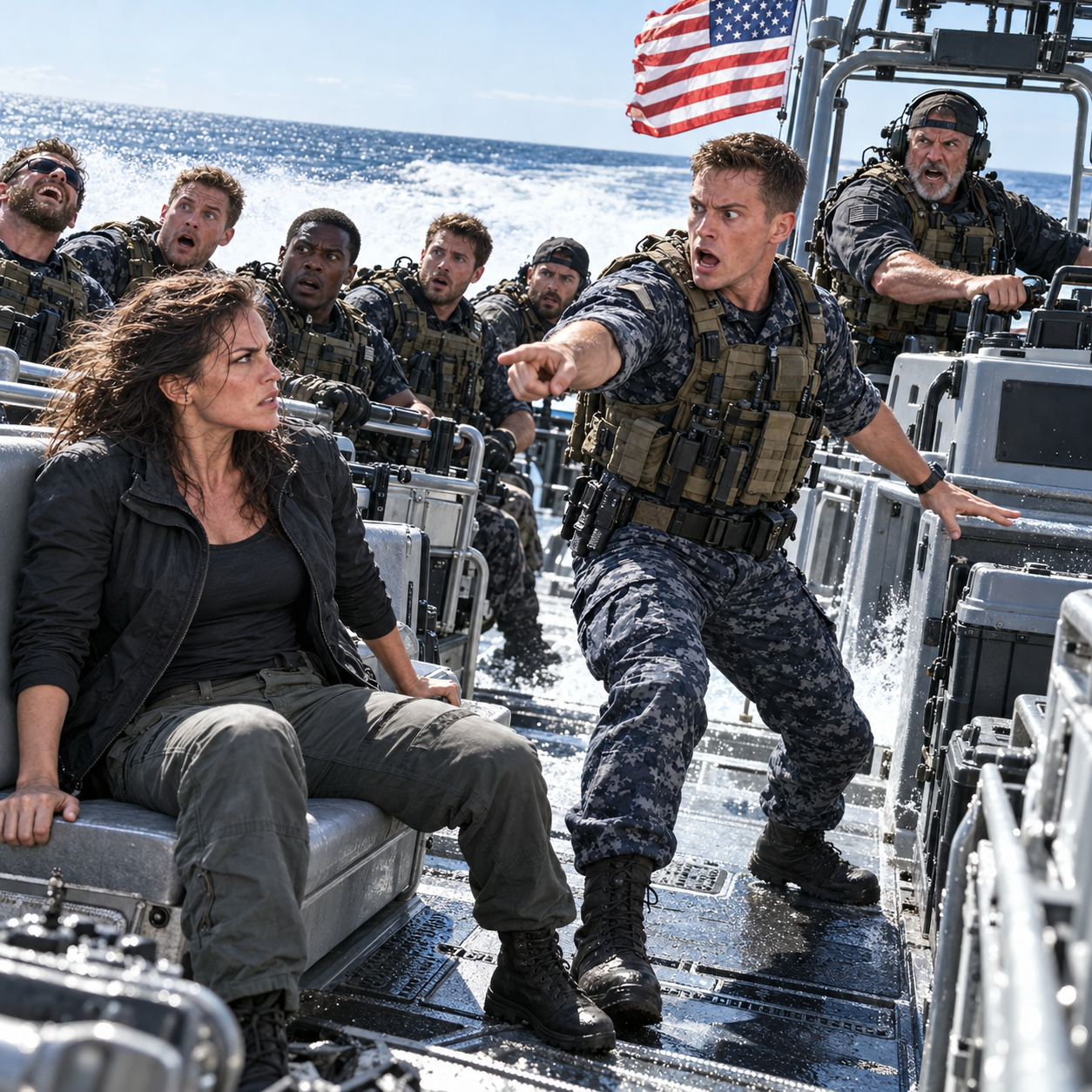
Lieutenant Owen Mercer said it to the men, not to me, which somehow made it worse. He was standing on the rubberized gunwale of an eleven-meter rigid-hull inflatable at 4:32 on a cold September morning, red deck lights washing his face in the color of an emergency exit sign, while six SEALs sat along the benches in dry suits and float coats with their equipment wedged between their boots.
A few of them laughed.
Not all of them meant it. Men laugh at stupid things before dawn when they’re cold, under-caffeinated, and waiting for somebody else to decide what kind of morning they’re going to have, but laughter doesn’t need conviction to do its work.
I sat on the stern deck with my back against the engine housing and my safety bag between my boots.
Mercer looked at me.
“Off.”
Beyond him, the pier glistened with rain. Security lamps threw oily yellow reflections across black planks, and beyond the breakwater the Pacific looked like somebody had rubbed charcoal over the horizon.
I did not move.
Lieutenant Mercer was twenty-seven, maybe twenty-eight, six feet tall, clean jaw, expensive confidence, the kind of young officer who looked exactly the way parents hoped their sons would look in uniform. His trident was still new enough that he checked whether people noticed it, although probably not consciously, and I could tell by the way he held himself that he was accustomed to rooms becoming slightly more attentive when he entered them.
“I’m not joking, Senior Chief,” he said.
“I know, sir.”
“Then get off.”
I looked toward the helm.
A large man with gray in his beard stood at the console with his back to us, checking gauges. He wore no name tape I could see and nothing about him advertised importance, which in the Navy usually means you should be careful because the people who no longer need to advertise it are often the ones running the room.
He never turned around.
“She’s on my manifest, sir.”
Mercer stiffened.
The Master Chief kept studying the console. “And we’re losing the tide. Sit down.”
For two long seconds, nothing moved except rain dripping off the canopy.
Mercer stepped down.
Then he noticed my helmet lying beside my bag, picked it up, and tossed it underhand toward me. It rolled once and bumped against the engine housing.
“Wear it,” he said. “If you’re staying.”
He was correct about the helmet.
He simply found a way to make safety sound like humiliation.
I put it on.
The lines came off, and the boat eased from the pier.
Chief Noah Kwan worked his way aft while we idled through the harbor. He was compact, fortyish, and had the permanent squint of a man who had spent half his career looking into sunlight bouncing off water.
He sat down beside me.
“I’m sorry, Senior.”
“Don’t be.”
“He shouldn’t have done that.”
“It’s his platoon.”
“It’s the Master Chief’s boat.”
I looked ahead.
Mercer stood beside the helm, staring toward the breakwater.
Kwan lowered his voice. “He’s got history.”
I almost smiled. “Everybody’s got history.”
“His father drove boats with Special Warfare in the late nineties. They took a civilian journalist out on a training ride, weather changed, boat rolled in the surf. Two men died.”
That made me look at him.
“Woman journalist,” Kwan said. “Mercer’s father apparently told the story every Thanksgiving. Said bringing her aboard had cursed the trip.”
“The reporter drove the boat?”
“No.”
“Made the weather?”
“No.”
“Ordered them through the surf?”
“No.”
Kwan rubbed his glove over one knee. “People don’t need logic when grief gives them something easier.”
That sentence followed me as he stood and returned forward.
People don’t need logic when grief gives them something easier.
I had heard a version of it before.
Not from him.
From myself.
We cleared the breakwater.
The Master Chief said, “Hold on.”
The throttles went forward.
The boat climbed, flattened, and began running close to forty knots.
A small military boat at forty knots is not transportation. It is a controlled argument between fiberglass, gravity, and the ocean, and the ocean wins often enough to keep everyone respectful.
The hull slammed.
Spray crossed the bow.
My knees absorbed each landing while my gloved hand stayed hooked around the safety line.
I was thirty-eight years old, twenty years into the Navy, and I had spent most of those years around things that could kill careless people very quickly. My name was Senior Chief Mara Keene, Explosive Ordnance Disposal, and officially that was everything the men aboard needed to know about me.
Range safety.
Explosive accountability.
Misfire procedures.
Somebody whose job was mostly saying, “Not yet.”
I liked being that woman.
Invisible expertise has a clean feeling to it.
Nobody asks what invisible expertise cost.
Nobody asks why a senior chief volunteers for the dull assignments everybody else tries to trade away.
Nobody asks why she hates ceremonies.
Nobody asks why the ribbon that should appear on certain uniforms is almost never there.
And nobody asks why she sometimes stands in front of a closet before leaving for work and looks at an old black dive bag without opening it.
The boat rose over another swell.
Mercer turned halfway around and said something to the man beside him. I couldn’t hear him over the engines, but I saw his chin move in my direction.
The petty officer did not laugh.
That mattered more than the laughter on the pier.
Ahead of me, one of the boat crewmen held a phone near the gunwale, filming the sunrise beginning behind us. The eastern sky had gone from black to iron gray, then to the thin bruised purple that appears just before daylight.
Another swell hit.
The boat dropped.
Green water came over the bow like a wall.
It struck my face hard enough to snap my head sideways.
My sunglasses vanished.
The neoprene hood beneath my helmet peeled backward, exposing my hair and face.
I lifted one hand to clear salt from my eyes.
The Master Chief glanced over his shoulder.
Then faced forward.
Then looked back again.
The second look lasted longer.
I knew that kind of look.
It was recognition fighting disbelief.
His eyes moved across my face as if matching it against something stored years ago in a place I couldn’t see.
My stomach dropped.
Not from the boat.
The Master Chief’s right hand went to the throttles.
“Lieutenant Mercer,” he said.
Mercer turned.
“Sit down.”
“Master Chief, what—”
“Sit down right now, sir.”
Something in the older man’s voice changed every face on that boat.
Mercer sat.
And without taking his eyes off me, the Master Chief pulled the throttles all the way back.
Part 2
Coming off plane that quickly feels like the ocean has grabbed your belt.
The bow dropped. Our wake caught the stern, lifted it, and rolled underneath us, and within seconds the violent hammering of forty knots became the slow slap of gray water against rubberized hulls.
Nobody spoke.
The engines idled.
A radio hissed somewhere near the bow.
Chief Kwan’s hand drifted toward his equipment because boats do not suddenly stop offshore without a reason, and every trained man aboard was searching for the emergency he had apparently missed.
The Master Chief stepped away from the console.
He pulled off his gloves.
That small gesture frightened me more than anything else.
He turned toward the stern.
Toward me.
The man was probably forty-eight, broad shouldered, weather carved into the corners of his eyes. Later I would learn his name was Master Chief Daniel Rourke, twenty-nine years in Special Warfare combatant craft, a man who had driven boats through darkness on rivers whose names still didn’t appear in polite conversations.
He planted his boots against the rocking deck.
Then he came to attention.
My chest tightened.
No.
Please don’t.
He raised his right hand to the edge of his helmet.
A perfect salute.
“Senior Chief Keene,” he said. “Good morning, ma’am.”
Nine faces turned toward me.
Lieutenant Mercer’s confusion arrived first.
Then irritation.
Then fear.
“Master Chief,” he said. “What are you doing?”
Rourke held the salute.
“What I was taught, sir.”
He finally looked at Mercer.
“And what you’re about to remember.”
Chief Kwan stood first.
I saw the moment he understood.
His mouth opened slightly, and his eyes widened in the way people look when a fact rearranges every conversation they’ve had with you. Then his boots came together and his hand rose.
The petty officer beside Mercer followed.
Then another.
Then both boat crewmen.
The sailor holding the phone seemed unsure whether to drop it, pocket it, or salute with it, so he awkwardly kept it in his left hand while raising his right.
Mercer stood last.
Slowly.
His face had lost its color.
He looked at me, and I watched memory replay behind his eyes: the pointing finger, the laughter, the word off, the helmet rolling across the deck.
He saluted.
I couldn’t stand.
My legs had gone strangely hollow.
So I remained seated on the wet stern deck and returned the salute from beneath my crooked helmet.
Thirteen years of avoiding this exact moment ended with salt water running down my face and my sunglasses somewhere at the bottom of the Pacific.
When their hands finally lowered, nobody knew what belonged next.
I did.
“We’re losing the tide, Master Chief.”
For half a second, Rourke’s mouth moved beneath his gray beard.
Maybe a smile.
“Aye, Senior Chief.”
He returned to the helm.
The engines rose.
We accelerated.
For the next ninety minutes, no one aboard said a word.
That silence gives me somewhere to begin explaining what they had recognized.
When I was twenty-three, I was an EOD technician attached to a Special Warfare platoon in southern Afghanistan. I was not the first woman to do dangerous work beside men, regardless of what television producers later wanted to call me, but I was the first woman most members of that platoon had ever worked beside in the field.
For four months, almost nobody cared.
They called me Keene.
They gave me the worst sleeping spot beside a generator, which was where the newest person belonged.
Chief Aaron Bell decided I could stay after I found a pressure device along a route that two men ahead of me had missed. That night he left a can of peaches on my cot without a note.
That was Aaron.
He hummed gospel songs while cleaning equipment and laughed loudly enough to reveal our position from another country.
Our interpreter was Farid Rahimi, a twenty-six-year-old Afghan who spoke four languages and claimed American coffee tasted like boiled roofing material. He taught me numbers in Pashto, mostly because he enjoyed correcting my pronunciation.
And there was Petty Officer Luke Dalton.
Twenty-five.
Wisconsin.
Bad jokes.
Loved his mother enough to complain about how often she called.
On September nineteenth, shortly after two in the morning, our platoon entered a compound where intelligence believed an explosives maker had been working.
Intelligence was correct.
He had also prepared for visitors.
Aaron was ten feet ahead of me.
Then he wasn’t.
I will not describe what the explosion did.
Some memories do not become more meaningful when you make strangers look at them.
I was knocked down.
I got up.
Aaron and Farid did not.
Luke and another operator were wounded beyond the safe path, inside an area seeded with buried pressure devices.
There was no fast solution.
There was only the slow one.
I got on my knees.
I used a probe.
Inches at a time.
You push into the dirt at a shallow angle and feel for anything that isn’t dirt.
You don’t hurry.
Especially when someone you care about is bleeding twenty yards away.
The first lane reached Luke.
Both his legs were badly injured, but he was conscious.
I got him onto my back.
“Talk, Keene,” he said.
“What?”
“Talk so I know you’re still walking.”
So I talked.
About Oregon.
My mother’s terrible garden.
My father’s ability to repair everything with hose clamps.
Aaron’s peaches.
Anything.
Luke kept answering until his voice became quieter.
I delivered him to the casualty point.
Then I went back.
I cleared toward the second man.
Carried him out.
He survived.
Luke died during evacuation.
That night became the reason for a citation I did not know anyone was writing.
But the moment that shaped the next thirteen years happened seven days later.
We were in a plywood-floored operations tent preparing for another mission when Petty Officer Eric Talbot—Aaron’s closest friend—looked toward our replacement chief and said, “Every time she’s around, somebody goes home in a box.”
The tent went still.
Talbot shook his head.
“I’m not saying she caused it. I’m saying she’s bad luck. I don’t want her on the next one.”
Nobody spoke.
That was the wound I could never explain.
Not his words.
Their silence.
They were grieving. I know that now.
They needed somewhere to place the impossible fact that Aaron and Farid and Luke were gone.
And I was different.
Female.
EOD.
Alive.
Grief needed a chair.
They chose me.
The next morning, I packed my kit, climbed into a truck, and left that platoon without making anyone defend what had happened.
For thirteen years, I told myself leaving had been professionalism.
On Lieutenant Mercer’s boat, I finally admitted the truth.
Leaving had also been surrender.
Part 3
Eighteen months after Afghanistan, a captain I had never met called my apartment and asked whether I was available to travel to Washington.
I thought I was in trouble.
Instead, he told me the President intended to present me with the Medal of Honor.
Even now, writing those words makes me want to explain them away.
Yes, that Medal of Honor.
The highest military award for valor.
The one most recipients never live long enough to wear.
I was twenty-five and mostly angry.
Angry because the citation turned one night into neat paragraphs. Angry because official language can make terror sound organized, and because every sentence beginning with “with complete disregard for her own safety” erased the fact that I had been terrified from the first explosion until sunrise.
Aaron’s mother attended.
Luke’s family attended.
Farid’s name was spoken by almost nobody.
Eric Talbot stood in the receiving line afterward.
He had flown in with former members of the platoon.
When he reached me, he shook my hand and looked at the floor.
He didn’t apologize.
I didn’t ask him to.
He moved on.
Then came the year I almost lost myself.
The Navy sent me to schools, legislatures, veterans’ events, sports stadiums, charity dinners, morning television programs, places where people asked what being a hero felt like.
I never found a useful answer.
The heroes I knew were dead.
A producer once asked whether I could describe carrying Luke with “more emotion” because viewers responded strongly to that section.
An older woman at a veterans’ luncheon once put a photograph of her dead Marine son in my hand and asked me simply to hold it because she believed it would mean something for someone like me to touch him.
I held that photograph beside a coffee urn while she cried.
Then I locked myself in a restroom stall and cried harder.
People were not cruel.
That was what made it difficult.
Most were kind.
But kindness from thousands of strangers can crush the shape out of a person when all of them need you to represent something different.
A year later, I asked the Navy for permission to disappear back into ordinary work.
No speeches unless necessary.
No introductions centered around the medal.
No ribbon on working uniforms when regulations didn’t require one.
Send me to ranges.
Send me to inventory explosive lockers.
Send me to teach technicians who thought safety briefs were boring.
Let Senior Chief Keene be Senior Chief Keene.
They agreed.
The actual medal went into a black dive bag in my apartment beside old swim fins and birthday cards.
For thirteen years, that arrangement worked.
Until Master Chief Rourke looked back on a boat.
We reached the island shortly after seven.
The demolition stores were unloaded, counted, signed for, then counted again because explosives have a wonderful way of making bureaucratic people suddenly enthusiastic about arithmetic.
Nobody mentioned the salute.
Nobody had to.
Lieutenant Mercer disappeared toward the range office.
Rourke found me beside one of the trucks.
Chief Kwan was with him.
“Senior Chief,” Rourke said. “You need to hear what happens next from me.”
I already knew.
“He’s getting a formal counseling entry.”
“Master Chief—”
“I’d write it if he’d treated any senior enlisted person that way aboard my boat. The medal doesn’t change the misconduct.”
Kwan looked uncomfortable.
“The platoon commander will hear about it too.”
“Why?”
“Because the video exists.”
I stared at him.
“What video?”
Kwan’s expression told me before he answered.
“Petty Officer Mason was recording the sunrise.”
Of course.
The young boat crewman with the phone.
“How much?”
“The engines coming down. The salute. Most of the boat.”
“Mercer’s comment?”
“Not the first one.”
That should have reassured me.
It didn’t.
Secrets kept for thirteen years rarely explode.
They leak.
One sailor showed another sailor.
A range technician recognized the strange sight of an entire boat saluting a woman seated in the stern.
Someone knew Rourke’s reputation.
Someone searched my name.
Someone found my official citation.
By evening, the video had escaped the island.
My phone found enough signal around nine that night to begin vibrating across the metal frame of my cot.
Messages.
Missed calls.
News alerts.
A screenshot of my own face in the old White House photograph placed beside a grainy frame from the boat.
One caption read: SEAL LT MOCKS WOMAN, FINDS OUT SHE’S MEDAL OF HONOR RECIPIENT.
I hated everything about that sentence.
At 9:26, Commander Elena Shaw called.
She had been my commanding officer for two years and possessed the rare ability to sound unimpressed by hurricanes.
“Congratulations,” she said. “You’re famous again.”
“I noticed.”
“Team commander called.”
“How bad?”
“He wants Mercer to apologize publicly on video. Uniform. Official page. Then he wants a photograph of you two shaking hands.”
“No.”
“Mara.”
“No dress whites. No medal. No handshake photograph.”
She sighed.
“I expected that.”
“And no public apology.”
“He’s trying to protect the command.”
“I’m not a public relations problem.”
“Today you are.”
I closed my eyes.
The generator outside the barracks trailer rattled like the one beside my cot in Afghanistan.
Everybody wanted a clean ending.
The internet wanted Mercer destroyed.
His command wanted contrition packaged into something shareable.
Rourke wanted discipline entered permanently into his file.
All of them believed they were offering me justice.
They were also offering me the easiest thing in the world.
A villain.
I knew too much about what happened when grief or embarrassment found an easy chair.
“Tell them no,” I said.
“To which part?”
“All of it.”
There was a pause.
“Even the counseling entry?”
“Especially that.”
“Mara, I need a reason.”
I looked through the tiny trailer window at darkness outside.
“Because tomorrow he’s running live demolition.”
“And?”
“I’m his safety.”
Another pause.
Longer this time.
“So?”
“So tomorrow I don’t want him afraid of my medal. I want him afraid of making a bad decision.”
Part 4
I found Lieutenant Mercer at six the next morning inside a converted shipping container that served as the range office.
He sat alone at a folding table with a whiteboard behind him and a coffee maker old enough to qualify for retirement benefits. His range card lay untouched in front of him.
He stood so quickly when I entered that his knee hit the table.
“Senior Chief.”
His hand started upward.
“Don’t.”
He froze.
“Not in here.”
He lowered it.
“Here I’m your safety.”
His eyes were bloodshot.
He hadn’t slept.
Neither had I.
“I need to apologize.”
“No, you need to brief your range.”
“I said something disgusting to you.”
“You did.”
“I threw your helmet.”
“You did.”
“I’ve already told my commander I’ll accept whatever—”
“There won’t be a video.”
His mouth closed.
“No photograph either.”
He stared.
“And Master Chief Rourke isn’t writing the counseling entry.”
“I don’t understand.”
“I know.”
I sat and pulled the range card toward me.
He remained standing.
“Sit down, Lieutenant.”
He sat.
“Yesterday every person above you offered me a different way to punish you. Your record, your reputation, your career, your face on a camera. I’m asking for your range card instead.”
“Why?”
Because thirteen years earlier nobody had stopped Eric Talbot from putting his grief on me.
Because I had punished myself ever since by disappearing.
Because destroying Mercer would be emotionally satisfying for twenty minutes and educational for nobody.
I did not say all that yet.
Instead I tapped the paper.
“First shot?”
“0900.”
“Net explosive weight?”
He answered.
“Minimum safe distance?”
Answered again.
“Misfire protocol?”
He hesitated half a second.
Not long.
But long enough for me to notice.
“Thirty-minute wait for suspected hang fire before approach.”
“Good.”
We worked forty minutes.
Mercer knew his material.
That complicated things, because incompetence would have made him easier to dismiss.
He was careful with calculations, knew his men’s assignments, corrected a clerical error before I mentioned it, and asked sensible questions when he wasn’t certain.
The problem wasn’t that he was stupid.
The problem was that smart people remain perfectly capable of carrying stupid beliefs when those beliefs were handed to them by someone they love.
When we finished, he folded his hands.
“My dad wasn’t a bad man.”
“I didn’t say he was.”
“Chief Kwan told you?”
“Enough.”
Mercer looked toward the closed container doors.
“He never blamed the reporter exactly.”
“He called women bad luck on boats.”
“Yeah.”
“That’s blaming the reporter with extra steps.”
His jaw tightened.
For a moment I expected defensiveness.
Instead he nodded.
“He lost two friends.”
“So did I.”
That stopped him.
I let it.
Then I stood.
“First shot at 0900.”
The first two detonations went perfectly.
The island range sat inside a basin surrounded by dry brown hills, hard earth scarred by years of controlled blasts. The bunker smelled like concrete dust, electrical tape, sweat, and burnt explosive residue.
Mercer ran both shots by the book.
His men watched him differently than they had on the boat.
Not with contempt.
With uncertainty.
They were waiting to learn what version of him would survive humiliation.
The third shot gave them their answer.
The charge had been prepared against a steel target almost two hundred yards away.
Everything checked.
Everybody withdrew.
Mercer stood behind the firing position.
“Fire in the hole.”
Three times.
He triggered the system.
Nothing happened.
On a demolition range, silence after a firing command is louder than any explosion.
One second.
Five.
Ten.
The steel target sat under the white morning sun.
Mercer checked his equipment.
Correctly.
Then I saw his shoulders change.
He removed his helmet from beside him.
I knew exactly what he was thinking.
Not today.
Not in front of her.
Not after yesterday.
He stepped toward the bunker entrance.
“Lieutenant.”
He stopped.
I kept my voice level.
“Nobody exits.”
His men looked between us.
Mercer looked toward the target.
“I can check—”
“No.”
“The connection at the box—”
“No.”
His face reddened.
For half a second the entire previous morning came back into the bunker with us.
Officer.
Woman.
Humiliation.
Audience.
Only now there was a potentially unstable explosive charge two hundred yards away.
“Misfire becomes a hang-fire assumption,” I said. “We wait the full thirty minutes.”
His fingers tightened around the helmet.
“Senior Chief—”
“Thirty minutes.”
We stared at each other.
Then something changed.
Not surrender.
Decision.
Mercer stepped backward.
He put his helmet down.
“Misfire at 0942,” he announced for the log. “Treat as hang fire. Approach no earlier than 1012.”
He sat.
I sat beside him.
The platoon moved toward the far end of the bunker and began talking quietly, granting him privacy without being asked.
Ten minutes passed.
Mercer stared at the strip of sunlight crossing the floor.
“My father said the reporter wanted photographs.”
I waited.
“He said weather was turning and she kept asking for another pass.”
“Was she in command?”
“No.”
“Driving?”
“No.”
“Then whoever stayed made the decision.”
He nodded.
“I figured that out when I was twelve.”
That surprised me.
He rubbed his palms together.
“I just never allowed myself to keep thinking after that.”
“Why?”
His laugh had no humor in it.
“Because then my dad had to be wrong.”
The sunlight moved another inch.
“He wasn’t driving either,” Mercer said. “But one of his closest friends was. Dad worshipped him. If the reporter wasn’t the reason they stayed…”
“Then somebody you loved made a bad call.”
He swallowed.
“Yeah.”
“And your family had to live with that.”
He looked at me.
“So they made her the chair.”
I said nothing.
He had remembered Kwan’s phrase or found the idea himself.
Either way, he understood.
“That’s what happened to you overseas.”
“Yes.”
“And yesterday I did it again.”
“Yes.”
His face twisted slightly.
“I’m sorry.”
This time I let him say it.
“I know.”
At exactly 1012, we stood.
We approached together.
The failure was painfully ordinary.
A bad connection.
Small.
Mechanical.
Fixable.
The kind of unimpressive problem that causes impressive funerals when impatient people decide rules are optional.
We repaired it.
Returned.
Repeated procedures.
The charge fired.
The steel plate rang across the basin.
Men cheered.
Mercer did not.
He wrote the time in the log.
Then looked at me.
“If I’d walked out at 0944…”
“You didn’t.”
“You stopped me.”
“No.”
He frowned.
“I told you to stop.”
“What’s the difference?”
“You chose to listen.”
Behind him, every member of his platoon had heard that answer.
And I realized something Eric Talbot’s platoon had never given me thirteen years earlier.
An argument.
Part 5
That evening Lieutenant Mercer wrote his own report.
Nobody ordered him to.
It was one page.
He described what he had said on the pier, the laughter, ordering me off the boat, throwing my helmet, and the fact that Master Chief Rourke had overruled him.
He did not mention my Medal of Honor.
Not once.
His final paragraph said his conduct had been disrespectful toward a senior enlisted specialist assigned under an approved training plan and had undermined his own authority by allowing personal superstition to influence professional judgment.
That mattered to me more than any apology video could have.
He sent it to his platoon commander and copied Rourke.
The Master Chief found me at the pier near sunset.
“Still think you’re letting him off easy.”
“Useful isn’t the same as easy.”
Rourke looked toward Mercer helping load equipment.
“You know how many young officers I’ve seen survive paperwork without learning a damn thing?”
“Probably a lot.”
“Plenty.”
“And how many remember sitting thirty minutes inside a bunker while everyone watches them?”
He considered that.
“Fair.”
We stood together while wind moved across the cove.
After a while he said, “I’ve known your face for thirteen years.”
I turned.
“There’s a hallway at the Warfare Center. Medal recipients.”
I knew the hallway.
Avoiding it had become an art.
“I walked it every week,” Rourke continued. “Still do when I’m there. Could name every person on that wall.”
“That’s an odd hobby.”
“I’m an odd man.”
“Fair.”
He almost smiled.
“I always wondered where you went. Everybody knew the story, but nobody knew you. Thought maybe you left the Navy.”
“No.”
“Opened a bakery.”
“I’m terrible at baking.”
“I gathered.”
That got a laugh out of me.
Then his face became serious.
“I’ll cancel the formal counseling.”
“Thank you.”
“But every boat crew I train from now until retirement is hearing about this.”
I groaned.
“Master Chief.”
“Not the medal.”
I studied him.
“The throttle.”
He nodded.
“The moment I recognized you, I stopped doing what I was supposed to be doing. I took a boat off plane offshore because I got emotional.”
That hadn’t occurred to me.
“It was safe.”
“Still unnecessary.”
“You saluted.”
“Could’ve done it on the island.”
He looked out at the sea.
“You aren’t the only one who learned something.”
The ride home the next afternoon happened under a cloudless sky.
The ocean had flattened overnight.
When I walked down the ramp carrying my bag, the entire platoon was already aboard.
A space had been left open on the bench between Chief Kwan and a broad-shouldered petty officer named Reid.
Mercer stood beside the stern.
He pointed.
“Bench, Senior Chief.”
I looked at the empty seat.
Then at him.
“Where are you sitting?”
“Here.”
The spot beside the engine housing.
My spot.
He sat on the deck.
Nobody laughed.
I took the bench.
For nearly two hours Mercer remained on that stern deck, absorbing vibration through his back every time the hull crossed a wake.
Nobody made him do it.
I would have stopped him if I believed it was theater.
It wasn’t.
He simply chose the uncomfortable seat he had decided belonged to me two mornings earlier.
Some apologies belong in sentences.
Some have to be physically occupied.
Back home, the video continued spreading.
People recognized me in grocery stores.
A sailor at a gas station asked for a photograph.
A television producer left three messages.
My mother called from Oregon.
“The neighbors have seen it.”
“I’m sorry.”
“Why are you apologizing?”
“Habit.”
She was quiet.
Then said, “Your father would have laughed at that lieutenant.”
“Dad laughed at everybody.”
“He would’ve liked the Master Chief.”
“Everybody likes the Master Chief.”
After the call I stood in my apartment kitchen, staring toward the hallway closet.
The black dive bag waited on the upper shelf.
For years it had held my medal, unopened letters, old photographs, and the pieces of my life that became easier when zipped away.
I left it closed.
Three days later, an email arrived.
The sender was Eric Talbot.
I hadn’t spoken to him since the White House receiving line thirteen years earlier.
The subject contained only my name.
Mara.
I opened it.
Two sentences.
I saw the boat video.
I was wrong about luck, and I was wrong about you first. I let an entire platoon be wrong with me because none of us wanted to admit Aaron’s death didn’t have a reason we could hate.
I read it once.
Then again.
Then a third time.
My hands were shaking.
For thirteen years I had imagined what I would say if Eric ever apologized.
Angry things.
Forgiving things.
Elegant things.
Nothing I had rehearsed remained when the actual moment arrived.
I typed one sentence.
Aaron would have argued with you.
Then I added another.
I should have argued too.
I sent it.
The reply came the next morning.
One word.
Yes.
I printed both emails.
Then I finally opened the black dive bag.
Part 6
The Medal of Honor is smaller than the weight people put on it.
Mine lay wrapped inside a piece of cotton beside old photographs and a folded program from Washington. The pale blue ribbon had thirteen white stars, and the medal itself caught my kitchen light with an almost embarrassing brightness.
I set it on the table.
Then I placed Eric Talbot’s email beside it.
For thirteen years I had thought keeping the medal hidden protected Aaron, Farid, and Luke from becoming background characters in a story about me.
Instead, I had hidden their names in the same bag.
That realization hurt more than the boat video.
Commander Shaw called a week later.
“You can keep saying no to interviews,” she said. “Nobody is ordering you onto television.”
“I know.”
“The Warfare Center asked again.”
Every year they asked.
Every year I declined.
A short talk to incoming Special Warfare candidates.
Nothing public.
No press.
I had always found a reason.
“How many?”
“Forty-six this cycle.”
I walked to my kitchen table.
The medal was still there.
I had not put it back into the bag.
“I’ll do it.”
Shaw went silent.
“You will?”
“Don’t make me repeat myself, ma’am.”
“I wouldn’t dream of it.”
Two weeks later I stood in the hallway Master Chief Rourke had described.
Photographs lined both walls.
Young men.
Older men.
Some smiling.
Some stern.
Almost all carrying eyes that seemed impatient with frames.
My photograph hung near the end.
It was terrible.
The White House lighting made me look yellow, and exhaustion had flattened my expression into something magazines later described as “stoic.”
Forty-two young men and four young women stood facing me.
They knew who I was.
That was unavoidable now.
What they didn’t know was why I had agreed to come.
“I could tell you about this photograph,” I began.
Nobody moved.
“I could tell you what award I’m wearing or repeat a citation you can find online.”
I pointed toward the frame.
“But that’s the least useful thing on this wall.”
I told them about Aaron Bell humming gospel songs.
About Farid teaching me to count.
About Luke Dalton saying, Talk so I know you’re still walking.
Then I told them about Eric.
The tent.
The sentence.
Bad luck.
The silence that followed.
I told them I had spent thirteen years believing the worst thing that happened to me was being blamed for surviving.
It wasn’t.
The worst thing was accepting the blame quietly enough that everyone else could keep it.
No one shifted.
No phones appeared.
I spoke for twenty-five minutes.
At the back of the group, Master Chief Rourke stood with his arms crossed.
Lieutenant Mercer stood beside him.
That surprised me.
Afterward the students filed away.
Mercer remained.
“I didn’t know you were coming,” I said.
“Master Chief invited me.”
Rourke raised his hands.
“I invite educational materials.”
“Apparently I’m a material now.”
“Very expensive government material.”
Mercer looked less defensive than he had on the island.
He also looked older.
Not physically.
Some experiences add years only to the eyes.
“My father’s coming to visit next month,” he said.
“That’s good.”
“I told him what happened.”
I waited.
“He got angry.”
“At you?”
“At first. Then at the Master Chief. Then you.”
“Efficient.”
Mercer smiled briefly.
“Eventually he got angry at himself.”
That was less funny.
“He said something he’d never told me. The reporter asked to turn back before the accident.”
I stared at him.
“What?”
“She got scared when weather started changing. She asked them twice to go in.”
The hallway suddenly seemed quieter.
“Why did your father tell the story differently?”
“He said his friend—the coxswain—wanted one more pass for the photographs. Dad agreed. When they came home without two men, blaming the civilian felt easier than blaming themselves.”
There it was.
The deeper thing beneath an old superstition.
Not ignorance.
Protection.
A story repeated until a boy inherited it as truth.
Mercer looked at his hands.
“My mother knew.”
“That’s why she left Thanksgiving dinner?”
“Yeah.”
“Why didn’t she tell you?”
“She thought contradicting Dad would make him worse.”
Family silence.
Platoon silence.
Different rooms.
Same architecture.
“What are you going to do?”
“I don’t know.”
“Good.”
He frowned.
“Good?”
“People cause trouble when they think they already know exactly what they’re going to do with painful truths.”
That afternoon, Rourke and I walked the hallway together.
He stopped at each photograph, just as he claimed.
At mine, he didn’t salute the frame.
He kept walking until he stood twenty feet away.
Then he turned.
Raised his hand.
This time I stood straight.
And returned it.
Part 7
The public story eventually became boring.
All public stories do.
A newer outrage appeared.
Then another.
The boat video stopped arriving in my messages every hour.
Reporters moved on to people willing to call them back.
Life returned to its natural size.
But inside the platoon, something had changed.
Lieutenant Mercer began asking for EOD involvement earlier in training plans instead of treating us like outsiders who appeared after the interesting decisions were made. He invited a female Coast Guard boat instructor back after previously dismissing her sessions as redundant, and according to Chief Kwan, when one operator joked about “bad luck,” Mercer stopped the class.
He did not give a speech.
He asked one question.
“Name the actual risk.”
Nobody answered.
“Then stop naming people.”
That was enough.
Several months later, his father, retired Chief Patrick Mercer, visited the base.
I had no intention of meeting him.
Life rarely cares what I intend.
I was leaving a training building when a gray-haired man in jeans and an old boat-unit jacket stood near the parking lot with Owen.
The resemblance was immediate.
Same height.
Same squared shoulders.
Same face built for certainty.
Owen saw me first.
“Senior Chief.”
His father turned.
Everything in him tightened.
“This is her?”
Owen winced.
“Dad.”
“It’s fine,” I said.
Patrick Mercer looked me over.
Not disrespectfully.
Defensively.
“I’ve seen the video.”
“I figured.”
“I didn’t teach my son to treat senior enlisted personnel like that.”
“No.”
“I taught him boats have traditions.”
“They do.”
“And some traditions exist because people died.”
“Also true.”
His jaw worked.
He had expected an argument.
I knew because I had spent years expecting them too.
“The woman on your boat in 1998,” I said. “Did she ask to turn back?”
His eyes shifted toward Owen.
So that was yes.
“It was complicated.”
“Most disasters are.”
“We wanted footage.”
“Who is we?”
He breathed out.
“My coxswain. Me.”
“And the reporter?”
“She wanted to go in.”
Owen stared at the pavement.
Patrick’s voice hardened.
“You weren’t there.”
“No.”
“You didn’t carry my friend out of the surf.”
“No.”
“You don’t know what that did to us.”
That one I could answer.
“I know exactly what it does when a dead friend leaves a hole and the living start looking for somebody easier to blame.”
He looked at me.
I did not tell him about the medal.
The medals were irrelevant.
I told him about Aaron.
Farid.
Luke.
Eric’s sentence in the tent.
My truck ride away.
Patrick listened.
He didn’t soften quickly.
Real people almost never do.
When I finished, he rubbed both hands over his face.
“The reporter’s name was Laura Bennett.”
It was the first time Owen had heard it.
His head snapped up.
“You knew her name?”
“Of course I knew her name.”
“You never said it.”
Patrick looked ashamed.
“I made her into ‘the reporter.'”
That sentence stayed with me.
Names prevent people from becoming furniture.
Or symbols.
Or bad luck.
Patrick left without apologizing to me.
I was glad.
The apology he owed wasn’t mine.
Two months later Owen told me his father had located Laura Bennett through the magazine.
He wrote her.
She responded.
I never asked what they said.
Some endings belong to the people who earned them.
My own ending arrived more quietly.
On the anniversary of the Afghanistan operation, I drove north before sunrise to a stretch of beach near Camp Pendleton.
I carried no uniform.
No medal.
Only three small pieces of paper.
Aaron Bell.
Farid Rahimi.
Luke Dalton.
I stood where the tide reached the dark sand.
For years I had spoken their names mostly when somebody asked about the citation.
That morning nobody had asked.
I said them because I wanted to.
Aaron Bell.
Farid Rahimi.
Luke Dalton.
The Pacific moved in and out.
No music.
No revelation.
No ghostly peace.
Just cold water around my boots and a gull behaving like an idiot twenty yards away.
It was ordinary.
That made it right.
Later that week, Commander Shaw called me into her office.
“Retirement package?”
“Not yet.”
“Good. I hate replacing competent people.”
She slid a folder across the desk.
Inside was a proposal for a new senior safety billet coordinating EOD support for several Special Warfare training commands.
I looked up.
“You trying to make me important?”
“God forbid.”
“Sounds like meetings.”
“Some.”
“I hate meetings.”
“Everybody does.”
I flipped another page.
The job included authority to review training plans before units reached the range.
Not glamorous.
Not public.
Exactly the sort of position where stopping one stupid idea early could save lives later.
“Why me?”
Shaw shrugged.
“Apparently you’re good at telling officers to sit down.”
I took the job.
Part 8
A year after the boat ride, I returned to the same pier before dawn.
Different exercise.
Different platoon.
Same wet boards under security lights.
The Pacific beyond the breakwater was black again, and diesel mixed with salt and wet rope in the air.
Master Chief Rourke was retiring in three months, although he refused to discuss it because he believed acknowledging retirement encouraged people to buy plaques.
Lieutenant Mercer had made full lieutenant.
Chief Kwan still had all ten fingers.
I counted because he held them up whenever he saw me.
“Your fault,” he said.
“My greatest achievement.”
Mercer arrived carrying a clipboard.
He had changed in small ways.
Less performance.
More attention.
He read the manifest.
Reached my name.
Looked toward the stern where I had automatically placed my bag.
“Senior Chief.”
“Sir.”
“Bench.”
I glanced toward the seating.
“You expecting rough water?”
“Always.”
“Superstitious?”
His expression changed.
Not offended.
Amused.
“Only about procedures.”
“That’s acceptable.”
I sat.
Nobody knew about the significance except the four of us.
That was enough.
During the transit, Rourke kept the boat at a reasonable speed because the swell was ugly.
Twenty minutes out, Mercer leaned toward him.
“Weather worsening.”
Rourke nodded.
“What do you want?”
Mercer checked the forecast display, studied the horizon, then looked back at the men.
“We turn around.”
No drama.
No ego.
No insistence on completing the mission because preparation had already cost time and money.
The boat turned.
Training was rescheduled.
Nothing exploded.
Nobody went viral.
Nobody received an award.
Nine people went home for lunch.
That might have been the most successful operation of my career.
Rourke caught me before I left the pier.
“Kind of disappointing.”
“What?”
“Nobody saluted.”
“Perfect morning.”
He grinned.
At his retirement ceremony three months later, he made one request.
No speeches from me.
I agreed.
Then he violated his own rule and gave a speech about everybody else for forty minutes.
His wife rolled her eyes from the front row.
Mercer attended with his father.
Patrick nodded when he saw me.
I nodded back.
That was enough between us.
Before leaving, Patrick came over.
“I wrote Laura.”
“Owen told me.”
“She answered.”
“I know.”
He looked toward the water.
“I apologized.”
I said nothing.
“She said she stopped blaming us years ago.”
“That happens sometimes.”
“Then she said that didn’t mean what we did was acceptable.”
I smiled slightly.
“That also happens.”
Patrick looked at me.
“I spent twenty-eight years telling myself she brought bad luck onto my boat.”
“No.”
“I know.”
He swallowed.
“We brought bad judgment onto it.”
There are moments when forgiveness is appropriate.
There are others when forgiveness is not mine to give.
So I did not tell Patrick Mercer everything was fine.
I did not absolve him for Laura Bennett.
I simply said, “Now you know what to teach your grandchildren.”
He nodded.
A month later, I finally moved the Medal of Honor out of the dive bag.
Not onto a wall.
Not into a display case.
I placed it inside a wooden box on a shelf beside three photographs.
Aaron Bell laughing beside a vehicle.
Farid Rahimi holding up a cup of terrible American coffee.
Luke Dalton making an obscene gesture toward whoever was taking his picture.
Eric Talbot’s printed email remained underneath them.
I kept that too.
Forgiveness is not pretending a person never harmed you.
It is not returning to the relationship that existed before.
Sometimes the relationship should stay gone.
Eric and I exchanged two emails in thirteen years and never became friends again.
That was enough.
He admitted what he had done.
I admitted what I had failed to do.
Neither of us demanded anything else from the other.
Lieutenant Mercer and I became something different.
Not friends exactly.
Professionals who trusted each other.
Years later, after he transferred to another command, he occasionally sent me training questions that began with, I know what the manual says, but what am I missing?
Those were my favorite questions.
Because rules tell you where the edge is.
Experience tells you why the edge exists.
And humility is what keeps you from stepping over it just to prove you can.
People sometimes ask whether I regret refusing the public apology.
No.
Mercer’s humiliation would have entertained thousands of strangers for a week.
His lesson changed the way he commanded people for years.
Those are not the same thing.
I also don’t regret staying aboard that first morning.
For thirteen years, I thought courage meant crossing a mined field on my knees.
That was one kind.
But courage changes shape as you age.
At twenty-three, courage was moving forward when everything in my body wanted to stop.
At thirty-eight, courage was staying seated when an old wound told me to leave.
The Master Chief’s salute did not heal me.
The medal did not vindicate me.
The internet certainly did not save me.
What changed me was smaller.
A lieutenant sat down when I told him to wait.
A man who had blamed a stranger for twenty-eight years finally said her name.
An old teammate admitted he had been wrong.
And I stopped allowing other people’s grief to decide where I belonged.
If terrible things happen around you, people will sometimes look for a reason simple enough to survive.
They may choose the outsider.
The woman.
The new person.
The one who lived.
They may call that person difficult, cursed, dangerous, selfish, unlucky, or anything else that lets everybody avoid examining the boat, the weather, the procedure, and the decisions that actually mattered.
Do not accept that story simply because everyone in the room is too tired or hurt to argue against it.
And if you are standing in that room while someone else becomes the convenient explanation, argue.
Say their name.
Ask what really happened.
Look at the decision.
Look at the procedure.
Look at the people with authority.
Bad luck is a comforting story because luck cannot be disciplined, trained, corrected, or held accountable.
People can.
That morning one year later, Lieutenant Mercer looked at worsening weather and turned the boat around.
Nobody died.
Nobody applauded.
Nobody even complained much.
We tied up before noon, and I drove home with coffee on my shirt and absolutely nothing heroic to explain.
That is how I prefer my stories now.
No medals.
No funerals.
No one searching for somebody to blame.
Just a crew making the right decision before the water gets rough.
THE END!
Disclaimer: Our stories are inspired by real-life events but are carefully rewritten for entertainment. Any resemblance to actual people or situations is purely coincidental.