I came to my younger brother’s Charleston wedding determined to be invisible for one night, but the bride’s sister had already decided what kind of woman I was. She mocked my clothes, my empty chair, and whatever small military life she imagined I had, then whispered, “Women like her never outrank anybody.” I would have ignored her—until a retired Marine general crossed the reception lawn, stopped directly in front of me, and said my name. That was when my brother started looking terrified.
### Part 1
The first thing I noticed at my brother Daniel’s wedding reception was that someone had placed my table behind a black speaker tower.
Not near it. Behind it.
Table fourteen sat at the far edge of the white pavilion overlooking Charleston Harbor, squeezed between the band’s equipment cases and a beige catering screen hiding stacks of dirty plates. From my chair, I could see half the dance floor, one corner of the cake, and the shoulders of anybody seated at the family tables.
My place card said Claire Mercer.
Nothing else.
That was exactly how I wanted it.
I was forty-two, had spent twenty-three years around Navy piers, logistics offices, amphibious ships, air terminals, and places where everything smelled faintly of hydraulic fluid. At my brother’s wedding, however, I wasn’t Commander Mercer, and I had no interest in becoming the evening’s military trivia question.
I was simply Claire, Daniel’s older sister.
The humid air had already made my left knee ache before the ceremony finished. An old ladder-well injury did not care that I was wearing a dark green dress instead of boots, so while the photographer gathered the wedding party beneath a flower-covered pergola, I walked toward the outdoor bar and asked the bartender for ice water with lemon.
That was where Lauren Tate noticed me.
Lauren was the bride’s older sister, thirty-eight, polished in the effortless way that usually required several hours of effort. Her pink silk dress had probably cost more than my plane ticket, and the floral perfume around her was so strong I could taste it whenever the breeze shifted.
“She’s got that look,” Lauren said behind me.
A second woman laughed. “What look?”
“You know. Pretty enough to get invited, not important enough to matter.”
The bartender glanced at me, then quickly lowered his eyes toward the cutting board.
I kept squeezing lemon into my glass.
Lauren moved closer to her friend and lowered her voice just enough to pretend she was being discreet. “Daniel said his sister works for the Navy somewhere. Probably administrative. Maybe she married somebody stationed in Norfolk and thinks being around uniforms makes her military.”
Her friend murmured something I couldn’t catch.
Lauren laughed again.
“Look where they seated her.”
I felt my jaw tighten.
Daniel had called me six weeks earlier and personally asked whether I was coming. I had mailed the RSVP the same afternoon because he insisted the venue had problems with online responses, and the return receipt had been delivered before Memorial Day.
There was no late RSVP.
Still, I reminded myself why I had come.
Daniel was seven years younger than me, and despite everything that had gone wrong between us during the previous four years, some part of me remembered a skinny nine-year-old following me through our parents’ house in Dayton asking whether I would help him fix his bicycle chain.
Tonight was not about me.
I lifted the water.
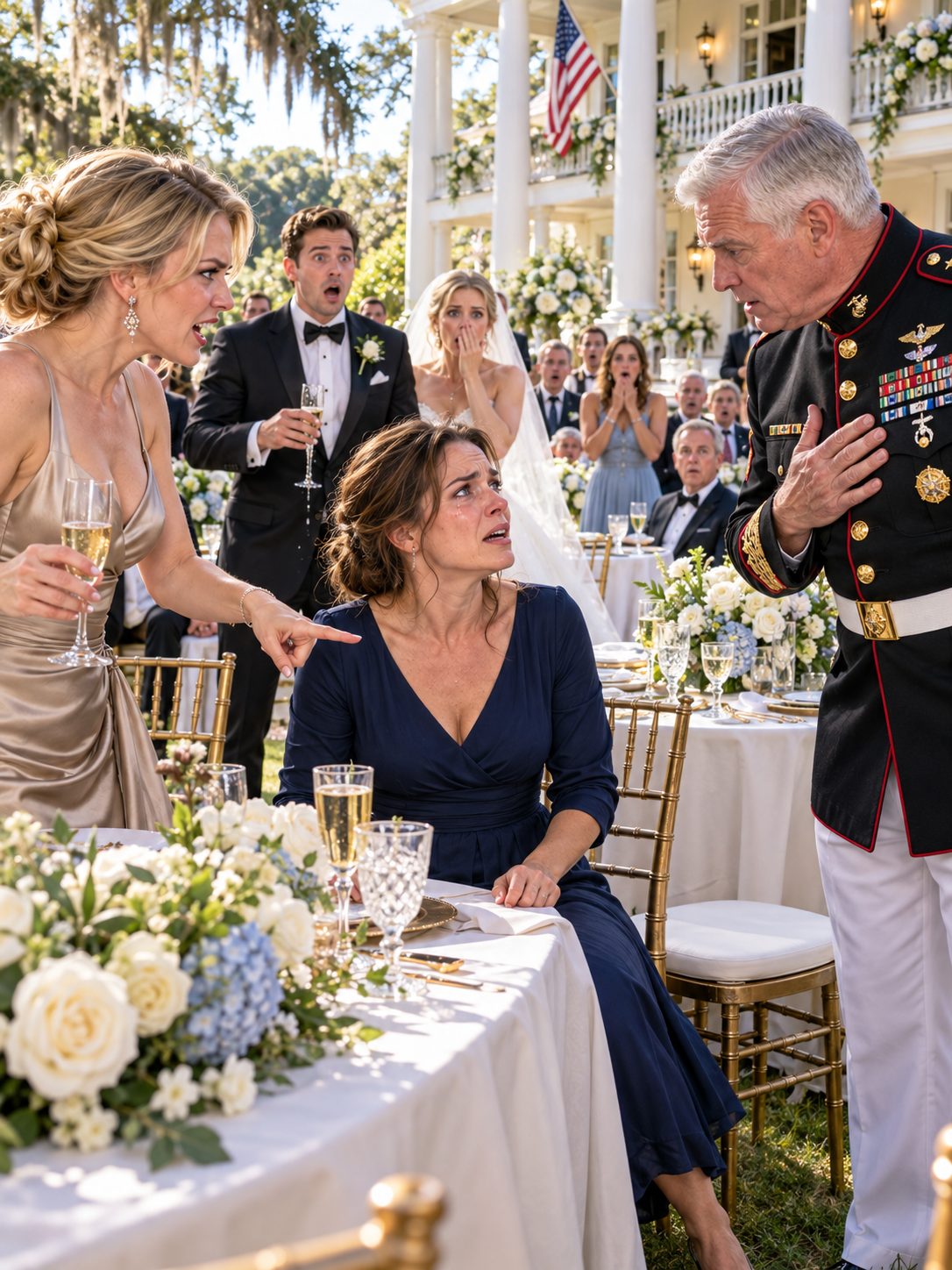
Behind me, Lauren whispered, “Trust me. Women like her never outrank anybody.”
A glass hit a nearby cocktail table with a hard, deliberate thud.
I turned.
An older man had separated himself from a group of guests about ten feet away. Silver hair, square shoulders, dark suit, no need to raise his voice or move quickly because people had apparently spent decades learning to get out of his path.
I recognized him before he took his second step.
Retired Major General Robert Tate, United States Marine Corps.
Father of the bride.
Father of Lauren.
Years earlier, I had sat across from him in a windowless planning room while three services argued over damaged port capacity and forty-eight hours of cargo movement nobody wanted to own. He had been the kind of general who listened for twenty minutes and then asked one question that exposed exactly who had prepared and who had come hoping rank would cover ignorance.
Now he stopped three feet from me.
“Mercer.”
Not loud.
He didn’t need loud.
My shoulders straightened before I could stop them.
“General Tate.”
He extended his hand. “I heard you were still tied to Norfolk.”
“For the moment, sir.”
“What pulled you down here?”
“My younger brother is getting married.”
His expression changed.
Not dramatically.
Just enough.
“Your brother?”
I nodded toward Daniel across the lawn.
He was standing beside the oyster station holding a cocktail he had forgotten to drink.
Daniel was looking directly at us.
And he looked sick.
Lauren stepped forward so quickly the silk of her dress snapped against her knees. “Dad, you know Claire?”
General Tate looked at his daughter, then back at me.
“We crossed paths on joint logistics work,” he said.
Lauren waited.
He offered nothing else.
“That’s funny,” she said. “Daniel made it sound like Claire just had some little Navy job.”
Daniel’s face changed across the lawn.
That sentence had landed somewhere he had not expected.
General Tate looked toward him, then toward the reception chart posted beside the pavilion entrance. He walked over, found my name, and stared at the card for several seconds.
“Why,” he asked, “is Daniel Mercer’s sister seated behind the sound equipment?”
Lauren’s hand moved to her necklace.
“She confirmed late.”
“I confirmed six weeks ago,” I said.
The words came out before I could decide whether I wanted them to.
Lauren turned toward me.
For the first time all evening, the confidence disappeared from her face.
General Tate did not accuse her of anything. He simply removed my place card from table fourteen and handed it to the wedding coordinator standing nearby.
“Move Commander Mercer to table two beside Evelyn and me.”
The coordinator blinked.
Lauren stopped breathing.
Across the lawn, Daniel lowered his glass.
That single word—Commander—seemed to move through the nearest guests faster than the music.
I hated that.
Not because my rank was secret, but because it suddenly felt like a weapon somebody else had drawn for me.
“Sir, that isn’t necessary.”
General Tate looked at me.
“I didn’t say it was necessary.”
His eyes shifted toward Lauren.
“I said move the seat.”
He nodded once and walked away.
Lauren stared at me as if my face had changed shape.
“You’re a commander?”
“Yes.”
“In the Navy?”
“That usually goes with the title.”
The bartender suddenly became very interested in a bucket of limes.
Lauren opened her mouth, closed it, then picked up her champagne and walked toward the house.
I wanted to feel satisfied.
Instead, I looked across the reception at Daniel.
He wasn’t embarrassed because Lauren had insulted me.
He wasn’t surprised General Tate knew me.
He looked afraid because something he had carefully arranged had just moved out of place.
And as the coordinator carried my name from table fourteen toward the bride’s family table, I realized I had been asking the wrong question.
The problem wasn’t who had put me behind the speakers.
The problem was why my brother had apparently wanted me there.
### Part 2
Table two had a perfect view of the harbor.
The USS Yorktown sat across the darkening water like a gray block cut from the horizon, tour boats dragging white wakes through the channel while the pavilion lights came on above us. I found myself seated between General Tate’s wife, Evelyn, and a retired Marine colonel named Paul Granger who spent twenty minutes discussing artificial knees with the seriousness of a procurement hearing.
It should have been funny.
Instead, I kept watching Daniel.
He was laughing too loudly.
Every time somebody approached our table, he found another reason to walk away. He visited cousins he had ignored all afternoon, shook hands with distant relatives, disappeared toward the bar twice, and somehow became fascinated with the DJ’s equipment.
Hannah, his new wife, noticed.
She noticed everything.
Hannah Tate Mercer was thirty-four, a fourth-grade teacher with the soft voice of someone who did not need to compete for attention. During dinner, she came to table two, squeezed my shoulder, and said, “I’m glad Dad found you a better seat.”
I smiled. “It’s your wedding. You don’t have to solve seating problems.”
Her eyes flicked toward Daniel.
“I didn’t make the seating chart.”
That sentence stayed with me.
I watched her return to the head table.
Evelyn Tate leaned toward me. “I’m embarrassed.”
“You don’t need to be.”
“I know Lauren.”
That made me look at her.
Evelyn folded her napkin carefully. “My daughter can decide what someone is worth before they’ve finished saying hello. It’s a habit I hoped adulthood would embarrass out of her.”
I almost laughed.
“Sometimes adulthood just gives people better clothes.”
Evelyn’s mouth twitched.
Across the room, Daniel caught me looking.
He turned away.
When the first dance began, I forced myself to stop studying him. Hannah rested her cheek against his shoulder, and for three minutes he looked almost like the brother I remembered rather than a man trying to keep six separate doors closed at once.
Afterward, General Tate found me near the coffee urn.
“No audience,” he said.
“That sounds ominous.”
“It isn’t.”
He carried black coffee. I carried water because the wine and my knee medication were not going to become friends.
We stepped toward the edge of the veranda.
The river smelled like mud and salt.
“I owe you an apology,” he said.
“You didn’t seat me behind a speaker.”
“No, but my family did.”
“Your daughter did, apparently.”
He looked toward Lauren.
“I’m not convinced she acted alone.”
That was the first moment the uneasiness in my stomach became something sharper.
I kept my face neutral.
“What makes you say that?”
He sipped his coffee. “Lauren doesn’t care enough about your brother’s relatives to invent a story about your RSVP. Somebody gave her one.”
That sounded exactly right.
I hated that it sounded right.
General Tate looked out over the water. “Daniel told us you rarely attend family events because your career keeps you overseas.”
“Sometimes.”
“He said you and he weren’t close.”
“That part is more recent.”
“He also said you were enlisted support staff.”
I turned slowly.
General Tate noticed.
“There it is,” he said.
“What?”
“The piece you didn’t know.”
The band started another song behind us.
I could hear glasses clinking, people laughing, a child asking for more cake.
“Daniel told you I was enlisted?”
“He said you’d spent years in Navy supply and had recently taken some kind of administrative position in Virginia.”
For a few seconds, I couldn’t answer.
I had enlisted at nineteen.
I was proud of that.
I had scrubbed storerooms, inventoried parts in heat that made paper curl, learned to sleep beneath pipes, taken classes at night, earned my degree one course at a time, and eventually gone through Officer Candidate School.
There was no insult in calling me enlisted.
The insult was using the truth of my beginning to erase everything that came after it.
“Interesting,” I said.
General Tate studied my face. “You want me to leave it there?”
“Yes.”
“You sure?”
“No.”
That earned a brief smile.
“But it’s my brother’s wedding,” I continued. “If there’s a conversation coming, I’m not having it beside the cake.”
“Fair.”
He shifted his weight.
“Still at Fleet Logistics?”
“For another few months.”
His eyebrows rose. “Selection board?”
I gave him a look.
He nodded.
“Understood.”
That was the Navy way of saying he knew something and would not ask me to confirm it.
Then he added, “Mason still talks about the Charleston pier problem.”
I laughed despite myself.
“Captain Mason remembers the parts of that story that make him look calm.”
“His version says the pier lost power, two civilian carriers stopped accepting cargo, customs threatened to shut down the staging area, and you spent thirty hours moving equipment through an alternate berth nobody else had approved yet.”
“That sounds more dramatic than it was.”
“He said you saved the schedule.”
“I saved six hours.”
“In that operation, six hours was the schedule.”
I looked at my water.
Praise had always made me uncomfortable, especially when it came with an audience.
General Tate seemed to understand.
He changed the subject to dry dock delays.
For ten minutes we talked about ships, ports, and the eternal military miracle of making seven incompatible systems pretend they had been designed to cooperate.
When we finished, I felt steadier.
Then I turned and found Hannah standing six feet behind us.
She had heard enough.
“Claire,” she said quietly, “what exactly do you do?”
Daniel appeared almost instantly.
“Hannah, they’re calling us for pictures.”
She didn’t look at him.
“What does your sister do?”
Daniel’s smile froze.
“Logistics.”
“That’s not what I asked.”
People were moving toward the dance floor.
Nobody around us seemed to notice the conversation yet.
Daniel rubbed the back of his neck.
“Claire works for the Navy.”
Hannah looked at me.
I could see a new thought forming behind her eyes.
“How long have you been an officer?”
“Fifteen years.”
Her gaze snapped toward her husband.
Daniel went pale.
“You told me she left the military after one enlistment.”
My stomach dropped.
That was more than minimizing my career.
That was a lie with architecture.
Daniel glanced around, then lowered his voice.
“This isn’t the place.”
“No,” I said.
He looked at me.
I kept my voice calm.
“But apparently you’ve spent a lot of time deciding what places I belong in.”
His jaw tightened.
“Claire, don’t.”
That word did it.
Not the insult.
Not the table.
Not even the lie.
“Don’t” was what he had said to me four years earlier when I asked why he had stopped answering calls after I helped keep his company alive.
“Fine,” I said.
I picked up my purse.
“I won’t.”
I left at 10:12, before the sparklers and before the newlyweds cut the second cake.
In the rental car, I sat with the door open and stretched my bad knee while a boat horn sounded somewhere beyond the marina. I could have driven to the airport hotel, changed my flight, and been gone before anybody woke up.
Instead, I opened my bag.
Inside was a manila folder I had not expected to use.
The paper on top showed a bank transfer dated August 14, 2019.
Forty thousand dollars.
From me.
To Daniel.
And suddenly I understood why my brother needed his new family to believe I had never become anybody at all.
### Part 3
I had not brought the folder to embarrass Daniel.
I had brought it because I worked in logistics, and logistics people keep records.
Original invoices, signed manifests, confirmation numbers, route changes, receipts—if someone later insists a shipment weighed eight tons instead of twelve, you do not argue from memory. You open the file.
The forty-thousand-dollar transfer had lived in a locked drawer at home for years.
That money had once been my cottage.
Not literally, of course.
It had been seven years of careful saving toward a small cedar-sided place on a creek outside Suffolk, Virginia. Two bedrooms, screened porch, enough yard for tomatoes, maybe a cheap aluminum skiff tied to a weathered dock.
I had looked at photographs of houses during deployments the way some people looked at vacation resorts.
Then Daniel called at 2:13 one Tuesday morning.
I had been asleep in Norfolk.
His voice sounded so different I checked the screen to make sure it was really him.
“Claire, I need help.”
Behind him I could hear rain striking metal.
He was sitting inside one of his company trucks outside a warehouse in Ohio.
Daniel had built Mercer Roofing from two ladders, our father’s tools, and the kind of stubbornness that can either create a business or destroy one. A bad spring had pushed him too far—too many crews, too much material bought on credit, two commercial clients delaying payment, and a bank that decided his line of credit had become somebody else’s problem.
“Payroll is Friday,” he whispered. “Fourteen guys.”
I sat up.
“How short?”
He was silent too long.
“Daniel.”
“Thirty-seven.”
“Thirty-seven hundred?”
“Thousand.”
I closed my eyes.
He started talking quickly, promising receivables were coming, promising the problem was temporary, promising he had contracts signed and crews working.
Then his voice broke.
“Dad’s name is still on two trucks.”
Our father had died eighteen months earlier.
Daniel knew exactly which door that sentence opened.
“Don’t use Dad,” I said.
“I’m sorry.”
“Do not use Dad to sell me this.”
“I’m not.”
“Yes, you are.”
The rain continued on his end.
I rubbed my face.
“How much do you need to make payroll and keep suppliers from freezing you?”
“Forty.”
I knew what that number meant.
So did he.
He had visited me in Virginia the year before and driven with me past the cottage I hoped to buy.
“You’d really live out here?” he asked.
“Absolutely.”
“There’s nothing around.”
“That’s the feature.”
He had laughed.
Now, at 2:13 in the morning, he knew the account existed.
I drove to the bank after sunrise.
At 7:08 a.m., forty thousand dollars left my savings and entered Daniel’s business account.
“Five thousand a month starting October,” he told me.
“I’ll have it all back before winter.”
October came.
No payment.
Then November.
Then Christmas.
Every explanation was reasonable by itself.
A customer was late.
A truck transmission failed.
Insurance premiums jumped.
One crew quit halfway through a commercial job.
Then the explanations stopped because Daniel stopped calling.
By the second year, I realized something stranger had happened.
My brother had not merely failed to repay me.
He had rewritten the rescue.
At a family Thanksgiving I attended briefly, an uncle congratulated him on surviving “without begging banks or relatives.”
Daniel looked at me across the room.
Then he smiled.
“Sometimes you just have to outwork the problem.”
I waited for him to correct it.
He didn’t.
That was when something between us broke.
Not over the money.
Money is replaceable.
Truth is harder.
By the time he met Hannah, Daniel’s story had apparently become cleaner still.
Self-made contractor.
No handouts.
No family rescue.
No older sister who had once wired him the down payment for her future because he was crying in a truck.
At 10:45 the morning after the wedding, I stood outside the house where the family brunch was being held and considered leaving.
Live oaks hung over the driveway.
The previous night’s humidity had turned into gray drizzle.
I could smell wet soil, coffee, and country ham through the screened veranda.
My phone buzzed.
Daniel.
Can we talk before brunch?
I stared at the message.
Then another appeared.
Please.
I typed back one sentence.
At the table.
Three dots appeared, vanished, returned.
Nothing came.
I slipped the phone away.
Inside, Hannah was helping her aunt carry biscuits to the veranda.
She looked tired.
Not wedding tired.
Knowledge tired.
“Morning,” she said.
“Morning.”
“Coffee?”
“Please.”
She poured without asking how I took it.
Black.
Then she lowered her voice.
“Daniel told me you were in the Navy for four years.”
“I know.”
“He told me you and he barely speak because you disapproved of his business.”
“That’s not why.”
“I figured.”
She placed the pot down carefully.
“What happened?”
I looked toward the veranda.
Daniel sat four chairs from General Tate, staring into a mug.
Lauren was at the opposite end of the table in beige linen, scrolling her phone with a stiff thumb.
“I’m not going to start your marriage with a family prosecution,” I said.
Hannah’s expression hardened.
“You’re not starting anything.”
I knew that look.
Teachers probably saw it immediately before somebody’s child learned consequences.
“You’re answering a question.”
I hesitated.
Then Lauren’s voice carried from the veranda.
“We were just talking about Daniel’s company surviving that terrible downturn.”
She sounded bright.
Too bright.
“Honestly, Hannah, you married a man who never needed anybody to rescue him. That’s rare.”
Daniel closed his eyes.
I felt something inside me settle.
No anger.
Just decision.
I walked onto the veranda.
General Tate lowered his newspaper.
Daniel looked up.
Lauren smiled as if the previous night had never happened.
I sat beside Hannah.
My folder remained inside my bag.
For the moment.
Lauren stirred her coffee.
“Daniel was telling us how he kept fourteen employees working during that awful year.”
He wasn’t telling them.
His lips hadn’t moved.
Daniel knew it.
I knew it.
Lauren continued anyway.
“Some people wait for somebody else to save them. Daniel actually built something himself.”
General Tate’s eyes moved toward me.
He said nothing.
Neither did Hannah.
I looked directly at my brother.
“Fourteen employees?”
Daniel swallowed.
“Claire.”
“You had fourteen?”
His fingers tightened around the mug.
Lauren looked between us.
“What?”
I kept my eyes on him.
“Tell them.”
Daniel shook his head once.
It was almost invisible.
“Tell them what happened that Tuesday night.”
His face collapsed before he said a single word.
And Hannah, watching him, finally understood that whatever truth was coming next had been living inside her marriage from the beginning.
### Part 4
Daniel put his mug down with both hands.
For a few seconds, nobody spoke.
A ceiling fan turned above us with a soft clicking sound, and somewhere inside the house a dishwasher rattled through a cycle as if ordinary life had refused to stop for us.
“Daniel?” Hannah said.
He looked at her.
Then at me.
Finally, he stared at the table.
“In 2019, my credit line froze.”
Lauren frowned.
“What does that have to do with—”
General Tate raised one finger.
She stopped.
Daniel breathed out through his nose. “Two commercial clients held payments. I had payroll due. Suppliers were threatening to shut down the accounts.”
“How much?” Hannah asked.
“Forty thousand.”
She looked at him.
“Where did you get it?”
He did not answer.
Her eyes moved to me.
I wanted him to say it.
He needed to.
“Where did you get the money, Daniel?”
“My sister.”
The words were barely audible.
Lauren’s spoon hit the saucer.
Daniel continued before courage deserted him.
“Claire had money saved for a house. She wired it to the company the next morning.”
Hannah’s face went still.
“How much of it did you repay?”
Daniel stared at her.
“That isn’t the point.”
“That’s exactly the point.”
“None,” I said.
He flinched.
Hannah closed her eyes.
Lauren leaned forward. “Wait. You gave him forty thousand dollars?”
“Yes.”
“Why would you do that?”
I almost laughed.
Not because it was funny.
Because that question exposed the entire problem.
“He’s my brother.”
Daniel covered his mouth with one hand.
General Tate looked toward him.
“There is nothing humiliating about accepting help when your people are going to miss payroll.”
Daniel nodded without raising his head.
The general’s voice became quieter.
“There is something humiliating about pretending the person who helped you doesn’t exist.”
Lauren’s cheeks reddened.
“I didn’t know any of this.”
“No,” I said. “You didn’t.”
Her eyes sharpened.
“You could have told me last night instead of standing there letting me—”
“Letting you what?”
That stopped her.
I kept my voice even.
“Letting you decide that a woman standing alone at a bar was beneath you?”
Lauren looked toward her father.
He didn’t rescue her.
“You didn’t need my résumé to behave decently.”
She pushed her chair back.
“I apologized.”
“No, you didn’t.”
The chair stopped.
She seemed genuinely surprised.
And she hadn’t.
Not once.
She had learned my rank, lost color, avoided me, and apparently converted all of that discomfort into the belief that I had somehow failed to provide enough information to prevent her cruelty.
“I was embarrassed,” she said.
“So was I.”
She stared at me.
“Not because you guessed wrong about my rank. Because you believed rank was what determined whether I deserved respect.”
General Tate looked down at his coffee.
I could tell he approved, which somehow irritated me because I did not want the conversation turning into a lesson delivered for his daughter’s benefit.
This wasn’t about Lauren anymore.
It was about Daniel.
Hannah turned toward her husband.
“Did you ask her to be seated at table fourteen?”
He froze.
That question changed the air.
I looked at him.
Daniel’s face drained completely.
“Daniel.”
“I didn’t make the seating chart.”
“That wasn’t my question.”
His hand went to his forehead.
Lauren suddenly became interested in her napkin.
Hannah saw it.
“So both of you knew?”
“I thought Claire might not come,” Daniel said.
“I had a signed delivery receipt.”
“I know.”
The words came out before he could stop them.
My pulse slowed.
Strangely, that was worse than anger.
“You know?”
Daniel shut his eyes.
Lauren stood.
“This is between you two.”
Hannah’s voice cut across the table.
“Sit down.”
Lauren actually did.
Daniel looked at me.
“I saw the RSVP.”
“Then why did Lauren tell everyone I confirmed late?”
He pressed his palms against his eyes.
“Because I told her.”
There it was.
No misunderstanding.
No careless coordinator.
No overbearing bride’s sister improvising social cruelty.
My own brother had supplied the lie.
“Why?”
He looked around the table as if one of the adults surrounding him might invent a better answer.
Nobody did.
“Because I had told Hannah’s family we weren’t close.”
“We weren’t.”
“I told them more than that.”
I waited.
His voice dropped.
“I said you’d never really done much after you left home.”
The room became very quiet.
I thought I had already understood the betrayal.
I hadn’t.
“You told them I left the Navy.”
He nodded.
“I told them you had enlisted for a few years and then bounced around civilian jobs near Norfolk.”
Hannah stared at him.
“Why?”
Daniel laughed once.
It sounded broken.
“Because every time somebody asked about my family, Claire made me feel like a fraud without even being in the room.”
I leaned back.
That was almost impressive.
“You borrowed my house money and somehow my career became the problem?”
“You don’t understand.”
“Then explain.”
He finally looked at me.
His eyes were wet.
“I was dating Hannah. Her father was a general. Her uncles were lawyers, doctors, business owners. Everybody had these polished stories about where they came from.”
“And?”
“And I had Dad’s old truck, debt, a roofing company that almost collapsed, and a sister who saved it.”
Hannah’s face changed.
Not sympathy.
Recognition.
Daniel continued.
“I wanted one thing that was mine.”
“You had one,” I said. “The company was yours. The work was yours. I never claimed otherwise.”
“But I knew.”
His fist pressed against his chest.
“I knew how close I came.”
I understood then.
Daniel had not erased me because I was insignificant.
He had erased me because I was evidence.
As long as I remained the unimpressive sister who had drifted through some minor Navy job, he could imagine the forty thousand dollars had come from nowhere important.
If I was Commander Claire Mercer—twenty-three years in uniform, a woman who had sacrificed something real to keep him afloat—then his story changed.
“So you put me behind the speakers.”
He nodded.
“I asked Lauren to keep you away from the family tables.”
Lauren whispered, “You said she hated being included in military conversations.”
I looked at her.
“And you believed that?”
She swallowed.
Daniel shook his head.
“That isn’t all.”
Hannah turned sharply.
“What else?”
He looked at me with the expression of a man who had finally reached the part of confession he feared most.
“I told people you gave me two thousand dollars.”
My breathing stopped.
“Two?”
He nodded.
“I said you helped with a supplier invoice. That was it.”
Forty thousand had become two.
My cottage had become an invoice.
My seven years of savings had become pocket change.
I reached for my purse.
Daniel immediately leaned forward.
“Claire, please.”
I pulled out the folder.
Nobody moved.
I placed it on the table but kept one hand over it.
“This contains the transfer confirmation.”
Daniel stared at it.
“I know.”
“I brought it because four years of dealing with you taught me something.”
His face tightened.
“What?”
“People who rewrite history eventually forget other people kept copies.”
Hannah’s eyes filled.
I pushed back my chair.
Daniel stood too.
“Claire.”
“No.”
“I’m sorry.”
“I believe you.”
That surprised him.
I picked up my bag.
“I believe you are sorry.”
His shoulders dropped with relief far too quickly.
Then I finished.
“But being sorry that the truth caught up with you is not the same thing as becoming safe for me again.”
His relief disappeared.
I walked toward the screen door.
Behind me, Hannah said his name.
Daniel answered with a voice I barely recognized.
I didn’t turn around.
But before I reached the driveway, the screen slammed behind me and footsteps came fast across the wet boards.
It wasn’t Daniel.
It was Hannah.
And she was holding a printed email.
### Part 5
“Claire.”
I stopped beneath the dripping live oak.
Hannah walked toward me barefoot, wedding-weekend sandals abandoned somewhere behind her. Her hair had fallen loose on one side, and she held three sheets of paper as carefully as if they might cut her.
“I need you to see this.”
I looked toward the house.
Daniel had not followed.
“Did he send it?”
“Two weeks ago.”
She held out the pages.
I took them.
The email chain began with Lauren asking Daniel where his sister should be placed because table two had one available seat.
Daniel’s reply was six lines.
Put Claire wherever you have extra room. She won’t care. Please don’t seat her with Dad or anybody military. She hates talking about that part of her life and tends to make things awkward. Also, don’t introduce her as my older sister unless it comes up. We aren’t close.
I read it twice.
The second time hurt less.
Not because it was less cruel.
Because the uncertainty was gone.
Hannah crossed her arms against the drizzle.
“He deleted that from his sent folder this morning.”
I looked at her.
“How do you have it?”
“Our wedding account forwards everything to both of us.”
Of course.
Planning a wedding had created the audit trail Daniel never considered.
“I searched your name after breakfast,” Hannah said. “There are more.”
I didn’t ask.
She told me anyway.
“He told Lauren you were jealous of him.”
I stared at the wet driveway.
“He said you always resented that he stayed in Ohio and built something while you ran away.”
That one almost made me smile.
I had enlisted because our father’s back injury had ended his factory job and my college tuition disappeared overnight.
Daniel knew that too.
“What are you going to do?” I asked.
Hannah’s eyes moved toward the house.
“I don’t know.”
“That’s between you and him.”
“He lied about you for our entire relationship.”
“Yes.”
“He lied about money.”
“Yes.”
“He lied about his business.”
“Yes.”
Her face tightened.
“How are you this calm?”
I looked at the paper in my hand.
“I’m not calm.”
My knee hurt.
My stomach felt hollow.
I wanted to go back inside and make Daniel explain each sentence aloud until even he could hear what kind of man had written them.
But I had spent too many years in rooms where panic accomplished nothing.
“I’m disciplined,” I said.
Hannah nodded slowly.
“That’s different.”
“Very.”
The screen door opened again.
General Tate stepped onto the veranda but stayed there.
He did not interfere.
I appreciated him for that.
Hannah wiped beneath one eye.
“I’m sorry.”
“You didn’t do this.”
“My family treated you—”
“Your sister treated me badly. Your father corrected it. Your mother was kind to me. You do not need to convert every individual choice into a family crime.”
A laugh escaped her despite the tears.
“That sounds like something Dad would say.”
“Don’t tell him.”
For half a second, we were simply two women standing in wet Charleston air after a terrible brunch.
Then Hannah’s expression became serious again.
“Daniel is coming to the airport.”
“No.”
“I didn’t ask you to meet him.”
“I mean no, he isn’t.”
She looked confused.
“I’m leaving at two.”
“He said he’ll drive over.”
“Then he can stand outside ticketing.”
“Claire—”
“I’m not punishing him.”
I folded the email.
“I’m declining another scene.”
Hannah studied me.
“You’re done with him.”
I considered the words.
“No.”
That surprised both of us.
“He owes me money. We’re going to deal with that like adults.”
“And after that?”
I thought about Daniel at nine years old, sitting cross-legged on our kitchen floor with peanut butter on his cheek.
Then Daniel at thirty-five, telling wealthy strangers his sister had never done much.
“After that, I don’t know him well enough to answer.”
Hannah looked toward the house.
I handed the email back.
“Keep your copy.”
She nodded.
Then she hugged me.
I stiffened for one second before returning it.
“Thank you for helping him,” she whispered.
“That was years before you knew him.”
“It’s still part of the man I married.”
“That’s what you need to decide.”
She stepped away.
General Tate was still waiting on the veranda.
When I walked toward my car, he came down the steps.
“Commander.”
“General.”
He extended his hand.
I shook it.
“I won’t insult you by apologizing for another grown man.”
“Thank you.”
“Still, I’m sorry this happened under my roof.”
“That I’ll accept.”
He released my hand.
“You know something?”
“What?”
“When Lauren made that comment last night, I thought correcting her facts might correct her thinking.”
I waited.
He looked toward the house.
“It doesn’t.”
“No.”
“She would have been just as wrong if you were unemployed.”
“Exactly.”
A faint smile appeared.
“You are very inconvenient.”
“So I’ve been told.”
He nodded toward the rental car.
“Safe flight.”
I opened the driver’s door.
“Thank you, sir.”
Then he said, “Claire.”
I turned.
Not Commander.
Claire.
“You didn’t need me to say your name last night.”
I looked back at him.
“No.”
“But sometimes a room does.”
That stayed with me.
At the hotel, I packed in eleven minutes.
Dress in the garment bag.
Shoes wrapped in plastic.
Folder beside the laptop.
The old habits of departure came back automatically.
Before leaving, I checked my phone.
Eight missed calls from Daniel.
Three messages from Lauren.
One from Hannah.
Daniel’s final text read:
I know sorry doesn’t fix it. I’m going to repay everything. I’m not asking you to believe me today.
I closed the screen.
At the airport, I cleared security, bought bad coffee, and found a seat near the windows.
Rain had stopped.
Sunlight broke through low clouds and painted the wet tarmac silver.
Boarding was forty minutes away when my phone vibrated again.
Bank notification.
Deposit received.
$900.00.
Memo:
First payment. No excuses.
I stared at it for a long time.
Then another message arrived.
Daniel:
I’m outside. I brought something that belongs to you.
I almost ignored him.
Then he sent a photograph.
A rust-darkened three-quarter-inch box wrench lay across his palm.
Our father’s initials were stamped into the steel.
And suddenly the money was not what made me stand up.
### Part 6
Daniel was waiting beside a rental SUV in short-term parking.
He wore an old Ohio State sweatshirt, work boots, and yesterday’s exhaustion. No suit, no wedding smile, no attempt to look like a man who had everything under control.
He held the wrench in both hands.
I stopped several feet away.
“Five minutes.”
He nodded.
“That’s more than I deserve.”
“Don’t perform.”
His mouth closed.
Good.
I was tired of performances.
He extended the wrench.
Our father had marked most of his tools because the men at the tire plant borrowed everything and returned nothing. EWM—Edward William Mercer—was punched crookedly into the steel near the head.
“You left this at home when you shipped out,” Daniel said.
“I left a lot of things.”
“I kept it in the truck.”
I took it.
The metal was cold.
For one strange second, I could smell our father’s garage again—oil, damp concrete, cut grass coming through the open door.
Daniel shoved his hands into his sweatshirt pockets.
“I used to tell myself I kept Dad’s work alive.”
“You did.”
He shook his head.
“I used his tools.”
“That counts for something.”
“Not as much as I told myself.”
We stood beneath the parking garage while traffic moved around us.
Daniel looked toward the terminal.
“I set an automatic transfer.”
“How much?”
“Nine hundred every month minimum. More when commercial payments clear.”
“Send me the schedule.”
“I will.”
“In writing.”
He nodded.
“And we’re doing a promissory note.”
His face tightened, but he nodded again.
“Fine.”
“With interest.”
That surprised him.
Not because the amount mattered.
Because the old Claire had refused interest.
“You said zero interest.”
“That was when you were my brother asking for emergency help.”
He stared at me.
I continued.
“This is a debt collection arrangement between two adults.”
The words hurt him.
I saw it.
I did not soften them.
“Okay.”
“You’ll sign it.”
“Yes.”
“If you miss payments, I won’t call to ask why.”
He swallowed.
“Okay.”
I turned the wrench in my hand.
Daniel’s eyes reddened.
“Are we ever going to be okay?”
There it was.
The question people ask when they want time to negotiate consequences downward.
I considered lying.
Instead, I said, “No.”
He looked stunned.
“We might someday be civil.”
His jaw trembled.
“We might even sit at the same Thanksgiving table.”
I kept my voice steady.
“But what we had is gone.”
“Claire—”
“You didn’t forget me.”
He looked down.
“You deliberately made me smaller so you could feel larger.”
“I know.”
“You took my money, erased what it cost me, lied about my career, lied about why we weren’t close, and arranged for me to be treated like an inconvenience at your wedding.”
“I know.”
“Stop saying you know.”
His face tightened.
“You know now because people saw it.”
That landed.
Good.
He wiped his mouth.
“What can I do?”
“Repay me.”
“That’s it?”
“For now.”
He looked helpless.
I remembered being twenty-six and taking him to breakfast after our father’s first surgery because Daniel was terrified Dad would never work again.
I remembered teaching him to drive stick.
I remembered mailing him fifty dollars from deployment when I was barely making enough myself because he wanted to take a girl to prom.
Those memories were real.
So was this.
Love did not cancel evidence.
Daniel reached into his pocket and pulled out a battered envelope.
“Nine hundred cash.”
“You already transferred nine hundred.”
“This is separate.”
“No.”
“My crew handed it to me Friday before I left.”
I frowned.
“What?”
“They knew I was coming to the wedding. I told them I was finally paying back family money.”
I stared at him.
“I didn’t tell them the whole thing.”
“Obviously.”
He accepted the hit.
“One guy gave me fifty. Another gave twenty. Mike put in two hundred.”
“Daniel, I’m not taking your employees’ money.”
“I know.”
“Then why bring it?”
“Because I needed you to see something.”
He opened the envelope.
Inside were bills and scraps of paper.
Names.
Amounts.
One note read:
For the person who kept our checks from bouncing.
My throat tightened.
Daniel looked at the envelope.
“I told them you wired the money.”
“When?”
“Yesterday morning.”
“Before brunch?”
“Yes.”
That surprised me.
“Why?”
“Because after Dad moved your seat, I spent half the night realizing I had built my whole life around making sure nobody knew I needed you.”
He inhaled shakily.
“And I was tired.”
I looked at him.
For the first time, I believed the apology had begun before the public confession.
That mattered.
It did not fix anything.
Both could be true.
“Give the cash back.”
“I will.”
“Tell them I said thank you.”
“I will.”
He nodded toward the wrench.
“That stays with you.”
“Yes.”
Daniel breathed in.
Then he stepped forward as if he wanted to hug me.
I raised one hand.
He stopped.
The pain on his face was immediate.
I refused to feel guilty for it.
“Not yet,” I said.
He nodded.
Maybe that was cruel.
Maybe it was honest.
I preferred honest.
I turned toward the terminal.
“Claire.”
I looked back.
“I did love you,” he said.
I believed that too.
“That was never the problem.”
His face crumpled.
I walked through the glass doors.
On the plane, I sat beside a retired electrician from North Carolina who slept before takeoff. Across the aisle, a young sailor in dress whites held his cover in his lap and stared out the window with the solemn expression of someone traveling toward a first command.
I turned my father’s wrench in my fingers.
Forty thousand dollars would take Daniel years to repay.
Trust might take longer.
Maybe it would never return.
The strange thing was, at thirty thousand feet, that possibility did not frighten me.
For years, I had been waiting for my brother to restore something he had broken.
Now I finally understood I did not need him to.
### Part 7
Three months later, I signed papers on the cottage.
Not the original one.
That property had sold years earlier to a couple from Richmond who painted it blue and built a ridiculous three-level dock.
Mine was smaller.
One bedroom downstairs, a loft upstairs, cedar siding faded by salt air, screened porch leaning just enough to make a contractor nervous.
I loved it immediately.
The yard ended at a narrow tidal creek where egrets hunted in the reeds and mosquitoes considered federal regulations optional. The kitchen cabinets were outdated, the water heater needed replacement, and the previous owner had installed a ceiling fan that shook like it was reconsidering gravity.
It was mine.
I bought it with savings rebuilt slowly after Daniel’s emergency.
Not revenge money.
Not repayment money.
Mine.
His automatic transfers arrived every month.
Nine hundred.
Then twelve hundred.
Then nine again.
He never missed.
We communicated through email.
Payment received.
Insurance certificate attached.
Promissory note updated.
No “miss you.”
No family photographs.
No pretending.
Hannah contacted me twice.
The first message came six weeks after the wedding.
She and Daniel had started counseling.
The second came after Christmas.
She told me they were still married but living separately for a while.
I wrote back four sentences.
I hope you’re well. I’m sorry this has been painful. You deserve honesty in your marriage. Whatever you decide, make the decision for yourself.
That was all.
I did not become her secret adviser.
I had already spent enough of my life managing Daniel’s consequences.
Lauren sent a handwritten letter.
Four pages.
I read one.
She apologized for judging me by appearance, apologized for the rank comment, apologized for assuming I was unimportant because I was alone.
Then she wrote that she had been “under tremendous wedding stress.”
I stopped reading.
Stress does not invent contempt.
It reveals where contempt was already stored.
I put the letter in a drawer.
I never answered it.
General Tate emailed once.
Subject line:
Old pier gossip.
The message contained a photograph from a veterans’ luncheon and one sentence.
Mason still claims you stole six hours from the laws of physics.
I replied:
Mason still owes me coffee.
That was the full extent of our correspondence.
By February, another change arrived.
My selection became official.
Captain.
I stared at the message on my office monitor for a long time.
No cheering.
No dramatic music.
Just fluorescent light humming above my desk, a half-eaten turkey sandwich beside a stack of port assessments, and a petty officer standing in my doorway waiting for me to notice her grin.
“Ma’am.”
“What?”
She pointed toward my screen.
“Congratulations.”
Within thirty seconds the office knew.
Somebody found cupcakes.
Somebody else taped an embarrassingly large paper eagle to my door.
Captain Mason called and said, “About damn time.”
Then Daniel called.
Not texted.
Called.
I watched his name vibrate across the desk.
For a moment, I considered letting it go to voicemail.
Then I answered.
“Hello.”
“Hey.”
His voice was careful.
“I heard.”
“From who?”
“Mom’s cousin Debbie.”
Of course.
Family intelligence networks remain undefeated.
“Congratulations, Claire.”
“Thank you.”
He was quiet.
Then he said, “Captain.”
I leaned back.
“Not until the promotion date.”
“Still.”
Silence.
I could hear roofing machinery on his end.
“Daniel?”
“Yeah.”
“I have a meeting.”
“Right.”
He inhaled.
“I just wanted to say I’m proud of you.”
There were years when that sentence would have cracked me open.
It didn’t.
That wasn’t punishment.
That was consequence.
“Thank you.”
He waited.
I did not fill the silence.
“All right,” he said. “I’ll let you go.”
“Take care.”
“You too.”
The call ended.
I stared at the phone.
Nothing dramatic happened.
No tears.
No cinematic grief.
Just a quiet recognition that indifference sometimes arrives so gently you mistake it for peace.
My promotion ceremony took place in April beside the Elizabeth River.
White uniforms.
Cold wind.
Families standing in folding chairs.
The same harbor smell that seems to follow Navy careers from beginning to end—salt, diesel, wet rope, paint.
I invited three people.
Captain Mason.
My closest friend Lena, a civilian engineer I had known for sixteen years.
And Evelyn Tate.
Not General Tate.
Evelyn.
She had mailed me a Christmas card with a handwritten note:
A woman should never need a title to be treated as if she belongs at the table.
That sentence had mattered more than Lauren’s four-page apology.
General Tate came with her anyway.
“Uninvited,” he announced.
“I can have security remove you.”
“Please do. It would improve my reputation.”
During the reception, he stood near the back drinking coffee.
No speeches.
No grand recognition.
Exactly right.
Later, while people ate sheet cake and complained about parking, a young ensign approached me.
She could not have been more than twenty-three.
“Captain Mercer?”
I turned.
“Yes?”
She looked terrified.
“I read the logistics review you wrote after the Norfolk surge.”
I almost laughed.
“You may be the only person who did.”
She smiled nervously.
“It’s why I requested this community.”
That silenced me.
Not the rank.
Not the ceremony.
That.
“Then I owe you an apology,” I said.
She laughed.
We talked for ten minutes.
As she walked away, General Tate appeared beside me.
“You all right?”
“Yes.”
He nodded toward the ensign.
“That’s the part nobody tells you about.”
“What part?”
“One day, somebody is standing behind you.”
I looked across the river.
For years, Daniel had been ashamed that I stood behind him during his worst moment.
Now I understood the difference.
Standing behind someone is not the same as living in their shadow.
The first is loyalty.
The second is a story frightened people tell themselves.
My phone buzzed.
A payment notification.
$2,500.
Daniel had apparently closed a large contract.
I locked the screen without opening the memo.
General Tate noticed but did not ask.
“Coffee?” he said.
“Terrible coffee?”
“Military tradition requires it.”
We walked toward the table.
For the first time in years, my brother’s debt did not feel connected to my future.
It was simply a number getting smaller.
And I was finally living inside a life that no longer needed him to understand its size.
### Part 8
Daniel repaid the final dollar twenty-nine months after the wedding.
The transfer arrived on a Wednesday morning while I was standing barefoot in my cottage kitchen watching rain hit the creek.
$1,742.16.
Principal and the modest interest written into the note.
The memo said:
Paid in full.
Nothing else.
I opened the spreadsheet where I had tracked every payment, entered the number, and watched the balance become zero.
Then I closed the file.
For several minutes, I expected to feel something larger.
Vindication.
Sadness.
Relief.
Instead, I noticed the coffee maker had finished brewing.
I poured a cup.
Outside, an egret lifted from the marsh.
That was it.
Forty thousand dollars had once represented a house I could not buy.
Then it represented betrayal.
Then obligation.
Now it was history.
Daniel emailed an hour later.
I kept my promise. I know that doesn’t undo anything. Thank you for saving the company when I didn’t deserve it.
I read the message once.
Then I replied.
Debt received in full. I wish you well.
I stared at the words before sending them.
Not cruel.
Not warm.
Accurate.
Hannah and Daniel remained married.
I learned that from our mother’s cousin Debbie, who considered privacy a theoretical concept.
Apparently Daniel sold one of the company trucks, reduced his crews, stopped bragging about growth, and started teaching apprenticeship classes at a local trade program. Whether he became a better husband was Hannah’s story, not mine.
We saw each other the following Thanksgiving.
Our mother’s sister hosted in Cincinnati.
I almost declined.
Then I decided I was tired of surrendering rooms just because Daniel might be inside them.
He arrived with Hannah carrying pies.
We looked at each other across Aunt Marcy’s foyer.
For a second, I saw the old instinct in his face.
He wanted to hug me.
He didn’t.
“Hey, Claire.”
“Hi, Daniel.”
“Happy Thanksgiving.”
“You too.”
That was all.
We ate at the same table.
He passed me potatoes.
I passed him cranberry sauce.
Nobody died from the restraint.
Later, Hannah joined me on the back porch.
Cold Ohio air cut through my sweater.
“You look good,” she said.
“So do you.”
“Daniel told me the loan is paid.”
“Yes.”
She nodded.
“I think he expected that to fix something.”
“I know.”
“He understands now.”
“Does he?”
“I think so.”
I looked through the window.
Daniel was helping Aunt Marcy stack plates.
“He doesn’t talk about reconciliation anymore.”
“That’s probably healthier.”
Hannah studied me.
“You really don’t want your brother back?”
There was no accusation in the question.
Only curiosity.
I thought carefully.
“I want him to have a good life.”
“That’s not what I asked.”
“No.”
I smiled faintly.
“It isn’t.”
She waited.
“I don’t hate him, Hannah.”
“I know.”
“I’m not sitting somewhere secretly hoping he suffers.”
“I know.”
“But there are relationships you can’t return to once you’ve learned what staying inside them requires you to ignore.”
She breathed out.
“That sounds final.”
“It is.”
She nodded.
Then she changed the subject.
Thank God.
We discussed her classroom instead.
The following spring, I retired after twenty-five years of service.
No giant banquet.
No hotel ballroom.
No slideshow containing photographs nobody remembered approving.
I held the ceremony on the pier.
About sixty people came.
Sailors.
Officers.
Civilians.
Old friends.
People who had known me when I was nineteen and polishing brass, and people who had met me when I was already Captain Mercer and assumed I had always known what I was doing.
I had not.
Nobody does.
General Tate attended.
So did Evelyn.
Daniel did not.
I had not invited him.
That choice caused some family discussion.
I survived.
After the ceremony, when most people had left, General Tate found me looking at the water.
“First time I saw you,” he said, “you were arguing with three colonels about crane capacity.”
“They were wrong.”
“They were.”
He smiled.
“Second time was my daughter’s wedding.”
“I remember.”
“She remembers too.”
“I imagine.”
He grew quiet.
“You know she still hates that story.”
“Good.”
He laughed.
Then his expression softened.
“Not because of the rank comment.”
I looked at him.
“Because she realized that if I hadn’t recognized you, she would have gone home believing she was right.”
That was the part I had thought about too.
If General Tate had not turned around that evening, Lauren might have finished her champagne feeling clever.
Daniel might have continued telling Hannah I had never accomplished much.
My place card might have remained behind the soundboard.
But none of those things would have changed who I was.
Only who they believed I was.
“I used to think that moment mattered because you said my name,” I told him.
He waited.
“It mattered because everybody else suddenly had to hear it.”
General Tate nodded.
“That sounds right.”
I looked at the river.
“But I don’t need that anymore.”
“No.”
He shook my hand.
“Most people don’t figure that out until much later.”
After retirement, I went home to the cottage.
My father’s wrench hangs above the workbench in the small shed.
Not polished.
Not framed.
Still stained dark with decades of grease.
Sometimes I use it.
Tools hate becoming monuments.
On summer mornings, I drink coffee on the screened porch while sunlight moves across the creek.
Nobody calls me Commander.
Nobody calls me Captain unless they are trying to annoy me.
Most days, I am simply Claire.
And that has become my favorite name.
I occasionally think about that wedding.
The roses.
The harbor.
The ridiculous speaker hiding half of table fourteen.
Lauren whispering, “Women like her never outrank anybody.”
She was wrong about my rank.
But that was never the important part.
The important part was that she believed a woman needed to outrank somebody before she deserved dignity.
Daniel made the opposite mistake.
He believed my accomplishments diminished his.
So he shrank me inside his story until he could stand comfortably beside the version of himself he wanted strangers to admire.
Neither of them understood something I spent half my life learning.
You do not become larger by making somebody else smaller.
And forgiveness is not an obligation to reopen a door.
I stopped hating my brother long before he finished repaying the money.
I wished him well.
I meant it.
But I never gave him the old relationship back.
Some things can be repaired.
Some should simply be acknowledged, learned from, and left behind.
The last time Daniel and I spoke, he called on my birthday.
We talked for nine minutes.
His company was stable.
Hannah had been promoted at school.
He asked about the cottage.
Before hanging up, he said, “Claire?”
“Yeah?”
“I’m glad you got your house.”
I looked through the porch screen at the tide rising through the grass.
“So am I.”
He paused.
“I wish I hadn’t cost you the first one.”
“I know.”
Another pause.
“Take care.”
“You too.”
I ended the call and set the phone facedown.
Then I went outside.
The dock boards were warm beneath my bare feet.
A small aluminum skiff rocked against the line exactly where I had once imagined one would.
The creek opened toward larger water beyond the reeds, bright under clean afternoon light.
For years, I thought justice would sound like somebody finally admitting what I had done for them.
It didn’t.
Justice sounded like water under a dock.
It looked like a house bought twice.
It felt like standing inside a life nobody else had permission to edit.
And it required no table assignment at all.
THE END!
Disclaimer: Our stories are inspired by real-life events but are carefully rewritten for entertainment. Any resemblance to actual people or situations is purely coincidental.