
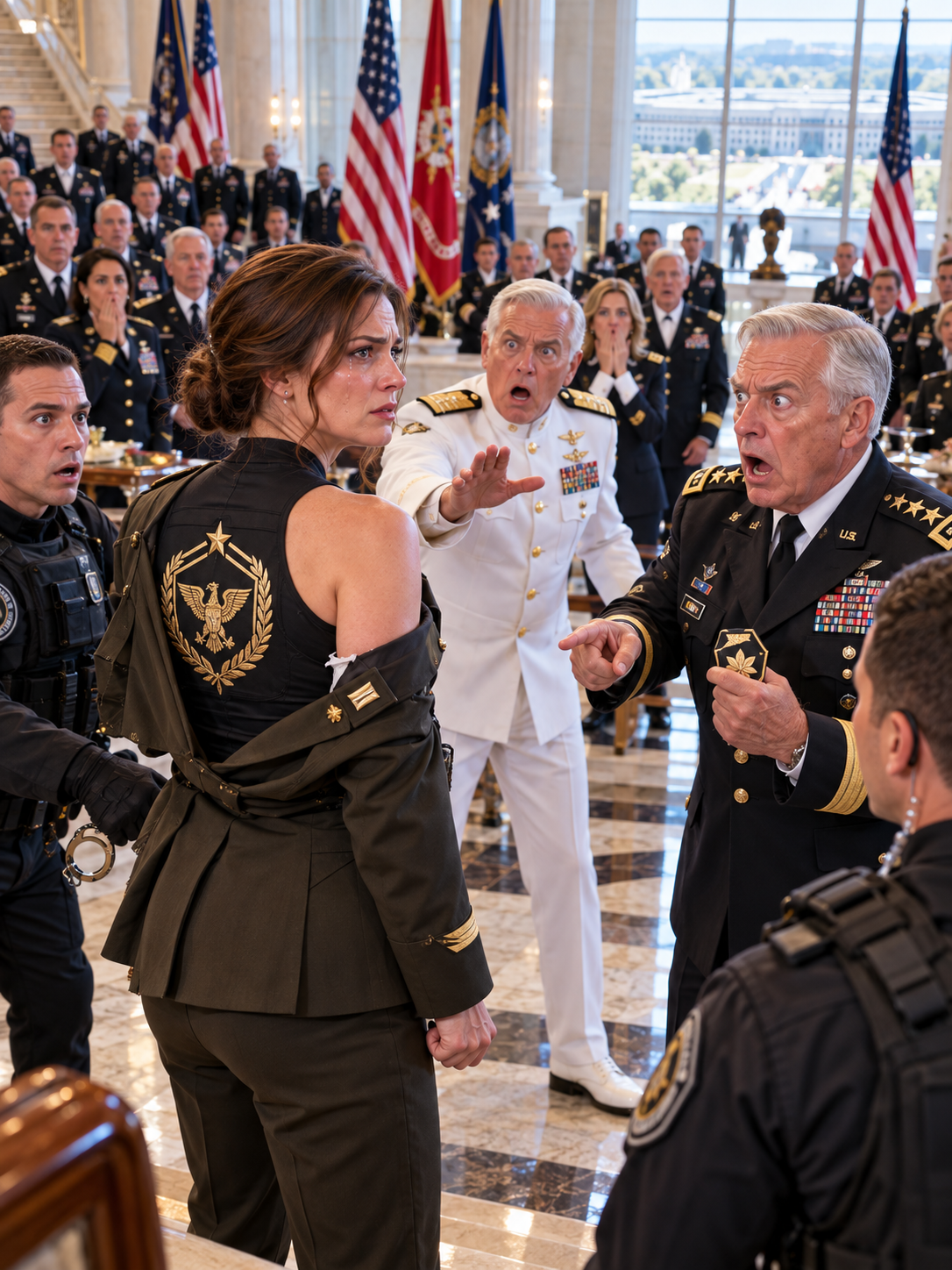
My father tore the insignia from my uniform in front of half the Pentagon and called me a traitor to everything our family stood for. I said nothing, even when he ordered armed guards to arrest me, because the truth hidden beneath my torn jacket was more dangerous than his accusation. Then an admiral recognized the symbol on my back, stared at my father, and said three words that changed the room completely: “She outranks you.” But that was only the beginning.
### Part 1
The first thing I heard when General Marcus Vale called me a traitor was the tiny metallic click of someone dropping a pen.
It hit the polished floor of the ceremonial hall and rolled beneath a row of chairs while nearly two hundred officers sat perfectly still beneath hard white lights. I had survived forty hours without meaningful sleep, a classified extraction overseas, and a flight home during which I had been ordered not to speak to anyone, yet nothing had prepared me for seeing my own father standing behind the podium with naked fury on his face.
“You betrayed your country.”
His voice carried easily without a microphone.
I stared at him from the center aisle, waiting for the punch line that never came. “Sir?”
He descended the steps toward me, silver stars flashing on his shoulders, and I realized he was not speaking as my father. General Vale had taken over completely, the man who had spent thirty-eight years believing discipline mattered more than affection, reputation more than explanation, and the chain of command more than blood.
“Do not call me sir as though that uniform still gives you that privilege,” he said. “Five service members are dead because operational intelligence was compromised. Your credentials appear in the access chain. You disappeared for thirty-six hours. And you expect this room to believe that is coincidence?”
A current of whispers moved through the chairs.
My throat tightened, but I kept my hands at my sides. I had been trained young never to react before I understood the battlefield, and my father had unknowingly given me that lesson himself when I was eight years old and he made me stand straight in our backyard while he corrected my posture.
“Where did you get the evidence?” I asked.
His mouth hardened.
That told me more than an answer would have.
He stepped close enough that I smelled black coffee and the sharp aftershave he had worn my entire childhood. “You do not get to interrogate me.”
Then his hand closed around the insignia on my shoulder.
The stitching tore.
Someone in the front row inhaled sharply as he ripped one symbol away, then another, stripping the visible evidence of my service from my uniform with furious precision. I should have stopped him, but something about the certainty in his eyes froze me more effectively than a weapon ever had.
My father truly believed I was guilty.
That frightened me far more than his anger.
“General,” someone warned.
He ignored them.
His hand caught the back of my service jacket, and when he jerked me around, fabric split near my shoulder blades. Cold air touched my skin.
Then the room changed.
The whispers stopped first.
My father noticed the silence and hesitated, still holding a fistful of torn fabric. I reached slowly toward the remaining clasps of my jacket because there was no point hiding what dozens of people had already glimpsed.
I removed the ruined jacket myself.
Across my upper back was a faded black-and-silver emblem: spread wings surrounding a single star, crossed by a thin vertical line.
It looked almost simple.
It was anything but.
I had received it at twenty-one in a room where no photographs had been allowed and where everyone present had been officially listed somewhere else. The mark belonged to a compartmented operations group known internally as Aster Division, an organization so deeply buried that most senior officers assumed it had been dissolved more than a decade earlier.
A chair scraped loudly at the front.
Admiral Thomas Rowan stood.
I knew him mostly by reputation. He had commanded fleets, advised two administrations, and acquired the kind of composure that made other powerful people lower their voices automatically.
He was not composed now.
His eyes went from the emblem on my back to my face, then finally to my father.
My father recovered first.
“Security,” he snapped. “Take her into custody.”
No one moved.
“Did you hear me?”
The nearest security officer looked at Admiral Rowan.
Rowan came down from the platform slowly. “General Vale.”
“What?”
The admiral stopped three feet away.
Then he said the three words my father would remember for the rest of his life.
“She outranks you.”
My father stared at him.
A murmur rolled through the room like distant thunder.
“That is impossible,” he said.
Admiral Rowan kept his gaze on me. “If that mark is authentic, Colonel Claire Vale holds delegated operational authority under a command structure separate from conventional rank during active Aster assignments.”
My father looked almost offended by the concept. “Aster was shut down.”
“Publicly.”
My pulse kicked once.
That word should not have been spoken in that room.
Rowan seemed to realize it too.
He turned to the officers. “This proceeding is suspended. Nobody photographs anything. Nobody leaves until security has collected every active device.”
My father stepped toward him. “You cannot suspend my investigation.”
“I just did.”
Five minutes earlier I had been humiliated in front of the most powerful people I had ever served beside. Now those same people were looking at me as though I had become something unfamiliar.
I bent down and picked up my torn jacket.
A young lieutenant removed his own outer coat and offered it to me without speaking. It was too large and smelled faintly of laundry starch, but I pulled it around my shoulders and thanked him quietly.
My father watched every movement.
For the first time since childhood, I saw uncertainty in his face.
Admiral Rowan approached me. “Colonel, you’re coming with me.”
“To be arrested?”
“To be protected.”
“From whom?”
His gaze shifted briefly toward my father.
“That is what I intend to find out.”
We left through a side corridor with two security officers walking beside me. Not holding me, not touching me, but close enough that the distinction felt temporary.
Behind us, voices erupted the moment the doors closed.
I heard my father’s above all of them.
“She killed our people!”
My step almost faltered.
Almost.
Rowan led me through two restricted checkpoints into a windowless conference suite deep inside the building. The fluorescent lights made everything look pale and unreal, and when the steel door sealed behind me, the admiral remained outside.
“There is water,” he said through the intercom. “Food will be brought.”
“How long?”
“I don’t know.”
That answer told me he was scared.
I sat on the edge of the narrow bench and finally allowed myself to replay my father’s accusation.
Five dead.
Compromised intelligence.
My credentials.
Thirty-six missing hours.
Individually, every fact could be explained.
Together, they formed a story designed for one audience in particular: General Marcus Vale.
Someone understood my father.
They knew his pride. They knew his obsession with reputation. They knew he would act before asking me a single personal question if he believed our family name had been stained.
And that meant this had never been merely an attack on my career.
My father was part of the weapon.
I looked at my reflection in the darkened security glass and whispered the conclusion I wished I hadn’t reached.
“Someone built this specifically for us.”
Then I remembered something from my final mission that had seemed insignificant at the time: a logistics officer arriving nine minutes late, sweating despite the cold, carrying a clearance folder that had already been signed.
The approving signature had belonged to my father.
### Part 2
I was still thinking about that signature when Admiral Rowan entered two hours later carrying a tablet and an expression that had lost all trace of surprise.
He dismissed the security officers, sat opposite me, and set the tablet face down. “I verified enough of your file to know the Aster authorization is genuine.”
“Then you know I wasn’t freelancing.”
“I know you were assigned to something I am apparently not cleared to read.”
“That should concern you.”
“It does.”
He folded his hands. “What concerns me more is that the evidence against you is multiplying faster than my investigators can examine it.”
I felt my stomach tighten.
Rowan turned the tablet around.
A surveillance image showed a woman entering a restricted military storage complex forty-eight hours before an explosion destroyed part of the facility. Her posture was mine, her face was mine, and even the small scar above her left eyebrow matched mine.
I stared for several seconds.
“It isn’t real.”
“Every news network in the country may have it before lunch.”
“I wasn’t there.”
“We’ve confirmed you were in another secure facility during part of that window.”
“Part?”
“Three hours remain unaccounted for.”
I leaned back.
There it was.
Not proof.
Architecture.
Whoever had built the accusation understood that successful lies rarely contradicted reality completely. They occupied the empty spaces around it.
“Who released this?”
“Anonymous defense sources.”
“Meaning someone with internal access.”
“Yes.”
He studied me carefully. “Your father believes the footage settles the matter.”
That hurt more than I wanted it to.
“Of course he does.”
Rowan’s eyebrow moved. “You expected that?”
“I know Marcus Vale.”
“He’s your father.”
“That’s why I know him.”
The door opened again, and a civilian man with gray at his temples entered carrying a weathered leather folder. I recognized Daniel Mercer immediately, though I had not seen him in seven years.
He had once been legal counsel for personnel assigned to Aster.
“You look terrible,” Daniel said.
“You always knew how to comfort people.”
“I bill by the hour.”
Rowan almost smiled.
Daniel sat beside me and opened his folder. “Privilege attaches to everything Claire tells me unless she authorizes disclosure.”
Rowan nodded. “You’ve got one hour.”
“Then quit wasting it.”
When the admiral left, Daniel’s humor vanished.
“Tell me exactly what happened during your final assignment.”
I did.
Not the classified purpose, only the sequence: deployment, rendezvous, logistics transfer, communications failure, altered extraction route, casualty report, my unscheduled return.
Daniel wrote without interrupting.
When I mentioned the clearance folder, his pen stopped.
“Whose approval?”
“My father’s digital authorization.”
“Did you see him sign it?”
“No.”
“Then you don’t know that he did.”
I stared at him.
Daniel pulled a gray notebook from his folder.
The cover carried a nearly erased Aster symbol.
My breath caught.
“I thought those were destroyed.”
“Most were. A legal preservation order protected several contingency logs after the division was supposedly closed.”
He opened to a page written in my own block handwriting from years earlier.
I had recorded unusual access patterns connected to a defense contractor named Silas Brant. At the time, Brant had seemed like a minor logistics administrator—competent, quiet, forgettable.
Daniel tapped one entry.
Two secure doors had recorded his badge within minutes of each other despite being far enough apart that the movement was impossible.
“I investigated this once,” I said.
“You flagged it. Someone above you shut the review down.”
“Who?”
“The authorization is sealed.”
My pulse accelerated.
Daniel turned another page.
A name appeared repeatedly beside Brant’s.
Nathan Weller.
Colonel Nathan Weller had been my father’s aide for nearly fifteen years.
He had attended Christmas dinners at our house. He remembered my mother’s birthday after she died. He was the man who used to tell people my father trusted him more than anyone in uniform.
“He was in the hall today,” I said.
Daniel looked up.
“Standing directly behind my father.”
Neither of us spoke for several seconds.
A memory surfaced.
Weller visiting our home when I was seventeen, laughing as my father complained that I questioned orders too often.
“You’ll appreciate that stubborn streak someday, General,” Weller had joked.
My father hadn’t laughed.
Now I wondered whether Weller had been studying both of us even then.
Daniel closed the notebook. “This is suspicion, Claire. Not evidence.”
“Then we get evidence.”
“You are locked in a Pentagon security suite.”
“I’ve worked with worse limitations.”
“Don’t say things like that to your attorney.”
The intercom activated.
“Turn on the monitor.”
Rowan’s voice.
Daniel hit the switch.
A cable news broadcast filled the screen.
My academy photograph appeared beside the surveillance image.
The headline beneath it called me a suspected insider connected to the destruction of a military facility.
I felt something cold move through my body.
The reporter said investigators were examining possible links between me and a “defunct clandestine military organization.”
Daniel muted the screen.
“They leaked Aster too,” he said.
“That isn’t an accident.”
“No.”
Someone was forcing the story outward.
Once the public believed I was guilty, bureaucratic caution would harden into political urgency. People who might privately question the evidence would become afraid of appearing soft.
Rowan entered.
His jaw was locked.
“This leak came from inside the building.”
“Can you trace it?”
“Not quickly enough.”
Daniel stood. “Then preserve everything before the same people manufacturing evidence begin deleting it.”
Rowan looked at him. “Already ordered.”
That surprised me.
Maybe Rowan was not merely cautious.
Maybe he had begun believing me.
I stood too. “I need access to the logistics approvals from forty-eight hours before my final mission.”
“No.”
“Admiral—”
“You’re still under investigation.”
“Then have your team pull them.”
He hesitated.
“Look for approvals routed to General Vale during large briefing blocks,” I continued. “Routine electronic countersignatures. Someone who knows his habits would bury a sensitive authorization among twenty harmless ones.”
Rowan went still.
“How do you know his habits?”
“He’s been my father for thirty-four years.”
That landed differently.
His expression softened by half a degree.
“I’ll check.”
After he left, Daniel packed his folder.
“My father will never admit he was manipulated,” I said.
“Maybe not.”
“He’d rather believe I betrayed the country than admit somebody made a fool of him.”
Daniel gave me a tired look. “Then don’t build your case around his apology.”
“I wasn’t planning to.”
That night I lay awake beneath the buzzing fluorescent light thinking about the father who had once told me never to embarrass him.
For years I had translated his severity into love because that interpretation hurt less.
Now I wasn’t sure there had ever been enough love beneath it.
At 3:17 in the morning, my door opened.
Rowan entered holding three printed pages.
He placed them in front of me.
There was the authorization from my final mission.
There was my father’s verified digital signature.
And beneath it was something worse.
The routing request had originated from Colonel Nathan Weller’s workstation.
### Part 3
By sunrise, Nathan Weller had become the first solid thread in a knot that stretched farther than any of us expected.
He had legitimate access to my father’s office systems, which meant the routing alone proved nothing. A senior aide moving documents for a general was as ordinary as coffee in the Pentagon, and Weller had spent years building a reputation for being painfully reliable.
“He’ll explain it as routine staff work,” Daniel said.
Admiral Rowan stood beside the conference table studying a series of access reports. “Which means we don’t accuse him.”
“Not yet.”
I walked slowly around the table, reading every timestamp.
The dates triggered a memory from my final operation: Weller had called me three days before deployment.
Not to discuss classified details.
Just to ask whether I would attend my father’s retirement banquet in the fall.
At the time, I had found the call almost touching.
Now I remembered one question differently.
“Still traveling light these days?”
I had laughed.
He had been asking whether I carried my normal personal equipment.
“I think Weller was checking my preparation status,” I said.
Daniel looked up. “Based on one casual question?”
“Based on when he asked it.”
Rowan folded his arms. “Still not enough.”
“I know.”
And that was the problem.
Every instinct I had developed over fifteen years told me Weller mattered, yet instincts were worthless if we wanted a case strong enough to survive a public scandal.
Daniel pulled another document onto the screen.
“There is something else.”
A series of payments moved through three consulting firms that had held defense contracts over the previous decade. The ownership structures changed repeatedly, but each path eventually touched an organization Aster had investigated years ago.
That old operation was the reason Aster had disappeared from public records.
We had uncovered weapons being redirected from legitimate procurement channels into private international networks. Senior officials had suspected the trafficking reached into powerful circles, but before the investigation could be completed, our division had been dismantled and its surviving personnel scattered.
Officially, the threat had vanished.
Unofficially, none of us had believed that.
“One of these firms received a contract amendment six months ago,” Daniel said.
“Authorized by whom?”
He turned the screen.
My father’s name appeared again.
I stopped breathing for a second.
Rowan noticed.
“That does not establish complicity,” he said.
“No,” I answered. “But it establishes proximity.”
My father’s fingerprints were everywhere without showing whether he was corrupt, careless, or deliberately targeted.
A terrible possibility occurred to me.
Maybe framing me was not the entire objective.
Maybe someone was building a case against the Vale family itself.
The intercom sounded.
A security officer announced that General Vale had arrived and demanded to see Admiral Rowan.
My father entered before Rowan answered.
He looked as though he had not slept.
His gaze went directly to me.
“What are you doing with restricted procurement records?”
“Trying to find the traitor.”
“You are the traitor.”
Daniel shifted beside me, but I raised a hand.
My father continued. “Another video was authenticated this morning.”
“By whose experts?”
“People I trust.”
“Like Colonel Weller?”
That stopped him.
His face changed subtly.
“What about Nathan?”
I slid the routing page across the table.
“He originated the authorization carrying your signature before my mission.”
My father’s eyes moved over the page.
Then he laughed once, without humor.
“Of course he did. He’s my chief aide.”
“He also appears repeatedly in preserved Aster access records.”
My father pushed the document back toward me. “You are desperate.”
“No. I’m asking you to look.”
“I’ve looked enough.”
“At what someone chose to show you.”
His palm hit the table.
“You think this is about my pride?”
“I know it is.”
Rowan stepped between us verbally before the argument could become something uglier.
“General Vale, sit down.”
My father stared at him.
Rowan did not repeat himself.
Marcus sat.
I had never seen another person make him do that without a fight.
Rowan placed the procurement records in front of him. “Did you personally review these approvals?”
My father glanced through them.
“I review thousands of actions.”
“So that’s a no.”
“I trusted my staff.”
“Specifically Colonel Weller?”
“Yes.”
The word hung there.
I watched my father understand what he had admitted.
Rowan’s voice remained level. “Then until we know more, you will have no direct involvement in this investigation.”
My father stood again. “You are removing me?”
“Temporarily.”
“On the accusation of my daughter?”
“On the evidence in front of me.”
He turned toward me.
The contempt in his expression was worse than anger.
“You’ve destroyed this family.”
Something inside me finally hardened.
“No, Dad. I’m trying to keep you from destroying yourself.”
He walked out.
I did not follow.
Daniel waited until the door closed. “You okay?”
“No.”
It was the first truthful answer I had given all morning.
Rowan looked almost uncomfortable, then changed the subject because military men of his generation often treated emotion like hazardous material.
“We need to understand what Aster discovered originally.”
I gave him the abbreviated history.
Ten years earlier, our team had penetrated a network moving restricted equipment through shell companies and diplomatic intermediaries. We had recovered shipping manifests, payment records, and communications suggesting help from inside the defense establishment.
Before we could identify the highest-level sponsor, the investigation was halted.
Two officials retired.
One disappeared overseas.
One man believed to coordinate the network was reported dead after a private aircraft accident.
“No body?” Rowan asked.
“Not one Aster ever verified.”
Daniel leaned back.
“And the network you’re seeing now uses some of the same companies?”
“Descendants of them.”
Rowan rubbed the bridge of his nose.
“So either the old conspiracy survived or someone wants us to believe it did.”
“Exactly.”
That was the first moment he looked genuinely tired.
“You realize what you’re asking me to consider.”
“That people trusted with national security may have used the system to protect a criminal network.”
“I realize the words, Colonel.”
“Then realize this too. Somebody knew enough about Aster to copy methods from operations that were never public. Somebody knew my father’s habits. Somebody knew mine.”
Rowan’s eyes sharpened.
“And somebody knew exposing your mark in that hall might save you.”
I froze.
Daniel turned to him.
“What?”
Rowan leaned forward. “Think about it. If the goal was simply to destroy Claire, why arrange a confrontation where her jacket might be torn? Why put people in that room capable of recognizing Aster?”
I replayed the scene.
My father grabbing me.
The ripping fabric.
The silence.
For the first time, another possibility appeared.
Perhaps the humiliation had not merely been a mistake.
Perhaps someone wanted the Aster symbol exposed.
“Why?” Daniel asked.
I answered quietly.
“To force the surviving members into motion.”
If someone believed old Aster personnel still possessed evidence, exposing me publicly would make every remaining veteran react.
Calls.
Travel.
Secure contacts.
Hidden records being opened.
A trap did not always target the person standing in it.
Sometimes it targeted everyone who came to rescue them.
Rowan immediately reached for the secure phone.
“Find every known surviving Aster member you can legally locate.”
A minute later, the first report came back.
One former member had vanished from his home in Colorado.
Another had missed work for two days without explanation.
Then Daniel’s phone vibrated.
He stared at the message.
“What?”
His face had gone pale.
He turned the screen toward me.
Someone had broken into the legal archive holding the preserved Aster contingency journals.
Nothing appeared stolen.
But one specific drawer had been opened.
The drawer containing my original records.
### Part 4
By noon, I stopped thinking of myself as the target.
I was bait.
Whoever had framed me understood that the accusation would awaken dormant relationships that had stayed quiet for years. Daniel had opened the legal archive, Rowan had begun tracing former Aster members, and I had started asking questions about an operation powerful people had spent a decade burying.
The enemy didn’t have to search for the old network anymore.
We were lighting ourselves up for them.
“Shut everything down,” I told Rowan.
He looked at me across the secure conference room. “Meaning?”
“No outreach to former Aster personnel. No electronic requests tied to the old program. We behave as though we believe the case against me.”
Daniel understood immediately.
“You want them comfortable.”
“I want them impatient.”
Rowan was less enthusiastic. “You’re suggesting controlled misinformation.”
“I’m suggesting we stop doing what they expect.”
We built the bait around something plausible.
A sealed after-action supplement would appear to contain the last surviving inventory from the destroyed depot, including identifiers capable of exposing diverted equipment. The document itself held nothing operationally useful, but access to it would be monitored under tightly controlled conditions.
Only six people would know it existed.
Rowan.
Daniel.
Me.
Two investigators.
And my father.
That last name created a heavy silence.
“You’re including Marcus?” Rowan asked.
“I have to.”
“Why?”
“Because I still don’t know whether he’s a victim or a participant.”
Saying it aloud hurt.
I had spent most of my life angry with my father.
Suspicion was different.
Anger still assumed you knew someone.
Suspicion meant admitting you never had.
Rowan authorized the plan.
The decoy document entered the system shortly before 2:00 p.m.
At 2:37, someone accessed it.
Daniel watched the trace data populate on an isolated display.
“Restricted terminal,” he said.
“Whose section?”
His eyes lifted.
“General Vale’s administrative wing.”
I felt my heart drop.
Rowan swore under his breath.
Then another line appeared.
The user attempted to copy the file.
A security camera automatically captured the workstation area.
The image loaded slowly.
It wasn’t my father.
Nathan Weller sat at the terminal.
His head was turned toward the doorway while one hand rested on the keyboard.
Daniel exhaled.
“We’ve got him.”
“No,” I said.
They both looked at me.
“We’ve got him touching bait. We don’t know why.”
Rowan frowned. “He’s accessing material outside his authorization after being removed from the investigation.”
“Enough to detain him. Not enough to explain the network.”
I watched Weller’s still image.
Something bothered me.
He looked nervous, but not surprised.
A man secretly stealing a file would usually minimize his exposure.
Weller appeared almost perfectly positioned for the camera.
“It’s too clean.”
Daniel saw it too.
“You think he’s letting us catch him?”
“I think someone is.”
Before either man could respond, alarms sounded in another section of the building.
Not emergency alarms.
Security alerts.
Rowan’s phone rang.
His expression hardened as he listened.
“What happened?”
He disconnected.
“Colonel Weller is gone.”
Daniel stood.
“Gone where?”
“His office is empty. His vehicle left the garage seventeen minutes ago under a previously approved movement authorization.”
“Cancel it.”
“Already done.”
I looked back at the frozen image.
Weller had touched the bait and vanished exactly when we were supposed to feel certain he was guilty.
A perfect suspect.
Just like me.
“He’s being burned,” I said.
Rowan paced once. “By whom?”
“Someone above or beside him.”
My father’s name immediately entered the room without anyone speaking it.
Twenty minutes later, he appeared in the doorway accompanied by security.
He looked furious.
“You put a surveillance trap inside my office.”
“Yes,” Rowan said.
“You suspected me.”
“Yes.”
My father’s eyes moved to me.
“You approved this.”
“I did.”
He looked wounded.
That almost made me laugh.
“You stripped my uniform in front of hundreds of people.”
“I believed you were a traitor.”
“And I believe you may have been compromised. Apparently belief is enough in this family.”
His face tightened.
“Where is Weller?” I asked.
“I don’t know.”
“You’ve worked beside him fifteen years.”
“I said I don’t know.”
“Did he ever ask you to approve materials outside normal channels?”
“All aides do.”
“Did he ever warn you about Aster?”
My father hesitated.
That was enough.
“When?”
“Two years ago.”
The room went silent.
“What did he say?”
My father looked away. “That remnants of the program had become unstable. That former operatives were operating without accountability.”
“Did he mention me?”
“Yes.”
My mouth went dry.
“How long before you began believing I might be compromised?”
He didn’t answer.
I stepped closer.
“How long?”
“A year.”
One year.
For twelve months my father had entertained the possibility that I had betrayed my oath.
He had eaten dinner with me twice during that period.
Called on my birthday.
Asked about work.
Never once asked whether I was in trouble.
“You could have spoken to me.”
“I couldn’t discuss classified concerns.”
“You could have spoken to your daughter.”
He looked at me with the same expression he had worn throughout my childhood whenever emotion threatened his control.
“I was protecting the institution.”
There it was.
Always the institution.
Always the legacy.
Always something more important than the person standing in front of him.
Daniel broke the silence.
“General, did Weller ever present material concerning Claire?”
“Yes.”
“What kind?”
“Intercept summaries. Financial anomalies. Contact reports.”
“Do you still have them?”
My father shook his head.
“Weller controlled the file.”
Of course he did.
Rowan’s phone rang again.
This time the news was worse.
Weller’s abandoned car had been found in an underground garage twelve miles away.
Inside were his government badge, phone, wallet, and a handwritten note.
Rowan had the note transmitted securely.
It contained one sentence.
CLAIRE VALE KNOWS WHAT HAPPENED IN PRAGUE.
I stared at the words.
Daniel whispered, “What happened in Prague?”
My father was watching me now.
So was Rowan.
For the first time since the accusation began, I genuinely didn’t know the answer.
“I’ve never operated in Prague.”
Rowan looked grim.
“Then someone wants us to believe you did.”
“No.”
I read the note again.
Something about it felt wrong.
Not a false clue.
A reference.
A name masquerading as a place.
Then memory struck.
During my first year with Aster, every emergency archive had been assigned an innocuous geographical code.
Paris.
Oslo.
Lisbon.
Prague.
I hadn’t thought about them in thirteen years.
“Prague isn’t a city.”
Daniel stared at me.
“What is it?”
I looked at my father.
“Aster’s dead-man archive.”
And if someone had finally located it, the evidence buried there could expose every surviving person connected to the old weapons network.
Including whoever had started this war.
### Part 5
The Prague archive had never been designed to survive forever.
It existed for one reason: if Aster itself were compromised, a sealed collection of raw records would preserve enough truth for someone outside the chain of command to reconstruct what had happened. Only a handful of people had known the storage protocol, and I had assumed the archive was destroyed when our program disappeared.
Daniel proved me wrong.
“It was transferred under judicial preservation,” he said after three calls through channels I couldn’t hear. “Physical media, sealed location, no network connection.”
“Where?”
“I don’t know.”
“Who does?”
“One custodian.”
Rowan leaned over the table. “Name.”
Daniel looked uncomfortable.
“Retired federal judge Evelyn Shaw.”
I remembered her.
Judge Shaw had been one of the few civilians who occasionally appeared during classified reviews, a woman with silver hair, sharp eyes, and no patience for officers impressed by their own rank.
“Can we reach her?”
Daniel tried.
No answer.
Again.
Nothing.
Rowan sent a discreet security team to her Virginia home.
They found it empty.
Not ransacked.
Not forced.
Just empty.
A cup sat beside the kitchen sink.
A lamp burned in the study.
Her car remained in the garage.
“She left willingly or somebody made it look that way,” Rowan said.
My father had been silent for nearly ten minutes.
When he finally spoke, his voice was lower than usual.
“Weller mentioned Shaw once.”
Every head turned.
“When?”
“Months ago.”
“Why?”
“He asked whether I’d ever met her.”
“And what did you say?”
My father’s jaw flexed.
“I told him she had reviewed early procurement cases.”
I could barely contain my frustration. “Anything else?”
“He asked whether she had retained records.”
Daniel closed his eyes.
My father snapped, “I didn’t know what he was looking for.”
“No,” I said. “You just answered him anyway.”
“Claire—”
“You trusted him more than me.”
His expression hardened from shame into defensiveness.
“He earned my trust.”
“And I didn’t?”
The question escaped before I could stop it.
For one second we weren’t officers in a secure room.
I was twelve years old again, holding a perfect report card while he asked why one grade was ninety-eight instead of one hundred.
My father looked away first.
Rowan cleared his throat. “We don’t have time for this.”
He was right.
That irritated me too.
Daniel began tracing Shaw through legitimate emergency channels while investigators examined Weller’s disappearance.
Then something unexpected happened.
A call came directly to the secure line.
Rowan answered.
A woman’s voice said, “Ask Colonel Vale what her mother kept in the blue cedar chest.”
Every muscle in my body tightened.
“Who is this?”
“Someone who doesn’t want Nathan Weller blamed for another man’s sins.”
The line disconnected.
My father went pale.
“You recognize the reference,” I said.
He sat down slowly.
My mother, Rebecca, had died nine years earlier after a short illness. She had been a civilian historian for a defense university, brilliant and patient in every way my father was not.
She also had a blue cedar chest.
I remembered it sitting at the foot of their bed.
After her death, most of her belongings had been boxed.
I hadn’t seen the chest since.
“Where is it?” Rowan asked.
My father rubbed his forehead.
“At my house.”
Less than an hour later, investigators retrieved it.
The lock was ordinary.
Inside were letters, photographs, university papers, my mother’s wedding veil, and a leather portfolio.
My father reached for it.
I stopped him.
“Let Daniel.”
He looked offended, then ashamed that he was offended.
Daniel opened the portfolio.
My mother’s handwriting covered the first page.
Marcus thinks loyalty means never questioning the people beside him. I fear someday someone will understand this weakness better than I do.
My father sat completely still.
I continued reading.
Years earlier, my mother had noticed inconsistencies in defense procurement research provided to her university. Contract names changed while addresses and legal representatives repeated.
She had quietly preserved copies.
One name appeared frequently.
Nathan Weller.
But another appeared above him.
Brigadier General Owen Kessler.
I knew Kessler.
Everyone did.
He had supposedly died eleven years earlier in a private aircraft accident overseas.
He had also been the officer most strongly suspected of coordinating the network Aster tried to dismantle.
Daniel turned another page.
My mother had written:
Marcus refuses to believe Kessler capable of corruption. Their careers began together. Nathan shares that loyalty. If I am wrong, I have insulted honorable men. If I am right, Marcus is standing too close to see what they are doing.
My father looked sick.
“You knew Kessler personally,” I said.
“He was my mentor.”
“Did he introduce you to Weller?”
My father’s eyes closed.
“Yes.”
The entire structure shifted.
Weller was not merely an ambitious aide manipulating my father.
He might have been placed beside him years earlier by Kessler.
But if Weller had been planted, why leave a note pointing us toward the Prague archive?
Unless he had finally decided to turn.
Rowan received another message.
His team had located Judge Shaw.
Alive.
She had checked herself into a private medical facility under another name after receiving threats.
She refused to speak electronically.
She would meet only one person.
Me.
Three hours later I entered a secured consultation room in a government hospital where Shaw sat beside a window watching rain streak the glass.
She had aged, but her eyes remained sharp.
“You look like your mother,” she said.
That hit harder than I expected.
“You knew her?”
“She gave me the documents that justified preserving Prague.”
I sat across from her.
“Who is attacking us?”
“I don’t know the current structure.”
“But you know who survived.”
She studied me.
“Owen Kessler never died.”
My stomach tightened.
“Where is he?”
“If I knew that, we wouldn’t be here.”
She reached into a folder.
“Your mother found something Aster missed.”
A photograph slid across the table.
It showed my father at a defense reception fifteen years earlier.
Weller stood beside him.
Kessler stood behind them.
And near the edge of the image was Admiral Thomas Rowan.
I stared at it.
Shaw watched my face carefully.
“You’ve been asking the wrong question, Claire.”
“What question should I be asking?”
She tapped Rowan’s image.
“Not who framed you.”
Her finger moved to my father.
“Ask who needed both of these men fighting over you while everyone else looked away.”
### Part 6
I returned to the Pentagon with a photograph that could destroy trust without proving a single crime.
Rowan recognized the reception immediately.
“Kessler was there with half the senior acquisition community,” he said. “So was I.”
“Judge Shaw wanted me to see it.”
“Why?”
“She thinks the framing operation is designed to make you and my father focus on each other.”
Rowan stared at me.
“Do you suspect me?”
“I suspect everyone.”
“Good.”
That answer surprised me.
He pushed the photograph back.
“If you stop suspecting people because they help you, you don’t deserve the authority Aster gave you.”
My father entered twenty minutes later.
He looked as if every hour since opening my mother’s portfolio had added a year to his face.
“I reviewed Rebecca’s records.”
I said nothing.
“She warned me once.”
“About Kessler?”
“Yes.”
“And?”
“I told her she was seeing conspiracies because she spent too much time studying procurement scandals.”
Something inside me twisted.
My mother had seen the truth and my father had dismissed her for the same reason he dismissed me: certainty mattered more to him than listening.
“I owe her an apology I can never give,” he said.
“That isn’t mine to fix.”
“I know.”
It was the first time he had responded to a boundary without arguing.
Rowan brought us back to the investigation.
Judge Shaw had released a narrow portion of Prague under emergency authority.
The files changed everything.
Kessler’s old organization had survived through layers of contractors, retired officials, intermediaries, and false consulting firms. Weller’s name appeared in several early records, but later entries suggested he had begun quietly recording evidence against the network.
“Nathan turned?” my father asked.
“Maybe,” Daniel said.
A more recent Prague note included a coded reference to an unnamed “inside source” seeking immunity.
The timing matched Weller’s unexplained behavior.
My father sat back.
“If Nathan was trying to expose them…”
“Then they framed him too,” I said.
“And his disappearance?”
“Either he ran or they took him.”
Daniel brought up the latest financial analysis.
Money connected to the network had flowed into a private intelligence contractor called Meridian Strategic Systems. Meridian provided secure technical services to multiple federal agencies, giving its employees access to buildings, maintenance channels, and infrastructure without attracting the attention a uniformed officer would.
The chairman of Meridian was a man named Grant Mercer.
Not Kessler.
But Grant Mercer had first established his company eleven years earlier.
Six weeks after Owen Kessler’s supposed death.
Rowan ordered a comparison of corporate registration documents with archived samples.
The results weren’t perfect.
They didn’t need to be.
The signatures shared unusual habits.
The same narrow capital M.
The same downward slash through a seven.
The same tendency to leave the final stroke unfinished.
“Kessler became Mercer,” Daniel said.
My father stared at the screen.
“I’ve met him.”
I turned.
“What?”
“Meridian briefed my office last year.”
“Weller arrange it?”
“Yes.”
There it was again.
But my father kept talking.
“Nathan was strange afterward. He asked whether I trusted Mercer.”
“What did you say?”
My father swallowed.
“I said I trusted anyone Kessler’s former associates trusted.”
I almost laughed from disbelief.
Even after the man’s supposed death, my father had remained loyal to his reputation.
Kessler had built an entire operation around that predictability.
A security message arrived.
A Meridian executive had just requested urgent access to a restricted Pentagon facility, claiming a system integrity emergency.
“Today?” Rowan asked.
“Right now.”
“Name?”
The officer read it.
Grant Mercer.
Nobody moved for several seconds.
Then Rowan said, “Do not deny him.”
My father looked sharply at him.
“You’re letting him enter?”
“I’m letting him believe nothing has changed.”
We had wanted our enemy impatient.
Now he was walking toward us.
The next hour moved with frightening calm.
No dramatic lockdown.
No obvious extra guards.
Rowan’s people quietly positioned investigators where they could observe without revealing interest.
I was officially returned to my holding room.
My father remained publicly suspended.
Daniel disappeared into the legal offices.
Every piece returned to its expected position.
Meridian’s delegation arrived shortly after 4:00 p.m.
Grant Mercer walked among them.
I watched him through a secure camera feed.
He was in his late sixties, silver-haired, lean, his face subtly altered by age and perhaps more than age.
I had seen Owen Kessler only twice in person years earlier.
Yet the moment Mercer tilted his head while listening to an escort, I knew.
Some habits survive new names.
“So that’s him,” Rowan said quietly.
“Yes.”
We still needed proof.
Identification alone would not dismantle the network.
Then Mercer did something we hadn’t expected.
He requested a private meeting with General Marcus Vale.
My father stared at the message.
“He thinks I still believe Claire is guilty.”
“He needs to know what you’ve discovered,” I said.
Rowan shook his head. “Too dangerous.”
My father stood.
“I’ll meet him.”
I studied him.
For most of my life, Marcus Vale had confused courage with control.
Now fear was visible in his face.
Maybe actual courage was finally possible.
“You don’t improvise,” I told him.
His eyes narrowed automatically.
Then he caught himself.
“I won’t.”
“You don’t confront him about Mom.”
A pause.
“I won’t.”
“And if he insults me?”
That old protective pride flickered.
Then vanished.
“I’ll listen.”
He entered the meeting room with a recording system already authorized.
Mercer greeted him warmly.
“Marcus. I’m sorry about Claire.”
My father’s shoulders stiffened.
Mercer continued.
“Some children become disappointments despite everything we give them.”
From the observation room, my hands curled.
My father said nothing.
Mercer leaned closer.
“You did the right thing exposing her.”
“Did I?”
The question was dangerous.
Rowan muttered, “Careful.”
Mercer smiled.
“Of course. The important thing now is ensuring the investigation stays focused.”
“Focused where?”
“On Claire.”
My father looked at him.
Mercer must have sensed something.
His expression changed.
Barely.
Then every light in the observation suite went black.
Emergency power returned seconds later.
The meeting room feed was gone.
Rowan grabbed the secure phone.
No response.
Then someone shouted from the hallway.
We ran.
The meeting room door stood open.
My father was inside alone.
Grant Mercer had vanished.
On the table lay a small folded piece of paper.
My father handed it to me.
Three words were written across the front.
YOUR MOTHER KNEW.
On the back was a time and location.
And beneath that, a message addressed only to me.
COME ALONE, VALKYRIE.
### Part 7
Ten years earlier, I would have followed that note exactly.
Aster had rewarded isolation, speed, and the belief that the safest person to depend on was yourself.
At thirty-four, I understood something my younger self had not.
Working alone made you harder to betray.
It also made you easier to bury.
“I am not going alone,” I told Rowan.
My father looked surprised.
Daniel smiled faintly. “Growth.”
The location led to an abandoned administrative property once used by a Meridian subsidiary outside Washington. Rowan’s investigators could establish surveillance, but rushing the building openly risked losing whoever remained inside.
More importantly, the note was personal.
Kessler wanted me angry.
People revealing old secrets usually wanted something in return, and I intended to learn what.
We arrived after sunset, though I never entered without support in place.
The building smelled of damp carpet and dust.
Emergency lights threw pale strips across the corridor.
In a former conference room, a single laptop sat open on a table.
No Kessler.
No guards.
Just a prerecorded video.
Owen Kessler appeared on the screen looking older than the Grant Mercer identity we had seen hours earlier.
“Claire Vale,” he said. “If you’re watching this, Marcus finally disappointed me.”
My jaw tightened.
“I suppose you want to know why your mother mattered.”
The video cut to scans of documents in Rebecca Vale’s handwriting.
My mother had traced Kessler’s financial network years before Aster reached it.
He knew.
He had tried to frighten her into silence, but she had copied everything and placed portions in independent archives.
Then came the sentence that stopped me.
“Rebecca gave Weller the first file.”
Nathan Weller had not been placed beside my father by Kessler.
My mother had asked Weller to watch him.
Weller had become trapped between loyalty to our family and pressure from the conspiracy.
For years he had fed Kessler harmless information to maintain his position while secretly preserving evidence.
Then I returned from my final operation.
Kessler realized old Aster records were being examined again.
He decided to burn every remaining threat at once.
Me.
Weller.
My father.
Even Rowan.
The video continued.
“Marcus was always the easiest of you. Tell him a trusted institution was threatened and he’d sacrifice anything. Reputation was never his weakness, Claire. Faith was.”
I hated how accurate that sounded.
My father believed systems could remain honorable even when people inside them failed.
Kessler had weaponized that belief.
A sound came from the hall.
I turned.
Nathan Weller stumbled through the doorway.
He looked exhausted, bruised, but alive.
“Don’t shoot,” he rasped.
I went to him.
“Where have you been?”
“Hiding badly.”
He gave a humorless laugh.
“Kessler realized I’d preserved records. I left the note about Prague because I knew you would understand it eventually.”
“You framed yourself.”
“I made myself look useful as a suspect.”
My father entered behind Rowan.
Weller’s face changed when he saw him.
“Sir.”
My father crossed the room and stopped.
“Nathan.”
Neither knew what to say.
Weller finally looked at me.
“Your mother made me promise something before she died.”
“What?”
“That if Marcus ever became so obsessed with duty that he stopped seeing you clearly, I’d protect you from his worst instincts.”
My father’s face collapsed.
Weller shook his head.
“I failed.”
“No,” I said.
I looked at my father.
“You weren’t responsible for his choices.”
Marcus absorbed that without defending himself.
Weller handed Daniel a small encrypted storage device.
“This is everything I’ve preserved for eleven years. Payments, communications, the false accident, Meridian’s real ownership.”
“Enough to prosecute?”
“If people still believe evidence matters.”
Daniel almost looked offended. “That’s my department.”
The final piece arrived from an unexpected place.
Judge Shaw contacted Rowan while we were still inside the building.
The Prague archive contained a sealed recording made by my mother.
She had interviewed an executive who identified Kessler as the coordinator of the trafficking operation.
The witness had died years earlier.
His testimony had remained inaccessible because the investigation closed.
Combined with Weller’s records, the evidence was devastating.
By midnight, federal and military investigators were moving simultaneously against Meridian facilities and several officials tied to the network.
Kessler tried to leave the country using another identity.
He never made it to the aircraft.
Two days later I entered the same Pentagon hall where my father had torn the insignia from my uniform.
This time the room felt smaller.
Maybe I was simply done being intimidated by it.
Colonel Weller stood under protective custody near one wall.
Daniel sat with investigators.
Admiral Rowan took the podium.
My father was seated in the front row without command authority.
Rowan explained that an independent review had cleared me of every accusation connected to the compromised operation and depot destruction. Evidence previously used against me had been manipulated through a coordinated campaign designed to conceal criminal activity.
Then he looked directly at me.
“Colonel Claire Vale, your record is restored.”
Applause began somewhere behind me.
I didn’t turn.
I was watching my father.
His eyes were wet.
He rose slowly.
For one terrible second, I thought he might make a speech.
Instead, he walked toward me and stopped at a respectful distance.
“Claire.”
The room became silent.
“I was wrong.”
Three simple words.
Once, I would have given almost anything to hear Marcus Vale admit them.
Now they felt strangely small.
“I know.”
His face tightened.
“I don’t expect forgiveness.”
“Good.”
A few people shifted uncomfortably.
I didn’t care.
My father had not made one mistake.
He had spent years teaching me that love was conditional, months entertaining accusations against me without asking whether I was safe, and one unforgettable night publicly humiliating me before understanding the evidence.
Kessler had manipulated him.
But manipulation worked because it found something already present.
“I understand how they used you,” I said. “That doesn’t erase what you chose.”
He nodded.
“I know.”
That mattered.
Not enough to repair us.
Enough to end the argument.
Admiral Rowan approached with a replacement insignia.
For a moment I thought he intended to pin it on my uniform.
Instead, he held it out in his palm.
My choice.
I took it.
My father watched.
And for the first time in my life, I understood that I did not need him to be proud of me.
I only needed to stop measuring myself against the empty space where his approval had always been.
That should have been the end.
It wasn’t.
As I left the hall, Daniel caught up with me.
“Kessler is talking.”
“Already?”
“He wants leverage.”
“What does he have left?”
Daniel’s expression turned serious.
“Names.”
“How many?”
“Enough that Rowan says dismantling this network could take years.”
I looked down the corridor where my father stood alone beneath white fluorescent lights.
Kessler had been caught.
The conspiracy was exposed.
My name was clear.
But I realized something else then.
Surviving the truth was not the same as knowing what to do with it.
And my next decision would change the rest of my life.
### Part 8
Six months later, I woke at 5:42 on a Tuesday morning and realized nobody had ordered me to be anywhere.
For nearly fifteen years, my days had belonged to somebody else.
Training schedules.
Briefings.
Flights.
Encrypted instructions.
Missions whose purpose I could not explain to the people who loved me.
Now sunlight slipped through the blinds of my apartment in Virginia while a coffeemaker gurgled in the kitchen, and the most urgent item waiting on my desk was an application from a former service member trying to finish college.
I had left active military service two months after Kessler’s arrest.
Not dramatically.
No speech.
No medals thrown onto a desk.
I simply reached the end of one identity and decided I was allowed to build another.
With Daniel’s help and a small group of veterans, I established the Northstar Foundation, an organization assisting service members whose careers had been damaged by classified assignments, administrative failures, or systems incapable of acknowledging what they had asked people to sacrifice.
Our office occupied part of a converted warehouse.
The heater made a terrible knocking sound.
The conference chairs didn’t match.
We ran out of decent coffee constantly.
I loved it.
Nathan Weller eventually entered a protected cooperation agreement.
His choices were complicated.
He had concealed information, obeyed people he should have challenged, and spent years attempting to correct compromises without exposing himself.
But unlike my father, he never asked me to pretend those mistakes were noble.
He testified.
He accepted the consequences.
Then he disappeared into a private life I suspected he had wanted for decades.
Admiral Rowan visited the foundation one afternoon carrying two cups of coffee and a sealed envelope.
“You’re difficult to schedule now,” he complained.
“I learned from senior officers.”
He sat across from my desk.
For several minutes we spoke about the widening investigations.
Kessler’s testimony had led to resignations, indictments, contract suspensions, and uncomfortable congressional questions.
Rowan never celebrated those outcomes.
Neither did I.
Institutions did not become healthier simply because corrupt people were exposed.
They became healthier only if the people left behind were willing to change what had allowed corruption to grow.
Finally, Rowan slid the envelope toward me.
“What is it?”
“An offer.”
I didn’t open it.
“Aster?”
His eyebrow rose.
“You haven’t lost your instincts.”
“I’m hoping to lose some of them.”
He smiled.
“The program is being reconstituted under entirely different oversight. No hidden authority structure. Civilian review. Independent legal monitoring.”
“And?”
“We want you to lead it.”
There had been a time when those words would have completed something inside me.
Command.
Trust.
Proof that every sacrifice meant something.
Instead, I looked through the glass wall of my office.
A former medic was helping a young veteran fill out scholarship paperwork.
Someone in the break room laughed.
A cheap printer jammed and began beeping angrily.
Ordinary life.
I had spent years believing ordinary meant unimportant.
I knew better now.
“No.”
Rowan nodded almost immediately.
“You rehearsed that.”
“I’ve been rehearsing it since the day I left.”
“The country could still use you.”
“The country is using me.”
I gestured toward the office.
“Just differently.”
He studied me, then put the envelope back into his coat.
“Fair enough.”
Before he left, he stopped at the doorway.
“For what it’s worth, Claire, your mother would probably have liked this place.”
My throat tightened.
“You barely knew her.”
“Long enough.”
After he left, I sat quietly for several minutes.
My mother’s blue cedar chest now lived in my apartment.
I kept her letters inside it.
Not because I wanted to preserve every painful secret, but because she had taught me something after her death that my father never managed to teach me while standing directly in front of me.
Questioning someone does not mean you are disloyal.
Sometimes it means you care enough to demand the truth.
My father and I did not reconcile.
That surprises people when they hear the simplified version of what happened.
They imagine the manipulation should excuse him.
They say Kessler exploited his fears.
They remind me he apologized.
All of that is true.
It is also true that Marcus Vale made choices long before Kessler ever used them.
He called achievement love.
He called control protection.
He called silence discipline.
And when forced to choose between trusting the daughter he had raised and protecting the reputation he had built, he chose the reputation first.
Understanding why does not obligate me to forget what it cost.
He wrote occasionally.
At first the letters were long.
Then shorter.
He stopped defending himself.
That was progress, though not the kind that restored our relationship.
One Sunday in October, I agreed to meet him at a quiet park near Arlington.
He arrived early.
Of course he did.
He wore a dark jacket instead of a uniform.
For the first time since I could remember, there were no stars on his shoulders.
We walked beside the river.
“I’ve been seeing someone,” he said eventually.
I looked at him.
“A therapist.”
That genuinely surprised me.
He almost smiled.
“Apparently I’ve spent forty years avoiding several conversations.”
“Only several?”
A short laugh escaped him.
It was the most human sound I had heard from my father in years.
Then he stopped walking.
“I keep wanting to ask what I can do to make you forgive me.”
I said nothing.
“But I think that’s still me trying to control the result.”
I looked at him carefully.
“Yes.”
He nodded.
“So I won’t ask.”
We continued walking.
At the parking lot, he hesitated.
“Are you happy?”
The question was so simple that I nearly didn’t recognize it as coming from him.
Not successful.
Not respected.
Not productive.
Happy.
“I am.”
His eyes dropped briefly.
“Good.”
There was grief in the word.
Maybe he finally understood that my happiness no longer required his presence.
He hugged me only after asking.
I allowed it.
Then I walked to my car without promising when I would see him again.
That was the relationship we had now.
Not hatred.
Not forgiveness.
Distance chosen deliberately.
Peace without pretending the past had become harmless.
The following Monday, I arrived at Northstar before everyone else.
Rain tapped softly against the warehouse windows.
I made coffee, opened the morning applications, and noticed an envelope someone had slipped beneath my office door.
Inside was a photograph.
My old Aster team standing together years earlier, faces younger, posture careless in the rare moment when no one expected us to be legends.
On the back, someone had written:
Ghosts deserve homes too.
No signature.
I smiled anyway.
I placed the picture on the shelf beside one of my mother’s letters.
Years earlier, my father told me the Vale name was a torch I was expected to carry without letting it fall.
I spent half my life terrified I would disappoint him.
Now I understood he had been wrong about that too.
A name was not a torch.
It was not a debt.
It was not a command.
My life belonged to me.
Kessler had tried to erase me.
My father had tried to define me.
Aster had once taught me how to disappear.
But in the end, the greatest victory of my life was far simpler.
I stopped disappearing.
And when I stepped outside that morning into the clean white light, I didn’t feel like Valkyrie, the officer people whispered about in sealed rooms.
I felt like Claire.
For the first time, that was enough.
THE END!
Disclaimer: Our stories are inspired by real-life events but are carefully rewritten for entertainment. Any resemblance to actual people or situations is purely coincidental.


