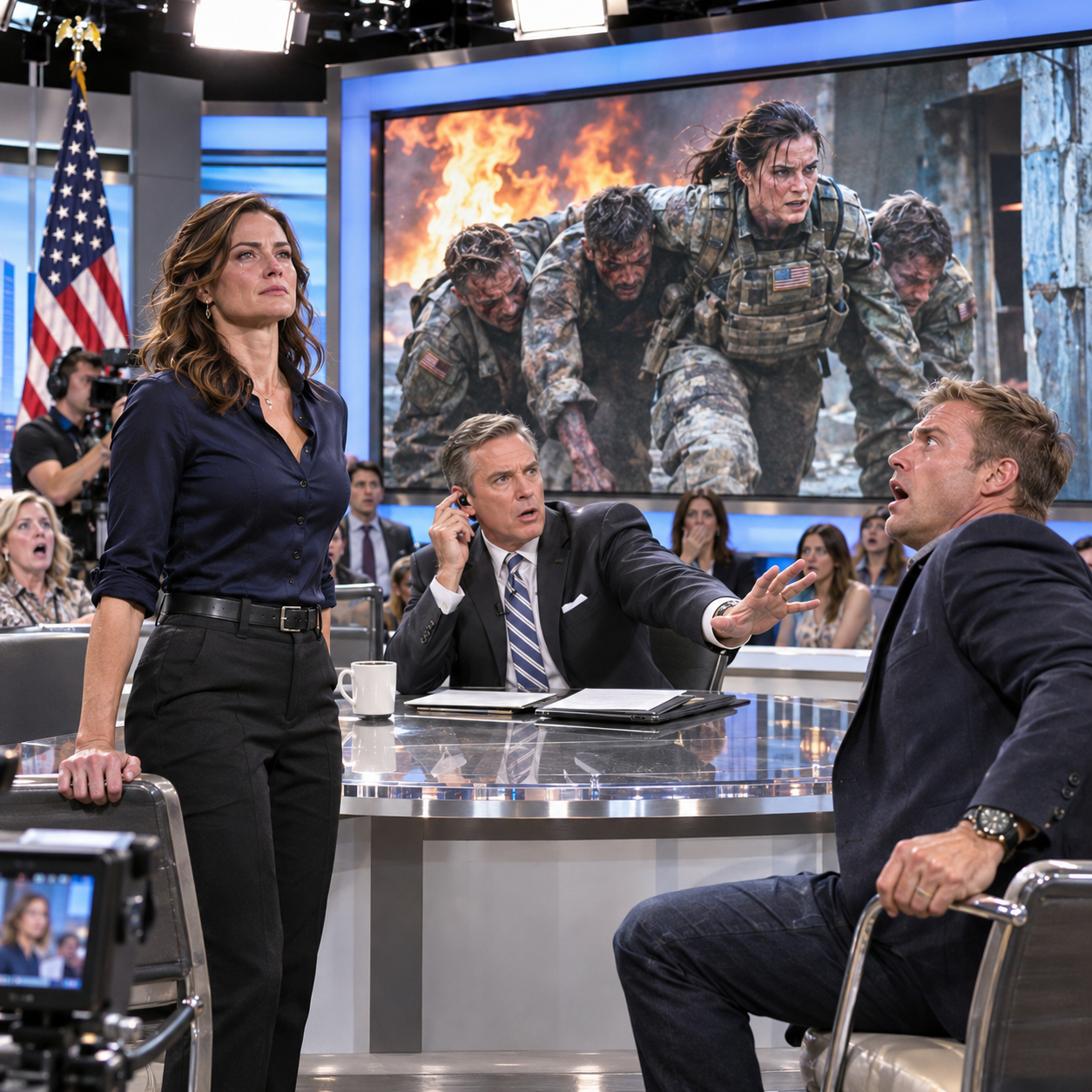
“She Left Us Behind!” My Former Squadmate Shouted On Live TV. Then The Host Received A Call From The Rescue Commander. “Play The Final Sixty Seconds,” He Ordered. The Screen Showed Me Dragging Three Wounded Soldiers Through Fire. My Accuser Went Pale When The Commander Paused The Footage. “Now Tell Everyone Who Locked That Exit.” The Truth Was Recorded.
My former squadmate accused me of abandoning our men inside a burning military bunker, and six million Americans watched him demand that I apologize. For three years, I had obeyed the orders that prevented me from defending myself, while he built a career on a version of events I knew was false. I refused to argue with him on television. Eleven days later, an envelope arrived containing a maintenance report that had supposedly been destroyed. One signature suggested the disaster had begun long before the storm.
Part 1
The first thing I noticed about the television studio was the smell. Under the expensive perfume and freshly cleaned carpet, there was a sharp electrical odor from the lighting equipment suspended above the stage. It reminded me of overheated wiring, and for one unpleasant second, I was back inside Ridge Outpost Four with concrete dust in my teeth and a man screaming my name.
I stopped beside the entrance until the feeling passed. A production assistant wearing a headset smiled at me and pointed toward a dressing room. “Captain Hartwell? We’re almost ready for you.”
“Leona is fine,” I told her.
I was thirty-five years old, medically retired from the Army, and no longer accustomed to anyone calling me Captain. These days, I coordinated emergency supply deliveries for a disaster-response organization outside Columbus, Ohio. My work involved warehouses, damaged highways, temporary shelters, and people who needed clean drinking water more urgently than they needed speeches about resilience.
The television appearance had seemed harmless when the invitation arrived. The program, The Nation at Nine, was producing a Veterans Day special about military personnel who continued serving their communities after leaving active duty. My former commanding officer had encouraged me to participate, saying it might help people understand how military rescue training translated into civilian emergencies.
My sister, Paige, had been less enthusiastic.
“Those shows don’t invite people because everything is going well,” she’d warned over dinner. “They invite people because somebody wants an argument.”
I told her she was being cynical. She reminded me that she worked in public relations and was professionally qualified to be cynical.
Nevertheless, I accepted.
I had spent three years avoiding cameras, interviews, and even ordinary conversations about the worst night of my life. I thought discussing disaster logistics might finally allow me to speak publicly about something useful without being reduced to the catastrophe at Ridge Four.
In the dressing room, a makeup artist adjusted the powder along a narrow scar beneath my jaw. I had earned that scar when a piece of metal struck my face during the collapse. My left shoulder still ached when the weather changed, and two fingers on my right hand had never recovered their full strength.
The artist noticed the uneven movement when I lifted my coffee.
“Old injury?” she asked.
“Something like that.”
She didn’t press.
I wore a dark navy suit, a white blouse, and a small veterans’ service pin. The producers had originally suggested my dress uniform, but I declined. I was no longer on active duty, and I didn’t want this interview to become another ceremony where everyone applauded sacrifice without asking what happened afterward.
At 8:42 p.m., a producer named Wren Calder appeared in the doorway holding a tablet.
“There’s been a slight adjustment to the guest lineup,” she said.
I looked up. “What adjustment?”
“We’ve added another veteran for a conversation about accountability and recovery.”
Something about her carefully neutral expression tightened my stomach.
“Who?”
She hesitated just long enough to answer the question before speaking.
“Gavin Sloane.”
I set down my coffee.
For three years, Gavin had been the public face of Ridge Four. His memoir, The Last Exit, had spent eleven weeks on the bestseller lists. He appeared at conferences, hosted a podcast, sold commemorative merchandise, and collected speaking fees that would have covered my annual salary several times over.
He described himself as the soldier who had tried desperately to save his teammates after their commander abandoned them during a catastrophic structural collapse.
The commander in his story was me.
“I’m not participating in a surprise confrontation,” I told Wren.
“He’s agreed to a respectful discussion.”
“That’s not what I said.”
She lowered her tablet. “We’re live in eighteen minutes. The network has already announced both names.”
I stood, feeling the familiar stiffness along my left shoulder.
“Then your network should have informed me.”
Wren glanced toward the hallway, where two technicians were carrying cables toward the stage. Her discomfort looked genuine, but she had known about Gavin before walking into my dressing room. I could see that much.
“You’ll have the opportunity to respond,” she said.
“Not to everything.”
She frowned. “What does that mean?”
“It means some things remain classified.”
I had been allowed to discuss the public findings: severe weather, structural failure, emergency evacuation, and casualties. Details concerning the facility’s systems, security arrangements, and portions of the rescue operation remained restricted under a classification agreement I had signed before my retirement.
Gavin understood that agreement. He had signed one too.
Unfortunately, restrictions on operational details hadn’t stopped him from making accusations that were difficult to disprove without discussing those same details. His lawyers had been careful with his memoir, filling it with personal impressions and statements that sounded factual while remaining just vague enough to defend.
I could say he was wrong. I couldn’t show the public exactly how.
Eleven days earlier, someone had slipped an envelope beneath the door of my apartment. Inside was a photocopy of a maintenance request for Ridge Four’s primary emergency exit. Most of the document was faded, but one sentence had been circled in blue ink: “Manual locking assembly may prevent emergency egress under load.”
The request carried a signature I recognized.
The disturbing part was that its signer had died during the collapse, and the official inventory listed the original maintenance file as destroyed.
I had forwarded the copy to my attorney, who had sent it through an authorized reporting channel. We hadn’t heard back. I hadn’t mentioned the envelope to Paige because I didn’t want her worrying about something I couldn’t explain.
Now I was being asked to sit across from the man whose name had appeared in the request’s routing history.
At 8:57, I stepped onto the stage.
The audience applauded politely. The host, Evan Locke, shook my hand with the practiced warmth of someone who had interviewed senators and movie stars without remembering a single conversation afterward.
Then the lights shifted.
Across the coffee table sat Gavin Sloane.
He looked older than I remembered, although the expensive haircut and tailored charcoal jacket disguised most of it. He had grown a short beard and wore a bronze commemorative coin mounted beneath his lapel. There was no visible trace of the frightened staff sergeant who had stood beside me inside Ridge Four.
He smiled without offering his hand.
“Long time, Captain.”
I sat down. “Gavin.”
The red lights above the cameras came on.
Evan introduced us as two veterans whose experiences at a classified military installation had taken dramatically different paths. He mentioned Gavin’s bestselling book, my humanitarian work, and the unresolved questions surrounding the disaster.
Then he leaned toward me.
“Captain Hartwell, for three years, Sergeant Sloane has maintained that your decisions cost lives at Ridge Four. Tonight, he’s agreed to speak directly to you.”
I looked toward the producer standing beside the main camera.
She wouldn’t meet my eyes.
Gavin took a slow breath, carefully arranging his face into the grief audiences expected from him.
“Two good men never came home,” he said. “Three more barely survived. And the person responsible has never admitted what she did.”
The studio became quiet.
I knew the two men he meant. Specialist Graham Fenwick had died in the lower communications section. Sergeant Adrian Cole had been killed when a support shaft collapsed. Their deaths haunted every survivor, including me.
But neither man had been under Gavin’s immediate protection that night. And the three injured specialists he claimed I had abandoned had been brought out alive.
Evan turned toward me.
“Why haven’t you addressed these allegations publicly?”
“Because the official review has not released all the relevant evidence,” I answered. “And because the families deserve facts, not speculation.”
Gavin laughed softly.
“That’s convenient.”
“It isn’t convenient for anyone.”
He leaned forward.
“Then answer one simple question. When the evacuation alarm sounded, did you leave your team behind?”
I could hear the air-conditioning above us.
“No,” I said.
Gavin shook his head and looked directly into the central camera.
“She left us behind!”
His voice cracked so perfectly that people in the audience gasped.
“She left us there while the building was coming apart. I heard men calling for help, and she was gone. I’ve spent three years wondering why she gets to sleep at night while the rest of us live with what happened.”
The audience began murmuring. Evan waited just long enough for the accusation to settle before asking whether I wanted to apologize.
I folded my hands to hide the trembling in my injured fingers.
“No,” I said. “I won’t apologize for abandoning people I did not abandon.”
Gavin stood and pulled the bronze coin from his lapel.
“Then look at this,” he demanded, dropping it onto the table. “Look at the names. Look at what your choices cost.”
The coin struck the glass with a hard metallic click.
I recognized the memorial emblem stamped onto its surface. I had helped design the original version for the families, before Gavin began selling copies through his website.
He had turned the dead into merchandise.
I looked at him and realized that whatever embarrassment the producers had planned was only the beginning.
Then the floor manager’s headset crackled.
A woman inside the control booth stood so abruptly that her chair rolled backward. She pressed a hand against the glass, pointed toward the studio entrance, and said something that made Wren’s face lose its color.
A production assistant hurried onto the stage carrying a telephone.
Evan stared at her in irritation.
“We’re live,” he whispered.
“I know,” she answered. “But Brigadier General Ingrid Sutter is asking for you.”
Gavin’s expression changed.
And for the first time that night, he stopped looking at the cameras.
Part 2
Brigadier General Ingrid Sutter had commanded the regional rescue operation on the night Ridge Four collapsed. When I last saw her, she was standing beside a helicopter with soot on her face, directing medics toward a stretcher while freezing rain struck the landing pad. She had been a colonel then, and I remembered her telling me to stop apologizing and let the surgeons do their jobs.
I hadn’t spoken to her in almost a year. Hearing her name in that television studio felt like seeing a familiar lighthouse during a storm, although I had no idea whether its light was meant for me.
Evan accepted the telephone reluctantly. “General Sutter, this is Evan Locke. We’re currently conducting a live interview, so perhaps we can arrange something after the broadcast.”
“Mr. Locke, your network received a verified public-release package concerning Ridge Outpost Four at 7:12 this evening. I am calling because your producers have continued broadcasting allegations that the released evidence directly contradicts.”
Evan glanced toward the control booth. Wren was already moving toward the technical director, speaking urgently into her headset.
“I’m not familiar with any package,” he said.
“Then I suggest you ask your executive producer.”
Gavin shifted in his chair. “General, with respect, this concerns what happened between the people who were actually inside that facility.”
“I know who was inside, Mr. Sloane. I commanded the team that brought them out.”
The audience became silent enough that I heard a camera motor adjusting its position. I kept my eyes on the telephone because looking at Gavin would have been too satisfying, and satisfaction was the last emotion I trusted in that moment.
Sutter explained that a security classification review had concluded earlier that day. Portions of the original emergency investigation, including selected camera recordings, had been cleared for public release after sensitive technical information was removed. The release did not resolve every outstanding question about Ridge Four, but it allowed investigators to correct several public claims without compromising protected systems.
Evan straightened in his chair. “Are you saying there’s evidence Captain Hartwell didn’t abandon her personnel?”
“I’m saying the public has been given an inaccurate account of the evacuation. Your network now possesses material showing what happened.”
Gavin interrupted before Evan could respond.
“With all due respect, cameras don’t show everything. There were blind spots. People have been manipulating this story since the investigation began.”
“You’re correct that cameras don’t show everything,” Sutter answered. “That’s why investigators compared the recordings with medical reports, radio logs, equipment records, and sworn witness statements.”
The word sworn made Gavin’s jaw tighten.
I knew why. He had given more than interviews after Ridge Four. He had submitted a sworn account during the formal inquiry, describing his movements and the condition of the emergency exit. I had read the publicly releasable summary, including his statement that he had remained near the access tunnel until the evacuation was complete.
That claim had always confused me. I hadn’t seen him there.
Evan asked Sutter whether she would participate by video. She agreed, provided the network showed the accompanying authentication information and did not alter the sequence. Within a minute, a technician established a remote connection from a military public affairs office.
The screen behind us changed from the program’s patriotic graphics to a plain video window. Sutter appeared in uniform beside a desk, with an American flag standing behind her. She looked tired, older than I remembered, and entirely uninterested in television drama.
“Captain Hartwell,” she said.
“General.”
“I owe you an apology for how long this has taken.”
I felt something tighten beneath my ribs. “You don’t owe me one, ma’am.”
“That isn’t your decision.”
Evan tried to resume control. “General, perhaps we could begin with what viewers should know about the events of November fourteenth.”
Sutter nodded. “Begin with the first released recording.”
The main display went dark, then brightened into grainy surveillance footage. A timestamp appeared in the corner above an identification line that had been partially obscured. The camera showed a narrow industrial corridor, its floor shining beneath emergency lights.
I recognized the place immediately.
Ridge Four had been built into the side of a mountain overlooking the North Pacific. Its upper structure housed communications equipment and support facilities, while four subterranean levels contained operations rooms, storage areas, and protected service corridors. The location was deliberately isolated, and weather reports frequently underestimated the violence of storms that struck the surrounding cliffs.
On November fourteenth, three years earlier, a powerful storm had battered the outpost for nearly twelve hours. We were already dealing with water intrusion and intermittent power failures when the first major structural alarm sounded.
I had been leading a five-person emergency response detail, including Gavin, assigned to assist personnel with evacuation and rescue operations. Our immediate objective was to move workers away from compromised sections and keep the secondary route accessible.
At 2:36 in the morning, something deep inside the mountain shifted.
I remembered the sound before anything else: a crushing metallic groan, followed by a vibration so violent that my teeth struck together. The corridor lights failed, returned in red, and failed again. Somewhere beyond the central operations room, a support assembly came apart with a noise like a freight train entering the building.
The released recording showed the first moments clearly.
Three specialists—Niko Serrano, Daniel Pryce, and Ellis Broder—were caught beneath a falling equipment gantry. A rolling storage rack toppled across the corridor, trapping another worker until a nearby technician dragged him free.
I watched my younger self appear through the smoke, helmet light sweeping across the floor. She dropped beside Niko, examined the collapsed frame, and started pulling loose equipment away from his legs.
I remembered what the camera couldn’t show. Niko’s breathing sounded wet and shallow. Daniel kept asking whether anyone had called his wife. Ellis was conscious for only a few seconds before his eyes closed again.
On the screen, Gavin entered the frame carrying a portable rescue harness.
I felt my fingers curl against my knees.
“Sergeant, bring the auxiliary rig,” my recorded voice said through the corridor’s emergency audio system. “Then hold the north access route. We have three casualties to move.”
Gavin appeared to hesitate.
He glanced toward the damaged ceiling, then toward the corridor leading away from us.
“That section’s coming down,” he said.
“I know. Get the rig.”
For years, I had replayed those few seconds, wondering whether a different order or a calmer tone might have changed what followed. I had never doubted Gavin was frightened. We all were. Fear wasn’t a moral failure, and I would have forgiven him for freezing.
What I couldn’t understand was everything he did afterward.
On the recording, Gavin set the rig beside the wall and disappeared down the north corridor. There was no visible injury, no exchange of orders, and no indication that I had directed him to leave.
Evan leaned toward the display.
“Where is Sergeant Sloane going?”
Sutter answered before Gavin could speak. “Toward the primary emergency exit.”
Gavin lifted his chin. “I was checking the evacuation route.”
“That is what your sworn report states,” Sutter said.
“And it’s the truth.”
The recording continued.
I worked with another technician, a young corporal named Iris Calder, to free the three trapped specialists. Iris had been working at an adjacent station when the collapse began. She barely weighed enough to handle the damaged lifting equipment, but she stayed with me, hauling steel and passing straps while emergency smoke filled the room.
We freed Daniel first. His left arm hung at an unnatural angle, and he could barely stand. Niko’s legs were pinned beneath the gantry, while Ellis lay unconscious underneath a fractured support panel.
The camera showed Iris pulling a rescue sled from storage. I helped her position Daniel on it before returning to Niko. By then, the emergency alarms were repeating a warning about imminent structural failure.
Every movement in the video seemed slower than I remembered. I could see my own hands searching for leverage beneath the steel. I could see Iris fighting to keep a lifting jack upright. And I could see, in the background, the empty doorway where Gavin should have been standing.
The worst part was knowing how much of that night the recording still couldn’t explain.
Evan turned toward me. His expression had changed from accusation to something resembling uncertainty.
“Captain, why didn’t you follow Sergeant Sloane?”
“Because three people couldn’t move,” I answered.
Gavin laughed sharply. “You can’t know what was happening near the exit. I was trying to get help.”
“Then let’s watch the exit,” Sutter said.
The display switched to an exterior security camera positioned beside a reinforced access hatch. Its battery-backed system had continued recording after the internal power failure.
At 2:39 a.m., Gavin appeared inside the escape corridor.
He was alone.
He reached the blast-resistant door and looked behind him. The camera clearly captured the movement of his shoulders as he waited, breathing hard.
Then he raised one hand toward the manual locking lever.
I stopped breathing.
I had dreamed about that door for three years, but until that moment, I had never seen what Gavin did on the other side.
His hand closed around the lever.
And the recording continued.
Part 3
Gavin pulled the locking lever downward.
On the security recording, the motion looked ordinary. A man reached for a handle and brought it toward his waist. There was nothing dramatic about the movement until the second steel bolt slid into position and the small indicator above the door changed from green to red.
Then the truth became impossible to misunderstand.
He had sealed the primary emergency exit while four people were still inside.
Evan stared at the screen. “Was that door supposed to be locked during an evacuation?”
“No,” Sutter replied. “The primary exit was required to remain available until the last personnel had cleared the danger area. The protective door could be secured against external hazards under specific circumstances, but the manual deadbolt was not to be engaged while personnel remained inside.”
Gavin gripped the arms of his chair. “You don’t understand. The pressure alarm was going off. I thought the door needed to be sealed.”
“Your sworn statement says you never touched the manual lock,” Sutter answered.
He opened his mouth, then closed it.
I had spent three years wondering whether Gavin’s testimony had contained an innocent mistake, an omission caused by trauma, or a deliberate lie. Seeing him search for an answer under the studio lights settled something inside me that I had been afraid to settle on my own.
He had known exactly what he was hiding.
The footage resumed. Gavin backed away from the secured door, glanced toward the camera, and continued along the protected evacuation corridor. He reached an external muster point just over two minutes later, where he reported that the primary route had become inaccessible.
What the public hadn’t known was that he identified me as the person responsible for closing it.
The rescue commander had never believed that account, but confirming the truth required evidence from systems whose existence and location had initially remained classified. The investigation had continued long after the public received its abbreviated findings.
Sutter directed the technician to display the next recording.
I appeared on the internal camera with Iris, dragging the rescue sled toward the exit. Niko and Ellis were secured with straps while Daniel moved beside us, supporting himself with one hand against the wall. The corridor was filling with smoke, and our helmet lights reflected from water running across the concrete.
I remembered reaching the door and pressing my shoulder into it.
Nothing happened.
I tried the emergency release. The mechanism moved slightly before stopping against something solid. I radioed the evacuation control point, but the damaged communications line returned only bursts of static.
“Open it,” Daniel had whispered behind me.
I pulled again. “I am.”
He started coughing so violently that Iris had to steady him against the wall.
On the television screen, I removed a portable cutting tool from my rescue kit. It had been intended for damaged hardware and vehicle extraction, not for defeating the locking mechanism of a military blast-resistant door.
But there was a narrow maintenance panel beside the internal release assembly. If I could remove the cover and reach the linkage, I might be able to disengage the bolt.
I had no idea whether the attempt would work.
The camera showed Iris pulling the injured men away from the sparks while I worked. At one point, I dropped the tool because my gloved hand had begun shaking uncontrollably. I picked it up, adjusted the power connection, and continued.
Evan looked from the recording to the scars on my hand.
“How long did that take?”
“Almost eleven minutes,” Sutter answered. “Captain Hartwell suffered burns and a significant inhalation injury. Corporal Calder kept the casualties positioned below the densest smoke while assisting with the emergency release.”
The footage showed me finally removing the damaged panel. I reached inside with a metal pry bar, pulled against the locking linkage, and fell backward when the internal mechanism released.
The door opened several inches.
Iris moved immediately, helping Daniel through before returning for the rescue sled. We pushed Niko and Ellis into the exterior access passage as the alarms changed from intermittent warnings to a continuous evacuation signal.
At 2:56 a.m., we emerged onto the upper landing.
The camera outside captured freezing rain blowing almost horizontally across the concrete. A helicopter’s searchlight moved through the darkness beyond the railings. Two members of Sutter’s rescue team were running toward us with stretchers.
Moments later, a section of the mountain above the lower facility collapsed, throwing a cloud of debris across the landing pad.
The recording ended.
For several seconds, nobody in the studio spoke.
I watched Evan study the darkened display. He had spent the opening segment treating me like a criminal who had escaped accountability. Now he couldn’t seem to decide whether he should apologize or continue asking questions.
Gavin decided for him.
“She was supposed to be in command,” he said. “Maybe I made a mistake with that door, but she was responsible for the entire operation. People died under her leadership.”
His voice had lost its theatrical grief. It sounded defensive, almost childish, and I recognized the tone from the night he had complained that I was taking too much time freeing Niko.
I turned toward him.
“Gavin, Graham Fenwick and Adrian Cole died before we reached the central operations corridor. You knew that when you gave your statement.”
He looked away.
“You also knew Niko, Daniel, and Ellis were alive when we brought them out. You visited them in the hospital. You spoke to their families.”
“I never said they all died.”
“You let people believe they did.”
A woman in the audience began crying quietly. I noticed her near the third row, wearing a pale green sweater and clutching a folded tissue.
Then I recognized her.
It was Daniel Pryce’s wife, Maribel.
She stood before anyone could stop her.
“My husband told investigators what happened,” she said, her voice shaking. “He told them she brought him out. Why did nobody ever ask him?”
Evan signaled for a microphone, but Maribel didn’t wait.
“After the accident, Daniel couldn’t drive or work for almost a year. Gavin came to our house with a camera crew and asked him to tell his story. When Daniel wouldn’t accuse Captain Hartwell, Gavin never called us again.”
I hadn’t known that.
Daniel and I had stayed in contact during his rehabilitation, but we rarely discussed Gavin. Each of us had been trying to build a life around injuries that didn’t disappear when the military paperwork ended.
Maribel wiped her cheeks.
“My husband is watching tonight. He wanted to come, but traveling is still difficult for him. He told me to make sure you knew he remembers who carried him.”
I pressed my lips together until I could trust myself to speak.
“Tell him I remember who kept everyone calm when the lights went out,” I said.
Sutter allowed the room to settle before continuing. She explained that the released material had been reviewed by independent technical specialists and military investigators. Their conclusions did not depend solely on the camera footage.
“Gavin Sloane submitted a sworn account containing several statements contradicted by authenticated records,” she said. “Those discrepancies are being examined by the appropriate investigative authorities.”
Evan turned toward Gavin. “Did you knowingly give investigators a false statement?”
Gavin stared at the floor.
“On advice of counsel, I’m not answering questions about an ongoing investigation.”
It was the first sensible thing he’d said all night.
Sutter continued, “And Captain Hartwell was not the subject of an adverse finding for abandoning her personnel. The record establishes that she remained with the casualties and assisted their evacuation.”
I had expected those words to feel like victory. Instead, I felt a terrible exhaustion, as though someone had finally allowed me to put down a weight I’d been carrying so long that I’d forgotten how to stand without it.
Evan cleared his throat. “Captain Hartwell, is there anything you would like to say to Sergeant Sloane?”
I looked at Gavin’s commemorative coin on the table.
There were two names engraved along its edge. Both belonged to men whose families still visited the military cemetery every November.
“I want him to stop using the dead to sell a story,” I said. “And I want the people who helped spread that story to examine why they believed it so easily.”
Evan’s face reddened.
I removed my microphone and placed it beside the coin.
I had no intention of staying for the network’s attempt to transform the truth into another profitable television segment.
As I walked toward the exit, I heard Sutter speaking again.
“There’s one additional matter the public should understand,” she said. “The investigation also identified maintenance warnings concerning the emergency door assembly before the disaster.”
I stopped.
“Those warnings,” Sutter continued, “may be connected to failures in the facility’s safety-reporting process. The newly released records establish who received them, although the broader investigation remains open.”
Behind me, Gavin said something I couldn’t hear.
I thought of the photocopied maintenance report waiting in my attorney’s office, the one carrying the signature of a man who had died at Ridge Four.
For three years, I had believed Gavin’s betrayal began when he locked that door.
Now I wondered whether it had begun weeks earlier, when someone decided the door didn’t need to be fixed.
Part 4
Outside the studio, Washington was cold and damp. A line of dark vehicles moved slowly beneath the streetlights, their headlights stretching across the wet pavement. I stood under the entrance canopy, trying to remember where the driver had arranged to meet me, while my phone vibrated so frequently that the screen never seemed to go dark.
Paige called first.
I answered before she could speak. “I’m okay.”
“No, you’re not,” she said. “You’re standing outside somewhere pretending you’re fine because that’s what you do.”
I looked across the street, where a delivery driver was struggling to close the back door of his van.
“Did you watch?”
“Every minute.”
“Then you know why I left.”
“I know. I’m proud of you for leaving.”
I closed my eyes. The television interview had ended less than five minutes earlier, but I already felt as though the entire country had entered my private life. Messages were coming from numbers I didn’t recognize. Reporters wanted immediate statements, acquaintances wanted explanations, and people who had believed Gavin were suddenly offering apologies they could have delivered at any point during the previous three years.
“Can you come home tonight?” Paige asked.
“My flight’s tomorrow morning.”
“Then don’t read anything until you get here.”
I promised I wouldn’t.
I broke that promise before reaching the hotel.
The first headline described me as a vindicated military hero. The second called Gavin a disgraced liar. A third featured a photograph of the moment he grabbed the locking lever, frozen beneath a caption asking whether criminal charges were imminent.
The speed of the reversal made me uncomfortable. Millions of strangers had decided who I was based on one television segment. Now they had apparently decided again. The only difference was that the second judgment happened to be closer to the truth.
At the hotel, I ordered soup, ate three spoonfuls, and called my attorney, Ruth Bellamy.
Ruth had represented me during a previous attempt to challenge Gavin’s public claims. She was practical, patient, and almost impossible to impress.
“I saw the broadcast,” she said. “I also received a call from the network’s legal department.”
“Already?”
“They’re concerned about statements made by their host. We should preserve everything, including the invitation describing the program as a veterans’ service interview.”
I sat on the edge of the bed.
“I don’t want another three years of fighting.”
“Neither do I. But you’re entitled to decide whether they profited from an accusation they had reason to question.”
I thought about Wren’s expression when she announced Gavin’s name. The network had known the confrontation would be painful. The producers had simply assumed my inability to discuss classified evidence meant there was no risk in humiliating me.
“Can we deal with it without another television appearance?”
“Absolutely.”
The next morning, General Sutter called me from her office.
She said investigators had attempted to contact Gavin after the broadcast through his attorney. There was no immediate arrest because the investigation involved more than what viewers had seen, and the agencies responsible needed to preserve their procedures.
“The video is compelling,” she told me, “but compelling television and admissible evidence aren’t identical things. We have to establish every element properly.”
“I understand.”
“There’s another reason I wanted to speak with you.”
I turned away from the hotel window.
“Ridge Four’s maintenance records are under review again. Your attorney submitted a document eleven days ago that appears to correspond with an item missing from the official archive.”
I pictured the blue circle around the warning about the door.
“Is it authentic?”
“We believe so. We haven’t established why it was listed as destroyed.”
“Did Gavin see it before the collapse?”
Sutter paused.
“His name appears in the routing records. That’s all I can confirm right now.”
When I returned to Ohio, Paige met me at the airport with a paper cup of coffee and no questions. She hugged me beside the baggage claim, holding on longer than usual, and drove us home through neighborhoods where children were playing basketball in the afternoon sunlight.
For nearly a week, I stayed away from the news.
I returned to work, inspected supply inventories, resolved a disagreement about delivery vehicles, and helped arrange temporary heating equipment for a flood-damaged shelter. The ordinary tasks settled me. Nobody in the warehouse asked for an inspirational speech, and I appreciated them for it.
On the sixth day, Daniel Pryce called.
His voice was rougher than I remembered, but he sounded steady.
“Maribel says she embarrassed the hell out of that television host,” he told me.
I laughed for the first time since the interview.
“She did.”
“Good. Somebody needed to.”
We talked about his daughter’s school play and the physical therapy exercises he still hated. Then he grew quiet.
“I watched the video three times, Leona. I never remembered how you got that door open.”
“You were having a pretty terrible night.”
“I remember asking you to leave me.”
I leaned against the kitchen counter.
He had begged me to take the others and go. His breathing was deteriorating, and he believed the delay would kill all of us. I had refused, partly because I couldn’t bear making that choice and partly because leaving him wouldn’t necessarily have helped the others.
“You told me we’d all leave together,” Daniel said.
“I wasn’t sure we would.”
“I know that now.”
Neither of us spoke for a moment.
“I wanted to tell you something,” he continued. “Gavin offered me money two years ago. Not directly. His publisher contacted me about contributing to the book, and the contract included a fee if I agreed to their outline.”
I straightened.
“What outline?”
“One where you ignored warnings and ran before the rest of us. I told them I couldn’t sign it because it wasn’t true. They said memory gets unreliable after trauma.”
I felt sick.
Daniel said he had kept the emails and sent them to investigators after the television broadcast. I told him to forward copies to Ruth as well, and he agreed without hesitation.
That evening, I sat at my kitchen table looking at the message he sent. The proposed chapter outline described Gavin as the last man attempting to reach three injured specialists after an officer-led evacuation had already begun.
It wasn’t merely an account of someone remembering a traumatic event incorrectly. Someone had actively tried to purchase support for a version of the story.
Eleven days after the broadcast, another envelope arrived at my apartment.
It was thicker than the first, and my address had been written by hand. Inside was a short letter from a civilian maintenance analyst named Mira Tolland, who had worked at Ridge Four before the collapse.
She explained that an older archive of contractor inspections had been discovered during the declassification review. A maintenance report previously believed destroyed had been recovered among misfiled training materials. She had provided the original to investigators, and she enclosed a copy of the newly cleared pages that she believed I deserved to see.
The report was dated twenty-three days before the disaster.
Graham Fenwick, one of the two men who died, had documented recurring problems with the emergency door’s locking mechanism. He also noted unusual movement around a support bracket near the communications level following repeated water intrusion.
His recommendations were clear: restrict use of the affected corridor, inspect the supporting structure, and repair the locking assembly before normal operations resumed.
Someone had marked the report “Priority Review.”
Six days later, a second form changed the status to “Corrective Action Completed.”
But the attached work log contained no replacement parts, no inspection photographs, and no technician hours.
Two signatures appeared at the bottom.
One belonged to civilian facilities supervisor Malcolm Dace.
The other belonged to Gavin Sloane.
I read the form three times, searching for an explanation that didn’t make me feel worse.
Gavin hadn’t merely abandoned us when the emergency began. He had acknowledged a safety problem weeks earlier, then signed paperwork declaring it resolved without a documented repair.
The records didn’t establish whether that failure caused the collapse. Only a full engineering investigation could answer that. But they proved that the men responsible for certifying the corrective action had known about a danger that remained unaddressed.
I immediately photographed the pages and called Ruth. She told me to preserve the envelope, avoid contacting the sender directly, and let investigators authenticate the materials against the original.
After we hung up, I returned to the kitchen table.
For three years, Gavin had accused me of failing the men we served with. He had made himself the voice of accountability while benefiting from a story that concealed his own decisions.
Now I understood why the maintenance report frightened him.
If the original warnings had been properly addressed, we might never have faced that locked door at all.
And the two men whose names he had used to sell his book might still have been alive.
Part 5
The investigation lasted another nine months.
During that time, I learned more about Ridge Four than I had discovered during all the years I served there. Investigators examined construction records, maintenance schedules, weather reports, and equipment inspections dating back nearly two years before the collapse. They interviewed surviving personnel, civilian contractors, engineers, and administrators who had approved the facility’s operating status.
The findings were more disturbing than any single act of cowardice.
The storm had been extraordinary, but the facility was supposed to withstand severe weather. Investigators found that repeated water intrusion had weakened part of the supporting structure, while inspections intended to identify the damage had been postponed or improperly documented. Several maintenance concerns had been marked resolved despite the absence of completed repairs.
Malcolm Dace, the civilian supervisor whose signature appeared beside Gavin’s, had been under pressure to keep the installation operational. Delays threatened a major contract review, and unresolved safety deficiencies could have triggered costly restrictions.
Instead of reporting the problems honestly, Dace approved corrective-action paperwork that overstated the work performed.
Gavin had signed off on the emergency exit’s condition after receiving Fenwick’s warning. Investigators established that he knew the locking assembly had not received the recommended repair.
None of that proved either man had predicted the catastrophic collapse. But both had helped conceal hazards that should have been addressed, and their false records had prevented decision-makers from understanding the actual condition of the facility.
The engineering panel concluded that the neglected structural problems had contributed materially to the failure. The storm triggered the final collapse, but the damage was worsened by deficiencies that earlier inspections should have identified.
When Ruth explained the findings, I thought of Graham Fenwick writing his report twenty-three days before his death.
He had recognized a problem. He had followed procedure. He had put the warning in writing.
And the people responsible for acting on it had signed a form saying everything was fine.
I used to believe the worst moment at Ridge Four was the instant Gavin locked the exit. Now I understood that the disaster had been shaped by smaller decisions made over weeks and months, in offices where nobody was afraid for his life.
The people involved had treated safety warnings as paperwork that needed clearing.
On an ordinary day, those decisions looked like administrative shortcuts.
During a mountain storm, they became matters of life and death.
Gavin’s attorney contacted Ruth shortly before federal prosecutors announced their charging decisions.
The message said Gavin wanted to apologize privately. He claimed he had been overwhelmed by fear during the collapse and had spent years struggling with guilt. His attorney suggested that a confidential conversation might help both of us move forward.
I read the message twice.
Then I called Ruth.
“Tell him I don’t want to speak with him.”
“Are you certain?”
“Yes.”
She didn’t question my decision.
I understood fear. I had felt it when the ceiling broke apart, when Daniel stopped responding to my questions, and when the emergency door refused to open. I knew what it meant to make decisions while your body was screaming at you to run.
But Gavin’s fear during the collapse did not explain three years of interviews, merchandise sales, manufactured accusations, and attempts to persuade injured veterans to support his story.
He had been safe when he signed his publishing contract.
He had been safe when he repeated false accusations on television.
He had been safe when his representatives offered Daniel money to endorse a fabricated narrative.
Those were choices he made long after the danger had passed.
I didn’t owe him the comfort of forgiveness.
The federal investigation ultimately resulted in criminal charges connected to false official statements and obstruction of the inquiry. Gavin later entered a guilty plea to two offenses, admitting that he had knowingly misrepresented his actions at the emergency exit and concealed material information from investigators.
Malcolm Dace faced separate charges arising from falsified maintenance records. The contracting organization lost its authorization to perform certain federal facility maintenance work, and additional administrative proceedings examined the officials who had accepted its assurances without sufficient verification.
The legal process couldn’t determine every individual contribution to the deaths at Ridge Four. It didn’t establish that any particular repair would certainly have saved Graham and Adrian.
That uncertainty mattered.
I had spent years watching Gavin build a profitable story by pretending to know things no witness could honestly know. I wasn’t going to replace his false certainty with my own.
What the evidence established was enough: serious warnings had been ignored, the emergency exit had been improperly secured, and Gavin had lied repeatedly to conceal his conduct.
The publisher withdrew The Last Exit from further distribution after the investigation’s findings became public. Gavin’s speaking engagements disappeared, and his commemorative merchandise business shut down.
I didn’t celebrate those announcements.
They couldn’t restore Daniel’s injured arm, Niko’s damaged legs, or the years Ellis spent recovering from his neurological injuries. They couldn’t return Graham and Adrian to their families.
The television network eventually issued a formal correction and a public apology. Its internal review found that producers had withheld relevant information about the nature of the interview and failed to apply appropriate scrutiny to allegations they knew I would have difficulty answering because of classification restrictions.
Through Ruth, I reached a confidential civil settlement with the network.
Part of the money helped cover the legal expenses I had accumulated defending myself. I committed another portion to a fund supporting rehabilitation and emergency financial assistance for injured service members and their families.
It wasn’t a grand gesture. I knew how quickly medical appointments, travel expenses, lost wages, and childcare costs could exhaust a family’s savings.
I wanted the money to do something more useful than purchase another advertisement featuring my face.
Six months after the criminal proceedings began, I testified before a congressional oversight panel examining safety reporting at government installations.
I brought no dramatic presentation. I read from my prepared statement, answered questions, and explained how emergency procedures fail when maintenance deficiencies are treated as completed tasks.
One member of the panel asked whether I believed stronger accountability measures would prevent tragedies like Ridge Four.
“They would help,” I said. “But accountability can’t begin after people die. It has to exist when somebody first reports that something is wrong.”
The room was silent for a moment.
Then I continued.
“Graham Fenwick did what he was supposed to do. He documented the problem. The system failed when other people decided his warning was inconvenient.”
I left the hearing with Paige beside me. We ate lunch at a small diner near the Capitol, where the waitress was more concerned about whether we wanted additional coffee than about anything I’d said on national television.
I appreciated that more than I could explain.
Over time, my life became quiet again.
I continued working in disaster logistics, eventually accepting a regional training position that allowed me to develop evacuation planning exercises for civilian emergency teams. My shoulder still hurt in cold weather, and I still disliked rooms without visible exits.
Some nights, I woke remembering the sound of that steel bolt sliding into place.
But the nightmares came less often.
I began seeing a counselor again, not because I thought the truth should have cured everything, but because I finally understood that proving I wasn’t responsible for Gavin’s actions didn’t erase what I had experienced.
I learned to talk about Ridge Four without feeling obligated to defend myself in every sentence.
Daniel occasionally visited with Maribel and their daughter. Niko sent photographs from his fishing trips, usually accompanied by complaints about the weather. Ellis returned to college and eventually found work helping veterans navigate disability services.
Iris Calder, who had held the rescue sled steady while I opened the door, became an emergency management instructor.
She visited Columbus one spring weekend and brought a photograph from our first training assignment together. We were standing beside a rescue vehicle, grinning into the camera, looking far too confident for two people who had only recently learned how much they didn’t know.
“I found this cleaning out a drawer,” she said.
I examined our younger faces.
“You looked terrified of the instructor.”
“I was terrified of the instructor.”
“You still passed.”
“Because you stayed after class and practiced with me.”
I shook my head. “You passed because you worked.”
She smiled and put the photograph on my refrigerator.
We didn’t talk much about Ridge Four that afternoon. We went grocery shopping, cooked dinner, and argued about whether her new apartment needed curtains.
It was wonderful to spend time together without either of us being defined by the worst night we’d survived.
On the third anniversary of the disaster after the broadcast, I attended a small memorial service for Graham Fenwick and Adrian Cole.
Their families had chosen a quiet gathering at the military cemetery rather than a public event. There were no television crews, no elaborate speeches, and no merchandise tables.
I stood near the back with Iris, Daniel, Maribel, Niko, and Ellis.
Graham’s widow, Rebecca, approached me after the ceremony. Her daughter, now old enough to understand why her father wasn’t coming home, held her hand.
Rebecca had once been uncertain what to believe about my actions. I knew because she’d told me so during a difficult telephone conversation after Gavin’s first interviews.
Now she hugged me.
“Graham would have wanted those warnings taken seriously,” she said.
“I wish they had been.”
“So do I.”
Her daughter looked up at my service pin.
“Did you know my dad?”
“Yes,” I answered. “He was very good at his job.”
She smiled faintly.
“Mom says he fixed everything.”
“He certainly tried.”
Rebecca’s eyes filled with tears, but she kept smiling as she led her daughter toward the others.
I remained beside the memorial for several minutes after most people had left.
Graham and Adrian were gone, and no court decision or public apology could change that. Their families would continue carrying losses that the rest of the world could acknowledge but never fully understand.
I thought about the two men as they had been before the disaster.
Graham kept a battered notebook filled with equipment sketches and complained whenever someone borrowed his tools without returning them. Adrian made terrible coffee, listened to old country music, and insisted he could cook a better steak than anyone stationed at Ridge Four.
Those were the details I wanted to remember.
Not the names engraved on Gavin’s merchandise.
Not the accusations shouted beneath studio lights.
Just two ordinary men who had deserved to come home.
When I returned to my car, I found a message from Ruth. Gavin’s attorney had forwarded another request for personal reconciliation, saying he wanted to express remorse now that the legal proceedings were reaching their conclusion.
I didn’t open the attachment.
I sent Ruth a brief reply asking her to decline any further personal contact. Then I put my phone away and drove home.
That evening, Paige came over with takeout, and we ate on my back porch while the sun disappeared behind the trees. She asked whether I felt relieved that the investigation was finally ending.
I considered the question.
“Somewhat,” I said. “I think I spent so long waiting for everyone to believe me that I forgot I was allowed to live without their permission.”
Paige nodded.
“That sounds like a good place to start.”
After she left, I went into the kitchen and looked at the old photograph of Iris and me on the refrigerator.
We had been young, confident, and convinced that following the correct procedures would always be enough. I knew better now.
Courage mattered, but so did preparation. So did honest records, functioning equipment, and people willing to report uncomfortable truths before a crisis forced everyone to confront them.
At Ridge Four, Gavin had chosen to protect himself by closing a door on the people who trusted him.
I had spent years believing I needed him to admit what he’d done before I could move forward.
I didn’t.
The investigators had established the facts. The families knew what happened. The surviving members of my team were building lives that belonged to them, not to the disaster.
And I was building mine.
I never forgave Gavin Sloane, and I never spoke to him again.
For the first time in years, his silence meant absolutely nothing to me.
THE END!
Disclaimer: Our stories are inspired by real-life events but are carefully rewritten for entertainment. Any resemblance to actual people or situations is purely coincidental.