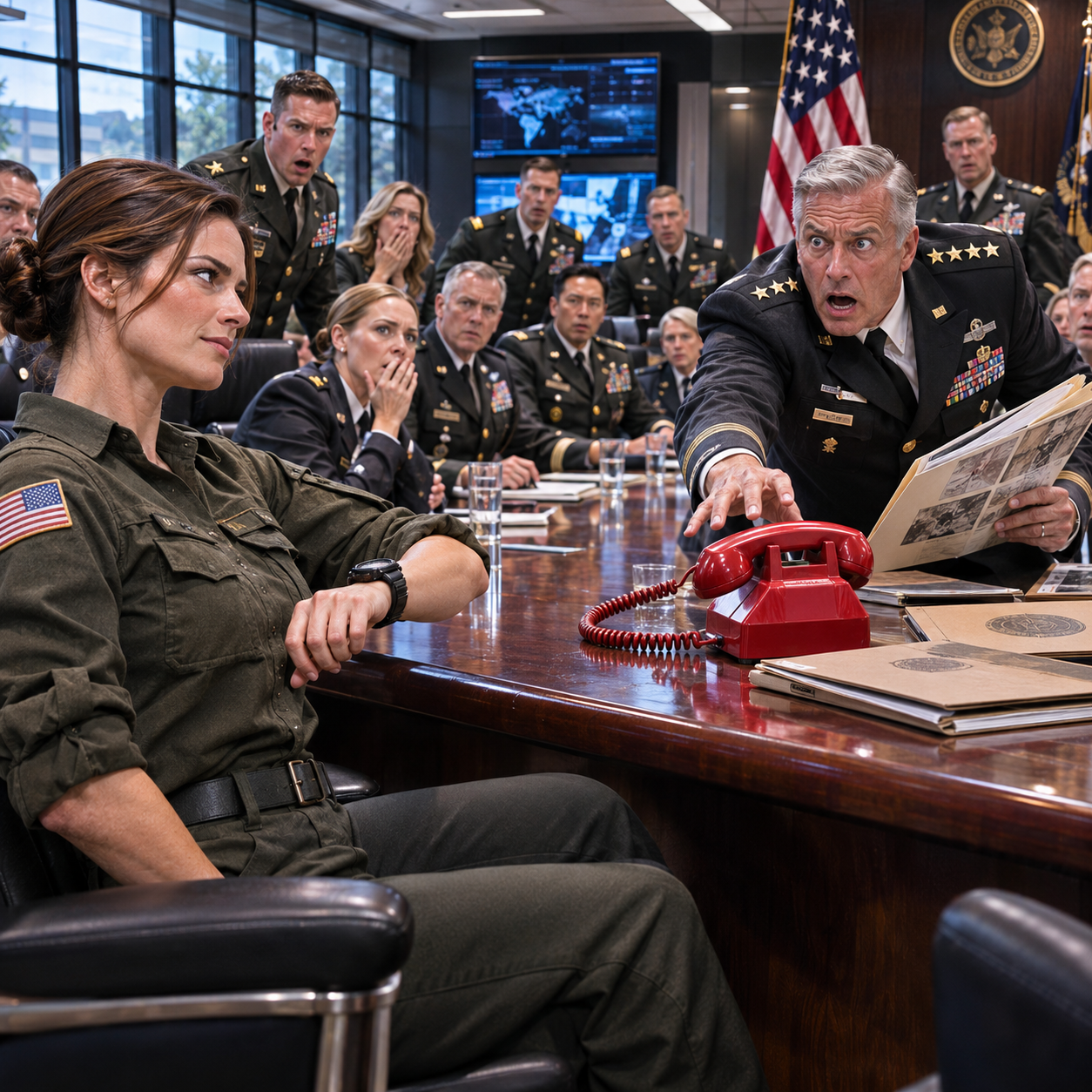
“She Washes Floors For Low-Ranking Soldiers,” My Sister Giggled To Her Billionaire Guests. Suddenly, Four Secret Service Agents Parted The Crowd. A Decorated 4-Star General Walked Straight To Me And Snapped A Salute: “Commander, The Pentagon Is Awaiting Your Orders!” My Sister Choked On Her Drink.
My sister handed me yellow rubber gloves in front of her fiancé’s wealthy family and announced that I cleaned military bathrooms for a living. Twenty people laughed. My mother stared at her plate, and I quietly thanked my sister for the gift. Then the dining room doors opened, and a four-star general walked straight toward me. Three days later, a federal investigator showed me a document bearing my signature. I had never signed it, and the person who submitted it knew exactly where I lived.
Part 1
The first thing my sister Sloane ever taught me was that embarrassment could be manufactured, packaged, and presented as entertainment. She had been practicing since we were children, when she discovered that making me look foolish was the fastest way to make our mother laugh. At thirty-nine, I had learned to recognize the warning signs: her overly sweet voice, the little tilt of her chin, and the way she looked around a room before delivering a remark meant to hurt. That Friday evening, all three appeared before the appetizers had even arrived.
We were sitting in the private dining room of the Hawthorne Club, an expensive establishment outside McLean, Virginia, where the carpets were thick enough to swallow footsteps and the servers seemed trained to anticipate a guest’s next breath. Sloane was celebrating her engagement to Adrian Kessler, whose family owned a defense consulting company that appeared regularly in business magazines. Twenty relatives, business associates, and carefully selected friends occupied the long dining table. I had been assigned a chair near the far end, between a distant aunt and a man who had spent twenty minutes explaining why government employees lacked ambition.
I wore a navy-blue dress I’d bought for a colleague’s retirement dinner, simple black heels, and the silver watch our late father had given me when I graduated from college. My car, a seven-year-old Honda Civic, was parked between two vehicles that probably cost more than my annual salary. None of that bothered me. What bothered me was the small wrapped box beside Sloane’s chair and the way she kept glancing at it whenever someone asked about my work.
For eleven years, I had worked within the Department of Defense on communications resilience and cybersecurity. My current position involved coordinating specialists responsible for protecting essential military communications when systems failed or came under attack. The work was demanding, much of it sensitive, and almost none of it suitable for dinner conversation. My office was located in a renovated military compound whose original brick buildings were still casually called the barracks.
Sloane had visited the installation once to drop off something for me. She remembered the old buildings, the security gate, and the fact that I had been wearing ordinary work clothes instead of a uniform. Somehow, this became proof that I was a janitor. I had corrected her twice over the years, explaining that I worked in technical operations, but she preferred the version that made a better joke.
Our mother, Elaine, never challenged her. After Dad died, Mom had become even more dependent on Sloane’s approval, adjusting her opinions to match whatever made her eldest daughter happy. When Sloane bought designer furniture on credit, Mom called it ambition. When I paid off my student loans and purchased a modest townhouse, Mom asked whether I was embarrassed to live alone.
That evening, Sloane had apparently decided my imaginary cleaning career deserved an entire performance.
She tapped a butter knife against her champagne glass, producing a delicate ringing sound. Conversations stopped, and Adrian draped an affectionate arm around the back of her chair. He was tall, impeccably dressed, and possessed the effortless confidence of someone who had never worried about a late mortgage payment. His father, Walter Kessler, leaned forward with the approving expression of a man accustomed to being entertained.
“Before dinner, I want to do something thoughtful for my little sister,” Sloane announced. “Corinne works incredibly hard, and I don’t think she gets enough recognition.”
I watched her reach for the box.
“Most of you don’t know this, but Corinne cleans the barracks for low-ranking soldiers,” she continued. “It’s honest work, of course, even if it isn’t glamorous.”
Several guests smiled uncertainly. Adrian’s mother, Patricia, raised her eyebrows, while Walter gave a small, amused grunt. My mother stared at her folded napkin. Nobody asked whether Sloane was telling the truth.
She approached my chair and placed the gift in front of me. The box was wrapped in ivory paper with a gold ribbon, the kind of packaging normally used for expensive jewelry. I untied it slowly, aware that nearly everyone at the table was watching. Inside lay a pair of bright yellow industrial rubber gloves, a miniature bottle of bathroom cleaner, and a printed card that read, “For the hardest-working scrubber in Virginia.”
Laughter traveled down the table in little bursts.
“You’ll finally have professional equipment,” Sloane said, grinning. “Don’t say I never support your career.”
I looked at the gloves, then at my sister. She was waiting for anger, tears, or the kind of public argument she could later describe as my ruining her engagement dinner. Instead, I replaced the lid and said, “Thank you, Sloane. That was very revealing.”
Her smile faltered for half a second.
A server appeared with the next course, and Sloane returned to her seat as if she had delivered a particularly charming toast. Mom leaned toward me and whispered, “Please don’t make this difficult. It’s her special night.”
I studied her face, searching for even a flicker of embarrassment on my behalf. There was none, only the familiar anxiety that I might disrupt whatever Sloane wanted.
“I haven’t said anything difficult,” I replied.
Across the table, Walter began asking Adrian questions about a government contract his company hoped to finalize. The conversation immediately became technical enough to catch my attention, though I kept my eyes on my plate. Walter mentioned a communications modernization project, an outside integration partner, and a delayed compliance review. Adrian answered quietly, then glanced toward me before changing the subject.
That glance was strange.
I had met Adrian only four times, but he had always seemed disproportionately interested in my workplace. At Christmas, he had asked whether I carried a government credential and whether civilian employees used the same security systems as uniformed personnel. At Easter, he wanted to know which installation buildings had been renovated. I had assumed he was making awkward conversation with someone whose profession overlapped his industry’s interests.
Now I remembered that Sloane had once requested a copy of my old employee photograph for a family presentation. She claimed Mom wanted it for a birthday slideshow. I had declined, but Mom still had boxes of my college paperwork and early employment records in her basement.
I glanced at Walter again. He was whispering something to Adrian, whose expression had turned unusually tight.
At 7:41, my personal phone vibrated against my leg. A message from my colleague Leila Hart appeared on the screen: “Urgent. Work channel unavailable. Are you still at Hawthorne?”
Leila was not someone who exaggerated. She supervised incident coordination for one of our partner teams and rarely contacted me outside approved channels. I typed a brief reply saying I was at the club, then slipped my phone beneath my napkin.
At 7:43, the chandeliers flickered.
The music stopped abruptly, and bright headlights swept across the courtyard windows. A server near the entrance pressed a hand against his earpiece. Two black SUVs had stopped beside the main entrance, and several security personnel were moving quickly through the lobby.
Walter stood halfway out of his chair. “What’s going on?”
The double doors opened before anyone could answer.
Four security officers entered, positioning themselves near the exits. Behind them came a broad-shouldered man with silver hair, wearing the dark service uniform of a United States Army general. Four stars gleamed on each shoulder, and the ribbon bars across his chest marked decades of service.
I recognized General Thomas Rourke, Vice Chairman of the Joint Chiefs of Staff.
We had worked together during a major communications failure overseas two years earlier. He knew my team, understood what we had prevented, and had personally insisted that their work receive recognition without compromising classified details. I also knew he had been attending a closed leadership gathering elsewhere in the club that evening.
Walter stepped forward and extended his hand.
“General Rourke, sir. Walter Kessler. We’ve met at the defense industry forum.”
The general barely acknowledged him.
He walked straight past the head of the table, past Adrian and my stunned sister, and stopped beside my chair. Then, to the astonishment of everyone watching, he raised his right hand in a crisp, deliberate salute.
“Director Bellamy,” he said. “I’m sorry to interrupt your evening.”
I stood immediately.
“General. What’s happened?”
His expression made the room feel suddenly colder.
“We’ve identified a serious compromise affecting a defense communications program,” he answered. “Your team’s contingency measures are being activated. We need you at the coordination center.”
A chair scraped sharply behind me.
Sloane was staring at him with her mouth slightly open, a champagne glass suspended in her hand.
“Director?” she repeated.
General Rourke did not answer her. Instead, he lowered his voice so only I could hear.
“Corinne, there’s another problem. The company connected to the compromised equipment has submitted documents claiming you personally authorized an exception.”
My eyes moved toward Walter Kessler.
For the first time that evening, he wasn’t smiling.
Part 2
The security officers escorted me through the club’s side entrance, away from the curious guests gathering in the lobby. Cold November air struck my face, carrying the smell of wet leaves and exhaust. Behind us, Sloane hurried through the doors in her expensive heels, calling my name with a desperation I had never heard from her before.
“Corinne! Wait!”
I stopped beside the SUV.
“Is this some kind of joke?” she demanded. “Why did that general call you director?”
“Because that’s my job title.”
“You told us you worked at the barracks.”
“I told you where I worked. You decided what I did there.”
Her cheeks flushed. “You let me embarrass myself in front of everyone!”
I looked at her for a long moment. Even now, she couldn’t bring herself to acknowledge what she had done to me. Her concern wasn’t that she had humiliated her sister; it was that she had humiliated herself in front of people she wanted to impress.
“You bought the gloves, Sloane,” I said. “Nobody made you.”
Adrian appeared behind her, breathing hard. He looked past me toward General Rourke, who was speaking with a security officer near the second vehicle. For an instant, Adrian seemed ready to approach him, but then he turned back to me.
“Corinne, whatever this is, my family’s company has an excellent relationship with the Department of Defense.”
“Then the company’s records should speak for themselves.”
His face changed. It was subtle, but unmistakable: a momentary tightening around the mouth, followed by a carefully rehearsed expression of concern.
Before he could answer, I climbed into the SUV.
As we pulled away, I saw my mother standing beneath the club’s entrance canopy. Sloane was crying angrily beside her, and Mom had already put an arm around her shoulders. Neither of them looked toward the departing vehicle.
General Rourke sat across from me. He loosened his collar slightly and studied the city lights sliding across the windows.
“You handled that room better than most people handle an inspection,” he said.
“I’ve had practice.”
“That salute surprised them.”
“It surprised me.”
He gave a tired smile. “It wasn’t about rank, Corinne. I remember what your team did when those field communications went down. Some people deserve to know their work matters.”
I appreciated the sentiment, but I was already thinking about the reported compromise. Our office had spent months building fallback procedures for precisely the kind of failure he had described. A problem involving a private contractor could be serious, especially if unauthorized changes had spread beyond the company’s designated systems.
“What do we know?”
“An outside integration provider introduced equipment that wasn’t properly accounted for in the approved configuration. We’ve isolated the affected connections. Your people are determining whether any operational information was exposed.”
“And the authorization?”
“That’s what concerns me.”
He passed me a sealed folder containing an unclassified administrative summary, not operational details. The name on its cover was Kessler Strategic Systems.
I stared at it while the traffic signals turned red ahead of us.
The coordination center occupied an unremarkable office building near a military installation in Northern Virginia. By the time I arrived, nearly everyone on my team was already working. Leila Hart met me outside the secure area, holding a paper cup of coffee she had clearly forgotten to drink.
“Everybody’s accounted for,” she said. “Primary services remain available through the approved fallback routes. The questionable equipment is disconnected.”
“Good. Any impact on people in the field?”
“Nothing confirmed. We’re checking independently.”
For the next several hours, the room operated with the controlled intensity I trusted. Engineers checked system integrity while operational liaisons verified communications through separate channels. My responsibility was coordination, approving defensive contingency decisions within my authority, and making certain nobody confused speed with certainty.
Nobody solved the problem by typing a miraculous command. We worked through checklists, independent verification, and decisions documented by people who knew they might have to defend them months later.
At 2:18 in the morning, Leila placed an administrative report on my desk.
“This isn’t the classified issue,” she said. “But I think you need to see it.”
The report described a facilities-support subcontractor that had received permission to install diagnostic equipment at two locations. That permission should have required multiple approvals and an explicit review of potential conflicts involving companies with personal connections to government officials.
Instead, the contractor’s file contained a supplemental clearance memorandum bearing my name.
According to the memorandum, I had reviewed the arrangement and confirmed that I had no relevant personal or financial connection to Kessler Strategic Systems.
I had never seen the document.
Worse, my sister was engaged to the son of the company’s owner. That relationship did not automatically mean I had a disqualifying conflict, but it made the claim that no relevant family connection existed plainly questionable.
“Where did they get my signature?” I asked.
“That’s under investigation.”
I looked closer at the document. The signature was recognizably mine, but it wasn’t the signature I used on official correspondence. The final stroke of my surname curled upward in a way I had abandoned years earlier.
Someone had copied an old version.
By dawn, our teams had contained the immediate technical problem. An independent review was underway, and the affected contractor equipment would remain disconnected until investigators understood how it had been approved. I had been removed from decisions specifically concerning Kessler’s company because of the apparent family connection, a precaution I requested myself.
The next morning, I slept for three hours before my personal phone began vibrating.
Sloane had called eleven times. My mother had left six voicemails, each more concerned with the scene at the club than the reason a general had interrupted dinner.
One message from Mom was particularly revealing.
“Corinne, Sloane has been crying all night. Everyone thinks she deliberately insulted someone important. You could have told us you had a respectable position. I don’t understand why you kept making us look foolish.”
I listened to it twice.
Apparently, if I had actually cleaned bathrooms for a living, Sloane’s cruelty would have been acceptable. The only offense anyone could recognize was that she had ridiculed a person whose position impressed wealthy people.
I deleted the message and made breakfast.
On Monday, I met with Captain Elena Weller, an investigator assigned to the administrative and criminal inquiries surrounding the contract. She had close-cropped dark hair, an economical manner of speaking, and a folder thick enough to make my stomach tighten.
She placed three documents across the conference table.
The first was the disputed clearance memorandum. The second was a vendor registration form containing my employee information. The third was a scanned copy of an old employment verification letter, dated more than a decade earlier.
“Do you recognize this?” she asked.
I did.
My mother had kept the original letter in a blue folder after I accepted my first federal position. She had wanted proof to show relatives that I had finally obtained steady work. I remembered signing it for a separate administrative purpose and leaving a copy at her house during a move.
“That document was in my mother’s basement.”
Weller nodded without showing surprise.
“We’re tracing how it reached the contractor. We’ve also found something unusual in the supplemental memorandum.”
She turned the final page toward me.
Beneath the forged signature was a handwritten note: “Family relationship verified through S.B. No conflict identified.”
S.B.
Sloane Bellamy.
My sister hadn’t merely attended an engagement party hosted by a company under investigation. Someone had named her as the person who verified information used to put my identity on a government-related document.
“Did your sister know your exact job?” Weller asked.
“No.”
“Did she know enough to understand that her fiancé’s company wanted something from you?”
I remembered Adrian’s questions at Christmas, the request for my photograph, and the way Sloane had looked toward Walter before presenting those yellow gloves.
“I think,” I said carefully, “we need to find out what she told them.”
Part 3
The investigation changed how I understood my family long before it produced any formal findings. For years, I had assumed Sloane’s behavior came from ordinary jealousy, encouraged by a mother who confused keeping the peace with keeping her favorite child satisfied. I had never considered that my sister’s habit of treating me as unimportant might become useful to people who wanted to conceal something.
Captain Weller instructed me not to discuss the investigation with anyone connected to the company. I followed that advice, retained an attorney named Fiona Calder for my personal interests, and handed over the relevant messages Adrian had sent during the preceding year. Most were harmless on their own. Together, they showed a persistent interest in my employment history, workplace location, and the kinds of administrative access government personnel might possess.
Eight days after the dinner, Sloane appeared on my doorstep.
She wore an expensive cream coat, oversized sunglasses, and the diamond engagement ring she had photographed so often that I recognized its setting before I noticed her face. She was carrying a bakery box from our childhood neighborhood, a sentimental touch that might have worked if she hadn’t spent the previous week leaving angry voicemails.
“I brought your favorite pastries,” she announced.
“Those are Mom’s favorites.”
She looked at the box, irritated. “Can I come inside?”
I stepped onto the porch and closed the door behind me.
“What do you want, Sloane?”
Her expression hardened immediately. “Adrian’s father has had contracts delayed. People are making horrible accusations. Mom says you could clear everything up if you wanted.”
“I can’t interfere with an investigation.”
“Nobody’s asking you to interfere. We just need you to correct a misunderstanding.”
She removed an envelope from her purse.
Inside was a three-page statement drafted by Kessler Strategic Systems’ attorneys. It said that I had discussed the company’s proposed equipment work with Adrian, understood the approvals, and had no objection to my name appearing in the administrative documentation.
None of that was true.
“Who wrote this?”
“The company’s legal people.”
“Then they should understand why I won’t sign it.”
Sloane exhaled sharply. “You don’t understand how much money is involved.”
“How much?”
She hesitated.
“It’s not about the amount.”
“Then why did you mention it?”
The silence that followed was longer than I expected. Eventually, Sloane admitted that Adrian had promised her a paid position coordinating charitable and community programs for the company after their wedding. The opportunity depended, she said, on several projects going forward.
I asked whether the position had been formally offered. She looked away.
“Adrian said everything was arranged.”
“Did you provide my employee records to his company?”
Her eyes flashed. “I helped with some paperwork.”
“What paperwork?”
“Nothing important. Just background information.”
“Did you give them my signature?”
“I don’t remember every piece of paper, Corinne!”
There it was: anger arriving exactly when the questions became specific.
I handed back the envelope.
“Don’t bring anything like this to my house again.”
Her eyes filled with tears, though her voice remained sharp. “You’re destroying my future because I made one stupid joke.”
“The joke was yours. The documents are a separate problem.”
She stepped closer, lowering her voice.
“If Adrian’s company goes down, my wedding is finished.”
I opened the door.
“Then you should be asking Adrian what he did.”
Sloane stood frozen on the porch while I went inside. Through the window, I watched her call someone before she had even reached her car.
Two days later, my mother visited.
Unlike Sloane, she arrived empty-handed. Her face looked exhausted, and for the first time in years, I noticed how carefully she had begun moving, as though she expected every conversation to contain something painful.
“I know you’re angry,” she said.
“I’m not interested in having that argument again.”
She sat at my kitchen table and folded her hands.
“Sloane told me Adrian needed some old information about you. I gave her the blue folder from the basement.”
I stared at her.
“All of it?”
“I didn’t go through every page.”
That folder contained copies of employment documents, an old identification photograph, tax records from my first year of work, and personal correspondence Dad had kept because he was proud of me. After he died, Mom had promised to preserve his things.
“Why would you give private documents to somebody else without asking me?”
“She said it was for a family background review. Adrian’s company does sensitive work.”
“You believed that?”
“I believed my daughter.”
“One of your daughters.”
Mom flinched.
She tried to explain that Sloane had always been emotional and needed reassurance, while I had been independent since childhood. Somehow, my ability to support myself had become a reason I deserved less consideration.
“Adrian’s family could have opened doors for you,” she added.
“I already have a career.”
“I didn’t know it was such an important one.”
I leaned back in my chair.
“Would it have been acceptable to give away my paperwork if I really cleaned toilets?”
She said nothing.
That silence answered more than any apology could have.
I asked her to leave and told her future communication would go through Fiona if it concerned the investigation. Mom started crying, but I didn’t change my mind. When the door closed, I felt less triumphant than hollow, as if a familiar piece of furniture had finally collapsed after years of pretending it was sturdy.
Meanwhile, the inquiry expanded.
Investigators established that Kessler Strategic Systems had presented inaccurate compliance records to support the installation of equipment supplied through a smaller affiliated vendor. The questionable documentation had helped the project avoid scrutiny that should have occurred before the equipment was approved. The technical incident had exposed the weakness in those procedures, and the resulting audit was uncovering additional irregularities.
I learned these findings gradually through authorized notifications and my attorney. I wasn’t part of the investigative team, and I had no intention of using my professional position to settle a family dispute.
Then Captain Weller requested a follow-up interview.
She placed an email in front of me, obtained from company records. Its subject line concerned a family-conflict review, and Sloane’s name appeared in the sender field.
In the email, my sister had described me as “Director of Communications Resilience” and confirmed that I worked in a federal defense office. She had attached the old employment documents my mother gave her and assured Adrian’s compliance manager that our relationship would not create complications.
The email was dated four months before the engagement dinner.
I read it twice.
Sloane hadn’t mistaken me for a janitor because she lacked information. She had known my title and deliberately kept repeating the lie.
“There’s one more paragraph,” Weller said.
She pointed toward the bottom of the page, where my sister had written: “For anyone outside the company, Corinne’s position can simply be described as basic facilities work. That’s how our family talks about it, and she never corrects anyone.”
My sister’s humiliating dinner performance suddenly looked different. It wasn’t merely a cruel joke. It reinforced the false picture of my work that she had already presented to people handling her fiancé’s business interests.
“Did she receive anything in exchange for providing the documents?” I asked.
“That’s one of the questions we’re examining.”
Weller turned another page.
Attached to Sloane’s email was a draft consulting agreement promising her an annual salary, a signing bonus, and additional compensation tied to the completion of the very contracts now under review.
The agreement had been prepared before Adrian proposed.
Part 4
I spent that weekend thinking about the consulting agreement.
Sloane had always wanted an impressive life, though she rarely distinguished between building one and persuading other people that she already had one. She had changed college majors three times, abandoned a small event-planning business after eighteen months, and blamed every setback on people who supposedly failed to appreciate her talent. Adrian’s wealth offered a shortcut to the respectability she wanted, and apparently she had been willing to turn my personal records into part of the bargain.
The agreement itself wasn’t proof that she had committed a crime. Fiona reminded me of that when we reviewed the documents I had been authorized to discuss. But it provided a reason to investigate why Sloane had become so involved in a contractor’s compliance paperwork despite having no professional experience in defense procurement.
“Your sister may have been promised something she didn’t fully understand,” Fiona said. “Or she may have understood more than she’s admitting. That’s for the investigators to establish.”
I hated that uncertainty. Not because I wanted her punished, but because I was still discovering how much of our relationship had been deliberately constructed around making me smaller.
At work, life continued with a discipline that made family chaos seem especially absurd. The technical teams completed their recovery assessments, verified the approved network configurations, and documented the sequence of failures. Our immediate response had prevented the affected systems from becoming a broader operational disruption, but the contracting issues were far from resolved.
Leila caught me looking at a photograph on my desk one evening.
It showed Dad and me beside my college graduation stage, his arm around my shoulders and a ridiculous paper flower tucked into his jacket pocket. He had been a high school maintenance supervisor, proud of work that most people noticed only when something broke.
“Your father?” she asked.
I nodded.
“He looks happy.”
“He was. He thought every honest job deserved respect.”
Leila studied me for a moment.
“You know, even if your sister had been right about your job, what she did at that dinner would still have been ugly.”
It was the first time someone had said aloud the thought that had been bothering me since Friday.
“That’s exactly it,” I replied.
For all the attention General Rourke’s entrance had attracted, the real offense wasn’t that Sloane had underestimated my title. It was that she believed certain kinds of people were safe to humiliate. The revelation of my position had embarrassed her, but it hadn’t created her cruelty.
Two weeks later, Sloane made another decision that complicated everything.
She posted photographs from the engagement dinner on social media, including one of me holding the yellow gloves. Her caption claimed that an innocent family joke had been followed by an extraordinary abuse of government influence. Without revealing anything classified, she suggested that I had retaliated against Adrian’s company because I resented her success.
The post spread through their social circle, attracting sympathetic comments from friends who knew nothing about the contract or investigation.
My mother called immediately.
“Please don’t answer her publicly,” she said. “She’s upset, and she’s making everything worse.”
“I wasn’t planning to.”
“She feels abandoned.”
“She accused me of abusing my position.”
“I know, honey. But if you could just tell her you love her—”
“Mom, I need you to hear what you’re saying.”
She went quiet.
“You want me to reassure someone who is publicly accusing me of professional misconduct while investigators are examining documents bearing my forged signature.”
“I just want my daughters to be close again.”
“Then you should have helped us build a relationship where one daughter didn’t have to absorb the other’s cruelty.”
I ended the call.
Fiona advised me not to respond to the post. Instead, she preserved copies and forwarded the relevant material to investigators through the appropriate channel. My workplace’s ethics office was already aware of the situation, and I cooperated fully with its independent review.
The next development came from a contractor employee who had raised concerns long before the dinner.
Her name was Meredith Shaw, and she had worked in compliance for Kessler Strategic Systems. According to information later documented in publicly available proceedings, Meredith had questioned the subcontractor’s qualifications and the unusually favorable treatment it received. She had also flagged the family relationship involving a federal employee, requesting independent verification instead of relying on the documents supplied by Adrian’s circle.
Her concerns had been dismissed.
An internal message instructed her to stop delaying the project over what management called “administrative technicalities.” When she continued asking questions, she was reassigned to unrelated work.
The significance of her warning was difficult to overstate. Someone inside the company had recognized the problem early enough to prevent it, but senior management had chosen to press ahead.
The contracting review uncovered inaccurate expense classifications, incomplete equipment records, and misleading certifications stretching back more than a year. The forged memorandum carrying my signature was not the origin of those practices. It was one more tool used to keep an already troubled project moving.
That discovery changed the shape of the case.
The company hadn’t merely made an unfortunate mistake involving my identity. Its leaders had disregarded warnings and presented documents they knew required verification, all while pursuing substantial government payments.
Sloane’s involvement now sat within a much larger pattern.
In January, I received an unexpected call from Walter Kessler.
He spoke with the practiced warmth of a man who believed every difficult conversation could be turned into a negotiation.
“Corinne, I think we should discuss how this affects both our families.”
“My attorney handles matters relating to the investigation.”
“Of course. But surely we don’t need lawyers to discuss family.”
I said nothing.
Walter continued, explaining that the company had provided jobs for hundreds of people and that a prolonged suspension from new contract work could hurt employees who had done nothing wrong.
That part was true, and it mattered. It was also the responsibility of the executives who had created the problem.
“Then you should cooperate with the review,” I said.
“Adrian tells me your sister provided these documents without understanding their significance.”
“That’s something investigators can determine.”
“She’s a young woman trying to start a life.”
“She’s thirty-six, Mr. Kessler.”
His friendly tone disappeared.
“You understand that this could have consequences for everyone involved.”
“Yes. I do.”
I ended the call and sent Fiona a record of the conversation.
By early spring, Kessler Strategic Systems had lost eligibility to compete for certain new federal awards while the responsible authorities examined the company’s conduct. Existing work was reviewed individually, and some employees were reassigned. Adrian stepped away from his executive duties, while Walter retained outside counsel and issued carefully worded statements about cooperating with investigators.
Sloane stopped posting photographs of her engagement ring.
Then, one Thursday evening, she called from a number I didn’t recognize.
I nearly declined, but answered when she identified herself.
Her voice was shaking.
“Adrian says the paperwork was my idea.”
I stood still beside my kitchen sink.
“What?”
“He’s telling the investigators I suggested using your documents. He says I told everyone you would approve if they asked.”
“Did you?”
There was a long silence.
“Corinne,” she whispered, “I thought he loved me.”
For years, Sloane had expected me to become her emergency exit whenever the consequences of her decisions became uncomfortable. This time, however, her fiancé was accusing her of helping create false records in a federal contracting matter.
And for the first time, I couldn’t tell whether my sister was frightened of losing Adrian or frightened that someone might finally learn the truth about what she had done.
Part 5
I didn’t offer to fix Sloane’s problem.
Instead, I told her to find an attorney who represented her interests rather than Adrian’s. I advised her to tell the truth and stop discussing the investigation with people who might use her words against her. It was the same practical advice I would have given an acquaintance, delivered without promises of forgiveness or rescue.
“That’s all you’re going to say?” she asked.
“What else do you want?”
“I want my sister back.”
I looked around my quiet kitchen, at the groceries I’d bought after work and the unopened mail beside the refrigerator. For most of my adult life, I had built a stable existence while Sloane alternated between ignoring me and demanding something. Now that her carefully arranged future was collapsing, she wanted to return to a relationship in which I was expected to carry whatever burden she placed in front of me.
“You wanted someone who would always make your life easier,” I said. “You never seemed particularly interested in having a sister.”
She began crying.
“I made mistakes.”
“Then take responsibility for them.”
I ended the call.
Over the following months, the investigation moved slowly through the federal legal system. There were interviews, document reviews, negotiations, and proceedings that attracted little attention outside the defense contracting community. Nothing happened with the dramatic speed of that evening at the Hawthorne Club.
The eventual findings were more damaging to Kessler Strategic Systems than any personal argument could have been.
Company officials had repeatedly certified that procedures were followed when internal records demonstrated otherwise. Unapproved equipment had entered a sensitive support environment because managers prioritized project deadlines and revenue over compliance concerns. Multiple employees had raised questions, but their warnings were ignored or suppressed.
Adrian had participated in submitting inaccurate documentation. Walter had approved decisions that allowed questionable work to continue despite warnings. The inquiry also established that Sloane had supplied personal records without my consent and knowingly helped create a misleading picture of my professional relationship with the company.
She had not designed the technical equipment or controlled the company’s contracting decisions. But she had actively assisted in concealing a relationship that could have triggered additional scrutiny.
When federal investigators questioned her about the records, she initially denied providing several documents. Her own emails and messages contradicted those statements.
That decision created a separate legal problem.
Eventually, Adrian admitted responsibility for falsified procurement certifications as part of a plea agreement. Other company officials faced civil and administrative consequences, while Kessler Strategic Systems reached a substantial financial settlement and lost access to federal contracting opportunities for a period determined through the relevant proceedings.
Sloane entered a plea concerning false statements made during the investigation. She received a sentence involving probation and financial penalties. It was not the dramatic punishment she had feared, but it was a permanent consequence that no engagement ring, fashionable address, or wealthy relative could erase.
Her wedding never happened.
Adrian ended the engagement before the proceedings concluded, and the promised consulting position disappeared along with it. His family retained expensive attorneys and sought to protect what remained of the business. Once Sloane could no longer help them, they had little interest in maintaining the personal relationship they had once celebrated.
Mom called when she learned the engagement was over.
“She’s staying with me,” she said. “She barely leaves her room.”
“I’m sorry she’s having a difficult time.”
“She’s lost everything she planned for.”
“She still has the chance to build another life.”
Mom sighed.
“You’re so hard on her.”
I closed my eyes.
For a moment, I was a child again, standing in our kitchen while Sloane blamed me for breaking something she’d dropped. I remembered Mom insisting I apologize because Sloane was already upset, as though being upset erased responsibility.
“Mom, I’m not responsible for the decisions she made.”
“Family should stand together.”
“Family should also tell the truth.”
She started to argue, then stopped.
I told her I would not be attending family gatherings for the foreseeable future and that I needed distance from both of them. I wasn’t trying to punish her. I simply no longer wanted to organize my life around the possibility that Sloane might become angry or Mom might feel uncomfortable.
For once, Mom didn’t ask me to reconsider.
A year after the dinner, I received a handwritten letter from Sloane.
It was six pages long.
She described how Adrian had impressed her with expensive trips and promises, how frightened she had been of losing him, and how she had convinced herself that providing my documents was harmless because his company already worked with the government. She admitted that she had known I held a directorship and had deliberately continued calling me a cleaner because it suited the explanation she had given Adrian’s colleagues.
She also acknowledged that she had enjoyed humiliating me.
That admission was the only part of the letter that surprised me.
“I kept needing you to be less than me,” she wrote, “because I didn’t know how to feel successful unless someone else was failing.”
Near the end, she asked whether we could meet for coffee.
I read the letter twice, folded it carefully, and placed it in a drawer.
I didn’t answer.
Forgiveness, I had learned, was not a debt owed to someone simply because they finally understood the damage they had caused. Sloane could change, rebuild her career, and become a better person without being invited back into my life. I hoped she would do those things, but I no longer needed to witness them.
My own life had changed too.
The technical investigation had led to stronger contractor verification requirements, improved equipment-accountability procedures, and better ways for employees to raise concerns without being ignored. Meredith Shaw, whose warnings had been dismissed, eventually found another position with an organization that valued her experience.
Our team received a departmental commendation for its response to the communications incident. It recognized dozens of people whose quiet, careful decisions had prevented a manageable problem from becoming a dangerous one.
I kept the commendation in my office, beside Dad’s graduation photograph.
General Rourke retired the following summer. At a small reception, he shook my hand and asked whether things had settled down with my family. I told him they had, though not in the way I once might have wanted.
He nodded.
“Sometimes the most difficult thing is accepting what people have shown you.”
I thought about that conversation during my drive home.
I still drove the same Honda. I still wore department-store dresses to ordinary dinners, and I still preferred a quiet Saturday morning to rooms full of people trying to establish who mattered most. My work remained demanding, and much of what we accomplished would never be publicly discussed.
That was fine with me.
One evening, while cleaning out the cabinet beneath my kitchen sink, I found the yellow rubber gloves Sloane had given me. I had brought the box home without thinking, and it had sat forgotten behind a container of dish soap.
The gloves were perfectly ordinary. I put them on and used them to scrub a stubborn stain from the kitchen floor.
As I worked, I remembered Dad coming home after a long shift at the school, his hands rough from repairing equipment and cleaning up other people’s messes. He never treated honest labor as something shameful, and he never needed a prestigious title to justify his place in the world.
I wished he had been alive to see how much I had grown. Not because a general had saluted me or because my sister’s wealthy future had fallen apart, but because I had finally stopped confusing loyalty with allowing people to hurt me.
Afterward, I rinsed the gloves and hung them beneath the sink.
They were useful, after all.
I never returned to the Hawthorne Club, never attended another dinner hosted for Sloane, and never gave her the reconciliation she requested. She could live with the consequences of her choices, while I was free to live without them.
My sister had spent years teaching people to laugh at what she believed was a small life. In the end, it wasn’t my job title that changed my future. It was my decision to stop letting her define it.
THE END!
Disclaimer: Our stories are inspired by real-life events but are carefully rewritten for entertainment. Any resemblance to actual people or situations is purely coincidental.