
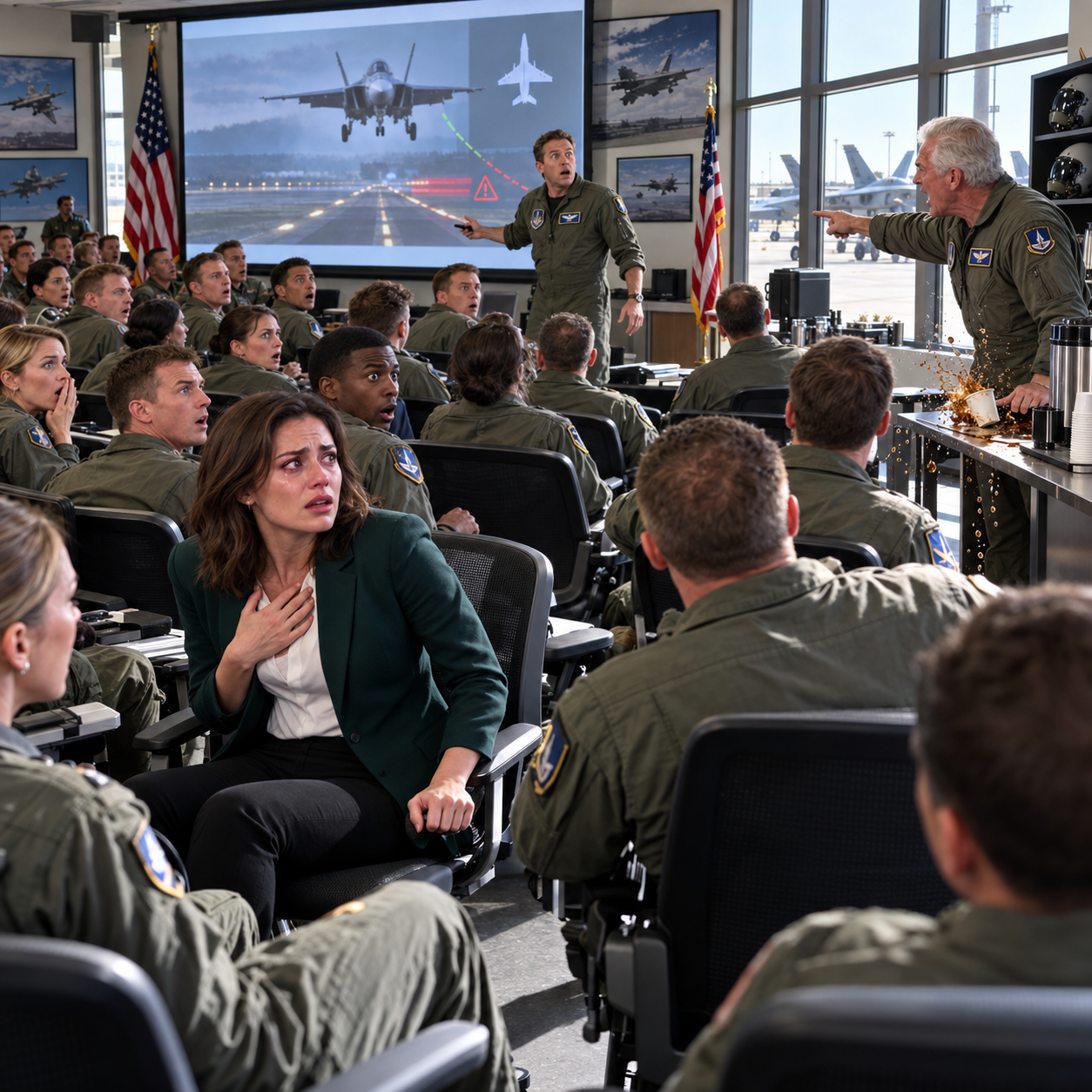
Safety Stand-Down. 40 Pilots. 1 Slide. “Lieutenant Blank. Panicked At Two Hundred Feet. Ended Her Own Career.” He Grinned At The Squadron. “Don’t Be Her.” I Sat In The Third Row, In Civilian Clothes. Nobody Had Told Him Why I Was There. The Gray-Haired Pilot By The Coffee Urn Set His Cup Down Hard. “You Want To Tell Them, Or Should I?”
At 9:20 that morning, a Navy safety officer put a photograph of my destroyed helicopter on a screen and told forty pilots not to make the mistake that had ended my career. They laughed, and I stayed silent because part of what he said was true. Twelve years earlier, I had made a terrible decision over the Pacific Ocean. But the laughter stopped when an old instructor asked a question nobody could answer. Three hours later, a young pilot approached me with a name I had spent twelve years trying to forget.
Part 1
The photograph appeared on the screen while I was reaching for my coffee. I recognized the bent tail boom first, then the broken rotor assembly and the pale scrape along the helicopter’s fuselage where the salvage crew had secured its lifting straps. The aircraft lay sideways on a barge beneath a cloudless Pacific sky, looking smaller than I remembered, almost harmless. It was strange to see something that had nearly killed three people reduced to a picture suitable for a PowerPoint presentation.
Lieutenant Commander Owen Baird stood beside the screen in a perfectly pressed flight suit, smiling at the audience. He was the aviation safety officer responsible for that morning’s training at Naval Air Station North Island, and until that moment, I had thought he was doing a decent job. His explanations were clear, his technical knowledge solid, and he had an easy way of making younger pilots comfortable asking questions. Then he pointed his laser at the wreckage and said, “Here’s a particularly expensive example of what happens when a pilot forgets that confidence isn’t the same thing as competence.”
A few men chuckled. Owen clicked again, revealing three lines beside the photograph: ENGINE FAILURE ON APPROACH. PILOT CONTINUED BELOW DECISION ALTITUDE. AIRCRAFT LOST.
“And our mystery lieutenant managed to turn one engine failure into a swimming lesson for the entire crew,” he added. “The helicopter was technically flyable, but apparently nobody told her that.”
More laughter followed, this time loud enough to make a mechanic standing near the hangar doors turn around. Owen raised one finger and delivered the line he had obviously practiced. “Remember, gentlemen and ladies, when things go wrong, don’t be Lieutenant Nobody.”
I sat in the third row wearing gray slacks, a dark blue sweater, and a civilian visitor badge. My name was Paige Ellery, although nobody in that room seemed to recognize it, and I had once been the lieutenant flying that helicopter. My hands remained folded around my notebook because I had learned years earlier that small movements could hurt more than people expected. The two healed compression fractures in my spine were an excellent reminder of why I no longer wore a flight suit.
The hangar smelled of hydraulic fluid, stale coffee, and cool salt air coming through the enormous open doors. Outside, sailors were moving a tow tractor across the flight line, its warning beeper occasionally cutting through Owen’s voice. Everything looked familiar enough to make my stomach tighten: the yellow safety lines, the scarred concrete, the aircraft silhouettes beneath the morning sun. I had spent some of the happiest years of my life in places exactly like this one.
I was forty-one now, a civilian aviation human-factors analyst working for Naval Safety Command in Norfolk, Virginia. My job was to study accidents and near misses, not to decide who deserved punishment, but to understand why intelligent, trained people sometimes made decisions that looked unreasonable afterward. I had been invited to deliver the afternoon presentation on decision-making under pressure. The title was “The Last Two Hundred Feet.”
Commander Morgan Reese, the wing’s chief of staff, had welcomed me when I arrived. She had promised to introduce me to Owen before his morning briefing, but a scheduling problem pulled her away before she could finish. I found a chair near the aisle, opened my notebook, and decided I could survive listening to someone else’s presentation for a couple of hours. I had not anticipated becoming its entertainment.
Owen moved to the next slide, and the audience’s attention followed him. I should have felt furious, but fury would have been easier than the dull, familiar weight that settled beneath my ribs. For twelve years, I had heard versions of the same story in classrooms, training videos, and conversations between pilots who never knew I was listening. The worst part was that the central criticism was correct: I had continued an approach when I should have climbed away.
What nobody in the room understood was what happened after that mistake.
Near the back wall stood Dane Keller, a retired naval aviator who now worked as a contract simulator instructor. His dark windbreaker carried the embroidered patch of the squadron, and his silver hair was cut almost as short as it had been when I served under him. I hadn’t seen him in nine years, but he had recognized me the instant he walked through the hangar. We had exchanged one brief nod before the presentation began.
When Owen made his joke, Dane set his coffee on the table so sharply that liquid spilled over the rim. He looked directly at me, his mouth tightening, and I knew he was remembering the same night I was. He took one step toward my row, but I shook my head before he could speak. Whatever he wanted to say, I was not ready to hear it in front of forty strangers.
Twelve years earlier, in March 2014, Dane had commanded our helicopter detachment aboard a littoral combat ship operating in the Western Pacific. I was twenty-eight, newly qualified as an aircraft commander, and proud of how quickly my career was progressing. Our ship, the USS Meridian, carried a small aviation team that functioned more like an exhausted family than a military unit. We knew one another’s habits, favorite complaints, and coffee preferences because life aboard ship offered very few opportunities for privacy.
One of those sailors was Boatswain’s Mate Second Class Luis Navarro, the landing signal enlisted sailor who guided helicopters onto the moving flight deck. Luis was broad-shouldered, patient, and remarkably calm when everyone else started shouting. He had a wife in Chula Vista and a young son who collected model airplanes. On difficult nights, when the deck rolled beneath us, I trusted Luis’s illuminated signaling wands more than any electronic display in the cockpit.
After one particularly rough landing, Luis knocked on my window while the helicopter’s blades were winding down. “Lieutenant, you’re staring at the ship’s lights instead of watching my signals,” he told me. “Those lights tell you what the bridge thinks is happening. I’m standing right here watching what actually is.”
I laughed and promised to remember. He didn’t laugh back.
“Seriously, ma’am. If I’m telling you to wave off, you wave off. Doesn’t matter what anyone else says.”
I wrote his advice on a strip of tape and stuck it inside my kneeboard.
On the night of March 11, 2014, that strip of tape was still there.
And when our helicopter approached the Meridian at 10:47 p.m., with one engine suddenly failing and the black Pacific stretching beneath us, I was about to discover how expensive six seconds of hesitation could become.
Part 2
We had been searching for a fishing vessel that had stopped responding to radio calls. Four hours of flying parallel tracks over dark water had produced nothing but rolling waves and scattered radar contacts. The mission was ordinary enough to become tedious, which was dangerous in its own quiet way. Everyone was tired, and we were looking forward to the familiar comforts of the ship: hot food, dry clothes, and somewhere to sit without wearing a harness.
My copilot, Lieutenant Junior Grade Ethan Mercer, was twenty-five and from rural Pennsylvania. He was the sort of man who apologized to furniture after bumping into it, but in the cockpit he was precise and dependable. Our rescue swimmer, Petty Officer Second Class Talia Moreno, sat behind us, occasionally reporting surface contacts with a dry humor that made long flights tolerable. I trusted both of them with my life, and that trust would be tested before the night ended.
The sea was rough but manageable. Winds crossed the deck at an awkward angle, and the ship’s motion made our approach more demanding than an ordinary landing ashore. At two hundred fifty feet, I could see the landing area outlined in deck lights, with the hangar face rising beyond it. The tower reported a clear deck, and the visual status remained green.
Then the number one engine failed.
There was no explosion or dramatic flash, just a sudden change in the helicopter’s vibration and an unmistakable sag beneath our seats. Warning lights illuminated the instrument panel, and Ethan immediately began calling out engine indications. I increased power on the remaining engine and adjusted our descent while my mind ran through the emergency procedures I had rehearsed countless times. We were relatively light after burning most of our fuel, and the aircraft could still produce controlled flight.
That mattered because our training allowed a carefully managed single-engine landing under certain conditions. Continuing toward an unobstructed deck could be safer than attempting to climb away, depending on altitude, weight, and available power. I had practiced that scenario repeatedly in the simulator, often with Dane waiting until the worst possible moment to fail an engine. I knew the procedure, and I believed I was following it.
At roughly two hundred twenty feet, two lights near the deck’s edge flickered.
It was a small irregularity, almost nothing. Spray might have crossed them, or the ship’s movement might have changed my viewing angle. Ethan confirmed the tower was still reporting green, and my instruments showed we could maintain the approach. I wanted the lights to mean nothing because the alternative meant adding more uncertainty to an already difficult emergency.
I held the approach.
Six seconds passed before I understood that I had waited too long.
As the ship rolled, its floodlights swept across the landing circle and revealed three sailors kneeling beside a heavy tow bar. They were securing equipment left from an earlier deck operation, their attention fixed on the chains beneath their hands. Near the edge of the landing area stood Luis Navarro, swinging his illuminated wands in the unmistakable signal to wave off. The deck was occupied, yet the approach status remained green.
I remember his arms crossing above his helmet. I remember the reflective tape on the sailors’ jerseys and the silver water beyond the ship’s stern. Most clearly, I remember looking at the altimeter and seeing a number that meant our safest option had already disappeared. We were around one hundred forty feet, too slow and too close to the ship for a reliable climb on the power we had available.
Ethan saw the sailors at almost the same instant.
“Paige, deck occupied!”
“I see them.”
“Wave off?”
I looked at our airspeed, the falling altitude, and the remaining engine’s limits. We could try to climb, but the helicopter might settle forward into the occupied deck before gaining enough speed. Or I could continue and put fourteen thousand pounds of aircraft directly into sailors who did not yet know we were bearing down on them. The time for making a comfortable choice had passed.
“I’m turning left,” I said. “Prepare to ditch.”
Ethan’s head snapped toward me, but he did not argue. He repeated the warning over the intercom, and Talia answered from the cabin, “Ready back here.” I rolled the aircraft away from the ship, keeping what little altitude remained while trying to control our descent toward the water. The helicopter was still flying, but I was deliberately taking it somewhere it was never meant to land.
I don’t remember the impact as one continuous event. I remember the water rising in the windscreen, then a crushing jolt that slammed through my lower back. Something cracked overhead, the cabin lurched sideways, and the world went from black sky to black water. The emergency flotation system did not keep us upright, and seawater rushed into the aircraft as it rolled.
Our underwater escape training had been drilled into us until the steps became automatic. Find a reference point, wait for the movement to stop, release the harness, and pull yourself toward the exit. But when I tried to move, pain tore through my back and my legs refused to cooperate. I was upside down, trapped in a flooding cockpit, with the awful realization that the procedure I knew perfectly was no longer something my body could perform.
Then someone grabbed my flight vest.
Talia had already helped Ethan escape, but she came back through the water to find me. She pulled at my harness, guided my arm toward the opening, and dragged me through the cockpit window while I struggled to keep my head oriented. We surfaced into cold wind and crashing waves, and I heard Ethan coughing somewhere nearby. Talia kept one arm around me because I could barely move without screaming.
A ship’s rescue boat reached us less than twenty minutes later. Ethan needed stitches along his jaw, Talia had injured her shoulder, and scans eventually showed two fractures in my spine. The helicopter sank before a recovery crew could reach it, though it was salvaged later. On the Meridian’s flight deck, every sailor survived without injury.
That should have been enough to make the night feel like a miracle.
Instead, as I lay in sick bay unable to turn my head without pain, Dane appeared beside my bed with his face drawn tight. He told me the ship’s helicopter control officer had authorized our landing while the deck crew was still securing equipment. Somewhere in the chain of reports between the tower and the flight deck, an occupied landing area had become a clear one.
I asked whether anyone had been disciplined. Dane said an investigation would determine what had happened, and he couldn’t discuss it yet. Then he hesitated, looking toward the closed door.
“Paige, there’s something else you need to understand,” he said. “Those sailors didn’t know the helicopter had an engine out. When you turned away, they thought you were making a normal waveoff.”
I stared at him.
“They didn’t realize you couldn’t climb,” he continued. “They thought you chose the water for some other reason.”
And for the first time since the crash, I began to wonder what story those men would be told about the pilot who had almost landed on them.
Part 3
The Navy’s investigation took months, but the story circulating through our old squadron took only days to become recognizable. A young pilot had pressed an approach too far, lost confidence when she saw something unexpected, and abandoned a flyable helicopter. The simplest version left out the people on the deck, the crossed communications, and the decision that followed. It also contained enough truth that I couldn’t dismiss it as entirely unfair.
There were two separate investigative processes, each serving a different purpose. One examined responsibility and the operational record; the other gathered protected safety information so pilots and sailors could speak candidly about their mistakes without every admission becoming ammunition against them. The protections governing that second process mattered enormously. Investigators needed people to describe what had really happened, including bad judgments, embarrassing assumptions, and errors they might otherwise hide.
I told the safety investigators everything.
I told them about the flickering lights above the decision point, about how badly I wanted the approach to work, and about the six seconds I wasted convincing myself the deck was safe. I described seeing Luis’s wands and the three sailors, and I explained why I had turned toward the water. I did not ask anyone to remove my responsibility from the accident. I had been the aircraft commander, and the decision to continue below the point where I could reliably wave off belonged to me.
Some findings and testimony remained protected within the safety process. I was permitted to understand the conclusions relevant to my duties, but not to distribute that privileged material or use it publicly to defend my reputation. The distinction was frustrating yet essential: facts independently known to witnesses could be discussed, while protected investigative statements could not simply be released because someone disliked the public story. I understood those boundaries professionally long before I learned to live within them personally.
A later fleet publication presented a short, nonprivileged account of the accident. It described an engine failure during an approach to a ship, a questionable deck indication, continued descent below the decision point, and a controlled ditching of an aircraft capable of limited single-engine flight. It recommended immediate waveoffs when conditions became uncertain. None of those points was false, but the account provided almost no understanding of the final choice.
Within a year, an instructor somewhere had turned that summary into a classroom example. Eventually someone added the salvage photograph, and another person attached a sarcastic nickname to the unnamed pilot. By the time I encountered it in a graduate seminar in 2018, the story had acquired a punchline. When a student announced that the mystery lieutenant must have panicked, the class laughed, and I pretended to take notes.
In 2016, after surgeries, rehabilitation, and repeated medical examinations, I had been permanently disqualified from flying. I signed my separation paperwork in an office with beige walls and a printer that jammed twice. Nobody was unkind, and that almost made the finality harder. The Navy had invested years in teaching me to fly, and my body could no longer tolerate the sustained vibration of a helicopter.
I returned to California briefly before earning an advanced degree in aviation safety. Eventually I joined Naval Safety Command as a civilian analyst, working on mishaps that reminded me almost daily of my own. My office overlooked a parking garage, and my desk was usually covered with diagrams, flight histories, and carefully worded reports. I learned to ask what information people possessed at the moment they acted, instead of judging them solely by what everyone learned afterward.
It was meaningful work, but my accident followed me into it.
I could have spoken about my personal experiences without quoting protected findings, yet every time the opportunity arose, I convinced myself silence was more honorable. Part of that came from respect for confidentiality, and part came from an uglier belief that I deserved whatever people thought of me. I had made the wrong decision before the final turn. Perhaps, I told myself, enduring the incomplete story was the price of that mistake.
Back in Hangar 2, Owen finished discussing a wire strike at a desert training range and opened the floor for questions. He clicked backward through several slides while answering a technical question about turbine performance. My wrecked helicopter reappeared behind him, larger than life. Several pilots looked at it with faint smiles, apparently remembering his earlier joke.
Dane Keller raised his hand from beside the coffee table.
“Owen,” he said, “how many people were on that flight deck when she turned away?”
The atmosphere changed so suddenly that I heard the projector’s cooling fan above the sound of the wind outside. Owen tilted his head, considering the question as if it were a minor technical detail. He glanced at the slide, then answered that the published summary did not specify any deck personnel.
“That’s interesting,” Dane said. “Because I was standing inside that ship’s hangar when she made the turn.”
Owen lowered the laser pointer.
“You were aboard?”
“I commanded the aviation detachment.”
Someone in the front row shifted in his chair, and several pilots turned toward Dane. Owen looked uncomfortable for the first time that morning, but he recovered quickly. He explained that the protected investigation might contain additional information and that the briefing needed to stay within the approved material.
“I’m not asking about a protected investigation,” Dane replied. “I’m asking whether you’ve considered what the pilot was turning away from.”
Nobody answered.
Owen suggested they discuss the issue privately and moved to the next slide. His voice remained professional, but the jokes disappeared, and the audience seemed less interested in laughing. I kept looking at my notebook, aware that Dane had just done something I had never managed to do for myself. He had made people question a story they had accepted without examination.
When the morning session ended, I stood slowly, waiting for the pain in my back to settle before moving toward the side door. As I passed the second row, a young lieutenant rose from his chair and turned toward me. His name tape read NAVARRO, and for a moment I thought exhaustion was making me see something that wasn’t there. Then he stepped closer, and I recognized the shape of his jaw and the familiar seriousness around his eyes.
“Ma’am,” he said quietly, “my name is Micah Navarro. I think you knew my father.”
I couldn’t find my voice.
He glanced toward the screen, where the photograph of my helicopter was still visible, and his fingers tightened around the paper cup in his hand. “My dad was on that ship,” he continued. “He doesn’t talk about that night, but I’ve been trying to understand something for years.”
“What is it?” I asked.
Micah looked directly at me.
“Why did he keep a picture of your helicopter in his workshop when everyone at flight school said the pilot was a coward?”
Part 4
For several seconds, I could only look at Micah. The last time I had seen his father, Luis had been wearing a green flight deck jersey, standing in the doorway of the ship’s sick bay with his unlit signaling wands in his hands. He had remained there without speaking, then disappeared before I could call his name. I had assumed he wanted nothing to do with the woman who had nearly brought a helicopter down on his sailors.
“Your father kept that photograph?” I asked.
Micah nodded. “It’s pinned above his workbench. He never explained it, but whenever I asked about becoming a pilot, he’d look at it before answering.” He glanced toward the hangar, where Owen was gathering his presentation equipment. “At flight school, an instructor used that accident to teach us why hesitation kills. Dad got upset when I mentioned it, but he wouldn’t tell me why.”
I leaned against the wall because standing had become uncomfortable. Micah was twenty-four, almost exactly the age Ethan had been when we went into the water, and his resemblance to Luis made it difficult to hold his gaze. I asked whether he had ever discussed the incident with his father directly. He said he had tried three times, and each conversation ended with Luis telling him to listen carefully to his landing signal enlisted personnel.
“Something else happened last week,” Micah added. “I was in the simulator with Commander Keller, and I waved off an approach because the deck lights didn’t agree with the landing signals.” He rubbed the back of his neck. “I made the safe call, but my previous evaluator had marked me down for an unnecessary waveoff during a similar scenario.”
That caught my attention more sharply than anything Owen had said. A safety lesson was supposed to improve decisions, not teach pilots that abandoning a questionable landing demonstrated weakness. Micah explained that the evaluator had emphasized committing to a clear deck unless an unmistakable danger appeared. The language sounded uncomfortably similar to the way my accident had been taught for years.
Before I could ask more, Owen appeared around the corner carrying his phone. His expression changed when he saw us, and Micah quickly excused himself. Owen waited until the young lieutenant was gone, then looked at my visitor badge, which had turned outward during our conversation. I watched him read my name and watched recognition settle across his face.
“Ms. Ellery,” he said. “Commander Reese just told me who you are.”
I nodded.
He glanced toward the hangar, then back at me. “I didn’t know that was your aircraft. I built that presentation from the published safety summary, and I’ve seen that example used for years.” His voice dropped. “I wasn’t deliberately trying to embarrass you.”
“You embarrassed someone,” I replied. “You just didn’t think she would be sitting in the audience.”
He absorbed that without arguing, which I appreciated. Then he explained that Captain Celia Hartwell, the wing commodore, planned to attend my afternoon presentation. He hoped we could avoid turning the event into a public confrontation over his briefing. I told him I intended to discuss aviation safety, precisely as I had been invited to do.
Commander Reese found me several minutes later. She apologized for the missed introduction, then suggested that my presentation remain focused on general decision-making principles. The commodore wanted the stand-down to produce practical lessons, she explained, rather than become an argument about an old accident. I understood her concern, but I wondered whether anyone would have worried about professionalism if I had simply continued sitting quietly.
At lunch, I found an empty ready room and opened my presentation. Forty-one slides covered decision thresholds, degraded situational awareness, fatigue, and the ways crews sometimes talked themselves into completing a maneuver that should have been abandoned. I had given variations of that lecture at seven installations. It was thorough, technically accurate, and almost completely impersonal.
I sat staring at the screen, thinking about Micah’s simulator evaluation. For years, my accident had been presented as a simple warning against poor judgment, yet pilots were still being taught to view a waveoff as failure when conditions appeared acceptable on paper. The case study criticized my hesitation without explaining the terrible choice that hesitation had created. It was a lesson with its most important consequence missing.
I deleted the first fourteen slides.
Then I deleted nineteen more.
By the time Dane entered the room, carrying two coffees, only a title slide and a blank page remained. He put one cup beside my laptop and examined the screen without speaking. I told him I intended to describe my own mistakes, including the part I had never said aloud to an audience.
“Good,” he replied.
“But I can’t disclose protected board material.”
“I know.”
“And I can’t tell your story for you.”
Dane pulled out a chair and sat opposite me. “You don’t have to. I was there, Paige, and I remember what I saw without needing an investigation to tell me.” He paused, looking older than he had that morning. “The question is whether you’re ready to let people hear both parts of that night.”
I told him about Micah and the photograph above Luis’s workbench. Dane looked down at his coffee for a long time before saying he had wondered when Luis’s son would learn what happened. He explained that several people aboard the Meridian had carried private memories of the crash that never fit comfortably into the brief official account. None had expected the incomplete version to become an enduring joke.
“Why didn’t you stop it earlier?” I asked.
“I should have,” Dane said. “At first, I thought the safety community would correct it. Then I figured you had reasons for staying quiet, and I didn’t want to speak over you.”
He reached into his jacket and removed a small green notebook with worn corners. Inside were entries he had made during the deployment: weather conditions, aircraft movements, maintenance issues, and short observations about the people under his command. He opened it to a page marked March 11, 2014, then slid it across the table.
Four names were written beneath the time of our final approach.
Below them, in Dane’s cramped handwriting, was a sentence that made my throat tighten.
“Aircraft turned away from occupied deck. All flight deck personnel accounted for.”
For twelve years, I had thought the only complete version of that night existed behind the locked doors of an investigation. But sitting across from me was a man with his own memories, his own records, and no intention of letting the story remain unfinished.
Part 5
By one o’clock, more than sixty people had gathered inside Hangar 2. Word about the morning’s exchange had traveled across the base, drawing pilots from neighboring squadrons and several maintainers who had no obligation to attend. Captain Hartwell stood near the back with her arms folded, listening to Commander Reese explain something quietly. Owen sat in the front row, his face composed but his hands clasped tightly together.
I walked to the podium, set down my notebook, and waited for the room to settle. My back was hurting, and I could feel the familiar pressure behind my ribs that appeared whenever I had been on my feet too long. I had spent the lunch break wondering whether I was about to make the greatest professional mistake of my civilian career. Then I saw Micah sitting beside the aisle, and I remembered what he had told me about his simulator evaluation.
The first slide appeared.
THE LAST TWO HUNDRED FEET.
I clicked once more.
A single sentence replaced it.
“THE ACCIDENT SUMMARY WAS TRUE. IT WAS NOT COMPLETE.”
Nobody spoke.
“My name is Paige Ellery,” I began. “Twelve years ago, I was a Navy helicopter aircraft commander conducting a night approach to a ship in the Western Pacific. The aircraft on the screen this morning was mine.”
I heard a chair shift somewhere in the fourth row. Owen lowered his eyes, but I didn’t look at him again. I explained that I would not discuss protected investigative findings or quote testimony from any safety board. What I could discuss was what I remembered, what I had done, and what my own experience had taught me.
I described the search mission, the engine failure, and the green deck indication. I told them about the lights that flickered and the moment I chose to continue instead of climbing away. I explained how fatigue, confidence, and my desire to complete the landing had shaped a decision that should have been governed by a simpler rule. When the available information no longer agreed, I should have waved off.
“Lieutenant Commander Baird gave you one useful lesson this morning,” I said. “Don’t make the decision I made during those six seconds. If the deck looks wrong while you still have a safe waveoff option, take it.”
No one laughed.
I showed them a diagram of the approach, marking where I first noticed the irregularity and where the remaining margin disappeared. I explained that continuing had not been a dramatic act of bravery or a conscious attempt to save anyone. It had been an avoidable mistake, made by a trained pilot who wanted to believe the situation was still manageable. The consequences had become unavoidable before I fully understood what was happening.
“Now I’d like someone else to describe what he saw that night,” I said.
Dane stood near the back wall and opened his notebook. He explained that he had been the officer commanding our aviation detachment and had watched the final approach from the ship’s hangar entrance. He had not participated in the protected safety investigation, and the account he was giving came from his own observations. Then he described the three sailors securing equipment in the landing circle and the landing signal enlisted sailor standing nearby.
He read their names.
Airman First Class Delaney Brooks.
Seaman Tobias Ward.
Petty Officer Third Class Spencer Hale.
Boatswain’s Mate Second Class Luis Navarro.
When Dane reached the final name, Micah stood.
He didn’t interrupt or look around. He simply rose beside his chair, standing so straight that the resemblance to his father made my eyes sting. Dane waited a moment before continuing. Luis had been signaling an immediate waveoff, he explained, while the other three sailors were still exposed in the landing area.
“The aircraft was already too low to execute a reliable single-engine climb,” Dane said. “I watched Lieutenant Ellery turn away from the flight deck instead.”
He looked toward the screen.
“She had a damaged power margin, three people aboard, and an occupied landing area ahead of her. At that point, there was no good outcome available. She chose the one that did not involve landing on sailors who couldn’t escape.”
The room remained motionless.
I returned to the diagram and showed the path of the helicopter’s turn toward open water. I described the impact, the aircraft overturning, and Talia coming back to help me escape when my injuries prevented me from reaching the surface. I spoke about Ethan maintaining discipline throughout the emergency and the rescue boat crew finding us in darkness. None of those actions erased my earlier mistake, but ignoring them made the account dangerously incomplete.
“An accident can contain both a preventable error and a lifesaving decision,” I said. “If you teach only the error, you may prevent one kind of failure while overlooking the skills that stopped something worse.”
A pilot near the front asked whether I believed I had made the correct decision to ditch. I answered that, given the situation I had already created, I believed turning away from the occupied deck was the least dangerous available choice. That did not make the approach correct or the loss of the aircraft inevitable from the beginning. It meant the evaluation of the flight could not end at the moment things went wrong.
Then Micah raised his hand.
“My father was the signalman,” he said, his voice steady despite the color rising in his face. “If a pilot waves off because deck signals disagree with tower clearance, should that ever count against them in training?”
“No,” I answered. “Not when the disagreement creates a genuine safety concern.”
I looked across the audience before continuing. “A pilot who refuses to land on an uncertain deck isn’t demonstrating weakness. They’re preserving options, which is one of the most important things an aircraft commander can do.”
Captain Hartwell stepped forward as I finished. She asked Owen to stand, then directed him to remove the current version of the accident slide from every briefing in the wing. She wanted it rebuilt using appropriate, nonprivileged material, with an accurate distinction between the initial error and the later emergency decision. She also ordered a review of how simulator instructors evaluated waveoffs when landing signals and other information conflicted.
“This is not just a PowerPoint problem,” she said. “It’s a training problem if we’re rewarding the wrong judgment.”
The briefing ended without applause, which suited me perfectly. Several pilots approached with technical questions, and I answered them until my back demanded that I sit down. Owen waited until the crowd had thinned, then came to the podium with the expression of a man who had spent the afternoon reconsidering his own words. He admitted he had repeated a joke because it made the room listen, not because it helped anyone understand the accident.
“I turned a person into a punchline,” he said. “And I taught the wrong lesson.”
I told him the best apology would be a corrected briefing that changed what pilots learned. He agreed and asked whether I would help build it. I said I would review his technical content, but he would have to explain his own mistake to the same people who had laughed that morning.
As he left, Micah approached carrying his phone.
“I called my dad,” he said. “He’s retired now, but he still lives south of here.”
I nodded, unsure what he wanted me to say.
“He wants to see you tonight.”
Micah hesitated, then turned the phone toward me. On the screen was a photograph of Luis standing beside his workbench, the picture of my helicopter pinned above it. Beneath the photograph, barely visible, hung a faded strip of tape with handwriting I recognized.
It was the reminder I had written for myself years earlier.
“Watch the wands.”
Part 6
Owen arrived in the squadron ready room at seven forty-five the following morning with two coffees, a legal pad, and a noticeably different expression. He had already removed his original slide from the wing’s shared briefing materials and drafted a message explaining why the replacement was necessary. I appreciated the preparation, but I made it clear that I was not there to help him restore his reputation. We were there to prevent an incomplete lesson from influencing another dangerous decision.
For the next three hours, we rebuilt the case study. The left side of the slide addressed my errors: continuing the approach after an unexpected deck indication, failing to wave off while a safe option remained, and allowing confidence to substitute for verification. The right side covered the occupied deck, the late waveoff signal, the decision to turn toward open water, and the crew’s successful escape. Across the bottom, we added a principle Owen had written himself.
“Evaluate the decision with the information available at the moment it was made.”
He stared at that sentence for a long time before admitting that he had been teaching accidents as stories with heroes and fools. It was an efficient approach for keeping an audience interested, he said, but it encouraged young pilots to believe competent people never made complicated mistakes. I reminded him that a safety officer’s obligation was not to entertain the room. It was to make people think clearly when the room was no longer there to help them.
By noon, Captain Hartwell had received a preliminary report from the training department. Micah’s earlier simulator evaluation had indeed characterized a precautionary waveoff as unnecessary, even though the scenario contained conflicting deck information. The evaluator had been applying a simplified scoring standard that emphasized completion of the approach without adequately addressing the uncertainty. Hartwell directed the training department to revise its guidance and review similar evaluations.
The problem was larger than one instructor or one poorly written slide. For years, the wing had praised decisive landings while giving too little attention to the judgment required to abandon one. My accident had not created that culture, but its incomplete retelling had helped reinforce it. I found no satisfaction in knowing how close another young pilot had come to learning the wrong lesson from my worst night.
Owen presented the corrected case study to the squadron that afternoon. He stood where he had stood the previous morning, but he did not smile when the salvage photograph appeared. Instead, he acknowledged that his original presentation had mocked the pilot and omitted important circumstances. Then he explained the full training lesson as carefully as we had written it.
“I was wrong about this case,” he told the room. “I should have questioned the material before I made it part of our training, and I shouldn’t have used a person’s career as a joke.”
He didn’t look toward me for approval. I was glad, because I had no intention of offering public absolution for something that had bothered me for twelve years. He had made an error, recognized it, and begun correcting it. That was meaningful, but accountability did not require me to pretend the original humiliation had never happened.
Later that afternoon, I met Luis Navarro at a small pier near the old seaplane ramp. The sun was sinking toward Point Loma, turning the harbor water silver beneath a cool breeze. He was broader than I remembered, with gray hair at his temples and the same steady expression he used to wear beneath his flight deck helmet. Micah had driven him there, but he left us alone after making certain we had found each other.
Luis approached slowly and held out his hand.
“Lieutenant Ellery,” he said.
“Just Paige now.”
He nodded, but when he shook my hand, he held it longer than people usually do. We stood beside the railing watching a fishing boat pass, neither of us quite knowing where to begin. Finally, Luis took a folded piece of paper from his jacket and handed it to me.
It was a copy of a photograph taken shortly after our deployment began. I was standing in front of the helicopter with Ethan and Talia, smiling into the sun while Luis stood beside us holding his signal wands. On the back, he had written a date and the words, “The people who came home.”
“I kept that picture in my workshop,” he said. “The wrecked helicopter, too. My boy never understood why.”
I asked about the strip of tape beneath the photograph. Luis smiled faintly and said he had found it when our equipment was being sorted after the accident. He had recognized my handwriting and kept it because he couldn’t bring himself to throw away a reminder of something he had once told me. Every time he looked at it, he remembered the night we had both watched the same lights and understood different things at different moments.
“I should have realized sooner that the deck was about to be called clear,” he said. “We were still working when the signal changed. I saw your approach lights coming, grabbed my wands, and started waving you off.”
“You did your job,” I told him.
“I did it late.”
“So did I.”
He looked out over the harbor and rubbed his hands together. For twelve years, he explained, he had remembered the moments when the helicopter continued toward him despite his warning. He remembered thinking I hadn’t seen the signal, then realizing I had turned away from the ship. When he watched the aircraft strike the water, he knew the decision had placed the entire flight crew in danger.
“I wanted to come into sick bay that night,” he said. “I stood in the doorway, but I didn’t know what to tell you.”
“I remember seeing you.”
His eyes widened slightly.
“I thought you blamed me,” I admitted.
Luis shook his head. “I thought you blamed yourself, and I didn’t know how to make that any easier. I still don’t.”
There was something strangely peaceful about discovering we had spent twelve years avoiding a conversation neither of us knew how to begin. He told me Micah had grown up determined to become a pilot, despite his father’s efforts to steer him toward engineering. When the boy entered flight school, Luis had been proud and frightened in equal measure. Hearing instructors use my accident as an example of cowardice had made him angry, but he had never found a way to correct the story without reopening his own memories.
“I should have said something,” he admitted. “I told myself the Navy knew what happened, so somebody else would straighten it out.”
I understood that reasoning better than he could have imagined. My own silence had been built from a similar mixture of responsibility, loyalty, and fear. Neither of us could change the night itself, and there was no value in pretending that twelve years of regret could be settled by one conversation. What we could change was what the next generation learned from it.
Dane arrived just before sunset, carrying three paper cups of coffee. He joined us at the railing without asking what we had discussed. For several minutes, we watched helicopters moving over the harbor, their lights becoming visible as the daylight faded. When one began its approach toward the base, all three of us followed it with our eyes until it disappeared behind the hangars.
Two weeks after I returned to Norfolk, Naval Safety Command began reviewing the revised training material. The new presentation separated the initial approach error from the subsequent decisions that prevented additional casualties. It preserved the essential warning about hesitation, but it also examined conflicting signals, communication failures, the importance of waveoff authority, and the crew coordination that had helped us survive. The photograph of my helicopter remained in the slide deck because I wanted it there.
Captain Hartwell’s training department also changed its simulator evaluation guidance. Crews would be assessed on how they recognized and resolved conflicting information, not merely whether they completed an approach. Micah later told me that his instructor had revisited the scenario where his earlier waveoff had been questioned. This time, the discussion centered on what information the pilot had and whether continuing was justified.
I received an email from Owen several weeks later. He had presented the corrected case at two additional safety sessions and wanted me to know that pilots were asking more difficult questions. He said the briefings were quieter, but the discussions afterward were better. I replied with a few suggestions about the diagrams and thanked him for doing the work.
I did not tell him everything was forgiven. I didn’t need to.
My back still hurt when I sat too long, and I still couldn’t look at a helicopter without remembering what it felt like to control one. Nothing that happened in San Diego restored my flying career or erased those six seconds over the Pacific. I would always be responsible for continuing an approach when I should have waved off. I had finally accepted that admitting the mistake did not require accepting a false account of everything that followed.
One evening, several months later, I opened the latest version of the training presentation on my office computer. The salvage photograph appeared on slide fourteen, the helicopter lying on its side beneath that bright Pacific sky. There were no jokes beside it, no references to panic, and no suggestion that the pilot had simply thrown away a flyable aircraft. Instead, the slide ended with two questions.
“What should the pilot have done before reaching the decision point?”
And beneath it:
“What prevented the consequences from becoming worse?”
I sat looking at those questions for a long time. For twelve years, people had answered the first one and believed they knew my whole story. Now young pilots would be taught to ask the second one, too. They would learn about an aircraft commander who waited too long, a flight deck crew caught beneath an incorrect clearance, a signalman who refused to stop waving his warning, and a rescue swimmer who returned to a sinking helicopter for someone who couldn’t escape.
The names mattered. The mistakes mattered. The decisions that saved lives mattered just as much.
I closed the presentation and placed a small photograph beside my computer. It showed four smiling people standing in front of a helicopter on a clear day in the Western Pacific. In the corner, Luis was holding his signal wands, and my younger self was looking toward the camera with the confidence of someone who had not yet learned how quickly an ordinary night could change everything.
I no longer needed to hide that young woman or defend every choice she made.
She had been wrong to continue the approach. She had been right to turn away from the occupied deck. Both truths belonged to her, and neither could be understood fully without the other.
For the first time in twelve years, when I thought about that night, I did not hear the laughter from a classroom or see the mocking words beneath a photograph.
I heard Talia answering, “Ready,” from the back of the helicopter.
I saw Luis’s warning wands moving against the dark sky.
And I remembered that all seven of us had come home.
THE END!
Disclaimer: Our stories are inspired by real-life events but are carefully rewritten for entertainment. Any resemblance to actual people or situations is purely coincidental.

