
Chapter 2
Four years earlier, my mother had died in the living room of our narrow brick house in Bayonne, New Jersey. Her name was Rosemary Castellano, and she had spent thirty years working as a school secretary, remembering every child’s name and somehow knowing which parents needed a little kindness and which ones needed the truth.
My father, Vincent Castellano, was a retired firefighter who had served Engine 9 for thirty-four years. Six feet tall, broad-shouldered, and blessed with a voice that could silence a crowded firehouse, he was known throughout our neighborhood as Captain Vinny. He could repair an engine, rebuild a kitchen, or carry a neighbor’s refrigerator down three flights of stairs, but he had never been particularly good at talking about his feelings.
My mother was different. She was small, sharp-eyed, and quick with a joke, and she had a way of telling you something difficult without making you feel small. She called me Noe and my younger sister Gianna her little Firecracker. Gianna was four years younger than me, with wild curls, a contagious laugh, and a talent for getting out of trouble by making everyone feel sorry for her.
As children, we were inseparable when it suited her and competitors when it didn’t. She borrowed my clothes without asking, broke things and blamed the dog, and once kissed my first boyfriend behind the bleachers at a school dance. When Mom caught her, Gianna cried so beautifully that Mom ended up comforting her instead of grounding her.
That pattern followed us into adulthood.
Gianna became a nurse, a good one, too. Patients trusted her because she remembered their grandchildren’s names and stayed a few extra minutes when someone was frightened. She could make a lonely person feel like the most important human being in the room, and I loved her for that. I also knew how much she needed to be loved in return.
When Mom was diagnosed with pancreatic cancer at sixty-one, Gianna took leave from the hospital and moved back home. For seven months, she slept on the couch beside the hospital bed we had set up in the living room. She learned to change dressings, manage medications, and recognize the smallest changes in Mom’s breathing.
I worked twelve-hour shifts at the dispatch center, often taking overtime because I couldn’t bear to sit at home and watch my mother grow weaker. I visited whenever I could, and Brandon drove Mom to appointments when my schedule made it impossible. He fixed my parents’ gutters, brought Dad coffee, and spent Sundays arguing with him about the New York Mets.
I used to joke that I had married the only man in New Jersey who actually liked his in-laws.
Brandon had been a regional sales manager for a flooring company when we met at a firehouse fundraiser eleven years earlier. He was tall and lean, with sandy hair that had begun turning gray at the temples and a laugh that could make strangers feel like old friends. We married two years later at St. Mary’s, where my father cried so hard that he had to borrow a second handkerchief from the priest.
For nine years, I believed I knew the man I had married.
Then came the afternoon my mother saw something she could never unsee.
In the last month of her life, Mom asked Dad to wheel her to the end of the driveway so she could feel the sun on her face. She was wrapped in a blanket, her hands resting on her lap, when she noticed Brandon’s car parked along the curb. Through the open passenger window, she saw Gianna lean across the front seat and kiss my husband.
It wasn’t a quick, confused kiss. Mom watched them hold each other as if the rest of the world had disappeared.
She didn’t call out. She didn’t wheel herself closer or make a scene. She asked Dad to take her inside, and the following day, when he sat beside her hospital bed, she told him what she had seen.
“Vinny,” she said quietly, “our girls are going to need us to be smart.”
She asked him for two promises. He was not to tell me while she was still alive because she couldn’t bear the thought of spending her final weeks watching me suffer. And on his seventieth birthday, four years later, he was to gather the family and give out a collection of letters she had written.
One would be for me. One would be for Gianna. One would be for Brandon, and there would be others for people she loved.
Dad promised.
Mom died on a Tuesday afternoon in March, at 4:04 p.m. Dad held her left hand, I held her right, and Gianna sat at the foot of the bed with her fingers resting against Mom’s ankle. Brandon stood by the window with his head bowed.
When Mom’s breathing stopped, my father kissed her forehead and walked into the garage. He stayed there until dark.
For four years, he kept his promise.
Then, two months before his seventieth birthday, he announced the letters at our Sunday family dinner. We were gathered around the backyard table, passing sausage and peppers and arguing over who had brought the best dessert, when Dad stood and tapped his wineglass with a fork.
“Your cousin Paulie says a man doesn’t turn seventy every day,” he announced. “So we’re having a party. Two hundred, maybe two hundred and fifty people. The whole neighborhood.”
My aunts cheered, and someone immediately began discussing the catering.
Dad waited for the noise to settle. “Before the cake, I’m going to do something Rosie asked me to do. She wrote letters before she died, and I’ve kept them sealed in a box in the garage. I’m handing them out that night.”
I looked at Gianna. Her smile froze for half a second, and her fork stopped halfway to her mouth. Then she glanced at Brandon, who lowered his wineglass very slowly.
The moment passed so quickly that I almost convinced myself I had imagined it.
Two weeks later, on September 9, I found a hotel receipt in Brandon’s gray work jacket. It was from a Marriott Courtyard on Route 440, room 214, paid in cash but linked to a card registered under the name G. Costa.
Gianna had kept the Costa name after her divorce from Marco two years earlier.
The receipt was dated a Tuesday. Brandon had told me he had been working late with clients in Hackensack that night.
I put the receipt back exactly where I found it and said nothing. For four days, I cooked dinner, listened to his stories about work, and watched the man I loved with the same careful attention I used when a frightened caller told me something didn’t add up.
I noticed the second phone in his glove compartment. I noticed the sweet smell of Gianna’s vanilla perfume in his car on a day she supposedly had been in Philadelphia. I remembered nine Tuesdays that no longer looked like ordinary workdays.
Then I drove to my father’s house after a night shift and sat on the concrete steps of his garage, crying so hard I could barely breathe.
Dad came outside carrying a flashlight. When he saw me, he set it down and lowered himself beside me with a grunt. He wrapped his big arm around my shoulders and waited until I could speak.
I told him about the receipt, the perfume, and the Tuesdays.
He listened without interrupting.
When I finished, he stared at the driveway for a long time before speaking.
“I know, Noe.”
I pulled away from him. “What do you mean, you know?”
He rubbed his eyes beneath his glasses. “Your mother saw them. Four years ago, before she died. She told me everything.”
The world seemed to tilt beneath my feet. I had been grieving my mother for four years, and all that time, she had known that the two people I trusted most were betraying me.
Dad told me about the kiss at the end of the driveway. He told me about Mom’s promises and the letters waiting in the garage. Then he led me to the old gray metal ammunition box on the shelf behind his restored 1967 Mustang.
Inside lay a stack of cream-colored envelopes tied with a yellow ribbon. Each bore a name written in Mom’s slanting blue hand.
He gave me mine.
“Not yet,” he said when I tried to open it. “She wanted you to read it on my birthday. You’ll understand when the time comes.”
I returned the envelope to the box, but I could barely sleep that night. I wanted to confront Brandon immediately, to demand answers from Gianna, to tell every person who had ever praised my marriage that they had been wrong about him.
Dad talked me out of it.
“Your mother knew those two,” he said. “She knew they’d deny everything if you confronted them without proof. Give them enough rope to tell the truth themselves.”
A week later, he called me at work. Gianna had already phoned him six times asking when he would distribute the letters, whether she could arrive early to help with the party, and where he kept the box. Brandon had called, too, asking questions he had never cared to ask before.
“They’re scared of what’s in there,” Dad said. “And I think they’re going to try to get it before the party.”
“What do we do?”
My father was silent for a moment. Then I heard the old firefighter’s determination return to his voice.
“We let them think they’ve won.”
At his kitchen table, over two cups of coffee and a plate of his terrible almond biscotti, Dad took a blank cream envelope from Mom’s stationery drawer. Using her old blue fountain pen, he copied her handwriting so carefully that I had to cover my mouth when he finished.
He wrote a letter designed to make Gianna believe that Mom had documented everything, including the affair and the disappearance of her mother’s diamond ring. He sealed it and placed it in the box where my real letter had been.
The original stayed with me, unopened, tucked inside my blazer.
My cousin Paulie, who ran a small DJ business, helped with the rest. I told him I wanted to surprise Dad with a toast and needed a wireless microphone. He lent me a tiny transmitter that could send nearby voices to the speakers beneath the party tent with a three-second delay.
“Flip the switch when you’re ready,” he said. “Everybody will hear you.”
I thanked him and kept my real reason to myself.
On the first Saturday in October, 250 people gathered beneath the lights behind my father’s house. There were firefighters in dress uniforms, neighbors who had known my parents for decades, cousins who had driven in from Pennsylvania, and a ninety-year-old former captain who saluted Dad from his wheelchair.
I wore a green dress beneath my navy blazer and Mom’s gold cross at my throat. The original letter rested inside my pocket, pressed against my ribs, while the transmitter sat quietly beneath the fabric.
Gianna arrived in a red dress, her curls pinned up, smelling of vanilla. She hugged me a little too tightly and whispered, “I’m so happy we’re all here, Noe.”
I held her because I loved her, even then. But when she pulled away, I saw her eyes move toward the house and the garage beyond it.
At 8:40 p.m., the band began Happy Birthday. My father stood behind a sheet cake covered in seventy candles, his eyes shining as the crowd sang. Halfway through the song, Gianna leaned toward Brandon and whispered something in his ear.
He nodded.
They slipped away together.
I waited ten seconds, pressed the switch inside my pocket, and followed them through the back door of my childhood home.
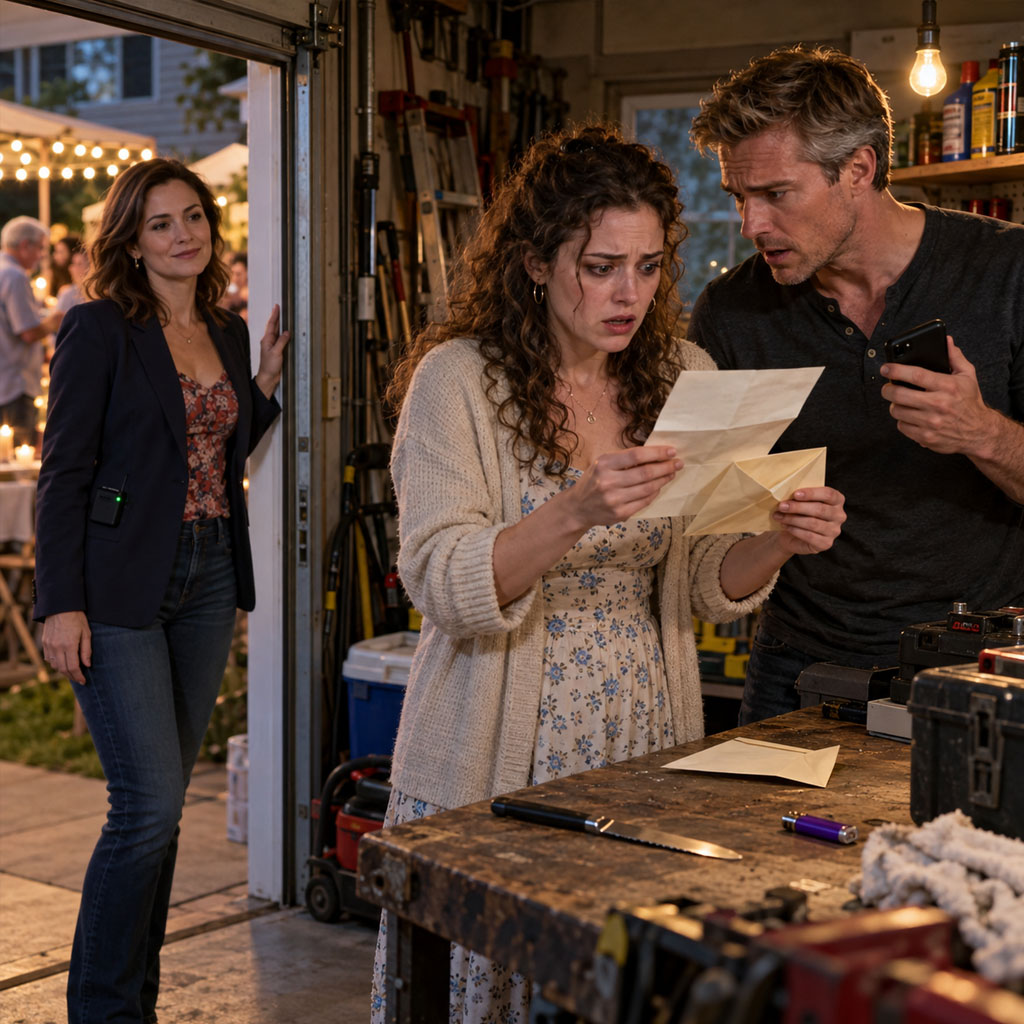
Now you understand why I was standing outside that garage when my sister whispered that our mother knew everything.
And why, when my husband told her to burn the letter, I finally opened the door.
Chapter 3
The flame from Gianna’s lighter trembled above the page, throwing a thin orange glow across her frightened face. Brandon turned toward me so quickly that his shoulder struck the workbench, sending a wrench clattering to the floor. For one brief moment, all three of us stood motionless.
“Don’t stop on my account,” I said. “The envelope has my name on it, after all.”
Gianna dropped the lighter. The butter knife struck the concrete with a sharp metallic sound, and Brandon went pale.
“Noel,” he said, forcing a smile that looked painful on his face. “This isn’t what it looks like.”
“Then tell me what it looks like.”
Before he could answer, my father’s voice came from behind the Mustang.
“Put the lighter down, Gianna. You’re going to hurt yourself, and that letter isn’t even your mother’s.”
Dad stepped into the light wearing his good blue suit, his old Engine 9 helmet tucked beneath one arm. He looked neither surprised nor angry. He looked like a man who had spent four years waiting for a fire to reveal where it had started.
Gianna stared at him. “What?”
“I wrote it,” he said. “Three weeks ago, at my kitchen table. Forty minutes with your mother’s pen.”
Her mouth opened, but no sound came out.
Dad took the letter from her trembling hand, adjusted his reading glasses, and unfolded the page. Then he read it aloud in the same steady voice he had once used to describe burning buildings and rescue operations.
“My dear Noel, by the time you read this, I’ll be gone. In March, I sat at the end of the driveway in my wheelchair and watched your sister kiss your husband through the window of his car. I have watched them since, and I have written down what I know.”
Gianna closed her eyes.
Dad continued. “I know about the Tuesdays. I know what has been missing from my jewelry box. Your grandmother’s diamond ring has not been there since the week of my wife’s funeral. Be kind if you can, but do not be a fool.”
He lowered the page and looked at Gianna over his glasses.
“That last part was a guess, sweetheart. I didn’t know about the ring. But the look on your face tells me I guessed right.”
Gianna covered her mouth with both hands. Tears gathered in her eyes, but she didn’t speak.
Dad’s voice cracked. “That ring came over from Naples in a handkerchief. Your grandmother gave it to Rosie, and Rosie wore it until she couldn’t wear jewelry anymore. You took it from her dresser, didn’t you?”
“I was going to buy it back,” Gianna whispered. “I swear I was. I only needed the money for the room, and the apartment, and Brandon said it was temporary.”
“Shut up, Gianna,” Brandon snapped.
“No,” I said quietly. “Let her finish.”
He turned toward me. “Babe, please. We can go inside and talk about this like adults.”
I reached into my blazer and unclipped the small black transmitter. Its green light blinked between my fingers.
“We are talking,” I said. “That’s what the microphone is for.”
For the first time that night, Brandon looked genuinely frightened.
“The transmitter has been live since the cake,” I explained. “Paulie connected it to the speakers in the tent. There’s a three-second delay, remember? Your voice has been traveling out there all evening.”
The band had finished the birthday song several minutes earlier. The speakers were quiet now, but the crowd had heard every word in that garage: Gianna admitting that our mother knew, Brandon ordering her to burn the letter, and Dad revealing that he had written it himself.
Two hundred and fifty people had been listening.
Brandon stepped toward me, his hand reaching for the device. Dad moved between us so quickly that I barely saw him cross the space.
“Don’t,” my father said, placing one broad hand against Brandon’s chest. “I spent thirty-four years running into burning buildings. Don’t make me regret inviting you to this one.”
Brandon stopped.
Then Dad turned to me, and all the anger left his face. What remained was exhaustion, grief, and the kind of tenderness that made me feel like a little girl again.
“Noe,” he said softly. “Open your letter.”
I took the original envelope from my pocket. The paper had softened against my body over the past three weeks, and the cream wax seal bore the tiny impression of Mom’s brass stamp. I slid a finger beneath the flap and unfolded two pages written in the handwriting I would have recognized anywhere.
The first line nearly undid me.
“My darling Noe, if you’re reading this, your father has kept his promise, and you’re standing in a room full of people who love you. Good. You’re going to need them.”
I swallowed and kept reading.
“I’m going to tell you something awful, and I want you to understand that this letter is not a punishment. I have loved you every second of your life. The week before I stopped getting out of bed, your father wheeled me to the end of the driveway so I could feel the sun. Brandon’s car was parked at the curb, and your sister was sitting beside him. I heard them talking, and then I watched them kiss.”
My father’s hand settled on my shoulder.
“I wanted to call you,” I read. “I wanted to scream at them both. But you were so tired, my love, working those long shifts and coming home to hold my hand. I could not bear to spend my last days watching your heart break. I am sorry that I chose silence.”
I paused, fighting for breath, then continued.
“I started a notebook. It is beneath the false bottom of the ammunition box, behind the paint cans in your father’s garage. There are fourteen entries, with dates and times. Use it only if you have to.”
My voice shook as I read her next words.
“I know my girls. Gianna will lie because she has always found it easier to cry than to tell the truth. Brandon will lie because he has convinced himself that whatever story he tells is the truth. If you confront them before they are ready to speak, they will make you the cruel one. So let them speak first.”
I looked at my sister. She had sunk to her knees on the concrete, her red dress spread around her, her hands hanging uselessly at her sides.
“Whatever you decide, decide for yourself,” Mom’s letter continued. “Not for your father, not for me, and not because you feel you owe the family a happy ending. The living get to choose.”
Then came the words that hurt more than any accusation could have.
“Gianna is my baby. She is not wicked. She is weak, and she has been hungry for love in a way I never understood. Perhaps I failed her in that. If she comes to you truly ashamed, without an excuse in her mouth, give her one chance. Not immediate forgiveness. Not the right to sit at your table as if nothing happened. Just one chance to tell the truth out loud, in front of people she is afraid of.”
I could barely see the final lines through my tears.
“If she lies again, if she begs to be forgiven without admitting what she did, let her go. I have written her a letter, too. Your father will give it to her when she is ready. I love you, Noe. Be kind if you can, but do not be a fool. Mom.”
I folded the pages against my chest.
For a long time, the only sound was the refrigerator humming in the kitchen and the kettle ticking as it cooled. Then Gianna lifted her head and looked directly at me.
“Okay, Noe,” she said. “I’m going to tell you the truth.”
I waited.
“It started six years ago, at your third anniversary. You were working a double, and I was still married to Marco. Brandon drove me home after dinner because I’d had too much wine. He kissed me in the car, and I kissed him back.”
She took a shaky breath. “Then it happened again. And again. It wasn’t love, Noe. I don’t think it ever was. He made me feel like I mattered most to somebody, and I wanted that so badly that I stopped caring about what it would cost you.”
Brandon shook his head. “That’s not how it happened.”
“Stop,” Gianna said. Her voice was quiet but firm. “You have had six years to tell your version. I’m telling mine.”
She explained that Marco had discovered the affair two years earlier and left her. She had lost her marriage and spent months pretending to friends that the separation had been mutual. All the while, she continued meeting Brandon, usually on Tuesdays, when I was working late.
“Room 214,” I said.
She nodded.
“Every Tuesday since Mom’s funeral. Before that, we met in his car. Once, we even met at your house when you were on a double shift.” She pressed her palms against her eyes. “I knew it was wrong. I knew what Mom would have said. I did it anyway.”
My father made a low, pained sound, but I raised a hand to ask him to let her continue.
“And the ring?” I asked.
“I pawned it the week after Mom died. I told myself I’d get it back before anyone noticed. I used the money for the hotel and the first month’s rent on the apartment in Hoboken.”
“What apartment?”
Brandon looked at her sharply, but it was too late.
Gianna’s face crumpled. “We signed a lease on Garden Street. Two bedrooms. We were going to move there after tonight.”
“And you thought getting my mother’s letter would help you?”
Brandon answered before she could. “We needed to know what she’d written. If there was anything in there that could cause trouble, we had to know before we made decisions.”
“Decisions about leaving me?”
He looked down.
I took a breath. “There’s something else you should know. That hotel receipt was how I began looking, but it wasn’t the end of it. The credit card was linked to our joint account, and the bank statements showed three large transfers to an account called Firecracker LLC.”
Brandon’s face went still.
“Twenty-eight thousand dollars in March. Thirty-one thousand in June. Twenty-two thousand four hundred in August. Eighty-one thousand four hundred dollars, all taken from the account we’d been saving for a down payment on a house.”
I had verified the transactions through the bank and kept copies of the statements. The account belonged to a small company Brandon had opened without telling me.
“Firecracker,” I said. “Mom’s name for Gianna.”
My sister stared at him. “You told me that money was from your bonus. You said it was your savings.”
“I was going to put it back,” he muttered.
“With what?” I asked. “The money you planned to make after you moved into your new apartment with my sister?”
He didn’t answer.
Gianna began to cry, but this time she looked at me rather than asking anyone to comfort her.
“I didn’t know the money came from your account,” she said. “I swear I didn’t. He told me he’d saved it. I knew about the apartment, but I didn’t know he was stealing from you.”
I believed her. That was the strangest part of the whole night. I believed that Brandon had told each of us whatever story we needed to hear so we would stay.
“You used my mother’s name as the emergency contact on the lease,” I said. “The woman who spent her last weeks protecting you from the truth.”
Gianna bent forward until her forehead nearly touched the concrete.
A small sound came from the doorway behind us.
I turned and saw Carol Reed, Brandon’s mother, standing in her lavender dress with her purse clutched against her chest. Her silver hair was perfectly set, but her face had gone white. Behind her stood my aunts, several firefighters, Father Dominic from St. Mary’s, and Paulie with the stage microphone still in his hand.
Beside them stood Marco Costa, Gianna’s former husband, whom I hadn’t seen in two years.
He looked at my sister on the garage floor and said only one word.
“Gianna.”
She covered her face.
Brandon turned toward the crowd. “Mom, I can explain. They’ve set me up. Noel’s recording me without permission. This is some kind of trap.”
Carol stepped forward and struck him across the shoulder with her purse.
“Eighty-one thousand dollars?” she demanded, her voice trembling. “You used our family’s name to rent an apartment with your wife’s sister? You let me sit at that birthday table and tell everyone what a good husband you were?”
“Mom—”
“Don’t call me that as if it makes this better.”
Her purse slipped from her hand. She looked at me, and the anger in her face gave way to shame.
“Noel, I’m sorry,” she whispered. “I raised him better than this. I swear I did.”
I crossed the small space between us and put my arms around her. She cried into my shoulder, and I held her because she was hurting, too.
Behind us, Brandon stood alone beneath the garage light. No one looked at him.
Then my father reached for the microphone in Paulie’s hand.
Chapter 4
Dad walked through the kitchen and out into the backyard, carrying the microphone as though it weighed nothing. The crowd parted to let him through, and the tent fell silent as he climbed the three steps to the stage. Seventy candles still flickered on the enormous cake, their wax pooling into the frosting.
“I’m sorry about the interruption,” he began. “I know most of you came for the ziti.”
A few people laughed, not because anything was funny, but because they needed a breath.
“My wife, Rosie, made me promise something four years ago. She asked me to give out some letters tonight, and I intend to keep that promise. I didn’t know what was in them, but I knew my wife. She was the smartest person I ever met, and she loved this family enough to tell us the truth even when it hurt.”
He reached inside his jacket and brought out the gray ammunition box. The yellow ribbon remained tied around the stack of envelopes, each one marked in my mother’s blue handwriting. He opened the box, removed the top letter, and read the name aloud.
“Gianna Castellano Costa. My youngest daughter, come up here, baby.”
For a moment, nobody moved.
Then Gianna rose from the garage floor and walked toward the stage. She had taken off her heels, and she crossed the grass barefoot, her red dress stained with dust and her makeup streaked down her cheeks. When she reached Dad, he placed the envelope in her hands and closed her fingers around it.
“Your mother wrote one for you, too,” he told her. “Read it when you’re ready. You don’t have to perform for anybody.”
But Gianna opened it immediately.
I watched her face as she read. First came disbelief, then grief, and finally a kind of exhausted relief that I had never seen in her before. She pressed the letter against her chest and bent forward, her shoulders shaking.
Years later, she would let me read that letter. I remember only the words she told me that night.
Mom had written, “Firecracker, I know. I’ve always known you, from the day you came into this world screaming at the nurse. I am not angry. I am sad that you were so hungry for love that you forgot how much you already had. The person who loves you is the person who tells you the truth. Tell your sister. Tell her out loud. That is the only door out of the dark.”
Gianna lifted her head and reached for the microphone.
“I did it,” she said to the people who had watched her grow up. “All of it. I betrayed my sister, I lied to my family, and I stole from the people who trusted me. I’m sorry.”
She didn’t ask anyone to forgive her. She didn’t blame her loneliness, her divorce, or Brandon. For the first time in her life, she simply stood still and allowed the truth to be enough.
Brandon came as far as the foot of the stage. He looked up at me, his face drained of color.
“Noel,” he said, “please believe that I loved you.”
“I know you think you did,” I answered. My voice surprised me with its gentleness. “But I think you loved being someone who was loved. There’s a difference, and it took me nine years to understand it.”
I removed my wedding ring and set it on the speaker stand beside the open box. It made a small, clear sound against the metal.
“The locks at our house have been changed since Wednesday,” I told him. “Your clothes are packed in four suitcases in the front hall. Your mother has offered to drive you to a hotel, but it won’t be the Marriott.”
He stared at the ring, then at me. For once, he had no smooth answer ready.
I stepped down from the stage and took my father’s hand. He squeezed mine, his eyes wet, and I leaned against his shoulder for a moment. The crowd remained quiet, waiting for someone to tell them what to do next.
I looked at the cake and the candles that were slowly burning down.
“Dad’s birthday cake is getting warm,” I said into the microphone. “And he hasn’t had a single bite. Can we please sing again?”
The drummer tapped his sticks together, and the band began the song from the top. Two hundred and fifty people joined in, ragged and teary and out of tune, while my father stood behind his cake with one arm around me.
He cried openly as he sang. When the last note faded, he took a deep breath and blew out all seventy candles.
Then he leaned toward me and whispered, “Rosie, we did it. We got them all in one room.”
The weeks that followed were quieter than that night, though they were not easy. The divorce paperwork took time, and the money took even longer to recover. Carol sold her condo in Wall Township despite my protests and wired $81,400 back into our house account the following Monday.
Her note contained only one sentence.
“I can’t give you back the years. This is what I can give.”
Brandon moved into his cousin’s spare room in Edison. He signed the divorce papers at a table in the parish hall, with Father Dominic as a witness and Carol holding his coat. He eventually found work at a flooring outlet in Paramus, and every Christmas he sent me a card that I left unopened in a drawer.
My father went to the pawnshop on Avenue C wearing his old Engine 9 jacket. He paid the exact amount Gianna had received for my mother’s diamond ring and brought it home in a small velvet box.
When he gave it to me, I told him it belonged to Gianna.
“Your mother wanted the truth,” he said. “She didn’t ask us to stop loving each other.”
I placed the ring in the same jewelry box where Mom had kept it. I wasn’t ready to give it to my sister, but I wasn’t ready to let it become another thing we lost, either.
Three days after the birthday party, I drove to Gianna’s small apartment in Hoboken. She had rented a one-bedroom place with her last paycheck, and when she opened the door, she wore a gray sweatshirt and looked so young that for an instant I saw the little girl who used to climb into my bed after thunderstorms.
I brought two cups of coffee, and we sat on the empty living room floor with our backs against the wall. There was no furniture yet, only a few boxes and the sound of traffic drifting through the window.
“I’m not going to tell you it’s okay,” I said. “It isn’t. I might not forgive you for a long time, and I don’t know if I’ll ever trust you the way I used to.”
She nodded without interrupting.
“But Mom asked me to give you one chance, and you finally told the truth. So I’m going to let you stand beside me, not close to me, not where you used to stand, but beside me. What happens after that depends on what you do.”
Gianna lowered her head onto my shoulder and cried until my sleeve was soaked. I held her, but I didn’t promise that everything would be all right. We both knew that some things could only be repaired slowly, if they could be repaired at all.
She went back to the hospital and picked up the night shifts nobody wanted. She began showing up at Dad’s Sunday dinners, helping clear the table and washing dishes without waiting for anyone to praise her. For four months, I could barely look at her for more than a few seconds, and there were Sundays when I left early because the sight of her across the table hurt too much.
Then, one snowy morning in February, my phone rang at six o’clock.
“Noe,” Gianna said, her voice trembling. “My water broke. I’m alone, and I don’t want to be alone.”
I drove to the hospital through the snow, and Dad arrived shortly afterward. We stayed beside her for eleven hours, Dad holding her right hand and me holding her left. At 4:04 that afternoon, exactly four years after Mom had died, a seven-pound baby girl arrived with a full head of black curls and a voice that could have rattled the hospital windows.
Gianna looked down at her daughter, exhausted and frightened and overwhelmed with love.
“We’re naming her Rosemary,” she whispered.
I watched my sister cradle that tiny, furious child, and something inside me finally began to soften. I didn’t forgive her all at once, and the birth of a baby didn’t erase what she had done. But I saw her holding a life that depended on her, and I wondered whether this might be the first time she understood that love was not the same thing as being wanted.
Marco began meeting Gianna for coffee on the first Saturday of every month. He never promised to take her back, and she never asked him to. He became Rosemary’s godfather, a decision that surprised some people but made perfect sense to me. He had been hurt by Gianna, too, yet he chose to be present for the child without pretending the past had never happened.
And every Sunday after dinner, Dad and I still go out to the garage. We pull the gray tarp off his restored Mustang, sit on the old vinyl seats, and share a plate of his terrible almond biscotti while he tells me stories about Mom that I have never heard before.
Sometimes we talk about the party. Sometimes we don’t. Dad has never been much for speeches, but one evening he looked over at me and grinned.
“She planned the whole thing like a fire drill, Noe. I just played my part.”
“You wrote a pretty convincing letter,” I told him.
He laughed. “Forty minutes. Got the slant right, too.”
I keep Mom’s real letter in a wooden box beside my bed. The paper has begun to yellow at the edges, and the blue ink has faded slightly, but I can still read every word. When I need to remember what happened that night, I read it slowly, not because I need proof anymore, but because it reminds me of the woman who understood that telling the truth and loving someone are not opposing acts.
My mother knew what Gianna and Brandon were doing, and she carried that knowledge through her final years because she wanted to spare me a pain she could not take away. Then she left behind a plan, a notebook, a stack of letters, and a husband who loved her enough to keep a promise even when it broke his heart.
I used to believe that forgiveness meant returning to the way things were before someone hurt you. Now I know better. Forgiveness can mean opening a door without inviting someone to walk straight back into your home. It can mean loving a person while refusing to trust them until their actions give you a reason.
And sometimes, the most loving thing you can do is let the truth be heard, even when it changes everything.
THE END.
⚠️ All characters and events are fictional. Do not imitate or apply them in real life. 😌😌😌


