
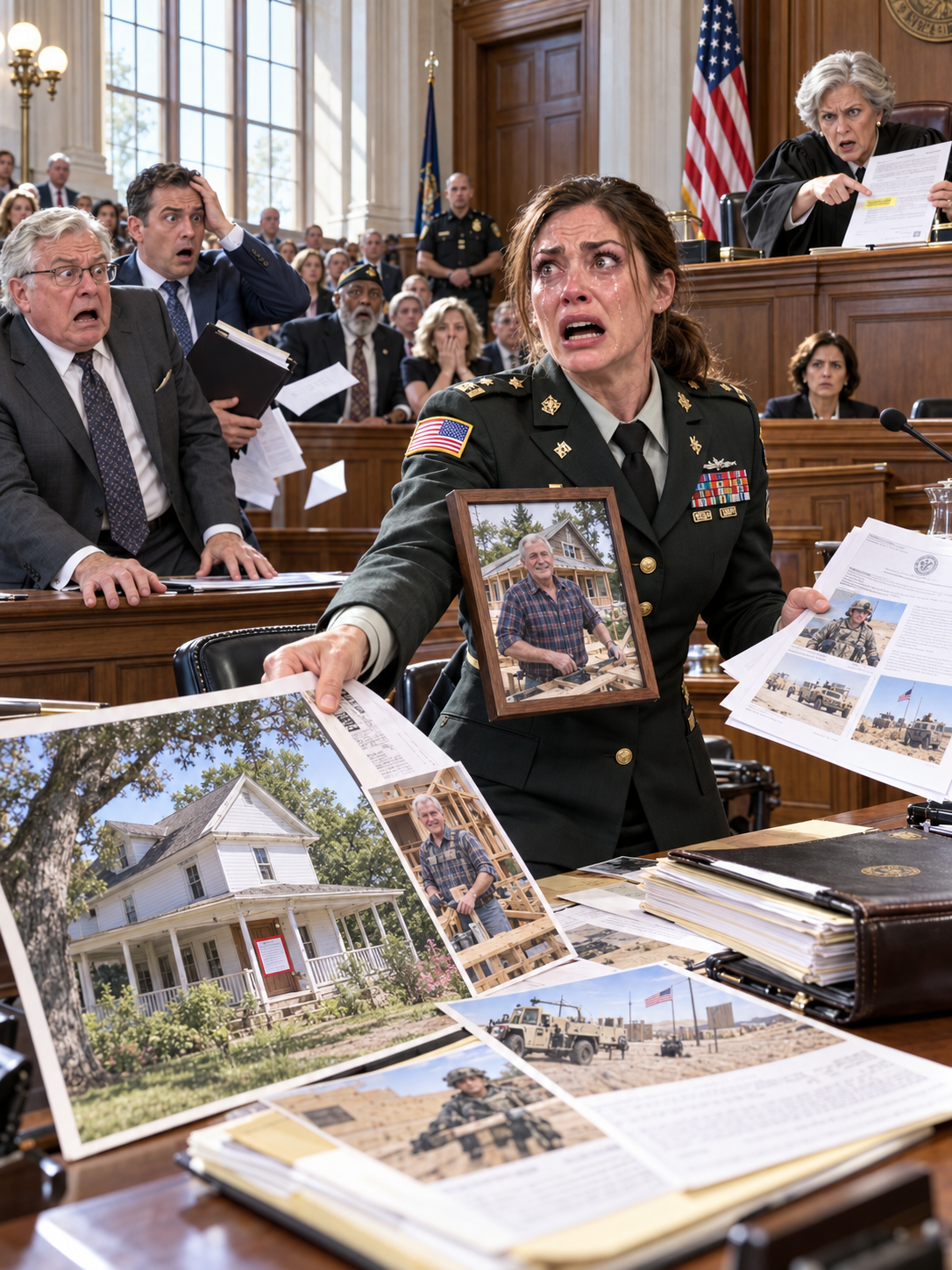
I came home from Iraq expecting to grieve my father in the house he had spent 40 years building with his own hands. Instead, I found a foreclosure notice taped to his front door and my uncle claiming I had ignored months of legal warnings. He had money, lawyers, paperwork, and a story that almost sounded believable. But buried inside his case was one date that should never have existed—and once a judge asked me where I had been that day, everything began unraveling.
### Part 1
The foreclosure notice was taped to my father’s front door with one crooked strip of clear packing tape, as if whoever put it there had been too impatient to press down the corners. I was still wearing my desert utilities, my deployment bag hanging from one shoulder, and my boots carried a fine layer of pale Iraqi dust all the way onto the porch in Wilmington, North Carolina. Three hours earlier, I had been standing beneath fluorescent lights at the airport convincing myself I was finally home; now I was staring at the words NOTICE OF FORECLOSURE SALE while cicadas screamed from the oak trees like nothing in the world had changed.
The paper named Harbor Point Restoration Group LLC as the claimant and listed $48,300 in unpaid renovation work allegedly performed on the property. Below that was the date I had supposedly been personally served with notice of the lawsuit: March 18, 2024. I read that line three times, then grabbed the porch railing because on March 18 I had been at Al Asad Air Base in Iraq, thousands of miles from North Carolina, signing morning duty reports while a dust storm turned the sky the color of dirty copper.
There was no mistake about where I had been. I had flight manifests, deployment orders, duty rosters, security logs, meal-card records, and more Marines who could place me in Iraq that day than I could fit into my father’s living room. Yet the affidavit attached to the notice claimed a process server had handed the papers directly to me at 3:42 p.m. on my father’s porch and described me as a brown-haired woman approximately five-foot-seven.
I am five-foot-seven.
That detail bothered me more than it should have.
I unlocked the front door and stepped into the house my father, Samuel Mercer, had left me when he died in January. The place still smelled like lemon furniture oil, sawdust from his workshop, and the faint trace of the aftershave he had worn since I was a kid; grief came at me so suddenly that I stopped in the entryway with my hand over my mouth. I had cried once after Dad died, inside a portable restroom at Al Asad at two in the morning, because it was the only place where nobody could see Captain Claire Mercer fall apart.
I dropped my bag beside the stairs and forced myself to read every page. The attorney representing Harbor Point was Trevor Sloan, whose office was in Los Angeles, and the company’s registered organizer was Douglas Mercer. My father’s younger brother, my Uncle Douglas, lived in Los Angeles and had spent the last two years telling Dad that keeping the waterfront house was “financially irresponsible.”
The cold feeling that settled into my stomach was worse than anger because anger still leaves room for doubt. I remembered Douglas at my father’s funeral, one hand on my shoulder while he told me, “Your dad knew you’d take care of everything.” He had hugged me beside the grave, waited until I boarded a military transport back overseas, and apparently started trying to take the house before the flowers on Dad’s casket had finished dying.
I called Lieutenant Colonel Tessa Grant from the Marine legal assistance office. “Ma’am, I just got home,” I said when she answered, and I heard my own voice become unnaturally steady in the way it always did when things were going badly. “Someone says they personally served me with foreclosure papers while I was deployed in Iraq.”
There was a pause. “Send me everything.”
She arrived that evening in civilian clothes carrying a laptop and a yellow legal pad. Tessa was in her early forties, sharp-eyed and economical with words, and she stood beneath Dad’s entryway light reading the papers without speaking while I watched her expression. When she reached the service affidavit, her eyebrows moved half an inch, which for her was the equivalent of shouting.
“You were physically in Iraq on March eighteenth?”
“Yes, ma’am.”
“Any leave around that period?”
“None.”
“Then whoever signed this affidavit has a problem.”
I showed her something else I had found while waiting. Harbor Point Restoration Group had been administratively dissolved by the state eighteen months before the lien was filed, and the address listed on several invoices traced back to a mailbox service outside Los Angeles. Tessa leaned back in Dad’s kitchen chair and stared at the screen for several seconds before saying, “Claire, don’t call your uncle tonight.”
“Why?”
“Because I want him comfortable.”
The next morning, I sat in my truck across from the New Hanover County courthouse while Tessa filed an emergency request to halt the foreclosure. I ignored her advice about contacting Douglas for almost seventeen minutes, then called him anyway because there are moments when military discipline loses to being someone’s daughter. He answered sleepily and immediately turned cheerful when he recognized my voice.
“Claire! You’re home. How was Iraq?”
“I found the foreclosure papers.”
Silence lasted less than a second, but it was enough.
Then Douglas sighed like I was forcing him to discuss an unfortunate family inconvenience. “I didn’t want you learning about it from a notice, sweetheart, but your father owed my company money for repairs. A lot of money. I tried to settle it privately.”
“You mean Harbor Point Restoration Group?”
“Yes.”
“The company dissolved in 2022?”
The warmth disappeared from his voice. “I don’t know what you’re looking at.”
“I also don’t understand how someone personally served me here on March eighteenth.”
This time the silence was longer.
“I was in Iraq, Douglas.”
He hung up.
I sat behind the steering wheel listening to the air conditioner hum and stared through the windshield at the courthouse columns. That phone call did something the legal papers hadn’t: it killed the last small possibility that this was bookkeeping, confusion, or some ugly misunderstanding. My uncle knew exactly what I was talking about, and for one brief second before he disconnected, I had heard fear.
That afternoon, my father’s next-door neighbor called. Evelyn Price was seventy-three, widowed, and possessed the observational powers of someone who had spent twenty years watching Harbor Crest Drive from a kitchen window while pretending she wasn’t watching anything at all. “Claire,” she said, “I’ve been waiting for you to come home because there was a man here in March, and what he did never sat right with me.”
I stood straighter. “What man?”
“Young fellow. Dark suit. Black SUV with California plates. He walked up to your porch, taped something to the door, took a picture, and left.”
“He didn’t knock?”
“Not once.”
My heart began pounding.
Evelyn lowered her voice. “My husband spent thirty-two years working for the sheriff’s department. I know what service of process looks like, honey, and that wasn’t it. So I wrote down the license plate.”
By sunset, Tessa had the plate number. Twenty minutes later, she called me back and told me the vehicle belonged to a private investigations company outside Los Angeles that had done previous work for Douglas Mercer.
Then she added, “Claire, there’s something else.”
I sat down at Dad’s kitchen table.
“We pulled the invoices supporting the lien,” she said. “Your uncle claims your father authorized almost fifty thousand dollars in renovations.”
“So?”
“One of the subcontractors listed on those invoices lives twelve miles from you.”
I stared at the darkening window.
“And according to him,” Tessa continued, “he never worked for your uncle’s company.”
For the first time, the foreclosure stopped looking like an attempt to collect money.
It started looking like someone had built an entire paper world around my father’s house—and expected me to stay overseas long enough for nobody to notice.
### Part 2
Owen Pritchard looked exactly like the kind of electrician my father trusted: faded work shirt, scarred hands, old pickup truck, and a ball cap that had probably survived three presidential administrations. He was sitting in Tessa’s office when I arrived the next morning, turning the cap slowly between his palms while a stack of invoices rested on the table. The moment I walked in, he stood and said, “Captain Mercer, I knew your dad twenty-two years, and I want you to understand something before we start. I never did what that paperwork says I did.”
Tessa slid two invoices toward me. The first was an original carbon copy from Owen’s records showing a 2021 electrical-panel upgrade for $4,850, billed directly to Samuel Mercer; the second, submitted by Harbor Point, described a “complete electrical modernization” costing $13,900 and carried Owen’s signature beneath a line identifying him as a Harbor Point subcontractor. I looked from one to the other while the old wall clock ticked loudly enough to irritate me.
“That’s not your signature?”
“No, ma’am.”
“Did Dad ever owe you money?”
“Your father paid before I could even mail reminders.”
Owen opened a folder and showed me photocopies of Dad’s checks. Dad’s handwriting was unmistakable, blocky and impatient, with little hooks at the ends of capital letters; every payment matched Owen’s real invoices, and none matched Harbor Point’s figures. By the time we finished comparing documents, three other contractors had already told Tessa similar stories.
A roofer named Luis Bennett said Harbor Point inflated his $6,200 repair into a $15,000 renovation. A carpenter said he had never heard of the company despite appearing on two invoices. Another invoice listed work performed during a month when Dad had been visiting me at Camp Lejeune for nearly two weeks, and the supposedly remodeled room looked exactly the same in photographs taken before and after.
Douglas had not simply invented one debt.
He had assembled a debt out of pieces of real work, changed the numbers, forged signatures, and wrapped the whole thing in enough truth to survive a casual glance.
That was when Tessa asked the question I had been avoiding. “Why this house?”
I looked toward the window.
“Because it’s worth money.”
“How much?”
I had checked the previous night. Dad bought the property before Wilmington’s waterfront prices climbed, and the house sat on nearly an acre less than ten minutes from the Intracoastal Waterway. A recent appraisal placed it just under $1.2 million.
Tessa tapped her pen against the desk. “And your uncle claims forty-eight thousand.”
“He’d spend more than that fighting me.”
“Exactly.”
We both understood at the same time.
The lien was never about recovering forty-eight thousand dollars.
It was a door.
If Douglas could obtain the property cheaply through foreclosure, the house itself was the prize.
I spent the next week living between Dad’s kitchen table, the courthouse clerk’s office, and Tessa’s conference room. Every file seemed to contain another small insult: signatures that looked almost right, dates chosen carefully around my deployment schedule, certified-mail records sent to an address Douglas knew I couldn’t access, and declarations claiming repeated attempts to reach me that never appeared in my phone or email history.
At night I slept in my childhood bedroom because I still couldn’t make myself use Dad’s room. The walls there had once been pale blue, but he’d repainted them white after I joined the Marines, telling me, “You’re an adult now, supposedly,” while grinning around a paintbrush. I would lie awake listening to the house settle and wonder how many nights he had spent alone here while Douglas quietly calculated what the property would be worth without him.
One evening I found a voicemail Dad had left eight months before his death. I had saved it because he sounded unusually annoyed.
“Claire, it’s your father. Obviously. Douglas called again about the house. Apparently, he’s discovered a career in giving unsolicited financial advice. Don’t worry about it. I told him no.”
I replayed it twice.
Then a third time.
There was nothing dramatic in Dad’s voice, just familiar irritation, but the message turned one of my memories sideways. Douglas hadn’t developed an interest in the house after Dad died; he had wanted it while Dad was alive.
Two days later, my cousin Jenna called.
Douglas’s daughter and I had never been close, but we hadn’t been enemies either. She was thirty, lived in Pasadena, and had sent me a handwritten condolence card after Dad’s funeral that was so sincere I kept it in the drawer beside my bed.
“Claire,” she said when I answered, “are you alone?”
“Yes.”
“I talked to a lawyer this morning.”
Every muscle in my shoulders tightened.
“Why?”
She breathed out shakily. “Because I know what my father did.”
I didn’t say anything.
“I told him it was wrong from the beginning,” she continued. “He kept saying Uncle Sam owed him and that you wouldn’t fight it because you were overseas. He said once the court entered default, everything would move too fast for you to stop.”
The room seemed to narrow around me.
“Jenna, how do you know this?”
“Because some of the paperwork was prepared at our house.”
She began crying, quietly at first. I could hear traffic behind her and imagined her sitting in a parked car somewhere in Los Angeles, staring through the windshield the way I had when Douglas hung up on me.
Then she said, “There’s a buyer.”
I stopped breathing.
A California developer named Nolan Pierce had signed an agreement with Douglas months before Dad died. The deal promised Douglas a substantial payment if he delivered clear title to the Harbor Crest property by the end of summer, and Pierce had already transferred a deposit into an account controlled by Douglas. Suddenly every deadline, false invoice, and fabricated service date had a reason.
“How much was the deposit?” I asked.
“Three hundred fifty thousand.”
I closed my eyes.
Douglas had already spent some of it.
Jenna said she had records.
Before I could ask what kind, she lowered her voice. “There’s something else, Claire.”
I heard a car door slam somewhere near her.
“After Uncle Sam died, a woman called my dad’s house. She said she had something for you.”
“What?”
“A letter.”
My throat closed.
“Dad told her you were unreachable and said he’d make sure you got it. He never did.”
I had to sit down.
Jenna continued in a whisper. “I found it in his desk two weeks later. He was going to destroy it, so I took it.”
All the legal strategy, all the invoices, all the rage disappeared for one second beneath a single thought.
My father had written to me before he died.
And my uncle had decided I would never read it.
### Part 3
I wanted Jenna to overnight the letter immediately, but Tessa told me not to move too quickly. “Your uncle already knows we’re challenging the foreclosure,” she said. “He doesn’t know Jenna is cooperating, and right now that is an advantage.” I hated the logic because it was correct, and I hated even more that preserving evidence meant waiting one more day to hold something my father had meant for me.
Jenna sent photographs instead. The envelope was plain white, my name written across the front in Dad’s handwriting, with “Personal—Claire Only” underlined twice. Seeing those letters on my phone hit harder than any courtroom filing because I could picture his hand making them, probably at the kitchen table with his glasses sitting too low on his nose.
The next photograph showed something else.
A copy of Douglas’s agreement with Nolan Pierce.
The Harbor Crest property was described by parcel number, address, and estimated redevelopment value. Douglas represented that he expected to obtain title through “resolution of estate encumbrances” by August 1, language polished enough to sound legitimate unless you already knew the encumbrance was a debt he had manufactured.
Pierce agreed to pay $910,000 after title transferred.
Douglas would clear nearly half a million dollars after expenses.
My father’s home had been reduced to arithmetic.
Tessa forwarded everything to a civilian attorney working with us, Marissa Cole, whose office specialized in property disputes and servicemember protections. Marissa had a habit of staring silently at documents before speaking, as if giving dishonesty one final opportunity to confess on its own.
“This explains motive,” she said. “But motive doesn’t win your hearing by itself.”
“What does?”
“Clean evidence.”
So we built clean evidence.
My deployment records showed I had been present at Al Asad every day surrounding March 18. My commanding officer provided a sworn declaration confirming I led a logistics briefing that afternoon. Base security logs recorded my access badge at 6:12 a.m., 11:47 a.m., 4:08 p.m., and 10:31 p.m., which meant Douglas’s process server would have needed to invent teleportation alongside perjury.
Evelyn signed a statement describing the man who taped the papers to my door. Investigators linked the SUV to Westmark Investigations, a California firm whose owner admitted Douglas had paid for “document delivery photography” but insisted he had never been told the employee would claim personal service. Owen and the other contractors supplied originals of every genuine invoice they could find.
The more organized our case became, the stranger Douglas became.
He texted me one night at 11:36.
We should settle this privately. Your father wouldn’t want family fighting in court.
I stared at the screen until anger stopped feeling hot and became almost funny.
I typed back: Dad also wouldn’t want you stealing his house.
Three dots appeared.
Vanished.
Appeared again.
Then nothing.
The following morning, a bouquet of white lilies arrived with no card. Dad hated lilies because they reminded him of funerals, and Douglas knew that; I carried them straight to the trash and found myself laughing once, sharply, at how badly my uncle understood me. He still thought every problem could be softened with gestures, every relationship could be reset if he acted offended long enough.
Then came the red herring that nearly shook me.
Marissa discovered a bank transfer from Dad to Douglas for $32,000 roughly a year before his death. The memo line contained only two words: FINAL HELP.
Douglas’s new attorney, Richard Keene, immediately argued that it proved an ongoing financial relationship and suggested the renovation debt might be legitimate. For the first time since coming home, uncertainty slipped under my skin.
Dad had never mentioned giving Douglas that kind of money.
I spent an entire night searching his desk, filing cabinets, and email archives, wondering whether grief had made me too eager to believe the best of him. Maybe Douglas had lied about the invoices but told some truth about the debt; maybe brothers made agreements daughters never knew about.
At three in the morning, I found an old email from Dad.
Douglas needs help again. I gave him money. Don’t start. I know exactly what you’re going to say, and yes, you’re right.
I almost laughed because I could hear his voice.
A second email, sent to his accountant, clarified the transfer: $32,000 gift to brother, no repayment expected.
The uncertainty vanished.
By dawn, it had been replaced by something steadier.
Dad had not been hiding a debt.
He had been embarrassed by his brother.
The foreclosure hearing was scheduled for July 9, and as the date approached, Douglas began filing motions designed to slow us down. Keene challenged Evelyn’s testimony, questioned whether contractor records were complete, and argued that even defective service could be cured if the underlying lien was valid.
Marissa responded page by page.
Tessa dealt with the military protections.
I did the one thing Marines are trained to do when a situation gets complicated: I kept showing up.
On July 8, I stood in front of Dad’s bedroom mirror wearing my dress blues. Tessa had suggested a civilian suit because it might appear less confrontational, but I wasn’t trying to intimidate anyone; I was refusing to disguise the fact Douglas had chosen my deployment as part of his plan.
I looked at myself and remembered Dad at my commissioning ceremony.
He had spent twenty minutes pretending not to cry, then finally said, “You know I’m allowed to be proud and terrified at the same time, right?”
“Apparently.”
“Good. Because that’s where we are.”
I smiled at the memory.
Then my phone rang.
It was Jenna.
Her voice was barely above a whisper. “Claire, Dad found out I copied the Pierce agreement.”
I turned away from the mirror.
“Are you safe?”
“Yes. I’m at a friend’s house.”
“What happened?”
“He knows I’m talking to you.”
There was a pause long enough for me to hear her breathing.
“Claire, he said something before I left. He said the service date doesn’t matter because his lawyer already has proof you were home.”
The room went still.
“What proof?”
“A photograph.”
I gripped the phone tighter.
“Of who?”
“He wouldn’t show me.”
For weeks, March 18 had been our strongest fact because facts don’t care how persuasive somebody sounds.
Now, twelve hours before the hearing, Douglas was claiming he had a photograph proving the impossible.
And for the first time, I wondered whether the lie waiting in court might be bigger than the one taped to my door.
### Part 4
The courtroom smelled like old paper, floor polish, and overworked air conditioning. I sat beside Marissa and Tessa in full dress blues while Douglas occupied the opposite table in a charcoal suit, his silver hair perfectly combed and his expression carefully arranged into wounded dignity. If I hadn’t known him my entire life, I might have believed he was the reasonable man in the room.
Judge Margaret Hale entered at nine sharp.
She was sixty-something, with rimless glasses and a face that revealed almost nothing. After reviewing the file, she looked toward Douglas’s table and said, “Mr. Keene, I understand your client maintains that Captain Mercer received valid personal service.”
“Yes, Your Honor.”
“And you have evidence beyond the affidavit?”
Keene stood. “We do.”
My stomach tightened.
He produced a photograph.
For half a second, my brain refused to understand what I was seeing.
A woman stood on Dad’s porch holding an envelope beside a man in a dark suit. She had brown hair, approximately my height, and wore a gray Marine Corps sweatshirt I recognized immediately because it belonged to me.
Douglas looked at me.
The expression in his eyes lasted barely a moment.
Triumph.
Then Marissa leaned toward me. “That’s not you.”
“No.”
“Who is it?”
I stared harder.
Then I knew.
“Jenna.”
The courtroom seemed to tilt.
The photo showed my cousin from behind and slightly to the side, enough to hide most of her face. She had stayed at Dad’s house for two nights after the funeral before returning to California, and apparently at some point she had borrowed the sweatshirt hanging in my old bedroom.
But the funeral had been in January.
The photograph was supposed to be March.
Marissa rose. “Your Honor, may we examine the original digital file?”
Keene hesitated.
Judge Hale noticed.
“Mr. Keene?”
“My understanding is that this is the original exhibit supplied by my client.”
“That was not my question.”
Ten minutes later, the metadata was on the courtroom monitor.
January 27, 2024.
The picture had been taken nearly two months before the alleged service.
Douglas’s face changed.
Just slightly at first.
Then completely.
Judge Hale removed her glasses. “Mr. Mercer, did you provide this image to your attorney as evidence Captain Mercer was served on March eighteenth?”
Keene stood immediately. “Your Honor, I need a moment with my client.”
“You may have five minutes.”
When court resumed, Keene looked like a man who had discovered the floor beneath him wasn’t structurally sound.
He asked to withdraw.
Douglas whispered something furious, but Judge Hale raised one hand. “Mr. Mercer, you will remain seated.”
Keene cleared his throat. “Your Honor, information has come to my attention that materially conflicts with representations made to counsel. I cannot ethically continue.”
The silence was extraordinary.
I could hear the fluorescent lights humming.
Judge Hale granted the withdrawal, then turned to Marissa. “Proceed.”
Owen testified first. He placed his real invoices beside the forged versions and explained every altered figure without raising his voice once; when asked whether Harbor Point had ever employed him, he answered, “No, ma’am. Never heard of them until Captain Mercer called.”
Evelyn followed.
She described the California SUV, the man walking up the driveway, the paper taped to my door, and the photograph he took before leaving. When Douglas tried to interrupt from his table, Judge Hale stopped him with a look so sharp he physically leaned back.
Then it was my turn.
I raised my right hand, swore to tell the truth, and sat facing the judge.
Marissa asked where I was on March 18.
“Al Asad Air Base, Iraq.”
“Could you have been in Wilmington, North Carolina, at 3:42 p.m. that day?”
“No.”
She handed the clerk my deployment orders, access logs, duty schedules, flight records, and my commanding officer’s declaration.
Judge Hale reviewed them one after another.
Then she stopped.
Her eyes went back to the affidavit of service.
“Captain Mercer.”
“Yes, Your Honor?”
“Were you responsible for a logistics briefing at Al Asad on March eighteenth?”
“Yes, ma’am.”
“At approximately what time?”
“Late afternoon local time.”
She looked toward Douglas.
Then back at me.
“So while this affidavit claims you were personally accepting documents in North Carolina, military records place you on a secured installation in Iraq.”
“Yes, Your Honor.”
Judge Hale tapped the service date once with her finger.
“Then how exactly were you personally served in Wilmington?”
Nobody answered.
I heard someone shift in the gallery.
Douglas had gone pale.
It wasn’t the dramatic collapse I had imagined during sleepless nights. There was no confession, no shouting, no cinematic explosion; just color draining from his face as if his body understood before his mind did that the story he had built could no longer carry its own weight.
Marissa introduced the corporate dissolution records next, followed by the contractor evidence and Pierce agreement. Judge Hale’s expression hardened with every exhibit.
Then Jenna entered the courtroom.
Douglas turned so fast his chair squealed against the floor.
She walked past him without looking down.
Her testimony lasted forty-three minutes.
She described her father’s plans for the property, the forged documents she had seen at his kitchen table, the agreement with Nolan Pierce, and the photograph Douglas had taken of her on Dad’s porch in January. He had asked her to hold an envelope while the investigator photographed them, claiming it was needed for “estate documentation.”
“He changed the date later,” she said.
Douglas stared at her like she’d stabbed him.
Jenna finally looked back.
“You told me it was just business,” she said quietly. “It stopped being just business when you used me to steal from Claire.”
By late afternoon, Judge Hale had heard enough.
She declared Harbor Point’s lien void, dismissed the foreclosure action, and referred the evidence concerning forged invoices, false service, and court filings to the district attorney. She also entered an order preventing Douglas or any entity connected to him from placing additional claims against the property without prior judicial review.
The gavel came down.
I didn’t feel victorious.
I felt tired.
Tessa put her hand over mine. “The house is safe.”
I nodded.
Outside the courtroom, reporters were gathering because someone had noticed the words Marine captain, deployment, and fraudulent foreclosure in the same public filing. I avoided them and walked toward the courthouse stairs.
Jenna caught up behind me.
“Claire.”
I turned.
Her eyes were red.
“I know helping now doesn’t erase that I stayed quiet before.”
“No, it doesn’t.”
She swallowed.
I wasn’t going to lie to make her feel better.
“But you eventually told the truth,” I said. “That matters too.”
She nodded, crying silently.
Then a woman standing near the bottom of the courthouse steps approached us carrying a plain white envelope.
I recognized her name before she introduced herself.
Dr. Miriam Cole.
The woman Dad had trusted with his final letter.
She held it toward me with both hands.
“Your father made me promise this would reach you personally,” she said.
I took the envelope.
The legal battle had ended.
But standing there with my father’s handwriting beneath my fingertips, I realized the part I feared most was still unopened.
### Part 5
I didn’t read Dad’s letter at the courthouse. I carried it home, walked past the kitchen and living room, and went directly to his workshop because that was the one place in the house that still felt untouched by death. Sawdust covered the corners, a half-empty can of linseed oil sat beside the window, and an unfinished walnut jewelry box rested on the workbench exactly where Dad had left it.
I sat on his old stool and opened the envelope.
Claire,
If you’re reading this, then Miriam kept her promise, which is good because you know I’ve never been talented at goodbyes. I need to tell you something about Douglas before I run out of chances.
I stopped and pressed my fingers against my lips.
Dad explained the $32,000 transfer first. Douglas had been buried in debt, and Dad gave him money not as an investment or loan but as one final attempt to help his younger brother. On the bank memo he had written FINAL HELP because he meant exactly that.
Then came the sentence that made my vision blur.
Douglas has no claim to this house. None.
Dad knew his brother wanted the property.
He wrote that Douglas had repeatedly pushed him to sell, had talked about redevelopment, and once suggested transferring partial ownership in exchange for “managing renovations.” Dad refused every time.
This house is yours, Claire. Not because it’s worth money. Because this is where you learned to ride a bike in the driveway, where your mother painted that ridiculous yellow kitchen you hated, where I built the workbench you’re probably sitting beside right now. I want you to have a place in this world nobody can order you out of.
I laughed through tears when I reached the next line.
And if Douglas tells you I’m secretly terrible with money, remind him I’m the brother who still owned his house.
I cried then.
Not the controlled tears I’d allowed myself in Iraq or the angry tears I had swallowed during the foreclosure fight. I bent over Dad’s workbench and cried until my chest hurt, one hand clutching his letter and the other gripping the wood worn smooth by forty years of his palms.
At the end he had written:
I was proud of you before the uniform. I’ll be proud of you after it. Don’t spend your whole life being strong for everybody else. Sometimes coming home is enough.
Love, Dad.
When I could breathe again, I looked at the unfinished jewelry box.
The hinges were still wrapped in brown paper beside it.
So I finished it.
My first attempt left the lid crooked. I cursed, removed the screws, filled the holes, and tried again exactly the way Dad would have made me do instead of pretending imperfection didn’t exist.
Six weeks later, Douglas was indicted on multiple state fraud and forgery charges related to the lien and supporting documents. Federal authorities also reviewed the false representations involving my military deployment, while Nolan Pierce’s lawyers scrambled to distance their client from the transaction and recover his deposit.
Trevor Sloan, the first attorney who had filed the original foreclosure, cooperated with investigators after evidence showed Douglas had concealed key facts from him. Richard Keene, who inherited the case later, produced his communications and made it very clear he had not known the photograph was falsely dated.
Douglas eventually called me from his attorney’s office.
I almost didn’t answer.
“Claire,” he said, and for once there was no fake warmth in his voice. “I’m asking you to remember that I’m family.”
I looked through Dad’s kitchen window at the oak tree in the backyard.
“You remembered I was family when you needed me not to fight back.”
“That’s not fair.”
I laughed once.
“You tried to take Dad’s house while I was deployed.”
“He owed me.”
“No, he didn’t.”
“You don’t know everything between brothers.”
“I know about the thirty-two thousand dollars.”
Silence.
“I have his letter.”
Another silence, much longer.
Then Douglas began crying.
Maybe it was fear.
Maybe shame.
Maybe grief finally catching up with him.
I didn’t care enough to decide.
“I made mistakes,” he said.
“No. You made documents. You made false invoices. You made a fake service record. You used Jenna in a staged photograph. Those weren’t mistakes.”
“Claire, please.”
“I hope you tell the truth now.”
“Can you forgive me?”
That question surprised me because I’d spent months assuming I wanted to hear it.
When it finally came, I felt almost nothing.
“No.”
He inhaled sharply.
I continued before he could speak. “Maybe someday I won’t be angry. Maybe someday I’ll hear your name and it won’t mean anything at all. But forgiveness isn’t a door you get to knock on because consequences finally found you.”
I ended the call.
I never regretted it.
Jenna and I didn’t suddenly become best friends either. She had waited too long to speak, and I wasn’t going to rewrite that just because she eventually did the right thing; but when she called, I answered, and when she testified again during the criminal proceedings, I sat behind her in the courtroom.
Some relationships survive damage by becoming something different instead of pretending nothing happened.
Mine with Douglas didn’t survive at all.
That was different too.
In October, Evelyn knocked on my door carrying a sweet potato pie.
“Your father got one every fall,” she said, shoving the dish into my hands with the authority of a woman serving a warrant. “You’re getting one too.”
“Evelyn.”
“What?”
“Thank you for writing down that plate.”
She looked at me like I’d said something obvious.
“Honey, I knew exactly what might happen if nobody did.”
Then she pointed at the pie.
“Return that dish or I’ll actually foreclose on you.”
I laughed so hard I had to lean against the doorway.
It was the first laugh I’d heard inside that house that sounded completely like mine.
A few weeks later, Tessa called with an update on Douglas’s case. His attorney was negotiating, but the evidence was overwhelming, and whatever agreement he reached would include felony responsibility, restitution obligations, and consequences that couldn’t be explained away as a family disagreement.
“How does that feel?” she asked.
I thought before answering.
“Quieter than I expected.”
“That’s usually how justice feels after the adrenaline wears off.”
She was right.
I had imagined victory would feel like watching Douglas lose.
Instead, victory felt like drinking coffee from Dad’s chipped mug on a Saturday morning without checking court deadlines. It felt like hearing rain on the workshop roof, learning which floorboard near the hallway still creaked, and planting rosemary beside the back steps because Dad had always said he would and never did.
On the last Sunday of October, I went into his workshop just before sunset.
The walnut jewelry box sat finished on a shelf above the workbench. One hinge was slightly crooked, and there was a shallow gouge near the back corner where my chisel slipped; months earlier I would have wanted to fix every flaw, but now I left them because they proved the box had been completed by someone who was learning.
Outside, Dad’s oak tree moved slowly in the wind.
I ran my hand across the workbench and remembered every piece of evidence we had gathered, every phone call, every courtroom argument, and especially the date that had cracked Douglas’s story open.
March 18, 2024.
He had assumed my deployment made me vulnerable.
He never understood that deployment created records.
Orders.
Logs.
Witnesses.
A trail stronger than the lie he’d built around my absence.
But standing there in the workshop, I finally understood I hadn’t fought so hard because of the property’s market value or because I needed to defeat my uncle. I had fought for the right to stand in that room, smell sawdust and oil, touch the same worn wood Dad had touched, and decide for myself what happened next.
I picked up a fresh piece of walnut from the shelf.
For most of that year, everything I made had been in response to somebody else’s choices: military orders, Dad’s death, Douglas’s fraud, lawyers, courts, hearings.
This piece of wood was different.
Nobody had started it before me.
Nobody had a claim on it.
I set it on the workbench, measured twice the way Dad taught me, and drew the first pencil line.
Then I turned on the shop light and began building something that belonged entirely to my future.
THE END!
Disclaimer: Our stories are inspired by real-life events but are carefully rewritten for entertainment. Any resemblance to actual people or situations is purely coincidental.


