
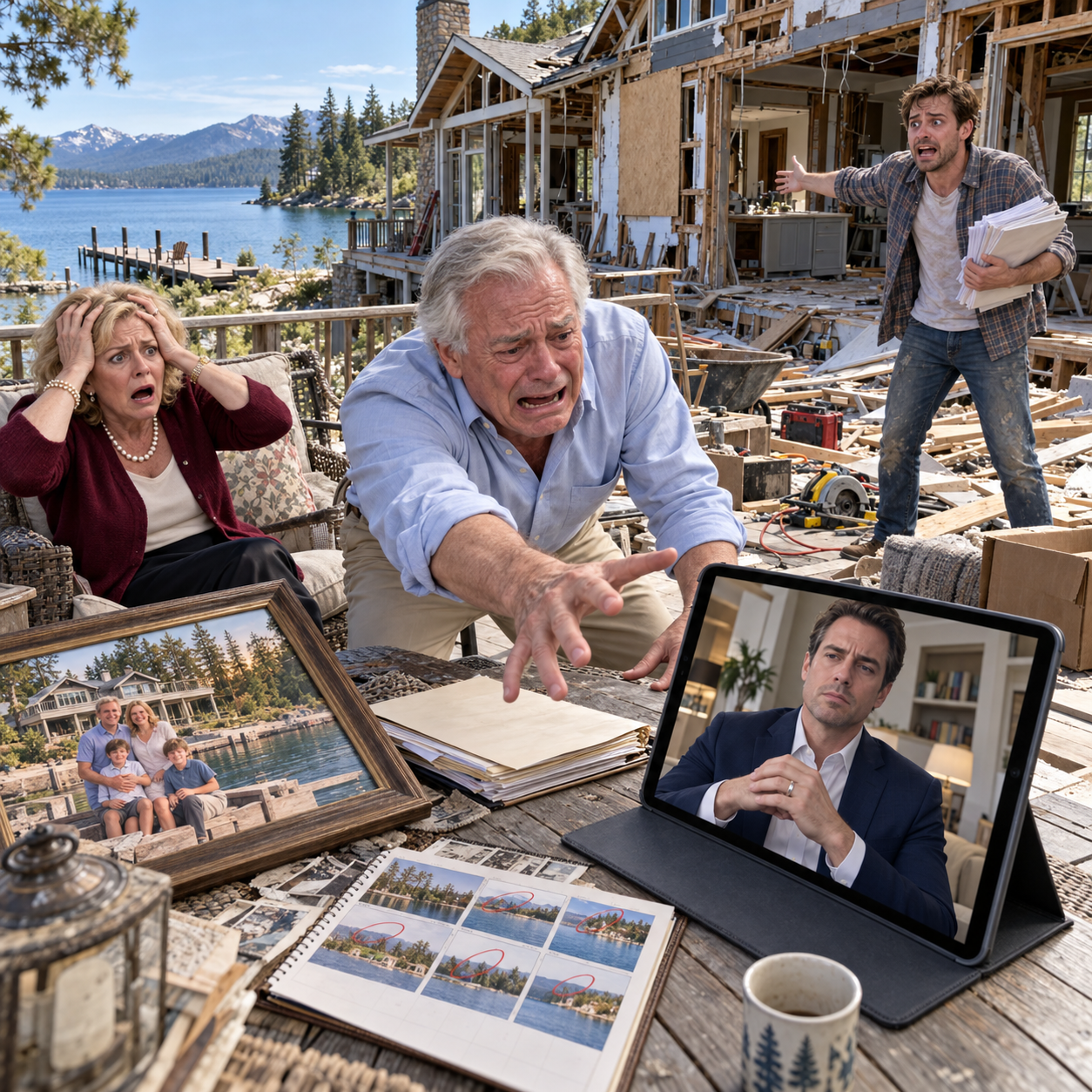
My parents gave my brother the lake house that held summers of my childhood, and he sent me six “approved” weekends when I was allowed to visit. I read the list twice, blocked his number, and stopped showing up. Then my parents skipped my wedding to defend him. Months later, Dad called in a panic: the house was gutted, buried in debt, and ruined. Suddenly, the son they treated like a guest was the only one who could save it.
### Part 1: One cruel text finally showed me my place in the family
My name is Ethan Mercer, I’m thirty-four, and for most of my life I was the easy son. That sounds flattering until you understand what it really meant. My younger brother, Caleb, was the one my parents talked about. He played baseball, could make a room laugh, and had the kind of confidence that made strangers remember him. I liked books, chess, and figuring out why bridges stayed standing. My father, Martin, never mocked me outright, but when Caleb had a game two towns away, Dad left work early. When I had an engineering showcase at college, he said parking downtown was a nightmare. My mother, Denise, loved us both, but Caleb warmed the room for her. I was the dependable lamp in the corner: useful, familiar, and easy to overlook.
The one place where none of that mattered was my grandparents’ lake house on Raystown Lake. Grandpa Walter and Grandma June owned a three-bedroom cabin with a crooked cedar porch, green kitchen cabinets, and a dock that groaned every time someone stepped on it. It was never fancy. It smelled like lake water, old wood, sunscreen, and the coffee Grandpa brewed too strong every morning. We spent three weeks there every summer. Walter taught me fishing knots, how to tell an oak from a hickory by the bark, and how to sit quietly enough for a blue heron to stop being afraid of me. When I was twelve, he put one hand on my shoulder while we watched the sunset and said, “This place will always be here for you, Ethan.” I believed him because Grandpa Walter never wasted words.
Grandma June died when I was twenty-two. Walter followed four years later. The day after his funeral, I drove to the cabin alone and sat on the dock until the sky went dark. In his will, he left the property to my mother, his only child. That made sense, and for several years nothing changed. My parents used it every July. Caleb came with girlfriends. I took a week off work whenever I could. Then Caleb married Paige. She wasn’t openly cruel. She was polished, observant, and always evaluating. She came from a family obsessed with property, appreciation, resale value, and “unlocking equity.” Within a year, Mom started mentioning how responsible Caleb was becoming and how the cabin “needed someone with a long-term plan.”
The announcement came over Sunday dinner. Mom had made roast, mashed potatoes, and lemon meringue pie, which should have warned me because she only baked that pie when she wanted everyone in a good mood before uncomfortable news. Dad cleared his throat and said, “Your mother and I have decided to transfer the lake house to Caleb.” I remember the fork stopping halfway to my mouth. Caleb stared at his plate, which told me he already knew. Paige wore a tiny satisfied smile. Dad explained that they planned to start a family, Caleb had ideas for renovations, and giving the house to one person would “avoid complications.” I asked Mom, quietly, “Do you really think Grandpa would have wanted me cut out completely?” Her mouth tightened. “He left it to me, Ethan. It was my decision.”
Legally, she was right. That almost made it worse. I finished the pie, thanked them for dinner, hugged Mom at the door, and drove home with my hands locked around the steering wheel. I didn’t yell because I had spent my whole life learning that being reasonable was the price of being accepted. Three weeks later, Caleb made sure I understood exactly what reasonable had bought me. He sent a text that began, “Hey, Ethan, Paige and I are getting the lake house organized. Here are the approved visit dates for next year.” There were six weekends. None were in June or July. Each came with rules: don’t move porch furniture, strip the beds, run the dishwasher, no pets, leave by Sunday afternoon.
I read the message twice. The kid who had once slept beside me in bunk beds while thunderstorms shook that roof had just turned me into a short-term guest in my own memories. I called my girlfriend, Nora, and read the message aloud. She was quiet for a few seconds, then said, “They’re not giving you visiting dates. They’re showing you where they think you belong.” That sentence hurt because it was true. I thought about every birthday where Caleb’s gift was bigger, every event my parents had missed because his schedule came first, every time Mom introduced him with pride and described my engineering career as “something with numbers.”
Three days later, I blocked Caleb. No speech. No threat. No family meeting. I just stopped volunteering to be the person who swallowed everything so everyone else could stay comfortable. Thanksgiving came six weeks later, and for the first time in my adult life, I didn’t go home. Nora and I cooked chicken, garlic potatoes, and a pie that collapsed in the middle but tasted great. The next morning Mom called. “Where were you? We waited.” I said, “I’m not family enough to have a key to the lake house, but I’m family enough to be expected at Thanksgiving. That doesn’t work for me.”
She sighed. “This is still about the lake house? Ethan, you need to let that go.”
I looked through my apartment window at the gray November sky and realized something that felt colder than anger. She didn’t misunderstand what they had done. She simply expected me to accept it. “I’m not angry, Mom,” I said. “I’m done pretending it doesn’t matter.” Then I hung up, and for the first time, silence felt less like punishment and more like freedom.
### Part 2: My parents chose my brother again, even on my wedding day
The months after Thanksgiving were strange because nothing exploded. Dad sent short messages telling me to call Mom. Mom left two voicemails saying this had “gone far enough.” Caleb, still blocked, made no attempt through email or work to reach me. Their silence confirmed something I had spent years avoiding: as long as I played my old role, they considered the family healthy. The moment I stopped absorbing the discomfort, I became the problem. Christmas made that even clearer. Nora took me to her parents’ home in upstate New York, where her father, Russell, asked about my work and listened through an entire explanation of structural load paths without checking his phone once. Her mother, Elaine, remembered the name of a project I had mentioned months earlier. I nearly cried over dinner because being noticed felt embarrassingly unfamiliar.
In January, my career changed. The engineering firm where I worked won a major waterfront development in Pittsburgh, and my boss, Grant Holloway, called me into his office. “You’ve spent ten years making other people look good,” he said. “This one is yours.” I became lead structural engineer over a team of twenty-three people. The hours were brutal, but I loved it. Every meeting reminded me that competence mattered more than charm. I had spent years believing being less lovable than Caleb made me less important. At work, nobody cared who could tell the funniest story at dinner. They cared whether I had checked the numbers twice before steel arrived on site.
The night I told Nora about the promotion, she threw both hands into the air and screamed so loudly our upstairs neighbor stomped on the floor. Then, while we were eating leftover noodles from cartons, she said, “We should get married.” I laughed because I had been carrying a ring-size note in my wallet for two weeks. “I was going to ask you.” She pointed her fork at me. “Too slow.” We got engaged without a ring, a photographer, or a dramatic proposal. It was perfect because for once happiness didn’t require an audience.
We chose a small vineyard for September. As invitations went out, I spent days deciding what to do about my family. I finally mailed one to my parents with a handwritten note: “I would love to have you there. This matters to me.” I did not invite Caleb or Paige. Three days later, Mom called. Her voice was careful. “Your father and I want to come, but excluding your brother is hurtful.” I almost laughed at the word hurtful. “I was his brother when he sent me visiting hours for Grandpa’s house.” She said families had to move past things. I asked why “moving past things” always seemed to mean I had to surrender while Caleb changed nothing.
She said she would talk to Dad and call me back. She never did. Neither of them came to my wedding.
That hurt more than the lake house. I wish I could tell you I felt nothing when I looked at the empty chairs reserved for them, but I noticed them before the ceremony started and again when Nora walked toward me across the stone terrace. I also noticed Russell standing beside her with tears in his eyes, Elaine fixing the edge of Nora’s veil, and Grant waiting at my side as best man. I realized I was surrounded by people who had chosen to be there without demanding that I betray myself first. My parents had made their choice. For once, I refused to chase them and ask them to choose again.
The year after the wedding moved fast. The waterfront project stayed ahead of schedule, and one of the developers offered me consulting work on three future projects. Nora and I bought a four-bedroom craftsman in a quiet neighborhood outside Pittsburgh. She painted the front door yellow. We planted two maple trees out back. I stopped measuring my life against the version my parents seemed to prefer. Then, on a Tuesday evening in late summer, Dad called for the first time since the wedding.
He skipped hello. “Your brother needs help.”
I leaned against the kitchen counter while Nora chopped vegetables beside me. “What happened?”
Dad exhaled. “The lake house is in trouble.”
For a second I thought I had misheard him. The house they had trusted Caleb to protect. The house I had needed permission to visit. That house was suddenly a family emergency, and somehow I was family again. Dad explained that Caleb and Paige had gutted the kitchen, torn out Grandpa’s pine floors, knocked down an interior wall, expanded the deck, and started replacing the dock. The budget had doubled, then doubled again. Their contractor had taken a large progress payment and vanished before finishing the work. The cabin now had exposed framing, one usable bathroom, partial plumbing, and structural problems around the porch.
Dad kept talking. Caleb had borrowed against his own house. His real estate income had fallen. Credit cards were maxed. Suppliers were demanding payment. “He may have to sell,” Dad said.
I looked at Nora. She had stopped chopping.
“Dad,” I asked, “why are you calling me?”
There was a pause long enough to answer the question before he did. “Because you understand buildings.”
That was when the old hurt changed shape. They still didn’t see me as the son who had been excluded. They saw the engineer who might solve the problem. But this time, being useful did not mean being obedient. “Send me the information,” I said. “I’ll look at it.” After we hung up, Nora studied my face. “Are you going to help him?”
I looked toward the yellow front door of the life we had built without them. “Maybe,” I said. “But not the way they think.”
### Part 3: I offered to save the house, but only on my terms
The next morning I called Adrian Cole, a real estate attorney I knew from the waterfront project. I explained the history and the debt. When I finished, Adrian asked one question. “Do you want the lake house?” I answered before he finished the sentence. “Yes.” Not because I wanted Caleb to suffer. Not because I wanted my mother to admit she had been wrong. I wanted the place because Grandpa Walter had built his life into it, and watching it get stripped apart for somebody else’s idea of luxury felt like watching a family photograph burn one corner at a time.
Adrian advised me to treat everything as business. No informal loans. No handshake promises. No paying contractors on Caleb’s behalf. If I wanted control, the cleanest path was a purchase. Before I called my brother, I hired a structural inspector named Renee Lawson to assess the property. She spent most of a day there and sent me a report with photographs that made my stomach hurt. The porch supports had been compromised. A drainage change had caused basement water intrusion. Plumbing lines were unfinished. Part of the electrical work needed to be redone. The open wall Caleb wanted removed had not been properly supported during demolition.
Renee estimated that finishing the job correctly and repairing the new damage would cost about $120,000. In its current condition, she valued the house around $90,000, less than half what a restored lakefront cabin in that area could command. I printed the report and spread it across our dining table. Nora read every page. Finally, she tapped one photo of the old porch. “If you buy it, are you trying to make it look expensive or make it feel like home?” I said, “Home.” She nodded. “Then let’s get it back.”
I unblocked Caleb and sent one text: “I heard what happened. I want to talk about the lake house. Just you and me.” He called within twenty minutes. The voice on the line was not the confident brother who had sent me rules. He sounded exhausted. He told me the contractor had disappeared, Paige’s family refused to help, and they were carrying debt they could no longer manage. He said they had tried to list the cabin quietly, but buyers walked away after inspections. He told me he barely slept. What he did not say was, “I’m sorry.”
I listened until he ran out of explanations. Then I said, “I may be willing to buy it.”
He went silent. “You want to buy the lake house?”
“I want to restore it. But I’m not putting money into property I don’t own.”
He asked what I would pay. I told him I needed a clean title review first. Adrian discovered two supplier liens connected to the failed renovation. After those were resolved, I offered $95,000, slightly above Renee’s current valuation. Caleb tried once to push higher. I slid the inspection report across Adrian’s conference table and said, “I’m not punishing you. I’m also not paying for the house as if you hadn’t torn half of it apart.” He stared at the photographs, then looked away.
Paige did not attend the closing. Caleb came alone in a wrinkled blue shirt. He signed page after page while Adrian explained every clause. When the final document was done, he sat back and rubbed his face. For the first time in years, he looked like my little brother instead of my parents’ favorite son. “I messed this up,” he said.
“Yes.”
He swallowed. “The house. And us.”
I waited.
He looked at the table. “That list was stupid. Paige said we needed boundaries once the title was ours. I went along with it because I liked feeling like something was finally mine.” He gave a short, bitter laugh. “Turns out I didn’t even know what to do with it.”
It wasn’t the perfect apology. He still blamed Paige too much. He still talked around the fact that he had accepted a gift he knew excluded me. But it was the first time he had admitted that what happened between us was not just my sensitivity. I said, “You should have told Mom and Dad the house belonged to both of our histories, even if the deed didn’t.”
“I know.”
I didn’t hug him. I didn’t say we were good. I shook his hand, and that was all.
The restoration started two weeks later under a contractor named Mason Reed, a broad-shouldered man in his fifties who specialized in old cabins. He walked through the damage with Renee’s report tucked under one arm. At the ruined kitchen, he shook his head. At the missing pine floors, he muttered something I won’t repeat. Finally, he stepped onto the crooked porch and said, “Whoever did this should be embarrassed. But the house is fixable.”
For five months, Nora and I drove up almost every weekend. We ate sandwiches on folding chairs while crews rebuilt the porch supports, corrected the drainage, restored the original kitchen layout, and laid pine flooring that matched Grandpa’s old boards. I asked Mason to keep one thing exactly as it had been. “The porch still needs to lean a little left,” I told him.
He stared at me. “You’re paying me to make it crooked?”
“I’m paying you to make it safe. The crooked part is family history.”
The first morning after the dock was finished, I stood at its edge while mist lifted off the water. I could almost hear Grandpa Walter behind me saying, “Sit still long enough and the lake tells you what matters.” For the first time since my mother’s dinner announcement, I understood what I had actually been fighting for. It was never ownership alone. It was the right to stop letting other people define where I belonged.
Then Mom found out I had bought the house.
### Part 4: I got the lake house back, but not the family we had
Mom called the night Caleb told her. “I heard you bought the lake house.” Her tone carried disbelief, irritation, and something close to fear. “I did.” She asked why I would spend that much money on a damaged cabin. I said, “Because someone needed to care about what it was, not what it could be turned into.” She immediately defended Caleb. They couldn’t have known the contractor would disappear. Renovations go wrong. The market changed. Paige had been under stress. I listened until she paused for breath.
Then I said, “You’re still explaining why his decisions shouldn’t count against him. You never once explained why cutting me out shouldn’t count against you.”
Silence.
I reminded her that she and Dad had transferred the house without even warning me, watched Caleb send me a schedule like I was a guest, then skipped my wedding because I refused to invite him. “And now,” I said, “the only reason we’re talking about fairness is because I own the property.”
“That’s not fair, Ethan.”
“No, Mom. It’s accurate.”
Her voice softened. “So what happens now? Do we need approved dates?”
I closed my eyes. That question told me she had understood the cruelty of Caleb’s list all along. She had simply hoped I would absorb it quietly. “No,” I said. “You don’t need a schedule. But access to a house isn’t the same as access to my life. Those are separate now.”
The restoration finished in early spring. The total cost of purchasing and repairing the cabin was a little over $210,000. The new appraisal came in just above $300,000, which pleased our accountant but meant almost nothing to me. The first warm weekend in May, Nora and I opened every window and let the smell of cedar and lake water move through the rooms. The kitchen looked like the one I remembered, only safer. The pine floors glowed in the afternoon light. The screen door still slapped shut too loudly. The porch still leaned just enough to make me smile.
My parents came once that summer. I did not invite them out of guilt. I invited them because I wanted to know whether I could share the place without surrendering myself again. Dad spent an hour sitting on the porch, looking across the lake. Eventually he said, “Walter would have liked what you did here.” From Martin Mercer, that was practically a speech. I thanked him. Mom brought her cranberry sauce, the same aggressively sweet recipe she had made every Thanksgiving of my childhood. We ate dinner without arguing, but we also did not pretend the past had disappeared. When she started to say, “We only wanted what was best for both of you,” I stopped her gently. “No, Mom. You wanted what was easiest. There’s a difference.”
She looked down at her plate and did not argue.
Caleb came up later that month without Paige. We took the canoe into the cove before sunrise. For a long time, neither of us spoke. The paddle dipped into dark water, birds moved through the trees, and the cabin disappeared behind us. Finally, he said, “I miss when this was simple.”
“It was never simple,” I said. “We were just kids.”
He nodded. “Do you think we’ll ever be close again?”
I could have given him the comforting answer. I didn’t. “I don’t know. Trust doesn’t come back because people miss each other.”
He accepted that. Strangely, that made me respect him more than another apology would have. We talk occasionally now. We are not enemies, but we are not restored brothers in some neat ending either. He has to build something new with me if he wants a relationship, and I no longer do all the construction for both of us.
As for my parents, I did not forgive them in the way they wanted. They wanted forgiveness to mean returning to the old arrangement: Thanksgiving attendance, automatic phone calls, pretending the wedding didn’t happen, pretending the house decision was just paperwork. I refused. I see them sometimes. I answer when I want to. I leave when the conversation becomes guilt disguised as concern. I love them, but I no longer organize my life around earning a place they should have given me freely.
The best thing that happened came in late summer. Nora walked into our kitchen at home carrying a tiny child-sized fishing rod with a ribbon tied around the handle. I stared at it, then at her. She smiled. “You’re going to need another fishing partner.”
I cried before she finished the sentence.
Our daughter is due in the spring. We have already talked about summers at the lake: catching fireflies on the porch, learning to fish from the dock, eating sandwiches with wet feet, listening to frogs after dark. I will tell her about Walter and June. I will tell her the crooked porch is supposed to look that way. Maybe someday I will tell her why the house almost left our family before finding its way back.
But I will never teach her that love has to be earned by being easy, useful, or quiet.
Grandpa Walter once told me the lake house would always be there for me. He was right, though not in the way I expected. I had to lose my place in my family before I understood that belonging is not something other people get to schedule for you. The dock still creaks. The porch still leans left. The door to the cabin is open.
My life, however, is no longer open to anyone who expects me to disappear inside it.
THE END!
Disclaimer: Our stories are inspired by real-life events but are carefully rewritten for entertainment. Any resemblance to actual people or situations is purely coincidental.

