
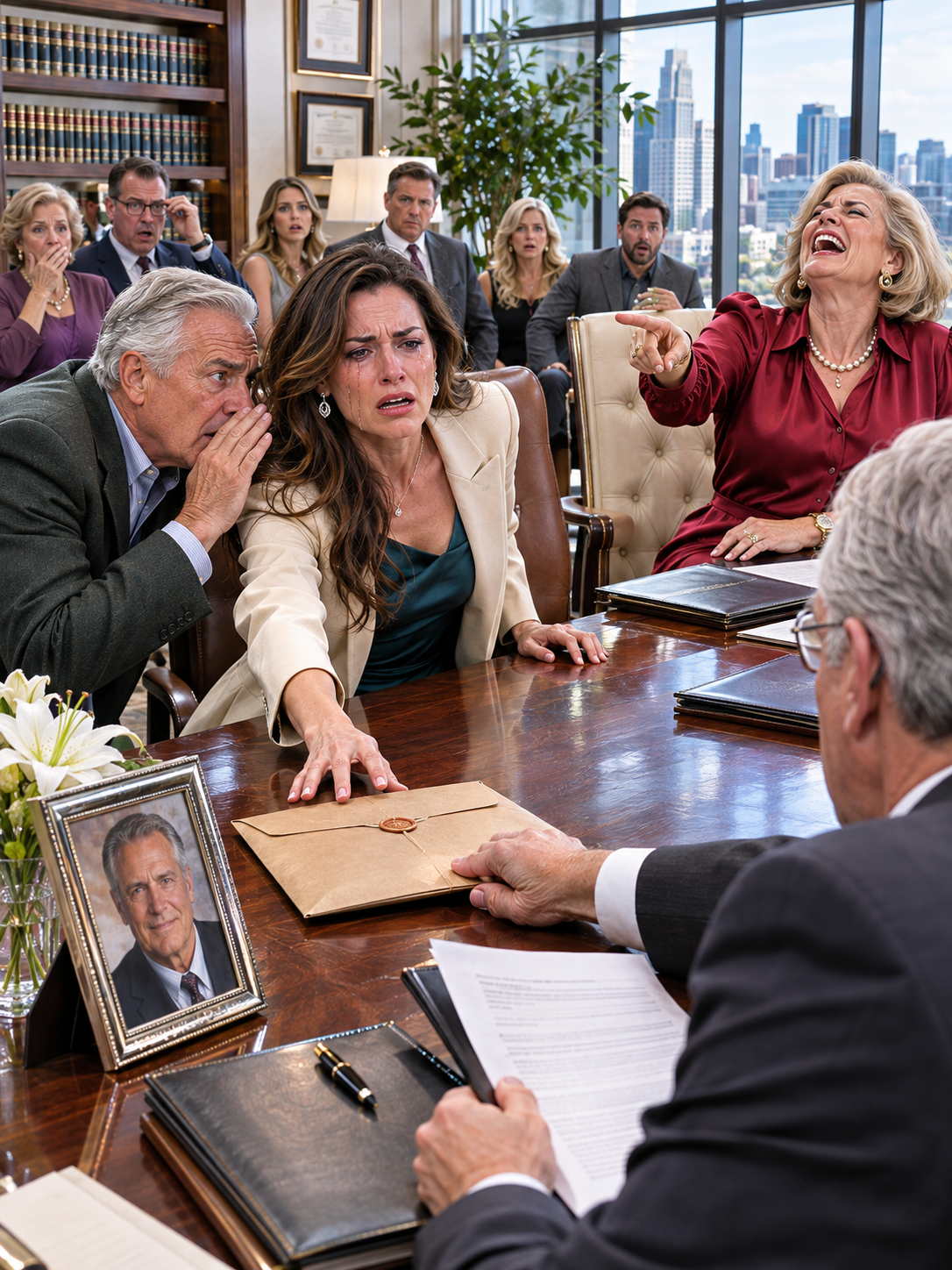
At The Will Reading In A Lawyer’s Office, With 9 Relatives In The Room, My Mother Laughed And Said: “Your Father Left You Nothing. He Hated You For 18 Years.” The Lawyer Opened A Sealed Brown Envelope Stamped With My Dead Father’s Name, Read The First Line Silently, And Pushed It Toward Me. I Said Nothing. My Uncle, Who Hadn’t Spoken To Me In Thirteen Years, Leaned Forward And Whispered: “Open It, But Not In Front Of Her.”
My mother laughed in front of nine relatives and announced that my father had hated me for eighteen years. He had been dead for three weeks, and I had come to his lawyer’s office expecting nothing more than another uncomfortable family gathering. I didn’t argue or defend myself. I simply told her I wasn’t there for his money. But that evening, when I finally opened the envelope his lawyer had given me, I found a document bearing my signature. It was dated eighteen years earlier. I had never signed it.
Part 1/5
The first thing I noticed when I entered the conference room was that my mother had taken the chair at the head of the table. She sat beneath a framed landscape painting, wearing a navy suit and the pearl earrings my father had given her for their twenty-fifth anniversary. A white porcelain cup rested beside her leather handbag, and she was discussing the weather with my aunt as though we were waiting for a restaurant reservation instead of settling a dead man’s affairs. When she saw me standing in the doorway, her smile thinned. “Well, Willa, I wasn’t sure you’d bother showing up.”
My name is Willa Ashford, and I was thirty-six when my father died. I worked as an operations manager for a hospital network outside Albany, owned a small townhouse, and had spent most of my adult life making sure nobody in my family could accuse me of needing anything. My father, Silas Ashford, had owned an appliance repair business for nearly thirty years, and until I turned eighteen, I thought he was the safest person in the world. My mother, Daphne, had spent almost two decades convincing me otherwise.
I remembered my father teaching me to cast a fishing line from a crooked wooden dock, standing behind me with his enormous hands guiding mine. He made pancakes on Saturday mornings, burning the first one every single time, and let me ride beside him in his service truck while he drove between customers. Sometimes he would stop at a gas station and buy me a chocolate milk without telling my mother, and we would drink our treats in the parking lot like accomplices. Those memories were so ordinary that I had never questioned whether they were real. What I questioned was why the man in them had apparently stopped loving me.
The change happened during my senior year of high school, when I was preparing to leave for college. My mother began telling me that Dad was disappointed in my plans, that he considered my scholarship inadequate, and that he had expected a daughter who cared more about her family. Whenever I tried to speak with him, he seemed distracted or irritated, and my mother always explained his behavior afterward. “He doesn’t know how to tell you himself,” she would say. “You need to accept that your father isn’t proud of you.”
One evening, shortly before graduation, she told me he had called me selfish for choosing a university three hours away. I confronted him at dinner, but instead of asking what I meant, he pushed his chair back and said, “I’m tired of having the same argument.” My mother stared at her plate while I cried, and Dad walked into the garage without another word. I left for college that August convinced he wanted me gone.
We exchanged occasional birthday cards and stiff Christmas greetings afterward, but the relationship never recovered. Whenever I received a message from him, my mother insisted it was a formality, and whenever he didn’t call, she told me I should finally accept the truth. At twenty-four, I stopped visiting for Thanksgiving after she said Dad had complained about my presence. By thirty, I had learned to describe my childhood without mentioning my parents at all.
His illness brought us into the same room again, though it didn’t make us close. During one hospital visit, I found him sitting upright in bed with a paper cup of ice water beside him, watching late-afternoon sunlight cross the windowsill. He asked whether I was still living in the townhouse with the red front door, which surprised me because I hadn’t realized he knew where I lived. When I said yes, he opened his mouth as though another question was coming, but my mother arrived with his clean clothes and immediately began discussing his next appointment. He lowered his eyes and never finished speaking.
Three weeks after his funeral, I walked into attorney Maris Bell’s office carrying all those unfinished conversations. Nine relatives had gathered, including my father’s younger brother, Tobin, who sat across from me with his hands folded tightly together. My mother waited until everyone settled before giving a small, theatrical laugh. “Don’t sit there looking hopeful, Willa,” she announced. “Your father hated you for eighteen years, and dying didn’t change that.”
The silence afterward was almost worse than the words. My aunt Hester studied her fingernails, one cousin shifted uncomfortably, and another pretended to read something on his phone. Tobin looked straight at my mother, his jaw tightening, but he said nothing. I placed my handbag on my lap and answered, “I didn’t come here expecting anything from him.” My mother gave a satisfied little nod, as though I had confirmed something important.
Maris began reviewing the estate, speaking in the measured voice of someone accustomed to families behaving badly around money. There was the house, a modest savings account, Dad’s remaining business equipment, and a life insurance policy whose beneficiary was already designated. My mother listened carefully, occasionally asking about property values and transfer dates, while I stared at a brass lamp reflected in the polished conference table. Near the end, Maris reached into a separate folder and removed a thick cream-colored envelope with my full name written across the front in my father’s handwriting.
“This was left specifically for you,” she said, breaking the seal only long enough to check the enclosed instructions. Her eyes stopped on the first paragraph, and the professional calm disappeared from her face for a brief, unmistakable second. She slid the envelope toward me and added, “Your father asked that you receive the complete contents personally.” My mother leaned forward immediately. “What contents?”
Before I could answer, Tobin touched my sleeve beneath the table. “Don’t open it here,” he whispered, keeping his eyes on the envelope. When I looked at him, I saw something I had never noticed in his face before: fear. I slipped the envelope into my bag, and my mother watched the movement as carefully as if I were hiding a stolen piece of jewelry.
That evening, I sat at my kitchen table with the envelope beside a mug of untouched tea. Inside were several folded pages, old photocopies, and a letter written in my father’s familiar blocky handwriting. The first sentence read, “Willa, if you’re reading this, I finally ran out of chances to tell you what happened when you were eighteen.”
Behind the letter was a document labeled “Acknowledgment of Distribution,” dated two weeks before I left for college. It claimed I had personally received $64,800 from a trust established by my grandmother, and the signature at the bottom looked remarkably like mine. There was only one problem.
I had never received that money, and I had never signed that paper.
Part 2/5
I sat perfectly still, listening to the refrigerator hum behind me. My grandmother, Eleanor Ashford, had died when I was sixteen, leaving behind a collection of antique dishes, a vegetable garden, and what my mother described as a small savings account that had been mostly consumed by medical expenses. Nobody had ever mentioned a trust, and certainly nobody had mentioned sixty-four thousand dollars. At eighteen, I had worked weekend shifts at a grocery store and borrowed money for textbooks because my scholarship didn’t cover everything. I remembered calculating whether I could afford to replace a broken laptop while my mother complained that college had made me financially irresponsible.
I turned back to Dad’s letter, spreading the pages across the kitchen table beneath the yellow light. “I never hated you,” he had written. “I was angry about things I believed you had done, and I let that anger become silence because silence was easier than admitting I didn’t understand my own daughter.” The next paragraph was harder to read. “That doesn’t excuse me, Willa, and I won’t pretend I was a good father simply because I loved you.”
He explained that my grandmother had established the trust five years before her death, naming my mother as trustee because she handled the family’s finances. The money was intended to help pay for my education and give me a start in adulthood, with the remaining balance available to me after I turned eighteen. According to the documents, the entire account had been distributed to me shortly before I left home. My father believed I had received it and was furious when my mother later told him I had accused them both of trying to control my future.
“Your mother said you wanted nothing more to do with us,” he wrote. “She showed me a note that appeared to be from you, saying you had taken Grandma’s money and were leaving without looking back.” I searched the photocopies until I found the note, written on lined notebook paper in handwriting that resembled mine but used a peculiar loop in the lowercase letters. It said I was tired of being treated like a child and never wanted Dad to contact me again. I had written plenty of angry things in my teenage journals, but those words had never been mine.
My father described several attempts to reach me over the following years. There were copies of letters mailed to an old college address, birthday cards returned after I moved apartments, and emails sent to an account I had abandoned during my sophomore year. He admitted that he had eventually stopped trying very hard, partly because he believed I wanted distance and partly because he couldn’t bear another rejection. The pages contained no dramatic declarations, just small questions about my classes, my job, and whether I still liked fishing. That ordinary concern made them almost unbearable.
At the bottom of one letter, written when I was twenty-three, he had added, “I saw your picture in the newspaper with the hospital volunteer group, and you looked happy.” I remembered that photograph because my mother had called after it appeared, complaining that I always found time for strangers but never my own family. I had assumed Dad knew nothing about my life beyond what she told him. Instead, he had apparently been following it from a distance, too frightened or ashamed to enter it.
Then I reached the final pages, dated only six months before his death. My father explained that during one of our hospital conversations, I had casually mentioned finishing my student loans. He had asked why I needed loans when Grandma’s trust should have covered most of my expenses, but my mother interrupted before I could answer. He later searched through old financial records and found irregularities that made him question the original distribution. “I should have asked you directly eighteen years ago,” he wrote. “I should have asked you again that afternoon.”
I read until nearly two in the morning, moving between anger and grief so quickly that neither feeling had time to settle. Part of me wanted to believe my father had been an innocent victim of my mother’s manipulation, a loving man separated from his daughter by someone else’s cruelty. Another part remembered every birthday he had allowed to pass without calling my current number, every family dinner where he had watched my mother humiliate me, and every chance he had to contradict her. Whatever my mother had done, he had made choices too.
The following morning, I called Tobin before leaving for work. He answered on the second ring and sounded as though he had been expecting me. “I read the letter,” I told him, gripping my kitchen counter. After a long silence, he asked, “Did Silas include the bank records?” When I said yes, he exhaled heavily and asked to meet at a diner near his house that afternoon.
Before our meeting, I phoned Maris Bell to ask about the trust. She confirmed that my father had provided the documents while preparing his estate papers but explained that the historic financial transactions required a separate review. “Your mother called twice this morning asking whether she could collect the envelope,” Maris added. When I asked what she had told her, Maris replied, “That the documents were delivered according to your father’s instructions and were no longer in my possession.”
My mother called eleven minutes later. I watched her name flash across my phone while standing beside my car in the hospital parking garage, then answered out of curiosity rather than obligation. “I understand your father left you some private papers,” she said, her voice unusually gentle. “He wasn’t thinking clearly near the end, Willa, and I don’t want you upsetting yourself over things he may have misunderstood.”
“I found Grandma’s trust documents,” I said, and the silence on her end stretched so long that I checked whether the call had disconnected. When she finally spoke, her voice had changed completely. “Those papers are eighteen years old, and you have no idea what was happening in this family back then.” I asked where the money had gone, but she told me not to discuss private family matters over the telephone. Then she said something that made my stomach tighten: “Your father was there when everything was signed.”
After the call, I examined the distribution record again, this time studying the smaller print beneath the signatures. My mother’s name appeared as trustee, authorizing the release of the money, and my supposed signature appeared as the recipient. Below both was a third signature, written in the same heavy block letters I had seen on every birthday card my father ever sent me.
Silas Ashford. Witness.
My mother had lied about the money, but my father had signed the document that allowed it to disappear.
Part 3/5
Tobin was already sitting in a booth when I arrived at the diner, stirring coffee he clearly had no intention of drinking. At sixty-one, he looked like my father around the eyes, though his face carried a permanent expression of apology that Dad had never quite mastered. He stood when he saw me and reached for a hug, but I sat down before he could touch me. I placed the photocopied distribution record between us. “Did he know the money was taken?”
Tobin stared at the page for several seconds before answering. “He knew some of it, Willa, but not everything.” He explained that in 2008, my father’s business had been struggling after two major commercial customers closed their accounts, leaving him with unpaid invoices and a repair shop full of equipment he couldn’t afford to maintain. My mother had also fallen behind on a home equity loan, something Dad apparently discovered only when foreclosure notices began arriving. While I was planning my move to college, they were desperately trying to keep their house and business from collapsing.
My grandmother’s trust offered an answer they should never have considered. According to Tobin, my mother told Dad that I had agreed to let them borrow the money temporarily because I had received a scholarship. She claimed I wanted to help the family and didn’t need the full amount immediately. “Your father believed her,” Tobin said, then shook his head. “Or he wanted to believe her, which might be worse.”
I pushed the document toward him. “He witnessed my signature without watching me sign.” Tobin nodded miserably and admitted that Dad had been shown the completed paperwork after my mother returned from a meeting with the bank. He signed because she insisted everything had already been arranged, and he was terrified of losing the business he had spent his adult life building. “He told himself he would replace the money before you ever needed it,” Tobin said. “Then the economy got worse, and there wasn’t anything left to replace it with.”
I remembered that summer differently now. My mother had refused to buy me a new suitcase, complaining that I didn’t appreciate the sacrifices my parents had made. Dad had taken extra service calls and returned home exhausted, sometimes falling asleep in his work clothes. I thought he resented the cost of sending me to college, unaware that the money meant for my education was already paying for his business. The sickening part was that I had been made to feel selfish for needing money that legally belonged to me.
Tobin removed a small notebook from his jacket pocket and slid it across the table. Dad had given it to him during his final illness, asking him to hold it until after the estate meeting, and its pages contained dates, names, and amounts written in pencil. Some entries corresponded to the trust withdrawals, while others described conversations with my mother that had never reached me. One page recorded a telephone call in which she told Dad I had threatened to cut off the entire family if he contacted me again. Another documented his attempt to visit my first apartment, an attempt my mother supposedly discouraged because I was “going through a difficult period.”
“Why didn’t you tell me?” I asked, looking up from the notebook. Tobin rubbed his forehead and admitted he had suspected something was wrong from the beginning. He had warned Dad that borrowing trust money without speaking directly to me was dangerous, but my father insisted it was a private arrangement between parents and daughter. Years later, Tobin considered contacting me himself, then accepted my mother’s insistence that I wanted nothing to do with the family. “I should have called you anyway,” he said. “Your father wasn’t the only coward in this family.”
That admission settled between us more heavily than any excuse could have. I had spent eighteen years imagining my relatives as people who genuinely believed my father’s supposed hatred, not as witnesses who had occasionally glimpsed the truth and decided silence was more convenient. Tobin didn’t ask me to forgive him, which was the only reason I could remain at the table. Instead, he told me he would provide a written statement about what he remembered, including the conversations Dad had shared with him during his illness.
That evening, I called my friend Leah, an accountant who had helped me prepare financial reports for a nonprofit several years earlier. She came over with takeout food, spread the documents across my dining table, and helped me trace the transactions using the records Dad had preserved. Approximately $43,000 had moved into accounts associated with his repair business, while the remaining $21,800 had gone toward the home equity loan my mother had concealed from him. The withdrawals weren’t evidence of some sophisticated investment scheme; they showed two frightened adults using a young woman’s inheritance to repair financial problems they refused to admit existed.
Then Leah found something I had overlooked. The home equity loan had been opened months before the business entered serious financial trouble, and several earlier advances appeared to cover personal expenses unrelated to Dad’s shop. My mother had been spending against the house while telling everyone she was the only financially responsible person in the family. When the payments became unmanageable, she used my trust to prevent Dad from discovering how deeply she had buried them.
I called Maris the following morning and asked for a meeting to discuss the financial records, explaining that I intended to consult independent counsel. She agreed and told me she had also received an unexpected request from my mother. Daphne wanted Dad’s old business records destroyed as part of closing the estate, arguing that they were obsolete and occupied unnecessary storage space. Maris had declined because the documents might still be relevant to outstanding legal and financial questions.
I looked at the notebook open beside my phone and understood why my mother had laughed at the will reading. She expected me to leave humiliated, convinced that asking questions would only prove how unwanted I had always been. Instead, the paperwork she wanted buried was beginning to expose a pattern of decisions that had controlled my life for nearly two decades. I asked Maris to preserve every document associated with my father’s business and the trust.
For the first time, I wasn’t going to let my mother’s version of our family become the official record.
Part 4/5
I met with an independent attorney named Nadia Sloane before confronting my mother. Nadia was direct, careful, and unimpressed by the emotional language surrounding the documents, which was exactly what I needed. She explained that eighteen-year-old transactions could create difficult questions about legal deadlines, missing records, and whether fraudulent concealment might affect the time available to pursue a claim. She also explained that my father’s signature did not establish my consent and that my mother’s actions as trustee deserved careful examination. We agreed that our first priority was preserving evidence and obtaining a full accounting rather than making accusations we couldn’t yet prove.
The following week, my mother agreed to meet at Maris Bell’s office after Nadia contacted her in writing. She arrived carrying an expensive handbag and accompanied by Aunt Hester, apparently assuming another family witness would help her control the conversation. The moment she saw my attorney, she stopped smiling. “Willa, I thought we were having a private discussion,” she said, refusing to sit until Maris assured her that she was welcome to obtain her own legal representation.
I had spent days imagining the things I might say, but when my mother finally settled into her chair, I felt strangely calm. Nadia placed copies of the trust documents on the table and asked whether Daphne disputed that she had managed the account. My mother acknowledged being trustee but immediately described the withdrawals as a family financial emergency. “Willa had a scholarship, and we were about to lose everything,” she said. “Any decent daughter would have wanted to help her parents.”
“Then why didn’t you ask me?” I said, leaning forward. My mother tightened her hands around her handbag and insisted she had explained the situation before I left for college. I reminded her that she had told me Grandma’s money was gone long before any of these conversations supposedly happened. When I asked whether she had personally signed my name, she stared at the document and said, “You have no idea how much pressure I was under.”
Hester shifted beside her, suddenly pale. “Daphne, you told me Willa took that money and left you struggling,” she said, sounding more bewildered than angry. My mother turned toward her sharply and ordered her to stay out of something she didn’t understand. I watched my aunt’s expression change as she realized the story she had repeated at family gatherings might never have been true. For the first time, my mother’s anger was directed at someone other than me.
Nadia returned to the forged note that supposedly told Dad never to contact me. My mother initially claimed she had never seen it, then admitted that she might have helped me “find the right words” during a difficult teenage period. When I told her I had never written or authorized that message, her explanation changed again. She said my father had been devastated by our arguments and needed protection from another confrontation. “I was keeping this family together,” she insisted, even as the evidence of what she had destroyed lay open between us.
“Did you ever tell him I wanted him back in my life?” I asked. My mother looked away, and I remembered the Christmas when I had phoned her to ask whether Dad might visit my townhouse. She had told me he was busy and preferred not to make things uncomfortable, while Tobin’s notebook recorded that Dad had been told I didn’t want him there. I asked how many invitations she had intercepted and how many ordinary conversations she had turned into proof that we hated each other. She said she couldn’t remember.
That was when the anger finally reached me, not as an explosion but as something steady and almost cold. I told her about the loans I had repaid, the holidays I had spent alone, and the years I had believed I was fundamentally difficult to love. She interrupted to remind me that I had become successful anyway, as though surviving her decisions somehow made them acceptable. “You have a good career and a nice home,” she said. “Why would you want to tear apart what’s left of this family over old money?”
“This isn’t only about the money,” I answered. “You made me believe my father hated me, and you made him believe I wanted nothing to do with him.” My mother began crying then, pressing a tissue beneath her eyes and saying she had sacrificed everything for us. I waited for her to acknowledge what she had taken, but she spoke only about the humiliation she was experiencing. Even her tears seemed directed toward an audience she expected to convince.
Before the meeting ended, Nadia requested records relating to the original withdrawals and proposed discussing restitution through counsel. My mother refused to acknowledge liability and said she would speak to an attorney, but her confidence had visibly weakened. Hester left separately, stopping beside me in the hallway to say she remembered Dad asking about me at several family gatherings. “Daphne always said you didn’t want him around,” she whispered. “I believed her because it was easier than asking you.”
Two days later, my mother sent a message offering me twenty thousand dollars if I would stop involving lawyers and promise not to discuss the matter with relatives. Nadia advised me not to negotiate directly, and I forwarded the message without responding. That afternoon, Maris located another folder my father had deposited with her shortly before his death. Inside was a statement describing his own role in the trust distribution, including his decision to sign without verifying my consent.
The statement was painful because he made no attempt to present himself as blameless. He admitted that he had benefited from the money, that he had chosen to believe my mother rather than ask me difficult questions, and that shame had kept him silent long after he began suspecting the truth. He also acknowledged that during his final illness, he had realized my supposed rejection might have been manufactured. His last request was simple: that I receive the documents and be allowed to decide for myself what to do with them.
I folded the statement and sat quietly for a long time. My father had loved me, but love had not made him brave, and his regret could not restore the years he had surrendered. I would never hear him explain himself in person, never know what he might have said if I had confronted him while he was alive. But I finally understood one thing clearly: I wasn’t obligated to protect either parent’s reputation at the expense of my own truth.
Part 5/5
The dispute lasted four months, though by the end it felt as if I had spent my entire adult life preparing for it. My mother’s attorney initially challenged the trust records and questioned whether I could establish what had happened eighteen years earlier. Nadia responded with the bank statements, my father’s written admission, and the documents showing that the disputed distribution had never reached an account controlled by me. Tobin also provided a statement describing the family’s financial problems and the conversations he remembered from that summer. Slowly, the argument stopped being about whether I was an ungrateful daughter and became about what my parents had actually done.
My mother eventually agreed to mediation, partly because she wanted to avoid a public dispute over the trust and partly because the documentary evidence was becoming difficult to explain. She resisted almost every proposed term, insisting that repayment should account for the sacrifices she had made raising me. Nadia calmly reminded her that ordinary parental responsibilities were not debts children owed, and that my scholarship had never entitled anyone to take my inheritance. After several sessions, my mother agreed to repay the original $64,800 and contribute toward my legal expenses.
The settlement required her to sell the family house, which had become too expensive for her to maintain alone. I knew she considered that the cruelest part because she had spent years treating that property as proof that she had successfully managed our family’s finances. When she accused me of forcing her out of her home, Nadia pointed out that the sale was her chosen method of funding a voluntary settlement, not an eviction. My mother had alternatives, but none allowed her to keep every benefit of the decisions she had made at my expense.
At the final signing, she looked smaller than I remembered, wearing a plain gray cardigan instead of her usual tailored clothes. Her attorney passed her the agreement, and she signed slowly, pausing when she reached the written acknowledgment that I had not authorized the original trust distribution. She didn’t look at me until the documents were collected. “I suppose you’re satisfied now,” she said, her voice brittle with resentment. I answered, “I’m relieved the truth is finally written down.”
She waited for me to say more, perhaps expecting an apology for embarrassing her or an invitation to rebuild our relationship. I had neither to offer. The woman who had laughed about my father’s supposed hatred had never once asked what it felt like to grow up believing I was unwanted. Even after the evidence emerged, she had treated the consequences to herself as more important than the damage she had done to me. When she reached for my hand, I stepped back and told her any future communication concerning the settlement should go through our attorneys.
The family reacted in different ways. Hester called to apologize for repeating stories about me without checking whether they were true, and two cousins sent messages admitting that they had believed I was the one refusing to reconcile. Others accused me of exploiting my father’s death to punish a grieving widow, but I stopped defending myself once I realized they weren’t interested in hearing the documents explained. I didn’t need every relative to approve of my decisions. I needed my life to stop depending on their approval.
Tobin was the exception I wasn’t ready to dismiss completely. He had admitted his mistakes without demanding forgiveness, and over the following months he continued answering my questions about Dad’s life. We met for coffee occasionally, discussing ordinary memories rather than trying to repair eighteen years in a single conversation. He told me about the years my father spent restoring old radios, the fishing trips he stopped taking after I moved away, and the small wooden boat he had always intended to repair. Those conversations helped me understand Dad as a complicated man rather than the villain my mother had invented or the innocent victim I briefly wished he had been.
One Saturday, Tobin invited me to visit Dad’s old workshop before the remaining equipment was sold. The building smelled of dust, machine oil, and the peppermint candies he used to keep in his shirt pocket. On a shelf near the back, I found a weathered tackle box with my initials scratched into the lid, along with a photograph of me at eleven years old holding a trout nearly as long as my forearm. Dad had written something on the back: “Willa’s first big catch. She wouldn’t let me help because she wanted to do it herself.”
I stood there holding the photograph, remembering how proud I had been that afternoon. For years, I had taught myself to dismiss those memories because my mother’s story suggested they couldn’t have meant anything. Now I knew that my father had loved me during those happy years and afterward, even when his behavior failed to communicate it. That knowledge brought comfort, but it also brought anger because he had possessed the truth and still allowed me to suffer. I could grieve him without excusing what he had done.
When the settlement payment finally arrived, I didn’t celebrate or buy anything extravagant. I placed most of the money into savings and used a small portion to establish an annual scholarship at a local community college for students covering their education without family assistance. I named it after my grandmother, whose original intentions had been buried beneath other people’s financial decisions. It felt appropriate to turn something that had been taken from me into an opportunity for someone else. But I made that decision for myself, not to give the experience some artificial happy ending.
My mother sent one final letter through my attorney after the house sold. She wrote that life was short, that families made mistakes, and that she hoped I would eventually understand she had acted out of love. There was no direct apology for taking the trust money, forging my signature, or deliberately keeping my father and me apart. I placed the letter in a drawer with the settlement records and instructed Nadia that I did not want any further personal contact. I didn’t hate my mother, but I no longer wanted her in my life.
A year after Dad’s death, I drove to the lake where he had taught me to fish. I carried his old tackle box down to the dock and sat watching sunlight move across the water, listening to a distant motorboat and the hollow knocking of waves against the wooden posts. For the first time, I allowed myself to miss him without repeating my mother’s words in my head. I wished he had been stronger, wished I had questioned what I was told, and wished we had found each other before illness made every conversation urgent. None of those wishes changed what had happened.
My father left me an envelope because he couldn’t find the courage to tell me the truth while he was alive. My mother lost the relationship she had spent eighteen years controlling because she couldn’t admit that I had a right to that truth. I couldn’t recover my childhood, and I couldn’t manufacture the reconciliation we had never experienced. But I could stop measuring my worth by the silence of a father who had failed me and the cruelty of a mother who had used that silence against me.
For eighteen years, I had believed I was a daughter nobody wanted. At thirty-six, I finally learned that the story was false.
And for the rest of my life, I would never let someone else tell me who I was again.
THE END!
Disclaimer: Our stories are inspired by real-life events but are carefully rewritten for entertainment. Any resemblance to actual people or situations is purely coincidental.

