
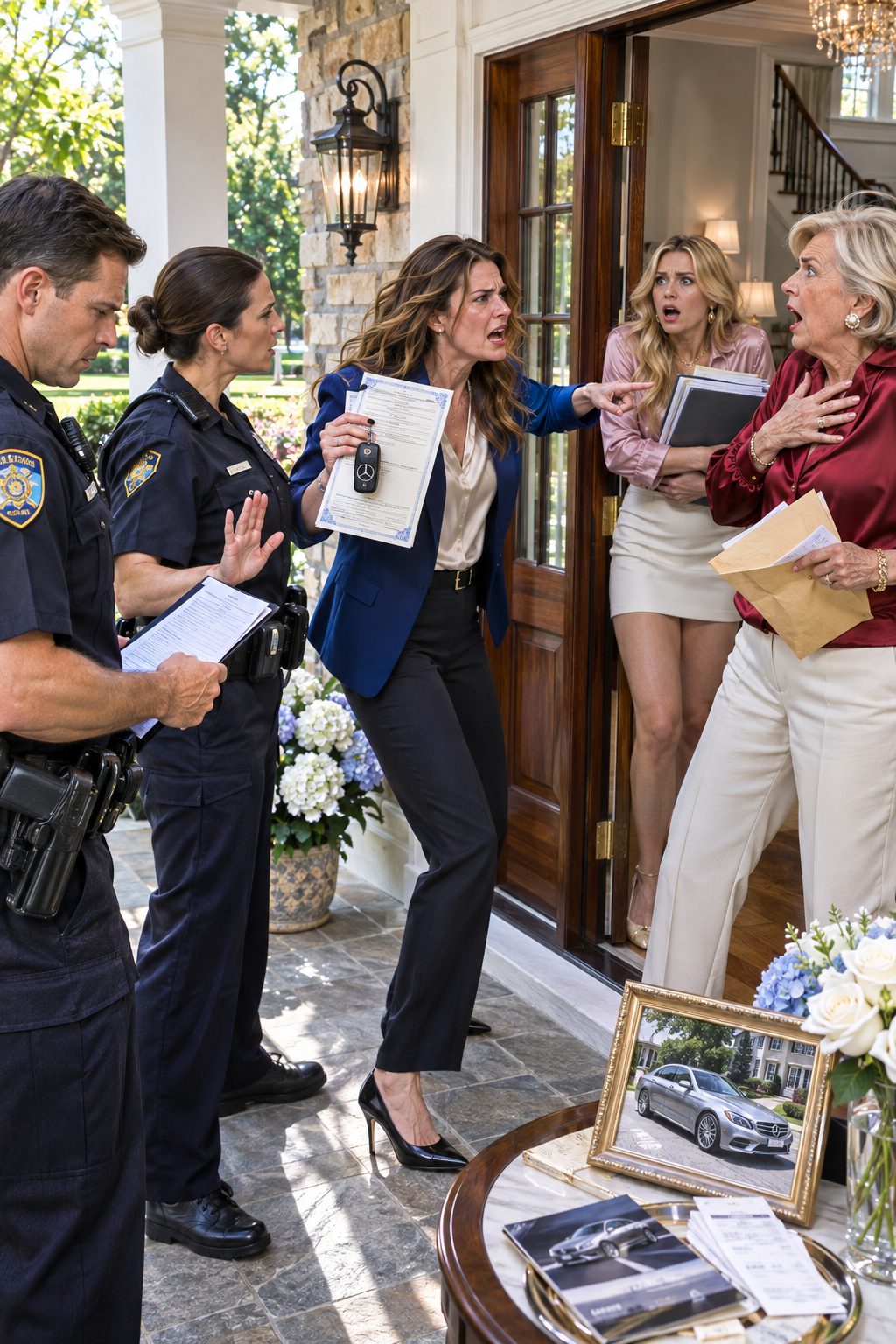
I Refused To Pay My Sister’s $54,000 Debt. So Mom Secretly Sold My Mercedes While I Was Away. She Laughed: “Sacrifice Is Part Of Being Family.” Mom Thought I’d Stay Quiet Like I Always Did. The Next Morning, Loud Knocking At Their Door. “Police! Open The Door!”
My mother sold my Mercedes while I was away on business because my younger sister owed $54,000. When I confronted her, she told me I should be proud to sacrifice something for family, and my sister didn’t even bother apologizing. I didn’t argue. I called the police, handed over my security footage, and went back to work. By the following morning, investigators had uncovered something that made the missing car seem almost insignificant: a financial document bearing my signature, dated eighteen months before the sale.
## Part 1/5
My name is Elise Calder, I’m thirty-one years old, and I live in Savannah, Georgia, in a brick townhouse with a narrow driveway and a garage barely large enough for my Mercedes GLE. I bought the car three years ago after receiving a promotion at the commercial property insurance firm where I’d worked since college, and I still remembered sitting in the dealership parking lot, afraid to start the engine because the leather interior smelled too expensive for someone who had grown up clipping grocery coupons. My mother, Vivian Calder, hadn’t congratulated me when I showed her the keys. She’d asked why I needed such an expensive vehicle when my younger sister, Brenna, was struggling to keep her event-planning company alive. That should have told me everything about how my family viewed anything I earned.
Brenna was twenty-seven, charming enough to persuade strangers to invest in ideas she’d barely researched, and remarkably skilled at making every financial disaster sound like an unfortunate accident. Her company, Magnolia Row Events, had started with wedding coordination and expanded into corporate parties, elaborate birthday celebrations, and equipment rentals she couldn’t afford. Over four years, I’d helped her pay an overdue commercial lease, covered payroll when a corporate client canceled, and quietly absorbed a $12,600 personal loan she’d promised to repay within six months. Every rescue ended with Brenna hugging me and Mom saying how wonderful it was that her daughters looked after each other. Somehow, nobody ever mentioned looking after me.
Two weeks before my Mercedes disappeared, Brenna called during my lunch break and announced that she needed $54,000 by Friday. She described overdue vendor invoices, personal credit balances, and several settlements she could supposedly negotiate if she paid immediately, although she became irritated whenever I requested actual statements. I told her I wouldn’t lend her any more money, and she went silent long enough for me to hear someone speaking in the background. Ten minutes later, Mom called to explain that I had savings, a stable career, and no children, whereas Brenna had a business and people depending on her. When I refused again, Mom said, “One day, Elise, you’ll understand what real family sacrifice means.”
That Sunday, I drove to my mother’s house for dinner because I wanted to explain my decision without another telephone argument. Brenna sat at the kitchen island scrolling through photographs of a luxury wedding she’d organized, while Mom stirred spaghetti sauce and discussed the financial sacrifices she’d made raising two daughters after our father left. I reminded them that I’d already contributed more than twenty thousand dollars to Brenna’s business, money I hadn’t recovered, and that I had my own mortgage and retirement plans. Brenna rolled her eyes and said, “You act like helping me would put you on the street.” Mom didn’t defend me; she simply placed another serving of pasta on Brenna’s plate and asked whether I’d considered selling something I didn’t really need.
On Monday morning, I left for a three-day commercial property inspection in Charleston, South Carolina, where a coastal hotel had suffered extensive water damage. I took a company rental car because my employer reimbursed business transportation, leaving my Mercedes locked in the garage with both keys secured inside my travel bag. Mom still knew the garage keypad code from the previous summer, when she’d checked on my house during an evacuation warning, but I had never imagined that access could become a liability. Tuesday passed in conference rooms, wet carpet, and conversations with contractors who disagreed about repair estimates. I noticed one garage motion alert around nine thirty that morning, but the notification vanished before I opened it, and I assumed it was another neighborhood cat.
I returned Thursday evening to find my garage empty, the concrete floor marked by fresh tire tracks and a small rectangle of adhesive backing near the side door. For several seconds, I wondered whether I’d forgotten taking the Mercedes somewhere, an absurd thought that demonstrated how impossible the alternative seemed. I called Mom, and when I asked where my car was, she answered with the casual impatience of someone discussing a misplaced casserole dish. “Brenna needed help, and you wouldn’t listen,” she said. “I arranged to sell it, Elise, and before you start screaming, the money has already gone toward her debts.”
I gripped the garage doorframe and asked how much the buyer had paid, but Mom refused to give me a number. When I asked who had signed the title, she said she’d handled the paperwork and accused me of making a family emergency unnecessarily complicated. “You can afford another car,” she insisted, as though that settled the question of whether she had permission to take this one. I asked whether Brenna knew what she’d done, and Mom answered, “Of course she knew, sweetheart; we discussed everything.” I ended the call before my mother could turn the conversation into another lecture about gratitude.
I stood in the garage for nearly ten minutes, watching the security camera’s small green indicator blink above the door. Part of me wanted to drive straight to Mom’s house, demand an explanation, and make her understand that this wasn’t something she could settle by calling me selfish. Instead, I remembered the paperwork investigations I’d handled at work, where assumptions meant nothing without documents, timestamps, and a reliable sequence of events. I called the Savannah police non-emergency line and reported that my vehicle had been removed and sold without my authorization. Then I opened my laptop and downloaded the garage recordings without changing the original files.
An investigator named Nolan Mercer arrived with another officer shortly after eight, and his first question was whether I had authorized anyone to sign for me. When I said no, he showed me a photograph of my Mercedes parked at a specialty automobile dealership outside the city, explaining that its title department had already flagged discrepancies in the seller’s authorization. He asked who knew my travel schedule, who had access to my garage, and whether any relatives possessed copies of my identification. I explained everything, including Brenna’s debt, my mother’s admission, and the forgotten emergency key she’d kept for years. Mercer studied his notes, then showed me the first page of an attachment the dealership had forwarded to investigators.
It wasn’t dated Tuesday.
The document carried my name, an unfamiliar company reference number, and a signature that looked disturbingly close to mine. According to the date printed above it, somebody had signed that document eighteen months earlier, when Brenna’s business was supposedly doing better than ever.
## Part 2/5
Mercer wouldn’t let me photograph the entire document because investigators were still confirming where it originated, but he wrote down the company name for me: Marshlight Commercial Finance. I’d never heard of it, although the word “commercial” made me think immediately of Brenna’s equipment rentals and the expensive expansion she’d announced the previous year. He told me not to contact the company until he’d established what records they could legally release, and I agreed because I didn’t want to complicate an investigation before it had properly begun. After the officers left, I made coffee I never drank, sat at my kitchen table, and finally opened Tuesday morning’s security recordings.
At 9:12 a.m., Mom’s silver SUV pulled into my driveway, and she stepped out carrying a blue accordion folder against her chest. She walked straight to the garage keypad and entered the code correctly on her first attempt, without checking her phone or looking around. At 9:27, Brenna arrived in her little white crossover, carrying two iced coffees, and greeted Mom with a cheerful wave. Nothing about their behavior suggested a frantic family trying to prevent financial ruin. They looked like two women meeting a contractor to discuss a home improvement project.
Brenna entered the garage and walked slowly around my Mercedes, inspecting the wheels and checking the interior through the tinted windows. Mom opened the passenger door, removed a small envelope from the glove compartment, and handed something to Brenna, who slipped it into her purse. I recognized the envelope immediately because it contained the vehicle’s registration and insurance documents, which I kept there for traffic stops and emergencies. Brenna glanced toward the camera mounted above the garage door, smiled faintly, and turned back to my mother. She hadn’t forgotten the cameras existed; she simply didn’t believe I’d ever use what they recorded.
A flatbed truck arrived shortly before ten, followed by a man wearing a navy polo shirt embroidered with Tidewater Auto Exchange, the dealership Mercer had mentioned. The man photographed my Mercedes, checked its mileage, and compared the vehicle identification number with documents Mom had brought. When he placed a clipboard on the hood, she hesitated briefly, adjusted the paper, and began signing. I couldn’t read the writing from that angle, but I could see her lift the pen, study something inside the blue folder, and attempt the signature a second time. My chest tightened as I understood she was copying my handwriting rather than signing her own name.
The microphone captured more than I expected, including Brenna asking whether the money would arrive before Friday and Mom assuring her that the broker understood the deadline. Then Brenna said, “She’ll be furious for a week, but she always gets over everything.” Mom laughed softly and answered, “She knows how much we need each other.” I replayed those sentences three times, feeling the sickening familiarity of a conversation I’d never been meant to hear. They’d discussed my likely reaction and decided in advance that it wouldn’t matter, because I had spent years teaching them that my anger eventually gave way to another apology I didn’t owe.
At 10:04, the truck carried my Mercedes away, but the footage revealed something even stranger later that afternoon. At 2:18, Brenna returned alone, entered through the side door with Mom’s emergency key, and walked directly toward the office where I kept tax records, insurance policies, and financial documents. Fourteen minutes later, she emerged carrying several sheets of paper, folded them into her handbag, and left without touching anything else. I checked the filing cabinet and discovered that a photocopy of my driver’s license was missing, along with an old registration document and a page from my vehicle purchase agreement. Everything else had been replaced carefully enough that I might not have noticed for months.
I uploaded the footage through the secure evidence portal Mercer had provided, then called him to report Brenna’s second visit. He asked me to photograph the filing cabinet exactly as I’d found it and warned me not to rearrange any additional paperwork until his team could decide whether a closer examination was necessary. When I mentioned Marshlight Commercial Finance, he paused and asked whether I’d ever guaranteed a business loan for Brenna. “Absolutely not,” I replied, explaining that I had refused even to cosign the lease for her first office because her bookkeeping was unreliable. Mercer told me that was important, but declined to elaborate until he’d reviewed the dealership’s correspondence.
Friday morning, Brenna finally called, sounding offended that I hadn’t checked on her after the sale. She told me the settlements had been paid and that I should consider the matter closed because pursuing it would only create unnecessary stress for Mom. When I asked why she’d entered my office, she claimed she’d needed an insurance document to help the dealership complete the transaction, then abruptly changed the subject to how embarrassed she’d been when creditors threatened to contact her clients. I asked whether she had ever used my name to obtain business financing, and her voice went completely flat. “What exactly have you been looking at, Elise?”
Before I could answer, my phone displayed a second incoming call from Mercer, and I ended the conversation with Brenna. He’d received additional records from Tidewater, including the account into which most of the sale proceeds had been deposited and the paperwork used to establish the seller’s authority. The dealership had agreed to pay $61,800 for my Mercedes, but only $55,240 had been released after fees and a temporary holdback, with the money wired directly into an account belonging to Brenna. Mercer said that part was straightforward; what concerned him was an older financial guarantee discovered among the documents submitted to justify the transaction. The guarantee identified me as someone who had already assumed responsibility for obligations connected to Magnolia Row Events, eighteen months before I ever knew my sister was in serious financial trouble.
I told him that was impossible because I’d never signed anything for her company. Mercer answered carefully, “Elise, somebody signed your name, and whoever did it may have been relying on that paperwork long before they took your car.”
## Part 3/5
By Monday, I’d retained a local attorney named Camille Sloane, a former insurance defense lawyer who specialized in financial disputes and knew how to examine a document without immediately accepting what it claimed. She listened while I explained the Mercedes, the garage recordings, and the unfamiliar business guarantee, occasionally interrupting to ask for dates or clarify which documents I’d personally signed. When I finished, she looked at the blank space on her legal pad and asked, “Has your mother ever had access to your Social Security number?” I told her she’d kept copies of my childhood records, college financial aid applications, and old tax paperwork, and that she’d once helped me obtain a replacement birth certificate. Camille wrote something down and suggested that we begin by establishing exactly what financial obligations existed under my name.
The first confirmed discrepancy appeared in a Marshlight Commercial Finance account opened eighteen months earlier for Magnolia Row Events. The original credit facility had been $38,500, intended to finance commercial event equipment and improvements to a rented storage facility, and the lender’s records identified me as a personal guarantor. My purported signature appeared on several pages, accompanied by identifying information that somebody had copied accurately from my records. Yet the mailing address for guarantor correspondence wasn’t my townhouse; it was my mother’s home. I had never received a statement because every important notice had apparently been directed to the person who wanted the agreement kept secret.
Camille explained that an unauthorized signature didn’t automatically create a valid obligation, but correcting the record would require formal disputes and supporting evidence. When she asked whether I recognized the witness signature on the financing agreement, I felt my stomach tighten. It belonged to Mom, who had apparently confirmed that I signed the document in her presence. The paperwork also contained a statement describing me as an informal financial backer of Magnolia Row, a claim I had never made or authorized. My mother hadn’t simply taken my car during a moment of panic; she’d been presenting me as a source of financial security for Brenna’s business for a year and a half.
That afternoon, I visited Mom because I wanted to understand the decision she’d made before anyone mentioned selling my Mercedes. She opened the door wearing gardening gloves, glanced at my face, and said, “If you’re here to threaten me again, I have nothing to say.” I followed her into the kitchen, where a half-finished grocery list lay beside a stack of unopened envelopes, and placed a copy of the financing agreement on the table. Mom recognized the Marshlight logo immediately, although she tried to disguise the reaction by reaching for her glasses. When I pointed to the witness signature, she stopped pretending she didn’t know what the document was.
“You signed as a witness when somebody pretended to be me,” I said, keeping my hand flat against the table because I could feel it trembling. Mom lowered herself into a chair and insisted that the arrangement had been temporary, something Brenna’s accountant had suggested while the company expanded. I asked whether the accountant had also suggested signing another person’s name without permission, and she told me not to be sarcastic. “We weren’t asking you to pay anything,” she said. “It was supposed to help Brenna qualify, and the business was going to cover everything.” I reminded her that lenders didn’t request personal guarantees for decoration and that the entire purpose was to make someone else responsible if the borrower failed.
Mom’s expression shifted from defensive to frightened when I asked why the lender had used her home address for my correspondence. She admitted that Marshlight had sent multiple notices over the summer, including a warning that the account was delinquent and that additional collection measures might follow. Brenna had fallen behind on other obligations too, and several creditors were offering discounted settlements if they received payment before Friday. When I asked what would happen if Marshlight contacted me directly, Mom stared at the refrigerator instead of answering. “You weren’t supposed to find out like this,” she finally whispered, and I realized she was more disturbed by the discovery than by what she’d actually done.
Brenna arrived while I was still sitting at the table, and she immediately accused me of humiliating our mother over something that could be repaired privately. I asked whether she had known about the guarantee, and her silence answered before her mouth did. She said the business had been doing well when the agreement was signed, that she expected to refinance within a year, and that nobody had intended for me to lose money. “Then why didn’t you ask me?” I demanded. Brenna looked toward Mom, who shook her head slightly, and I understood that even now they were deciding together which version of the truth I was allowed to hear.
I explained that the sale of my Mercedes had created a police investigation, and that the older guarantee would now be examined separately. Brenna’s face went pale, but Mom immediately stepped between us and asked whether I was willing to let my sister lose her business over a signature. I told her the company had been failing long before I discovered either document, and that signing my name hadn’t made its finances healthier. “You had everything you needed,” Mom said, her voice suddenly sharp. “Your sister was trying to build something, and you wouldn’t even share the security you had.” I asked whether she’d ever considered that my security existed precisely because I refused financial arrangements I couldn’t afford.
I left with Mom calling after me that I was destroying the family and Brenna crying loudly enough for the neighbors to hear. When I reached my car, Camille called with news from an additional packet of documents Marshlight had released through the dispute process. The lender had not merely sent routine overdue notices; it had issued a final demand warning that the purported guarantor could be contacted directly if the account remained unsettled. The notice was dated eleven days before Brenna asked me for $54,000, meaning both women had known their earlier deception was about to surface. And attached to that notice was an email from Mom asking whether a full settlement would prevent the lender from contacting me about the guarantee.
For the first time, I understood why selling my Mercedes had seemed so urgent to them. They weren’t only trying to rescue Brenna’s business; they were trying to erase evidence of what they’d already done before I learned my name was attached to it.
## Part 4/5
The police arrived at Mom’s house shortly after ten the following morning, carrying a search warrant covering specific financial records and electronic communications connected to the vehicle transaction. I learned the details later from Mercer, not because I’d been invited to watch, but because the evidence they recovered affected my identity and property. Mom initially insisted this was a family disagreement and that I had misunderstood an arrangement she’d made to protect Brenna. When investigators explained that they were examining an unauthorized vehicle sale and suspected misuse of my identity, she asked whether they could simply call me and settle everything over the telephone. Mercer told her that the evidence needed to be documented regardless of how the family felt about it.
Investigators recovered the blue accordion folder from Mom’s bedroom closet, along with copies of the Mercedes purchase documents and emails concerning Marshlight’s final demand. They also obtained communications showing that Mom had contacted Tidewater Auto Exchange several days before I left for Charleston, asking whether a vehicle could be sold while its registered owner was unavailable to sign in person. She had told the broker that I was traveling for work and had already agreed to the transaction, a claim the company accepted provisionally because she’d supplied detailed ownership information. The dealership’s compliance department later detected discrepancies when comparing signatures, but the payment process had moved ahead before the concerns were fully resolved. That mistake would create serious problems for the dealership, although it didn’t make my mother’s authorization genuine.
Brenna’s interview revealed how deliberately the plan had unfolded. She initially claimed Mom had assured her I approved the sale, but investigators showed her messages discussing my refusal and whether I might become angry when I returned. She then insisted she hadn’t known the documents were unauthorized, until they showed her the footage of her entering my office and the message she’d sent afterward confirming that she’d obtained my identification. Eventually, she acknowledged that she’d participated because she feared creditors would expose the old guarantee and jeopardize the company’s remaining contracts. She’d persuaded herself that once the debts were settled, she could eventually repay me and explain everything as a temporary emergency.
My mother offered a different explanation, claiming she’d believed years of financial support gave her permission to make a decision I would eventually appreciate. Investigators asked why she’d needed to copy my signature if she genuinely thought I’d agreed, and she answered that I was difficult to reach while traveling. They showed her emails discussing my refusal before the sale and asked whether she’d attempted to contact me to obtain written authorization. She admitted she hadn’t because she knew I’d say no. According to Mercer, that admission was one of the clearest statements she’d made during the interview.
The biggest discovery came from records provided by the former bookkeeper at Magnolia Row, a woman named Harriet Voss who’d left the company six months earlier after repeatedly questioning Brenna’s accounts. Harriet had retained legitimate business correspondence showing that Mom had originally introduced me to the lender as a willing guarantor, even though nobody from the company had ever met or spoken with me. In one message, Mom described me as financially comfortable and unlikely to object once the loan helped Brenna succeed. Another message asked that lender notices be sent to Mom’s house because I supposedly traveled frequently and preferred having family handle paperwork. Harriet told investigators she’d assumed my consent had been obtained, but the email record showed exactly who had supplied that assurance.
Camille helped me submit formal identity disputes, contact the relevant financial institutions, and obtain written confirmation that Marshlight was investigating the purported guarantee. I froze my credit, changed every password my family might know, replaced the garage code and house locks, and removed Mom from my emergency contacts and account permissions. None of those actions felt dramatic, but each corrected a vulnerability I’d allowed to remain because I believed family members wouldn’t misuse access. I also had to explain the disputed financing to my mortgage lender after it appeared in a financial review, which was humiliating despite knowing I hadn’t created the problem. For the first time, I understood that the cost of this betrayal wasn’t limited to the value of my Mercedes.
Meanwhile, Magnolia Row began collapsing under obligations the settlement money hadn’t fully resolved. The $54,000 payment had cleared several negotiated debts, including the immediate Marshlight settlement amount, but Brenna still owed rent, taxes, and vendors who had continued providing services on promises of future payment. Her largest corporate client canceled a holiday contract after she failed to secure the necessary venue, and several suppliers stopped extending credit. Mom called my aunt Rosalie and told her I’d ruined Brenna’s livelihood by involving the police, and within days relatives I barely spoke to were sending messages urging me to show compassion. I answered one of them with the dates of my refusal, the unauthorized sale, and the older guarantee; after that, I stopped defending myself.
A week later, Camille received a proposed private family settlement from a lawyer Mom had hired. Mom and Brenna offered to repay the value of my Mercedes over several years if I signed a release stating that I’d previously agreed to support Magnolia Row financially. The agreement also asked me to withdraw my complaints wherever possible and decline voluntary cooperation with further inquiries. Camille read it twice, then pointed to a paragraph that would have treated the old guarantee as a legitimate arrangement I now wished to terminate. Signing it could have undermined my own position and created a written admission that wasn’t true.
I looked at the proposed repayment schedule, which depended on earnings from a company that was already unable to pay its bills. My mother wasn’t offering to accept responsibility; she was asking me to provide one more signature to repair the damage caused by the signatures she’d already taken. Camille asked what response I wanted sent, and I told her to reject the offer without negotiation. Before she forwarded the reply, she showed me a separate letter from the dealership’s attorney confirming that my Mercedes could be returned once investigators completed the necessary evidence procedures. My car was finally coming home, but the question of who would repay the money already spent had turned into a much larger legal battle.
## Part 5/5
My Mercedes was returned six weeks after the investigation began, on a bright Thursday morning that felt almost offensively ordinary. An employee at Tidewater Auto Exchange met me beside the vehicle, explained that the title transfer had never been completed, and handed over the keys after I signed the necessary release documents. The car looked exactly as I’d left it, except for a small scratch near the rear bumper and a faint chemical smell from the dealership’s detailing service. I sat behind the steering wheel for several minutes, remembering how proud I’d been when I first bought it and how casually Mom had decided that my ownership didn’t matter. Getting the car back was a relief, but I knew I’d never see it quite the same way again.
The Marshlight guarantee took longer to resolve because the lender needed to examine the original paperwork and the circumstances under which it had been submitted. With Camille’s assistance and the evidence collected by investigators, I formally disputed the authorization and received written confirmation that I would not be held responsible for the fraudulent agreement. The lender corrected its records, and the disputed information was removed from the relevant credit reporting systems after additional follow-up. I kept every confirmation letter in a new folder, separate from the documents my mother had once been able to access. It was the first time in months I could open my mailbox without wondering whether another stranger believed I owed money.
Brenna closed Magnolia Row Events before Christmas, selling equipment at a fraction of what she’d originally paid and surrendering her rented storage space. Several customers received partial refunds through arrangements overseen by her attorney, while other creditors continued pursuing the company for unpaid obligations. She moved into a smaller apartment and accepted an administrative position with a local hospitality business, something she’d once described as beneath her ambitions. Mom sold investments and drew heavily from her savings to help address the financial obligations arising from the unauthorized vehicle transaction. For years she’d insisted that sacrifice was necessary when it involved my money, but I never heard her use that word again once the money came from her own accounts.
The criminal case proceeded separately from the effort to recover the dealership’s payment, and the eventual negotiated resolutions required both women to acknowledge conduct they had spent months minimizing. Mom accepted responsibility for signing my name on the vehicle authorization and participating in the earlier financing paperwork, while Brenna acknowledged her role in obtaining and submitting documents without my consent. Both faced court-ordered supervision, financial penalties, and restitution obligations under agreements reached through their attorneys and the prosecutor. The dealership pursued recovery of the funds it had released, and the financial consequences became their responsibility rather than another expense transferred to me. I attended the final hearing because Camille wanted me to understand the resolution, not because I expected an apology.
Mom sat several seats away wearing the navy cardigan she’d worn to my college graduation, clutching a tissue that remained folded in her hands. Brenna stared at the floor while their attorney reviewed the conditions, and I felt a strange sadness watching two people I’d spent so much of my life protecting finally confront consequences I couldn’t remove. Afterward, Mom approached me in the hallway and asked whether we could talk privately, but I told her there was nothing she needed to say that couldn’t be said there. “I never wanted to hurt you,” she whispered. I answered, “You knew I would say no, and you decided to do it anyway.”
Brenna joined us, her eyes red, and said she’d honestly believed she could repay me before anything serious happened. I reminded her of the security recording, of how she’d smiled at my camera and told Mom I’d be angry for a week before getting over it. She looked away and murmured that she’d been scared, but I told her fear didn’t explain eighteen months of concealing a financial guarantee or returning to my home to take identification documents. “You didn’t expect me to forgive you,” I said. “You expected me to give up because that’s what I’ve always done.” Neither of them contradicted me.
Mom tried one final argument, telling me that families were supposed to survive mistakes and that someday I might regret abandoning the people who loved me. I looked at her for a long moment and realized I no longer needed her to understand the difference between a mistake and a calculated series of decisions. “I’m not asking you to stop being my mother,” I replied. “I’m telling you that being my mother doesn’t give you access to my home, my finances, or my decisions anymore.” She started crying, and although seeing her like that hurt, I didn’t step forward to comfort her. I walked out with Camille, leaving Mom and Brenna together to face the future they’d created.
Over the following months, I stopped answering messages passed along through relatives and declined invitations to family gatherings where I was expected to pretend the whole thing had been an unfortunate misunderstanding. I spent Thanksgiving with friends, took a short vacation to Asheville, and began saving again without calculating how much of my paycheck might be needed for Brenna’s next emergency. Eventually, I sold the Mercedes through a legitimate dealership and bought a smaller SUV, not because my family had been right about what I needed, but because I wanted the freedom to make that decision myself. The replacement wasn’t particularly impressive, and I loved it for precisely that reason. Nobody had chosen it for me, taken it from me, or attached an obligation to it.
Almost a year after the sale, I received a letter from Mom, handwritten on the cream stationery she’d used for birthdays when I was little. She said she’d been thinking about the things I’d told her, that she was sorry for the pain she’d caused, and that she hoped we might someday sit at the same table again. I read the letter twice, placed it in a drawer, and continued making dinner without writing a response. Maybe she finally understood something about what she’d done, and maybe she simply missed having someone who could make difficult problems disappear. I no longer felt responsible for determining which explanation was true.
My mother had sold my Mercedes believing that my financial stability made everything I owned available to my sister. Instead, the transaction exposed an older deception, dismantled a business sustained by borrowed money and false assurances, and ended the arrangement in which I was expected to absorb every family emergency. I didn’t celebrate their losses, and I didn’t forgive them simply because the consequences had finally become painful. I learned that the most important thing I’d ever protected wasn’t my car, my savings, or even my good credit.
It was my right to decide what I was willing to give, and to have that decision respected.
THE END!
Disclaimer: Our stories are inspired by real-life events but are carefully rewritten for entertainment. Any resemblance to actual people or situations is purely coincidental.