
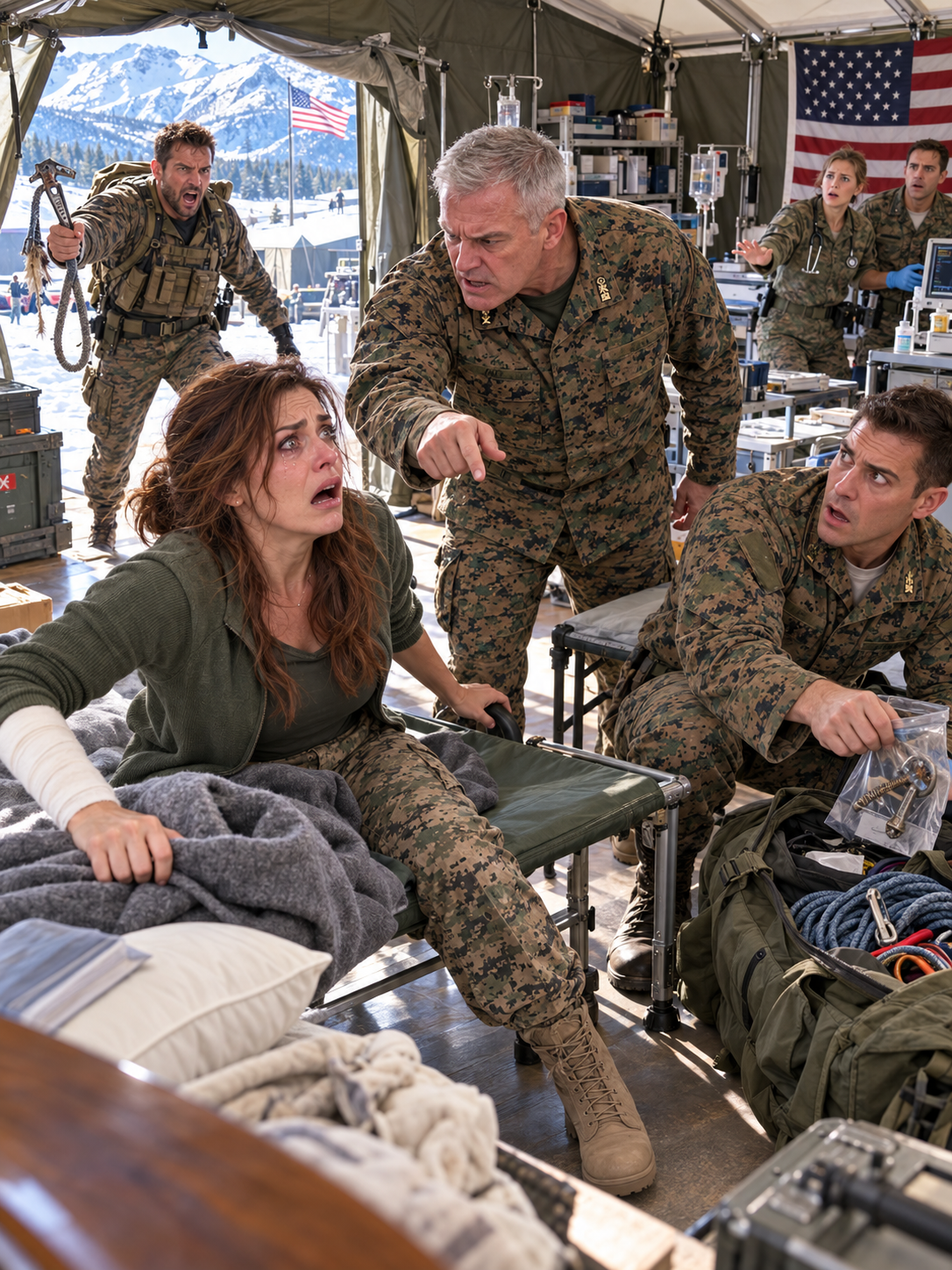
I had 19 years and 4 months in uniform when an ice anchor failed beneath me during winter survival training near Bridgeport, California, sending me sliding toward a mountain drop. I survived because a Marine major refused to leave me behind. That should have been the end of it. Instead, from a medical cot that night, I heard my lieutenant colonel discussing my injury like a failed plan. Then someone planted evidence in my bunk, and I realized the mountain hadn’t betrayed me at all.
### Part 1
The anchor snapped with a sound like a rifle shot bouncing off granite, and for half a second my brain refused to understand what had happened. Then my boots disappeared from under me, my left hip slammed into the frozen shelf, and the forty-pound rucksack on my back turned into dead weight dragging me downhill through loose shale and crusted snow. I remember the bitter smell of pine resin, white sky spinning above me, and one absurd thought flashing through my head: nineteen years and four months, and this is how I miss retirement.
My left boot caught a hidden fissure, twisting my knee under me with a deep pop that made bile rise into my throat. I clawed at the slope with both gloves, drove my heels into the scree, and finally stopped close enough to the drop that I could see empty air below my shoulder. The wind ripped across the Sierra Nevada ridge near Bridgeport, thin and vicious at altitude, while snow crystals rattled against my goggles like sand.
“Ellison, don’t move that leg.”
The voice came from above me, calm enough to sound almost irritating. Marine Major Cole Harrigan was forty-seven, gray at the temples, broad through the shoulders, and famous among the instructors for never raising his voice even when everyone else had decided panic was appropriate. He came down the slope sideways with an ice axe, kicking precise footholds until he reached me, anchored himself to a granite horn, and took the weight of my ruck before gravity could finish what the broken anchor had started.
“Talk to me, Staff Sergeant.”
“Left knee,” I said through clenched teeth. “Old injury just filed for divorce.”
His eyes went to the unnatural angle of my boot, then to my face. There was no pity in his expression, which I appreciated more than I could explain. After nineteen years in Army logistics, including years spent quietly managing damage from an old deployment injury, I had learned there was a big difference between somebody assessing whether you were hurt and somebody deciding you were finished.
A lieutenant called from higher on the ridge, “Major, if we stop now, we miss the navigation window.”
Harrigan did not even turn around. “Rig the rescue sled. We’re not leaving an NCO on a ledge to satisfy a stopwatch.”
That ended the discussion.
While two instructors came down with the litter, Harrigan cut the cargo straps loose from my pack and stabilized my knee. I glanced up toward the failed anchor point, mostly because looking anywhere else meant looking over the drop. One edge of the metal break seemed unusually smooth beneath the frost, almost like the surface had been weakened before it snapped, but pain makes ordinary things suspicious, and I shoved the thought aside.
“This will hurt,” Harrigan said.
“I’ve had government dental work. Impress me.”
The corner of his mouth moved.
They rolled me onto the fiberglass sled and strapped me in. Harrigan took the lead line himself, and for nearly two miles he and three younger service members hauled me through deep powder, frozen brush, and wind that cut through every layer I wore. Nobody made a speech about duty or sacrifice; they simply leaned forward, dug their boots into the mountain, and kept pulling.
By the time we reached the staging area at Pickel Meadow, dusk had turned the valley blue-gray. Floodlights burned through blowing snow, generators throbbed behind the maintenance sheds, and the air smelled of diesel, wet canvas, wood smoke, and coffee that had probably been simmering since dawn. Medics moved me into the aid station, locked my knee in a brace, and told me I would not be putting weight on it for a while.
I was staring at the lantern swinging from the center pole when voices stopped outside the canvas wall. One belonged to Lieutenant Colonel Valerie Stroud, the senior Army oversight officer for our joint training exercise. Stroud had the polished efficiency of someone who remembered every regulation that helped her and somehow misplaced every one that did not.
“Is Ellison finished with the course?” she asked.
A medical officer answered, “She cannot continue the movement phase.”
There was a pause.
“Good,” Stroud said. “Start the physical disqualification documentation tonight. I want her retention status reviewed before the quarter closes.”
My fingers tightened against the blanket.
Nineteen years and four months.
Sixteen years earlier, those words would have sounded like paperwork. At that point in my career, they sounded like a loaded weapon. If Stroud could turn the injury into a permanent disqualification before my retirement eligibility locked in, nineteen years of deployments, inventories, missed holidays, field exercises, and waking up at 0430 for somebody else’s emergency could end six months short of the finish line.
Then a second voice spoke, male and low.
“The weather almost handled it for us.”
I stopped breathing.
Stroud answered without hesitation. “She wasn’t supposed to come down that ridge.”
Their boots crunched away through the frozen gravel.
For several minutes I lay perfectly still, listening to the generator outside and wondering if pain had distorted what I had heard. The military teaches you to smooth over uncomfortable things because most days that skill keeps organizations functioning. Somebody says something strange, somebody signs the wrong block, somebody gives an order that does not quite smell right, and you tell yourself there is probably an explanation.
But there are sentences you cannot explain away.
She wasn’t supposed to come down that ridge.
I barely slept. By 0600, the camp had frozen solid under a hard white frost, and I dragged myself outside on aluminum crutches because staying in the medical tent felt too much like waiting to be processed out. Harrigan stood beside the field kitchen wearing a faded fleece cap and holding a battered metal mug, looking at the mountains while steam curled around his face.
“You’re supposed to be inside,” he said.
“Inside is where people fill out forms about me.”
He studied me for a moment, then handed over his thermos without asking what I meant. The coffee was black, scorched, and strong enough to strip paint.
“Stroud pulled your personnel file after midnight,” he said. “Emergency medical review went up this morning.”
“I know.”
His eyes shifted toward me.
“I heard her outside the aid station.”
I told him what Stroud had said and watched his expression change almost imperceptibly. Harrigan was not a dramatic man; with him, anger appeared as stillness. He looked back toward the ridge, then asked, “Why would a lieutenant colonel care this much about whether one staff sergeant reaches twenty years?”
I watched wood smoke drift over the motor pool.
“Because eight years ago,” I said, “I found a logistics discrepancy with her name on it.”
That finally made him look directly at me.
In 2018, I had been the senior supply NCO for a joint logistics detachment overseas. During a drawdown, my section reconciled transferred refrigeration units, mobile repair equipment, generators, and commercial containers moving between bases. The numbers should have been boring.
They were not.
Several high-value items had disappeared between the shipping manifests and the receiving documents. Leasing charges had been paid on equipment nobody could locate, container numbers appeared twice, and signatures from different receiving sites looked identical. The officer who certified the missing equipment as destroyed or unrecoverable was then-Major Valerie Stroud.
I reported the inconsistencies.
Two nights later, our records room burned.
Stroud called me into her office the next morning, poured me coffee, expressed sympathy about the lost documentation, and casually asked whether I had kept copies anywhere else. I told her the paper files were gone.
That answer had been technically true.
What she never knew was that I had copied every suspicious container number and shipment reference into a green clothbound notebook I used for field reconciliation. I had taken that notebook home when the deployment ended and kept it in the bottom of my footlocker beneath my father’s folded burial flag.
Harrigan stared at me through a breath of white steam.
“Your orders here came through Stroud?”
“Her name was on the oversight roster.”
“And the original records?”
“She thinks they burned.”
He turned toward the mountain again.
Then he said, “Your anchor.”
I felt cold despite the coffee in my hand.
“You saw it too?”
“I saw enough to want another look.”
Neither of us spoke for several seconds. The morning wind moved through the pine branches overhead, carrying fine snow across the road like smoke.
Finally Harrigan said, “If someone wants you medically separated, that is misconduct. If someone tampered with equipment on that ridge, it is something else entirely.”
“I know.”
“Can you prove it?”
“Not yet.”
He took the thermos back, screwed the cap on, and looked toward the equipment shed.
“Then we don’t accuse anybody,” he said. “We get proof.”
At that moment, the assembly whistle screamed across the camp.
Three sharp blasts.
Soldiers and Marines began moving toward the training bays, and Harrigan fell into step beside me, quietly shortening his stride to match my crutches. I thought the mountain had been Stroud’s one chance to remove me.
By lunch, I would learn she had prepared another.
### Part 2
At 1300, another whistle called the entire company onto the frozen gravel apron outside the supply bays. Forty students formed two uneven ranks beneath a sky the color of old steel, parkas powdered with fresh snow, while I stood at the far end with my bad leg locked straight and my crutches sinking into slush. Lieutenant Colonel Stroud walked out of headquarters carrying a red-tabbed folder, accompanied by Captain Jonah Reed, the installation security officer, and two military police sergeants.
“Attention to orders,” Reed called.
Stroud stepped forward. “This morning, an inspection of the medical station identified missing controlled pain medication from secured trauma supplies.”
The effect on the formation was immediate. Shoulders stiffened, conversations died, and even the wind suddenly seemed louder against the sheet-metal buildings. Missing equipment could mean a miserable week of statements and inventories; missing controlled medical supplies could destroy a career.
“Command has authorized an inspection of all student field equipment and sleeping areas,” Stroud continued. “Military police will begin immediately.”
I watched her instead of the MPs.
She was too smooth.
Every pause landed perfectly. Every expression arrived at exactly the right moment: concern, disappointment, professional reluctance. Stroud looked like a commander being forced by unfortunate circumstances to investigate her own troops, except I had heard that same controlled voice through canvas discussing my fall as if the mountain had missed an appointment.
The MPs moved tent by tent, dragging duffels and assault packs into the open. Snow hissed across the gravel while people whispered behind gloved hands, and I caught the young lieutenant from the ridge looking toward my brace twice. The third time, he leaned toward another officer and said something that made both of them glance at me.
I knew what they were thinking.
Old knee injury. Career soldier nearing retirement. Difficult mountain course.
Everybody loves a story that explains itself before the facts arrive.
About ten minutes later, one MP came out of the barracks carrying an olive-drab assault pack. He set it on the hood of a Humvee, opened the side compartment, and removed a small pharmacy bottle.
“Found beside bunk four.”
My stomach went hollow.
Stroud opened her folder slowly. “Bunk four is assigned to Staff Sergeant Mara Ellison.”
Every face in the formation turned toward me.
The lieutenant from the ridge muttered, “Of course.”
I ignored him.
I looked at the pack.
Stroud looked almost sorrowful. “Staff Sergeant, do you want to explain why controlled medication was discovered in your equipment?”
“That isn’t my pack.”
Her expression changed by half a degree. “Your name tape is attached.”
“Name tapes are Velcro, ma’am.”
“Do not turn this into an argument about technicalities.”
That sentence nearly made me laugh.
My entire professional life had been built on technicalities. Serial numbers, hand receipts, date-time groups, container codes, transfer documents, missing signatures—the tiny details officers ignored until those details became the only thing standing between them and disaster.
Stroud nodded toward the MPs. “Secure the evidence. Staff Sergeant Ellison will remain under supervision pending formal review.”
“Hold on.”
Harrigan stepped away from the instructor cadre.
He walked onto the gravel at the same unhurried pace he had used descending the ridge, hands loose at his sides. Stroud’s jaw tightened before he had even reached the Humvee.
“This is an Army matter, Major.”
“This is a joint training installation,” Harrigan said, “and every serialized piece of field gear issued through this course is covered under the instructor property account.”
“It was found in her sleeping area.”
“Then identifying the pack should take thirty seconds.”
He looked toward me.
I understood.
“Turn it over,” I said.
The younger MP hesitated, then flipped the pack onto its front.
“Look inside the lower compartment,” I continued. “Every issued pack carries a stock identification and local property marking. My pack came from Colorado. Inside the top flap, my brigade code is stenciled in black. Left shoulder buckle was repaired with a safety clip and green wire three years ago.”
Captain Reed opened the lid.
There was no stencil.
He checked the buckle.
No wire.
Stroud said, “Students exchange equipment constantly.”
“Not that equipment,” I replied.
Reed reached deeper into the bag and found a barcode label sewn beside the radio pouch. He pulled a folded checkout sheet from his jacket and ran his finger down the list.
His face changed.
“What?” Stroud asked.
Reed looked at the label again. “This pack belongs to the Marine training inventory.”
“Who signed for it?”
He hesitated.
Then he said, “Specialist Aaron Pike.”
A murmur moved through the formation.
Pike was Stroud’s driver and administrative assistant.
Stroud’s voice sharpened. “An equipment mix-up proves nothing. The medication was still located beside Sergeant Ellison’s bunk.”
I pointed my crutch toward the bottle.
“Then check that too.”
Reed lifted it.
“The medical station uses sealed field packaging for controlled supplies,” I said. “That looks like a commercial pharmacy container.”
The older MP examined the thermal label. “She’s right.”
Stroud’s eyes hardened.
“Run the patient information,” I said. “My name won’t be there.”
The MP read the small print, then silently showed it to Captain Reed.
He looked toward Specialist Pike, who was standing near headquarters with both hands jammed into his parka pockets.
Whatever name was on that label, it was not mine.
The atmosphere changed so quickly I could feel it. A few minutes earlier, everyone had been watching my career collapse. Now they were looking from the bottle to Pike to Stroud, trying to reconstruct what they had accepted without question.
The young lieutenant who had whispered “of course” stared down at his boots.
I felt no satisfaction.
Only exhaustion.
Harrigan broke the silence.
“Captain, there’s another item you should secure.”
Reed looked at him.
“The failed anchor from the ridge.”
Stroud’s head snapped toward Harrigan.
“I recovered it yesterday morning,” he said. “The break was not consistent with ordinary fatigue. One side had been deliberately weakened.”
“What exactly are you suggesting?” Stroud demanded.
“Nothing yet.”
That calm answer frightened her more than an accusation would have.
Harrigan continued, “I bagged the hardware and photographed it before moving it. Someone with tool access worked across most of the anchor shaft before Ellison’s team used it.”
Reed’s expression hardened. “Who had access to the climbing cache?”
“Cadre, equipment personnel, and selected headquarters support staff.”
Stroud closed the red folder.
Harrigan added, “Specialist Pike signed the equipment shed key log the morning before the ridge movement.”
The color drained from Pike’s face across the yard.
Stroud finally lost the polished tone. “This is becoming an absurd collection of coincidences.”
“Maybe,” Reed said. “That is what investigations are for.”
Stroud stared at him.
He turned to the MPs. “Nobody touches the barracks, medical storage, climbing shed, or headquarters vehicle logs until they’re documented.”
Then he looked toward the formation.
“Dismissed.”
Nobody moved immediately.
Forty people stood under falling snow watching a lieutenant colonel, a Marine major, and a staff sergeant on crutches occupy three points of a triangle nobody wanted to enter.
When the ranks finally broke, Harrigan came toward me.
“You all right?”
“No.”
“Good answer.”
I watched Pike hurry inside headquarters.
“He knows something.”
Harrigan nodded. “People like Pike always know something. The question is whether fear of Stroud outweighs fear of becoming her evidence.”
That afternoon, investigators photographed my bunk, copied key logs, and secured the pack. I gave a statement in a windowless office that smelled like toner and wet wool while my knee pulsed inside the brace.
Stroud was interviewed separately.
So was Pike.
By sunset, neither of them had returned to the training area.
I thought that meant the worst was over.
At 2015, Captain Reed found me eating lukewarm soup in the mess tent and placed a clear evidence bag on the table.
Inside was the broken anchor.
Across its shaft were a series of fine parallel cuts.
“Major Harrigan was right,” he said.
I stared at the metal until the spoon in my hand stopped shaking.
Then Reed pulled out a second photograph.
It showed the equipment shed security log.
Beside the entry made the morning before my fall was Pike’s signature.
Beneath it, written in a different hand, was an authorization initial I recognized immediately.
V.S.
Valerie Stroud had not merely wanted me gone.
She had put her initials next to the door that made it possible.
### Part 3
The formal investigation started the next morning, but the camp changed before any investigator asked the first question. Conversations stopped when Stroud passed through a building, Pike no longer drove the headquarters vehicle, and the officers who had spent the previous week laughing around her coffee urn suddenly discovered reasons to be somewhere else. Rank still mattered, but suspicion has its own gravity, and everyone could feel it pulling the room in a new direction.
Harrigan and I were told not to discuss the case with other students. That left us plenty of time to discuss weather, bad coffee, my increasingly purple knee, and every subject except the one occupying both our minds.
“You think Pike will talk?” I asked as we sat outside the medical station that afternoon.
Harrigan peeled the paper wrapper from an energy bar. “Depends which version of himself he wants to preserve.”
“What does that mean?”
“He can be the man who helped her, or the man who tells investigators how she used him. People become very interested in morality once consequences develop names.”
I laughed despite myself, then regretted it when my knee shifted.
For the first time since the fall, I asked Harrigan something personal. “How long have you been doing this?”
“Mountains?”
“Cleaning up messes without looking impressed by them.”
He stared across the frozen valley. “Long enough to know that most disasters become obvious after somebody ignores three small warnings.”
That answer stayed with me.
My first warning about Stroud had come years earlier, in a supply office overseas where she had asked whether I kept duplicates. The second had been my orders to a physically punishing course six months before retirement. The third had been that anchor.
I had ignored the pattern because recognizing it would have required admitting that somebody with rank, access, and institutional credibility might be willing to destroy my career over a notebook.
At 1700, two Army criminal investigators arrived from another installation.
They separated everyone who had touched the climbing cache, the barracks, or the medical station. I spent ninety minutes walking one investigator through the old overseas shipment discrepancy, including dates I had not spoken aloud in years. When I mentioned the green notebook, she stopped writing.
“Where is it?”
“Colorado Springs.”
“Who knows it exists?”
“Until yesterday? Me.”
“And now?”
“Major Harrigan.”
She studied me. “Did you tell Stroud?”
“No.”
“Did you ever hint that original information survived the fire?”
“No.”
That bothered her.
It bothered me too.
If Stroud believed the records were gone, why target me now?
The investigator asked for my phone.
There were no threatening messages from Stroud, no obvious trail, nothing connecting her directly to the old discrepancies beyond what I had remembered from years ago. For the first time, I wondered whether I had misread the motive.
Maybe the mountain incident had nothing to do with the old fraud.
Maybe Stroud wanted me gone for something I did not even know I knew.
That possibility was worse.
The answer came from an unexpected place.
At 2230, somebody knocked on the medical barracks door.
Specialist Aaron Pike stood outside wearing no hat despite the snow. His face looked gray and young, which struck me because until then I had thought of him only as Stroud’s thirty-year-old driver, the guy who polished the staff vehicle and carried folders from building to building.
“Sergeant, can I talk to you?”
I glanced down the hallway.
“You should be talking to investigators.”
“I did.”
“Then go back to your quarters.”
His hands shook. “I need you to understand something.”
I almost closed the door.
Then he said, “She knew about the notebook.”
Every muscle in my body went still.
I opened the door wider.
Pike stepped inside but remained near the entrance. “Three months ago, Colonel Stroud had me pull archived travel records and personnel files for people connected to an old logistics inquiry. Your name was one of them.”
“How did she know about my notebook?”
“She didn’t at first.”
He swallowed.
“Then somebody found an old witness statement from the records-room fire. A clerk remembered seeing you writing shipment numbers by hand weeks before it happened.”
The room suddenly felt too warm.
Pike continued, “Colonel Stroud kept asking whether you had ever submitted those notes anywhere. When she found out you were approaching retirement, she said there was still a chance an audit could reach back through the old account during final reconciliation.”
“So she brought me here.”
He nodded.
“To scare me?”
“At first.”
“At first?”
Pike looked at the floor.
“She wanted you medically dropped from the course. Said the injury history made it easy. She told me to make sure your equipment assignment was… unfavorable.”
My stomach tightened.
“What does unfavorable mean?”
He looked up.
“I loosened things. Swapped older equipment into your issue stack. I swear to God, Sergeant, I thought she wanted you to fail.”
“And the anchor?”
His face collapsed.
“I didn’t know what she had done until afterward.”
“Who cut it?”
“I think she did.”
The words landed harder than I expected.
Pike rubbed both hands across his face. “She made me sign out the shed key. She went in alone. Twenty minutes. When she came out, she told me to return it.”
“What about the pack?”
“That was me.”
At least he did not lie.
“She said if you came back injured, the medical board might still take weeks. She needed something immediate that would put you under investigation.”
“You planted the bottle.”
“Yes.”
“Where did it come from?”
He hesitated. “She gave it to me.”
I looked toward the hallway, expecting investigators to appear.
“Why are you telling me instead of them?”
“I told them part of it.”
“Part?”
His fear finally irritated me more than his confession.
“Pike, someone nearly sent me off a mountain.”
“I know.”
“No, you know the sentence. I know what the ground looked like twelve feet from the edge.”
He flinched.
I lowered my voice. “So either tell investigators all of it, or get out.”
He pulled his phone from his pocket.
“I recorded her.”
That changed everything.
Pike explained that Stroud had frightened him long before Bridgeport. She used minor administrative mistakes to keep people dependent, helped careers when they obeyed, and quietly damaged them when they did not. Weeks earlier, after she ordered him to manipulate my equipment assignment, he had started recording some conversations because he thought he might eventually need protection.
“I have one where she talks about the ridge.”
My mouth went dry.
Pike unlocked the phone but did not press play.
“You need to give that to investigators.”
“I will.”
“Not tomorrow.”
He nodded.
Then footsteps appeared at the end of the hallway.
Harrigan.
He took in Pike’s face, my expression, and the phone between us.
“You tell them?” Harrigan asked.
Pike whispered, “I’m going to.”
Harrigan stepped closer.
“Then go now.”
There was no anger in his voice, which somehow made the order impossible to resist.
Pike walked away.
Harrigan remained beside me.
“You believe him?” I asked.
“I believe frightened people sometimes tell the truth late.”
“That isn’t the same as courage.”
“No.”
I leaned against the doorframe. “You know what bothers me most?”
“What?”
“I spent my entire career teaching soldiers to document everything. I told them memory fails, people transfer, stories change, paper remains. Then somebody came after me, and all I had was a memory of a fire and a notebook in a footlocker two states away.”
Harrigan looked at me.
“You also had nineteen years of knowing what details matter.”
I glanced toward his face.
“That pack didn’t save you because paperwork is magical,” he said. “It saved you because you noticed what everybody else missed.”
An hour later, investigators collected Pike’s phone.
At 0110, Harrigan returned from headquarters with a look I had never seen on him before.
Not anger.
Shock.
“They listened to the recording,” he said.
“What did she say?”
He hesitated.
Then he repeated nine words.
“If the mountain doesn’t finish it, the barracks will.”
I sat down because my good leg suddenly felt unreliable.
But Harrigan was not finished.
“There’s something else. Stroud mentioned your notebook.”
I looked up sharply.
“She said they still hadn’t found it.”
They.
Not she.
Whatever had started overseas eight years earlier had never been only Valerie Stroud.
### Part 4
The word “they” kept me awake until dawn. I had spent the last three days believing one ambitious officer had carried an old secret across years because she was terrified of losing her retirement, her reputation, or both. Now the case felt wider, and for the first time I understood why Stroud had moved with such confidence: she had never believed she was standing alone.
Investigators placed her on restricted duties that morning. Pike disappeared into another building for interviews, and Harrigan was ordered to surrender the broken anchor directly to evidence control.
Meanwhile, two investigators flew to Colorado Springs.
They opened my footlocker in the presence of my unit commander and found the green notebook exactly where I had said it would be, beneath my father’s burial flag, its cloth cover faded at the corners. Every handwritten container number was photographed before the book was sealed.
The old shipment records were harder to find.
Harder did not mean gone.
A civilian archivist in Pennsylvania located backup financial and freight records from the year of the overseas drawdown. The surviving files showed that several containers Stroud had certified as destroyed were later received by commercial companies through an intermediary freight contractor.
One company name appeared repeatedly.
North Valley Strategic Services.
The investigators brought me a printout.
I stared at it for several seconds before recognizing the name.
“Pike mentioned a private company?”
“No,” the investigator said. “Why?”
“Because I’ve seen this before.”
Not in 2018.
Three months earlier.
When my orders to Bridgeport came through, the travel authorization had included a contracted equipment-support line item. I had noticed the vendor because the billing rate looked high for temporary storage support.
North Valley Strategic Services.
Stroud had not merely feared an old audit.
The old scheme was still alive.
The investigators traced the company through several registration changes until they reached a holding firm partially owned by Stroud’s older brother and managed by a retired logistics warrant officer who had served in the same region overseas. The amounts involved were larger than anything I had suspected from the missing generators and refrigeration units.
My notebook was not evidence of one bad shipment.
It was a map to the first transaction.
Stroud had known that if anyone reopened that ledger, they could follow the numbers forward.
That afternoon, she requested to speak with me.
The investigators refused.
She requested again.
They refused again.
By evening, she stopped asking politely.
I heard her voice through the headquarters hallway while I waited for another interview, sharper than I had ever heard it in public.
“She has constructed a fantasy around normal logistical irregularities!”
An investigator answered, “Colonel, sit down.”
“She has been resentful for years. She failed the course, got injured, and now she is retaliating.”
I almost admired the attempt.
The door opened.
Stroud saw me sitting twenty feet away.
For the first time since Bridgeport began, there was nothing rehearsed in her face.
Only hatred.
“You,” she said.
An investigator stepped between us.
Stroud ignored him.
“You have no idea what you’ve done.”
That sentence should have scared me.
Instead, something in me finally clicked into place.
I had heard versions of it my entire career.
You are making this harder than necessary.
You are embarrassing the command.
You need to think about your future.
You do not understand the bigger picture.
All of them meant the same thing: stop asking questions that inconvenience somebody more powerful than you.
I stood carefully with my crutches.
“No, ma’am,” I said. “I know exactly what I did. I kept the record.”
Her face twisted.
The investigator led her away.
Two days later, the installation commander convened a formal inquiry. There were no cameras, no dramatic courtroom speeches, and no moment where Stroud broke down and confessed. Real investigations are mostly rooms with bad lighting, stale coffee, folders, timestamps, signatures, and people asking the same question three different ways.
I testified for forty-seven minutes.
I explained how the first discrepancies appeared, why I copied the shipment numbers, what happened to the records room, and why Stroud’s questions afterward had bothered me. Nobody interrupted to imply I was bitter, injured, too old, confused, or simply trying to protect my pension.
For once, the facts were allowed to arrive before the conclusion.
Harrigan testified the next morning.
He described the ridge conditions, my fall, the anchor recovery, and the tool marks with the same calm voice he used to order coffee. When Stroud’s attorney suggested the cuts could have occurred during prior use, Harrigan produced close photographs showing bright metal beneath the scored surface, inconsistent with long-term exposure.
Then investigators played Pike’s recording.
Stroud’s voice filled the room.
“If the mountain doesn’t finish it, the barracks will.”
Nobody moved.
The second recording was worse.
Stroud was speaking with a man investigators later identified as the retired logistics officer connected to North Valley Strategic Services.
“She kept something from the fire,” he said.
Stroud answered, “Then she doesn’t retire with it.”
The room seemed to lose oxygen.
I looked down at my hands.
For all my preparation, hearing it spoken aloud affected me more than I expected. Stroud had not merely wanted to ruin my career; retirement had been the deadline because once I left active service, I would take my personal effects, including that notebook, permanently outside her reach.
Harrigan sat across the room.
He did not look at Stroud.
He looked at me.
That helped.
By the end of the week, Stroud was relieved of authority. The case expanded beyond Bridgeport into procurement fraud, false records, conspiracy, obstruction, and the deliberate tampering with training equipment.
Pike cooperated fully.
I did not forgive him.
When he asked through his attorney whether I would provide a statement acknowledging his cooperation, I told the investigator the truth.
“He helped expose what happened. He also helped put the pack beside my bed.”
Both things could be true.
People sometimes think justice requires you to choose between anger and fairness. It does not.
You can tell the truth about someone without cleaning them up first.
My retirement review was halted, then reversed. Instead of being pushed toward medical separation, I received written confirmation that my service eligibility and benefits would remain intact while I recovered.
The paper arrived on a Friday.
Twenty years.
The number looked strangely small on the page.
Harrigan found me outside headquarters with the letter in my lap.
“You going to frame it?” he asked.
“I was thinking refrigerator magnet.”
“Very dignified.”
“I’ve given enough dignity to government paperwork.”
He sat beside me on the bench.
For a while we watched snow settle on the roofs.
Then he said, “My retirement orders came through too.”
I turned.
“When?”
“This morning.”
“You waited six hours to mention that?”
“You had a bigger day.”
That was Harrigan.
No speeches. No need to occupy the center of a room.
Just a man who had dragged me off a mountain and somehow made even retirement sound like a note on a grocery list.
“What are you going to do?” I asked.
“I have three acres outside Bozeman.”
“That sounds suspiciously like manual labor.”
“Cedar clearing.”
“Absolutely not.”
“There’s coffee.”
“Better coffee than here?”
“That is an insultingly low standard.”
I smiled.
He reached into his jacket and placed a worn brass challenge coin in my palm.
Mountain Warfare Training Center.
“Keep it,” he said.
“For surviving?”
“For noticing.”
The next morning, medical transport took me toward Reno.
As the van pulled out, I looked back at the ridge where I had fallen. Snow had filled the tire tracks, softened the roofs, and covered every footprint from the frantic days behind us.
But it had not erased the anchor marks.
It had not erased the logs.
And it had not erased what Stroud said.
For most of my life, I had believed survival meant enduring whatever came next.
I was beginning to understand that sometimes survival meant refusing to carry the people who tried to bury you.
### Part 5
People like clean endings. They want the villain exposed on Friday, the hero vindicated by Saturday, and happiness waiting with coffee on Sunday morning. Real life is slower. My knee needed months of rehabilitation, the investigation outlived the snow at Bridgeport, and I had to learn how to wake up without immediately expecting somebody to challenge my right to still be in the room.
Stroud never received forgiveness from me because she never deserved it.
Her attorneys sent statements describing stress, career pressure, and the influence of other people in the procurement network. I understood every word and accepted none of it as an excuse.
Pressure may explain why people show you who they are.
It does not erase what they choose.
Pike eventually accepted responsibility for his part and continued cooperating with investigators. I heard he left the service under a reduced agreement after helping establish the broader financial trail.
I did not call him.
I did not write.
I did not need revenge, but I also did not owe him comfort because he finally became afraid of the same machine he had helped turn against me.
The larger fraud investigation reached contractors, retired personnel, and several accounts that had been moved through shell companies for years. My green notebook became one of the earliest pieces tying the original shipment numbers to the later transactions.
I got it back almost a year later.
The cover had an evidence sticker across the inside flap.
I left it there.
Some things should show where they have been.
As for my career, I reached twenty years.
The Army offered me a stateside logistics coordination assignment while my knee recovered, and for several months I stayed because leaving immediately would have felt like letting Stroud decide the date after all. I trained younger supply specialists, reviewed audit procedures, and developed an annoying reputation for asking people to show me original source documents when they tried to summarize numbers verbally.
One lieutenant complained that I was “obsessed with receipts.”
“Correct,” I told him.
He thought I was joking.
Cole Harrigan retired that summer.
His daughter, Natalie, came to the ceremony, and he was more nervous about seeing her than he had been on the mountain.
They loved each other.
They were also carrying twenty years of missed birthdays, interrupted holidays, canceled plans, and deployments that always seemed urgent to everyone except the child waiting at home.
I understood her suspicion the first time we met.
To her, I was another person from the military world that had taken more of her father than it returned.
So I did nothing.
No forced friendship.
No speeches about how good a man he was.
Children of service members hear that sentence their whole lives from people who never had to eat birthday cake beside an empty chair.
Natalie softened slowly.
The breakthrough came because Cole burned toast.
He managed to fill my kitchen with smoke so thick the alarm screamed while he stood beneath it waving a dish towel like he was directing helicopters.
Natalie stared at him.
“You cook?”
“I cook.”
“You heated canned soup once when I was fourteen.”
“I added seasoning.”
“That was pepper.”
“It improved the soup.”
I laughed hard enough that my knee hurt, and Natalie almost smiled before she remembered she was trying not to.
By the end of the weekend, she was mocking his reading glasses.
It was the healthiest thing I had witnessed in months.
Cole and I did not fall into some dramatic romance because he saved me.
For a long time, we were simply two people who had stopped needing to explain why certain noises woke us up or why paperwork could make our shoulders tighten.
He drove down to Colorado every few weeks.
Sometimes we ate barbecue at my kitchen counter.
Sometimes we argued about tires, grocery stores, or why he believed paprika should be stored wherever he happened to put it rather than where the label said paprika.
One evening he stood from my couch and both knees cracked.
I looked over.
“Your joints have sound effects now.”
“Tactical aging.”
“That’s arthritis.”
“Operational experience.”
“You own a heating pad.”
“You own four.”
“Four is preparedness.”
He laughed.
That laugh had sounded rusty the first time I heard it on the mountain.
It did not anymore.
The following August, we drove back to Bridgeport.
I told everyone it was because Cole wanted to visit the training center.
He knew better.
There are places your body remembers more clearly than your mind does, and sometimes you have to return before the memory stops owning the landscape.
Without winter snow, the Sierra looked completely different. Brown granite broke through green slopes, sunlight flashed across the high ridges, and the air smelled warm with dust and pine instead of metal and ice.
We parked near the lower trail.
My knee started complaining within fifteen minutes.
“You good?” Cole asked.
“No.”
He smiled. “Good answer.”
We walked slowly.
No timer.
No formation.
No lieutenant checking distance.
No colonel waiting to turn pain into paperwork.
When we reached the overlook near the old training route, I stopped.
The slope below us looked smaller than I remembered.
That annoyed me.
“Memory is rude,” I said.
Cole glanced over. “How?”
“I almost died there, and now it looks like a postcard.”
“It didn’t look like a postcard in February.”
We stood quietly.
Wind moved through the trees.
My bootlace came loose, and before I could bend down, Cole crouched.
“I can tie my own shoe.”
“Your knee disagrees.”
“Former majors are still bossy.”
“Former staff sergeants still complain.”
He tightened the lace and rose carefully, one hand on his thigh.
His knees made a faint pop.
I raised an eyebrow.
“Not a word.”
I looked across the ridge.
For months people had praised me for being strong.
I never liked it.
Strength sounded like something clean, something heroic.
What I remembered was fear.
I remembered lying on a cot listening to Stroud discuss my career.
I remembered the planted pack.
I remembered realizing that somebody had touched the anchor that was supposed to keep me alive.
Mostly, I remembered how tired I had become from trying not to inconvenience anybody with my pain.
Cole stood beside me.
After a while he asked, “Do you trust me up here?”
The question landed deeper than either of us expected.
It was not really about the mountain.
I thought about my failed marriage years earlier, about senior leaders who rewarded silence, about Stroud pouring coffee after the records-room fire while trying to determine whether I still possessed evidence that could hurt her.
Then I thought about Cole pulling a sled through the snow without once making me feel like cargo.
“With my life,” I said.
He looked at me.
I added, “But I’m walking down on my own legs this time.”
His smile was small.
“I know.”
That was what mattered.
He knew.
He never asked me to be less independent so he could feel more necessary.
We stayed until late afternoon, watching the shadows lengthen across the valley.
A year earlier, I would have measured my worth by how much weight I could carry, how long I could stay quiet about pain, or how efficiently I could solve problems without anyone noticing the cost.
Bridgeport cured me of that.
Getting older had not made me useless.
A bad knee had not erased nineteen years of judgment.
Being underestimated had not made me weaker.
It had simply made the people underestimating me slower to recognize what was in front of them.
And rank had never been the strongest thing in the room.
Truth was.
Not dramatic truth.
Not shouted truth.
The boring kind.
A stock number.
A barcode.
A signature.
A notebook nobody thought survived a fire.
A line of handwriting preserved long enough for the right person to read it.
Stroud spent years believing that if she became important enough, nobody would question the numbers beneath her signature.
She was wrong.
The system did not save me because it was perfect.
It saved me because enough people finally did their jobs, and because I had kept mine honest long before I knew honesty would become evidence.
I never forgave Valerie Stroud.
Eventually, I stopped thinking about her often enough that forgiveness became irrelevant.
That was better.
She had already taken enough space from my life.
I was not giving her any more.
When Cole and I started down the trail, the sun was dropping behind the ridge and the air had begun to cool. My knee hurt, his knees clicked, and neither of us was moving quickly.
For once, nobody cared.
At the parking area, he tossed me the truck keys.
“You’re driving.”
“Why?”
“My knees.”
I laughed. “Tactical aging?”
“Shut up, Ellison.”
I climbed into the driver’s seat.
The old brass challenge coin was still in the center console where I kept it beside spare change and a tire-pressure gauge.
I picked it up, turned it once between my fingers, and set it back down.
The mountain had nearly taken my career, my future, and my life.
Instead, it gave me the one lesson I should have learned years earlier.
You do not survive by pretending nothing can hurt you.
You survive by knowing what matters, keeping your own record straight, and refusing to disappear when somebody with more power decides you are inconvenient.
The truth never needed Valerie Stroud’s rank.
It never needed my anger.
It never needed Cole Harrigan to raise his voice.
It only needed enough time to catch up.
And eventually, it did.
THE END!
Disclaimer: Our stories are inspired by real-life events but are carefully rewritten for entertainment. Any resemblance to actual people or situations is purely coincidental.


