
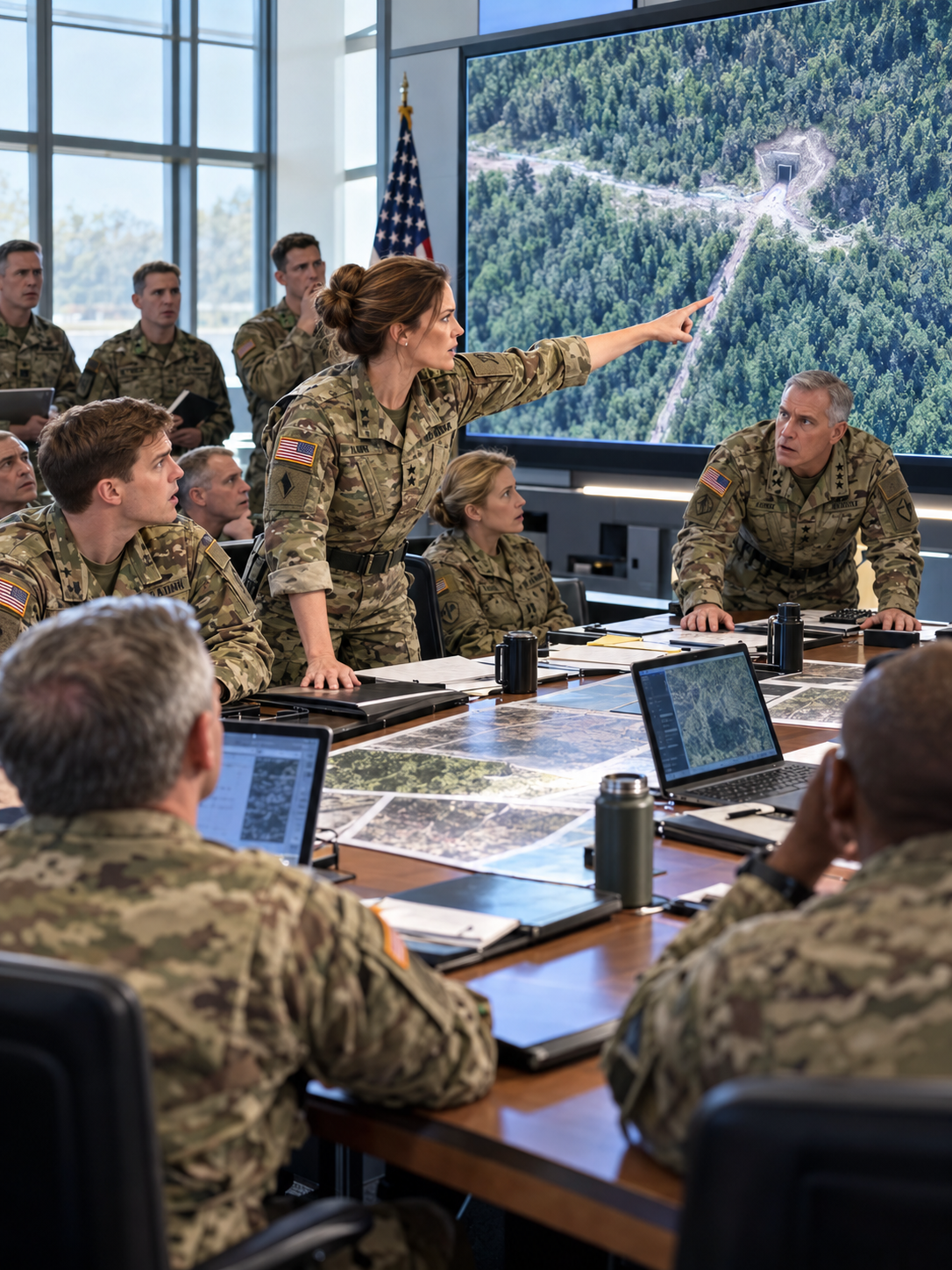
“You’ve never been on a real mission,” the young captain said, and half the briefing room laughed with him. I let them laugh because after twenty-three years in the Army, I had learned that explaining yourself to strangers was usually a waste of breath. Then a satellite image appeared on the wall, showing seven missing Americans somewhere in Eastern Europe, and I noticed something nobody else could see. I pointed at a blank patch of forest and said, “That tunnel should not exist.” The general stopped cold. “How do you know that?”
### Part 1
There is one thing twenty-three years in the Army taught me that no leadership course ever managed to put into words: the loudest man in a room is rarely the most dangerous one. Men with something to prove tend to fill silence as quickly as possible, while men who have already learned what fear sounds like in the dark usually do not mind letting other people talk. That morning, I walked into Strategic Operations Room Three with a spiral notebook tucked under one arm and a paper cup of black coffee in my hand, looking exactly like what everyone expected me to be—a forty-seven-year-old lieutenant colonel who had spent too long behind a desk.
Nobody stood when I entered, which was fine with me, and nobody stopped talking except Captain Evan Cole, who paused halfway through telling three younger officers some story about a deployment exercise in Latvia. Evan was thirty-one, sharp uniform, sharper haircut, and the kind of confidence that comes from being good at nearly everything you have tried so far. He glanced at the silver in my hair, then at the notebook under my arm, and his mouth twisted into an amused smile. “Headquarters finally sent us a strategist,” he said loudly enough for everyone nearby to hear, and Major Simmons chuckled before Evan added, “Maybe he can remind us which way north is.”
A few people laughed, and I took my seat without looking at them because at my age you learn that some insults are really invitations, and you do not have to accept every invitation you receive. My coffee smelled burned enough to strip paint, the fluorescent lights buzzed overhead, and rain tapped against the narrow reinforced windows near the ceiling. Evan watched me sit down and seemed disappointed that I had not reacted, so he tried once more. “No offense, sir, but have you ever actually been outside the wire?”
I opened my notebook and clicked my pen. “Once or twice.”
That drew another laugh, because they thought I was joking, and maybe it was better that way. My official record gave them plenty of reasons to make assumptions: planning assignments, intelligence coordination, doctrine development, liaison work, years of classified billets described in language so bland it could have belonged to an accountant. What it did not contain were six nights in a freezing valley, a burning farmhouse, a collapsed tunnel, three men whose voices I still heard sometimes when a room became too quiet, or the promise I had made to an ambassador beneath the sound of distant artillery.
Colonel Thomas Reed entered at 0712, and the room changed instantly. Reed was not theatrical, which was one reason I respected him; he simply walked to the front, set a red folder beside the keyboard, and said, “We have seven Americans missing.” The laughter died so completely that I could hear the ventilation system humming behind the walls, and the screen behind him lit with a satellite photograph of an industrial valley surrounded by forest and low mountains.
“These five aid contractors and two embassy security personnel disappeared fourteen hours ago,” Reed continued. “Their vehicle was found abandoned here, eight miles west of the border. Signals intelligence indicates they may have been moved into this district sometime before midnight.” He switched images, revealing rusted factories, broken smokestacks, a narrow river, an old church on a hill, and roads that twisted through the valley like gray veins.
Evan was no longer smiling. “If they’re alive, whoever grabbed them won’t keep them there long.”
“That is the working assumption,” Reed said. “And before anyone asks, diplomatic options are moving too slowly.”
The words had barely left his mouth when someone knocked twice, and a young communications specialist entered carrying a sealed black envelope with both hands. I expected him to give it to Reed, but he passed the colonel, passed two majors, circled the table, and stopped beside me. His Adam’s apple moved when he swallowed. “Lieutenant Colonel Mercer?”
“That’s me.”
“This was transmitted through secure command channels thirty minutes ago.” He placed the envelope in front of me. “Instructions say it must be delivered personally.”
Across the black seal, in plain white type, were five words: FOR DANIEL MERCER—EYES ONLY. Nobody laughed this time, and when I slid the envelope beneath my notebook without opening it, Evan stared as if I had broken some rule of human curiosity. “You’re not going to read that?”
“When I need to.”
“What if it matters?”
“If it matters right now, someone will tell me.”
Colonel Reed studied me for half a second longer than necessary before turning back to the screen, but I had already noticed the shift in his expression. He knew something about that envelope, or at least knew where it had come from, and I did not like that. “Focus,” he said, expanding the satellite image. “Thermal movement was detected six hours ago in Warehouse Twelve. We are building an extraction plan now.”
Ideas came fast: helicopter insertion, blocking the southern road, cutting power, entering through the western loading bays before sunrise. Evan favored a direct approach supported by two assault teams, and normally I would have let the room work through its options before speaking. But I could not stop staring at the river.
There was something wrong with it.
Not wrong in the way an analyst means when he finds a discrepancy; wrong in the way your childhood home feels wrong after someone moves the furniture. The river curved north beneath the church, then disappeared behind a line of trees before reappearing near the factory, and my stomach tightened before my mind understood why. I could smell wet stone suddenly, hear water dripping in darkness, feel mud sucking at my boots, and for one brief second the briefing room vanished.
“Mercer?”
Reed’s voice pulled me back. Every face had turned toward me.
“You see something?”
I stood slowly and walked closer to the screen. “This image is accurate, but the map layer isn’t.”
Evan frowned. “The satellite pass was twenty-three minutes ago.”
“I know.”
“Then what exactly is outdated?”
I raised one finger toward the northern bend in the river. “There should be a bridge here.”
The intelligence officer beside Reed zoomed in. Trees, broken concrete, no bridge. Evan folded his arms. “There isn’t.”
“There used to be.”
The intelligence officer switched to an archive layer from twelve years earlier, and a narrow concrete bridge appeared across the river. Nobody said anything for a moment. Reed looked from the screen to me. “How did you know that?”
I opened my mouth, but what came back first was not an answer. It was rain hitting a steel helmet, somebody breathing too fast behind me, and the distant sound of a church bell ringing through smoke.
“I don’t know yet,” I said.
Evan gave me a skeptical look, but before he could speak, another image appeared—closer, sharper, centered on the old stone church overlooking the valley. The second I saw its bell tower, a memory I had buried for eleven years came apart inside me like a locked door finally giving way.
I heard myself whisper, “I know this place.”
Colonel Reed turned slowly toward me.
And this time, nobody in the room laughed.
### Part 2
The church filled the entire wall display, every weathered stone sharp enough to touch, and I stood so close to the screen that I could see individual patches of repaired masonry. For eleven years, I had trained myself not to remember that valley unless a clearance officer forced me to, yet there it was again under bright fluorescent lights, harmless-looking and distant. My hands stayed steady, but I could feel an old pressure building behind my ribs. “Zoom in on the bell tower,” I said.
The intelligence officer glanced at Reed, got a nod, and enlarged the image. I pointed toward the upper third. “That section collapsed.”
“It looks intact,” Evan said.
“It isn’t original.”
The analyst overlaid imagery from different years, and the room watched the top of the tower disappear in an older photograph before reappearing after repairs. Evan’s expression changed slightly, though he recovered quickly. “You could have seen that in archival material.”
“I could have.”
My finger moved lower. “The road beside the church used to continue another three hundred yards before turning east.”
A second archive search confirmed it.
Major Simmons stopped taking notes. “How are you doing that?”
I did not answer because the memories were arriving faster now. A wet road beneath yellow streetlamps, the smell of diesel and burned wood, four frightened civilians crouched in an equipment shed, a young sergeant named Peter Hall telling me he could not feel two fingers on his left hand. I had been thirty-six years old then and had believed exhaustion was something the body could eventually get used to.
Evan came to stand beside me. “You said you’d never been there.”
“No,” I said. “You said that.”
His jaw tightened. “Fine. Have you been there?”
I studied the church for another second. “Yes.”
The room went so quiet that the rain against the windows suddenly sounded loud. Reed stepped away from the table. “When?”
“Eleven years ago.”
“What were you doing?”
There were answers I could legally give and answers I could not, and unfortunately most of the useful ones belonged in the second category. “I was supporting an operation.”
Evan gave a short breath through his nose. “Supporting from where?”
I looked at him. “Inside the valley.”
That silenced him.
Reed moved closer to the display. “You spent time in this specific district?”
“Six nights.”
“And nobody thought that was relevant before this briefing?”
“My file wouldn’t tell you.”
The red folder beside Reed suddenly seemed more important. His eyes dropped toward it, but he did not open it. “Why not?”
“Because the operation was compartmentalized.”
Evan glanced between us. “What operation?”
I ignored the question and studied the forest behind Warehouse Twelve, where a thin depression in the tree line formed a shape I had once known better than the hallways of my own house. “Their plan is wrong.”
“Whose?”
“Ours.”
That earned me several hard looks. I picked up the digital pen and circled the western loading bays the team had been discussing. “If the same structure is still underneath this place, a frontal entry here puts the first team in a funnel. There used to be reinforced maintenance corridors under both loading platforms, and anyone defending the building will hear you before you reach the main floor.”
Evan shook his head. “Ground-penetrating scans show no corridor network.”
“They wouldn’t.”
“Why?”
“Because most of it sits beneath old flood-control concrete reinforced with slag. The signal scatters.”
The intelligence officer typed quickly, then looked up. “He’s right about the material. Soviet industrial plans from the seventies mention slag-reinforced foundations, but there’s nothing about tunnels.”
“Of course there isn’t.”
Evan leaned toward the table. “You keep saying things like that.”
“Because whoever built the lower route didn’t want it on civilian plans.”
“And you know because?”
I traced a line from the river through the woods toward Warehouse Twelve. “Because I helped modify it.”
Nobody moved.
The words had come out before I decided to say them, and hearing them spoken aloud made the room feel smaller. Reed stared at the line I had drawn. “Modify what?”
“An old service passage. It started as drainage access, then connected to utility tunnels beneath the factory complex. We widened two sections, cut through one retaining wall, concealed the river entrance, and created an emergency route under the eastern basement.”
Evan looked openly skeptical now. “You built a tunnel in the middle of a foreign industrial district?”
“Not the tunnel. The route.”
“With what, a construction crew?”
“With twelve people, hand tools, stolen electrical equipment, and not enough sleep.”
Major Simmons gave a disbelieving laugh, but there was no humor in it. “Why?”
I set the pen down. “Because we needed a way out.”
The sentence changed something in the room. Nobody asked who “we” were at first, perhaps because everyone understood that people do not spend six nights carving an escape route through abandoned infrastructure during a sightseeing trip. Then Evan asked the obvious question. “Out from what?”
I met his eyes. “That part is still classified.”
He looked frustrated. “Seven Americans are missing right now. You can’t keep hiding behind classification.”
“I’m not hiding behind anything.”
“Then tell us what happened.”
“I can tell you what gets those people home.”
His face reddened. “And we’re supposed to just trust you?”
“No. You’re supposed to verify everything I say.”
That answer slowed him down. I pointed again at the map. “Check the river elevation. Then compare Warehouse Twelve’s basement floor to the waterline. If the difference is still around twenty-two feet, part of the eastern service route may still be usable.”
The analyst worked for nearly a minute. “Twenty-one point seven.”
“Check historical flood records. If there hasn’t been a major event above the nineteen-year threshold, the lower chamber probably hasn’t collapsed.”
Another pause. “No qualifying flood.”
Evan looked at the screen, then back at me. The confidence in his face was thinning, replaced by something more useful: doubt. “So where is the entrance?”
“Under the trees on the north bank.”
“There’s nothing there.”
“There shouldn’t be.”
I drew a small circle near the river. “A maintenance hut used to stand here. We demolished it, filled the visible stairwell with rubble, then left a secondary opening under a concrete drainage cover twenty feet downstream.”
Reed folded his arms. “Could someone still use it?”
“Yes.”
“Would the people holding our Americans know about it?”
“Probably not.”
“That’s a big assumption.”
“No,” I said. “The big assumption is believing the front entrance is safer because you can see it.”
Evan looked like he wanted to answer, but the secure phone on the center of the table rang before he could. It was an old black instrument reserved for command-level communications, and everybody knew the difference between that ring and an ordinary call. Reed picked it up immediately. “Colonel Reed.”
He listened for ten seconds without moving. Then his eyes shifted toward me.
“Yes, General.”
Another pause.
“Understood.”
He placed the receiver down carefully, almost silently. “Operational authority has been amended.”
Major Simmons frowned. “By whom?”
“Joint command.”
Reed looked directly at me. “Effective immediately, Lieutenant Colonel Daniel Mercer will exercise tactical planning authority for the recovery operation.”
Evan stared at him. “Sir?”
Reed opened the red folder at last. “I was given this yesterday with orders not to break the seal unless Washington authorized it.”
Inside was a single faded photograph.
Seven exhausted civilians stood beside a helicopter in the rain, wrapped in blankets and staring at the camera as if they still did not believe they were safe. Beside them stood a much younger version of me, mud covering my uniform, one sleeve torn open, my face so thin and tired that for a second even I hardly recognized it.
Evan leaned closer.
Colonel Reed spoke quietly.
“This photograph came from an operation the official record says failed.”
### Part 3
Nobody touched the photograph. It lay in the center of the table like an object from another lifetime, its corners curled slightly, the colors faded toward gray, and I could feel eleven years collapsing into a few inches of paper. One of the civilians was Ambassador Jonathan Vale, who had been kidnapped with six members of his security and support team during a diplomatic evacuation. Publicly, the search for them had ended after nine days with no confirmed survivors.
Evan pointed at the picture. “That’s Ambassador Vale.”
“Yes,” Reed said.
“He died in captivity.”
“That is what the public record says.”
Evan’s eyes moved to me. “But he’s standing beside Mercer.”
Reed took a page from the folder. “Operation Iron Lantern. Compartmented recovery mission. Twelve personnel inserted after conventional rescue options were considered too risky.” His gaze paused on the page. “Mission was officially terminated following loss of contact on day four.”
The phrase sounded neat and bureaucratic, which was how the Army often described the worst days of somebody’s life. I remembered day four differently: freezing rain, a radio crushed beneath fallen concrete, Sergeant Hall bleeding through a field dressing, and six people packed into a basement while armed patrols searched the streets above. We had not lost contact because we were dead. We had lost contact because transmitting would have told the men hunting us exactly where we were.
Reed continued. “Four days after the mission was declared unsuccessful, the ambassador and all six civilians were recovered across the southern border.”
Major Simmons stared at me. “How?”
I looked toward the map. “We walked.”
Evan shook his head. “From here?”
“From the factory district through the drainage network, across the river, up the eastern ridge, then south through the forest.”
“With seven civilians?”
“And what was left of our team.”
He caught the wording immediately. “What was left?”
I did not answer.
Reed closed the folder halfway. “The file lists Mercer as route planner and acting ground commander following loss of the original mission commander.”
Evan’s face had gone pale. “How many made it back?”
“That information is not relevant to today’s operation,” I said.
It was relevant to me every day, but I was not going to turn dead friends into credentials so that a captain who had mocked me an hour earlier would respect my résumé. Peter Hall had been twenty-eight and obsessed with rebuilding an old Ford pickup. Captain Luis Ortega had carried photographs of his twin daughters inside a plastic bag under his body armor. Staff Sergeant Nolan Pierce had once spent forty minutes fixing the ambassador’s broken glasses because the old man could not see more than two feet without them.
I looked at Evan. “You wanted to know whether I had been on a real mission. Now you know enough.”
He lowered his eyes. “Sir, I—”
“Later.”
That was not cruelty. Seven people were still missing, and apologies do not stop clocks.
I erased the previous assault markings from the digital map. “We have thirty-seven minutes before the entry team stages. We’re changing the route.”
The room moved immediately. Evan took a seat instead of arguing, Major Simmons shifted communications support to the northern river sector, and the intelligence officers pulled every historical engineering document they could locate. For the first time that morning, nobody tried to fill silence for the sake of hearing himself speak.
I marked three points. “Team One crosses here. The river looks deeper downstream, but the bed is smoother at this bend and the current pushes toward the northern bank instead of away from it. Stay below the exposed rocks; anything higher silhouettes you against the water.”
Evan wrote it down. “Then the drainage cover?”
“Yes. If it still opens.”
“And if it doesn’t?”
“There’s a secondary access twenty yards east, but I don’t like it.”
“Why?”
“Because eleven years ago it was unstable.”
He glanced at me. “Eleven years can make unstable worse.”
“Exactly.”
We moved to the basement layout. Warehouse Twelve had changed ownership twice since Iron Lantern, and above ground almost everything had been rebuilt or stripped, but the foundations remained. That mattered because whoever had taken the Americans appeared to be using the same kind of advantage we had used years ago: a forgotten place nobody important had bothered to remember.
At 0810, new drone footage arrived. An armed man exited the northern side of Warehouse Twelve, smoked beneath an overhang, then disappeared through a doorway that did not appear on current plans. Evan leaned toward the screen. “Guard rotation.”
“Maybe.”
The man returned six minutes later carrying an empty plastic container.
“Water,” I said.
Major Simmons nodded. “For the hostages?”
“Possibly.”
Another figure emerged carrying a bag of trash, then looked toward the river before going inside. I froze the footage. “Zoom the mud near his boots.”
Evan stared. “What am I looking at?”
“White mineral residue.”
The analyst enhanced the image. “Could be lime.”
“No. Limestone dust.”
The drainage tunnel cut through limestone.
Reed saw it at the same moment I did. “They’re using the lower level.”
“And if they’re using the lower level,” I said, “they may already know about part of the tunnel.”
The room tightened again.
Our advantage had just become less certain.
At 0822, an intercepted transmission made it worse. Intelligence translated only fragments, but one phrase repeated twice: “Move them before the light changes.” Nobody needed an expert to understand what that meant.
Evan looked at the clock. “We go now.”
I wanted to agree, but experience had taught me that urgency and speed are not the same thing. “Not until we know which exit they’re preparing.”
“We don’t have time to wait.”
“We have even less time to guess.”
His jaw tightened, and for a second the old Evan returned. “With respect, sir, those people could be moved while we’re studying dust.”
I turned toward him. “Captain, eleven years ago I watched a team lose three men because somebody confused action with progress. You will not make that mistake today.”
The words hit harder than I intended, and the room became still. Evan held my gaze for a second before nodding. “Understood.”
Five minutes later, the drone caught a vehicle leaving the south gate empty.
A decoy.
Then another camera picked up movement in the woods northeast of the compound, exactly where our old emergency tunnel ended.
My stomach dropped.
Someone had cleared the exit.
“They know about the tunnel,” Evan said.
I looked at the map and suddenly understood why the seven Americans had been taken to this valley in the first place.
Maybe the location was not an accident.
And maybe the people waiting inside Warehouse Twelve already knew that someone like me would recognize it.
### Part 4
The possibility sat in my mind like a piece of ice. Eleven years was a long time, governments changed, militias disappeared, officers retired, borders shifted, and people who once had names ended up as photographs in forgotten folders. Yet somebody had selected the one factory complex on earth where I had personally helped create an escape route that officially did not exist.
Reed saw the expression on my face. “What are you thinking?”
“I think this operation may be bait.”
Evan stopped marking his map. “For us?”
“For whoever remembers Iron Lantern.”
Major Simmons looked at the rescued-ambassador photograph. “How many people outside this room would even know?”
“More than there should be and fewer than you’d expect.”
That was the problem with secrets. People imagined classified information lived inside a perfect steel box, but secrets behaved more like water; given enough time, they found cracks. Someone had known Ambassador Vale survived. Someone had known we escaped through the industrial tunnels. Maybe they had never known my name, but the moment our rescue planners started studying the valley, somebody might have expected the past to walk back through the door.
I changed the mission again.
The main assault team would still approach the drainage entrance, but they would not enter it. Instead, a smaller reconnaissance element would watch the northeast exit while Evan’s team moved through an old storm culvert beneath the eastern road. The culvert did not connect directly to the factory, which was exactly why I liked it.
Evan studied the route. “This puts us two hundred yards farther away.”
“It also puts you somewhere they aren’t waiting.”
“And the hostages?”
“If the captors believe we’re entering from the river, they’ll move them toward the northeast tunnel. We let them.”
He looked up sharply. “You want them to move the hostages?”
“I want them away from Warehouse Twelve.”
“That’s a dangerous gamble.”
“Yes.”
The room waited.
I added, “But storming a prepared basement with seven civilians inside is worse.”
Evan looked at the map for several seconds, then nodded. “We can intercept them in the wooded cut here.”
“That’s the idea.”
Colonel Reed approved the revision without hesitation. “Launch.”
The command center became a different world once the teams started moving. Live drone feeds covered four monitors, radio traffic came through in short clipped bursts, and the smell of fresh coffee mixed with overheated electronics. I stood behind Evan’s operations station, watching tiny green markers crawl across a digital terrain map while every part of my body remembered doing the same route without satellites, drones, or anybody watching over us.
Team One reached the river.
No contact.
Reconnaissance reached the northeast ridge.
No contact.
Evan’s assault element entered the storm culvert at 0917, moving slowly through darkness while helmet cameras showed rusted concrete walls and shallow water. I could hear their breathing through the feed.
Then the river reconnaissance team whispered, “Movement.”
Two armed men appeared near the concealed drainage entrance.
They waited.
They were not guards.
They were an ambush.
Evan looked across the room at me. Neither of us said anything because there was nothing to say. If we had followed the original plan, his soldiers would already have been walking directly into them.
Seconds later, Warehouse Twelve came alive. Four people emerged from a lower loading door, then three more, and between them moved seven figures with their hands secured. Even through grainy drone footage, I could see one stumbling.
“Our people,” Simmons said.
They headed northeast.
Exactly as we had hoped.
Reed leaned toward the radio. “Captain Cole, confirm visual?”
“Confirmed.”
“Execute.”
What happened next lasted less than four minutes, although it felt much longer from the command center. Evan’s element came out of the culvert behind an embankment, moved parallel to the hostage group, and waited until the captors entered a shallow wooded cut where visibility narrowed.
The first distraction was a vehicle alarm triggered near the factory.
Two captors turned.
Evan’s team moved.
There were shouted commands, bodies dropping behind trees, a short burst of controlled gunfire somewhere off camera, then silence. I gripped the edge of the console hard enough for my knuckles to hurt, listening for the words that mattered.
“Seven packages secure.”
Nobody cheered yet.
“Repeat, seven packages secure.”
Then came the second part.
“One friendly wounded, stable.”
I closed my eyes for one second.
No deaths.
That was enough.
The teams began withdrawal, but just as I allowed myself to breathe, reconnaissance reported movement from the southern ridge. Three vehicles were approaching fast along an old logging road.
Evan’s voice came over the radio. “We need an alternate extraction.”
Everyone looked at the map.
The planned route back across the river would take too long.
Reed asked, “Options?”
Nobody answered.
I stared at the terrain, and another memory surfaced: Ambassador Vale shaking from exhaustion beside a stone wall, Peter Hall pointing through the rain toward a narrow track none of us had noticed before. There had been an old quarry road on the southern slope, nearly invisible beneath the trees.
I reached for the pen.
“Captain, turn west at the next fork.”
Evan replied, “That dead-ends at the ridge.”
“Not if the quarry road still exists.”
A pause.
“You sure?”
“No.”
Someone behind me inhaled sharply.
I continued, “But I’ve used it before.”
That was enough for him now. “Turning west.”
The drone followed as the team climbed between trees, reached what looked like a wall of brush, then disappeared beneath the canopy. For thirty seconds we saw nothing.
Then a helmet camera showed cracked pavement.
The road still existed.
It led them above the valley and around the approaching vehicles, straight toward the extraction zone on the western ridge. Forty-one minutes after the first team crossed the river, the final American boarded a helicopter.
Not one hostage had been lost.
Not one soldier had been left behind.
The command center finally erupted, but I did not. I sat down because my knees had begun to shake.
For eleven years I had remembered that valley as the place where some of my friends never came home.
That morning, for the first time, it became the place where everyone did.
And I had not realized until then how badly I had needed that.
### Part 5
The helicopters returned to the air base shortly after sunset, their rotors beating the evening air hard enough to send dust curling across the concrete. I stood well back from the landing zone while medics moved toward the rescued Americans, and for a few minutes nobody cared about rank, strategy, classified files, or who had been right in a conference room that morning. Seven people who had expected the worst were stepping onto American-controlled ground alive.
Evan was the last member of the assault team to climb down. His uniform was streaked with mud, one sleeve was torn near the elbow, and he looked ten years older than he had when he laughed at me over coffee. A cluster of public affairs officers and senior commanders waited near the hangar, but he ignored them and walked directly toward me.
He stopped an arm’s length away. “Sir.”
“Captain.”
For a second he looked almost uncomfortable. “I owe you an apology.”
“You already admitted you were wrong.”
“That was before I almost walked twenty people into an ambush.”
“You didn’t.”
“Because you stopped me.”
I glanced toward the medics loading one of the rescued contractors onto a cart for evaluation. “Then remember why.”
He nodded. “Experience.”
“More than that.”
He waited.
“Never become so invested in looking confident that you stop being curious.”
His mouth tightened into a tired half-smile. “That sounds painfully specific.”
“It is.”
He laughed quietly. “Fair enough.”
Then he held out his hand. I shook it.
Three days later, the rescue was on every major network. Reporters praised the response force, interviewed officials, showed blurry footage of helicopters returning at dusk, and repeated the names of the seven rescued Americans until the whole country knew them. Captain Evan Cole was mentioned as the ground commander who led the recovery element, Colonel Reed appeared behind a podium, and analysts spent hours discussing intelligence cooperation between allied governments.
My name never appeared.
That did not bother me.
Iron Lantern remained classified, the valley’s old tunnel network disappeared beneath broad phrases like “alternate access routes,” and nobody outside a few rooms would ever know why the rescue planners suddenly abandoned the obvious approach. That was how these things worked. The public needed the outcome, not every ghost that had helped produce it.
What I did not expect was the black envelope.
I had almost forgotten it until I returned to my quarters and found it tucked inside my notebook. The seal broke with a dry crack, and inside were two sheets of paper.
The first contained updated authority orders signed before the briefing had even started. Washington had known the location might connect to Iron Lantern hours before I walked into the room, which meant the envelope had never been about telling me something.
It had been about giving me permission.
The second page was handwritten.
Daniel,
We hoped we would never need you to remember that valley again. Unfortunately, seven people needed what only a handful of us knew you still carried.
Vale asked me once to tell you something if Iron Lantern was ever declassified. It still isn’t, so I suppose I’m cheating.
He said you were the reason he stopped believing survival belonged to the strongest man in the room. Sometimes it belongs to the one who notices the door everybody else walks past.
—R.
I read the note twice.
Ambassador Vale had died four years earlier, peacefully, surrounded by his family. I had known about his death, of course, but I had never known he remembered me beyond official reports and a single photograph nobody was supposed to see.
For a long time I sat beside the window with the paper in my hands.
Then I folded it carefully and put it back inside the envelope.
A week later, I returned to Strategic Operations Room Three.
Nothing had changed physically. The fluorescent lights still buzzed, the coffee still tasted like somebody had filtered it through an engine block, and the same rain-stained windows sat too high on the walls to see anything useful through them. Yet when I entered carrying my notebook, the room became quiet.
That made me uncomfortable.
“Please don’t do that,” I said.
Major Simmons grinned. “Do what?”
“The funeral-home silence.”
A few people laughed.
Evan sat near the digital map with two younger captains. He had a cup of coffee in one hand and the expression of a man who had been waiting all morning for an opportunity.
He looked around the room. “Anybody here think Lieutenant Colonel Mercer has never been on a real mission?”
The laughter came immediately.
This time I joined them.
One of the younger officers raised a hand. “Sir, I’ve learned enough this week to know that whatever answer I give to that question will probably hurt me.”
“That,” I said, taking my seat, “is the first intelligent thing anyone has said before eight in the morning.”
Even Evan laughed.
What mattered was not that he respected me now. Respect based only on one dramatic revelation is fragile; eventually the story becomes old, somebody newer arrives, and people find another legend to admire. What mattered was that Evan had changed the way he listened.
During the next briefing, a twenty-six-year-old intelligence lieutenant questioned one of his assumptions. Two weeks earlier, Evan probably would have dismissed him in ten seconds.
Instead, he said, “Show me what you’re seeing.”
The lieutenant walked to the map.
Everyone listened.
I sat back with my terrible coffee and smiled to myself.
That was the part nobody writes into commendations.
People like to imagine leadership is proven in the spectacular moment: the rescue, the firefight, the impossible decision, the classified photograph dropped onto a conference table. But most of the time, leadership reveals itself afterward, when nobody is applauding and you decide whether humiliation made you wiser or merely quieter.
Evan became wiser.
So did I.
For years, I had convinced myself that silence meant strength, and often it did. But Iron Lantern had also taught me to bury parts of myself so completely that even people who needed my experience sometimes could not see it until circumstances forced the truth into the open.
There was a difference between needing recognition and allowing knowledge to die with you.
I began teaching again.
Not Iron Lantern, never the classified details, but the lessons underneath it: how terrain lies to you, why old infrastructure matters, how panic narrows vision, why the obvious route is often the one somebody else prepared for you, and why assumptions become dangerous when they stop feeling like assumptions.
Months later, Evan attended one of those sessions.
He stayed afterward while everyone else left.
“You know what bothers me most?” he asked.
“What?”
“That first morning, I thought I had you figured out in thirty seconds.”
“That’s about twenty-nine seconds longer than most people take.”
He smiled. “Does that ever stop happening?”
“No.”
“So what do you do?”
I closed my notebook.
“You let people be wrong until their mistake matters.”
“And then?”
“Then you speak.”
He considered that for a moment. “That’s it?”
“That’s it.”
Outside, late afternoon sunlight spread across the base, bright and clean against the hangar roofs. Somewhere beyond the building, a helicopter started up, and for a few seconds the vibration carried through the floor beneath my boots.
Eleven years earlier, that sound had meant escape.
Now it simply meant another crew was going home.
I thought about the men I had lost in that valley, the seven civilians we brought out, and the seven Americans who had just been rescued because an old scar on a map had reminded me of a place I once wished I could forget. I had spent years believing the heaviest memories were the ones you could never discuss.
I understood something different now.
The heaviest memories are the ones that still have work left to do.
People will underestimate you because of your age, your silence, your job title, your clothes, or whatever simple story helps them sort the world faster. You can spend your life fighting every assumption, or you can let your actions decide which ones deserve an answer.
Captain Evan Cole once looked across a briefing room and told me, “You’ve never been on a real mission.”
I never needed revenge for that.
I only needed him to come home from his.
And when he did, everyone in that room finally understood the truth I had learned years before: the most important person in a crisis is not always the one speaking the loudest.
Sometimes it is the quiet man staring at the map because he remembers where the hidden door used to be.
THE END!
Disclaimer: Our stories are inspired by real-life events but are carefully rewritten for entertainment. Any resemblance to actual people or situations is purely coincidental.


