
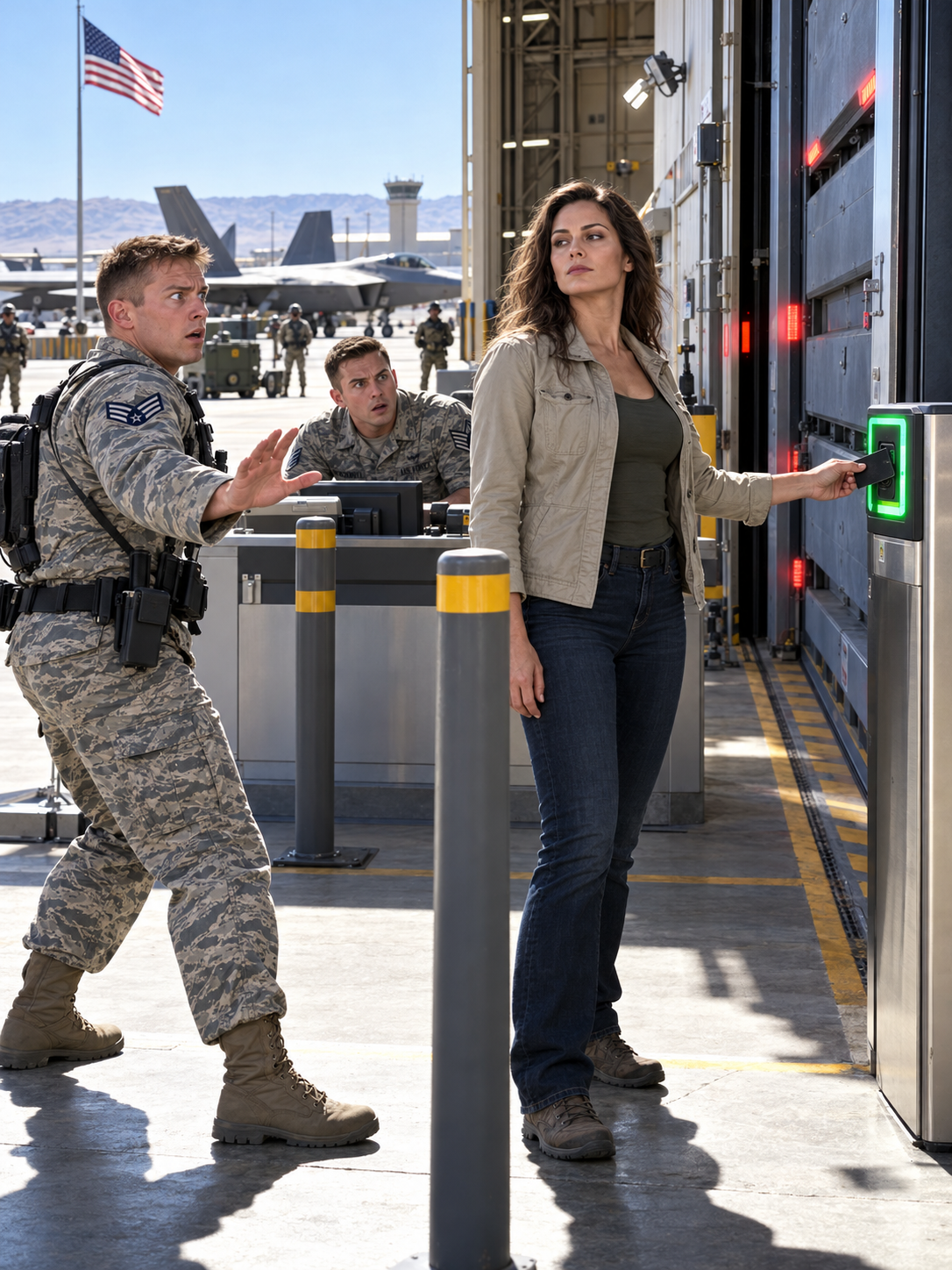
I arrived at a Nevada flight line dressed like someone easy to dismiss, and Airman Cole Mercer decided I didn’t belong before he ever asked for my ID. He mocked me, blocked the hangar entrance, and threatened to have me escorted off base while his partner laughed from the security desk. Then I inserted one black access card into their scanner. The screen changed color, the doors locked, and suddenly the men who had been laughing weren’t looking at my clothes anymore.
### Part 1
By eight-thirty that morning, the Nevada heat had already turned the concrete outside Hangar Four into a griddle. Jet fuel hung in the air with the bitter smell of burned metal and hot rubber, and every few seconds another mechanical whine rolled out from somewhere behind the reinforced doors. I crossed the flight line carrying one black transit case and wearing an olive flight suit with no visible rank, no name tape, and nothing on my shoulders that told strangers who I was.
That was intentional. My name is Major Mara Ellison, and after twelve years around tactical aviation, I had learned that a unit behaved very differently when it knew headquarters was watching. So when four frontline fighters developed nearly identical radar anomalies within three weeks, nobody announced my visit, nobody rolled out a staff car, and nobody warned the wing commander that an investigator from the Air Force System Safety Directorate would be standing at his hangar before lunch.
Officially, I had come to determine whether the aircraft were suffering from a hardware problem. Unofficially, I had been given instructions that fit on a single encrypted page: observe first, identify the failure, and assume nothing. That last instruction mattered because the maintenance reports coming out of Falcon Ridge Air Base looked almost too clean.
Aircraft broke. Sensors drifted. Connectors failed. Numbers rarely behaved as politely as the reports I had been reading for six straight nights.
I reached the yellow security line outside Hangar Four and saw two airmen working the checkpoint. One sat behind the glass control desk, tapping lazily through a spreadsheet while chewing something, and the other stood beside the turnstile with his arms crossed over a spotless tactical vest. His name tape read MERCER.
I took one step toward him. “Good morning. I need access to Hangar Four.”
He looked at my flight suit, then my face, then the black case in my hand. What he did not look at was the credential pouch clipped inside my left sleeve.
“Flight line is restricted personnel only, ma’am,” he said.
“I know.”
He gave me a thin smile. “Then you know you need to turn around.”
Behind the glass, the other airman snorted without looking up. Mercer seemed encouraged by the sound, because he shifted directly into my path and planted one boot over the painted yellow line as though defending a border from invasion. “Supply dispatch is down in Sector Two. Contractors check in at Administration.”
“I’m not a contractor.”
“Sure.”
I watched him for a second. He was young, maybe twenty-three, with sunburn along the bridge of his nose and the relaxed confidence of someone who had repeated the same procedure so many times that he had stopped thinking about why the procedure existed.
“I need you to verify my credentials,” I said.
Mercer laughed once. “You don’t have clearance for this facility.”
“You haven’t checked.”
“I don’t need to.”
That sentence bothered me more than the attitude.
Good security personnel could be suspicious. I wanted them suspicious. What I did not want was a guard making access decisions from clothing, age, gender, or whatever private hierarchy he had built in his head.
I placed the transit case beside my boot. “Airman, ask for my identification.”
His expression hardened. “Lady, I already told you. No clearance. Get lost.”
The airman behind the desk finally looked over and grinned. Across the bay, two maintainers had also started watching, and I could feel the moment turning into entertainment for everyone except me.
Mercer reached toward my shoulder as though he intended to physically steer me backward. I shifted half a step, enough that his hand touched nothing but air.
“Do not touch me,” I said.
Something in my voice made the desk operator stop smiling, but Mercer was already committed. “Then don’t make this difficult. Turn around before I call security and have you escorted off the flight line.”
I could have told him my rank. I could have shown him the authorization memorandum in my case. I could have called Colonel Nathan Rourke, the wing commander, and ended the performance with one sentence.
Instead, I reached into my sleeve pocket.
Mercer rolled his eyes when he saw the matte-black credential. “Civilian logistics cards don’t work here.”
“It isn’t a logistics card.”
He leaned closer. “Whatever it is, you’re not putting it in that terminal.”
I slid past the edge of his shoulder before he decided whether to stop me. The movement wasn’t aggressive; it was simply faster than his assumption that I would obey him. I inserted the card into the cipher reader beneath the glass.
For three seconds, nothing happened.
Mercer folded his arms. “Told you.”
Then the terminal made a sound I had only heard during controlled security exercises.
Two deep electronic tones filled the vestibule. The ordinary green login screen vanished, the interface reset, and the entire display burned amber before a second band of purple appeared around the border.
LEVEL 5 ACCESS VERIFIED.
SPECIAL ACCESS PROGRAM.
DIRECT OVERSIGHT AUTHORITY.
The laughter disappeared.
A heavy metallic thud shook the wall as the facility’s security system automatically sealed the inner access door. The desk operator jerked upright so quickly his chair slammed into the cabinet behind him.
Mercer’s face lost its color.
“What did you do?” he whispered.
“Exactly what I asked you to let me do three minutes ago.”
He stared at the screen, then reached suddenly toward my credential as if pulling it out might undo what he had just seen. I placed my palm over the reader cover.
“Don’t.”
He stopped.
“You interfere with an active security authentication, and your morning gets considerably worse.”
Mercer withdrew his hand.
The terminal began issuing a repeating alert tone. Somewhere upstairs, a phone rang, followed almost immediately by the sharp sound of running footsteps on metal stairs.
The desk operator whispered, “Oh, God.”
A man in a flight uniform appeared on the upper catwalk and took the steps two at a time. Colonel Nathan Rourke reached the checkpoint with Captain Elise Navarro, the base security commander, less than a minute after the alert began.
Rourke barely glanced at Mercer.
He looked straight at me.
His posture changed instantly.
“Major Ellison.”
He snapped a salute.
I returned it.
The silence behind me became so complete that I could hear the cooling fans inside the security terminal.
“We were not notified you were on station,” Rourke said.
“That was the point, Colonel.”
His eyes shifted toward Mercer, then toward the screen, and something cold settled over his face. “Airman Mercer, did you verify Major Ellison’s identification before denying her entry?”
Mercer’s mouth opened.
Nothing came out.
Captain Navarro stepped beside him. “Airman?”
“I didn’t see rank, ma’am.”
“That wasn’t my question.”
Mercer swallowed. “No, ma’am.”
Colonel Rourke’s voice became quiet. “Surrender your checkpoint credential.”
Mercer stared at him.
“Now.”
His fingers shook when he unclipped the badge from his vest.
I should have felt satisfied. Instead, I looked through the glass toward the four grounded fighters inside Hangar Four and felt the knot in my stomach tighten.
A careless guard was embarrassing.
But careless people rarely existed alone inside systems that rewarded shortcuts.
And I hadn’t flown across the country because someone was rude at a door.
I had come because four aircraft were lying to their pilots.
### Part 2
Ten minutes later, I was inside a secure briefing room that smelled like stale coffee, overheated electronics, and dry-erase marker. Colonel Rourke sat at the head of the steel table while six people filled the remaining seats: maintenance supervisors, avionics specialists, Captain Navarro, and Chief Master Sergeant Alan Crowe, the senior enlisted maintenance manager responsible for Hangar Four. Mercer sat against the far wall without his security credential, staring at the floor.
I plugged my encrypted drive into the isolated projector. “I’m not here about the checkpoint.”
Mercer looked up.
“That’s Captain Navarro’s responsibility now. I’m here because aircraft 771, 784, 806, and 819 reported temporary radar degradation during high-altitude maneuvering.”
Chief Crowe leaned forward. “We’ve already isolated the likely modules.”
“I read the reports.”
“We’ve changed two processor assemblies and ordered replacements for the others.”
“I read those reports too.”
Crowe’s expression tightened slightly. “Then you know we’re looking at component fatigue.”
That was the official explanation. A component inside the radar array was allegedly drifting outside tolerance after sustained vibration, causing brief data interruptions before automatically recovering.
It was plausible.
That was precisely why it bothered me.
I brought up a graph showing twenty-two recent sorties. “These are your turnaround records.”
Crowe nodded.
“Your crews are fast.”
One of the technicians smiled nervously, apparently believing I had complimented them.
I changed slides.
The smile disappeared.
“The manufacturer requires forty-five minutes for a complete synchronization cycle after this class of radar discrepancy,” I said. “Your records show repeated completion times between seven and nine minutes.”
Crowe crossed his arms. “We have experienced technicians.”
“Experience doesn’t change how long a diagnostic cycle takes.”
A captain from avionics shifted in his chair. “Ma’am, some stages can run concurrently.”
“Not these.”
Nobody answered.
I looked at Rourke. He wasn’t defending them, which told me something. Either he genuinely didn’t know what I had found or he was smart enough not to interfere before I finished.
I opened another file. “Here’s where it gets strange.”
The maintenance tracking system showed full diagnostics completed successfully, every box checked, every required verification marked green. If those records were accurate, the aircraft should have been receiving complete recalibrations.
But the internal clocks inside the fighters said otherwise.
I had requested direct memory snapshots before leaving Ohio. They had arrived while I was in transit, and what they showed had bothered me enough that I had barely slept on the plane.
“The aircraft don’t agree with your maintenance system,” I said.
Chief Crowe frowned. “What does that mean?”
“It means somebody’s paperwork says forty-five-minute procedures were completed while the aircraft themselves record less than ten minutes of diagnostic activity.”
The room changed.
Until then, everyone could blame failing electronics.
Now we had people in the equation.
Crowe glanced at two technicians. “Could be clock corruption.”
“It could.”
His shoulders relaxed a fraction.
That was the red herring I had expected.
I pulled up timestamp comparisons from unrelated systems—engine controllers, navigation modules, onboard power-management units, and radar memory. All of them matched one another within normal tolerances.
Only the maintenance entries claimed something different.
“Four separate aircraft would have to develop identical timing corruption while every unrelated system preserved accurate synchronization,” I said. “Possible, but unlikely.”
Crowe leaned back slowly.
Colonel Rourke looked at him. “Chief?”
“I need to speak with my section leads.”
“You’ll speak here.”
Crowe’s jaw worked once before he nodded.
I continued through the logs. There were no obvious signatures of sabotage, no foreign code, no spectacular technical villain hiding behind the anomalies. Instead, I kept finding tiny irregularities that looked almost boring.
Diagnostics terminated early.
Manual overrides.
Warnings acknowledged faster than a human technician could reasonably investigate them.
And one authorization code appeared again and again.
“Whose credential is MC-17?”
Nobody moved.
Then Mercer, from the far wall, whispered, “Mine.”
Every face turned toward him.
He looked miserable. “It’s my maintenance support profile.”
I stared at him. “You’re security detail.”
“I transferred from avionics three months ago.”
Chief Crowe’s head snapped toward him. “Mercer.”
“What?”
“Stop talking.”
That was the first moment I knew the problem was bigger than one careless airman.
Colonel Rourke heard it too.
He leaned forward. “Chief, why are you telling him not to answer an investigator?”
Crowe’s face went flat. “Because he’s nervous and likely to say something inaccurate.”
Mercer looked from Crowe to me, and I saw something different replace the panic in his eyes.
Fear, yes.
But not fear of me.
I closed the laptop halfway. “We’re taking a ten-minute recess.”
Crowe started to rise.
“You stay seated.”
His hands froze against the table.
I pointed toward Mercer. “Airman, corridor.”
We stepped outside, where the air-conditioning sounded absurdly loud after the silence of the briefing room. Mercer rubbed both hands over his face.
“I didn’t change the software,” he said immediately.
“I didn’t ask if you did.”
“I know how it looks.”
“No. Right now, I know almost nothing about how it looks.”
He stared at the floor.
“So help me understand.”
For several seconds he said nothing. Then he glanced back toward the steel briefing-room door.
“When I was in avionics, we were getting killed on turnaround numbers,” he said. “Everybody knew it.”
“Who is everybody?”
“The whole section.”
“What did you do?”
He swallowed.
“We learned how to skip part of the cycle.”
“How?”
“There’s a maintenance override.”
“That override exists for controlled bench testing.”
“I know.”
“And you used it on operational aircraft?”
His face tightened. “We were told the redundant channel would catch anything important.”
“Who told you?”
He said nothing.
I waited.
Mercer’s eyes flicked toward the briefing-room door again.
Then he whispered two words that changed the entire direction of my investigation.
“Chief Crowe.”
### Part 3
I did not confront Crowe immediately. Accusations were easy; proof mattered, and men who built careers around polished numbers usually built equally polished explanations for those numbers. I returned to the briefing room, reopened my laptop, and acted as though the conversation with Mercer had changed nothing.
Chief Crowe watched me carefully. “Are we continuing?”
“We’re starting over.”
I removed the maintenance summary from the display and opened the raw event logs instead. “No interpretations. No readiness reports. No performance dashboards. We work from machine data only.”
Crowe’s mouth tightened.
For the next hour, we reconstructed twenty-two sorties one event at a time. The room became hot despite the air-conditioning, coffee cups accumulated beside elbows, and every few minutes someone had to explain why a warning had been acknowledged, why a cycle had been terminated, or why a required verification appeared in the official log without a matching event inside the aircraft.
A pattern emerged.
It wasn’t random.
The shortened diagnostics happened most often on days when the schedule was crowded and leadership was tracking turnaround performance. When there was no time pressure, crews performed the full procedure.
That meant they knew how.
They simply weren’t doing it when the numbers mattered.
Colonel Rourke stared at the projection. “How long has this been happening?”
Nobody answered.
I enlarged the date range.
Six weeks became three months.
Three months became seven.
Then I found the oldest matching override.
Eleven months.
Someone at the table muttered, “Damn.”
Crowe finally spoke. “Major, this makes the pattern look worse than it is.”
I turned toward him. “Explain how.”
“The radar system has built-in redundancy. The abbreviated cycle doesn’t remove primary functionality.”
“It disables a verification stage.”
“Temporarily.”
“During flight.”
“Under controlled operating conditions.”
“Thirty thousand feet is not a controlled maintenance environment.”
His voice sharpened. “You’re interpreting procedure without the operational context we deal with here.”
That sentence drew my full attention.
I had heard variations of it throughout my career. It usually meant, You understand the rule, but we believe our pressure makes us special.
“What operational context justifies inaccurate maintenance certification?” I asked.
Crowe pushed back from the table. “Our sortie commitments increased twenty-seven percent this year. We lost eleven experienced technicians to reassignment and medical separation. Headquarters still expected the same readiness rate.”
That was useful information.
It was also not an answer.
“So you falsified completion times?”
“I didn’t say that.”
“The computers did.”
For the first time, his confidence cracked.
Colonel Rourke stood. “Chief, did you authorize abbreviated radar diagnostics?”
Crowe looked at him. “Sir, I authorized experienced technicians to use professional judgment.”
“That is not what he asked,” I said.
Crowe glared at me.
I didn’t return the emotion. Anger was convenient because it let people tell themselves the conflict was personal.
This wasn’t personal.
I entered Mercer’s old credential code into the audit filter. Seventeen manual overrides appeared.
Then another technician’s code.
Thirty-one.
Another.
Twenty-six.
Finally, I searched Crowe’s supervisory credential.
There were only four.
He exhaled through his nose. “See?”
“Not yet.”
Each of Crowe’s four authorizations occurred immediately before clusters of shortened diagnostics. His credential wasn’t being used to perform the bypass.
It was being used to unlock the permission that allowed junior technicians to do it.
The silence grew heavy.
Colonel Rourke stared at the dates. “You approved this.”
Crowe shook his head. “I approved elevated maintenance access.”
“Immediately before they bypassed procedures.”
“They needed access to meet schedule.”
“And afterward?”
Crowe said nothing.
I opened one final dataset.
This one had not come from the maintenance section. It came from flight telemetry collected during the anomalies.
The projected graph showed two altitude channels moving almost perfectly together—until one broke away.
The line dipped.
Recovered.
Dipped again.
Then disappeared for six seconds.
A pilot traveling hundreds of miles per hour could cover an uncomfortable amount of distance in six seconds.
“This is aircraft 784,” I said. “During a high-bank training maneuver three weeks ago.”
One of the engineers leaned forward. “That looks like channel divergence.”
“It is.”
“The backup should have rejected it.”
“The backup had not been correctly synchronized because the diagnostic was terminated after eight minutes.”
Nobody spoke.
I advanced the timeline.
“Here’s aircraft 819.”
A second graph showed the same failure.
Then a third.
Three aircraft.
Three incidents.
Three pilots who had reported that their displays briefly felt wrong but recovered before they could isolate the cause.
Crowe’s face changed.
Not dramatically.
Just enough.
For months, people had convinced themselves their shortcut was harmless because nothing catastrophic had happened. Now the proof was glowing on the wall.
“Those crews were flying with compromised redundancy,” I said. “You didn’t save thirty-seven minutes of maintenance time. You borrowed those minutes from the pilots.”
Colonel Rourke removed his glasses and stared down at the table.
“When is the next full tactical exercise?” I asked.
“Tuesday.”
“How many aircraft?”
“Twelve.”
“How many from this hangar?”
“Eight.”
My stomach tightened.
The four grounded fighters were only the ones showing obvious symptoms.
There could be others.
I shut down the projector. “Nobody leaves this room.”
Crowe looked up sharply. “Excuse me?”
“We are expanding the audit to every aircraft serviced by this section during the last year.”
“You don’t have evidence every aircraft is compromised.”
“Correct.”
I gathered my files.
“And I’m going to make sure we keep it that way.”
Captain Navarro stepped toward the door to summon additional security. Colonel Rourke was already reaching for the secure phone when Chief Crowe suddenly stood.
“You’re going to destroy this unit over a maintenance shortcut that hasn’t killed anyone.”
His words landed harder than shouting would have.
I looked at him.
“That,” I said, “is exactly how people get killed.”
Then my laptop chimed.
A new encrypted dataset had arrived from the depot analysis team.
I opened it.
The first line made my pulse jump.
The four grounded fighters weren’t the only aircraft carrying the altered configuration.
There were eleven.
### Part 4
Within twenty minutes, Hangar Four stopped functioning as an ordinary maintenance facility. Captain Navarro restricted access, Colonel Rourke suspended all independent avionics activity, and eleven aircraft were placed under technical quarantine until every radar system could be inspected from scratch. The flight schedule board outside operations changed so quickly that red cancellation markers filled nearly half the screen.
People were angry. Pilots wanted answers, schedulers wanted revised launch times, and maintenance supervisors wanted to know how long the stand-down would last. I gave everyone the same answer: “As long as it takes to know the aircraft are safe.”
Chief Crowe was escorted to a separate office to provide a formal statement. He wasn’t handcuffed, shouted at, or publicly humiliated; that wasn’t how serious accountability worked. His network permissions were frozen, his supervisory credentials were removed, and the investigation moved around him with the quiet efficiency of a machine whose purpose he had underestimated.
Mercer found me near the water station shortly after two in the afternoon.
His uniform shirt was dark beneath the arms, and every trace of the smug guard from that morning had disappeared. “Major Ellison?”
I filled a paper cup. “What do you need?”
“Can I talk to you?”
“You are talking to me.”
He flinched. “I mean privately.”
We stepped several feet farther down the corridor, though Captain Navarro remained within sight.
Mercer rubbed his hands together. “I know what I did at the checkpoint was wrong.”
“Yes.”
“I should’ve checked your ID.”
“Yes.”
“I was being an idiot.”
I waited.
He seemed disappointed that I wasn’t arguing with him.
“But this investigation…” His voice dropped. “If they charge me for the maintenance overrides too, my career is done.”
“Possibly.”
His eyes widened. “That’s it?”
“What do you want me to say?”
“That I didn’t mean to hurt anyone.”
“I believe you.”
He stared at me.
“That doesn’t erase what happened.”
He looked toward the hangar. “We were under pressure. Chief Crowe kept showing us the numbers. Every week it was another chart, another briefing, another warning that our section was making the whole wing look bad.”
“And?”
“He said the full diagnostic was conservative. Said the redundancy made the risk theoretical.”
“Did you believe him?”
“At first.”
That word mattered.
“At first?”
Mercer’s face tightened.
He told me that two months earlier, a pilot had returned from a night sortie complaining that the altitude picture had briefly flickered during a turn. Mercer had been back in the avionics shop helping cover a personnel shortage, and he noticed that the aircraft had been serviced using the abbreviated cycle.
“What did you do?” I asked.
“I told Staff Sergeant Keene.”
“And?”
“He told Crowe.”
“What happened?”
“The next morning Crowe pulled us together and said the pilot report was unrelated. He told us not to start inventing connections because we were nervous.”
“Did you believe him?”
Mercer looked at the floor. “I wanted to.”
There it was.
Not ignorance.
Permission.
Sometimes people knew something felt wrong and searched for the nearest authority figure willing to tell them it was fine.
“Why did you keep using the shortcut?”
His voice was almost inaudible. “Because everybody else did.”
I set the cup on the windowsill.
“Airman, do you know what bothered me most about this morning?”
He looked embarrassed. “How I talked to you?”
“No.”
His eyebrows lifted.
“You never checked.”
He said nothing.
“At the checkpoint, you decided you already knew who I was. In maintenance, you decided someone else already knew the shortcut was safe. Both failures came from the same habit.”
His shoulders sank.
“You stopped verifying.”
For a long moment we listened to the muted whine of equipment beyond the sealed doors.
“I can’t change your disciplinary process,” I said. “And I won’t interfere with it.”
He nodded slowly.
“But when investigators ask what happened, tell them everything. Don’t protect your pride, don’t protect Crowe, and don’t invent excuses.”
“Will that help?”
“It will make your statement useful.”
“That wasn’t what I meant.”
“I know.”
I left him there and returned to the hangar.
By late afternoon, the depot team had confirmed that eight of the eleven aircraft had received incomplete calibration cycles at least once. Four displayed measurable synchronization drift.
One showed something worse.
During a previous training sortie, the system had briefly accepted conflicting altitude information from two sources before resolving the discrepancy. The event had lasted less than four seconds, too short to generate a major cockpit alert.
The pilot had described it afterward as “a weird flash.”
Nobody had investigated it further because the aircraft passed the abbreviated ground check.
Colonel Rourke read the report beside me.
His face went pale.
“That could have happened Tuesday,” he said.
“Yes.”
“With twelve jets maneuvering together.”
“Yes.”
He turned toward the maintenance bay, where technicians from another unit were beginning full diagnostic cycles. “How did I not know?”
It was the first question he had asked all day that had no easy answer.
“You received good numbers,” I said.
He looked at me.
“And eventually, you started trusting the numbers more than the process creating them.”
Rourke closed his eyes for a moment.
Then he straightened.
“Fix it.”
We worked until after sunset.
Every aircraft received a genuine full calibration. Every override permission was revoked. Every maintenance record connected to the shortcut was secured for review.
Shortly after eight, Captain Navarro handed me an evidence summary.
I read the final page and stopped.
Chief Crowe hadn’t created the shortcut.
Someone had taught it to him.
And according to an archived email chain, that person had left Falcon Ridge eight months earlier with a promotion.
### Part 5
The next morning began before sunrise. Nevada air was cool for once, and the flight line lights threw hard white reflections across the concrete while crews prepared equipment for another day of inspections. I stood inside Hangar Four with coffee that tasted like burnt cardboard and read the archived messages for the third time.
The person who had introduced the abbreviated procedure was Lieutenant Colonel Grant Hollis, a former maintenance operations director who had transferred to a staff position at another command. His messages never explicitly ordered anyone to falsify records. People who understood bureaucracy rarely wrote sentences that clean.
Instead, Hollis had used phrases like “exercise informed flexibility,” “protect readiness presentation,” and “avoid unnecessary diagnostic dwell.” Attached to one message was a spreadsheet comparing sections by turnaround time, with Crowe’s team highlighted near the bottom.
The implication was obvious.
Make the numbers improve.
Crowe had taken that pressure and turned it into practice.
Then the practice became habit.
By the time Hollis left, nobody needed him there anymore.
That was how unsafe cultures survived.
They taught themselves.
I forwarded the archive through the proper investigative channel and returned my attention to Falcon Ridge. Hollis would have his own questions to answer somewhere else, but my responsibility was the aircraft sitting in front of me.
By ten, seven fighters had passed complete diagnostics.
The eighth needed a replacement synchronization unit.
The remaining three were still undergoing inspection.
Colonel Rourke joined me beneath the wing of aircraft 784. His uniform looked as though he had slept in it.
“Group command has the preliminary report,” he said.
“And?”
“They’re suspending next week’s readiness evaluation.”
I nodded.
Six months earlier, that news would probably have horrified half the maintenance leadership.
Now it felt like oxygen.
“Crowe has been relieved pending investigation,” Rourke continued. “Three supervisors have lost certification authority. Mercer and two technicians are being reassigned to supervised duties while legal determines individual responsibility.”
“Good.”
Rourke studied the aircraft above us. “I keep thinking about Tuesday.”
“So do I.”
“If you hadn’t come…”
“But I did.”
He looked at me.
I understood why commanders tortured themselves with alternate outcomes. I had done it too after accidents early in my career, replaying every decision until imagination became its own punishment.
“The point of safety work isn’t proving what would have happened,” I said. “It’s removing the condition that could have allowed it.”
He nodded slowly.
Across the hangar, a technician called for power.
The fighter’s systems came alive one at a time. Cooling fans rose into a steady hum, status lights blinked across the service panel, and the radar test sequence began.
Nobody skipped anything.
Forty-five minutes meant forty-five minutes.
I watched the timer because somehow it had become the most beautiful number on the base.
Mercer appeared near the tool station carrying inventory sheets under supervision. He saw me and hesitated before approaching.
“Major?”
“Yes?”
“I gave my statement.”
“Good.”
“Everything.”
I waited.
He looked toward the checkpoint where we had met the day before. “I keep replaying that morning.”
“Don’t replay it forever.”
His expression showed surprise.
“Learn from it.”
He nodded.
“I thought you were nobody.”
I almost smiled. “That wasn’t your mistake.”
He frowned.
“People are going to look ordinary sometimes. Visitors, junior airmen, contractors, civilians, officers out of uniform. Your job isn’t to guess which ones matter.”
“What is it?”
“Follow the standard.”
He looked toward the hangar floor.
“Every time?”
“Especially when you’re bored.”
He gave a small, embarrassed laugh.
I didn’t forgive him because there was nothing personal between us that required forgiveness. His consequences belonged to the command, and I had no interest in rescuing him from them simply because he now understood why the rules mattered.
Understanding after failure was valuable.
It just wasn’t the same thing as avoiding failure in the first place.
At 1642, aircraft 784 completed its full calibration.
Every channel synchronized correctly.
The radar array passed redundancy verification.
One of the technicians lifted his headset and gave me a thumbs-up.
I exhaled.
The next aircraft passed six minutes later.
By the time the final report was signed, all eleven fighters had either been restored to proper configuration or held for component replacement. None would return to flight until an independent team certified the work.
Colonel Rourke met me at the administrative vestibule with the completed audit packet.
He signed the final endorsement and handed it across.
“Major Ellison.”
“Colonel.”
“I owe you an apology.”
“For what?”
“For having a unit where someone could treat verification like an inconvenience.”
I took the packet.
“You don’t owe me an apology. You owe your pilots a correction.”
He looked toward the hangar.
“They have it.”
“Then we’re finished.”
He extended his hand.
I shook it.
Outside, the late afternoon sun stretched long shadows across the Nevada concrete. A fighter near the far apron started its auxiliary power unit, and the turbine rose from a low mechanical growl into a clean, steady whine.
I stood beside my rental car for a moment and listened.
No applause.
No dramatic ceremony.
No one announcing that the day had been saved.
Just a machine operating exactly the way it was supposed to because somebody had finally stopped pretending that shortcuts were efficiency.
Before leaving the base, I passed Hangar Four one final time.
A different security airman stood at the checkpoint.
He raised his hand.
“Ma’am, identification please.”
I handed him my ordinary temporary transit credential instead of the black card.
He examined the photograph.
Checked the authorization.
Verified the visitor list.
Then he handed it back.
“Thank you, Major. Have a safe trip.”
I smiled.
“Good work, Airman.”
Driving toward the main gate, I thought about how easily people confuse authority with appearance. They expect power to arrive in polished boots, visible insignia, an official vehicle, and a crowd of people stepping aside.
Sometimes it does.
Sometimes it arrives carrying its own bag in an unmarked flight suit.
But that wasn’t the lesson I carried away from Falcon Ridge.
The real lesson was simpler.
Standards are most important when nobody impressive is standing nearby to enforce them.
Mercer had dismissed me because he thought I wasn’t important enough to verify. Crowe had dismissed mandatory diagnostics because he believed the risk wasn’t important enough to slow down for. Different situations, same failure.
They trusted assumption more than evidence.
I had spent twelve years learning how dangerous that could become.
At the main gate, the guard checked my credential before lifting the barrier.
Exactly as he should.
I drove into the desert evening with the audit packet secured beside me and eleven aircraft behind me that would not fly again until we knew they were safe.
The black Level Five credential remained zipped inside my sleeve pocket.
I hadn’t needed it since that first morning.
Real authority had never been written on the card anyway.
It was in knowing the standard, following the evidence, and refusing to look away when the truth became inconvenient.
THE END!
Disclaimer: Our stories are inspired by real-life events but are carefully rewritten for entertainment. Any resemblance to actual people or situations is purely coincidental.


