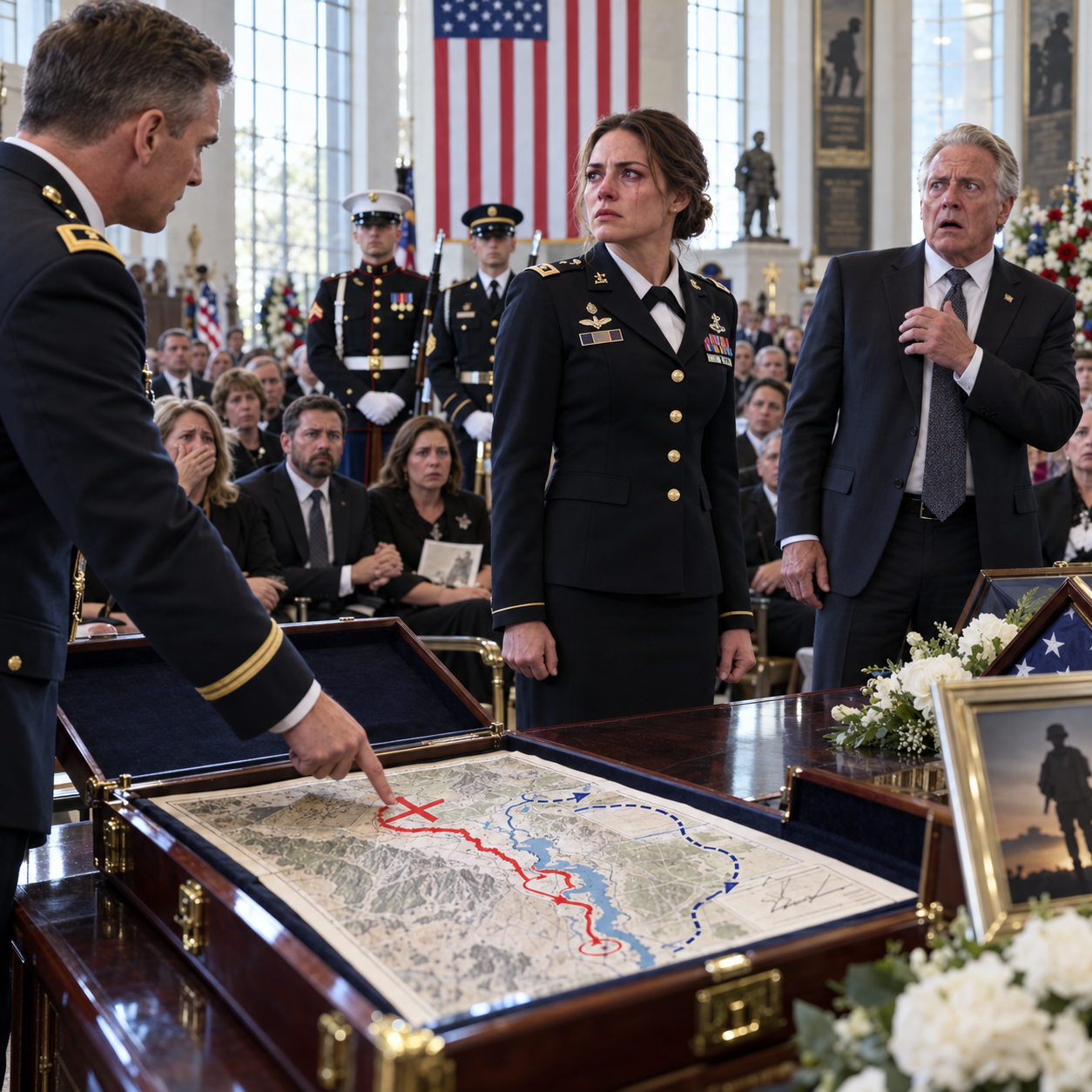
“She Abandoned Her Unit!” My Father Announced Before The Fallen Soldiers’ Families. The Honor Guard Opened A Box Bearing My Name. Inside Was The Original Evacuation Map, Its Safe Route Crossed Out In Red. “She Refused That Order,” The Captain Said. Dad Smiled. “So She Disobeyed.” The Captain Pointed To The Signature Authorizing The Route. It Was Dad’s. The Order That Put Them In Danger Was His.
My father called me a coward in front of two hundred people at a memorial for fallen soldiers, and almost everyone in the room believed him. My mother stared at her plate, my brother looked away, and men who had known me since childhood let the accusation stand. I didn’t interrupt him. I simply waited. Six weeks after an honor guard carried a locked walnut box onto that stage and destroyed the story my father had built around me, an investigator called about something found behind the drywall of his private study—something suggesting Outpost Echo had never been the beginning.
Part 1
The first thing I noticed when my father called me a disgrace was the sound of a spoon hitting porcelain three tables away. It was a tiny noise, almost ridiculous against the size of the banquet hall, but the room had gone so quiet that I heard the spoon bounce twice before settling beside a coffee cup. Two hundred people were watching Colonel Thomas Vance stand beneath the memorial banner in his dress blues, his ribbons lined up perfectly across his chest, and tell them that his only daughter had abandoned soldiers under fire. I stood near the back wall in my own uniform, hands clasped behind me, while the skin beneath my collar grew hot enough to sting.
“Leadership means acknowledging failure,” my father said into the microphone, his voice carrying the calm weight that had made young officers sit straighter for most of his career. “Even when that failure shares your blood.” A few people glanced at me immediately, and others followed once they understood what he was doing. My mother, seated at the family table near the stage, lowered her eyes to the white tablecloth, while my younger brother Daniel stared straight ahead as if he had suddenly developed a deep interest in the folded memorial program in front of him.
My father paused exactly long enough to let the room absorb the cruelty while mistaking it for principle. “Eighteen months ago, at Outpost Echo, brave men and women were placed in danger because one officer lacked the moral fortitude to follow lawful orders. She abandoned her assigned route. She left her position without authorization. She chose her own judgment over command.” His eyes found mine across the room, and for a moment I was twelve again, standing in his study after bringing home a B-plus in chemistry while he asked why I had embarrassed him.
I did not look away.
“She disgraced this family,” he continued, “and she disgraced this uniform.”
The silence broke into whispers. I recognized some of the faces turning toward me: parents whose children I had served beside, retired officers who had eaten barbecue in our backyard, women who had brought casseroles when my grandmother died. One man shook his head slowly, not in sympathy but disappointment, and that hurt more than I expected. The official reprimand had followed me for a year and a half, but hearing the accusation spoken aloud by my father turned rumor into ceremony.
He had invited me himself.
The email had arrived four days earlier from his personal account: Your attendance is expected. Whatever our differences, you owe the fallen that much.
I almost deleted it. Then I noticed that the annual memorial had been moved from the civic center to the old officers’ banquet hall on the edge of Fort Halston, a venue large enough for senior command staff and representatives from the Inspector General’s office. That detail had seemed unusual, though not enough to explain the strange voicemail I received the next morning from a blocked number.
“Lieutenant Vance,” a man had said, “if you attend the memorial, remain until the program is formally concluded. Do not leave early, regardless of what is said.”
He had hung up before I could answer.
So I came.
My father finished his condemnation and rested both hands on the podium. “Some wounds in military families are private,” he said, adopting the solemn expression he used whenever he wanted people to believe something cost him deeply. “Others carry lessons greater than ourselves.”
That was when I realized he had planned the entire speech.
This was not anger. It was insurance.
Something had changed behind the scenes, and he was trying to bury me one last time before it surfaced.
He bowed his head as though preparing to lead a prayer.
The double doors at the back of the hall opened.
Every person in the room turned at once.
Six members of an honor guard entered in full ceremonial uniform, their footsteps landing in perfect rhythm against the marble floor. Two carried a polished walnut case between them. Captain Owen Miller walked ahead, expression unreadable, and I recognized the red-and-gold Inspector General insignia on his armband before anyone around me did.
My father saw it a second later.
His hands tightened around the podium.
“Captain Miller,” he said when the formation reached the center aisle. His voice remained smooth, but I knew him well enough to hear the strain beneath it. “This presentation is not on the program.”
Miller stopped at the foot of the stage and saluted.
“No, sir.”
The microphones caught every word.
“By order of the Inspector General, this proceeding supersedes the local program.”
A soft movement went through the audience, chairs shifting, fabric brushing, people sitting forward. My mother finally looked up. Daniel turned toward me, confusion written openly across his face.
My father gave a thin smile. “Proceeding?”
Captain Miller climbed the steps.
The two sergeants followed and placed the walnut case directly beside the microphone. A brass plate on its lid reflected the overhead lights.
Even from the back of the room, I could read my name.
Lieutenant Maya Vance
Operational Logistics Command
For eighteen months, I had imagined what vindication might feel like. I had pictured anger, relief, maybe satisfaction. Instead I felt something colder.
Fear.
Because I had never seen that box before.
Neither, judging by his face, had my father.
“What is this?” he demanded.
Miller removed a small key from his breast pocket.
“Recovered archive material from Outpost Echo.”
My father’s face changed.
It was slight. Most people would have missed it.
I didn’t.
His eyes moved from the box to the doors, then toward the side exit.
That was the moment I understood something I should have understood eighteen months earlier.
My father was not afraid of what the box might prove about me.
He already knew.
He was afraid of what else was inside.
Part 2
Captain Miller turned the key slowly enough that the click of the lock carried through the speakers. Nobody moved. My father stood less than three feet from him, shoulders square, chin lifted, every inch of his posture still performing command even though the tendons in his neck had tightened. When Miller opened the lid, I expected photographs, testimony, maybe the reconstructed communications log investigators had spent months refusing to discuss with me.
Instead he pulled out a weathered field dossier wrapped in a clear evidence sleeve.
My father exhaled.
It was the smallest sound, but I heard it.
Miller unfolded a topographical map and placed it beneath the document projector. The twin screens behind the stage filled with the terrain surrounding Outpost Echo: western ridge, river canyon, landing zone, medical station, service road. I had stared at that map so often in nightmares that I knew every contour line. A thick red X crossed the canyon route, drawn in my own hand.
My father almost laughed.
“There,” he said, turning toward the audience. “That is exactly what I have been saying. Lieutenant Vance deliberately altered the evacuation plan.”
Miller looked at him.
“Yes, sir. She did.”
A murmur spread through the room.
My mother covered her mouth.
I remained still.
Miller changed the projected image.
The next page was an original dispatch order I had been told no longer existed.
My stomach tightened.
Eighteen months earlier, after the shooting stopped and the surviving convoy reached friendly territory, military investigators informed me that the primary server at Echo had been destroyed. The communications terminal had burned. The satellite printer had been crushed beneath part of the command structure. Headquarters claimed the emergency order could not be reconstructed from existing archives.
Yet there it was.
Time stamp: 00:17.
Directive: Redirect medical convoy through River Canyon Route C. Prioritize transport of Logistics Assets 41-A, 41-B, and 41-C.
Medical personnel secondary.
My father stared at the screen.
Miller spoke without raising his voice.
“This is the original evacuation directive transmitted to Lieutenant Vance’s station eleven minutes after the first perimeter breach.”
My father stepped closer. “That proves nothing except she received a lawful order.”
“The three logistics containers named in that order were not listed on the outpost inventory.”
My father’s jaw flexed.
I felt something shift in the room.
Not belief yet.
Curiosity.
Miller turned to another page.
“Lieutenant Vance contacted command to verify the directive. That call was deleted from the primary log forty-three minutes after Outpost Echo fell.”
My hands went cold.
I remembered sitting at the communications console while red emergency lights flashed across the ceiling. Outside, explosions rolled through the ground beneath my boots, and somebody in the corridor kept shouting for more stretchers. The satellite phone shook in my hand as my father answered.
“Maya, do not question the order,” he had said. “Move the containers. Use the canyon.”
“There are seven wounded here.”
“Then leave them with medical staff.”
“They are the medical staff.”
A pause.
I could still hear it.
Then his voice became something I had never forgotten.
“Your career depends on following that directive.”
At the memorial, Captain Miller placed another document beneath the projector.
A digital restoration report.
“The call was recovered three months ago from a secondary encrypted server maintained by Strategic Mobility Command.”
My father’s voice hardened.
“This is classified operational information. You have no authority to display—”
“The material was declassified at 0600 this morning.”
That stopped him.
Miller advanced the page until the authorization block filled the screens.
My father’s signature appeared twenty feet high behind him.
Colonel Thomas R. Vance.
Verified digital seal.
The room reacted all at once.
A woman near the front whispered, “Oh my God.”
Someone else said my father’s name.
I heard Daniel’s chair scrape backward.
My mother stared at the screen as if she could make the signature disappear through concentration alone.
My father turned toward Miller. “That could have been inserted afterward.”
“It was authenticated by three independent forensic teams.”
“This is absurd.”
“Colonel.”
Miller’s voice changed.
Not louder.
Sharper.
“The canyon route you ordered was struck fourteen minutes after Lieutenant Vance refused it.”
The room went silent again.
I closed my eyes.
That was the part I had never known.
Investigators had not told me.
If I had followed the order, our convoy would have entered the canyon shortly before the attack.
Miller continued.
“Recovered enemy surveillance data shows the route was under observation before the evacuation directive was issued.”
My eyes opened.
My father looked at him quickly.
Too quickly.
There it was again.
Fear.
Not shock.
Recognition.
I saw Captain Miller notice it too.
“You knew,” I said.
It was the first thing I had spoken since my father walked to the podium.
The microphone closest to me picked it up.
My father looked across the room.
For eighteen months I had imagined asking him why he destroyed my life. The question that came out was different.
“You knew the canyon was compromised.”
He straightened.
“I knew no such thing.”
Captain Miller reached into the walnut case.
“This investigation is not limited to Lieutenant Vance’s disciplinary action.”
My father’s face lost color.
Miller withdrew a second folder.
This one bore a federal evidence label.
He did not open it.
Not yet.
“Three days after Outpost Echo,” he said, “a civilian defense contractor filed an insurance claim for equipment allegedly destroyed during the attack.”
I watched my father.
His eyes closed for half a second.
That was enough.
“The serial numbers on that claim,” Miller continued, “match the three unregistered containers Colonel Vance ordered Lieutenant Vance to transport through River Canyon Route C.”
Nobody whispered now.
Nobody moved.
The terrible thing about truth is that once enough of it enters a room, lies stop looking complicated.
They start looking cheap.
My father stepped away from the podium.
Captain Miller followed him with his eyes.
“Colonel Vance,” he said, “where were those containers supposed to go?”
My father did not answer.
From the rear doors, four people in plain clothes entered the hall.
One wore a federal badge on his belt.
The other three carried sealed evidence bags.
And one of those bags contained a black notebook I recognized immediately.
It had sat in the locked drawer of my father’s desk for most of my childhood.
Part 3
My father called the notebook his deployment ledger.
When I was young, I thought every senior officer kept one. It was black leather, soft at the corners from years of handling, with a thin red ribbon marking his place. He never allowed Daniel or me to touch it, and whenever he traveled, it disappeared into his locked briefcase.
Seeing it inside a federal evidence bag made something old and shapeless begin to take form.
My father looked at the investigator carrying it and said, “You had no authority to enter my home.”
“We had a warrant,” the man replied.
My mother stood so abruptly that her chair struck the table behind her.
“Thomas?”
He ignored her.
That told me more than any answer.
For years my mother had defended him with the exhausted loyalty of someone who had spent too long arranging her life around one person’s certainty. When he missed birthdays, she said command came first. When he humiliated Daniel for quitting ROTC, she said our father expected excellence because he loved us. When he locked me out of the family home after my reprimand, she called once from a grocery store parking lot and whispered, “Give him time.”
I had given him eighteen months.
Captain Miller closed the folder on the projector.
“The memorial portion of this event is suspended.”
My father snapped toward him. “You don’t suspend my event.”
Miller’s expression did not change.
“It isn’t your event anymore.”
Two military police officers came forward.
That was when my father finally looked at me.
Not as a daughter.
As a problem.
“You have no idea what you’ve done.”
I almost laughed.
The sentence was so familiar I could have finished it for him. He had said some version of it whenever anyone challenged him: to Daniel after he refused West Point, to my mother when she questioned a financial decision, to a young lieutenant I once saw leave our kitchen in tears. Every disagreement became betrayal because Thomas Vance believed consequences were things that happened to other people.
“I didn’t do anything,” I said. “You did.”
One of the investigators opened the federal folder and removed a document.
My father stopped speaking.
The man introduced himself as Special Agent Eric Nolan with the Defense Criminal Investigative Service. “Colonel Vance, you are being detained pending questioning regarding procurement fraud, conspiracy, obstruction of a military investigation, and actions resulting in the endangerment of U.S. service members.”
A shocked noise passed through the hall.
My mother sat down slowly.
My father’s composure cracked.
“This is theater,” he said. “You bring federal agents into a memorial because a disgruntled subordinate refuses accountability?”
Nolan glanced toward me.
“Lieutenant Vance did not initiate this investigation.”
That surprised me.
My father seemed surprised too.
Nolan lifted the black notebook.
“This did.”
They escorted my father through the side doors.
He did not resist, but he kept talking until the doors closed—about jurisdiction, command authority, procedural misconduct. Nobody followed him. The same people who had spent the previous hour admiring his uniform now watched him disappear with the stunned stillness of passengers realizing the pilot has been arrested.
Then Sergeant Lucas Hayes walked onto the stage.
I recognized him immediately despite the cane.
Behind him came Corporal Mateo Ruiz.
For eighteen months I had avoided searching their names online. I knew both had survived the mountain evacuation, but I had convinced myself they hated me for everything that followed. They had been wounded, transferred, questioned, and trapped inside the same sealed investigation while my father’s version spread publicly.
Hayes stopped in front of me.
He saluted.
Ruiz did the same.
My throat tightened so quickly I could not speak.
Hayes lowered his hand.
“You carried me into that vehicle when I told you to leave me.”
I remembered.
His leg had been mangled below the knee, blood soaking through two field dressings. He kept pushing my hands away because incoming fire was getting closer.
“You were delirious,” I said.
“I was still annoying.”
Ruiz gave a broken laugh.
A few people nearby did too.
Hayes looked toward the stage where my father had stood.
“We asked to testify eighteen months ago. They told us operational security prevented any public statement.”
“Who told you?”
His expression changed.
“Colonel Vance’s office.”
Something inside me settled.
My father had not simply responded to an investigation.
He had managed the witnesses.
That night at Echo came back in fragments: diesel fumes, wet gravel, the metallic taste of fear, the communications printer coughing out a directive that made no sense. I had believed his motive was preserving three illegal containers.
Now I began wondering how many people had been used to protect them.
Captain Miller handed me the walnut case.
Inside lay the restored orders, my original map, and a sealed envelope.
“What’s this?”
“Your status review.”
I opened it.
My reprimand had been vacated.
My rank restored retroactively.
There was also a recommendation for a valor citation.
For a few seconds the words blurred.
I thought vindication would feel like getting my old life back.
Instead I saw the basement apartment where I had spent eighteen months waking at four in the afternoon, eating cereal over the sink, and driving to a fleet garage where nobody knew what Lieutenant Vance had once meant.
That life was mine too.
Nobody could restore the time.
Applause began somewhere behind me.
Others stood.
Soon the entire room was on its feet.
I wanted to disappear.
Not because I was ashamed.
Because the same people who had accepted my father’s story without question were now ready to convert me instantly into something heroic.
Real life had not felt heroic.
It had felt lonely and greasy and cold.
I closed the walnut box.
Daniel approached slowly.
“Maya.”
I looked at him.
His eyes were red.
“I should’ve called.”
“Yes.”
“I believed him.”
“I know.”
He seemed to expect more.
Maybe forgiveness. Maybe reassurance.
I had none to give.
My mother joined him, trembling.
“Can we go somewhere and talk?”
“No.”
Her face tightened.
“Not today,” I added.
That was more kindness than I felt.
Captain Miller touched my elbow.
“Lieutenant, Agent Nolan wants you to come to the Inspector General’s office tomorrow morning.”
“Why?”
He glanced toward the evidence bag carrying my father’s notebook.
“Because Outpost Echo may not have been the first operation connected to those containers.”
“How many were there?”
“We don’t know.”
He hesitated.
“But one entry in the ledger goes back eleven years.”
Eleven years.
I had still been in high school.
“What entry?”
Miller looked at me carefully.
“It contains your mother’s name.”
Part 4
My mother called twenty-three times that night.
I watched her name light up my phone while I sat on the floor of my basement apartment with the walnut box beside me and a cold cup of coffee balanced on an overturned milk crate. The apartment smelled faintly of motor oil because I had never learned to stop bringing the garage home on my clothes, and rain ticked against the narrow window at sidewalk level. At midnight, Daniel texted once.
Mom doesn’t know what her name means in the ledger.
I believed him.
That did not mean I answered.
The next morning I reported to the Inspector General’s regional office wearing the only civilian suit I owned. Captain Miller met me in the lobby and led me upstairs to a windowless conference room where Special Agent Nolan had arranged copies of documents across a table.
The black notebook sat inside a clear evidence sleeve.
Up close, I could see my father’s handwriting through the plastic.
Numbers.
Initials.
Dates.
Short location codes.
Nolan pointed to one page.
“This entry was written eleven years ago.”
Beside a sequence of payment figures were the initials E.V.
Elaine Vance.
My mother.
I stared at them.
“What does it mean?”
“We hoped you could tell us.”
“I was seventeen.”
“Do you remember your mother working with defense contractors?”
“She was an accountant before Daniel was born.”
“What kind?”
“Corporate finance. Government contracts, I think.”
Nolan nodded.
“Vanguard Meridian Systems.”
I knew the name.
Everyone around Fort Halston knew it. Vanguard supplied communications hardware, vehicle systems, field navigation equipment, and a dozen other things advertised in patriotic magazine spreads featuring mountains and helicopters.
The three containers at Echo belonged to Vanguard.
I sat back.
“My mother worked for them?”
“For six years.”
I tried to remember that period of my childhood. My father had been deployed constantly. My mother wore business suits and kept a calculator beside the kitchen phone. Then one day she stopped working and told us she wanted to focus on family.
Nolan slid a photocopy toward me.
It was a resignation letter.
My mother’s signature appeared at the bottom.
Reason for departure: internal ethical concerns.
I read it twice.
“She reported something.”
“We believe she discovered irregular invoicing connected to military transport contracts.”
“Connected to my father?”
“We don’t know yet.”
I looked at the ledger.
“You think he used her?”
Nolan chose his words carefully.
“We think Colonel Vance’s access became significantly more valuable to Vanguard Meridian around the same time your mother left.”
Captain Miller leaned against the wall.
“Several officers who served with your father during that period later approved emergency procurement waivers benefiting Vanguard.”
“What happened to them?”
“One retired early. One died overseas. Two are cooperating.”
I felt sick.
For eighteen months I had reduced my father’s betrayal to one night.
That had been survivable in a strange way. One decision could be explained by panic, greed, desperation.
Eleven years could not.
Nolan opened another folder.
“We recovered partial financial records showing payments to a consulting company called North Passage Solutions.”
“I’ve never heard of it.”
“The registered owner is deceased.”
“Who?”
“Your maternal uncle.”
I stared at him.
My mother’s brother, Stephen, had died of a heart attack nine years earlier. He had repaired air conditioners for a living and complained every Thanksgiving about insurance premiums.
“He didn’t own a consulting company.”
“We don’t believe he knew he did.”
My father had used a dead man’s identity.
The conference room suddenly felt too small.
I stood and walked to the water cooler, though I was not thirsty.
“When did my mother know?”
“That’s what we need to determine.”
I finally called her from the parking lot.
She answered before the first ring finished.
“Maya?”
“Did you report Vanguard Meridian?”
Silence.
Cars moved along the road beyond the fence.
“Maya, where are you?”
“Answer me.”
Another pause.
“Yes.”
The word came out quietly.
“What did you find?”
“I don’t want to do this on the phone.”
“Then meet me.”
She suggested the house.
I refused.
We met at a diner beside the interstate, the kind with sticky menus and coffee poured from glass pots every eight minutes. She looked older than she had the day before. Without makeup, with her gray-blond hair pulled back carelessly, she no longer resembled the polished colonel’s wife who organized holiday receptions.
“I found duplicate invoices,” she said. “Shipping records for equipment that appeared in two places at once.”
“Did Dad know?”
She wrapped both hands around her coffee mug.
“I asked him.”
“And?”
“He told me military accounting was complicated.”
“That isn’t an answer.”
“I know.”
I waited.
She looked toward the window.
“Then my supervisor called me into his office. He said my clearance for certain files had been revoked. A week later, someone broke into my car.”
My anger shifted.
“Why didn’t you tell anyone?”
“I did.”
“Who?”
She looked at me.
“Your father.”
I closed my eyes.
Of course.
“He said he would handle it through command channels,” she continued. “Two days later he came home with copies of emails I had sent to Vanguard’s compliance office. He put them on the kitchen table and asked if I understood what could happen to our family if I accused defense officials of fraud without proof.”
“What did you do?”
“I resigned.”
The shame in her voice made me angry again, though differently now.
“You let him frighten you.”
“Yes.”
“And then you spent eleven years defending him.”
Her mouth trembled.
“Yes.”
There was nothing satisfying about hearing her admit it.
Only damage.
“Did you know about Echo?”
“No.”
“Did you believe I abandoned my unit?”
She looked down.
“At first.”
That answer hurt more than a lie would have.
“And afterward?”
“I started noticing how hard he worked to stop me from asking questions. He changed passwords. He began locking his study again. When I mentioned your case, he would get furious.”
“But you stayed silent.”
“Yes.”
The waitress approached with a coffee pot, sensed the table, and quietly walked away.
My mother reached into her purse.
“There’s something else.”
She placed an old brass key on the table.
I recognized it.
My father’s study had a built-in cabinet behind the bookshelves, an antique thing nobody used because the lock had jammed years ago.
Except apparently it had not.
“He thought I lost this,” she said.
“What’s inside?”
“I don’t know.”
“You never opened it?”
“I was afraid he would know.”
I stared at the key.
For eighteen months everyone had praised my father for choosing duty over family.
Now I understood how he had actually kept our family together.
Fear.
I took the key.
That afternoon, with a federal warrant and Agent Nolan beside me, I opened the cabinet.
Inside were no medals.
No classified documents.
No cash.
Only a stack of old photographs, three burner phones, and a sealed envelope with one sentence written across the front in my father’s handwriting.
IF ECHO FAILS, BLAME MAYA.
Part 5
I did not touch the envelope.
Agent Nolan photographed it where it lay, then called the evidence team into the room. My childhood home filled with people wearing gloves and shoe covers while I stood beside the bookcase remembering Christmas mornings, piano lessons, and the time my father helped me build a model bridge for seventh-grade science class. Ordinary memories are inconvenient that way.
They survive the people who contaminate them.
The envelope contained a draft incident report dated two weeks before the attack on Outpost Echo.
Two weeks.
My name appeared six times.
Lieutenant Maya Vance failed to maintain assigned logistical position.
Lieutenant Vance abandoned established evacuation protocol.
Lieutenant Vance acted independently and without authorization.
He had written the story before the event happened.
Nolan read the report in silence.
“So Echo wasn’t improvisation,” I said.
“No.”
“He expected something to happen.”
“Possibly.”
“He expected me to refuse.”
Nolan looked at the pages.
“Or he needed someone whose refusal would be believable.”
That was worse.
I remembered the arguments my father and I had been having before deployment. He called me rigid. I called him careless with procedure. At dinner three months before Echo, he told one of his friends, laughing, “Maya would report God for violating a checklist.”
Everyone had laughed.
Including me.
Now the joke looked like reconnaissance.
The burner phones produced more.
One contained messages with a Vanguard Meridian executive named Preston Hale, who had retired suddenly after Echo and moved to Arizona. They spoke in coded language about “retrieval windows,” “unmanifested inventory,” and “clean losses.”
Then Nolan found a message sent the afternoon before the attack.
Vance: My officer will follow written protocol unless direct command supersedes.
Hale: Can she be controlled?
Vance: If necessary, her resistance gives us the explanation.
I read that sentence until the words stopped behaving like language.
Her resistance gives us the explanation.
My father had not simply decided to blame me after I disobeyed.
He had placed me there because I might.
I sat on the edge of his desk.
Nolan said something, but I did not hear it.
All my life, my father had told me I was difficult because I asked why. He praised obedience in public and punished questions at home. When I chose logistics command instead of the career path he recommended, he called it stubbornness.
Now I understood.
My stubbornness had been useful.
At Echo, seven wounded soldiers were supposed to die beside me.
Our deaths would have transformed the illegal containers into wartime losses.
If I obeyed, the evidence disappeared.
If I refused and survived, I became the scapegoat.
Either way, my father believed he had planned for me.
He had simply failed to imagine that records survive in places powerful men forget to erase.
The investigation expanded quickly after that.
Preston Hale was arrested three days later.
Two Vanguard executives entered negotiations with prosecutors.
A retired brigadier general surrendered his passport.
News vans appeared outside Fort Halston and outside my apartment building. Reporters discovered the fleet garage where I worked, and my supervisor, Mr. Callahan, responded by hanging a handwritten sign on the gate that said EMPLOYEES ARE WORKING. PLEASE TRY IT SOMETIME.
I loved him for that.
I kept working nights.
People found this confusing.
My reinstatement gave me the option to return immediately to active duty pending placement, but I was not ready to walk into another command and pretend eighteen months had vanished because someone stamped VACATED on my reprimand.
Hayes visited the garage one night.
He arrived carrying two cups of terrible vending-machine coffee and watched me replace a seized brake caliper on a municipal snowplow.
“This is very glamorous,” he said.
“You’re jealous.”
“Deeply.”
His cane leaned against the tool cabinet.
We talked about Echo for the first time.
He remembered more than I did.
He remembered me shouting at everyone to load the wounded.
He remembered Ruiz driving with one hand because the other arm had been burned.
He remembered the first explosion inside the canyon below us.
“We saw it from the ridge,” he said.
I stopped turning the wrench.
“I didn’t.”
“You were inside the carrier.”
“How bad?”
He looked down at his coffee.
“The road disappeared.”
I swallowed.
Seven wounded.
Four medical staff.
Three drivers.
Me.
At least fifteen people would have entered that canyon.
“Why didn’t you tell investigators?”
“I did.”
“And?”
“They told me the strike location was classified.”
Of course.
Hayes watched me for a moment.
“You know what bothers me most?”
“What?”
“I spent a year thinking you knew we believed you.”
I looked at him.
“We didn’t think you ran. None of us.”
“Then why didn’t anyone call?”
“We were ordered not to discuss the mission.”
“That didn’t stop everyone else from discussing it.”
“No.”
He looked ashamed.
“I should’ve called anyway.”
I appreciated that he did not ask me to make him feel better.
“Yeah,” I said. “You should have.”
He nodded.
That was enough.
A week later, my father’s attorney contacted me.
Colonel Vance wished to speak privately.
I declined.
The attorney tried again.
My father claimed he possessed information that could protect my mother from prosecution.
That got my attention.
When I told Nolan, he frowned.
“Your mother isn’t currently a target.”
“Then why would he say that?”
“Because he wants you in the room.”
I thought of the envelope prepared before Echo.
My father planned conversations the way other people planned routes.
“What if we let him think it worked?”
Nolan smiled without humor.
Three days later, I sat behind reinforced glass at the military detention facility.
My father entered wearing a plain uniform with no ribbons.
For the first time in my life, nothing on his chest told the world how important he was.
He picked up the phone.
“So,” he said, “you finally decided to listen.”
I almost walked out.
Then he leaned closer.
“Your mother signed one of the original Vanguard authorizations.”
I stayed seated.
He smiled.
“There’s the daughter I remember.”
“What authorization?”
“The one that started all of this.”
My stomach tightened.
He continued.
“You think I built this alone?”
I said nothing.
His smile faded.
“There were people above me, Maya.”
“Names.”
“You don’t get names for free.”
“What do you want?”
He looked directly into my eyes.
“My family to stop helping the government destroy me.”
I finally understood why he had requested the meeting.
He still believed family meant leverage.
“I’m not helping them destroy you.”
His expression changed.
“You did that yourself.”
I hung up.
As I stood, he struck the glass with his palm.
“Maya.”
I looked back.
For the first time, he appeared frightened.
Not angry.
Frightened.
“They’ll kill to keep this buried.”
That sentence followed me into the hallway.
Agent Nolan was waiting outside.
Before I could repeat it, his phone rang.
He listened for several seconds.
Then he looked at me.
“What happened?”
Nolan lowered the phone.
“Preston Hale was found dead this morning.”
Part 6
Preston Hale’s death was ruled a suicide within forty-eight hours.
Nobody on the investigative team seemed convinced.
Hale had been cooperating. His attorney had spent three days negotiating terms, and according to Nolan, he had begun identifying procurement officers who helped Vanguard move unregistered equipment through military logistics networks. Then he was found in a rented apartment outside Phoenix with no note and a wiped laptop.
My father’s warning stopped sounding theatrical.
For the first time, Nolan asked whether I wanted protective security.
I said no.
Then somebody broke into my basement apartment.
Nothing obvious was stolen.
That frightened me more.
The walnut box remained locked beneath my bed. My laptop was untouched, television still on the shelf, cash still inside a coffee tin above the refrigerator. The only thing disturbed was a folder containing copies of my restored service record.
Someone had gone through it.
I moved into temporary housing on base that evening.
Daniel helped carry boxes.
We had not spoken properly since the memorial.
He set a crate of books on the kitchen counter and said, “I was a coward.”
I kept unpacking.
“I don’t mean Echo,” he added. “I mean with you.”
I looked at him.
He had always been the easier child.
He made jokes during tense dinners. He learned early when to agree with our father and when to leave the room. When Thomas Vance wanted him at West Point, Daniel quietly applied to engineering schools instead, then spent four years listening to our father describe that choice as wasted potential.
“You were scared of him,” I said.
“So were you.”
“Yes.”
“But you still fought him.”
“Sometimes.”
He shook his head.
“No. You always did.”
That was not how I remembered childhood.
I remembered learning to read footsteps in the hallway. I remembered hiding mediocre report cards until my mother was home. I remembered apologizing for things I had not done because apology shortened arguments.
Maybe courage and fear had always lived in the same room.
Daniel sat on the edge of the counter.
“Mom wants to cooperate fully.”
“She should.”
“She asked if you’ll talk to her.”
“I’ve talked to her.”
“You know what I mean.”
I did.
“Not yet.”
He nodded.
He did not pressure me.
That mattered.
The next break came from my mother.
She found an old tax archive in a storage locker my father had forgotten existed. Among household records were Vanguard Meridian statements from the years she worked there. One set contained handwritten notes documenting duplicate serial numbers and altered shipping destinations.
She had kept proof.
She had simply buried it.
When Nolan asked why, she said, “I suppose I wanted evidence that I hadn’t imagined it.”
Her notes identified a program called Lantern.
Lantern was not a product.
It was an accounting method.
Vanguard sold advanced field systems to the government, then listed some as destroyed, lost, or transferred. Certain officers used emergency waivers to approve replacements. The original equipment quietly moved into private channels and eventually foreign sales.
Taxpayers paid twice.
Someone else bought the missing equipment a third time.
My father’s role had been logistical access.
But he was not the highest-ranking participant.
One signature appeared repeatedly above his.
Major General Calvin Reese.
Reese had retired five years earlier and now sat on Vanguard Meridian’s board of directors.
He was also the guest of honor who had been scheduled to speak immediately after my father at the memorial.
That explained why my father chose that day to destroy me publicly.
He knew Reese would be present.
He needed to remind everyone what the accepted story was before investigators arrived.
Except Reese never reached the memorial.
He had canceled that morning, citing illness.
When federal agents searched his Virginia home, they found it empty.
Passport gone.
Car gone.
Phones left behind.
A warrant followed.
Then came the discovery that changed Echo again.
The enemy surveillance Miller had mentioned at the memorial was not random.
Someone had transmitted the canyon coordinates from a commercial satellite account twenty-one minutes before my father issued the evacuation order.
The account belonged to a Vanguard subcontractor.
I read the report twice.
“They gave them the route.”
Nolan did not answer immediately.
“They appear to have allowed hostile forces to know military equipment would move through that canyon.”
“Allowed?”
“That is the cautious word.”
“What’s the accurate one?”
He looked at me.
“They may have arranged the ambush.”
I stood so quickly the chair rolled backward.
“They were going to murder us.”
“We are investigating.”
“They knew wounded Americans would be in that convoy.”
“Yes.”
“My father knew?”
“We don’t have proof he knew the route was being passed to hostile actors.”
“He told me to use it.”
“I know.”
“He prepared a report blaming me two weeks before.”
“I know.”
I paced to the wall.
My hands were shaking.
For months I had wanted proof that my father caused the destruction of my career.
Now every new fact made that loss feel smaller.
Fifteen lives.
Maybe more.
That was what his scheme had risked.
That evening I finally visited my mother.
She had moved out of the family house and into a furnished apartment near Daniel’s place. Cardboard boxes covered the living room floor.
She opened the door and seemed surprised to see me.
“I found your Vanguard notes,” I said.
Her face changed.
“Nolan told me.”
“You knew enough to be afraid eleven years ago.”
“Yes.”
“Why did you stay?”
She sat on the couch.
For once, she did not defend herself quickly.
“I told myself leaving would destroy the family. Then each year I stayed made the next year harder to explain. Eventually I wasn’t protecting the family. I was protecting the version of myself that had chosen not to act.”
That answer was painfully human.
I hated it less than excuses.
“I needed you,” I said.
Tears filled her eyes.
“I know.”
“When he threw me out, I needed one person to say maybe I wasn’t lying.”
“I know.”
“You didn’t.”
“No.”
I waited for the apology.
She gave one.
Not dramatic.
Not demanding forgiveness.
“I failed you.”
I nodded.
“I know.”
We sat in silence.
I did not forgive her that night.
But when I left, I hugged her once.
It was not absolution.
It was acknowledgment that broken things could exist without being repaired immediately.
At 2:13 the next morning, Nolan called.
General Reese had been located.
Not overseas.
Not hiding in a safe house.
He had driven to an abandoned Vanguard storage facility sixty miles from Fort Halston.
Police surrounded the building.
Before surrendering, Reese requested one person.
Me.
Part 7
I did not go inside the warehouse.
Despite Reese’s request, Nolan refused to let a civilian witness walk into an unsecured standoff, restored lieutenant or not. I watched from an armored command vehicle parked behind a line of state police cruisers while dawn slowly turned the October sky gray.
Reese surrendered at 6:41.
He carried no weapon.
He carried a file box.
That box contained records dating back fourteen years.
The Lantern program had begun as ordinary procurement fraud—false losses, inflated replacement contracts, hidden resale. Then war created opportunities its architects had never expected. Equipment could disappear inside attacks, base closures, emergency transfers, and chaotic evacuations.
Eventually, according to Reese’s notes, some participants stopped waiting for chaos.
They created conditions where losses became easier to explain.
Echo was one.
There were at least four others.
My father had participated in two.
One resulted in no casualties.
The other killed three soldiers.
That operation happened six years before Echo.
I knew one of their names.
Captain Aaron Bell.
He had been a friend of my father’s.
Bell died when a supply vehicle struck an explosive device on a route changed at the last minute. I remembered his funeral because my father delivered the eulogy.
He stood beside the flag-draped coffin and told Bell’s widow that no officer could ask for a more loyal friend.
I went to the bathroom and vomited.
The trial began four months later.
By then my face had become familiar enough on television that strangers occasionally recognized me in grocery stores. I hated that. Some called me heroic, others wanted photographs, and a few conspiracy websites decided I had engineered the investigation to punish a strict father.
I learned not to read comments.
My father accepted no plea agreement.
He believed a jury would understand command decisions.
He believed status still worked like gravity.
When I testified, he sat at the defense table and watched me with the same expression he used during childhood arguments: disappointed, patient, certain I would eventually recognize his superior logic.
The prosecutor asked about Echo.
I described the alarm.
The wounded.
The order.
The phone call.
The red marker.
The mountain route.
“Why did you refuse Colonel Vance’s directive?”
“Because following it required abandoning wounded personnel and moving unlisted cargo through an indefensible corridor during an active attack.”
“Did you know at the time that Colonel Vance had financial ties to individuals connected to Vanguard Meridian?”
“No.”
“Did you know he had prepared a report blaming you before the attack occurred?”
“No.”
“What did you believe?”
I looked at my father.
“I believed my father had made a terrible decision under pressure.”
That was the last kindness I ever gave him.
The prosecution displayed the prewritten report.
Then the burner-phone messages.
Then the payment ledgers.
Then Reese testified.
My father finally looked away.
General Reese had taken a plea deal in exchange for cooperation. He described my father as ambitious, useful, and increasingly reckless.
The defense attorney attacked him aggressively.
“So your testimony is that Colonel Vance knew hostile forces had received the canyon coordinates?”
Reese hesitated.
“No.”
My stomach dropped.
The attorney turned toward the jury.
“There is no evidence my client knew an ambush had been arranged.”
Reese continued.
“He didn’t need to know.”
The lawyer stopped.
Reese leaned toward the microphone.
“Thomas knew the equipment had to disappear. He knew casualties would make the disappearance easier to certify. He specifically said his daughter was expendable because her disciplinary history could be manufactured afterward.”
The courtroom went silent.
My father whispered something to his lawyer.
I did not hear it.
I did not need to.
For years I had wondered whether some hidden part of him loved me beneath the discipline, the criticism, the control.
That question ended there.
Not because he hated me.
Something colder.
He valued himself more.
The jury deliberated for two days.
They found him guilty on multiple counts of conspiracy, fraud, obstruction, falsification, and conduct tied to the endangerment of service members. Additional military proceedings stripped him of rank and benefits connected to his offenses.
Vanguard Meridian survived as a corporation, but barely. Executives resigned. Contracts were suspended. Congressional hearings followed.
Families reopened questions they had been told were settled.
Captain Bell’s widow attended every day of my father’s trial.
After sentencing, she found me outside the courthouse.
Her name was Laura.
She looked exhausted.
“Your father came to my house every anniversary,” she said.
I did not know what to say.
“He brought flowers.”
I swallowed.
“I’m sorry.”
She shook her head.
“No. I’m telling you because I spent six years believing that meant he loved Aaron.”
Her voice broke.
“Now I think he was checking whether I suspected anything.”
I understood that kind of reclassification.
When truth arrives late, it does not only change the future.
It rewrites the past.
My mother testified too.
Her cooperation protected her from being treated as a participant in the early financial documents, though investigators publicly criticized her failure to report what she knew.
She accepted that.
Daniel changed his last name.
I did not.
People asked why.
Because Vance belonged to me too.
My father did not get ownership of every sound attached to him.
Six months after the trial, I received orders.
I had requested assignment to a logistics integrity unit created after the Lantern investigation.
My job would be reviewing emergency procurement and operational transport systems for vulnerabilities exactly like the ones my father exploited.
The irony was obvious.
So was the purpose.
Before I reported, I visited him once.
Not because he asked.
Because I wanted to know whether I could look at him without becoming the daughter standing in his study waiting for judgment.
He appeared older.
Gray.
Smaller.
“You got what you wanted,” he said through the phone.
“No.”
“You destroyed my career.”
“You did.”
“My marriage.”
“You did.”
“My name.”
“That one you tried to destroy yourself.”
His eyes narrowed.
“You always needed the last word.”
I stood.
“No.”
I looked at him one final time.
“I just stopped letting yours define me.”
I hung up.
He said something as I walked away.
I did not turn around.
Part 8
Two years after the memorial, I returned to the same banquet hall.
I almost refused the invitation.
The building still carried memories in strange physical places: the curve of the stair railing, the marble floor beneath the rear doors, the place near the wall where I had stood while my father told a room full of people what kind of woman I was.
This time I wore my uniform because I wanted to.
Not because anyone expected it.
I had been promoted to captain six months earlier.
My work with the logistics integrity unit was less cinematic than newspaper articles made it sound. Most days involved spreadsheets, audit trails, shipping records, and conference calls where people argued about serial numbers.
I loved it.
Corruption thrives on boredom.
People imagine wrongdoing as whispered deals in dark rooms. More often it hides inside a duplicate invoice nobody checks, a shipping code someone assumes is correct, a signature copied onto a form because asking questions would slow everything down.
I had become very comfortable slowing things down.
Sergeant Hayes attended the memorial with his wife.
Ruiz came with two children who spent most of the reception stealing desserts from unattended tables.
Daniel arrived wearing a suit and carrying a badly wrapped housewarming gift even though I had moved three months earlier.
My mother came alone.
Our relationship had changed into something neither of us tried to name.
We had dinner every few weeks.
Sometimes conversation was easy.
Sometimes it was not.
She never asked me to forgive her anymore.
That helped.
A memorial display near the entrance now included photographs of service members whose cases had been reevaluated because of Lantern.
Captain Aaron Bell was among them.
So were three others.
Outpost Echo had become part of a larger investigation that changed contracting rules across several commands. None of that brought anyone back.
Consequences are not resurrection.
But they matter.
Captain Miller found me near the old podium.
“You’re standing in exactly the same place.”
“I know.”
“Does it feel strange?”
“Yes.”
He nodded toward the stage.
“You’re speaking in ten minutes.”
“That feels worse.”
He laughed.
The organizers had asked me to say something about integrity.
I nearly declined that too.
The word had been used so often around my father that it once sounded like polished wood and medals.
Now I thought integrity looked more like a tired mechanic refusing to sign a repair sheet because the brake measurement was wrong.
It looked like my mother finally handing investigators documents that implicated her husband.
It looked like Daniel admitting he had been afraid.
It looked like Hayes saying he should have called.
It looked like people choosing truth after failing to choose it earlier.
When I stepped behind the podium, I did not mention my father by name.
Everyone knew.
I spoke about systems.
About how institutions become dangerous when loyalty to individuals becomes more important than loyalty to facts.
About how silence rarely feels dramatic when you choose it.
Usually it feels temporary.
Practical.
Polite.
Then enough temporary silences line up and become a structure strong enough to protect the worst person in the room.
I told them I had learned that courage was not always charging toward danger.
“Sometimes,” I said, “courage is being the person who writes down the number that doesn’t match.”
People smiled.
Some laughed softly.
I finished quickly.
No roaring applause.
No dramatic entrance.
I preferred it that way.
Afterward, an older woman approached me.
I recognized her as the widow of one of the soldiers whose death had been connected to Lantern.
She held a small cardboard box.
“This was recovered with my husband’s effects,” she said.
Inside was an old handheld GPS unit.
Investigators had returned it after closing his case.
“He kept backups of everything,” she told me. “That used to drive me crazy.”
I understood.
She smiled.
“They said this helped confirm one of the altered routes.”
I touched the scratched plastic case.
An ordinary object.
That was what nearly every important piece of evidence had been.
A forgotten server.
A notebook.
A key.
An envelope.
A GPS unit.
Truth had not arrived like lightning.
It had accumulated.
Later, I walked outside alone.
The afternoon was cold and bright.
For a moment I remembered leaving the first memorial with the walnut box in my arms while strangers apologized.
I had thought then that the story was ending.
It had barely begun.
My phone buzzed.
Daniel had sent a photograph.
Hayes and Ruiz were standing beside the dessert table while Ruiz’s daughter held three cupcakes and looked completely unrepentant.
The caption read:
Security breach. Major losses sustained.
I laughed hard enough that a couple walking past looked at me.
I texted back:
Contain the threat.
Then I sat on the stone steps.
My father was serving his sentence several states away. We had no contact.
My mother had started volunteering with a financial-ethics organization that supported whistleblowers inside government contractors. I did not consider that redemption.
Maybe she did.
That was her work to do.
Mine was different.
I no longer needed the people who doubted me to understand exactly what those eighteen months had cost.
I no longer needed my father to admit why he chose me.
And I did not need to convert betrayal into some lesson about gratitude.
Some things are simply wrong.
What mattered was what came afterward.
The careers built on falsified records ended.
The families lied to for years received answers.
New controls made repeating the same scheme harder.
The wounded men my father considered acceptable collateral were alive.
So was I.
I thought about the version of myself who had sat in a damp basement apartment after night shift, scrubbing grease from her hands while wondering whether silence would swallow the truth permanently.
I wished I could tell her one thing.
Not that everything would be restored.
It would not.
Not that everyone would apologize.
They would not.
I would tell her that a ruined reputation was not a ruined life.
Those were different things.
The walnut box now sat on a shelf in my office.
I kept no medal inside it.
Only copies of the original evacuation order, my red-marked map, and the first page of the prewritten report my father had prepared before Echo.
Some colleagues thought that was strange.
I kept it because I never wanted to forget how close an official document came to replacing reality.
Near sunset, I returned to the banquet hall to retrieve my coat.
Most guests had left.
A maintenance worker was wiping down the podium.
For a second, the room looked exactly as it had before everything broke open.
Quiet.
Orderly.
Respectable.
I stood where my father had stood.
Then I moved the microphone aside and helped the worker carry a stack of chairs.
He looked embarrassed.
“Ma’am, you don’t have to do that.”
“I know.”
We carried them anyway.
Outside, the last light stretched across the memorial garden.
My father had once taught me that honor was something other people recognized in you.
He was wrong.
Honor was what remained when recognition disappeared.
For eighteen months, nearly everyone I knew believed I was a disgrace.
I still loaded seven wounded soldiers into those vehicles.
I still crossed out the order.
I still chose the mountain.
The truth did not make that choice right.
It had been right before anyone knew.
And for the first time in my life, that was enough.
THE END!
Disclaimer: Our stories are inspired by real-life events but are carefully rewritten for entertainment. Any resemblance to actual people or situations is purely coincidental.