
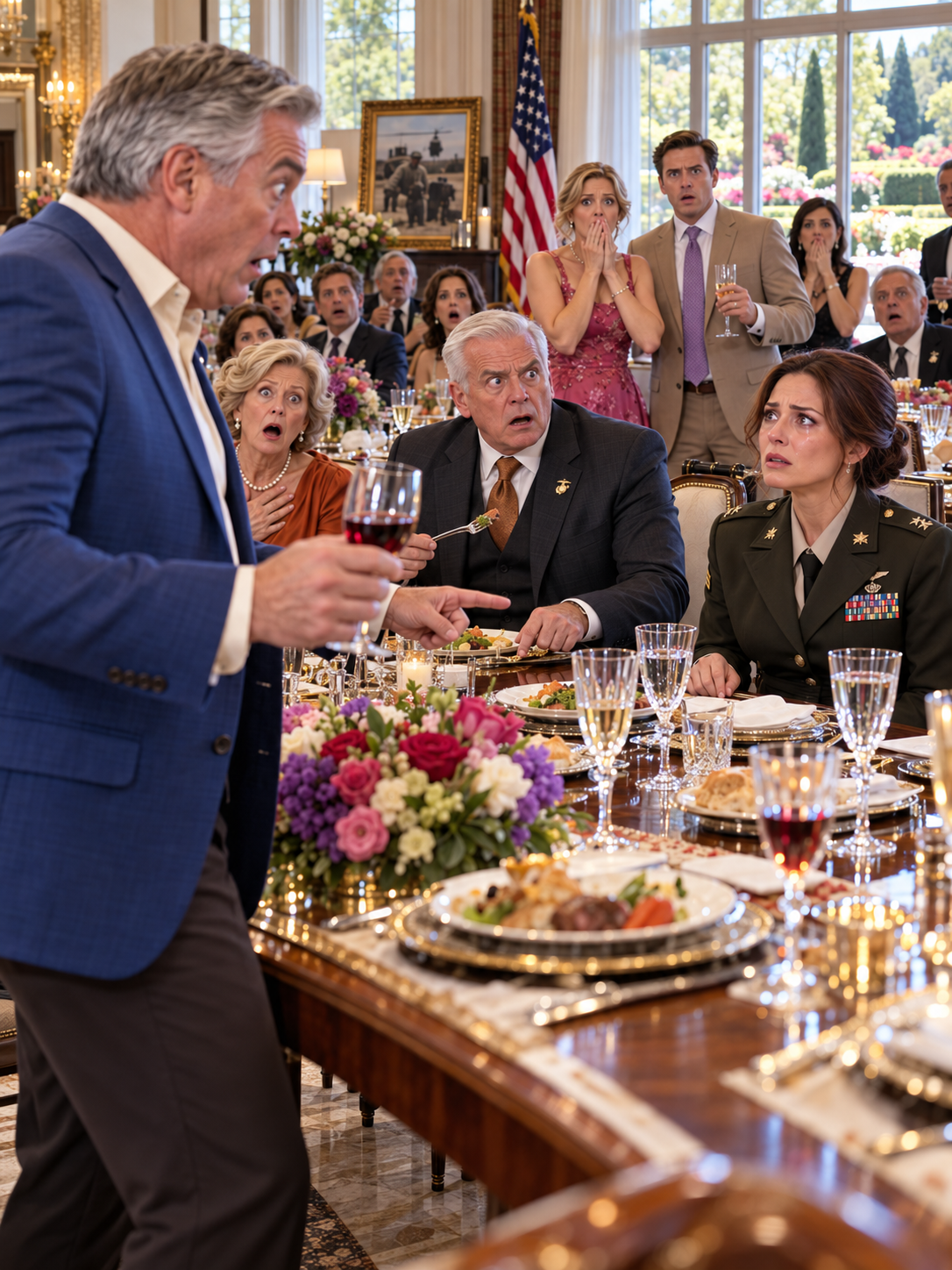
For 13 years, my father told relatives, neighbors, and strangers that Afghanistan had turned me into a cold, humorless woman who had forgotten how to live. I let him tell that story because correcting him would have meant opening memories I had no intention of performing for anyone. Then, during my sister’s engagement dinner, he made the joke again. A retired Marine colonel stopped eating, stared at my uniform, and quietly said, “Wait. I know you.” That was when my father’s version of me began falling apart.
### Part 1
Three hours before Colonel Grant Mercer silenced my father’s dining room, I was driving north through Virginia with my Army service uniform hanging from a hook behind the passenger seat and a paper cup of coffee cooling untouched in the console. My name is Natalie Hayes, I was forty-one years old, and after almost nineteen years in the Army I had become very good at keeping my voice steady while everyone around me lost theirs. That skill had been useful in helicopters, briefing rooms, hospital corridors, and, more often than I liked to admit, inside my parents’ house.
My younger sister, Lauren, was getting married in the spring, and that Saturday was the first formal dinner between our family and her fiancé’s parents. Lauren was thirty-four, quick to laugh, easy to love, and still capable of calling our mother twice in one afternoon without sounding irritated; Owen Mercer, her fiancé, was thirty-seven, thoughtful, patient, and one of the few men I had ever met who could listen to my father repeat the same fishing story without checking the clock. I wanted the evening to go well for Lauren, which was the only reason I had agreed to spend the night at my parents’ brick colonial outside Richmond instead of driving home afterward.
Mom opened the front door before I knocked. “Natalie. Good. You’re early,” she said, hugging me hard enough to wrinkle my cream blouse before stepping back and giving me the inspection she had been giving me since high school. Her eyes moved from my dark slacks to the small gold earrings I had worn because they were the closest thing I owned to festive. “You didn’t bring your uniform?”
“It’s in the car.”
Her face brightened. “Grant was a Marine colonel. I thought it would be nice.”
I almost told her that two people having served in uniform did not require one of them to dress like a centerpiece, but I could already smell rosemary chicken from the kitchen and hear Lauren laughing upstairs. “Fine,” I said, because I had come there for my sister. Ten minutes later I walked downstairs in uniform, and my father looked up from arranging bottles on a side table.
“Well,” Richard Hayes said, grinning, “look who decided to remind us she’s important.”
Lauren’s expression tightened immediately. “Dad.”
“What?” He raised both hands. “I’m kidding.”
Those two words had protected him for most of my adult life. If I ignored the remark, he got to keep making them; if I objected, I became too serious, too sensitive, proof that his joke had been correct in the first place. I had learned years earlier that arguing with my father about his humor was like wrestling smoke, so I adjusted my cuff and asked Lauren where she wanted the extra wineglasses instead.
The Mercers arrived shortly after six. Owen’s mother, Judith, was warm and gracious, carrying a bakery box even though Mom had told everyone she had already made dessert, while Grant Mercer entered behind her with the relaxed posture of someone who had spent decades learning exactly when he did and did not need to occupy a room. He was tall, silver-haired, and broad through the shoulders, but what I noticed first was how carefully he looked at people when they spoke.
Owen introduced us near the foyer. “Dad, this is Lauren’s sister, Natalie.”
Mercer glanced at my insignia and held out his hand. “Major.”
“Colonel.”
“Retired,” he corrected with a slight smile. “You still have to work for a living.”
“That’s what they keep telling me.”
For the first half hour, the evening was almost normal. We talked about wedding traffic, seating arrangements, Lauren and Owen’s search for a house, and Mom’s conviction that the reception band was going to be loud enough to crack glass; my father told two stories about Lauren as a child, Owen embarrassed himself by admitting he had already practiced his vows in the garage, and even I laughed when Judith confessed she had secretly purchased three dresses because she could not choose one.
Then we sat down for dinner.
My father was at the head of the table, which was exactly where he liked to be. Somewhere between the salad and the chicken, Judith asked me, “How long have you been in the Army?”
“Almost nineteen years.”
Dad leaned back with his wineglass. “Natalie was always the serious one. Then Afghanistan finished the job.”
Lauren’s fork stopped halfway to her mouth.
Dad smiled as though he had delivered a line everyone already knew. “She came home from Afghanistan and this is what she turned into.”
Two people laughed softly. Not because it was funny, but because polite people sometimes laugh when they sense that laughter is expected of them.
“Dad,” Lauren said.
“Oh, come on. Natalie knows I’m kidding.”
I lifted my water glass. “I know.”
He took that as permission.
“She used to talk, believe it or not,” he continued. “Now you ask her one question about overseas and she looks at you like you requested launch codes.”
This time nobody laughed.
Across the table, Colonel Mercer stopped eating.
Dad either did not notice or did not care. “She’s been like that since she came home. Quiet, private, always watching everybody. War changes people, I guess.”
I felt Mercer’s eyes move toward me. He studied my face, then my nameplate, then my face again with a concentration that made the back of my neck tighten.
He slowly set down his fork.
“Wait.”
The word was not loud, but it cut through the room.
My father blinked. “What?”
Mercer leaned forward slightly and kept looking at me. “I know you.”
Dad gave a surprised laugh. “You do?”
Mercer ignored him. His expression had changed completely, as if he had opened a door in his memory and found something standing on the other side.
“You never told them what you did in Afghanistan.”
Mom froze with her hand around her water glass. Lauren turned toward me. Owen looked from his father to me as if he had missed an entire conversation.
I kept my voice level. “There were a lot of us there, Colonel.”
Mercer’s eyes softened.
Then he nodded once.
He understood exactly what I meant.
My father did not.
“See?” Dad said with a nervous laugh. “This is what she does. Ask her anything simple and suddenly we’re all in a classified briefing.”
Mercer turned toward him.
“It wasn’t classified.”
My father’s smile disappeared.
Mercer looked at me once more before saying quietly, “And if she never told you, Richard, that was her choice.”
The room changed in a way I could almost feel against my skin. Thirteen years of jokes suddenly sounded very different when nobody was laughing.
Dad shifted in his chair. “What exactly are we talking about?”
Mercer did not answer him immediately. He was still looking at me, and I already knew where his memory had gone because mine had gone there too—to a dark valley, crowded radio traffic, red instrument lights, dust swallowing the landing zone, and voices in my headset that I had spent thirteen years refusing to turn into entertainment.
Then Mercer said, “I commanded Marines involved in that operation.”
My father stared at me.
I did not move.
“Some of my men came home,” Mercer said, “because of what happened that night.”
For the first time all evening, my father had nothing to say.
And for the first time in thirteen years, I realized I was tired of protecting him from the truth he had never cared enough to ask for.
### Part 2
After Mercer spoke, the only sound I noticed was the low hum of Mom’s refrigerator through the doorway and the faint scrape of Lauren’s thumbnail against the stem of her wineglass. Dad kept staring at me as if two versions of his oldest daughter had suddenly appeared in the same chair, the one he had explained to everyone for thirteen years and the woman a retired Marine colonel had just described with unmistakable respect. I lowered my eyes toward my plate because I knew exactly which night Mercer remembered, and I had no desire to watch my family study my face while I returned there.
Afghanistan, 2013. I was twenty-eight and serving my second deployment as a Black Hawk pilot in command, and if there is one thing I have always hated about the way people talk about combat, it is the assumption that extraordinary moments must feel extraordinary while they are happening. Most of the time they feel like exhaustion, checklists, fuel calculations, weather reports, radio calls, sweat trapped under gear, and people doing ordinary jobs under circumstances where an ordinary mistake can cost someone his life.
The mission had begun badly and deteriorated from there. A Marine element working with Afghan partner forces had taken casualties in difficult terrain; the weather was closing in, visibility was poor, and the landing zone had been unpleasant before anyone reported hostile fire nearby. Our aircraft was one of several tasked with supporting the evacuation, and I have always insisted on that detail because memory loves turning complicated events into simple legends, usually with one person standing in the center where dozens actually belonged.
I had a copilot beside me, two crew chiefs behind us, medical personnel ready to receive casualties, another Army crew solving the same problem nearby, and Marines on the ground holding enough space for us to get in and out. Nobody did anything alone that night. I was simply the pilot in command, which meant that when the information stopped being perfect, some of the decisions became mine.
On our first approach, my headset was full of coordinates, casualty numbers, wind reports, terrain warnings, and people talking over one another because everyone had something urgent to say. The aircraft shuddered through turbulence as we descended, and through night vision the ground looked flatter than it was until faint infrared markers appeared ahead of us. One crew chief called movement to our left; my copilot corrected a number I had already seen; we landed hard enough to feel it through our seats.
The doors opened and Marines rushed toward us carrying wounded men. One was conscious, one was not, and the medic moved so quickly over the second man that his knee slammed into a piece of equipment without him seeming to notice. I remember the smell more than anything—fuel, dust, hot metal, sweat, blood—and I remember realizing that somewhere behind me a stranger’s life was being reduced to numbers shouted over engine noise.
We lifted, delivered the wounded to a treatment location, refueled, and received another call.
Same area. More casualties. Worse weather.
Someone higher in the chain asked whether we could still make the landing zone.
I remember looking at my instruments, then the terrain, then listening to my crew. Courage and stupidity sometimes stand close enough together that people watching from far away cannot tell them apart, but inside an aircraft the difference matters; you do not continue because you want somebody to call you brave later, you continue because the risk still has a purpose and the people around you believe the aircraft can perform the job.
My crew chief reported what he could see. My copilot agreed the approach remained workable. The ground element was still holding.
So we went.
Something struck the aircraft during that run.
Not enough to bring us down, but enough to make every person aboard understand how quickly the equation could change. My crew chief called damage, I considered breaking away, and then another transmission came through saying wounded men were waiting below.
I made the final call to continue.
For years afterward, when people who knew pieces of the report spoke about that decision, they sometimes made it sound solitary. It was not. I trusted the people in that aircraft because they had earned my trust, and we trusted the people on the ground because they were giving us the best information they could while fighting to keep that landing zone usable.
We landed.
We loaded casualties.
We lifted.
Later, as part of the wider evacuation effort, we went back again.
By dawn, I was so tired I could barely taste the coffee someone handed me. The floor of the aircraft needed cleaning, one of my crew chiefs had blood on his sleeve that was not his, and nobody stood around congratulating anybody because by then we were too exhausted to manufacture a moment out of what had happened. We sat in gray morning light beside the aircraft, saying almost nothing, wearing the strange expression people get when they were too busy to be afraid during something and only discover afterward that fear had been waiting for them.
A few days later, my commander called me in. Reports needed completing, statements needed verifying, and someone had submitted an award recommendation connected to the mission. Every time somebody praised me, I named my crew, the other aircraft, the medics, the Marines holding the ground, because that was not modesty; it was accuracy.
One of the wounded Marines we carried that night was Gunnery Sergeant Luis Ramirez.
I did not know his name at the time.
To me, he had been a badly injured man under harsh cabin lighting while a medic fought to keep him alive. I learned the name later, just as I eventually learned Colonel Grant Mercer had commanded Marines connected to the operation, and apparently, somewhere along the way, he had learned mine.
When I came home, Dad met me at the airport.
He hugged me so hard that for perhaps ten seconds neither of us spoke. Then, twenty minutes later as we drove toward Richmond, he glanced across the car and asked, “Anything exciting happen over there?”
I remember watching trees pass outside the window and feeling too tired to explain what bothered me about the word exciting.
“Nothing I want to talk about,” I said.
He took it personally.
Over time that one answer became an entire family theory.
Natalie came back different.
Natalie got too serious.
Natalie stopped having fun.
Natalie never talked about Afghanistan because something must have happened to her.
They were right about one thing: many things had happened. What they never understood was that silence was not evidence I was broken; sometimes silence was simply a boundary, and the worst moments of strangers’ lives were not stories I wanted to perform over Thanksgiving dinner.
Back at my parents’ table, Mercer shifted in his chair.
“I remember the date,” he said.
Dad lifted one hand. “Grant, whatever Natalie did thirteen years ago, I’m sure we don’t need to turn dinner into a war story.”
There it was.
The instinct I knew better than any other.
Control the room. Reduce the uncomfortable thing. Turn seriousness into humor before anyone has time to examine it.
For thirteen years I had helped him do exactly that by staying silent.
This time, I looked at Mercer and said nothing.
I did not rescue my father.
Mercer folded his hands in front of him. “Richard, your daughter was one of the people we trusted when things went bad.”
“My crew was,” I corrected.
Mercer nodded immediately. “Her crew was.”
That mattered to me.
Lauren leaned forward, her dinner forgotten. “What happened?”
Mercer answered carefully. He described difficult terrain, deteriorating weather, wounded Marines, Army air crews continuing an evacuation under dangerous conditions, and an aircraft that kept returning when people were still waiting to get out. He never used the word fearless, never called me a hero, and never made me the only person in the story.
Then he looked toward Lauren.
“Natalie was pilot in command of one of those aircraft.”
Mom covered her mouth.
Owen stared at me.
Dad’s face tightened.
Lauren whispered, “Why didn’t you tell us?”
I looked at my sister.
“Because the worst night of somebody else’s life wasn’t mine to turn into a family story.”
Nobody spoke.
Then my father leaned back and said, almost angrily, “How exactly were we supposed to know any of this?”
That question told me the evening was about to become something much bigger than Afghanistan.
### Part 3
“You could have asked,” I said.
Dad’s expression changed as if I had accused him of something ridiculous. “I did ask.”
“No, Dad.”
“I absolutely asked.”
Ordinarily, that would have been where I stopped. My habit had always been to correct only the things that mattered and let the rest float away, because arguing over every distorted memory inside my family would have required a second full-time job. But looking at him across that table, watching him turn thirteen years of indifference into evidence that I had somehow hidden myself from him, made me tired in a way anger never had.
“You asked if I shot anybody,” I said.
His jaw tightened.
“You asked if flying through gunfire was exciting. You asked whether I came home with any good stories.”
Lauren looked down.
Dad’s cheeks reddened. “I was trying to talk to you.”
“You were trying to make the conversation comfortable for yourself.”
“That’s not fair.”
“You never asked what it was like.”
Mom said my name softly. “Natalie.”
I turned toward her. “You didn’t either.”
The words hurt her. I could see that immediately, but truth does not become false because someone wishes you had delivered it more gently.
Dad pushed back slightly from the table. “This is unbelievable. She stores things up for years, says nothing, then suddenly acts like everybody failed some test we didn’t know we were taking.”
Something inside me became very clear.
Even then, he was not asking what he might have missed.
He was asking how my silence made him look.
I slid my chair back.
Lauren’s eyes widened. “Natalie—”
“I’m fine.”
Dad laughed once. “Of course you are.”
That did it.
I stood.
“No, Dad. That’s exactly the problem.”
He looked up at me.
“For thirteen years, every time you didn’t understand me, you invented an explanation. You told people Afghanistan made me cold. You said I came back strange. You joked that I was married to the Army. You decided privacy meant something was wrong with me because that was easier than admitting you didn’t know.”
His face hardened. “I never said something was wrong with you.”
“You didn’t need those exact words.”
“Do we really have to do this in front of everyone?”
I almost laughed.
He had spent thirteen years explaining me in front of everyone, but now that I was speaking for myself, privacy had suddenly become sacred.
“No,” I said. “We don’t.”
I picked up my purse, kissed Mom’s cheek, and turned toward Mercer.
“Colonel.”
He gave a small nod.
“Major.”
No speech. No salute. No performance.
Just respect.
Outside, the evening air felt colder than it had when I arrived. I made it halfway down the driveway before I heard the front door open and Lauren call my name.
She hurried after me without a coat.
“Natalie, wait.”
I stopped beside my car.
Her eyes were wet, and she wiped one cheek impatiently. “I’m sorry.”
“For what?”
“For laughing.”
That answer caught me off guard.
She folded her arms tightly against herself. “All those years when Dad made those jokes, sometimes I laughed too. Or I rolled my eyes like it was harmless. I told myself if it really bothered you, you’d say something.”
“It bothered me.”
“I know that now.”
A long silence stretched between us.
Then Lauren glanced toward the house.
“I think there’s something else you should know.”
My hand was on the car door. “What?”
“Dad talks about you all the time.”
I frowned.
“At veterans events. At church. At the fundraiser he runs every year. He tells people his daughter served in Afghanistan, that our family understands military sacrifice, that supporting veterans is personal for him.”
For a second I thought I had misunderstood her.
“What fundraiser?”
“The Commonwealth Veterans Assistance Benefit. The big one three weeks from now.”
I knew the event. Dad had volunteered with the nonprofit for years, and I had quietly helped him correct military titles, review biographies, verify terminology, locate speakers, and fix the details he routinely promised before checking whether they were possible. He loved the ballroom, the flags, the applause, the donors, and most of all the microphone.
“What exactly does he say about me?”
Lauren’s mouth tightened. “Enough that people think your service is one of the reasons he got involved.”
Something cold moved through me.
At home, Afghanistan was his explanation for why I was difficult.
Outside the house, Afghanistan apparently made him admirable.
I looked back at the lighted windows.
“Did you know?”
“Not how much he used it. Not until recently.”
I left before Dad came outside.
The next morning, I drove south before my parents were awake. Normally I would have left Mom a note on the kitchen counter, texted Lauren, checked whether Dad had calmed down, and performed the quiet administrative work of keeping my family from becoming uncomfortable with itself.
That morning I did none of it.
By Monday afternoon, I was back at work reviewing flight schedules and trying to convince myself the dinner had stayed in Virginia.
It had not.
Mom called once. Lauren texted twice.
Dad remained silent.
That was his normal strategy when embarrassed. He waited until the other person became uncomfortable enough to repair the relationship for him.
I had spent years repairing it.
This time, I left it broken.
Three days later, Lauren texted me a photograph.
At first I thought it was another wedding item. Then I enlarged it and saw the program for the upcoming veterans benefit.
My name was printed beneath the event information.
Major Natalie Hayes, U.S. Army — Special Guest.
Under the words was an old photograph of me taken before a deployment ceremony.
I stared at the screen.
Lauren called immediately.
“You saw it?”
“Yes.”
“I didn’t know he was doing that.”
“Did Dad tell them I agreed to this?”
A pause.
“I think so.”
I closed my office door.
“Natalie, I’m sorry.”
“Stop apologizing for him.”
Lauren went quiet.
That was new.
Usually she would have started explaining Dad before I finished speaking.
Instead she asked, “What are you going to do?”
My first instinct was painfully familiar: fix it quietly. Call Dad, let him claim a misunderstanding, attend for ten minutes, smile for photographs, allow everyone else to keep their dignity while I swallowed mine.
Instead, I called him and asked why my name was on a program for an event I had never agreed to attend.
“It’s not a big deal,” he said.
There it was again.
“I’m listed as a special guest.”
“You usually come.”
“I usually help behind the scenes.”
“After what happened at dinner, I thought this might be a good way to put everything behind us.”
I almost admired the logic.
He had mocked me, discovered other people respected me, and decided the solution was to display me publicly.
“You thought advertising my service without asking me would fix things?”
“Advertising? Natalie, you’re my daughter.”
“That is not permission.”
His voice sharpened. “The tickets are almost sold out.”
“What does that have to do with me?”
Silence.
Then he said, “There was more interest after people heard you might attend.”
I sat very still.
“Take my name off the program.”
“The programs are already printed.”
“Then correct them.”
“You have no idea what that costs.”
“I know exactly what printing costs.”
“You’re being unreasonable.”
“No. I’m being clear.”
Then he said the sentence that ensured I would not change my mind.
“After everything I’ve done to support your career—”
“Dad.”
He stopped.
“Take my name off.”
I ended the call with my hands shaking slightly.
Then, for the first time in my life, I decided I was not going to let my father handle the consequences himself.
I was going to make sure everyone involved knew exactly what he had done.
### Part 4
The nonprofit’s executive director was a woman named Evelyn Price, whom I had met several times over the years while helping Dad correct small mistakes before they reached donors or speakers. I wrote her a short email with no accusations and no history lesson: I had not agreed to appear, speak, serve as an honored guest, endorse promotional material, or have my military service used to advertise the event. I added that I respected their mission, wished the organization success, and wanted the correction handled without turning my family dispute into public entertainment.
Evelyn called less than an hour later.
“Natalie, I’m very sorry.”
“You don’t need to apologize.”
“We were told your attendance was confirmed.”
“I assumed you were.”
A pause followed.
“Was it your father?”
“Yes.”
Her voice became careful. “He told the committee he had spoken with you.”
I looked at the gray afternoon beyond my office window. “He hadn’t.”
“We’ll correct it.”
“Thank you.”
“It may have to be an insert rather than a complete reprint.”
“That’s fine.”
She hesitated. “I also want you to know we would never have used your service record in outreach if we had understood you hadn’t agreed.”
“I know.”
That was enough.
I did not demand that they punish Dad or remove him from the event, because consequences become strangely easy to dismiss when you design them yourself. I wanted the organization to respond to what he had actually done, not to my anger.
Two days later, Lauren called.
“He’s furious.”
“I figured.”
“They removed him as master of ceremonies.”
I closed my eyes.
Lauren continued, “He can stay on the volunteer committee, but Evelyn told him someone else is running the program, and he’s no longer making decisions about speakers or publicity.”
Part of me felt guilty.
A larger part felt relieved.
For once, Dad had involved me in something without asking and had to live with the result without my stepping in to protect him.
That evening, he called.
“Do you have any idea how humiliating this is?”
I listened to him breathe.
Then I said, “Yes.”
He waited, perhaps expecting sympathy.
“I do.”
He ended the call thirty seconds later.
For the first time, I did not apologize for understanding exactly how humiliation felt.
Two days before the fundraiser, my phone rang again. This time the caller was Colonel Mercer.
“Major Hayes.”
“Colonel.”
“I thought you should know something before Saturday.”
His voice was serious enough that I stood from my desk without realizing I had done it.
“What happened?”
“Luis Ramirez heard your name connected to the event.”
The office around me seemed to disappear.
For an instant I was back under red cabin lights with dust in my teeth, hearing a medic call numbers over rotor noise.
Mercer continued.
“He’s coming.”
I gripped the edge of my desk.
I had never met Gunnery Sergeant Ramirez while he was conscious.
Not really.
I knew his name from reports, later correspondence, and fragments passed between units after the operation. I knew he had survived, endured a long recovery, left active service years later, and built a life I had never tried to enter because I had always believed surviving something together did not create ownership over another person.
“Does he know I didn’t agree to be featured?”
“Yes.”
“Does he want some kind of public recognition?”
“No.”
The answer came immediately.
“He said the same thing you did. No scene.”
That helped.
Still, when I hung up, I stood alone in my office for several minutes.
For most of the next day I considered skipping the benefit entirely.
That surprised me.
I had flown into places more dangerous than hotel ballrooms and sat through casualty briefings, memorial services, command reviews, promotion boards, and enough family dinners to qualify as prolonged exposure. Yet the idea of standing face-to-face with a man I remembered only as blood, movement, and urgent numbers unsettled me in ways I could not organize.
Lauren called that evening.
“You’re still going, right?”
“I haven’t decided.”
“Natalie, don’t let Dad decide this for you too.”
That landed.
I leaned against my kitchen counter.
“I’m not worried about Dad.”
“I know.”
She did not tell me what I was feeling or rush to solve it.
Eventually I said, “I’ll go.”
The benefit was held at a hotel conference center outside Richmond. I arrived in civilian clothes deliberately: navy blouse, dark slacks, low heels, no uniform, no ribbons, nothing that could be turned into a performance. Evelyn met me near the entrance and looked relieved to see me.
“Thank you for coming.”
“I’m here as a guest.”
“Absolutely.”
“No announcement.”
“None.”
“No introduction.”
“Understood.”
“No surprise presentation.”
She almost smiled. “I promise.”
Inside, the ballroom was filling with retired service members, spouses, church groups, local donors, business owners, and volunteers moving between round tables set with white linens and small American flags. A silent auction lined one wall, silverware chimed against plates, and the air smelled faintly of coffee and hotel carpet cleaner.
Dad stood near the stage.
He saw me almost immediately.
His expression changed.
Not anger exactly.
Something tighter.
For the first time in years, there was no microphone in his hand. A younger member of the nonprofit board stood at the podium reviewing note cards while Dad remained ten feet away with nothing to control.
We exchanged one nod.
Nothing more.
Mercer arrived with Owen shortly afterward and crossed the room toward me.
“Major.”
“Colonel.”
“Still retired.”
“Still a colonel.”
A faint smile appeared, then vanished.
“Ramirez is here.”
My shoulders tightened.
Mercer noticed. “He doesn’t want a scene.”
“Good.”
“He specifically asked that nobody announce anything.”
“That’s better.”
He looked beyond me.
I followed his gaze.
Near the back of the ballroom stood a man in his mid-fifties speaking with another veteran. He was broad through the shoulders, though age and old injuries had changed the way he carried his weight, and a cane rested beneath his right hand.
I recognized nothing about him.
Then he turned his head.
Something about the angle of his face struck a place in my memory I had spent thirteen years keeping closed.
He saw Mercer.
Then he saw me.
He stopped talking.
The room around us kept moving, but the three of us seemed to stand in a separate pocket of silence.
Ramirez handed his drink to the man beside him.
Then he began walking toward me.
Slowly.
Carefully.
And across the ballroom, I saw my father watching.
### Part 5
When Luis Ramirez reached me, he studied my face for several seconds before saying, “Ma’am.”
His voice was rougher than I expected.
“I’ve wanted to shake your hand for thirteen years.”
I held mine out. “Then you owe a few other people handshakes too.”
A smile pulled briefly at his mouth. “Already working through the list.”
That broke something inside me, not dramatically, but enough that I smiled back.
His grip was firm.
For several seconds neither of us spoke.
Then he said, “I don’t remember much from the flight.”
“You probably weren’t supposed to.”
“I remember noise.”
“That sounds right.”
“Somebody leaning over me yelling numbers.”
“Also sounds right.”
He looked down for a moment. “Then I remember waking up later and everybody telling me how close it was.”
There are sentences for which military training provides absolutely no useful response.
So I told him the only thing that felt true.
“I’m glad you made it.”
He looked back at me.
“So am I.”
No one applauded.
No photographer appeared.
No crowd gathered.
It was better that way.
We talked for several minutes about the crew. One had retired. Another was still flying. A medic who had worked that mission had eventually gone into nursing. Ramirez listened carefully, asking about them rather than himself.
Then he said, “People kept telling me somebody kept coming back.”
“We all kept coming back.”
He nodded.
No argument.
Just understanding.
Across the ballroom, Dad was still watching.
He was too far away to hear the conversation, but he could see Ramirez’s face and the way Mercer stood beside us. He could see respect without anyone needing to announce it from a stage, and I wondered whether that was the first time he understood how little his version of my life had ever required my participation.
Later, during dinner, I got up for coffee.
Ramirez found Dad before I returned to my table.
I did not hear the beginning of their conversation. I only came close enough to hear Ramirez ask, “You really didn’t know?”
Dad shook his head.
“No.”
Ramirez studied him.
Then he said quietly, “She never owed anybody that story.”
Dad lowered his eyes.
“But you probably owed her the courtesy of not inventing one for her.”
Ramirez walked away.
Dad stood alone beside the coffee station with one hand resting against the table.
For the first time in my memory, he had no microphone, no punch line, and no way to decide how another person interpreted him.
I took my coffee and returned to my seat without speaking to him.
When the formal program began, Evelyn thanked the volunteers from the stage. Dad’s name was mentioned, and he received polite applause, but someone else ran the evening he had expected to command. He sat in the audience while another man introduced speakers, handled transitions, told the stories, and closed the event.
Dad had spent years believing control of the microphone meant control of the room.
That night he learned the room continued perfectly well without him.
When the program ended, I found him near the registration table holding one of the corrected programs. The place where my name had once appeared as a special guest was gone.
He looked at the paper.
Then at me.
“I think I’ve been telling people the wrong story about you for thirteen years.”
I held his gaze.
“You’ve been telling it to me too.”
His mouth tightened.
For one second I thought he might apologize.
Instead he said, “You could have handled this differently.”
There it was.
Even after everything.
“What differently?”
“You went around me. You contacted Evelyn without giving me a chance to fix it.”
“I asked you to take my name off.”
“You knew what it would do to me here.”
“No, Dad. I knew what you had done to me here.”
His eyes flicked toward several nearby guests.
“Can we not do this in public?”
I almost smiled at the repetition.
“You used my military service publicly. You confirmed my attendance publicly. You advertised me publicly. Now you want privacy because the consequences are yours.”
“I was trying to help veterans.”
“And that does not make my consent optional.”
He stared at me.
Behind him, volunteers folded table signs and gathered programs. The ballroom was emptying, chairs scraping lightly across carpet as staff cleared glasses.
Dad lowered his voice. “I’m your father.”
“I know.”
“I was proud of you.”
“No.”
His face changed.
“You were proud of having a daughter who served. That’s different from being proud of me.”
“That is ridiculous.”
“Is it?”
He said nothing.
“At home, Afghanistan was the reason I was difficult. Outside this house, it was the reason people should admire you.”
“I never said that.”
“You didn’t have to.”
For once, I did not explain further.
I simply picked up my coat.
Dad watched me put it on.
“You’re really going to walk away over this?”
The question surprised me because it revealed how small he still believed the problem was.
“No,” I said. “I’m walking away from the arrangement we had.”
“What arrangement?”
“The one where you decide what I mean, what I’ll tolerate, what I’ll fix, and what parts of my life you’re allowed to use.”
He stared at me.
“That arrangement is over.”
I walked toward the exit.
Outside the ballroom, Lauren was waiting with Owen. She must have seen my face because she did not ask what Dad had said.
Instead she handed me my purse, which I had left at the table.
“You okay?”
“Yes.”
She looked toward the ballroom doors.
“Do you want me to talk to him?”
“No.”
“Mom?”
“No.”
Lauren nodded.
For years, my family had treated every conflict with Dad like a small fire that had to be smothered before he became uncomfortable.
That night I decided to let it burn out on its own.
Three days later, he called.
I watched his name appear on my phone and let it ring until voicemail.
He called again the next morning.
I did not answer.
Then Mom called.
“Natalie, your father wants to come see you.”
“That doesn’t mean I have to see him.”
“He wants to apologize.”
“He knows my address.”
Mom was silent.
“Natalie, please.”
That word used to work on me.
Please meant do this because your father will not.
Please meant accept half an apology so Thanksgiving remains comfortable.
Please meant be the reasonable one.
“I’m not arranging his apology for him, Mom.”
The following Saturday, a dark sedan pulled into my driveway just after two.
Dad got out alone.
No mother.
No Lauren.
No audience.
For the first time in my life, he had come to me without someone else softening the ground in front of him.
I let him inside.
And when he sat at my kitchen table, I knew within five minutes that his apology was going to cost him far more than he had expected.
### Part 6
Dad looked around my kitchen as if he had never really noticed my house before. It was not large, but it was mine: clean counters, a row of mismatched coffee mugs, two framed photographs on a shelf near the breakfast nook, one from flight school and another showing my old crew standing beside an aircraft under a washed-out overseas sky. His eyes stayed on the second photograph longer than anything else in the room.
“Is that them?”
“Yes.”
He nodded.
I poured coffee and sat across from him.
For a while neither of us spoke.
Then he began exactly where I expected.
“I was scared when you deployed.”
I waited.
“I don’t think you ever understood that.”
“That may be true.”
“You came home different.”
There it was again.
The same sentence, only this time without the joke.
“You were quieter. You didn’t want to talk. Your mother and I had no idea what happened.”
I let him continue.
“I tried to get you to open up.”
“No, Dad.”
He frowned. “I did.”
“You tried to get me to talk in ways that were comfortable for you. That isn’t the same thing.”
He leaned back. “You shut us out.”
I felt something in me become perfectly still.
“You keep describing what I did wrong so you don’t have to examine what you did.”
“That’s unfair.”
“No. It’s uncomfortable.”
His eyes narrowed.
“When you didn’t understand me, you labeled me. When I didn’t tell you stories about Afghanistan, you decided I was cold, strange, humorless, damaged by it.”
“I never said damaged.”
“You didn’t need to.”
“You were changed.”
“Yes.”
The answer stopped him.
I leaned forward.
“Of course I was changed. I was twenty-eight. I had spent months operating in places where small decisions mattered in ways most people never have to experience. I watched medics work on men whose names I didn’t know. I lost people. I came home and discovered ordinary life had continued perfectly well while mine had become something I couldn’t explain over dinner.”
His face softened.
“Why didn’t you ever tell me that?”
“Because I did not owe you every detail.”
His eyes dropped.
“But you did owe me respect.”
The refrigerator hummed behind us.
Dad rubbed his palms together.
“You know what hurt the most?” I asked.
He shook his head.
“You made jokes at home about what the Army had done to me while telling strangers that having a daughter who served gave you some special connection to sacrifice.”
“I was proud.”
“No. You liked the story.”
His head lifted.
“You liked saying your daughter was in Afghanistan. You liked what it said about you. But when the actual daughter came home and didn’t behave the way you expected, you made that into another story too.”
“That’s not how I saw it.”
“I know.”
The answer seemed to surprise him.
“That is exactly the problem.”
He looked toward the crew photograph.
For a long moment, neither of us spoke.
Then Dad said something I had never heard him admit.
“I didn’t know how to fit your life into mine.”
I said nothing.
“Lauren made sense to me,” he continued. “School, regular job, marriage, house. Things I understood. You kept choosing things I knew nothing about.”
“So you made them smaller.”
His mouth twisted.
“Yes.”
The word came so quietly I almost missed it.
“If I made jokes about it, I didn’t have to admit I was out of my depth.”
That was probably the most honest thing he had ever told me.
Then he looked at me.
“I’m sorry.”
I waited.
He swallowed.
“I’m sorry I made your silence about me.”
That was better.
“And I’m sorry I used your service at that fundraiser without asking you.”
I nodded once.
He seemed relieved too quickly.
Then I said, “I believe you mean that.”
His shoulders lowered.
“But things don’t go back to normal.”
The relief disappeared.
“What does that mean?”
“It means I am done repairing your mistakes.”
“I don’t ask you to repair everything.”
I gave him a look.
He started to object and then stopped.
“That fundraiser would have fallen apart three years ago if I hadn’t fixed the speaker list,” I said. “When you didn’t understand somebody’s military title, you called me. When you promised a veteran’s biography before you checked details, I fixed it. When someone canceled, I helped you find a replacement. When you embarrassed Mom, she called me so I could translate what you ‘really meant.’ When you fought with Lauren, I explained you to her.”
Dad stared at his coffee.
“That arrangement is over.”
He was quiet.
“If we have any relationship after this, you don’t get the old version of me back.”
“What old version?”
“The one who carried everything quietly while you decided what my quiet meant.”
That hurt him.
I could see it.
But pain was not always cruelty. Sometimes it was simply what understanding cost when it arrived years late.
He stayed another twenty minutes.
At the door, he turned toward me.
I expected a question about Afghanistan, Ramirez, medals, or the mission.
He asked none of them.
“What do you need from me right now?”
I thought about it.
“Space.”
His face fell.
“How much?”
“I don’t know.”
“Natalie—”
“I said I believe your apology. I didn’t say it repaired thirteen years.”
He nodded slowly.
“Okay.”
Then he left.
For the next six weeks, we barely spoke.
Mom struggled with it more than Dad did. She called twice trying to convince me that family relationships needed “grace,” and both times I told her grace did not require pretending nothing had happened. Lauren, to her credit, stopped mediating entirely.
That mattered.
When Dad sent me a birthday text, I answered, “Thank you.”
When he called once to ask how work was going, I talked for ten minutes and ended the conversation when I wanted to.
He never mentioned Afghanistan.
He also never asked me to help with the veterans nonprofit again.
The strange thing about boundaries is that once they stop being theoretical, you discover how much of a relationship was built around your willingness not to have them.
Three months after the dinner, Lauren’s wedding arrived.
She called me two weeks beforehand.
“I want to ask you something, and you can say no.”
“All right.”
“Would you wear your uniform?”
I was silent.
She rushed to add, “Not because of Dad. Not because of Owen’s family. Not for photographs. You’ve spent almost half your life in the Army, and I want you there as yourself.”
I looked at the uniform hanging in my bedroom closet.
“Okay.”
The wedding morning was bright and warm. Mom cried when she saw me. Lauren cried harder and ruined the makeup someone had spent forty minutes applying.
Dad looked at me from across the bridal suite hallway.
For a second I braced for an old joke.
Instead he said, “You look good, kiddo.”
“Thanks.”
Nothing else.
That tiny absence of humor told me more than another apology would have.
Colonel Mercer found me before the ceremony.
“Major.”
“Colonel.”
“Still retired.”
“Still a colonel.”
He smiled.
The ceremony itself was wonderfully ordinary. Lauren cried through half her vows, Owen nearly dropped the ring, Mom laughed too loudly, and for forty minutes nobody cared about Afghanistan, family arguments, military rank, or who had been wrong.
At the reception, Mercer gave a toast about marriage.
He never mentioned me.
But near the end he said, “Familiarity is not the same thing as understanding. Some of the most important things about people we love are the things they never put into words.”
Across the room, Dad looked toward me.
I looked back.
Neither of us smiled.
Later, standing near the bar, I heard him speaking to an older couple I did not recognize.
He saw me approaching.
“This is my daughter, Natalie.”
I waited for the old line.
“She’s an Army officer.”
Then he paused.
“I spent a long time thinking I knew her better than I did.”
The couple nodded politely.
They probably had no idea what the sentence cost him.
I did.
But what happened an hour later made me realize Dad’s apology was not the final decision I had to make.
It was only the first.
### Part 7
The reception had thinned by the time Dad found me outside. Music from the ballroom drifted through open doors in muffled waves, and the courtyard smelled like damp stone, flowers, and the faint sweetness of wedding cake someone had carried past us minutes earlier. I was sitting alone on a low wall when he approached, and instead of sitting immediately, he asked, “Mind if I join you?”
That was new too.
“Go ahead.”
He sat a few feet away.
For a while we watched guests move through the warm rectangles of light spilling from the reception hall.
Then he said, “Is there anything about Afghanistan you want me to understand?”
My body stiffened before I could stop it.
He noticed.
“Not what happened,” he added quickly. “Not what you did. Not how many people you helped. I mean… is there anything you want me to understand?”
I looked toward the dark lawn.
Years earlier, that question might have opened something.
Now it mostly showed me how much time had passed.
I told him about a morning after a long night of flying. Not the evacuation. Not Ramirez. Not the blood on the floor.
I told him about terrible coffee.
“One of my crew chiefs blamed the medic,” I said. “The medic blamed me. I blamed whoever bought the coffee. We got laughing so hard somebody almost spilled the whole pot.”
Dad smiled faintly.
“That’s what you remember?”
“One of the things.”
He nodded.
He did not ask for more.
That mattered.
But it did not erase anything.
When the wedding ended, I drove back to North Carolina alone. On the highway, surrounded by darkness and the soft blue glow of the dashboard, I realized something I had resisted admitting: Dad had changed, but I had changed too, and my change did not involve wanting the relationship we might have had if he had understood me thirteen years earlier.
There are apologies that rebuild things.
There are apologies that simply allow you to stop being angry.
Those are not the same gift.
Over the following months, Dad behaved better.
He stopped making jokes about me at family gatherings. When relatives asked questions about Afghanistan, he no longer answered for me. Once, during Thanksgiving, a cousin said, “Natalie never tells us anything,” and Dad surprised everyone by saying, “Then I guess it’s hers to keep.”
I appreciated that.
I did not reward it with access he had not earned.
That distinction became important.
Mom occasionally acted as if Dad’s improvement meant I should resume calling every Sunday, visiting more often, helping with his volunteer work, and behaving as though the difficult years were now closed. I refused.
“Natalie, how long does he have to pay for it?” she asked me once.
“I’m not punishing him.”
“It looks like punishment.”
“That’s because you’re used to my closeness being automatic.”
She went quiet.
“I don’t hate Dad. I don’t want revenge. But an apology does not obligate me to return to a relationship that exhausted me.”
Mom sighed.
“Family should matter.”
“It does. That’s why this mattered.”
After that, she stopped pushing as often.
Lauren understood first.
One Sunday afternoon she drove down to see me alone, carrying two coffees and no agenda. We sat on my porch while a summer storm gathered beyond the trees.
“I used to think forgiving someone meant making everything normal again,” she said.
“I did too.”
“You don’t anymore?”
“No.”
She looked down at her cup.
“I’m still sorry I laughed.”
“I know.”
“I keep thinking about how easy it was. Dad would make some comment, everybody laughed, and we got to feel like you were the weird one instead of asking whether the joke was cruel.”
I looked at her.
“That probably happened more than either of us remembers.”
She winced.
“Does that mean you don’t trust me?”
“Not the way I used to.”
Her eyes came up.
I had no interest in hurting her, but I had even less interest in lying.
“I love you, Lauren. You’re my sister. But yes, it changed things.”
She nodded slowly.
“Okay.”
No argument.
No demand for immediate forgiveness.
That response did more for us than all her earlier apologies combined.
Our relationship eventually became closer, not because I forgot, but because she stopped asking me to forget.
Dad and I remained different.
He sent messages. I answered some.
We had lunch occasionally. I left when conversations drifted toward old patterns.
He never regained the privilege of assuming I would organize his life, interpret his feelings, or protect him from embarrassment.
Then, almost a year after the engagement dinner, Evelyn Price contacted me.
The veterans nonprofit was hosting a smaller event honoring medical evacuation crews and ground personnel who had served in several conflicts. She made it clear she was not asking me to speak.
“Luis Ramirez suggested something,” she said.
I smiled despite myself.
“That sounds dangerous.”
She laughed. “He wants several people from the 2013 operation invited together. Not honored individually. Just invited.”
My first response was hesitation.
Then Evelyn said, “Your old crew chief, Aaron Pike, already said yes.”
I sat upright.
I had not seen Aaron in four years.
“Who else?”
She read several names.
Some I knew immediately.
Others I knew only from reports.
For the first time, the event did not feel like someone trying to extract a dramatic story from me. It sounded like a room full of people who understood that no single person owned what had happened.
“I’ll come,” I said.
The gathering was held in a modest banquet room without a stage.
That alone made me like it.
Aaron saw me first.
“Look who finally learned how to show up somewhere without a helicopter.”
I hugged him so hard his glasses shifted.
Ramirez arrived with his wife. Mercer came later. Several former Marines stood around a table arguing over details of the weather thirteen years earlier as though the entire night could be settled by enough coffee.
I laughed more that afternoon than I had at any military event in years.
Then I looked toward the door.
Dad was standing there.
My stomach tightened.
For one sharp second I assumed he had ignored my boundaries and come looking for another piece of my life.
Then Evelyn crossed the room and greeted him.
I realized she had invited him separately as a longtime volunteer.
He had not known I would be there.
Dad saw me.
He stopped.
Then, instead of coming over, he gave me a small nod and moved to another table.
That should have been the end of it.
But later, as I stood with Aaron and Ramirez, I heard a donor ask Dad, “Isn’t your daughter one of the people from that mission?”
Dad glanced toward me.
For years, that question would have been an invitation he could not resist.
Instead he said, “You’d have to ask her.”
The donor turned toward me.
Dad walked away.
I watched him go.
And that was the moment I finally understood something I had been avoiding: my father might genuinely have learned the lesson.
But learning the lesson did not mean I owed him the ending he wanted.
### Part 8
After the event, Dad caught me near the parking lot.
He stopped several feet away.
“I didn’t know you’d be here.”
“I figured.”
“I almost left when I saw you.”
“Why?”
“I didn’t want you thinking I followed you.”
That answer would have been impossible for the man he had been a year earlier.
I nodded.
“Thanks.”
He slid his hands into his coat pockets.
“I heard you laughing in there.”
I waited.
“You sounded happy.”
“I was.”
He gave a small smile.
“I’m glad.”
Then he looked toward the building.
“I used to think I wanted you to tell me what happened over there.”
I said nothing.
“I don’t anymore.”
That surprised me.
“What changed?”
He considered the question.
“I think I wanted the story because I thought understanding the story would let me understand you. Then I realized I had plenty of chances to understand you without it.”
The parking lot lights reflected faintly on wet pavement from an earlier rain.
Dad continued.
“I missed them.”
“Yes.”
“I know.”
For the first time, his admission did not make me angry.
It simply felt true.
He took a breath.
“I also know you’re never going to trust me the way you used to.”
“No.”
His face tightened slightly, but he nodded.
“And I know saying I’m sorry doesn’t require you to.”
“No.”
He looked at me.
“Do you forgive me?”
There it was.
The question everyone around us had been circling for almost a year.
Mom wanted forgiveness because she believed it would restore family peace. Dad wanted it, I suspected, because he needed to know whether becoming better could somehow erase being worse. Lauren had learned not to ask.
I thought about the engagement dinner.
The laughter.
The fundraiser program.
Thirteen years of hearing my privacy described as damage.
Then I thought about the man standing in front of me now, who had stopped answering questions that belonged to me and had finally learned to leave some doors closed.
“I’m not angry the way I was,” I said.
His eyes stayed on mine.
“But if you mean, ‘Do I forgive you so we can become what we used to be?’ No.”
He swallowed.
“I see.”
“What we used to be worked mostly because I absorbed things you didn’t want to examine.”
He looked down.
“I don’t want that relationship back.”
A long silence followed.
Then Dad nodded.
“Okay.”
No defense.
No accusation.
No appeal to family.
Just okay.
Strangely, that was the moment I respected him most.
People sometimes imagine boundaries as walls built from anger. Mine were not. Mine had doors, but I decided when they opened, how long someone stayed, and what they were allowed to carry through them.
Dad and I never returned to weekly phone calls.
I did not resume helping with his volunteer commitments.
He stopped using my service in speeches, introductions, fundraising materials, or stories.
When someone asked about me, he learned to say, “Ask Natalie.”
Sometimes we had lunch.
Sometimes months passed without seeing each other.
I was no longer trying to punish him, and I was no longer trying to make him comfortable.
That left us with something smaller than the relationship he wanted and more honest than the one we had.
Mom eventually stopped campaigning for reconciliation.
Lauren and I became close again slowly, through actions rather than speeches. She called when she wanted to talk, not when Dad wanted information, and when her first anniversary came around she invited me to dinner without inviting our parents merely because she assumed family events had to include everyone.
As for Afghanistan, I never told my family the entire story.
I never described every wounded man, every approach, every voice on the radio, every decision, or every memory that still returned unexpectedly when a certain smell or sound reached the wrong corner of my mind.
Some memories belonged to the people who had been there.
Some belonged to me.
Luis Ramirez understood that better than almost anyone.
We became occasional friends, the kind who exchanged messages on holidays and met for coffee when geography happened to cooperate. He never called me his hero, and I never called him a man I had saved.
Once, when someone at a gathering asked how we knew each other, Ramirez smiled and said, “Long flight.”
I nearly choked on my coffee.
Aaron Pike laughed for thirty seconds.
That was the version of the story I could live with.
Years earlier, Dad had asked whether anything exciting had happened in Afghanistan.
I used to think the mistake was the question itself.
Eventually I understood the deeper problem: he had asked for a story before asking who I had become.
Colonel Grant Mercer changed my family without trying to.
At one dinner table, he had looked at my nameplate, remembered an operation thirteen years earlier, and interrupted a joke my father had been telling for so long that everyone had mistaken repetition for truth.
“Wait. I know you.”
Those four words did not reveal some secret hero my family had failed to appreciate.
That was never the point.
They revealed that my father had spent years speaking confidently about a life he had never bothered to understand.
The hardest part was not exposing him.
It was recognizing how often I had helped him preserve that illusion.
I had smiled.
I had ignored the jokes.
I had fixed the fundraisers.
I had translated his intentions.
I had protected everyone else from discomfort and then wondered why nobody protected me.
I stopped.
That was the real change.
A year and a half after Lauren’s wedding, I was promoted. The ceremony was small, attended by people I actually wanted there.
Lauren came with Owen.
Mom attended.
Dad did not.
Not because we were fighting.
Because I had not invited him.
That decision would once have filled me with guilt.
Instead, when Lauren asked quietly whether I was sure, I said, “Yes.”
She nodded.
Nothing more.
Afterward, my old crew chief Aaron slapped my shoulder, Ramirez sent a message containing exactly three words—“About damn time”—and Mercer called to congratulate me.
When everyone had gone, I stood alone for a moment in the quiet hallway outside the ceremony room.
Sunlight came through tall windows and fell across the polished floor.
For most of my adult life, people had mistaken my silence for sadness, damage, resentment, mystery, arrogance, or distance.
It was none of those things.
Sometimes silence was simply the place where I kept what belonged to me.
Afghanistan changed me.
My father had been right about that much.
What he never understood was that change is not the same thing as damage. Privacy is not shame. Quiet is not emptiness, and loving someone does not give you ownership of the experiences that made them who they are.
My father spent thirteen years explaining me to other people.
Then one retired Marine colonel recognized me, and suddenly Dad was forced to see how little of me he had ever known.
He eventually learned how to listen.
I learned something harder.
I learned that someone changing does not require me to restore their old place in my life.
His apology belonged to him.
My boundaries belonged to me.
And for the first time in years, I no longer needed him to understand that for it to be true.
THE END!
Disclaimer: Our stories are inspired by real-life events but are carefully rewritten for entertainment. Any resemblance to actual people or situations is purely coincidental.


