
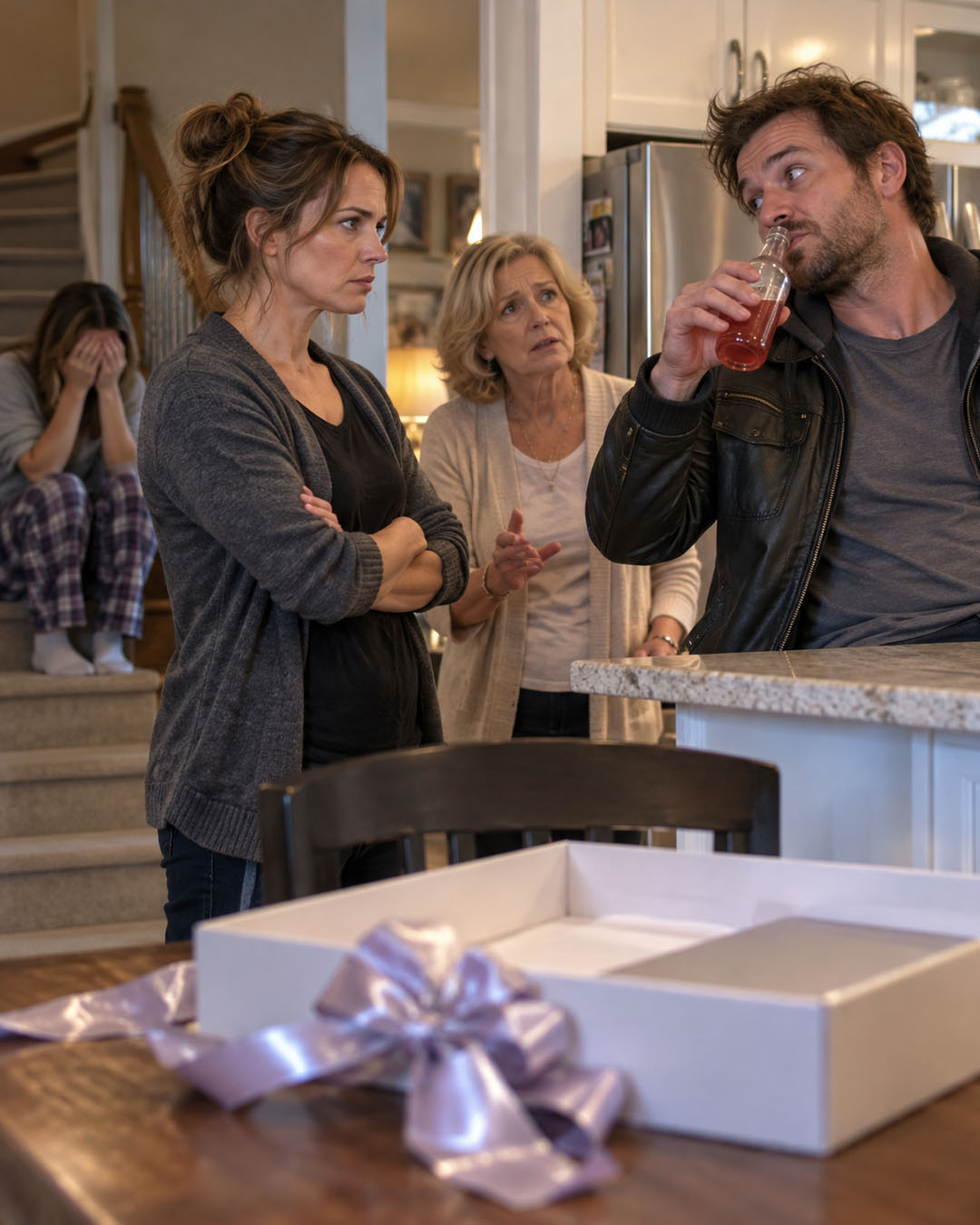
Chapter 2
The pawn shop sat between a check-cashing business and a convenience store under harsh yellow lights.
Maya held my hand as we walked inside. Officer Ramirez was already waiting near the counter, calm and professional, with a small notebook in one hand.
She reviewed the video.
Then the receipt.
Then the serial number.
The shop manager brought out the laptop.
When Maya saw the lavender case, she began crying.
Not loudly.
She simply pressed her lips together and stared at it as though someone had returned a missing pet.
Brian arrived twenty minutes later.
Mom came with him.
Officer Ramirez stepped forward.
“Mr. Riley, did you remove this laptop from your sister’s residence?”
Brian looked at Mom.
Then me.
Then Maya.
“I was going to return it.”
“That isn’t what I asked.”
He swallowed.
“Yes.”
“Did you have permission?”
“I’m family.”
“Did you have permission?”
His shoulders dropped.
“No.”
Maya looked at the floor.
I hated that she had to hear it.
But she also needed to hear it.
For once, the truth was not being softened to protect Brian.
The laptop eventually came back to us, while Brian was taken through the formal process connected to the theft report and pawn transaction.
Mom cried in the police-station hallway.
Then she turned on me.
“What you did tonight is unforgivable.”
I stepped slightly in front of Maya.
“What Brian did was wrong. What you did was tell a crying child that her uncle’s rent mattered more than what he stole from her.”
“He needed help.”
“So did she.”
“He could end up with a criminal record.”
“He made that decision when he took the laptop.”
“You always have to be dramatic.”
I nodded.
Then I used the sweetest voice from a cartoon teacup I once played.
“And today’s episode is called Brian the Borrowing Bear Meets Consequences.”
Maya made a tiny snorting sound behind me.
Mom looked horrified.
I didn’t care.
At home, Maya put the laptop on her desk but didn’t open it.
I stood in her doorway.
“Want company?”
She shook her head.
Then nodded.
I sat on the floor beside her.
After a few seconds, she whispered, “I feel stupid.”
My heart broke.
“Why?”
“Because I trusted him.”
I pulled her against me.
“Trusting somebody you love does not make you stupid.”
“He was supposed to be safe.”
“I know.”
She was quiet.
Then she asked, “Why didn’t Grandma care?”
There were easier answers.
Grandma was scared.
Grandma loves everyone.
Grandma didn’t understand.
But easy answers were part of what had created Brian.
So I told her the truth.
“Grandma cared more about protecting him from consequences tonight than protecting you. That was wrong.”
Maya cried against my shoulder.
I held her tighter.
“That will never happen in this house again.”
The next morning, my phone showed dozens of missed calls and messages.
Mom began gently.
Please call me. We have to fix this.
Then came guilt.
Brian is terrified.
Then manipulation.
Your father would be ashamed of what you’re doing to this family.
My father was very much alive. He simply avoided conflict with such dedication that sometimes people forgot he was involved.
Finally came anger.
You are not the daughter I raised.
I stared at that message.
For once, Mom was right.
I was not.
She had raised a daughter who kept everyone comfortable.
A daughter who paid.
A daughter who laughed.
A daughter who converted pain into jokes so nobody else had to feel guilty.
That daughter had disappeared somewhere between the empty laptop box and Officer Ramirez asking Brian whether he had permission.
I sent one reply.
Do not contact Maya. Do not come to my house. Brian is no longer allowed on my property. The spare key is no longer valid.
Then I changed every lock.
I removed the old keypad code.
I notified Maya’s school counselor that there had been a family incident and she might need support.
Then we ordered pizza and watched a terrible movie about a haunted summer camp.
Halfway through it, Maya paused the television.
“Mom?”
“Yeah?”
“Can we make a new family rule?”
“Sure.”
“If someone says, ‘Family helps family,’ they have to explain who is helping who.”
I laughed so hard I started crying.
“So adopted.”
The legal process moved more quietly than television would have you believe.
There were hearings, paperwork, interviews, and attorneys.
Brian told relatives that I had called police over a misunderstanding.
Mom became his unofficial public-relations department.
According to her, the laptop had already been returned, so continuing the case was cruel.
Then my aunt Linda called.
She was Mom’s older sister and one of the few people in the family who had never been especially impressed by Brian’s excuses.
“Did he take the laptop?”
“Yes.”
“Without permission?”
“Yes.”
“Pawn it?”
“Yes.”
“Do you have video?”
“Yes.”
“Good.”
I blinked.
“Good?”
“Your mother told me he borrowed it.”
I almost laughed.
Aunt Linda continued.
“Borrowing generally does not involve a pawn shop.”
Then her voice changed.
“Hope, he stole my debit card two years ago.”
I sat down.
“What?”
“He took it from my purse. Spent $640.”
“Why didn’t I know?”
“Your mother begged me not to tell anyone. Said he was ashamed and would repay me.”
“Did he?”
“No.”
My chest tightened.
Maya wasn’t Brian’s first victim.
She was simply the youngest person we had finally refused to silence.
Chapter 3
Two weeks later, Mom appeared on my porch carrying a casserole.
I saw her through the security camera before opening the door.
I kept the chain latched.
Her eyes immediately dropped to it.
“You put that on because of me?”
“Yes.”
She flinched.
For one dangerous second, guilt almost made me remove it.
Then I remembered Maya’s face.
“I brought dinner.”
“We already have dinner.”
“Hope, please.”
I waited.
“Brian’s hearing is next week.”
“I know.”
“He wants to apologize.”
“Then he can tell his attorney that.”
“He’s embarrassed.”
“Maya is hurt.”
Mom tightened her grip on the casserole dish.
“He could have a record for the rest of his life.”
“That is not something Maya caused.”
“He’s your brother.”
“She is my child.”
We stared at each other through six inches of open doorway.
Then Mom said it.
“Maya would have gotten over it.”
Everything inside me became very still.
“That sentence,” I said quietly, “is why you are not allowed around her right now.”
I closed the door.
My hands were shaking when I went back to the kitchen.
Maya appeared in the hallway.
“Was that Grandma?”
“Yes.”
“Did you let her in?”
“No.”
She nodded.
Then, so softly I almost missed it, she said, “Thank you.”
That was when I knew.
Not at the pawn shop.
Not at the police station.
Not when Aunt Linda confirmed that Brian had done this before.
My daughter thanked me because I had kept a door closed.
Whatever guilt I carried after that belonged to me, not to her.
At the hearing, Brian wore a wrinkled button-down shirt and sat beside his attorney.
Mom sat behind him.
Dad sat beside her, silent.
Maya chose not to attend.
I was proud of her.
Brian’s attorney described financial stress, a temporary lapse in judgment, and the fact that the laptop had been recovered.
Then the facts were presented.
Unauthorized entry.
Property belonging to a minor.
Pawn transaction.
Security footage.
Serial numbers.
Brian stopped looking at me.
The court ultimately imposed probation, community service, counseling, restitution-related obligations, and restrictions on contacting Maya without my approval.
Outside, Brian approached me.
“Hope.”
I stopped.
“I’m sorry.”
“For what?”
His jaw tightened.
“For taking the laptop.”
“And?”
“For pawning it.”
“And?”
He looked back at Mom.
Then sighed.
“For hurting Maya.”
The words were technically correct.
The feeling behind them was harder to find.
“I’ll tell her you said that.”
“That’s it?”
“What else do you want?”
“I want you to stop treating me like I’m some kind of monster.”
I looked at my brother.
Then I used my soft baby-lamb voice.
“Oh no. Brian the Borrowing Bear doesn’t like consequences.”
His face reddened.
“Seriously?”
I dropped the voice.
“Completely.”
Mom rushed toward us.
“Hope, enough.”
I turned.
“No, Mom. Enough happened years ago.”
Her mouth opened.
“Aunt Linda’s debit card. Dad’s missing tools. The emergency cash I supposedly misplaced five years ago.”
Mom froze.
So did Dad.
Brian looked at her.
I continued.
“Every time he did something wrong, you gave him a softer place to land. You didn’t help him. You taught him that other people would pay.”
Dad finally spoke.
“Hope, maybe this isn’t the place.”
I laughed once.
“Of course not. There has never been a place for uncomfortable truth in this family.”
Then I walked away.
The weeks afterward were not easy.
Boundaries don’t magically erase love.
I missed Mom.
I remembered Brian at eight years old following me around the backyard.
I remembered tying his shoes when he was little and taking him for ice cream after he got stitches in his chin.
That was the hardest part.
People who hurt us are rarely strangers in black hats.
Sometimes they are children we once loved before they grew into adults who discovered that love could be used like credit.
Maya changed too.
She began backing up every file in three places.
Then she asked me for a lock on her bedroom door.
I cried privately after she asked.
Then I installed it.
Her drawings became darker for a while.
June the astronaut looked angrier.
The stardust-allergic cat grew sharper teeth.
One villain had a suspicious resemblance to an adult raccoon who constantly explained why other people’s belongings should be available for his emergencies.
I didn’t interfere.
Art was where Maya put pain when she refused to let it become poison.
Two months after the theft, she asked me to voice a character in a three-minute animation.
“What am I playing?”
“A raccoon mechanic.”
“Hero or villain?”
She grinned.
“He steals parts from June’s spaceship because his rent is due.”
“Very subtle.”
“I’m fourteen.”
“Fair point.”
I hunched my shoulders and squeaked in the most ridiculous voice I could produce.
“But Captain, I did not steal your moon battery! I temporarily redistributed a shiny resource!”
Maya burst out laughing.
I added, “Besides, you can use the school spaceship.”
She laughed harder.
Then suddenly she cried.
I immediately stopped.
“Too much?”
She shook her head.
“No.”
I waited.
“I just missed laughing.”
So we sat there laughing and crying together until neither of us knew which was which.
Healing, I learned, has no consistent sound.
Sometimes it is sobbing.
Sometimes it is a cartoon raccoon with a criminal vocabulary.
Chapter 4
Three months after the theft, Mom mailed me a four-page letter.
Page one described how lonely she was.
Page two described Brian’s difficulties.
Page three discussed how mothers sometimes make mistakes.
Maya appeared near the bottom of page four.
I am sorry Maya was so upset. A laptop can be replaced, but family cannot.
I folded the letter.
There are apologies that open doors.
There are others that knock while still insisting the person inside was wrong to close them.
I didn’t reply.
A week later, Dad came alone.
No casserole.
No envelope.
Nothing in his hands.
I opened the door with the chain still attached.
He looked at it.
“I deserve that.”
I said nothing.
“Can I have five minutes?”
“You can talk from there.”
He nodded.
Then my father said something I had waited most of my life to hear.
“I failed you.”
I gripped the door.
Dad looked older than he had at the courthouse.
“I let your mother deal with Brian because it was easier. She protected him, and I stayed out of it because I didn’t want the arguments.”
“That sounds accurate.”
“When you were young, Brian needed more help.”
“He did.”
“You were responsible. Independent. We told ourselves you didn’t need anything.”
My throat tightened.
“That isn’t a compliment.”
“I know.”
He looked down.
“Help turned into excuses. And because you kept surviving, we stopped noticing what surviving cost you.”
For several seconds, neither of us spoke.
Then I asked, “What exactly are you apologizing for?”
Dad met my eyes.
“For letting you be used. For staying quiet. And for sitting there when your mother told Maya to use the school computers.”
The words did not fix our family.
They did something more important.
They sounded true.
“Does Mom know you’re here?”
“Yes.”
“How did that go?”
“Poorly.”
Despite myself, I almost smiled.
“I’m not ready to let you inside.”
“I understand.”
“Maya decides whether she sees you.”
“That’s fair.”
Fair.
Such a small word.
In my family, fairness had always been treated like a luxury we couldn’t afford whenever Brian was involved.
Dad did not ask me to forgive him.
That made me trust his apology more.
By summer, Maya finished her animation.
It was 3 minutes and 12 seconds long.
June stood beside her damaged spacecraft while the raccoon mechanic threw excuse after excuse at her.
“My rent was due.”
“I was desperate.”
“You have more parts.”
“You’re making me feel bad.”
Then June looked at him and said, “Your emergency does not make my dream yours to sell.”
Maya voiced June herself.
I played the raccoon.
She uploaded the film to a student animation forum.
The next afternoon, she came running downstairs carrying the same lavender laptop.
“Mom!”
“What?”
“People like it.”
She showed me comments from other young artists.
An animation teacher had written that she showed real promise.
Someone asked whether June and the cat would return in another episode.
Maya’s eyes filled.
This time, the tears were happy.
And nobody took anything from her afterward.
We made pancakes for dinner.
While eating whipped cream directly from the can because we had temporarily abandoned civilization, Maya asked, “Do you think Uncle Brian will ever really be sorry?”
“I don’t know.”
“Grandma?”
“I don’t know that either.”
She considered this.
“I think I’m okay not knowing.”
I squeezed her hand.
“That’s a strong place to reach.”
Months later, I saw Brian unexpectedly in the frozen-food aisle at a grocery store.
He looked thinner.
He wore a hardware-store uniform with a name badge clipped to the chest.
For a second, we both considered pretending not to see each other.
Then he said, “Hope.”
“Brian.”
He shifted awkwardly.
“How’s Maya?”
“Good.”
“I saw her animation. Aunt Linda showed me.”
I waited.
“It was really good.”
“She worked hard.”
Brian stared at a freezer door.
“I was awful.”
That was new.
Not unlucky.
Not desperate.
Not misunderstood.
Awful.
He rubbed the back of his neck.
“I’m not asking you to tell her anything. I’m not asking for money or forgiveness. I just know now it wasn’t only the laptop.”
I tightened my grip on my shopping basket.
“I don’t know what to do with that.”
“Yeah.”
He nodded.
“I figured.”
No dramatic music played.
We didn’t hug between the frozen pizzas.
He simply said, “I’m sorry, Hope.”
Maybe he meant it.
Maybe consequences had finally taught him what our family never had.
Maybe both things were true.
“I hope you become someone who doesn’t need forgiveness before he stops hurting people,” I said.
Then I walked away.
Chapter 5
By winter, our house felt different.
Not perfect.
Safer.
Dad slowly earned back small pieces of trust by respecting the limits I set. He called before visiting. He never pressured Maya to see him. When she eventually agreed to have lunch with him, he let her choose the restaurant and didn’t mention Brian once.
Mom remained outside our lives.
She sent occasional messages through Dad.
I read some.
Ignored others.
Love did not require immediate access.
That lesson had taken me thirty-seven years to learn.
Aunt Linda became a regular visitor. She taught Maya how to make lasagna and demonstrated a creative vocabulary whenever the sauce misbehaved.
Maya kept drawing.
I kept recording.
One afternoon, while I was voicing a nervous frog for a children’s series, she taped a handmade sign to my studio door.
MOM SPEAKS FOR DRAGONS.
KNOCK ONLY IF EMOTIONALLY PREPARED.
Underneath, she drew a tiny raccoon behind cartoon jail bars holding another sign.
I TEMPORARILY BORROWED JUSTICE.
I laughed until my stomach hurt.
That evening, I found Maya sitting cross-legged on her bedroom floor beside the empty laptop box.
The silver ribbon from her birthday was still tucked inside.
“Do you want me to throw that away?”
She shook her head.
“Are you sure?”
She ran one finger over the ribbon.
“At first it reminded me of what Uncle Brian did.”
“And now?”
She looked up.
“Now it reminds me that you chose me.”
I had to sit down.
For months, some part of me had wondered whether calling the police had been too much.
Whether I had made a private wound public.
Whether I should have handled everything quietly.
Whether protecting Maya had cost too much.
But children understand protection long before they understand family politics.
They know when adults believe their pain.
They know when someone tells the truth even when the truth is inconvenient.
They know which doors are opened for them.
And which doors are kept closed for them.
I pulled Maya into my arms.
“I will always choose you.”
“I know.”
Those two words were worth every angry voicemail.
Every accusation.
Every uncomfortable holiday.
Every relative who said keeping peace mattered more than telling the truth.
People say family is everything.
I don’t believe that anymore.
Trust matters.
Safety matters.
Accountability matters.
The people who can look at a crying child and care more about her pain than an adult’s excuses—those people matter.
Brian took my daughter’s laptop from my home and pawned it because he needed money.
He called it borrowing.
My mother said Maya could use the school computers.
For years, I would have laughed, paid the bill, and found a way to keep everyone comfortable.
That night, I finally did something different.
I told the truth to people who were required to write it down.
And Brian learned what our family should have taught him years earlier.
Desperation can explain a choice without excusing it.
Love can survive accountability.
Being family does not make another person’s property yours.
And when someone hurts your child, protecting the family does not mean protecting the person who caused the harm.
Sometimes protecting the family means looking at the child who was hurt and making absolutely certain she knows whose side you are on.
THE END.
⚠️ All characters and events are fictional. Do not imitate or apply them in real life. 😌😌😌


