
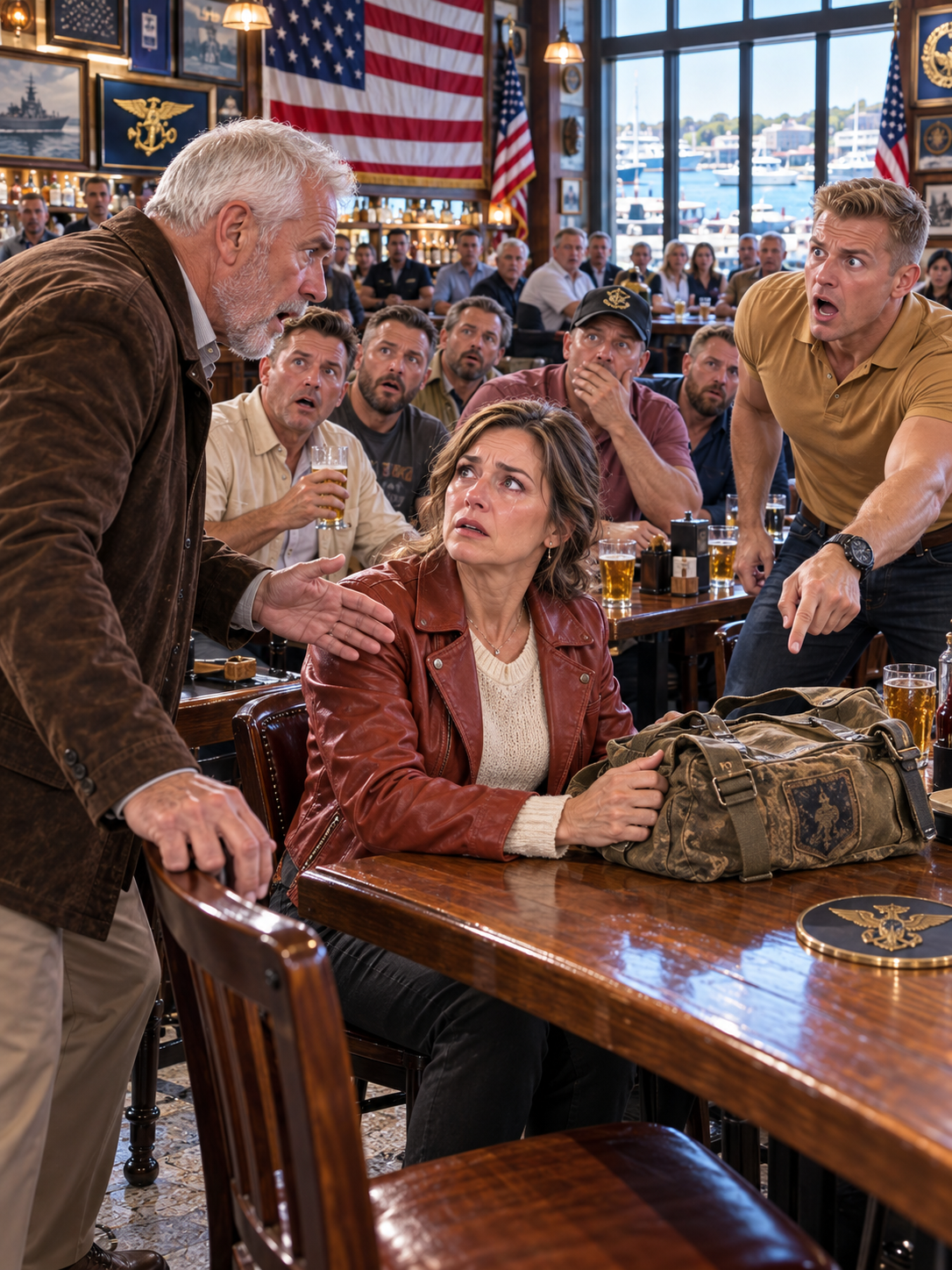
A young Navy SEAL pointed at the faded patch on my bag and accused me of stealing a history I had never claimed. I could have ended the argument by giving him my rank, but rank wasn’t the reason my hands started shaking. Seventeen years earlier, men had heard the name “Nightfall” over a broken radio while an operation was falling apart overseas. When an older SEAL crossed the bar, stared at me, and whispered that forgotten name, every man at the table stopped laughing.
### Part 1
“That’s stolen valor.”
The words were loud enough to cut through the music, the clink of glasses, and three separate conversations behind me. One second, the young man beside my stool had been smiling while his friends laughed at some joke I hadn’t heard; the next, he was pointing at the faded patch sewn onto my old canvas bag like a prosecutor displaying evidence. I kept one hand around my glass and looked at him, wondering how a quiet drink after a retirement gathering had turned into a public interrogation.
Twenty minutes earlier, Harbor House had felt exactly like the kind of Virginia Beach bar I remembered from years ago: dark wood scarred by thousands of elbows, framed deployment photographs along the walls, challenge coins trapped beneath glass, and the salt-and-fryer smell that clung to places close to the ocean. I was forty-three, a Navy commander, but nothing about me advertised it that night. I wore jeans, a charcoal jacket, civilian shoes, and carried a canvas shoulder bag so old that one corner had been repaired twice.
The bartender, Dean Foster, had noticed the patch while setting down my drink. He was a former petty officer with white at his temples and the habit of polishing the same glass whenever business slowed. “Haven’t seen one of those in a long time,” he said, nodding toward the worn black patch with a pale crescent symbol and a single word stitched beneath it: NIGHTFALL.
I touched the edge of it without thinking. “Neither have I.”
“Still answer to it?”
“Not for seventeen years.”
Dean gave me a strange look, the kind people give when they recognize a door they know better than to open, then moved down the bar. Behind me, somebody laughed. I didn’t pay attention until a young man in his late twenties stood and walked over.
I learned later that his name was Cole Barrett. He had the compact, athletic build of someone who trained because his life required it, close-cut hair, and the sharp confidence of a man who had recently become very good at something difficult. His eyes moved from my face to the Nightfall patch, then to a smaller insignia stitched beside it, faded enough that most civilians would have ignored it.
“Got a call sign, sweetheart?” he asked.
I looked at him.
One of his friends laughed. Cole smiled wider and hooked a thumb toward my bag. “Or are you just playing soldier?”
“I think you misunderstood what you’re looking at.”
“Did I?” He stepped closer. “You serve with Naval Special Warfare?”
“I served where I was assigned.”
That answer clearly bothered him. He wanted a category he understood, something simple enough to put me inside and judge. “That patch wasn’t handed out at the mall.”
“No,” I said. “It wasn’t.”
He studied my face for another second, but I could almost see the conclusion settle behind his eyes. Once people decide what you are, facts have to work twice as hard to reach them. Cole pointed again at the bag. “That’s stolen valor.”
Dean stopped polishing his glass.
The laughter behind Cole died. One of his friends, a broad-shouldered man I later learned was Mason Reed, leaned back and looked suddenly uncomfortable. My fingers tightened around the glass, not because Cole had embarrassed me, but because his words had pulled something loose in my head.
Static.
A radio operator saying he had lost part of the transmission.
Someone breathing too fast.
A man’s voice saying a name I had spent seventeen years refusing to hear in dreams.
I set the glass down carefully. “You have a suspicion. That isn’t the same thing as knowing.”
Cole gave a short laugh. “Then tell me who you are.”
“Why?”
“Because if you’re wearing something you didn’t earn—”
“I didn’t say I earned anything you earned.”
“You’re dodging.”
“No. I’m choosing not to explain myself to a stranger who opened with an accusation.”
Mason spoke quietly from the table. “Cole, leave it.”
Cole barely glanced at him. “I’m just asking.”
“No,” I said. “You were asking thirty seconds ago.”
His smile disappeared. “Anybody can make up a war story.”
That was when the chair scraped across the floor.
The sound came from the far side of the room, and somehow everybody heard it. An older man had risen from a table beneath a framed photograph of a destroyer. He was in his late fifties now, gray at the temples, broad through the shoulders despite the stiffness in the way he stood.
I knew him before he took his first step.
Senior Chief Marcus Hale.
Seventeen years disappeared so quickly my stomach turned. I remembered him younger, sunburned, furious, exhausted, arguing with me over a radio route while a clock counted down. I remembered the last time I had seen him overseas, when neither of us had known what to say after a casualty report arrived.
Marcus crossed the room without looking at Cole.
He stopped several feet from me.
All the color seemed to leave his face.
Then, in a voice so quiet I almost wished I hadn’t heard it, he said, “Nightfall.”
My throat tightened.
“Hello, Hale.”
Nobody laughed after that.
Cole looked from Marcus to me. “You know her?”
Marcus didn’t answer immediately. Even when he was younger, silence had been one of his weapons. He let it sit there until Cole shifted his weight.
“I do,” Marcus said.
Cole pointed toward me as if he still needed the room to understand his question. “She was with the teams?”
“No,” I answered.
Relief flickered across his face.
It lasted half a second.
Marcus turned toward him. “She never said she was.”
Cole’s jaw tightened. “Then what’s the patch?”
Marcus looked at the bag, and something old moved through his expression. “That patch has a history.”
“So do a lot of things.”
“So does she.”
I hated how many people were watching now. I had spent most of my adult life learning to function in rooms where attention could become dangerous, and that night I wanted the opposite. I wanted to finish my drink, go home, and remain Elena Hart, not the twenty-six-year-old lieutenant who once answered to Nightfall.
Cole folded his arms. “What does Nightfall mean?”
“Not your story to demand,” Marcus said.
“Hale,” I warned.
He looked at me.
“Leave it.”
Something passed between us that Cole couldn’t understand. Marcus remembered what that name carried. Cole thought this was still about whether he had won an argument.
“If it’s real,” Cole said, “why not explain it?”
For the first time, anger rose high enough that I felt it in my jaw. I picked up my bag and stood. “Because I don’t owe a stranger my worst night just to make him feel better about being wrong.”
Mason looked down at the table.
Cole’s face reddened. “I’m protecting something people actually earned.”
“Then protect it,” I said. “Don’t use it as permission to invent stories about people you don’t know.”
I left cash beside my unfinished drink.
Marcus stepped closer. “Elena.”
“Not tonight.”
Outside, the coastal air was cool and damp, carrying the smell of salt, wet pavement, and diesel from traffic farther down the road. I reached my car but didn’t unlock it. Instead, I stood with both hands on the roof, breathing slowly until the parking lot stopped feeling like another place seventeen years earlier.
Nightfall had been locked away for almost two decades.
Cole Barrett had opened the box without knowing there was a body inside it.
What he didn’t know was that the name had never belonged to a SEAL at all.
And the first time Marcus Hale heard it over a radio, he had nearly ignored me.
### Part 2
Seventeen years earlier, I was twenty-six and still young enough to believe that if I prepared harder than everyone else, people would eventually stop questioning why I was in the room. I was a Navy lieutenant assigned to intelligence support for a joint task element overseas, working nights because nights were when the maps changed fastest and bad information became dangerous. My world was screens, radio traffic, satellite imagery, dry-erase markers, stale coffee, and rooms kept so cold by electronics that I wore a fleece even when the air outside felt like an oven.
I wasn’t kicking in doors. I wasn’t carrying a rifle through villages. My job was to study what the people outside the operations center couldn’t see and tell them when the picture looked wrong.
Marcus Hale was a chief then, and he distrusted almost everything about people like me. He didn’t dislike me personally; that would have been easier. He disliked the idea that someone behind a screen could tell experienced operators something meaningful about ground they were physically standing on.
I thought he relied too much on instinct.
He thought I relied too much on pixels.
We were both partly right.
The nickname Nightfall had started as a joke from Petty Officer Owen Dawson. Owen was impossible to miss in any room because he laughed like somebody had paid him to make sure everyone else heard the punch line. He was married to a woman named Claire, talked constantly about a fishing boat he planned to buy, and once spent twenty minutes searching for sunglasses that were sitting on top of his head.
I worked nights so often that Owen started saying, “If everything goes bad after sunset, at least Nightfall will answer.”
The name stuck.
I pretended to hate it.
The truth was that I liked belonging to something, even indirectly.
The operation that changed everything began as one of those nights that felt routine only in hindsight. Marcus’s element was moving toward a planned extraction corridor we called Route Crimson. Earlier surveillance had shown little activity there, weather was stable, and the timeline had already slipped enough that nobody wanted another change.
Then one of our feeds showed two vehicles moving near the corridor.
Vehicles alone meant nothing.
Ten minutes later, a late human-source report suggested a local facilitator might have passed information about coalition movement.
The source wasn’t fully corroborated.
My senior watch officer, Lieutenant Commander Paul Hensley, read the report twice and rubbed his eyes. “Thin.”
“I know.”
“We don’t reroute an element based on thin.”
I looked again at the imagery. One uncertain clue could be noise. Two uncertain clues could still be noise, but sometimes they overlapped in a way that made the back of your neck tighten.
“They need to know.”
Hensley looked at the clock. “Tell them confidence is low.”
I reached for the radio.
“Mercer Actual, Nightfall.”
Static answered first.
Then Marcus’s voice. “Nightfall, send it.”
“Recommend alternate extraction. Route Crimson no longer assesses clean.”
A pause followed.
“We’re already moving.”
“I know.”
“What changed?”
“Vehicle activity near the corridor and a late source report indicating possible compromise.”
“Confidence?”
That was the question that could ruin people if you lied about it.
I stared at the screen.
“Not high enough to guarantee hostile intent,” I said. “High enough that I would not send you through that route.”
The operations center became completely silent.
Nobody looked at me.
Marcus did not answer for several seconds.
Finally, his voice came back. “Stand by.”
I waited.
My palms were sweating despite the cold room.
Then: “Copy. Shifting to alternate.”
I exhaled.
Hensley glanced at me. “You better be right.”
“I hope I’m wrong.”
Twenty-seven minutes later, another surveillance platform caught movement near the original corridor consistent with men establishing positions along an approach. It wasn’t proof of a fully developed ambush, but it was enough that nobody in the room questioned the reroute anymore.
Someone behind me muttered, “Good catch, Nightfall.”
I should have felt relief.
Instead, I remember thinking the night wasn’t finished.
It wasn’t.
The element reached another phase of the operation, and the radio traffic changed. Voices became shorter. Someone asked for a position update. Another voice cut across him. Then there was shouting I couldn’t fully understand and the unmistakable shift that occurs when planning stops and survival takes over.
“Contact.”
The word seemed to empty the air from the room.
We started tracking fragments.
Direction.
Location.
Movement.
A request for support.
Then somebody said, “Dawson’s hit.”
I froze.
Hensley snapped, “Hart.”
I forced my eyes back to the board.
“Tracking.”
I did my job.
That part matters to me because for years I remembered only the moment I heard Owen’s name. I forgot the next forty minutes, when I helped push updated information, checked routes, coordinated what we could coordinate, and remained at my station until every surviving member of the element was accounted for.
Owen wasn’t among them.
At dawn, the casualty information reached our watch floor.
Petty Officer First Class Owen Dawson.
Married.
Claire Dawson.
Thirty-one years old.
I stared at his name on a printed page until the letters stopped looking like language.
Marcus found me later in a hallway outside the operations room. He looked older than he had twelve hours earlier, his uniform dusty, his face gray beneath the tan. For a long moment, neither of us said anything.
“You were right about Crimson,” he said.
I shook my head.
“Hart.”
“Owen is still dead.”
His face changed. “That wasn’t Crimson.”
“I saw one threat.”
“That doesn’t mean you were supposed to see every threat.”
“You don’t know that.”
“Yes, I do.”
I wanted him to be angry with me. Anger would have been easier than the exhausted certainty in his voice.
“I nearly ignored you,” he said.
“But you didn’t.”
“I wanted to.”
I looked at him.
Marcus stared at the floor. “My first thought was, she’s twenty-six, she’s behind a screen, and I’m standing on the ground. What does she know that I don’t?”
“I probably thought something equally generous about you.”
He almost smiled.
Almost.
Then both of us remembered why we were standing there.
In the days that followed, I carried a blank sheet of stationery inside my notebook. I told myself I was going to write Claire. Every night, I unfolded it, stared at the empty page, and put it away again.
What was I supposed to say?
Your husband joked with me about bad coffee.
Your husband gave me a nickname.
Your husband survived the road I warned them away from.
Your husband died anyway.
I never wrote the letter.
That blank page stayed with me until the deployment ended.
Years passed. Promotions came. Assignments changed. I became better at hiding the places where memory could still reach me.
But I stopped using Nightfall.
I packed the patch away.
Eventually, without remembering when, I stitched it onto the canvas bag.
Seventeen years later, standing in a Virginia Beach parking lot after Cole Barrett accused me of stealing someone else’s service, I realized the patch had never been the thing I was protecting.
It was the guilt underneath it.
And the next morning, that private guilt became public in a way I had not expected.
### Part 3
By nine the next morning, Cole’s accusation had traveled farther than either of us wanted. Naval communities can look enormous from the outside and feel like small towns once somebody says something foolish in front of the wrong witnesses. I filed no complaint, called no commanding officer, and mentioned the incident to no one at work, but people had been in Harbor House, and people talked.
Mason Reed called Cole before breakfast.
I heard about the conversation later from Marcus.
“You accused a Navy commander of stolen valor in a bar,” Mason told him.
Cole’s answer came quickly. “I didn’t know she was a commander.”
Mason apparently went silent for several seconds.
Then he said, “That’s the problem.”
“What’s that supposed to mean?”
“You think it would’ve been fine if she was a civilian?”
Cole had no answer.
Mason reminded him that he had laughed too. “Difference is, I figured out when to shut up.”
That afternoon, one of Cole’s senior teammates pulled him aside. The man didn’t threaten paperwork or lecture him about embarrassing the command. He simply said, “You want to protect the Trident? Protect it.”
Cole nodded.
The man looked him straight in the eye. “Don’t use it like a club.”
I knew none of that while it was happening.
I went to work.
Nobody in my office mentioned Harbor House, which told me either they hadn’t heard or they were smart enough to pretend they hadn’t. I spent the morning reviewing briefing material, the afternoon in meetings, and nearly convinced myself the entire episode would disappear if I refused to feed it.
At three fourteen, my phone lit up with Marcus Hale’s name.
I watched it ring twice before answering.
“What?”
“That’s warm.”
“I’m working.”
“So am I.”
“You retired.”
“I work very hard at being retired.”
Despite myself, I almost smiled.
Marcus’s tone changed. “Can we talk?”
“I don’t want to discuss Barrett.”
“Neither do I.”
That was a lie, but not enough of one to make me hang up.
We met after work at a small coffee shop overlooking the water. Marcus was already seated near the window with a black coffee in front of him. In daylight, I could see the years on his face more clearly, the fine lines near his eyes and the scar at his chin I didn’t remember.
For a while, we talked about harmless things.
Who had retired.
Who had divorced.
Which officer had become an admiral everyone once swore would never survive lieutenant commander.
Then Marcus rubbed his thumb along the paper rim of his cup.
“I’m sorry.”
“You didn’t accuse me.”
“I said the name.”
“You recognized me.”
“I could have kept my mouth shut.”
“Yes.”
He looked surprised.
I took a sip of coffee. “But I’m not angry that you didn’t.”
Marcus looked toward the water. “I haven’t said that name out loud in years.”
“Neither have I.”
“I thought about that night more than I should.”
“So did I.”
He looked at me. “I almost ignored you.”
“You’ve mentioned that.”
“I don’t think you understand how close I came.”
“And you don’t understand that you changed the route.”
“Because I got lucky enough to listen before my pride made the decision for me.”
“That isn’t luck.”
Marcus’s mouth tightened. “Tell yourself the same thing.”
I knew exactly what he meant.
I looked down at my coffee.
He waited.
“I’m not doing this with you.”
“With me?”
“The part where you explain why Owen wasn’t my fault.”
“I wasn’t going to.”
I looked up.
Marcus leaned back. “I was going to tell you Claire will be at the memorial gathering Saturday.”
My body went still.
Every year, men from that deployment and their families gathered near the anniversary period. I had attended exactly two in seventeen years, both early on, both briefly.
“I know.”
“She asks about you.”
That hit me harder than I expected.
“She shouldn’t.”
“Why?”
I didn’t answer.
Marcus did it for me.
“Because you still think you owe her something.”
“Her husband died.”
“So did other men on other nights you worked.”
“He gave me that name.”
“That isn’t responsibility.”
“It feels like it.”
“Guilt usually does.”
I looked at him sharply.
Marcus held my gaze. “Come Saturday.”
“No.”
“Elena.”
“No.”
“Claire would like to see you.”
“I don’t know what you told her.”
“Very little.”
“Keep it that way.”
Marcus looked disappointed, but he didn’t argue.
Then he said, “Barrett will be there.”
I laughed once without humor. “Absolutely not.”
“I’m not arranging a public apology.”
“You better not be.”
“I’m telling you because right now that kid thinks this story is about him.”
I stared at him.
Marcus stood and pulled on his jacket.
“It isn’t.”
He left before I could answer.
Saturday morning came gray and cold.
I drove to the veterans hall anyway.
For nearly ten minutes, I sat inside my car with the engine off and watched people cross the parking lot carrying coffee, framed photographs, bakery boxes, and folded jackets. I could have left at any moment. Nobody knew I was there.
Then another car pulled into a space three rows away.
Cole Barrett climbed out.
Mason got out from the passenger side.
Cole looked different without the bar around him, less confident somehow. He shoved his hands into his jacket pockets and stared at the building as if he was considering the same escape I was.
He didn’t see me.
I almost started my engine.
Then I remembered Marcus saying Claire asked about me.
I took my hand off the key.
Inside, the hall smelled like brewed coffee, old wood, and whatever industrial cleaner they had used on the floor that morning. Folding chairs had been arranged around tables. Deployment photographs filled one wall, and near the front stood a display of men who had not come home.
I saw Owen’s face from across the room.
The photograph was seventeen years old.
His grin wasn’t.
Then a woman beside the display turned.
Claire Dawson looked at me for one long second.
“Elena?”
I nodded.
She crossed the room before I could invent an excuse.
Then she put both arms around me.
I stayed stiff for half a heartbeat.
After that, I hugged her back.
“I wondered if you’d ever come again,” she said.
“I should have.”
Claire pulled away and studied my face. “You came today.”
Across the room, Cole had seen us.
More importantly, he had heard Claire’s name.
Marcus walked over a few minutes later and gave me a look that wisely contained no triumph. The three of us stood beside Owen’s photographs while the room slowly filled.
Then Claire opened her purse.
“I brought something,” she said.
She removed a worn envelope, its edges softened by years of handling.
My stomach tightened.
“What is that?”
Claire looked at me.
“Something Owen wrote before his last operation.”
And then she unfolded a page that had survived seventeen years.
### Part 4
Claire held the paper carefully, pinching it near the folds as if she had performed the same motion hundreds of times. People gathered around slowly, not because she called them over, but because memories have gravity in rooms like that. Marcus stood beside me, and somewhere behind him I could see Cole and Mason watching without moving closer.
Claire smiled as she began reading. “He says the coffee tasted like somebody strained it through a boot.”
Three men laughed.
Marcus muttered, “That tracks.”
Claire continued. “He also says Hale snores.”
“I do not.”
“You did according to my husband.”
The room loosened.
For a few minutes, Owen was not a framed photograph or a casualty date. He was a man complaining about coffee, making fun of Marcus, asking Claire whether the dog had destroyed another shoe, and reminding her not to let his brother borrow his truck.
I felt something inside me shift.
Then Claire’s voice softened.
“There’s one more part.”
I knew before she read it.
I have no idea how.
She looked down.
“Nightfall kept us from doing something stupid again last night. Whoever she is, she’s got better instincts than Hale, which isn’t exactly a high bar.”
Laughter moved through the room.
Marcus lowered his head with a tired smile.
I couldn’t move.
Claire looked at me.
“For years, I didn’t know who Nightfall was.”
Nobody spoke.
“I found out later.”
“Claire,” I said.
She folded the paper halfway, then stopped.
“He came back from that mission phase because you spoke up.”
My throat closed.
“He didn’t come home from the deployment.”
“No.”
Her voice held no anger.
“That doesn’t erase the night he did.”
For seventeen years, I had measured myself only against the ending.
Owen died.
Therefore everything before that had become irrelevant.
Claire had remembered the part I had refused to count.
I looked away, pretending interest in a photograph because I didn’t want the room to see my eyes.
Marcus quietly picked up another photo from the display and handed it to Cole.
Cole hesitated before taking it.
I watched him turn it over.
Several names had been written across the back in faded ink. Hale. Dawson. Two others I recognized. At the edge of the photograph stood a twenty-six-year-old version of me wearing a headset around my neck and looking irritated that someone had pulled me away from work.
Someone had written one word beside me.
Nightfall.
Cole stared at it.
His face changed.
He finally understood that the patch on my bag was not a costume, not a claim to somebody else’s qualification, and not a souvenir I had bought because I wanted strangers to think I was interesting.
It was a name other people had given me.
A memory I had spent years trying not to deserve.
Later, when people broke into smaller groups, Cole approached me.
“Commander Hart.”
“Elena is fine here.”
He nodded.
“I owe you an apology.”
I waited.
“What I said at the bar was out of line.”
Still I waited.
“I’ve seen people fake service before,” he continued. “Back home there was this guy who claimed he’d been a SEAL. People bought him drinks, gave him money, treated him like—”
There it was.
The apology turning into a defense.
I let him finish.
Then I asked, “What exactly did I steal from you?”
Cole blinked.
“Ma’am?”
“Your deployments?”
“No.”
“Your training?”
“No.”
“Your teammates?”
His eyes lifted to mine. “No.”
“Your Trident?”
“No.”
“Did I claim any of them?”
He looked down.
“No.”
I didn’t raise my voice. I didn’t need to.
“You decided what I was before you knew who I was.”
“I know.”
“No,” I said. “I think you’re beginning to know.”
His face reddened.
Behind him, Mason stared at the floor.
Cole tried again. “I didn’t mean—”
“That sentence rarely improves anything.”
He closed his mouth.
For the first time since I had met him, Cole Barrett had nothing to say.
Marcus walked toward us, but I shook my head slightly. This wasn’t his conversation.
Cole handed him the photograph.
Then he turned and walked out of the hall.
Mason took a step after him.
Marcus stopped him with a hand on his shoulder. “Give him a minute.”
I should have felt satisfied.
Part of me had imagined this moment after leaving the bar: Cole confronted with facts, embarrassed in front of the people whose approval he had wanted, forced to realize how reckless he had been.
Instead, I looked at Claire.
She was carefully folding Owen’s note along creases worn into the paper over seventeen years.
And suddenly I understood that Cole was not the only person in that room discovering that a story he had believed about himself might be wrong.
For years, I had told myself I failed Owen.
Claire had just told me Owen didn’t see me that way.
That should have been comforting.
Instead, it terrified me.
Because guilt had become part of how I remembered him.
If I put it down, I didn’t know what would be left.
I stayed at the memorial longer than I expected.
Claire showed me photographs I had never seen: Owen holding an absurdly large fish, Owen asleep on a sofa with a dog across his chest, Owen wearing a Christmas sweater that looked designed to cause physical pain.
“He hated that sweater,” Claire said.
“He deserved it.”
She laughed.
The sound caught me off guard.
I laughed too.
For several seconds, Owen was alive in memory without blood, radio static, or a casualty sheet attached to him.
On my way out, Marcus followed me to the parking lot.
“You okay?”
“No.”
“Good.”
I turned. “Excuse me?”
He put both hands in his coat pockets. “If you’d said yes, I’d know you were lying.”
I looked back at the building.
“Did Claire really ask about me?”
“For years.”
“Why didn’t you tell me?”
“I tried.”
“No. You invited me to memorials. You never said she asked.”
Marcus hesitated.
“Because I thought you’d run farther.”
He was right.
I hated that.
I unlocked my car.
Before I got inside, Marcus said, “Barrett isn’t done with this.”
“That’s his problem.”
“I know.”
“I don’t need him punished.”
“I know.”
“I don’t need another apology either.”
Marcus studied me.
“That one,” I said, “was for him.”
I drove away believing the matter was finished.
It wasn’t.
Three days later, Marcus called again.
This time, he had a message from Cole.
No audience.
No memorial hall.
No excuses.
Just one request.
He wanted five minutes to finish what he had failed to say.
### Part 5
My first instinct was to refuse.
I had spent enough time being turned into somebody else’s lesson. Cole had made his accusation because he wanted to feel certain; then he had offered an apology because he wanted relief. Neither impulse required me to participate.
Marcus didn’t pressure me.
“He asked,” he said. “I told him I’d pass it along. That’s all.”
I waited until the following morning before answering.
“Five minutes.”
We met near the waterfront in broad daylight. Families pushed strollers along the path, cyclists passed behind us, gulls screamed over the railing, and an elderly couple occupied the nearest bench while sharing something from a paper bag. I chose the location because I didn’t want Harbor House, memorial photographs, or military walls influencing the conversation.
Cole arrived before me.
No teammates.
No audience.
He stood when I approached.
“Commander.”
“Cole.”
He looked toward the water, then back at me. “There’s something I didn’t finish Saturday.”
“I noticed.”
He winced.
Good.
“When I was nineteen, there was a guy in my hometown who told everybody he’d been a SEAL,” he said. “He used it to get free meals. Donations. He told people about missions that never happened. When somebody finally exposed him, my dad said the worst part wasn’t the free stuff. It was that he borrowed dead men to make himself look bigger.”
I listened.
Cole rubbed his palms against his jeans.
“That stuck with me.”
“I can understand why.”
He looked surprised.
“You thought I’d say it didn’t matter?”
“I thought you’d say I was making excuses.”
“You were making excuses Saturday.”
His jaw tightened.
“This is different.”
“How?”
“Because today you’re explaining where the impulse came from. Saturday you were explaining why the impulse made you right.”
Cole looked at the pavement.
A boat horn sounded somewhere across the water.
“I saw your patch,” he said. “Then the insignia. You gave me an answer I didn’t like. I thought I knew what that meant.”
“You had a reason to be suspicious.”
He looked up.
“You didn’t have a reason to treat suspicion like confirmation.”
“No.”
“In our line of work, that difference matters.”
“I know.”
A familiar voice behind us said, “I didn’t.”
Marcus walked toward us holding two coffees.
I stared at him. “You said no audience.”
“I’m not an audience. I’m elderly supervision.”
“You’re fifty-eight.”
“Ancient.”
Cole looked confused.
Marcus handed me one coffee. “Seventeen years ago, she told me Route Crimson looked wrong.”
Cole’s attention sharpened.
Marcus continued. “My first thought was that she was young, behind a screen, and nowhere near the ground. I wanted to trust what I could see more than what she could.”
“You didn’t believe her?”
“Not enough.”
I looked at Marcus. “You changed the route.”
“Because I listened before pride made the decision for me.”
Cole stared out over the water.
Marcus took a drink.
“I got the opportunity to correct myself before being wrong cost someone,” he said. “Not everybody does.”
Then he walked away.
I watched him go. “He planned that.”
Cole almost smiled. “Definitely.”
The smile disappeared quickly.
He took a breath.
“I accused you of something you didn’t do.”
I said nothing.
“I wanted the guys at that table to watch me catch a fraud.”
There it was.
No hometown.
No fake veteran.
No noble purpose.
Just the ugly human thing underneath it.
“I was showing off,” he said. “And when Mason told me to stop, I kept going because backing down in front of them felt worse than being wrong.”
“That’s honest.”
“I was wrong.”
He looked directly at me.
“I’m sorry.”
I nodded.
“I accept the apology.”
Relief crossed his face, but I raised one hand before he could mistake acceptance for absolution.
“That doesn’t make us friends.”
“I understand.”
“And it doesn’t mean you’re entitled to the rest of my story.”
“I understand that too.”
“Good.”
I started to leave.
“Elena?”
I turned.
Cole hesitated.
“I won’t do it again.”
“That’s an impossible promise.”
His expression shifted.
“You will judge people again,” I said. “So will I. You’ll get irritated, suspicious, territorial, tired. The promise isn’t that you’ll never feel certain too early.”
“Then what is it?”
“Learn to notice when certainty arrives before evidence.”
He nodded slowly.
“Do better when nobody’s watching.”
A few days later, Marcus called me laughing.
“You’ll appreciate this.”
“That usually means I won’t.”
Cole had been walking through a common area when he noticed a young sailor wearing an old challenge coin on a cord around his neck. Something about the coin had caught his attention. Marcus said the old version of Cole would probably have made a sarcastic comment before asking a question.
This time, Cole stopped himself.
“Where’d you get that?” he asked.
The sailor touched the coin. “My brother.”
“He serve?”
“Yeah.”
The sailor paused.
“He died three years ago.”
Cole stood there for a moment.
Then he said, “I’m sorry.”
That was all.
Nobody applauded.
Nobody knew Cole had changed what he was about to say.
Which was exactly the point.
I thought about that conversation longer than I expected.
One restrained comment did not transform a man.
One apology didn’t erase what happened at Harbor House.
But accountability had started somewhere small and invisible.
Still, I wasn’t ready to call Cole changed.
I had spent too long around competent people to confuse intention with character.
The real test would come when his suspicion was justified.
When he met someone who actually was exaggerating service.
When he had the facts.
When humiliation would be easy.
We didn’t have to wait long.
Three weeks later, I walked back into Harbor House for the first time since the accusation.
Marcus was already there.
So were Mason and Cole.
And before the night was over, a stranger at the bar would give Cole every excuse he needed to become the man I had met the first time.
### Part 6
I paused inside the Harbor House doorway longer than I wanted anyone to notice.
The same photographs hung on the walls. The same challenge coins gleamed beneath the bar top. Dean was polishing a glass that probably didn’t need polishing, and a baseball game played without sound on two televisions above the liquor shelves.
Cole saw me first.
He stood halfway.
His uncertainty was almost funny.
I could see him trying to decide whether he should shake my hand, call me Commander, leave me alone, or somehow salute a woman in jeans standing inside a bar.
“Sit down, Barrett.”
Marcus grinned. “She’s still giving orders.”
“I outrank you.”
“You always did in your own mind.”
That earned the first real laugh from me.
Mason pulled out a chair.
I sat.
My old canvas bag went beneath the table, Nightfall patch facing outward.
Dean brought my drink without asking and nodded at the bag. He didn’t say anything about it.
Neither did Cole.
For the first hour, the conversation stayed deliberately ordinary. Football. Bad knees. Marcus’s refusal to admit he needed reading glasses. Mason’s plan to replace a kitchen sink that everyone predicted would end with him flooding his house.
Then a man two stools down began talking loudly.
He looked to be in his early sixties, with silver hair, a sun-weathered face, and a Navy tattoo on his forearm.
Nothing about that was unusual in Virginia Beach.
He mentioned serving four years.
Still ordinary.
Then somebody asked where.
The story grew.
“I worked with the teams,” he said.
I noticed Cole notice.
Mason noticed Cole noticing.
Marcus noticed all of us and took another sip of his drink.
A few minutes later, the man was saying, “We ran missions with those guys.”
Cole’s posture changed.
The old version of him would already have been on his feet.
This time, he stayed seated.
Finally, when the stranger made another vague reference to operations, Cole turned.
“What was your rate?”
The man hesitated.
“Logistics.”
“What command?”
Another pause.
He named a legitimate support command.
Cole nodded.
“So you supported operations?”
The stranger’s confidence faded slightly. “Yeah.”
“But you weren’t a SEAL.”
“No.”
“You didn’t run missions as part of a SEAL platoon.”
The man looked around.
People had begun listening.
“No.”
For half a second, I saw the temptation on Cole’s face.
He had facts.
He was right.
He could destroy the man publicly and tell himself the humiliation was deserved.
Instead, he asked, “Why say you did?”
The stranger stared into his beer.
“People hear logistics and their eyes glaze over.”
Nobody laughed.
“I did four years,” he continued. “Deployed once. Moved gear. Kept records. Half the time people acted like that didn’t count.”
Cole leaned back.
“Then tell the boring story.”
The stranger looked at him.
“Four years in logistics is still four years of service,” Cole said. “You don’t need somebody else’s résumé to make yours matter.”
The man rubbed a hand across his face.
“You’re right.”
“I know.”
Mason kicked Cole beneath the table.
Cole jerked. “Ow.”
Mason smiled. “Humility was going so well.”
Even the stranger laughed.
The conversation moved on.
No public execution.
No cheering.
No speech.
Just a correction that separated what the man had actually done from what he had falsely implied.
Marcus glanced at me.
I said nothing.
He didn’t need me to.
Cole had done exactly what I asked him to do.
Better when nobody required it.
Later, after Mason left and the room thinned, Cole’s eyes moved toward my bag.
“Can I ask you something?”
“You can ask.”
He nodded toward the patch.
For a moment, I braced myself.
“What was Owen like?”
I wasn’t prepared for that.
Of every question he could have asked, I expected none of them to involve Owen as a person.
I looked down at my drink.
Marcus smiled before I did. “Oh, this should be good.”
I thought about the photograph at the memorial.
Then another memory came.
“He lost his sunglasses once.”
Marcus groaned. “Dear God.”
“For twenty minutes,” I continued, “he had half the team helping him look.”
Mason had returned from the restroom and stopped beside the table. “Where were they?”
“On his head.”
Cole laughed.
Marcus pointed at me. “She’s leaving out the best part.”
“I was getting there.”
“Owen accused me of stealing them.”
“He accused everybody.”
“He threatened to search my gear.”
“You probably deserved it for something else.”
Marcus laughed so loudly Dean looked over from the bar.
Then I was laughing too.
Not the careful laugh people use at memorial gatherings when grief is still watching.
A real one.
For the first time in seventeen years, I told a story about Owen Dawson that did not end with the night he died.
One story became another.
Owen once tried to improve the coffee by combining two terrible brands and somehow made something worse.
He wrote Claire emails complaining that Marcus snored loud enough to compromise their location.
He once spent an entire afternoon convincing a new guy that a completely fake piece of equipment required a calibration ritual.
With every memory, the casualty sheet in my head lost a little authority.
Cole mostly listened.
That mattered.
He did not ask what happened during the operation.
He did not ask why I was called Nightfall.
He did not ask for the story he once demanded.
When the laughter finally faded, I touched the worn edge of the patch.
Something about it felt lighter.
For years, I had believed memory was a debt.
If remembering Owen stopped hurting, then maybe I was leaving him behind.
Sitting at that table, I began to wonder if I had understood remembrance backward.
Maybe pain wasn’t proof of loyalty.
Maybe laughing at his missing sunglasses was not an insult to the dead.
Maybe it was one of the ways we brought them back into a room.
As I prepared to leave, Cole looked toward the bag once more.
“You know,” he said, “when I first saw that patch, I thought the story had to be about proving whether you deserved to wear it.”
I slipped the strap over my shoulder.
“And now?”
He thought about it.
“Now I think maybe the patch doesn’t need my opinion.”
“Progress.”
Marcus raised his glass. “Write down the date.”
Cole shook his head.
Outside, the air smelled like salt again.
This time, the smell didn’t pull me backward seventeen years.
I drove home thinking about Owen laughing.
Not dying.
It should have felt like betrayal.
Instead, for the first time, it felt like permission.
Then, two months later, Claire gave me something I had refused to ask for.
And it finally broke the part of the story I had been using to punish myself.
### Part 7
The next memorial gathering came sooner than I expected.
This time I did not sit in my car for ten minutes.
I parked, got out, and walked straight toward the veterans hall carrying coffee and a box of pastries Claire had asked me to pick up. The change was small enough that no one else would have noticed, but I did.
Inside, Marcus was arguing with Mason about football.
Cole was helping move folding chairs.
Claire stood near Owen’s photographs talking with another widow.
Nobody stopped speaking when I entered.
Nobody whispered Nightfall.
I realized I was grateful for that.
Cole noticed me and lifted one hand.
“Morning, Commander.”
“Elena.”
“Still feels dangerous.”
“It should.”
He smiled and went back to the chairs.
That was as much friendship as we had, and I liked it that way.
I had forgiven the fact that he apologized sincerely. I had not rewritten the beginning to make the ending sweeter.
Later, a nervous young sailor approached our table.
He couldn’t have been older than twenty.
He looked at Marcus. “Senior Chief Hale?”
“Depends who’s asking.”
“My dad said you served with a friend of his.”
Marcus asked the name.
The sailor told him.
Marcus’s entire face brightened. “Your father owes me twenty dollars.”
The young man laughed uncertainly.
Cole pulled out the empty chair beside him.
“Sit down. You might finally get the truth.”
A few months earlier, Cole might have measured the sailor before making room for him. He might have looked for some challenge in the boy’s uncertainty. Now he simply made room.
Marcus noticed.
So did I.
Neither of us said anything.
Later, Claire found me standing near Owen’s photograph.
“He hated that one,” she said.
“He looks half asleep.”
“He was. He’d been up all night.”
I smiled.
Claire held out an envelope.
“What’s this?”
“Open it.”
Inside was a photocopy of Owen’s letter.
The same one she had read months earlier.
I immediately tried to hand it back.
“Claire, you should keep this.”
“I have the original.”
“I don’t need—”
She closed my fingers around the envelope.
“This one should stay with Nightfall.”
For a moment, I couldn’t speak.
The room continued around us: coffee pouring, chairs scraping, somebody laughing at the far wall.
“I spent seventeen years thinking I failed him.”
“I know.”
“You never blamed me?”
Claire looked toward her husband’s photograph.
Then back at me.
“Elena, if I blamed every person who couldn’t save Owen from everything, I’d spend my whole life angry at people who loved him.”
The sentence entered quietly.
No dramatic music.
No revelation shouted across a room.
But something inside me finally gave way.
I had spent years applying an impossible standard to one night because impossible standards make grief feel controllable.
If I should have seen everything, then maybe everything could have been prevented.
If everything could have been prevented, then the world made sense.
Claire had lived with the harder truth.
Good people could make good decisions.
Warnings could work.
Routes could change.
Men could survive one danger.
And another danger could still take someone you loved.
None of those facts erased the others.
Marcus found me afterward standing outside near the side entrance.
“You disappeared.”
“I’m twenty feet from the door.”
“At our age, that’s travel.”
I handed him the photocopy.
He read Owen’s line about Nightfall and smiled.
“He really wrote that?”
“You didn’t know?”
“No.”
I took the page back.
Marcus shoved his hands into his pockets.
“I owe you another apology.”
“You’ve already apologized.”
“Not for that night.”
I knew immediately what he meant.
“You listened when it mattered.”
“Barely.”
“But you listened.”
“I spent years thinking about how close I came to ignoring you.”
I looked at him.
“Marcus, you can’t keep punishing yourself for the decision you didn’t make.”
His eyebrows rose.
The hypocrisy of my own sentence hit me one second too late.
Marcus smiled.
“Interesting.”
“Don’t.”
“Say that again.”
“I hate you.”
“No, you don’t.”
“I tolerate you historically.”
He laughed.
Then his expression softened.
“We both got stuck at the same place for different reasons.”
I looked at Owen’s letter.
“Yes.”
Behind us, the side door opened.
Cole stepped outside carrying a trash bag.
He heard the last part.
“Everything all right?”
Marcus nodded. “Commander Hart was just admitting I’ve been right for seventeen years.”
I stared at him.
Cole smirked. “Careful, Commander. Sounds like stolen valor.”
For half a second, nobody moved.
Cole’s face changed instantly.
“Oh no.”
Marcus broke first.
He laughed so hard he had to lean against the wall.
I tried to stay angry.
I failed.
“Barrett.”
“Yes, ma’am.”
“Do not push your luck.”
“Understood.”
Mason shouted through the open door, “Did Cole finally get himself killed?”
“Not today,” I called.
The room inside erupted with laughter.
And I laughed with them.
That evening, I slid Owen’s photocopied note into the canvas bag behind a small interior pocket. The Nightfall patch remained on the outside.
I stood in my kitchen with the bag in my hands for a long time.
For years, I had believed the name belonged to the worst night.
Now I was beginning to understand that I had chosen the wrong moment.
Nightfall did not belong only to the moment Owen died.
It belonged to the warning before Route Crimson.
To the pause when Marcus reconsidered.
To the route that changed.
To the men who lived because someone listened.
To Owen making bad coffee jokes.
To Claire preserving a letter.
To every ordinary thing that existed before the casualty report.
I put the bag beside the door.
For the first time in seventeen years, I did not want to remove the patch.
Months later, another gathering would give me the chance to walk away from the name for good.
Instead, I finally chose what it meant.
### Part 8
By the following spring, Nightfall no longer felt like a word I had to avoid.
I didn’t start introducing myself with it. I didn’t turn it into a story for strangers. I certainly didn’t let Marcus tell the more dramatic version he had begun polishing for anyone willing to buy him coffee.
But I stopped flinching when somebody from the old group used it.
That was enough.
At the next memorial gathering, I entered through the front doors carrying my canvas bag openly over one shoulder. The hall looked the same: folding tables, old photographs, paper cups, flags near the front, conversations layered over one another until the room sounded like a large family reunion where half the family had once worked very hard not to get killed together.
Cole was already there.
He had changed without becoming a different person.
He still spoke too confidently sometimes. Marcus still corrected him. Mason still enjoyed watching the correction happen.
But Cole had become slower to judge.
That mattered more to me than whether he felt ashamed of one night in a bar.
At some point, another young sailor approached our table holding an old photograph.
“My father gave me this,” he said.
Marcus studied it.
“I know three of these idiots.”
The sailor laughed.
Cole moved his chair sideways.
“Grab a seat.”
No inspection.
No challenge.
No demand that the young man prove why he belonged near the conversation.
Just room.
I watched him sit down.
Cole caught me looking.
“What?”
“Nothing.”
“That look means something.”
“Don’t ruin it.”
He nodded wisely. “Learning.”
Later, Claire and I stood together near Owen’s photograph.
She had replaced the picture he hated with one of him holding a fish nearly as long as his leg.
“That’s better,” I said.
“He lied about how big it was for years.”
“I believe that.”
Claire smiled.
“You look different.”
“So do you.”
“No. I mean you.”
I glanced down at the bag.
She followed my eyes.
“You kept it.”
“The patch?”
“Yes.”
“I thought about taking it off.”
“Why didn’t you?”
I considered the question.
“Because I finally remembered the whole night.”
Claire squeezed my arm.
Not the ending.
The whole night.
That distinction had taken seventeen years.
Marcus joined us a few minutes later with three coffees even though nobody had asked him to get any.
“I’ve been thinking,” he said.
“That’s dangerous,” I replied.
He ignored me.
“Back then, when you warned us off Crimson, I thought listening meant surrendering authority.”
“You were thirty-something and unbearable.”
“I was thirty-six and magnificent.”
Claire laughed.
Marcus continued. “Took me a long time to understand that listening doesn’t make you smaller.”
“No.”
“Sometimes it keeps you alive long enough to learn humility.”
Across the room, Cole heard the last word.
“Are we discussing me?”
“Always,” Marcus said.
Cole walked over.
For a moment, I remembered him standing beside my barstool months earlier, pointing at my bag with absolute certainty.
That version of him had not disappeared.
People don’t shed arrogance like an old jacket.
They learn to recognize it sooner.
Cole looked at the Nightfall patch.
“I never asked what you actually did after you warned them.”
“That’s because I never offered.”
“Fair.”
I surprised myself.
“We changed the intelligence picture. Supported the movement. Passed updates. Did what people in operations rooms do while other people do harder things outside them.”
Cole shook his head.
“Different things.”
“What?”
“Not harder. Different.”
I looked at him.
Months earlier, that correction might have sounded like flattery.
Now it sounded like understanding.
“Owen died later,” I said.
Cole nodded.
“For years, I thought seeing the first danger meant I should have somehow seen the second.”
“That doesn’t make sense.”
“No.”
“Didn’t stop you from believing it?”
“No.”
Cole looked toward Owen’s photograph.
“Funny how obvious somebody else’s bad logic is.”
I smiled.
“Yes.”
He hesitated.
“For what it’s worth, I’m glad Marcus said the name that night.”
I looked across the room at Marcus.
“So am I.”
The answer surprised me.
The accusation had hurt.
It had dragged me into a memory I had spent years avoiding.
But I would not give Cole credit for healing something he wounded by accident.
That belonged to Claire.
To Marcus.
To Owen’s letter.
And, eventually, to me.
Before the gathering ended, Claire asked for everyone’s attention.
She told one short story about Owen attempting to cook breakfast during a beach trip and setting off a smoke alarm with bacon.
People laughed.
Then Marcus told the sunglasses story.
I corrected half of it.
Mason claimed Marcus’s version was funnier.
Cole sided with me for survival.
For the first time, Owen’s photograph watched over a room where my memories of him were not arranged around his death.
When the chairs started folding and people began leaving, I slipped the photocopy of his old letter back into the bag.
The paper rested directly behind the patch.
Outside the hall, evening sunlight reflected from parked cars. The air carried salt from the ocean and the faint sound of traffic from the main road.
Marcus walked out beside me.
“You heading home?”
“Eventually.”
He nodded toward Cole, who was helping an older veteran carry a box to his car.
“Kid turned out all right.”
“He’s improving.”
“That’s practically affection from you.”
“Don’t spread rumors.”
Marcus smiled.
Then he became serious.
“You know you saved lives that night.”
“I know.”
He stopped walking.
It took him a second to realize what I had said.
“You know?”
“Yes.”
Not maybe.
Not but Owen died.
Not I should have done more.
Just yes.
Marcus’s eyes softened.
“Good.”
He walked toward his truck.
I remained near my car.
Behind me, Cole finished loading the box. He started toward the building, then saw me preparing to leave.
“Good night, Nightfall.”
Months earlier, that word had emptied a bar.
Seventeen years earlier, it had traveled across static.
Now nobody froze.
Nobody stared.
Nobody needed an explanation.
I looked at Cole.
“Good night, Barrett.”
He grinned.
“See? Didn’t even accuse you of anything.”
“Growth.”
“Painful growth.”
“You survived.”
“Barely.”
I got into my car.
Before starting the engine, I looked once more at the canvas bag on the passenger seat.
Stolen valor was real.
People did claim service, qualifications, sacrifices, and stories that did not belong to them. Those lies mattered precisely because real service was often quieter, stranger, and less cinematic than the stories people invented.
But suspicion was not proof.
Confidence was not judgment.
Earning something difficult did not grant anyone the right to decide another person’s history before asking enough questions to understand it.
Cole had earned his Trident long before he met me.
Humility took longer.
Marcus had learned the same lesson seventeen years earlier, when he chose to trust information he did not want to hear.
And I had my own lesson to learn.
I had mistaken guilt for loyalty.
I thought honoring Owen required keeping the worst moment of his life at the center of mine.
Claire taught me otherwise.
Owen was not only the man whose name came over a radio after everything went wrong.
He was the man who hated terrible coffee, lost sunglasses on his own head, teased Marcus about snoring, wrote ridiculous letters home, loved Claire, and once decided a stubborn young intelligence officer working the night watch needed a better name.
Nightfall.
For seventeen years, I thought it belonged to death.
I was wrong.
It belonged to the warning Marcus listened to.
To the road his men did not take.
To the extra hours Owen lived.
To the voices that answered one another through static.
To the people who remembered more than the ending.
I started the engine.
The fading daylight washed the parking lot in clean silver-blue light as I pulled onto the road toward the coast.
The patch remained on my bag.
It would stay there.
Not because I needed strangers to know what it meant.
Not because I owed anyone proof.
And certainly not because one young SEAL had finally decided I deserved to wear it.
It stayed because, after seventeen years, I had stopped asking the name to punish me.
Nightfall was mine.
And for the first time, I could carry it home.
THE END!
Disclaimer: Our stories are inspired by real-life events but are carefully rewritten for entertainment. Any resemblance to actual people or situations is purely coincidental.

