“The Taliban Wouldn’t Fear A Girl Like You,” Dad Laughed In Front Of The Veterans. Then The Navy SEAL Froze: “No Way… You’re Her. The Angel Of Death?”
The night my father called me a glorified file clerk in front of two hundred veterans, several men laughed, and my aunt studied the crumbs on her plate. I straightened my jacket, thanked the bartender, and left without correcting him. Three weeks later, the Navy lieutenant my father praised like the son he had always wanted arrived with a folded program. My name appeared beneath a promise I had never made. He pointed to the signature and asked, “Did your father write this?”
## Part 1
The American Legion hall in Frederick, Maryland, smelled of burnt coffee, lemon furniture polish, and the fried onions someone had been keeping warm since noon. A paper banner stretched over the stage: FRONTLINE PROMISE FUND—FIVE YEARS OF SERVICE. Veterans in their best jackets filled the folding chairs, while their families crowded the walls and passed around plastic plates of sheet cake. I arrived ten minutes late, hoping the applause would cover the sound of the side door. My father saw me before I reached the coffee table.
“Marin, over here,” Colonel Theodore Vale called, waving with the hand that still wore his old academy ring. He had been retired for fifteen years, but nobody in Frederick called him Theodore unless they were serving him a subpoena or checking his blood pressure. He had telephoned me four times that week to insist I attend, a level of attention I usually received only when he needed somebody to fix his printer. “And stand up straight,” he added when I reached him. I was thirty-four, an Air Force major, and apparently still twelve in his eyes.
Standing beside him was Lieutenant Graham Rourke, a Navy SEAL with tired brown eyes and the careful posture of someone recovering from an old injury. Dad had met him at a veterans’ breakfast two years earlier and adopted him into every family story since, despite Graham having an actual mother in Virginia. Dad kept a magazine photograph of him on the mantel, next to a portrait of himself receiving a commendation in 1998. Graham shook my hand without the exaggerated grip that men sometimes offered when they learned I served. “Good to meet you, Major,” he said, and Dad’s smile tightened at the rank.
The evening was supposed to raise money for emergency home repairs and career-transition grants for former service members. The fund had been my mother’s idea, started around our kitchen table with a cigar box of checks and a handwritten list of families who needed help. After she died, Dad renamed it, installed himself as chairman, and began holding increasingly elaborate dinners. I still donated every December because the original purpose mattered to me.
Near the raffle table, I recognized a woman from the previous year’s gathering: Mabel Quinn, a retired Army medic who used a cane with a worn blue handle. She had applied for money to install a ramp at her house after a fall made her front steps dangerous. “Still waiting,” she told me when I asked, glancing toward the stage. “They said the committee was busy planning tonight, so I borrowed my neighbor’s ramp to get here.” Her laugh was dry and brief. “I thought maybe showing my face would remind them I have one.”
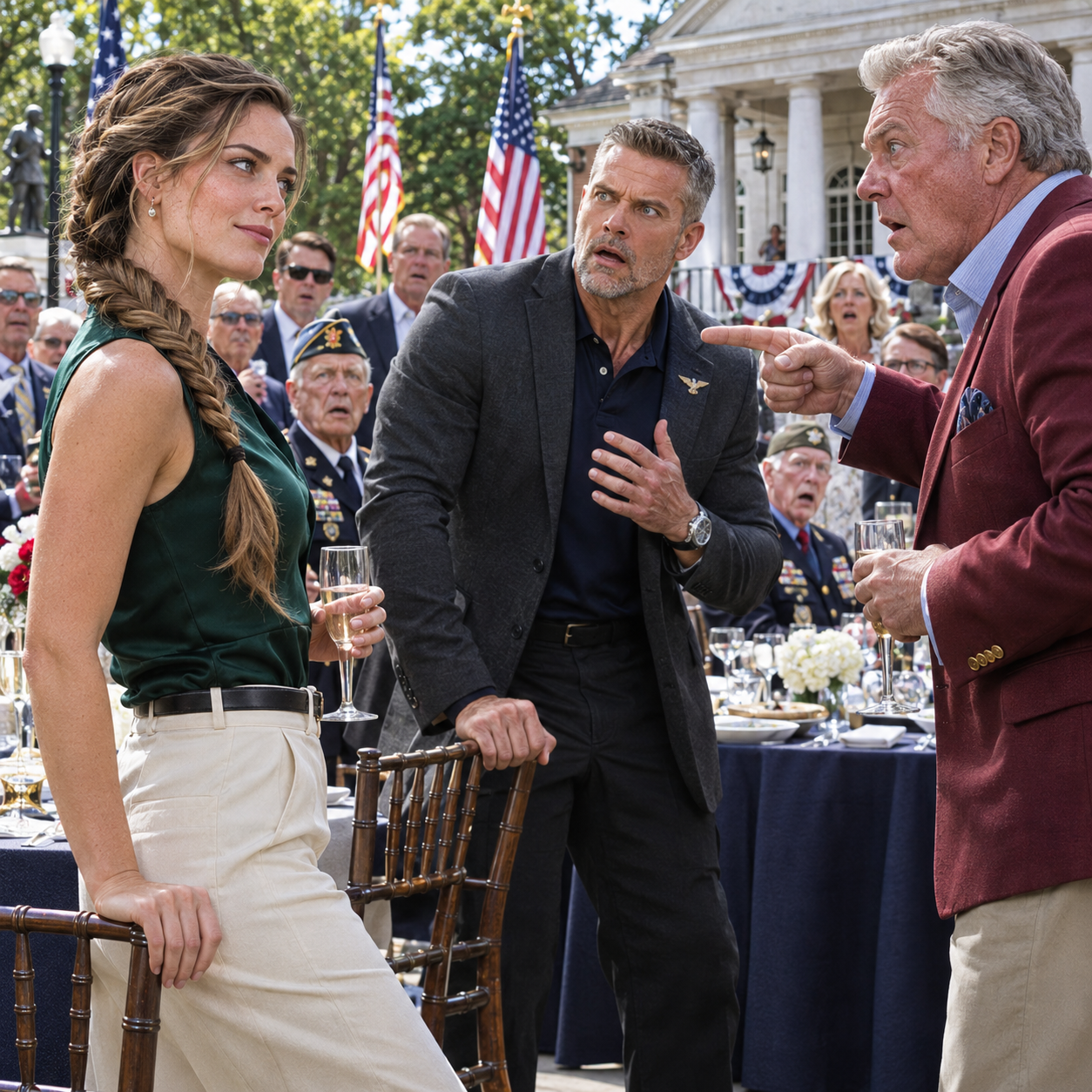
After thanking the sponsors, Dad asked Graham to stand and described a dangerous overseas mission in broad, dramatic strokes. Graham remained seated, his expression hardening as Dad hinted at details he had never been given permission to share. Then Dad spotted me beside Mabel and smiled into the microphone. “My daughter made it, folks. Marin works with computers for the Air Force, pushing papers where the air-conditioning never quits.” The room gave him the easy chuckle he had trained it to give. I felt Mabel’s hand close around her cane.
“She’s a good girl,” Dad continued, “but when trouble comes, you want a man like Lieutenant Rourke, not somebody who knows how to make a spreadsheet.” A few people laughed louder, and others looked into their drinks. My aunt Celia, sitting three tables away, lowered her eyes instead of objecting. Dad lifted his glass toward Graham. “Some people serve by doing the fighting, and some people serve by staying safely out of the way.” I could hear the refrigerator motor behind the bar click on.
Graham didn’t raise his glass. He looked at my face, then at Dad, as if he was weighing whether speaking would help or only make me the center of a larger spectacle. I gave a small shake of my head, not because I was protecting my father but because I didn’t want this night turned into a debate about my worth. Mabel whispered, “He’s wrong, you know.” I said, “I know,” and helped her steady her plate on the table. That was the first time the words had sounded true without effort.
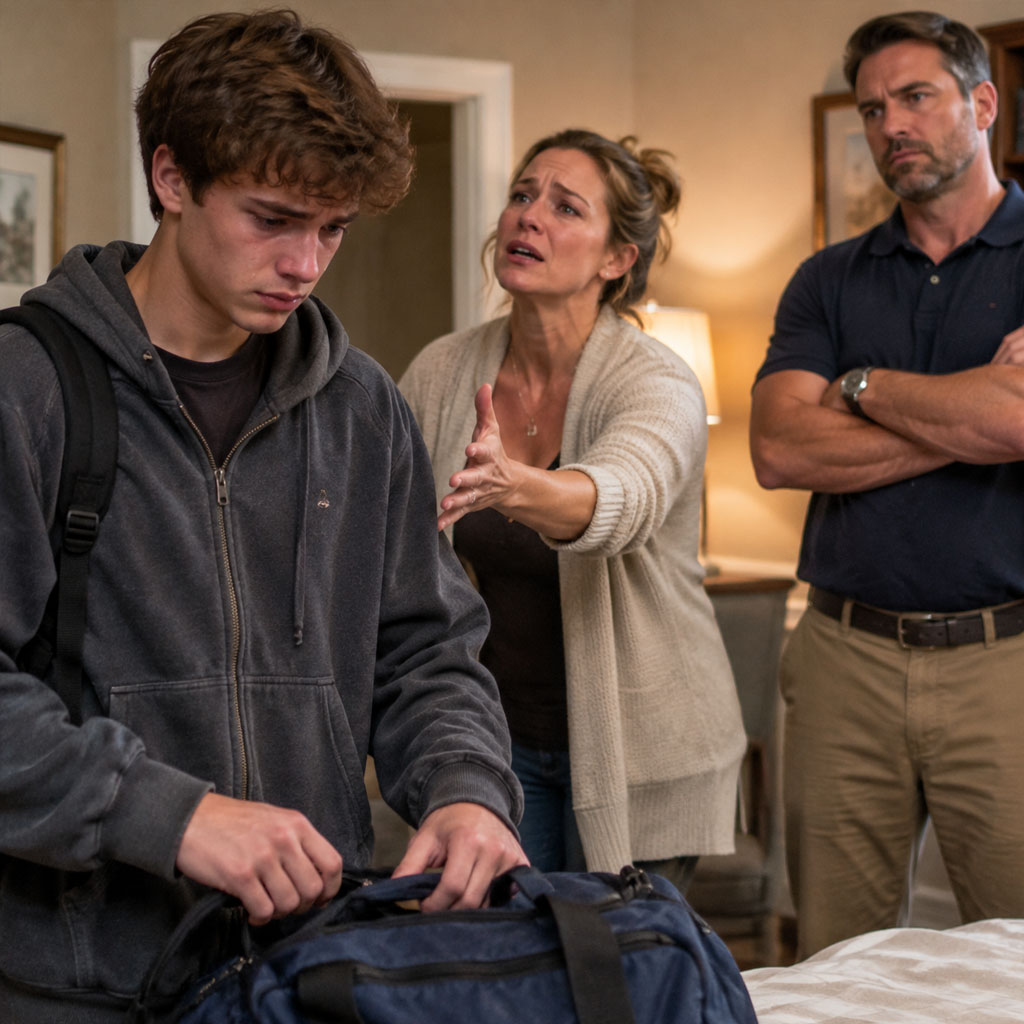
When the applause finally moved on, Dad caught my sleeve and asked why I looked so serious. “You can take a joke, can’t you?” he said, smiling for the donor beside him. “I can,” I answered. “What I won’t do is help you make that joke again.” His smile held for another second, then disappeared. He called me sensitive under his breath and stepped away to introduce Graham to the county commissioner. I picked up my coat, said good night to Mabel, and walked through the side exit without making a scene.
By Monday, a photograph from the dinner had reached my work email through a colleague who recognized me in the background. It showed Dad and Graham beneath the banner, and below it was a link to the fund’s new promotional booklet. On page four, a quotation attributed to me praised my father’s leadership and promised that my “professional military network” would help identify candidates for the next round of grants. I had said no such thing. Beneath the quotation sat an image of my signature, lifted from a letter I had written years earlier to thank a donor.
I called the number on the booklet and asked who had approved my endorsement. The volunteer on the line sounded startled, then told me the chairman had personally supplied it. Before I could ask anything else, she said, “Major Vale, is it true you’re arranging for Lieutenant Rourke to receive a special honor next month?” My hand went still on the desk. The invitation list for that ceremony hadn’t been released, and my father had never asked me about it.
## Part 2
I printed the booklet at home, not at work, and put it beside my mother’s old photograph on the kitchen counter. The signature was unmistakable, including the unusual stroke on the V. Dad had scanned a thank-you letter I wrote in college and attached it to an endorsement I hadn’t given. Instead of confronting him, I sent the fund’s board secretary a short message asking her to remove my name and signature immediately and preserve the source material.
The secretary, Ruth Kessler, replied within an hour. She asked to meet Friday. I agreed and called the appropriate office at my base about an unauthorized use of my military title in charitable advertising. The officer made a note of it. She also reminded me that a retired colonel couldn’t use family ties to imply official military support for his fundraising efforts. I knew my father would hear that as an insult rather than a rule.
When I was thirteen, he’d taped a schedule to our refrigerator the week after my mother’s funeral. Breakfast at six-thirty, homework at five, lights out at nine, no exceptions for grief. He said structure would make me strong, then complained when I cried during a school concert because someone else was playing the piano my mother used to play. I studied until the house went dark because numbers stayed where you put them. Years later, when I earned my commission, he told relatives I’d found a safe way to wear a uniform. I didn’t argue; by then I knew argument only gave him another audience.
Eleven months earlier, during an overseas operation whose public summary would eventually be approved for release, I was leading the overnight watch when a team of twelve moved toward a remote valley. For weeks, reports had pointed to the same location, but one detail bothered me: a local source’s last message arrived too neatly, confirming information we hadn’t asked him to confirm. Our aerial picture failed just as the team approached a narrow stretch of ground. People around me began searching for an alternate feed. I pulled up the earlier reporting and asked them to compare the timing instead of treating the newest message as the most reliable one.
The team leader’s voice came through with a hiss of static. “Control, we’re approaching the route change. Do you have eyes?” I knew the voice only as the officer in charge of the ground element, and he knew me only by the call sign Harbor. It had been chosen on a boring Tuesday from a list of approved words, but the team liked to joke that I could find shelter in a storm. I asked the leader to stop and wait while we checked a different source. He answered with a single measured “Copy,” and I heard wind scratching against his microphone.
An alternate sensor came online and showed movement on the high ground where our original information had predicted nothing. We couldn’t identify every shape, but the pattern was enough to make the original route unacceptable. I recommended a withdrawal to safer terrain and told the ground commander exactly what we knew and what we didn’t. “Hold where you are,” I said. “The map is telling us less than the silence is. Don’t give that silence your people.” He made the decision to turn, and I watched the team move out of danger while we rebuilt the picture around them.
Later, an investigation found that someone had deliberately fed misleading information into the reporting chain, hoping the Americans would follow it. I wasn’t the only person who had caught inconsistencies, and the operation succeeded because a dozen people made disciplined decisions when the plan stopped making sense. But the team gave me credit for insisting on the pause when everyone wanted to keep moving. Afterward, their commander sent a note through official channels: All twelve returned. Tell Harbor her voice was the last thing I heard before we changed course. I kept a copy in a locked drawer and never showed Dad.
Three weeks after the dinner, Graham Rourke stood outside my apartment building with a paper folder pressed beneath his arm. He had requested a conversation without discussing our service over the phone. “I owe you an apology for not speaking up at the dinner,” he said when I came down. I told him the joke was my father’s, not his, and he looked relieved only for a moment. “He keeps telling people you’ve promised him access to a military awards event,” Graham continued. “I told him to stop using my name in his pitch. He said you were handling it.”
We sat at a picnic table under a light that attracted every moth in Maryland. Graham unfolded the same brochure I’d received, along with a separate sheet advertising a private reception honoring his “extraordinary operational record.” He said Dad had offered to sell sponsorship tables there, although no military organization had authorized such an event. Then Graham looked at me with the same unsettled expression I’d seen across the Legion hall. “I heard a woman once, over a very bad radio connection,” he said. “You sound like her when you stop to think before answering.” I kept my face still and told him I couldn’t discuss operations or identities.
He nodded and didn’t press. Instead, he slid another page across the table: a budget summary Dad had given him to prove the charity was thriving. One column listed emergency home-access grants, including Mabel Quinn’s request, as “deferred”; another showed a large payment for a brass commemorative wall bearing my father’s name. The payment came from money donors had specifically marked for home repairs. Graham tapped the figures once, without saying what either of us was thinking. The woman who couldn’t climb her own steps had helped finance a monument to the man who wouldn’t return her calls.
## Part 3
Ruth’s first conversation with me had been cautious. The second, after she examined the budget Graham showed me, was not. She brought donation letters, board minutes, and copies of invoices, all drawn from the charity’s own records. “I thought we were behind on applications because the economy got bad,” she said. “Now I think we were behind because your father decided photographs of donors mattered more than the people they were donating to.” She slid a list across the table: seventeen requests delayed during the monument project.
People had written “ramp,” “heating,” or “job training” on their checks, and the fund had deposited the money into accounts intended for those purposes. Dad had then persuaded a small finance committee that an expensive tribute wall would attract future donors, so the charity temporarily borrowed from the restricted accounts to pay for it. No board vote had authorized the transfer, and no repayment schedule existed. “We have to fix this properly,” she said. “I won’t turn it into a family argument.”
Mabel agreed to meet us at a diner near the hospital, where she ate her eggs with one hand because the other was stiff from arthritis. She showed us photographs of the front steps that had kept her inside through a week of icy weather. When Ruth apologized, Mabel didn’t cry or thank her for noticing. “I filled out every form they gave me,” she said. “I didn’t ask for a statue. I asked to get to my own mailbox.” Afterward, Ruth stared through the diner’s window at the municipal flag twisting in the wind. She looked like someone reexamining years of her own silence.
Dad called that afternoon. “Did you go digging through my charity?” he demanded, skipping hello, and I knew somebody on the committee had spoken to him. I told him I’d asked that my name be removed and had reported what I’d personally seen; the directors would make their own decisions. “Graham’s turned against me because of you,” he said. I reminded him Graham was an adult with a judgment of his own. There was a pause, followed by the familiar command: “You will not embarrass this family.” I looked at the photograph of Mom above my desk and said, “You don’t get to call your reputation the family.”
That night, Aunt Celia arrived with a shoebox and stood in my doorway as though she expected to be turned away. She had heard about the review and wanted to give me papers she’d kept since my mother’s funeral. “Elise left these with me because she thought Theodore would throw them out,” she said. I was angry that Celia had watched him belittle me for decades while holding something my mother wanted me to have. She didn’t defend herself. “I should have handed them to you years ago,” she admitted, leaving the box on the table and going home without asking me to forgive her.
Inside were canceled checks, photographs, and my mother’s handwritten notes on the fund’s first grants, including a picture of Mom helping a former Army mechanic measure his front door while wearing the yellow raincoat I remembered from childhood. On a folded piece of stationery, she’d written: “Theodore wants a dinner where officials can see what we do. I want people to get what they need without having to tell their worst stories in front of an audience. If the fund ever becomes about our name, it has stopped being mine.” I read it until the words blurred, then found the original charter reserving designated gifts for direct assistance.
Meanwhile, I received official confirmation of an award I’d tried not to think about. General Evelyn Saye had nominated my team, and a sanitized citation was approved for an awards ceremony. I would be called forward as the team lead, but the paperwork described contributions from everyone involved. The operation’s sensitive details would remain private. For once, I could let someone say what I’d done without choosing between secrecy and self-respect.
Graham had been asked to attend as the ground-team representative, and we confirmed our identities in an authorized briefing room, with clearance and permissions settled before either of us spoke. He stared at the closed folder on the table before saying, “That night, I thought my people were going to die because I’d trusted the wrong information.” He swallowed and added, “You gave me room to make a different decision.” I told him he had made that decision himself. He smiled without looking up. “I’m still going to say thank you.”
I had one family guest invitation. I could have given it to Celia, but I wasn’t ready to sit beside her after the shoebox, and I didn’t want Graham carrying the burden of explaining himself to my father forever. I invited Dad, with no explanation beyond the time, location, and dress requirements. His response arrived twelve minutes later: Glad they’ve finally recognized Graham. I can help introduce him to the right people afterward. I wrote back that no fundraising, sponsorships, or introductions were permitted and that security would enforce the guest rules. He replied with a thumbs-up emoji, which was how I knew he hadn’t listened.
The evening before the ceremony, Ruth called with the results of the accountant’s preliminary review. The restricted funds could be restored if the monument project was canceled and its deposits recovered, but Dad had signed a second contract that would cost the charity more money to unwind. He’d done it two days after the Legion dinner, using that night’s new pledges. “He actually wrote it on the authorization form,” Ruth said. Under the justification line, my father had entered four words: For the family’s legacy.
## Part 4
The ceremony took place at a base auditorium with dull blue seats, a polished wooden stage, and a lobby display devoted to the men and women who had served there before us. It wasn’t the secret fortress my father imagined. Guests showed identification, signed in, and received programs containing only information approved for release. I wore service dress and stood near the aisle while families found their seats. Dad arrived in a tailored blazer with his retired rank embroidered on a small lapel pin, carrying a folder that looked suspiciously thick for a guest who had been told not to solicit donations.
“Where’s Graham sitting?” he asked before greeting me. I pointed him toward the front section reserved for operational participants. “Good. I want to be near him when they call his name.” He glanced at my uniform and said, “Nice to see they’ve let your office people attend in dress blues.” Ushers were already guiding guests down the aisle. I said, “Read the program, Dad,” and returned to my seat with the other recipients.
Graham caught my eye across the room and gave a brief nod. Beside him sat two members of his old team, one with a healing scar at his temple and another balancing a small stuffed rabbit on his knee for the child in his lap. They didn’t look like magazine covers. They looked tired, slightly uncomfortable in formal clothing, and glad to be home. Dad leaned across the aisle and began talking about Graham’s achievements to a stranger whose name he hadn’t asked. When the stranger turned away to soothe his daughter, Dad looked offended.
General Evelyn Saye stepped to the microphone without music or theatrical lighting. She spoke first about maintenance crews, medical personnel, analysts, and families whose work was usually invisible at celebrations of military success. Then she described a joint operation in which a ground team had reached a dangerous decision point while essential information was failing. She did not identify the country or the target, and nobody in the room needed her to. “A commander on the watch floor questioned a report that supported the plan,” she said. “She recommended a pause, and that pause allowed the ground leader to make a decision that brought twelve Americans home.”
I saw Graham lower his head. My father, meanwhile, leaned forward with a broad smile and placed a hand on Graham’s shoulder, apparently preparing to help him rise. General Saye continued, describing how the analysts had challenged one another’s conclusions and how several branches of the team had worked together to recover the truth. “The ground personnel called their voice of reassurance Harbor,” she said, using the nickname cleared for the ceremony. Graham’s head came up sharply. He looked past the stage at me, and the recognition I’d seen in the Legion hall finally settled into certainty.
“Major Marin Vale,” the general announced, “please join me.” My father kept his hand on Graham’s shoulder for a second too long, as if he thought his own ears had failed him. Graham stood to applaud, followed by the people around him, and I made my way down the aisle through the sound of palms meeting palms. I wasn’t watching Dad at first. I was watching the little girl with the rabbit, who was clapping enthusiastically without understanding why grown-ups were suddenly crying. Then I passed my father’s row and saw him staring at me as though he had never learned my name.
Onstage, General Saye handed me a citation and quietly reminded me that our whole team was being recognized. I thanked her and stepped to the microphone to give the short remarks I had written the night before. I spoke about people willing to question their own conclusions and about commanders who listened when an analyst said the available picture was incomplete. “No one gets home because one person needs to be a hero,” I said. “They get home because people trust one another enough to change their minds.” In the front row, Graham wiped his face with the heel of his hand, and Dad sat very still.
Afterward, families gathered around the refreshment tables, and the little girl proudly introduced her rabbit as Captain Buttons. Graham approached me with the two men from his team and made the introductions properly, without turning gratitude into a performance. “So you’re Harbor,” one of them said, offering a handshake. “We used to argue about whether you’d have a Texas accent.” I laughed and told him he’d lost the bet. Graham waited until the others wandered away before saying, “I knew at the dinner that I’d heard you somewhere. I’m sorry I let him talk about you like that.” I told him he could choose what to do differently next time.
Dad finally approached while I was setting down a paper cup of coffee. He looked past me at General Saye, who was speaking with the families of the other recipients. “You should have told me,” he said, keeping his voice low. I asked what he would have done with the information. He opened his folder, revealing promotional brochures with the new wall’s design, and said, “This could save the fund, Marin. Your award, Graham’s reputation, the family name. We could explain everything to the donors together.” I closed the folder with one finger and told him to put it away.
“You used my signature without permission,” I said. “You spent money meant for people’s homes on a wall with your name on it. Don’t make my work part of your excuse.” His face flushed, and for the first time he looked less like a retired colonel than a man who had lost control of a meeting. “Your mother would have understood what I’m trying to build,” he insisted. I thought of her yellow raincoat, her small neat handwriting, and the ramp Mabel still needed. “No,” I said. “She left written instructions about exactly this.” The fear that crossed his face told me he knew which instructions I meant.
## Part 5
Dad stared at me over the closed folder. “She wrote plenty of things when she was sick,” he said, his voice suddenly small. “She couldn’t see what it would take to keep the fund alive.” That was when I understood the fear I’d seen in his face: he didn’t think the letter was a misunderstanding, and he hadn’t forgotten the arguments behind it. He knew my mother had wanted emergency assistance protected from the expense of ceremonies. “You could have told the board, or me,” I said. He looked toward the general and answered, “I built something people respected.” He still couldn’t hear the difference between being respected and being useful.
The board met ten days later without him presiding. Ruth had hired an independent accountant, and the charity’s attorney explained which donor restrictions remained binding despite changes to the fund’s name and bylaws. The review found no evidence that Dad had personally taken the money, but he had authorized spending that the fund was not allowed to make. His assurances that new donations would eventually cover the shortfall weren’t an accounting plan. The directors voted to remove him as chairman, cancel the wall, and negotiate repayment of the nonrecoverable costs. They also notified the appropriate state office and wrote to every affected donor.
The oldest records made the most painful reading. Years before her death, my mother had opposed a proposal to spend assistance money on a grand annual banquet, and Dad had argued that donors needed to see the organization looking successful. She’d persuaded the original directors to protect gifts designated for individual families, and he’d signed the minutes acknowledging the vote. After she died, he treated those protections as inconvenient relics and gradually surrounded himself with people who trusted his title. What Ruth uncovered wasn’t one extravagant mistake; it was a choice he’d made repeatedly whenever a person in need competed with his idea of an impressive legacy.
Ruth found an experienced contractor willing to begin Mabel’s ramp while the board finalized restitution, and I drove out on a Saturday to help clear flowerpots from the porch. Mabel supervised us from a lawn chair under a wool blanket, calling instructions in the cheerful, unforgiving voice of somebody who had once run a field clinic. When the last rail was secured, she tested it slowly, one hand on her cane and the other brushing the new wood. At the bottom she turned around and looked back at her front door. “Now,” she said, “I can come and go without asking a neighbor to carry me.” Nobody took a photograph for a brochure.
Dad left three voice messages during that month. The first accused me of ruining a lifetime of service, the second asked whether General Saye might provide a letter that would help him with the board, and the third said he had always been proud of me but didn’t know how to show it. I returned only the last call. “You knew how to show pride,” I told him. “You showed it to Graham in front of everybody, every chance you got.” He said he hadn’t meant to hurt me, and I answered, “You were told that you had, and you kept doing it.”
He asked what it would take for us to be a family again. I watched a delivery truck stop beneath my apartment window while the driver searched for a package in the back. For years, I’d imagined that question as the beginning of an apology I could finally accept; now it sounded like another request for me to do the emotional work he had refused to do. “I won’t be part of your public story or your private excuses,” I said. “Please don’t contact my workplace, and don’t ask other people to speak for you.” I didn’t promise forgiveness. I wished him well and ended the call.
Celia wrote me a long letter that winter, admitting how often she’d chosen an easy family dinner over standing up for a grieving girl. I read it and put it in a drawer, not ready to build a relationship out of her late understanding. At work, life continued in its unremarkable rhythm: early briefings, faulty coffee machines, careful decisions, and colleagues who argued with me because they trusted my judgment enough to challenge it. I took a pottery class on Thursdays and learned to make bowls that leaned slightly to one side. For the first time, being good at something didn’t feel like an audition for my father’s attention.
Graham sent a photograph the following spring, approved for sharing and entirely ordinary. He was standing in a backyard beside the members of his old team, holding a crooked birthday cake while the little girl from the ceremony grinned behind seven candles. His message said, “She calls it the year of Captain Buttons. Thought you’d appreciate the update.” I did. The next time Graham and I worked together, he disagreed with my assessment during a planning session, and we spent twenty minutes examining the evidence until we found what neither of us had noticed. That was respect, too: neither of us needed the other to be a legend.
A year after the Legion dinner, I visited Mabel on a bright October morning. The ramp had weathered to a soft gray, and she had set two pumpkins by the rail because she could finally carry things through her doorway without fearing the steps. The fund had a new name, a larger independent board, and a simple policy that put applicants before banquets; my mother’s name appeared only in its history, where she would have wanted it. Mabel handed me a cup of coffee and asked whether I’d heard from my father. “Not in a while,” I said, and realized it was true. Beyond her porch, the mail carrier turned into the driveway, and Mabel went down the ramp to meet him herself.
THE END!
Disclaimer: Our stories are inspired by real-life events but are carefully rewritten for entertainment. Any resemblance to actual people or situations is purely coincidental.