
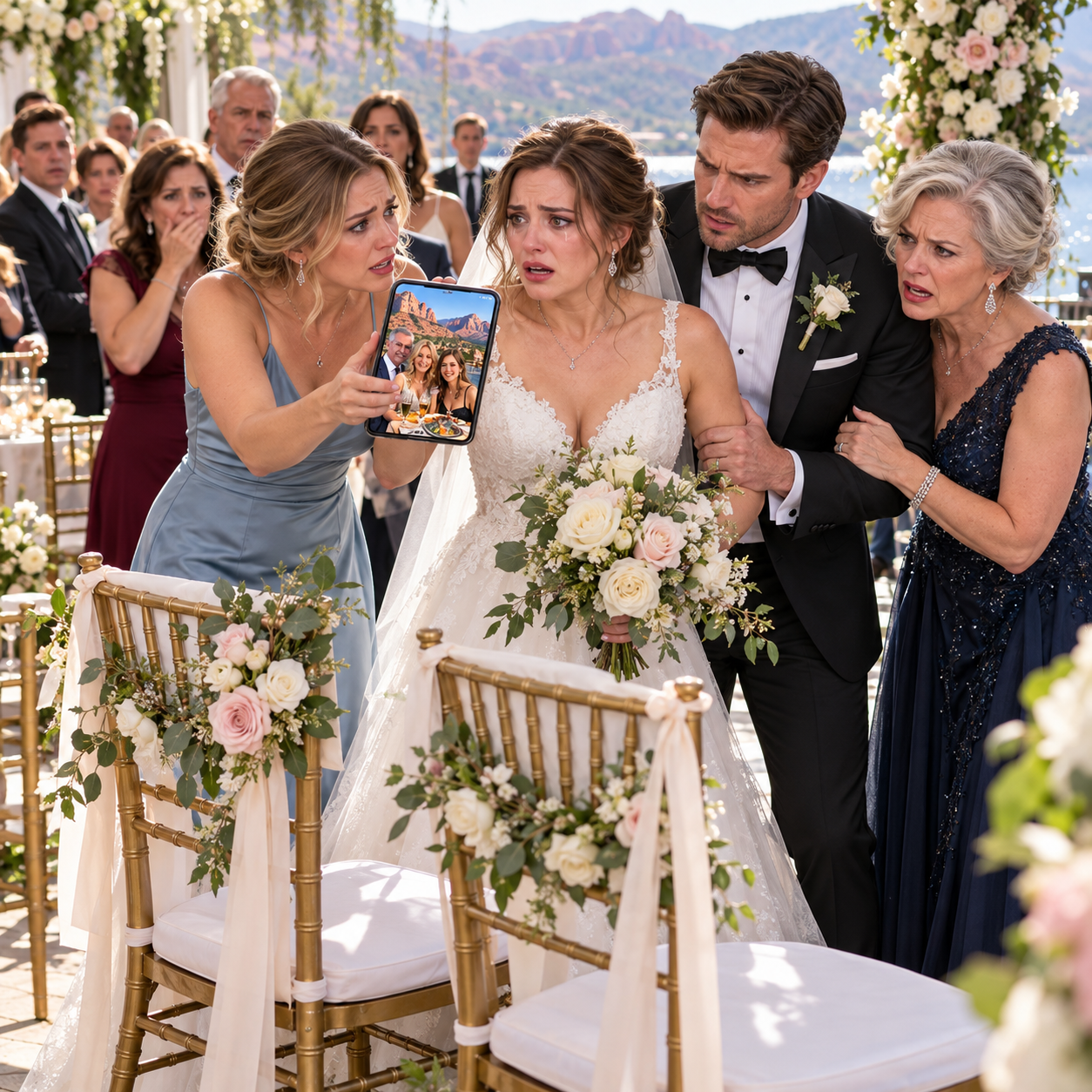
2 chairs sat empty at my wedding because my parents chose my sister’s “healing retreat” over walking me down the aisle. They had even canceled the $4,800 payment promised for my rehearsal dinner. I gripped my aunt’s arm, swallowed my tears, and married Ethan anyway. Then a cousin shoved a photo beneath my nose: my parents laughing beside my sister at a lavish Sedona rooftop restaurant. On the table sat a card that made my stomach drop: “ROMANCE WEEKEND PACKAGE.”
### Part 1
The first time my mother asked me to move my wedding, she said it so casually that for several seconds I thought I had misunderstood her. I was standing in her kitchen with a mug of coffee cooling between my hands while rain tapped softly against the window over the sink, and she was rearranging a bowl of lemons as if we were discussing changing a restaurant reservation instead of a wedding date that had been booked nine months earlier.
My name is Claire Hart, and until that afternoon I had spent thirty-two years becoming extremely good at being the reasonable daughter. My younger sister, Brielle, was allowed to be sensitive, overwhelmed, spontaneous, heartbroken, misunderstood, or “in a complicated season.” I was organized. Reliable. Flexible. Those words sounded like compliments when I was young. It took me years to understand they were also instructions.
My fiancé, Ethan Cole, and I had chosen June 21 for reasons that were almost embarrassingly practical. The glass chapel outside Columbus was available, Ethan’s grandmother could travel then, the florist could guarantee the white peonies I loved, and our photographer had one Saturday left before his summer schedule filled. We had already paid deposits, mailed invitations, arranged hotel blocks, booked musicians, ordered rentals, and listened to my mother debate chicken versus salmon for nearly three weeks.
Then Brielle’s boyfriend left her.
To hear my parents describe it, he had abandoned her at sea during a hurricane. In reality, they had dated for eighteen months, argued constantly, broken up twice, reconciled twice, and finally ended things after he told her he was exhausted from having every disagreement interpreted as emotional betrayal. Brielle moved home for eleven days, cried into expensive throw pillows, and discovered an online retreat in Sedona promising “restoration,” meditation, desert excursions, guided reflection, and what appeared from the photographs to be an extraordinary amount of lounging beside resort pools.
The retreat ran June 21 through June 25.
My wedding was June 21.
“She needs us,” Mom said, finally turning away from the lemons. “This could be an important turning point for her.”
“Then she can book another session.”
“She says this is the only one that feels right.”
I looked at my mother, waiting for the rest of the sentence, because surely no adult woman was going to ask her daughter to relocate an entire wedding because another adult daughter preferred one particular weekend in Arizona.
Dad entered from the garage before she had to say it. He wiped grease from his fingers with a shop rag and leaned against the counter. “Your mother thinks you should consider another date.”
I laughed once. It wasn’t amusement. It was the sound a person makes when reality becomes too ridiculous to absorb quietly.
“People have flights,” I said. “Ethan’s grandmother arranged a medical transport service. We’ve paid thousands in deposits.”
“Money can be replaced,” Mom replied.
“Dates can be changed,” Dad added.
There it was. The family motto I had never heard spoken aloud: Claire can move.
I thought about my sixteenth birthday, when we left my dinner early because Brielle had been excluded from a sleepover. I remembered my college graduation, when my parents missed the department reception because Brielle was having a crisis with a roommate. I remembered my engagement dinner turning into a two-hour discussion about whether Ethan’s proposal had triggered Brielle’s fear that everyone else was moving forward without her.
“I’m not changing it,” I said.
Mom’s face tightened. Dad straightened.
A few seconds later the side door opened and Brielle walked in wearing cream leggings, an oversized sweatshirt, and the solemn expression she used whenever she wanted ordinary selfishness to sound medically significant.
“I knew you’d react like this,” she said.
“You booked a vacation on my wedding weekend.”
“It’s not a vacation.”
“The website has massages.”
“It’s restorative work.”
“It has a heated infinity pool.”
Her eyes immediately filled. “This is exactly why I didn’t want to discuss it with you. You have no respect for what I’ve been going through.”
I should have argued. Old Claire would have argued beautifully. She would have explained every contract, every guest, every dollar, every logistical consequence until everyone agreed she had technically earned the right to keep her own wedding date.
Instead I looked at all three of them and finally understood that they already knew.
They simply expected me to surrender anyway.
“I’m getting married June 21,” I said. “You can come or not.”
Dad’s expression hardened. “Maybe marriage will finally teach you that you’re not the center of this family.”
The sentence landed with almost surgical precision.
Then Mom folded her hands and whispered, “If you refuse to compromise, your father and I will go with Brielle.”
I looked at her.
“You’re saying you’ll miss my wedding?”
“We’re saying choices have consequences.”
For one second I could hear nothing except the kitchen clock ticking above the pantry and rainwater sliding through the gutter outside. Then I picked up my purse.
“So do yours.”
Brielle gave me a wounded look. “I never asked them to choose.”
“No,” I said. “You just booked something on my wedding date and waited for them to do what they always do.”
I left before anyone answered.
My hands shook so badly in the driveway that I sat behind the steering wheel without starting the car. A message appeared on my phone before I pulled away.
Brielle.
I hope someday you understand that compassion matters more than one perfect day.
I stared at those words until something inside me stopped hurting and began changing shape.
When I got home, Ethan was rolling pizza dough on our kitchen counter, flour streaked across his forearm. He looked at my face, put down the rolling pin, and listened while I told him everything.
When I finished, he didn’t say my parents would come around.
He didn’t tell me to forgive them.
He pulled a legal pad from a drawer and wrote five words across the top.
WEDDING WITHOUT CLAIRE’S PARENTS.
My throat tightened.
“They’re really going to do it,” I whispered.
Ethan looked at me across the counter. “Then we stop planning around the people we wish they were.”
That night, my mother confirmed by text that she and Dad would not attend unless I reconsidered.
The following morning, the restaurant hosting our rehearsal dinner called.
The payment my parents had promised to make had been canceled.
And suddenly their absence was no longer the worst thing they had taken from me.
### Part 2
The rehearsal dinner deposit was $4,800. My mother had offered to cover it months earlier, insisting it was “one thing she wanted to do for her daughter,” and because I was apparently still capable of optimism then, I had believed her. When I called Dad from the parking lot at work, he did not deny canceling the payment.
“We had to redirect some resources,” he said.
“To Brielle?”
“She needs support right now.”
“And I don’t?”
“You and Ethan have stable incomes.”
That sentence finished what the kitchen conversation had started. My parents did not think I needed less because I possessed some magical resilience. They gave me less because I had learned to survive it.
Ethan’s parents quietly covered half the rehearsal dinner, while we paid the rest ourselves after cutting welcome bags, upgrading nothing, and giving up the antique car Dad had promised to arrange. Every solution hurt in a peculiar way because none of them were difficult. People simply helped. Nobody required me to collapse first. Nobody made care conditional on how desperate I could make myself appear.
The question of who would walk me down the aisle stayed untouched until my aunt Diane called. She was my mother’s older sister, a blunt woman who owned a small hair salon, drank unsweetened tea year-round, and regarded emotional euphemisms as a personal insult.
“You want company Saturday morning?” she asked.
“For what?”
“For walking into that chapel with your head up.”
I closed my eyes.
“I don’t need anyone to give me away.”
“Good. I wasn’t offering to give you away. I was offering my arm.”
I said yes.
Two weeks before the wedding, Diane took me to lunch at a diner where the booths were cracked and every dessert rotated under scratched glass. After listening to the entire story, she stirred her tea and said, “You know this isn’t really about Arizona.”
“I know.”
“No, sweetheart. I don’t think you do.”
She reminded me of things I had filed away as isolated incidents. Brielle’s dance recital replacing my middle-school award banquet because she was nervous. My parents paying Brielle’s rent after she quit a job while telling me they couldn’t help with my graduate-school application fees. The Christmas when everyone left my house after dessert because Brielle called from three neighborhoods away saying she “felt abandoned.”
“They built a family system around whoever makes the biggest emergency,” Diane said. “You became the safe person to disappoint.”
The phrase followed me home.
Three nights before the wedding, Brielle called from an unfamiliar number. Wind rushed against her phone, and behind her I could hear music and laughter.
“You blocked me,” she said.
“Yes.”
“I hope you’re proud of yourself.”
I stepped onto our balcony so Ethan wouldn’t have to hear her. “What do you want?”
She was quiet for a moment. Then her voice lost the soft therapeutic tone she had been using for months.
“You have no idea what it’s like being your sister.”
I almost laughed. “Apparently it includes resort travel.”
“You always get everything because you’re the good one. The steady one. Everybody trusts Claire. Claire has a plan. Claire never falls apart.”
“That is a strange complaint from someone whose crisis just cost me my parents at my wedding.”
“You don’t understand.”
“Then explain.”
Her answer came after several seconds of background chatter.
“I just wanted something to happen that wasn’t about you.”
The call disconnected.
I stood outside listening to cars move through wet streets below us while the meaning settled.
The following morning was my wedding day.
I woke before sunrise feeling strangely calm. Not numb. Not healed. Simply finished bargaining. The bridal room smelled like hairspray, coffee, and the damp green scent of flower stems. Diane arrived in a deep blue dress and announced that beige had been considered and rejected “on moral grounds.” My friends laughed. I laughed with them.
At four-thirty, the musicians began playing.
Two chairs sat empty near the front.
For a moment I looked at them and felt the old reflex whisper that maybe the doors would open.
They didn’t.
Diane linked her arm through mine.
“You ready?”
“Yes.”
And I was.
The late-afternoon sun poured through the chapel glass as we walked. I heard the quiet scrape of chairs, the cello filling the room, somebody sniffing back tears. Then I saw Ethan waiting at the end of the aisle.
He wasn’t looking toward the doors behind me.
He was looking at me.
That mattered.
We married without my parents. The world did not split open. Nobody whispered about the missing father. Nobody treated me like an abandoned bride. We ate rosemary chicken, danced badly, laughed too loudly, and watched Ethan’s grandfather fall asleep beside the dessert table.
Near sunset our photographer, Marcus, led us behind the chapel where the trees threw long shadows over the garden.
“Don’t pose,” he said. “Just look where you want to look.”
Ethan’s hand rested lightly against my back. Wind lifted the edge of my veil. I looked toward him first, then toward the camera.
The shutter clicked.
Later that evening, my cousin Natalie approached with her phone held awkwardly against her chest.
“I think you should probably know,” she said.
On the screen was a public photo from Sedona.
Brielle sat beneath string lights at a rooftop restaurant, laughing beside a man I recognized as her ex-boyfriend’s former business partner. My mother was raising a cocktail behind them. Dad was grinning beside her.
This was no therapeutic retreat.
Natalie zoomed in on a table card visible near Brielle’s hand.
ROMANCE WEEKEND PACKAGE.
I stared at it.
My parents had not skipped my wedding because my sister needed saving.
They had skipped my wedding because she had wanted something more.
A week later, Marcus emailed our photographs.
There were hundreds of them, but one stopped me cold.
It was the garden portrait.
My veil catching sunlight. Ethan beside me. My face calm, almost startlingly so.
I didn’t look abandoned.
I looked free.
I forwarded that single photograph to my parents without a message.
Mom called the next morning.
Dad texted ten minutes later.
And for the first time in my life, they sounded frightened that I had learned how little I needed their permission.
### Part 3
Mom cried when we finally spoke.
“You looked so happy,” she said.
I sat on the edge of my bed while Ethan read in the next room. “I was.”
The silence on her end lasted several seconds.
Dad eventually joined the call. His voice lacked the confident edge it had carried when he told me marriage might teach me humility.
“We didn’t think you would actually go through with everything without us.”
That sentence told me more than an apology could have.
Their absence had been leverage.
They expected me to panic, reschedule, plead, compromise, or spend my wedding day visibly wounded enough to prove their importance. Instead, a photograph had arrived showing a daughter standing upright in sunlight beside people who had actually come.
Mom invited me to dinner.
“Just us,” she promised.
When I arrived Thursday evening, Brielle’s car was in the driveway.
I nearly turned around.
Inside, she sat at the dining table drinking wine while Dad arranged plates and Mom performed nervous little tasks around the kitchen. The house smelled like lemon cleaner and roasted chicken. Everything looked painfully normal.
“I was told this was just us,” I said.
“We thought everyone talking together might be healthier,” Mom replied.
“An ambush is not healthier.”
Dad told me to sit.
I did, because I wanted to hear what story they had prepared.
Mom began with, “Things got out of hand.”
“No,” I said. “You skipped my wedding. That was a decision.”
Dad frowned. “We made the best choice we could at the time.”
“At a romance package?”
Brielle stiffened.
I placed my phone on the table and showed them the Sedona photograph.
Mom’s eyes dropped immediately. Dad’s jaw tightened.
Brielle rolled hers.
“Caleb joined me for part of the trip,” she said. “That doesn’t mean I wasn’t struggling.”
“You let them think you needed an emergency intervention.”
“I needed to get away.”
“You needed my wedding weekend?”
Her cheeks reddened.
Then she said the sentence that removed the final ambiguity.
“I honestly thought you would move it.”
The room became completely quiet.
“You chose that weekend intentionally?”
“I knew you’d already booked things,” she said, becoming defensive. “But people change wedding dates. It happens.”
Mom whispered her name.
Brielle kept going. “You always get the big stable life moments. I wanted once to matter more.”
There it was. Not healing. Not helplessness.
Competition.
Before I could answer, Dad reached into the sideboard and removed an envelope.
“We wanted to make a gesture toward repairing things.”
Inside was a check for $2,900.
Dated the previous day.
After they had seen the photograph.
“This isn’t an apology,” I said. “This is damage control.”
“You’re determined to interpret everything negatively,” Dad snapped.
Aunt Diane appeared in the kitchen doorway before I could respond.
She had apparently been called by Natalie, who had seen my car outside and suspected exactly what kind of “family dinner” was occurring.
Diane looked at the check.
“Don’t cash that.”
Mom went pale.
I turned toward her. “Why?”
Diane’s expression changed.
“Because that money probably came from what’s left of Eleanor’s account.”
My grandmother Eleanor had died six years earlier. I knew she had left modest inheritances, furniture, jewelry, and her beloved lake house in a family trust.
I did not know she had created a separate investment account for me.
Mom had been its custodian.
The next morning Diane and I visited Eleanor’s old attorney, Martin Lowell. He confirmed the account had existed and helped me request historical statements.
When the records arrived, Ethan sat beside me at our dining table while I opened them.
The balance when I turned twenty-five had been $19,384.
Then the withdrawals began.
$4,000.
$3,500.
$2,700.
$5,200.
Each one appeared around some Brielle disaster I remembered: a broken lease, an abandoned certification program, months without employment, a failed business attempt.
The most recent withdrawal was $6,900.
Twelve days before my wedding.
The attached transaction history showed airfare to Arizona, a resort deposit, restaurant charges, spa expenses, and a guided desert excursion.
I felt physically cold.
My parents had taken money my grandmother left for me to fund the trip they demanded I move my wedding around.
Ethan stood behind my chair reading silently.
“We need a lawyer,” he said.
Dad called before I could answer.
“I know you received the statements,” he said.
Not hello.
Not I’m sorry.
“Your mother is devastated.”
I laughed quietly.
“Of course she is.”
“That money remained within the family.”
“My name was on it.”
“Brielle is your family.”
“She is not entitled to inherit from me while I’m still alive.”
His voice sharpened. “Come over.”
I did.
But I brought Ethan, Diane, and a formal letter from an attorney requesting a complete accounting of every withdrawal and preservation of all financial records.
Dad read the first page and looked at me as if I had committed the betrayal.
“You hired a lawyer against your own parents?”
“No. I hired a lawyer because of my own parents.”
Mom covered her face.
Brielle stood abruptly. “All of this because of money?”
I looked at her.
“No. The money is just the first thing nobody can rewrite.”
Then Diane mentioned something else.
Grandma Eleanor’s lake house.
A trust meeting had been scheduled for the following week, and my parents had planned to ask me to sign a restructuring agreement.
Nobody had told me about it.
When I asked why, Mom looked away.
And before anyone said another word, I already knew whose emergency they expected my property to solve next.
### Part 4
The proposed trust agreement would have transferred operational control of Grandma Eleanor’s lake house to my parents, with a “future compensation plan” for my share.
At the attorney’s office the following Tuesday, I asked one question.
“Why?”
Dad gave me three answers before reaching the real one. Maintenance costs. Taxes. Simplifying ownership.
Finally Mom whispered, “Brielle owes money.”
Of course she did.
Sedona had included more than romance. Brielle and Caleb had been discussing a wellness business—a rented studio offering meditation classes, sound sessions, boutique products, and weekend events. Caleb introduced her to an investor. Contracts were signed carelessly, money changed hands, and the fantasy collapsed before the first customer ever entered the building.
Brielle owed $24,000.
My parents wanted to use the lake property to solve it.
Again.
I stared across the conference table at the three people who had spent my entire life describing my endurance as a personality trait.
“You were going to have me sign away part of Grandma’s house before I knew you had already taken my money.”
Mom began crying.
“We were going to compensate you.”
“With what?”
Nobody answered.
Brielle folded her arms. “Why does everything have to become evidence with you?”
“Because stories are easy for you. Numbers aren’t.”
She flinched.
Dad pushed the agreement toward me. “We’re trying to keep this family together.”
I pushed it back.
“No. You’re trying to keep Brielle from experiencing consequences.”
His chair scraped loudly against the floor.
“You’ve always had more stability than she has.”
The old compliment. The old trap.
“I had more stability because every time something broke, you handed me fewer pieces and called me strong.”
Mom covered her mouth.
I continued before guilt could stop me.
“You let me lose money because I could survive it. You missed my wedding because you assumed I could survive it. You expected me to lose part of Grandma’s house because I could survive that too.”
“You are stronger,” Dad said desperately.
“No. I was safer to disappoint.”
Even Brielle went quiet.
I refused to sign.
Our attorney pursued repayment of the investment funds, and after weeks of letters my parents agreed to a structured settlement rather than fight over records they could not explain. The lake house remained protected by the original trust. My share stayed mine.
Mom emailed an apology.
The first version contained seventeen variations of “we were trying to help your sister.”
I did not answer.
Months later she sent another.
That one was shorter.
I made your competence an excuse not to protect you. I kept rescuing Brielle because being needed made me feel like a good mother. I did not understand that every rescue had someone else paying for it. I am sorry we missed your wedding. I am even more sorry that we expected missing it to change your answer.
I believed her.
Believing someone is not the same as giving them access.
Dad took longer.
He appeared once at our apartment and accused me of choosing Ethan over my family.
I looked at him beneath the fluorescent lobby lights and finally said something I wished I had understood at twenty.
“I didn’t choose Ethan instead of you. I chose the people who showed up.”
Dad stared at me for a long moment.
Then he left.
Brielle sent messages from new numbers for several months. Some angry. Some wounded. One simply said, I hope winning was worth destroying your family.
I deleted it.
There had been no winning.
There had only been refusing to lose deliberately.
By our first anniversary, Ethan and I had moved into a small townhouse with an uneven backyard and a kitchen cabinet that refused to close unless you lifted it slightly. We hosted friends for dinners. Painted a guest room twice because we hated the first color. Fought about where to store the vacuum cleaner. Replaced a basil plant I kept killing with rosemary, which seemed more willing to tolerate me.
Our wedding portrait sat on a bookshelf in a plain black frame.
Not as revenge.
Not as a shrine.
Just because I loved it.
That photograph had changed everything without containing anything dramatic. No crying parents. No screaming sister. No visible betrayal.
Just me in late sunlight, veil lifting behind my shoulder, Ethan’s hand resting gently against my back.
I looked peaceful.
That was what destroyed the story my parents had told themselves.
They had believed their absence would leave a hole large enough to pull me backward.
Instead, the photograph showed a life continuing around it.
On our anniversary, Ethan and I returned to the conservatory for dinner. The greenhouse smelled exactly as I remembered: warm stone, wet leaves, roses beginning to open. Afterward we wandered into the empty ceremony room, where chairs were stacked against the wall.
I stood near the place where the aisle had ended.
“Do you ever think you’ll forgive them?” Ethan asked.
I considered it.
“I don’t think about forgiving them much anymore.”
“That sounds different.”
“It is.”
Anger had once made me feel connected to them. Every imaginary argument kept me standing in their kitchen, still trying to win a trial they had already rigged.
Indifference was quieter.
A week later an envelope arrived from Mom.
Inside was a photograph of me at eight years old sitting on Grandma Eleanor’s dock with a fishing pole across my knees, squinting angrily at the sun.
On the back Mom had written:
You were never easier. You simply learned earlier that asking us for less hurt less. I see that now.
I sat at our kitchen table for a long time.
It was the most honest thing she had ever given me.
It was also too late to build a relationship on.
I framed the childhood picture and placed it in my home office beside a photocopy of Grandma Eleanor’s estate letter, the one that had eventually surfaced during the legal review.
Grandma had written one sentence that I kept.
Never confuse being able to carry something with being required to carry it.
The wedding portrait stayed in the living room.
My parents eventually saw it again when a relative mailed them our anniversary card. Diane told me Mom cried. Dad reportedly stared at it for several minutes without speaking.
Years ago, that information would have given me satisfaction.
Now it barely moved me.
Because the woman in that photograph was not waiting for them to understand anymore.
She was walking toward the person who had come.
Toward a room full of people who had come.
Toward a life that did not demand she shrink whenever someone else needed more space.
My parents wanted their absence to teach me that I was not the center of the family.
Instead, it taught me something far more useful.
I did not need to be the center of their family.
I only needed to stop living at its edge.
And I did.
THE END!
Disclaimer: Our stories are inspired by real-life events but are carefully rewritten for entertainment. Any resemblance to actual people or situations is purely coincidental.


