
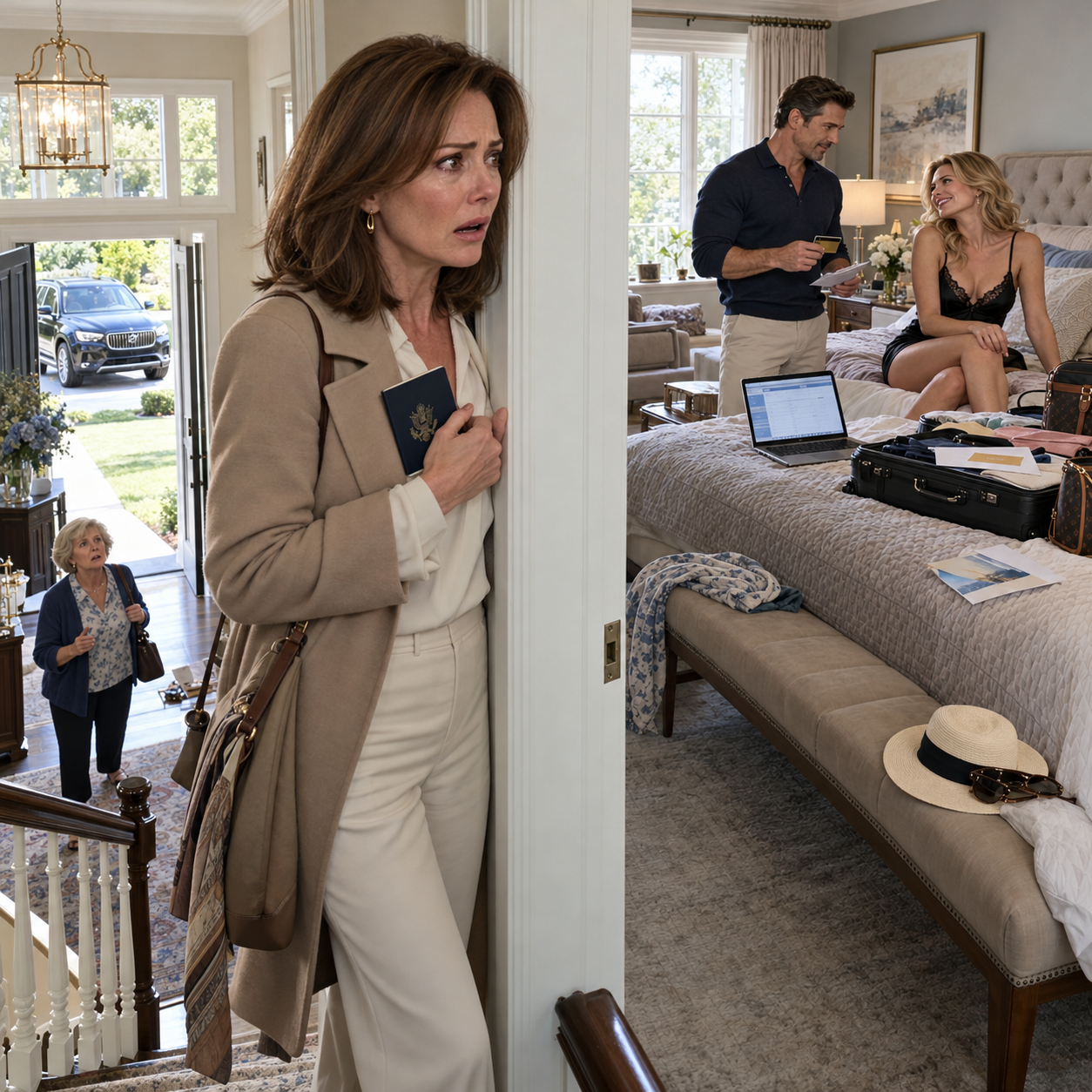
On our 18th anniversary, my husband handed me a luxury cruise ticket—and insisted I go alone. As the car waited outside, my elderly neighbor whispered, “Tell him you forgot your passport. Lock yourself in the bathroom for ten minutes.” I obeyed. Just five minutes later, a strange woman laughed inside my bedroom. “Is Claire gone?” she asked. “Halfway to the terminal,” my husband calmly replied. Then he said, “If the authorization clears, Claire doesn’t have to know anything until Tuesday.”
### Part 1
My husband handed me the cruise ticket over breakfast on our eighteenth wedding anniversary, tucked inside a pearl-white envelope tied with a navy ribbon that looked expensive enough to make suspicion feel ungrateful. Morning sunlight filled our kitchen, catching on the chrome coffee maker and the glass vase of tulips I had bought for myself two days earlier, while Nathan stood across the island flipping pancakes with the concentration of a man trying very hard to look thoughtful.
“Happy anniversary, Claire,” he said, sliding the envelope toward me. “Three nights. Ocean-view suite, spa package, everything covered.”
I looked at the ticket, then at him. Nathan had forgotten our anniversary dinner the year before because of a “client emergency,” yet now he had apparently planned a luxury cruise without asking whether I wanted one. “Why aren’t you coming?”
“My quarterly review got moved.” He smiled and touched my shoulder. “You’ve been carrying too much lately. You deserve a break.”
Deserve. Nathan loved polished words that made questions seem unreasonable. Practical. Temporary. Secure. Deserve. During the previous six months, those words had accompanied unexplained withdrawals, late nights, new passwords, and a faint unfamiliar perfume I had once smelled on the passenger seat of his car.
I almost confronted him then, but marriage teaches you strange forms of self-doubt. You begin wondering whether noticing too much is worse than what you noticed. So I thanked him, packed a small suitcase, and allowed him to carry it downstairs as if he were still the attentive husband our friends believed him to be.
A sedan Nathan had arranged was already turning onto our street when I stepped outside. Across the narrow lawn between our houses, my elderly neighbor, Eleanor Weller, sat on her porch beneath a faded striped awning. Eleanor was seventy-six, widowed, and more observant than every neighborhood security camera combined. She rarely interfered in anyone’s business, which was exactly why I stopped when she called my name.
“Claire.”
Something in her face made me walk closer.
She lowered her voice. “Tell Nathan you forgot your passport. Go back inside with your bag, lock yourself in the upstairs bathroom, and stay there ten minutes.”
I stared at her. “What?”
“Ten minutes,” she repeated. “Not five. Not seven.”
The sedan stopped at the curb. Behind me, our front door opened and Nathan called, “Ready?”
Eleanor held my gaze. “Trust me.”
I had known that woman twelve years. She had collected our mail during vacations, sat beside me at my father’s memorial service, and once called me at work because Nathan had left our garage door open in a storm. She had never once manufactured drama.
I turned toward my husband. “I forgot my passport.”
His expression changed so quickly most people would have missed it. One tight blink. A stiffening around the mouth. Then the smile returned.
“Go grab it.”
I carried my suitcase upstairs, stepped into the hall bathroom, and locked the door. The tile was cold beneath my feet because I had kicked off my shoes downstairs. I sat on the closed toilet lid and listened to the air conditioner hum through the vent.
One minute passed.
Then two.
At four minutes, I heard the front door.
At five, a woman laughed.
The sound was low and familiar in the wrong way, not because I recognized the voice, but because I recognized intimacy. Nobody laughs like that with someone else’s husband unless they already know where the boundaries disappeared.
“Are you positive she left?” the woman asked.
Nathan answered from somewhere near our bedroom. “The car picked her up. She’s halfway to the terminal.”
“She didn’t suspect anything?”
Nathan chuckled. “Claire never suspects until there’s paperwork in front of her.”
My stomach tightened.
The woman laughed again. “That’s terrible.”
“It’s true.”
I pressed my palm against the bathroom wall to steady myself.
Then she asked, “And Monday?”
“Handled. We’ll have the lake documents first. The house review is scheduled afterward. By the time she gets back, the important part will already be finished.”
Every emotion I had expected—rage, grief, panic—arrived together and somehow canceled one another out. What remained was a cold, unnatural clarity.
This was not only an affair.
They were using my absence.
I pulled out my phone and started recording.
The woman said something about movers. Nathan replied that the neighbors had already been given a story about “water remediation.” Then came a sentence that turned my skin cold.
“If the authorization clears,” Nathan said, “Claire doesn’t have to know anything until Tuesday.”
Authorization.
I had not authorized anything.
For nearly ten minutes I listened while the man I had slept beside for eighteen years discussed my life like a schedule. Then I unlocked the bathroom door.
Nathan and the woman were standing in our bedroom. She was perhaps forty, stylish, dark-haired, wearing a cream blouse and gold earrings. My wedding photograph was visible behind her shoulder.
Nathan went pale.
“You’re supposed to be gone.”
That sentence hurt more than seeing her.
I lifted my phone. “Apparently I’m not very good at following your schedule.”
The woman grabbed her handbag. “Nathan, you said—”
“I know what I said.”
“No,” I interrupted. “Please stay. I’m learning so much.”
Nathan recovered quickly. He always did. “Claire, this looks awful, but if you’ll calm down—”
“Who is she?”
The woman answered before he could. “Paige Lennox.”
Nathan shot her a look.
That told me her name mattered.
I opened my contacts and called Adrienne Cole, the attorney who had handled my father’s estate two years earlier. I had met her three nights before after discovering two unexplained inquiries involving the deed to my house. At the time, I had felt ridiculous asking whether I should protect property from my own husband.
Now I felt foolish for waiting.
Adrienne answered immediately. “Claire?”
“Do it.”
“Everything?”
“Everything.”
Nathan stepped toward me. “What are you doing?”
“Protecting myself.”
He laughed, but there was strain underneath it. “From what?”
“Apparently I’ll know once I find the paperwork.”
An hour later, Adrienne was sitting at my dining table while Nathan stood across from her demanding explanations he was no longer entitled to receive. Paige had already left. Nathan had tried following her, but Adrienne calmly informed him that the house—purchased with my father’s inheritance before Nathan’s name was ever added to any household accounts—had that morning been moved into a protected trust according to documents we had prepared three days earlier.
“You can’t remove me from my own home,” Nathan said.
Adrienne looked at him. “It isn’t your property.”
His face hardened.
That was when something slipped from the cruise envelope I had tossed onto the table.
A single photocopied page fluttered onto the hardwood.
I picked it up.
At first it looked ordinary: an authorization granting access to property records, estate documents, financial accounts, and certain trust information during a three-day period beginning that morning.
Then I saw the signature.
Claire Holloway.
My name.
My handwriting, almost.
But not mine.
Adrienne took the page from my hand and read it twice.
Nathan stopped talking.
I looked at him across the table and understood that Eleanor had not saved me from catching my husband with another woman.
She had stopped me from boarding a ship while my husband used a forged signature to dismantle my life.
And when Adrienne quietly asked, “Claire, do you own property anywhere else?” I realized there was one place Nathan had been asking about for months.
A lake cottage my father had supposedly sold before he died.
### Part 2
Nathan left that afternoon with two suitcases and enough wounded dignity to make it seem, from a distance, as though I had betrayed him. He kept saying we had misunderstood one another, that financial pressure had pushed him into decisions he regretted, and that Paige was “complicated.” He never explained why my signature appeared on an authorization form or why he needed me away until Monday.
After the front door closed, Eleanor crossed the lawn carrying banana bread wrapped in foil.
“You knew,” I said when I let her inside.
“I knew something was wrong.”
We sat in the kitchen, where the pancakes from that morning had hardened on a plate beside the sink. Eleanor explained that Paige had visited our house at least three times while I was working. Once she had parked two blocks away. Another time Nathan met her at the side entrance. The previous week, Eleanor had overheard Nathan speaking on his phone beside the hedge.
“He said ‘deed,’ ‘Monday,’ and ‘signature,’” she told me. “Yesterday he asked whether you would have cell service on the cruise.”
I closed my eyes.
“I should have told you sooner.”
“No,” I said. “You told me when it mattered.”
Adrienne arrived before noon with Marcus Dean, a private investigator who had worked with her firm for years. Marcus was quiet, broad-shouldered, and had the unsettling habit of noticing rooms before people. While Adrienne examined the forged authorization, Marcus asked simple questions about Nathan’s office, banking habits, business debts, and recent behavior.
Nathan owned a regional consulting company that he insisted was “between contracts.” For months he had blamed delayed client payments for strange account activity. I had believed him because our mortgage was paid, the lights stayed on, and financially comfortable people often mistake functioning autopay for safety.
Adrienne opened her laptop.
“There’s a company named Blue Harbor Holdings that requested your deed history twice this month,” she said.
I frowned. “Never heard of it.”
“Paige Lennox works there.”
My stomach dropped.
Blue Harbor handled real estate closings, private financing, and distressed-property transactions. Paige was not simply Nathan’s mistress. She had direct access to the exact machinery he would need to leverage property quickly.
Marcus examined several months of our joint statements and found payments to a storage company, a transportation service, and Blue Harbor Consulting. The total was just over thirty thousand dollars.
“He used our money to prepare this,” I said.
Adrienne nodded. “And possibly to hide assets.”
Eleanor, standing beside the counter with her arms folded, muttered, “Cheap men are always expensive.”
By afternoon our joint credit lines were frozen, my salary was redirected, and formal notices had been sent to the county recorder, two banks, and every financial institution connected to my father’s estate.
I expected relief.
Instead I felt violated in increasingly specific ways.
Nathan knew my passwords because I had trusted him. He knew where my father’s death certificate was kept because he helped me organize paperwork after the funeral. He knew which drawer contained my passport because he had once surprised me with an anniversary trip to Maine. Every ordinary intimacy had become potentially useful evidence against me.
Before leaving, Eleanor mentioned something else.
“Last night Nathan carried boxes into his SUV.”
“What kind of boxes?”
“Banker’s boxes. Heavy ones.”
Marcus and I went to the garage.
Nathan’s workbench was cluttered as always, but a clean rectangle in the dust showed where several boxes had recently stood. Beneath the bench, I found a torn adhesive label.
RIDGEMONT STORAGE
UNIT 417
Marcus looked at it, then at me.
“You have access?”
I searched Nathan’s desk.
The third drawer was locked. Inside, behind tax folders, we found a brass key tagged 417 and a manila envelope bearing my maiden name, Claire Benton.
The envelope contained photocopies of my passport, Social Security card, father’s death certificate, car title, trust correspondence, and old bank statements.
Marcus spread them across the desk.
“He created an identity package.”
I sat down because my knees suddenly felt unreliable.
The next morning, with Adrienne beside me and Marcus carrying the storage key, we drove to Ridgemont.
Unit 417 smelled of dust, cardboard, and hot metal. When Marcus lifted the rolling door, I recognized my belongings immediately.
My mother’s china.
My grandmother’s rings.
Two winter coats.
Family photographs.
The silver frame from our wedding.
A cedar chest blanket.
My father’s old watch.
Nathan had been removing pieces of my life before I even knew they were missing.
In the back sat two suitcases and several folders. Adrienne opened the first.
Inside was a draft sales agreement.
Property: 84 Blackwater Ridge Road.
Seller: Claire Benton Holloway.
I stared at the address.
Blackwater Lake.
The cottage my father told me he had sold five years earlier.
“He didn’t sell it,” Adrienne said softly.
A handwritten note had been clipped to the agreement.
Monday, 10:00 a.m.
Lake first.
House after lunch if cruise departure confirmed.
Paige’s handwriting, according to Marcus.
Another folder contained moving schedules and instructions to describe the removal of household property as emergency water-damage restoration if neighbors asked questions.
Then Marcus discovered a small lockbox beneath a blanket.
Inside were cash, a prepaid phone, and a thick binder of emails.
The phone still had power.
One unheard voicemail waited.
I pressed play.
Paige’s voice filled the storage unit.
“Nathan, call me. If Claire misses boarding, we need to postpone everything. And Mallory keeps asking when she gets her share, so deal with your sister-in-law before she creates another problem.”
I stopped breathing.
Mallory.
My older sister.
I replayed it.
Adrienne’s expression tightened.
Marcus quietly asked, “Does your sister know about the cottage?”
“I thought nobody did.”
Then memory started rearranging itself.
Mallory asking about Dad’s estate at Christmas.
Mallory joking that I had always been “the favorite.”
Mallory asking whether Nathan’s company was struggling.
Mallory once mentioning Blackwater Lake even though I had never told her I had discovered anything about it after Dad died.
When we returned home, I searched every box from the storage unit.
Near the bottom of one marked TAXES was a copy of a safe-deposit-box access form from my father’s old bank.
Authorized proxy: Mallory Benton.
The request date was four months earlier.
Nathan gave me the cruise ticket last week.
Which meant my sister had started reaching into my father’s locked financial records months before Nathan tried sending me away.
And whatever this scheme was, my husband had not created it alone.
### Part 3
I drove to Blackwater Lake before sunrise because waiting until lawyers finished making phone calls felt impossible. Adrienne objected. Marcus offered to accompany me. I refused both and promised to call the moment I arrived.
The cottage stood at the end of a narrow gravel road surrounded by pine trees and waist-high weeds, its faded green shutters hanging crooked against cedar siding. My father’s name was still barely visible on the mailbox.
BENTON.
Seeing it made grief return through smell before memory: damp wood, lake water, old leaves, and the faint mineral scent of a place that had spent decades absorbing summers.
Fresh tire tracks cut through the weeds.
A realtor’s lockbox hung from the front railing.
Inside, the cottage appeared abandoned until I noticed details that did not belong. Bottled water on the counter. A clean coffee mug beside the sink. Dust wiped from the kitchen table. A black hair tie on the bedroom floor.
Paige had been here.
On the table lay another Blue Harbor sales packet containing a proposed Monday closing and a note.
Need original trust amendment.
Mallory thinks attic trunk.
My hands began shaking.
The attic was cramped, hot, and thick with insulation dust. In the far corner I found my father’s old military-style storage trunk. Beneath tax records and photographs lay a sealed envelope bearing my name.
Claire.
The letter inside had been written seven months before he died.
If you are reading this, someone finally became too curious about Blackwater.
I laughed once because that was exactly how Dad spoke.
He explained that the cottage had never been sold. Instead, he had placed it and the wooded ridge behind it into a private trust after developers started buying lakefront land. The true value, he wrote, was not the cabin but access through the ridge.
Then came the sentence that made me sit perfectly still.
Mallory knows enough to be dangerous if she feels cheated. Nathan has also asked me about the deed three separate times. Do not let either of them rush you.
My father had suspected both of them.
A floorboard creaked downstairs.
I froze.
Then my sister’s voice drifted upward.
“Claire, I know you’re here.”
Mallory stood in the kitchen when I descended, dressed in white jeans and an expensive tan jacket, sunglasses pushed into her hair. She looked irritated rather than ashamed.
“You followed me?”
“I guessed.”
I placed Dad’s letter on the counter but kept one hand over it.
“How much were you supposed to get?”
Her expression changed.
“So you heard Paige’s message.”
“How much?”
Mallory exhaled. “Nathan said the cottage sale would solve his business problems, and after everything settled, he would make sure I received what Dad should have left me.”
I stared at her.
“Dad left you nearly four hundred thousand dollars.”
“Mom used part of it.”
“That isn’t my fault.”
“No, nothing ever is.” Her voice sharpened. “You got the house because you were the responsible daughter. You handled Dad’s medical appointments. You became executor. Everyone treated you like some saint while I became the careless one.”
There it was.
Not desperation.
Resentment.
I asked whether she knew about Paige.
Mallory looked away.
That hesitation answered me.
“You knew Nathan was having an affair and still helped him take my property?”
“He told me your marriage was basically over.”
“He was sending me on an anniversary cruise.”
“He said it was easier if you weren’t here.”
I almost laughed at the cruelty of how casually she said it.
My phone rang.
Adrienne.
I answered.
“Claire, the bank sent the safe-deposit access logs,” she said. “Your sister entered the box twice using an old proxy authorization from your father. Once in February, once in April.”
Mallory’s face drained of color.
I switched to speaker.
Adrienne continued. “We also obtained Blue Harbor visitor records. Mallory met Nathan and Paige there three times.”
Silence filled the cottage.
“Do you want me to contact law enforcement?” Adrienne asked.
Mallory stepped toward me. “Claire, wait.”
I looked at my sister, then at the table where Dad once taught us card games during thunderstorms.
“Yes,” I said.
Mallory started crying immediately.
By the time I returned to the city that afternoon, my mother had called eleven times. I finally agreed to meet her at her condo, where she begged me not to “destroy the family over money.”
“It isn’t money,” I said. “It’s fraud.”
“Mallory thought she was helping Nathan protect your marriage.”
“By opening my father’s safe-deposit box?”
“She made a mistake.”
“No. She made appointments.”
My mother flinched.
Then came the sentence that ended something between us.
“Families survive worse things than this, Claire. You don’t send your sister into legal trouble because you’re angry.”
I stood.
“I’m not creating her consequences. I’m just refusing to absorb them.”
Outside, I called Adrienne.
She told me Nathan’s business had defaulted on several private loans that morning. He had also emptied a marina storage slip and was apparently moving boxes onto a charter boat.
Marcus was already heading there.
Then my phone buzzed.
Nathan.
Come alone. I can explain everything.
A second message appeared.
Bring the letter you found at Blackwater. You still don’t know what your father was hiding.
I stared at the screen.
Nathan knew there was a letter.
Which meant he had been searching the cottage long before I arrived.
At the marina, storm clouds hung low over the brown river while boats knocked against their slips. Marcus met me by the dock office and pointed toward slip twenty-two.
Nathan was loading banker’s boxes onto a cabin cruiser.
Boxes marked with my father’s initials.
When he saw me, he looked relieved.
“I knew you’d come.”
“What are you stealing now?”
His face tightened. “I’m trying to save myself.”
Finally, the truth without decoration.
His company had collapsed months earlier. He borrowed private money expecting a contract to rescue him, then promised Blackwater Ridge as collateral even though he had no right to it.
“You used my inheritance to guarantee your debts?”
“I planned to replace everything.”
“After selling my property.”
Rain began hitting the dock.
Nathan stepped closer. “The ridge is worth millions, Claire. Your father knew. That’s what the letter says, doesn’t it?”
Before I answered, Paige appeared at the end of the dock, soaked, furious, carrying a large envelope.
Police arrived seconds later after Marcus’s earlier call.
Nathan’s face changed.
Paige pointed toward one of the boxes. “Open that one.”
Inside were my grandmother’s rings, my father’s watch, original trust documents, and another sealed letter addressed to me.
Nathan was led away while Paige shoved the envelope into my hands.
“He lied to me too,” she said. “This is everything.”
The top page was an email from Nathan to one of his private lenders.
Cruise confirmed. She’ll be gone through Monday. Once the trust clears, my wife won’t be a problem.
I read the sentence twice.
Then Paige handed me a flash drive.
“You need to see the security footage from Blue Harbor,” she said. “Especially the meetings with Mallory.”
My husband’s affair had opened the door.
But the evidence in my hands was about to prove that the people closest to me had not merely betrayed me.
They had organized my disappearance from my own financial life like a business transaction.
### Part 4
The evidence ended Nathan’s version of the story quickly.
Paige gave investigators emails showing the cruise schedule, staged water-damage plans, mover appointments, property valuations, lender messages, and discussions about how long I would be unreachable. Blue Harbor security footage showed Nathan and Mallory exchanging documents while Paige prepared preliminary closing files. Bank records confirmed Mallory had copied trust paperwork from my father’s safe-deposit box before Nathan’s worst debts became public.
The final piece came from the second letter found at the marina.
My father had discovered that Blackwater Ridge controlled access to land containing commercially valuable graphite deposits. Years earlier, developers had offered him what looked like generous money for the cottage, but he realized they wanted the ridge more than the lakefront. He placed everything into layered trusts so neither daughter could be pressured into a quick sale.
His letter ended with three lines.
Value attracts people.
Pressure reveals them.
Never let someone else’s emergency become your signature.
I read those lines at my kitchen table while Eleanor buttered toast across from me, Adrienne sorted legal documents, and Marcus reviewed the marina inventory.
Then Eleanor casually said, “Your father always did enjoy sounding wise after being difficult.”
I looked up. “You knew him?”
“Worked with him thirty-five years ago.”
She had been a legal secretary at the small firm where Dad prepared some of his earliest estate documents. When Blue Harbor representatives began appearing around my property, she recognized the terminology and started watching Nathan more closely.
Dad had left me more than property.
He had left people who noticed.
Three weeks later, I entered the courthouse wearing a navy dress and carrying nothing except my testimony.
Nathan looked smaller at the defense table than he ever had in our house. Mallory sat behind him beside my mother. Neither sister nor mother looked at me when I entered.
The hearing itself was almost disappointingly ordinary.
No shouting.
No dramatic confession.
Just facts.
Forged authorization.
Unauthorized access.
Removal of personal property.
Misuse of marital funds.
Attempted disposition of trust assets.
Conspiracy.
The language was sterile, but I found comfort in that. Betrayal becomes strangely manageable once someone gives every piece of it a proper name.
Paige testified remotely and admitted her role. She did not ask for sympathy. She said Nathan told her our marriage was effectively finished and that I had privately agreed to liquidate property to rescue his company. She eventually realized he was lying when she discovered he had promised Mallory a percentage while telling lenders he possessed uncontested authority.
Then I testified.
I described the anniversary breakfast.
The ribbon.
The cruise ticket.
Eleanor telling me to pretend I forgot my passport.
The bathroom tile under my bare feet.
Nathan saying, “Claire never suspects until there’s paperwork.”
The forged signature.
The storage unit full of my belongings.
Mallory’s safe-deposit visits.
The cottage.
My father’s warning.
I did not cry.
Not because the story no longer hurt, but because I no longer needed anyone in that courtroom to understand my pain before believing my facts.
Nathan testified last.
He blamed debt.
Fear.
Business pressure.
My father’s “controlling estate planning.”
He claimed he never intended to permanently deprive me of anything and insisted he planned to restore the money once his company recovered.
The judge asked him a simple question.
“Then why forge your wife’s authorization instead of asking?”
Nathan had no answer.
By late afternoon, my exclusive control of the house, cottage, and Blackwater trust was formally affirmed. Civil fraud proceedings continued. Criminal referrals involving document fraud, theft, and conspiracy moved forward. Nathan accepted a negotiated plea months later after prosecutors combined the banking records, property files, and storage-unit evidence.
Mallory cooperated after realizing Nathan’s emails made it impossible to pretend she had merely misunderstood him. Her attorney repeatedly described her conduct as a “family judgment error.”
I never used that phrase.
Outside the courtroom, my mother approached me near the elevators.
“You’ve made your point,” she said.
I looked at her. “This wasn’t a point.”
“Mallory is still your sister.”
“Nathan was still my husband.”
“People make terrible mistakes.”
“Yes.”
“Does that mean you never forgive them?”
I looked past her toward Mallory. She was standing near a courthouse window with her arms folded tightly across her chest, watching me.
“I’m not required to rebuild a relationship just because the person who broke it regrets the consequences.”
Mallory came closer.
“I really am sorry.”
I believed she was sorry.
That surprised me.
It simply did not change anything.
“I hope you become someone who would never do this again,” I told her. “But you’ll have to become that person without me.”
My mother began crying.
I walked away.
The divorce was finalized that fall. Nathan’s company disappeared under debt and litigation. He moved out of state after completing the first part of his sentence and court obligations. Paige lost her position at Blue Harbor but avoided the most serious charges by cooperating early.
Mallory sent me three letters.
I read all three.
I answered none.
My mother stopped speaking to me for nearly six months because she believed I was punishing her by refusing to “bring everyone together.” Eventually she began sending short messages about holidays and weather. I responded politely when I wanted to and ignored the rest.
Forgiveness stopped being a family assignment.
The Blackwater property became something entirely different.
Adrienne helped me negotiate a long-term access lease with strict environmental protections rather than selling the ridge outright. The agreement gave me financial independence far beyond anything Nathan had imagined taking from me, while leaving the cottage untouched.
I restored the porch.
Repaired the shutters.
Rebuilt the dock.
Eleanor visited that summer and complained about mosquitoes for three straight days while secretly loving every minute of it.
Marcus came up once to help move furniture. Months later, he asked me to dinner. I said yes, slowly and without promises, because companionship felt different when nobody was demanding access to the parts of me I had once mistaken for proof of love.
On the first anniversary of the cruise ticket, I drove to Blackwater alone.
Morning mist floated above the lake. Pine needles covered the path to the dock, and the wooden boards were still cold beneath my bare feet.
I brought coffee in my father’s dented old percolator.
I also brought the pearl-white cruise envelope.
For a year I had kept it in a desk drawer because some objects deserve to become evidence before they become trash.
I sat at the end of the dock and tore it into four pieces.
The lake was perfectly still.
My phone buzzed.
Eleanor.
Still alive?
I smiled.
I typed back, Better than that.
Then I put the phone beside me and watched sunlight move across Blackwater Ridge, across the land Nathan thought would save him, the land Mallory thought she deserved, the land my father protected because he understood something I had needed eighteen years of marriage to learn.
The most dangerous people are not always the ones who hate you.
Sometimes they are the people who love having access to you.
I never forgave Nathan.
I did not reconcile with Mallory.
And I stopped apologizing for refusing to call betrayal complicated simply because it came from family.
Nathan thought three nights at sea would give him enough time to take control of my life.
Instead, ten quiet minutes behind a locked bathroom door gave me mine back.
And this time, I kept it.
THE END!
Disclaimer: Our stories are inspired by real-life events but are carefully rewritten for entertainment. Any resemblance to actual people or situations is purely coincidental.


