Part 2: I canceled the trip and reclaimed my own holiday
Howard used to tell me that Kyle needed patience because a child abandoned by his mother carried wounds other people couldn’t see. I had believed him, even when Kyle was old enough to understand that kindness had limits. There were times Howard had quietly replaced money Kyle borrowed from our savings, explaining that the boy had suffered enough already. Sitting at the kitchen island, I finally recognized how easily compassion had become an excuse for avoiding difficult conversations.
I returned to the rental confirmation and canceled the reservation. The screen displayed the $1,400 refund, and a confirmation arrived in my email. Next, I opened my Chase account and found Kyle’s name under authorized users, exactly where it had been for five years. What began as a card for emergencies had gradually paid for restaurant dinners, electronics, and weekend trips I hadn’t known about until I reviewed my statements.
I clicked the option to remove him and confirmed the change. Then I opened my GEICO account, arranged to separate his truck from my policy at the upcoming renewal, and sent him the notice so he could obtain his own coverage. I did the same with our Verizon family plan, transferring the responsibility for his and Lindsey’s lines to their own account. By the time I finished, three confirmations sat in my inbox, and I was surprised by how ordinary the kitchen still looked.
Nobody had shouted or slammed a door. I had simply stopped paying bills that belonged to two employed adults.
Upstairs, I took out the brown leather duffel Howard had given me for our fifteenth anniversary. I packed two cashmere sweaters, jeans, a dark green dress, and the pearl earrings he had bought me on our last birthday trip together. Then I booked five nights at a small waterfront inn in Charleston, South Carolina, a city Howard and I had talked about visiting but never reached. Before leaving, I removed two envelopes from beneath the Christmas tree, each containing a generous check for Kyle and Lindsey, and placed them inside my desk drawer.
There was one more thing I did before carrying my luggage downstairs. I went into the attic and brought down two boxes containing Kyle’s childhood trophies, yearbooks, and baseball photographs. I had been meaning to give them to him for years, but whenever I mentioned clearing out his old bedroom, he said he liked knowing everything was still there. I stacked the boxes near the hall closet, then locked the house and drove to the airport.
At the departure gate, my phone buzzed with a message from Kyle. “Did you get the rental confirmation resent? Lindsey says the reservation isn’t showing up.” I looked through the terminal windows at a plane moving slowly across the runway before typing, “I canceled it this afternoon. Since I’m no longer coming, I won’t be renting the cabin.” He called almost immediately, but the boarding announcement had begun, so I silenced the phone and joined the line.
By evening, I was in Charleston, walking through the lobby of an inn that smelled faintly of polished wood and cinnamon. My room had a four-poster bed, white cotton curtains, and a view of the harbor lights. I left my suitcase beside the dresser and went downstairs for dinner, ordering she-crab soup and a glass of white wine at a restaurant overlooking the water. For the first time in years, I ate without checking whether someone else needed anything.
When I returned to my room, twelve missed calls were waiting. Most were from Lindsey, whose messages had become increasingly frantic. “Are you serious? We’re outside the cabin, and they say there’s no reservation. Kyle is devastated. Where are we supposed to stay, Jocelyn?” A later message announced that they had found a hotel, followed by another saying the card they expected to use had been declined.
I opened the final text. “We need another card number. Call us.”
I sat beside the window and replied, “The card wasn’t declined. Kyle is no longer an authorized user on my account. You’ll need to use your own payment method. I hope you’re able to enjoy the rest of your holiday.”
Three dots appeared, disappeared, and returned before Lindsey finally wrote, “You’re doing this to punish us.”
I put the phone on the nightstand without answering. Outside, the harbor lights shifted across the dark water, and somewhere below my window a couple walked past laughing. I made myself a cup of chamomile tea, set my alarm for sunrise, and went to bed.
Part 3: A neighbor uncovered the price behind their sudden reunion
On Christmas Eve morning, I walked along the Battery while the harbor turned pale gold beneath a winter sunrise. I passed old brick houses decorated with evergreen wreaths, watched a man exercise his golden retriever, and stopped for breakfast at a small café where the waitress recommended shrimp and grits. I ordered a second cup of coffee and stayed near the window reading a novel. No one asked me to drive anywhere, pick anything up, or settle an argument.
Around noon, my neighbor Doris sent a message. We had lived beside each other for fifteen years, sharing garden tools, spare keys, and the occasional glass of wine on her back porch. She was also acquainted with Carol, Lindsey’s aunt, who worked at a local hair salon and possessed an unfortunate habit of repeating family conversations. Doris’s message began, “Jocelyn, I think there’s something you should know about Claudia.”
I called her from a bench overlooking the water. Doris hesitated before explaining that Lindsey had found Claudia on Instagram about two months earlier. Claudia’s photographs showed her standing beside expensive cars, posing in marble kitchens, and smiling on the terraces of enormous houses. According to Carol, Lindsey had become convinced that Claudia had married someone wealthy and could provide the financial security she and Kyle had been struggling to achieve.
“Carol said Lindsey was practically planning what they’d ask her for,” Doris told me. “A little help with their debts, maybe a down payment on a house. She thought getting Kyle close to his mother would open the door.”
I watched a sailboat move beyond the waterfront. “And Claudia?”
“That’s the other thing,” Doris said. “She works for a home-staging company. Those houses aren’t hers, Jocelyn, and neither are the cars. She’s been having money troubles herself.”
After we hung up, I opened Claudia’s public Instagram profile. I recognized one of the elaborate living rooms immediately because I had seen the same property in a real estate advertisement, complete with its listing photographs. The glamorous life Lindsey had admired was a collection of beautiful spaces Claudia had helped prepare for sale. I saved a few screenshots, although I suspected the truth was more complicated than a handful of pictures could prove.
I knew Doris was passing along something she had heard secondhand, and I wasn’t prepared to convict Lindsey on gossip alone. Still, I remembered how she had questioned me about the cabin’s cancellation policy and how carefully Kyle had avoided discussing their plans. Their financial difficulties weren’t a secret, and neither was Lindsey’s frustration with the modest house they rented. The possibility that my son’s reunion had become a search for someone richer was difficult to dismiss.
Christmas Day passed slowly, but not unhappily. I wore my green dress to a waterfront brunch, called my college friend Patrice, and spent the evening reading beside the inn’s fireplace. When Patrice asked about Kyle, I told her what had happened without trying to soften it. She listened for a long time before saying, “Jocelyn, loving someone doesn’t mean you have to make every consequence disappear.”
That evening, I thought about Howard and the many conversations we had postponed because we feared hurting Kyle. I remembered our son’s first bicycle, his college graduation, and the little boy who once climbed into my lap after a nightmare and asked whether I would ever leave him. I had promised I wouldn’t, and I had kept that promise through twenty-four Christmases. But somewhere along the way, Kyle had mistaken my permanent love for an unlimited willingness to finance his decisions.
I drove home from the airport on December 27, with a silver bracelet I had bought in Charleston tucked inside my handbag. The neighborhood was quiet, its lawns scattered with fallen leaves and discarded Christmas wrapping. As I turned onto my street, I recognized Kyle’s truck parked near my driveway. He and Lindsey were sitting on my front steps, wearing the same heavy coats they had packed for Tahoe.
Kyle stood when I pulled up, his hair uncombed and his face tired. Lindsey rose beside him, holding her phone in one hand and looking toward my front door. Neither smiled when I got out of the car. I retrieved my duffel from the backseat, walked toward the porch, and waited for one of them to speak.
“Mom,” Kyle said, “we need to talk.”
I took my house key from my purse. “All right. But before we discuss anything else, I’d like my spare key back.”
Part 4: My son finally learned what being a mother meant
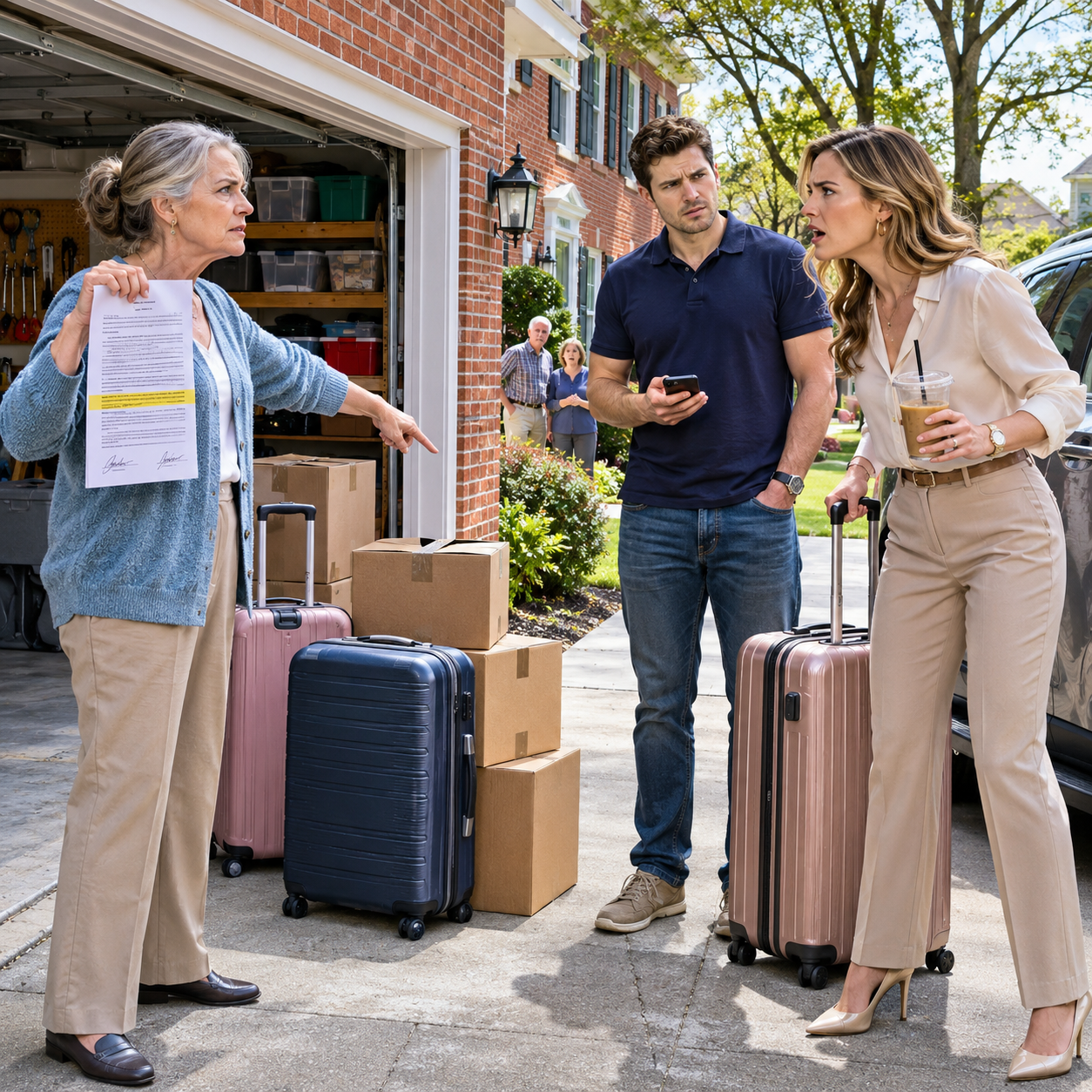
Kyle looked at me as though I had asked for something unreasonable. “The house key? Mom, seriously?” Lindsey crossed her arms and pointed out that they had driven eleven hours to see me, suggesting the least I could do was invite them inside. I glanced at the porch furniture Howard had built years earlier, then back at my son. “We can talk here, and I’d still like the key.”
Kyle reached into his pocket and worked the brass key loose from his ring. He placed it in my palm without looking directly at me. I slipped it into my coat pocket, remembering the afternoon I had given it to him after he moved out, telling him he would always have somewhere to turn in an emergency. At the time, I had meant comfort, not permission to treat my home and finances as his permanent backup plan.
Lindsey spoke first. “Do you understand what you did to us? We couldn’t get into the cabin, the hotel cost a fortune, and the card you removed was the one we were counting on. Now our truck payment might bounce, and you don’t even seem concerned.”
“I am concerned,” I said. “But you invited someone else on a vacation I paid for, without discussing it with me. I canceled the rental because I wasn’t going, and the credit card was never supposed to cover your regular expenses.”
Kyle stared at the steps. After a moment, he said, “Claudia left on Christmas Eve.”
I waited while he rubbed his hands together against the cold. “She said the trip wasn’t what she expected. She thought you were coming, and when she found out you weren’t, she got upset. She said she’d hoped all of us would finally be together.” He looked toward Lindsey, who seemed startled by that explanation. “Then she booked a flight home.”
I considered the woman who had left a four-year-old boy behind and wondered what she had imagined finding at Tahoe. Perhaps she had wanted a reunion without facing the difficult conversations that should have come first. Perhaps she had believed I would help make her return easier, as I had made so many other things easier for Kyle. Whatever her reasons, she had left again when the circumstances failed to match her expectations.
I turned toward Lindsey. “I know about the Instagram photographs, and I know why you contacted Claudia. Carol told Doris about the conversations you had.”
Lindsey’s eyes moved toward Kyle before settling on the flower bed beside the porch. “I didn’t force him to reconnect,” she said. “He wanted to know her.”
“That may be true. But you thought she had money.”
For several seconds, Lindsey examined the screen of her phone. Then she said, “We needed help, Jocelyn. You know how expensive everything is. I thought maybe she’d want to do something for her son.” Kyle turned toward her, his expression sharpening as he asked, “You told me we should see her because family matters. Was that really why?”
“Both things can be true,” Lindsey replied, her voice growing strained. “I thought she could help us, and I thought you deserved to know your mother. I didn’t know those pictures were fake.”
“They weren’t fake,” I said. “They were photographs of houses she was paid to stage. You assumed they belonged to her, just as you assumed I would keep paying for your vacation after you excluded me.”
Kyle leaned against the porch railing, looking older than he had before Christmas. I could see the little boy who had waited for Claudia’s birthday calls, even as I struggled to recognize the adult who had sent that text from the comfort of his own home. “Mom, I shouldn’t have said you weren’t my real mother,” he told me quietly. “I was angry, and Lindsey said you would understand once everything settled down.”
“Your father and I made mistakes too,” I said. “We thought we were protecting you when we kept rescuing you. I’ve spent years doing things you should have learned to do yourself, because I was afraid saying no would make you feel abandoned again.”
I reached toward him, straightened the collar of his coat as I had done when he was young, then lowered my hand. “Kyle, Claudia is your biological mother, and nobody can take that away from either of you. But I’m the woman who raised you, who sat beside your hospital bed when you broke your arm, who watched you walk across the graduation stage. I have been your actual mother every day since you were five. I shouldn’t have to prove that with a credit card.”
He looked at me for a long time. “I’m sorry,” he said. “I really am.”
“I believe you regret what happened. But I’m not going to pretend it didn’t happen.”
Lindsey shifted forward, trying to sound practical. “Could we at least borrow enough to cover the hotel and the truck payment? We could pay you back over the next few months.” I shook my head and told her they needed to speak with their lender, review their expenses, and arrange payments they could afford. When she asked whether I was willing to let them lose their truck over Christmas, I explained that I couldn’t keep rescuing them from bills they had chosen to accumulate.
Kyle didn’t argue. He stared at the wet pavement until I opened my front door and brought out the two cardboard boxes from the hallway. His old baseball trophies and school yearbooks were inside, along with photographs I had carefully organized before leaving for Charleston. I explained that I planned to repaint his childhood bedroom and use it as a studio, something I had wanted to do since Howard died.
Kyle opened the top box and lifted out a photograph of himself in his Little League uniform. Howard was standing behind him, one arm around his shoulders, while I knelt beside them holding the team’s homemade championship banner. Kyle ran his thumb over the edge of the picture before replacing it. “Dad would have hated all this,” he murmured, and I answered, “Your father loved you. He also wanted you to become a man who could stand on his own.”
He carried the boxes to the truck without another argument. Lindsey followed, holding her phone but no longer looking at it. Before climbing into the driver’s seat, Kyle turned toward me and said, “Can I still call you sometimes?” I nodded and told him that the phone calls were never what I had objected to. Then I went inside, closed the door, and put the brass key in the small wooden dish on my dresser.
By spring, the guest bedroom had become a painting studio with warm cream walls and two large canvases beside the window. I wasn’t particularly talented, but I loved the smell of fresh paint and the quiet pleasure of making something without wondering whether anyone else approved. Doris visited on Saturdays, and we spent afternoons drinking coffee and talking about our gardens. For the first time in years, my savings account grew steadily instead of disappearing into emergencies that belonged to someone else.
Kyle began contacting me occasionally. He sent a photograph of his dog on a hiking trail, asked about one of Howard’s favorite recipes, and mentioned that he and Lindsey had worked out a payment arrangement for their overdue bills. Our conversations remained brief, but I answered because I still loved my son. I simply stopped treating every message as a request I was obligated to solve.
On Mother’s Day, I was sitting on the back porch with my morning coffee when my phone lit up. Kyle had sent a photograph of the three of us at his high school graduation, followed by a message that read, “Thank you for being my mom. Not just my real mom. My actual mom. I understand the difference now, and I’m sorry it took me so long.”
I studied the photograph for several minutes. Howard was laughing, Kyle had his arm around me, and my younger self was smiling beneath the bright June sunlight. I wanted to call Kyle and invite him over, to hear his voice and tell him everything would be fine, but I knew trust couldn’t be restored simply because a person finally found the right words. I replied, “Thank you, sweetheart. I hope you’re doing well. Love, Mom.”
Then I placed the phone beside my coffee cup and watched a robin hop through the garden beneath the maple tree Howard and I had planted when Kyle started second grade. The tree had survived storms, harsh winters, and years when I worried its branches would never grow properly. Now its leaves stretched across the lawn, casting patches of shade over the flowers I had planted that spring.
I still loved my son. I still hoped we would find our way toward a better relationship, one built on consideration rather than obligation. But I had learned that being someone’s mother didn’t require me to disappear whenever they wanted more room for themselves.
That Christmas, I had walked away from a grocery cart filled with everything my family expected me to provide. Months later, sitting beneath the tree Howard and I had planted together, I understood that I hadn’t walked away from my son.
I had simply stopped paying for the privilege of being his mother.
And for the first time in many years, there was a place at the table that belonged entirely to me.
The End .
All characters and events in this story are fictional, created for storytelling and entertainment purposes. Thank you sincerely for reading. Your feedback and support are invaluable and motivate me to continue sharing more stories with you.