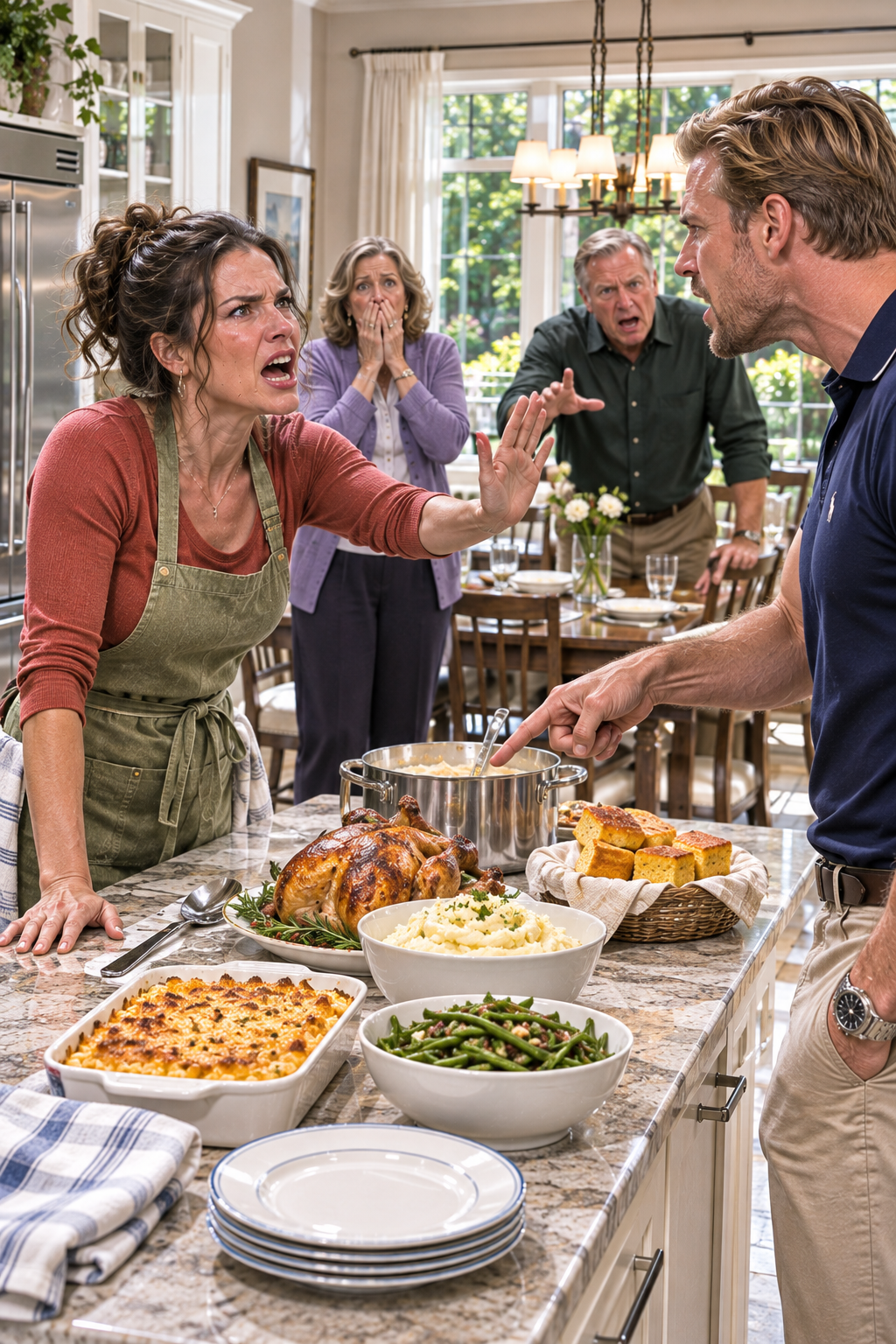
When my brother called my homemade dinners “poverty food,” his children were sitting close enough to hear him. I told him I would keep feeding them, but I would never cook separate meals just to protect his pride. His fiancée laughed, and my parents pretended the insult was harmless. Three days later, she sent me an $18,000 bill for their wedding venue, insisting that family members were supposed to make sacrifices. I refused that, too. Three weeks later, while recovering from an injury that changed my face, I received a phone call about a financial agreement I had supposedly signed. The signature looked like mine, but I had never seen the document.
Part 1/5
My name is Mara Bellamy, I’m thirty-four years old, and until last September, I thought the biggest problem in my family was my brother’s inability to distinguish generosity from obligation. Graham was four years older than me, divorced, and raising two children with his ex-wife, Nina, who worked unpredictable shifts at the county hospital. His daughter, Ivy, was ten, and his son, Caleb, was seven, with a talent for finding every missing sock in my apartment except his own. For nearly three years, I had picked them up from school twice a week, helped with homework, and fed them dinner before Graham finished work. Nobody paid me, and I never asked, because those evenings had become some of my favorite hours of the week.
I worked as an office coordinator at a physical therapy clinic outside Columbus, Ohio, earning enough to cover my mortgage, groceries, and a modest emergency fund if I watched my spending. My house was small, with a crooked back porch and a kitchen that smelled permanently of coffee, garlic, and whatever I was preparing for dinner. I cooked the way our grandmother had taught me, stretching good ingredients into satisfying meals without pretending that inexpensive food was something shameful. Chicken and rice, turkey chili, homemade soup, baked potatoes loaded with vegetables—those were the dinners Ivy requested and Caleb occasionally helped prepare. Everything changed after Graham got engaged to Sloane Mercer, a thirty-two-year-old marketing consultant who talked about ordinary family life as though it were an unfortunate branding problem.
The first argument happened on a Thursday evening when Graham and Sloane arrived early to collect the kids. I had made chicken thighs with roasted carrots and buttered rice, and Ivy was explaining a school project while Caleb carefully removed every carrot from his plate. Sloane surveyed the table, wrinkled her nose, and asked whether I had anything more appropriate for children who were “getting used to better things.” Before I could answer, Graham laughed and said, “Come on, Mara, you know this is poverty food,” while reaching into my refrigerator for a soda. Ivy stopped chewing, and I noticed Caleb quietly pushing his plate away, embarrassed by a meal he had been enjoying seconds earlier.
I put down the serving spoon and asked Graham to repeat himself, hoping he might hear how ugly the words sounded. Instead, he explained that Sloane preferred the children to eat differently, with separate portions and more expensive ingredients, because their future household would have higher standards. “Then you can prepare those meals at your house,” I told him, keeping my voice level while Ivy stared at the table. Graham accused me of being sensitive, and Sloane suggested I could simply cook two dinners whenever the children visited. I told them I would continue offering one wholesome meal to everyone at my table, but I wasn’t running a private restaurant, and I wouldn’t teach my niece and nephew to be ashamed of what ordinary people could afford.
Graham left irritated, Sloane barely said goodbye, and the children remained unusually quiet as they gathered their backpacks. At the door, Ivy whispered that she liked my chicken better than the expensive meals Sloane ordered, then asked whether wanting seconds made her poor. I crouched beside her and said there was nothing embarrassing about enjoying food someone had prepared with care, but her question stayed with me long after their car disappeared. That weekend, my mother, Elaine, called to suggest I could have avoided the argument by offering another option, and I reminded her that Graham was welcome to feed his own children however he liked. She changed the subject, which was how our family usually handled uncomfortable truths.
The following Wednesday, an email arrived from Sloane with an attached invoice for Willowglass Landing, a waterfront estate advertising formal gardens, panoramic river views, and an illuminated champagne fountain. The rental price was $18,000 for six hours, excluding catering, decorations, photography, and the musicians Sloane had apparently already reserved. Her entire message consisted of three sentences: “Your share of the venue. Please send payment by Friday. We need to secure the date.” I checked the recipient line twice because I couldn’t believe she was demanding more than I had saved during the previous year for a wedding I wasn’t planning. I replied that I couldn’t contribute to the venue, congratulated them on their engagement, and offered to help with reasonable preparations if they needed assistance.
Sloane called less than a minute later, speaking loudly enough that I had to move the phone away from my ear. She explained that my parents were covering catering, our uncle was arranging flowers, and everyone was expected to contribute something meaningful, as though their voluntary gifts created a financial obligation for me. When I pointed out that the wedding budget was approaching $75,000, she accused me of trying to punish Graham because of the dinner disagreement. “This is his second chance at happiness,” she said, “and you’re making it about yourself over some cheap food and a little money.” I told her that $18,000 wasn’t little money to me, and she announced that we would settle the matter at Sunday dinner before hanging up.
Sunday dinner at my parents’ house had been a family tradition for twelve years, usually involving Dad’s grill, Mom’s potato salad, and someone arguing about the Buckeyes. That afternoon, Sloane arrived with a white dress, a gold-lettered wedding binder, and a color-coded chart assigning expenses to relatives who hadn’t agreed to anything. My father, Walter, looked genuinely bewildered when she announced that I was refusing to fulfill my financial responsibility, while my mother quietly explained that nobody had assigned me a venue fee. Graham stood beside the refrigerator with his arms folded, avoiding my eyes as Sloane described the waterfront ceremony she had supposedly dreamed about since childhood. When I refused again, she suggested twelve monthly payments of $1,500, and Graham finally muttered that perhaps they should look at a less expensive location.
Sloane slammed her binder shut and walked outside, leaving the adults staring at one another while the children played in the next room. I thought the argument had reached its natural conclusion until Ivy came into the kitchen, tugged at my sleeve, and asked whether the money Grandma had been putting away for her college was supposed to pay for weddings. I asked where she’d heard that, but she glanced toward the patio and said Sloane had promised they would put everything back once I paid my share. Before I could ask another question, Graham appeared in the doorway and told Ivy to go find her brother. The look he gave me wasn’t anger anymore; it was the expression of someone who realized a secret had escaped.
Part 2/5
I followed Graham into the hallway and asked whether he had taken money from the children’s education savings to pay for the wedding. He told me to lower my voice, which answered more than an outright denial would have, and said the account belonged to him because he had opened it after Ivy was born. I reminded him that our parents had been contributing to those savings every Christmas and birthday, believing the money would eventually help their grandchildren attend college. “It’s temporary,” he whispered, glancing toward the patio, “and we were going to replace it before anyone noticed.” When I asked how he intended to do that without my $18,000, he looked past my shoulder and said we should discuss it another time.
Sloane returned before I could press him, carrying her binder and wearing the strained smile of someone determined to regain control of an audience. She announced that she was prepared to compromise by accepting half the money immediately and allowing me to finance the remainder, then opened her planner to a page of dates she expected me to meet. Dad told her firmly that the conversation was finished and that the wedding would have to fit the couple’s actual budget. Sloane looked toward Graham for support, but he remained silent, and the rejection seemed to humiliate her more than anything I had said. She gathered her papers, announced that nobody respected her commitment to the family, and marched upstairs toward my parents’ home office.
Dinner ended without the usual second helping of dessert, and I helped Mom clear the dishes while Dad went downstairs to check on the children. Mom admitted that Sloane had been pushing for a bigger wedding for months, but she insisted Graham had probably just made an impulsive financial mistake. I asked whether she considered withdrawing money intended for his children’s education an ordinary mistake, and she stopped scrubbing a plate long enough to look frightened. Before she could answer, we heard something heavy being dragged across the upstairs floor, followed by Sloane’s heels striking the wooden steps. She appeared in the kitchen carrying my parents’ wedding album, a massive leather-bound book from 1989 with reinforced metal corners and a spine thick enough to hold decades of photographs.
Mom reached for it immediately, asking Sloane to return the album before she damaged something irreplaceable. Sloane held it against her chest and began talking about family loyalty, sacrifice, and how my parents had supported each other through difficult times. I told her that an old wedding album wasn’t a negotiating tool and that I wouldn’t discuss the venue again. Her face changed so suddenly that I remember noticing the red blotches rising along her neck before she shouted, “Pay for my dream venue, or I’ll destroy you.” She stepped forward and swung the album with both hands, striking the bridge of my nose with one of its heavy corners.
The sound was sharp and strangely distant, followed by a burst of pain that made the kitchen tilt beneath my feet. I stumbled against the counter, gripping its edge while blood ran over my lips and onto the front of my blouse, and Mom screamed for Dad to come upstairs. Graham rushed from the hallway, caught sight of the album on the floor, and demanded to know what Sloane had done, but she kept repeating that I had pushed her too far. Dad pressed a clean kitchen towel into my hands and told me to lean forward while he called for help. Somewhere behind us, Sloane began crying about her wedding, and I realized she was still talking about the venue while everyone else was trying to stop the bleeding.
Graham drove me to the emergency department, where a nurse took one look at my swollen face and moved me into an examination room. I told the attending physician exactly what had happened, including Sloane’s threat, the album, and the argument over the money, because I didn’t want the incident described later as an unfortunate family accident. The medical team photographed my injuries, examined the swelling, and ordered imaging to determine whether the impact had damaged the bones and cartilage inside my nose. A CT scan confirmed two nasal fractures and a significant displacement of my septum, which explained why breathing through my right nostril had become almost impossible. The doctor told me that once the swelling decreased, I would likely need surgery to restore the structure of my nose and prevent lasting breathing problems.
A police officer arrived after the hospital contacted law enforcement with my permission, and I gave a detailed statement while an ice pack rested against my cheek. My parents confirmed what they had witnessed, and Graham eventually brought the wedding album to the hospital after an officer requested that it be preserved as evidence. The officer photographed its damaged corner, documented the staining, and explained that prosecutors would review the circumstances to determine the appropriate charges. I signed the statement without asking Graham how he felt about any of it, although he stood beside the door looking as though he’d aged ten years. For the first time since his divorce, I didn’t feel responsible for making his problems easier to survive.
I spent the next several days sleeping in short stretches, eating soft food, and waiting for the throbbing in my face to settle. Nina brought the children a few minutes away from my house so they could leave handmade cards on the porch, but I asked her not to bring them inside because I wasn’t ready for them to see my injuries. She told me Graham had confessed to taking money from the education account and had promised to return it, although he still hadn’t explained where the replacement money would come from. I asked Nina to document everything rather than rely on his promises, and she said she had already contacted an attorney. That was when I understood that Sloane’s wedding had threatened far more than my savings.
On Friday morning, while I was resting on the couch, a woman named Denise from Willowglass Landing called about an outstanding financial authorization. She said the venue’s accounting department needed to verify my contact information because my name appeared as a secondary guarantor on their reservation paperwork. I told her I had never agreed to pay for anything, and after a careful conversation, she arranged for a redacted copy of the relevant agreement to be sent to me. There it was: my full name, my employer, an estimate of my annual income, and an electronic signature attached to a promise to cover the unpaid venue balance. What frightened me most wasn’t the signature, which I knew I hadn’t provided, but the employment information beneath it—details I had shared with only one person in my family when he helped me organize paperwork for my mortgage.
Part 3/5
I stared at the document until the letters stopped making sense, then called Denise and asked whether anyone had verified my identity before adding me to the agreement. She explained that the paperwork had been submitted through the couple’s online planning account, and the venue had relied on the information supplied during the reservation process. I told her the authorization was false and asked her to suspend any attempt to collect money from me while I reported it. Denise sounded genuinely alarmed, promised to preserve the original records, and advised me to submit a written dispute through the company’s legal department. I forwarded everything to the detective handling the assault investigation and began a folder on my computer labeled simply “Wedding.”
The following Tuesday, I met Dr. Corinne Vale, an ear, nose, and throat surgeon who examined my scans and carefully explained what the injury meant. The fractures had disrupted the alignment of my nasal bones, and the cartilage separating my nostrils had shifted enough to obstruct normal breathing. She recommended reconstructive surgery after the initial swelling had settled, warning that leaving the damage untreated could create long-term problems with airflow and recurring discomfort. The estimated medical charges were approximately $23,000, although my health insurance and a state victim-assistance program might cover much of the expense. I had expected a frightening appointment, but I hadn’t expected to sit in a surgeon’s office discussing the possible permanence of something that had happened in less than a second.
Dr. Vale arranged additional consultations because the internal damage was more complicated than the external fractures initially suggested. Several specialists reviewed my imaging, and with my consent, the regional surgical network circulated the case for further professional assessment and treatment planning. Over the following weeks, the number of physicians who had reviewed the findings reached ten, although Dr. Vale remained responsible for my care. Their consistent conclusions provided useful medical documentation, but she made something clear that mattered more to me than any legal terminology. “Your recovery comes first,” she said, “and you don’t have to turn your treatment into a public demonstration of what happened.”
Meanwhile, Sloane had been arrested after investigators interviewed the witnesses and examined the physical evidence, and the prosecutor’s office filed felony assault charges. Her parents arranged bail, but a court order prohibited her from contacting me, directly or indirectly, while the case proceeded. My mother called after the arrest and cried because she’d never imagined watching someone connected to our family leave her house in handcuffs. I asked whether she had imagined watching her daughter leave that same house with a broken nose, and she went quiet before apologizing. We had a long conversation about the difference between keeping peace in a family and allowing the loudest person to decide what everyone else must tolerate.
Graham came to my house the next evening, carrying groceries I hadn’t requested and looking exhausted beneath his work jacket. He admitted that he had withdrawn $11,400 from the children’s education account, using $9,000 for the venue deposit and the rest for wedding-related expenses. Sloane had promised they could restore the money once relatives paid their assigned contributions, and he’d convinced himself it was harmless because the account was legally under his control. When I showed him the false financial authorization, his face went pale, but he admitted he’d provided Sloane with my employment paperwork because she claimed the venue needed proof that family members could support the event. “I thought she was putting together a budget,” he said, and I asked whether he genuinely believed a budget required my income records and a signature I hadn’t provided.
He began crying, and for one uncomfortable moment, I felt the familiar urge to reassure him that everything would work out. Instead, I asked him to leave the groceries on the porch and told him he needed to be completely truthful with Nina, the police, and anyone investigating the financial records. He asked if I could forgive him for not stopping Sloane, but I told him that the problem began long before the album struck my face. He had mocked the food I prepared for his children, dismissed their feelings, gambled with their savings, and supplied my private information to someone who wanted access to my money. I wasn’t going to pretend those choices disappeared simply because he regretted their consequences.
The venue’s legal representative responded to my dispute with a request for a formal statement, and an attorney I hired helped me challenge the unauthorized guarantee. Further review revealed that Sloane had already represented me as a committed financial supporter before she sent the $18,000 invoice, and my refusal threatened the financing story she’d given the venue. The records also exposed how much of her extravagant wedding budget depended on promised contributions rather than money the couple actually possessed. When the venue received notice of the criminal proceedings and the disputed authorization, its management canceled the reservation under the contract’s applicable provisions. Graham was left trying to recover the remaining funds while Nina worked through the financial consequences of his withdrawals with her attorney.
By October, my surgery was scheduled, and the prosecutor had begun preparing me for the possibility of testifying in court. A victim advocate explained the process, helped me organize my medical bills, and reminded me that I wasn’t responsible for managing Sloane’s feelings about being prosecuted. One evening, Nina sent me screenshots from Graham’s old messages that had surfaced during their discussions about the children’s savings. In one exchange, written before the Sunday dinner, Sloane suggested that showing me what was “at stake” might finally make me pay, and Graham replied that I usually gave in when the family put enough pressure on me. Reading those words hurt differently from the injury, because they showed that the evening hadn’t simply collapsed into chaos; my brother had helped create the pressure that made it dangerous.
Part 4/5
The night before surgery, I stood in my bathroom studying a face I barely recognized, wondering whether the swelling would ever fully disappear. My nose curved slightly to the left, the skin around my eyes remained discolored, and breathing through my right nostril required enough effort to make sleeping uncomfortable. I photographed myself because the prosecutor had asked me to document the healing process, then immediately hated that I was thinking about evidence while brushing my teeth. My friend Delaney, who had volunteered to drive me to the hospital, called to ask whether I needed anything, and I admitted that I was frightened the operation might not restore everything. She told me that being frightened didn’t make the decision wrong, and I slept better after hearing someone speak about my recovery without mentioning the wedding.
On October fifteenth, Dr. Vale performed the reconstruction, repairing the fractured bones and repositioning the damaged cartilage that had narrowed my airway. The procedure lasted nearly four hours, and when I woke up, my face felt heavy beneath bandages and internal splints. Delaney drove me home the following day, stocked my refrigerator with soup, and wrote the medication schedule on a sheet of paper so I wouldn’t have to remember everything myself. Recovery was slower than I’d imagined, with headaches, interrupted sleep, and days when I became frustrated by how much energy simple tasks required. At my follow-up appointment, Dr. Vale said the repair was healing as expected and that the improvement in my breathing would become clearer once the remaining swelling subsided.
During those weeks, my parents visited without bringing Graham or asking me to make peace with him. Dad repaired the loose railing on my back porch, and Mom brought containers of chicken soup while finally acknowledging how often she’d encouraged me to tolerate Graham’s behavior for the sake of family harmony. Nina arranged supervised visits with the children once I felt comfortable, and I was surprised by how carefully they avoided asking about my face. One afternoon, Caleb handed me a drawing of the four of us eating dinner together, with an enormous bowl of rice in the center of the table. Ivy explained that he’d wanted to make something that reminded me of happier Thursdays, and I put the drawing on the refrigerator where I could see it every morning.
In December, I met with Assistant District Attorney Rebecca Sutter to review the evidence before trial. She had the original wedding album, photographs of the kitchen, my hospital records, the eleven injury photographs, and the medical reports documenting the fractures and surgical treatment. Dr. Vale had agreed to testify, while the additional specialist reviews supported her conclusions without requiring every physician to appear in court. Rebecca warned me that Sloane’s defense would probably describe the incident as an impulsive accident arising from a heated family disagreement. I told her I understood that a jury would have to decide what happened, but I wanted them to hear the exact threat Sloane made before she swung the album.
The trial began in January, with Sloane seated beside her attorney in a dark suit and a carefully arranged expression of anxiety. I testified on the second morning, explaining the original argument about my cooking, the wedding invoice, the confrontation at my parents’ house, and the moment the album struck me. Her attorney questioned whether I had insulted Sloane’s wedding plans, whether I had raised my voice, and whether the album could have hit me accidentally while she was gesturing. I answered as precisely as possible, refusing to exaggerate anything because the truth was already serious enough. When Rebecca showed the jury photographs of my injuries, I looked toward the courtroom windows rather than the screen and concentrated on keeping my hands still.
Mom and Dad testified about the argument, Sloane’s verbal threat, and the deliberate movement they witnessed before the impact. Dr. Vale explained the force required to cause the fractures, the internal displacement, and why reconstructive treatment had been medically necessary. The defense argued that Sloane had lost control for an instant without intending such serious harm, but the prosecution emphasized the difference between an accidental collision and swinging a heavy object after making a threat. Rebecca also introduced portions of the wedding correspondence to explain why Sloane had been demanding money and how the dispute had intensified. Watching those ordinary emails appear on a courtroom screen was unsettling, because I remembered receiving them at my kitchen table without imagining they would eventually help explain a violent crime.
Graham testified on the third day, and for the first time, he acknowledged publicly that he’d withdrawn money from his children’s education savings. He confirmed that Sloane expected to replace the funds with contributions from relatives, then admitted he’d given her my employment information despite never receiving my permission. When Rebecca asked about the disputed financial authorization, he hesitated long enough that I knew his previous explanation had been incomplete. He finally conceded that he had been sitting beside Sloane when she entered my information into the venue’s online system, and although he hadn’t personally typed my signature, he’d seen my name listed as a guarantor. “I assumed we’d get Mara to agree afterward,” he said, and something inside me settled into a painful certainty that his apology had concealed another deliberate choice.
The jury returned its verdict after less than two hours of deliberation, finding Sloane guilty of the felony assault charges and the associated serious-injury allegation submitted to them. She began crying as the verdicts were read, and Graham covered his face with both hands while my mother reached for mine. I felt relief, but it was quieter than I’d expected, without the satisfaction people sometimes describe when justice finally catches up with someone who hurt them. Outside the courthouse, Rebecca explained that sentencing would take place the following month and that the financial authorization remained part of a separate investigation. As Graham approached me near the exit, I realized the verdict had answered what Sloane had done, but it had also revealed how much my own brother had been willing to sacrifice to keep her happy.
Part 5/5
Graham caught up with me outside the courthouse and asked whether we could talk before I left. He looked exhausted, his eyes swollen and his hands trembling, and for a moment I saw the older brother who used to walk me home from school and defend me against neighborhood bullies. Then I remembered his testimony, the children asking whether their college savings had disappeared, and the way he’d dismissed my concerns until the consequences became impossible to ignore. “You knew she was using my information,” I said, and he admitted he’d hoped I would eventually agree because refusing would embarrass both of them. I told him that he hadn’t simply failed to protect me; he’d participated in a plan that treated my choices as obstacles to overcome rather than decisions to respect.
Over the following month, the financial consequences of the canceled wedding became clearer. Willowglass Landing formally released me from the disputed guarantee after reviewing the evidence and my sworn statement, and its legal department cooperated with investigators examining the unauthorized authorization. Graham’s efforts to recover the deposit were largely unsuccessful, leaving him responsible for replenishing the money he’d taken from his children’s education savings. Nina obtained a revised custody and financial agreement requiring documented repayment contributions, independent account statements, and clear restrictions on future withdrawals. Graham complained that the arrangement would take years to satisfy, but Nina reminded him that the children had never agreed to finance a wedding in the first place.
Sloane’s sentencing hearing took place in February, on a cold morning when the courthouse steps were slippery with freezing rain. Before the judge imposed a sentence, I read a victim-impact statement describing the surgery, missed work, medical appointments, sleepless nights, and the lasting change in how safe I felt around people I’d once trusted. I explained that the physical damage had required extensive treatment, but the emotional damage came from knowing someone had considered my refusal to surrender money a justification for hurting me. Sloane’s attorney requested leniency, describing her lack of previous convictions and the damage imprisonment would cause to her future. The judge acknowledged those considerations but emphasized the deliberate threat, the use of a heavy object, the resulting serious injury, and the choices Sloane had made before and after the assault.
Sloane received a four-year state prison sentence, along with restitution obligations for qualifying losses and a continuing restriction against contacting me. Her mother began crying immediately, while her father stared straight ahead, and Graham remained seated without looking toward either family. Sloane briefly turned in my direction as officers prepared to escort her away, but I didn’t respond to the expression on her face. I had spent months hearing other people explain what her intentions might have been, and none of those explanations changed what she’d done. The court couldn’t give me back the months I’d spent recovering, but it could establish consequences that didn’t depend on my willingness to forgive her.
A week after sentencing, Sloane’s mother mailed a letter to my attorney asking whether I might someday consider writing to her daughter. The letter mentioned Sloane’s regret, her lost career opportunities, and how much she had wanted to begin a happy marriage with Graham. There was no mention of Ivy and Caleb’s savings, my unauthorized financial guarantee, or the moment Sloane had swung my parents’ wedding album toward my face. I asked my attorney to respond that I did not want further communication and that any outstanding restitution matters should proceed through the proper channels. I didn’t feel the need to explain my decision because I’d already spent too much of my life defending reasonable boundaries to people determined to ignore them.
Graham moved into a smaller apartment and began repaying the education account through automatic monthly transfers. He sold his newer truck, picked up additional weekend shifts, and attended the parenting classes required under the revised custody arrangement, although none of those changes repaired our relationship. He sent several messages apologizing for calling my food embarrassing and admitting that he’d become obsessed with presenting a more successful image after his divorce. I eventually replied that I hoped he would become a better father, but I wasn’t interested in rebuilding our relationship while I was still dealing with the consequences of his actions. When he asked whether we might spend the holidays together, I told him I would continue seeing the children through arrangements with Nina, not through him.
My parents handled my decision better than I expected, particularly after I explained that forgiveness wasn’t a family assignment someone could distribute across the dinner table. Mom admitted that she’d spent years asking me to accommodate Graham because he was more difficult to confront, and Dad acknowledged how often I’d provided childcare and meals without anyone noticing the work involved. They stopped carrying messages between us, and Sunday dinners became smaller, quieter gatherings where nobody pretended that avoiding conflict was the same as resolving it. Mom eventually received her wedding album back after the court released the evidence, but she kept it wrapped in a cloth inside a cabinet rather than returning it to its old display shelf. She told me she could no longer look at it without remembering how narrowly an ordinary family gathering had avoided becoming something even worse.
By spring, Dr. Vale confirmed that my reconstruction had healed successfully and that the remaining swelling was continuing to improve. My breathing was noticeably better, the faint scar near the bridge of my nose had become difficult to see, and I was gradually returning to my normal routines without planning every activity around fatigue or discomfort. Insurance and victim-assistance funds covered much of the treatment, while restitution payments addressed additional eligible expenses, though I still had to spend time sorting out claims and paperwork. I returned to work full-time, repainted my kitchen a soft green, and planted herbs beside the porch steps where Dad had repaired the railing. Those ordinary projects gave me something I hadn’t felt since the assault: the sense that my home belonged entirely to me again.
One Thursday evening in May, Nina brought Ivy and Caleb over for dinner, and Caleb immediately asked whether we could make the chicken and rice they’d always liked. Ivy chopped carrots while I seasoned the chicken, and we talked about school, a field trip, and the summer camping trip Nina was planning. When we sat down, Caleb took a generous helping, then looked at me seriously and asked whether Graham had been wrong to call the food poor. I told him that people sometimes use money to make themselves feel important, but that the price of a meal had nothing to do with the love, effort, or dignity of the person preparing it. Ivy reached for a second helping and said, “I don’t think of it as poverty food, Aunt Mara; I think of it as home food,” and for the first time in months, the memory of that awful Thursday didn’t make my chest tighten.
After the children left, I washed the dishes, packed away the leftovers, and stood beside the open kitchen window listening to the neighborhood settle into evening. My brother had wanted me to cook two dinners because one wasn’t impressive enough, and his fiancée had wanted me to pay for a wedding because their own choices had made it unaffordable. Both demands came from the same belief that my time, money, and patience were available whenever someone else wanted them. Graham was finally learning to live within the limits he’d ignored, and Sloane was serving a sentence for a decision no one had forced her to make. I didn’t forgive them, and I didn’t spend my evenings wishing things had turned out differently; I simply kept my door open to the people who treated my kindness as a gift rather than an entitlement.
That night, I put Caleb’s drawing back on the refrigerator after wiping a little flour from its corner, then switched off the kitchen lights and went upstairs. I knew there would be future birthdays, holidays, and family gatherings where Graham’s absence would require explanations, and I was prepared to give them without bitterness or false promises. What mattered was that Ivy and Caleb would never have to wonder whether their aunt loved them enough to provide a second, more expensive dinner, because they already knew love wasn’t measured that way. They would always have a seat at my table, a warm meal, and someone willing to listen when the world made them feel small. For the first time, I understood that protecting my peace didn’t mean closing my heart; it meant refusing to let the people who hurt me decide who was allowed inside it.
THE END!
Disclaimer: Our stories are inspired by real-life events but are carefully rewritten for entertainment. Any resemblance to actual people or situations is purely coincidental.