
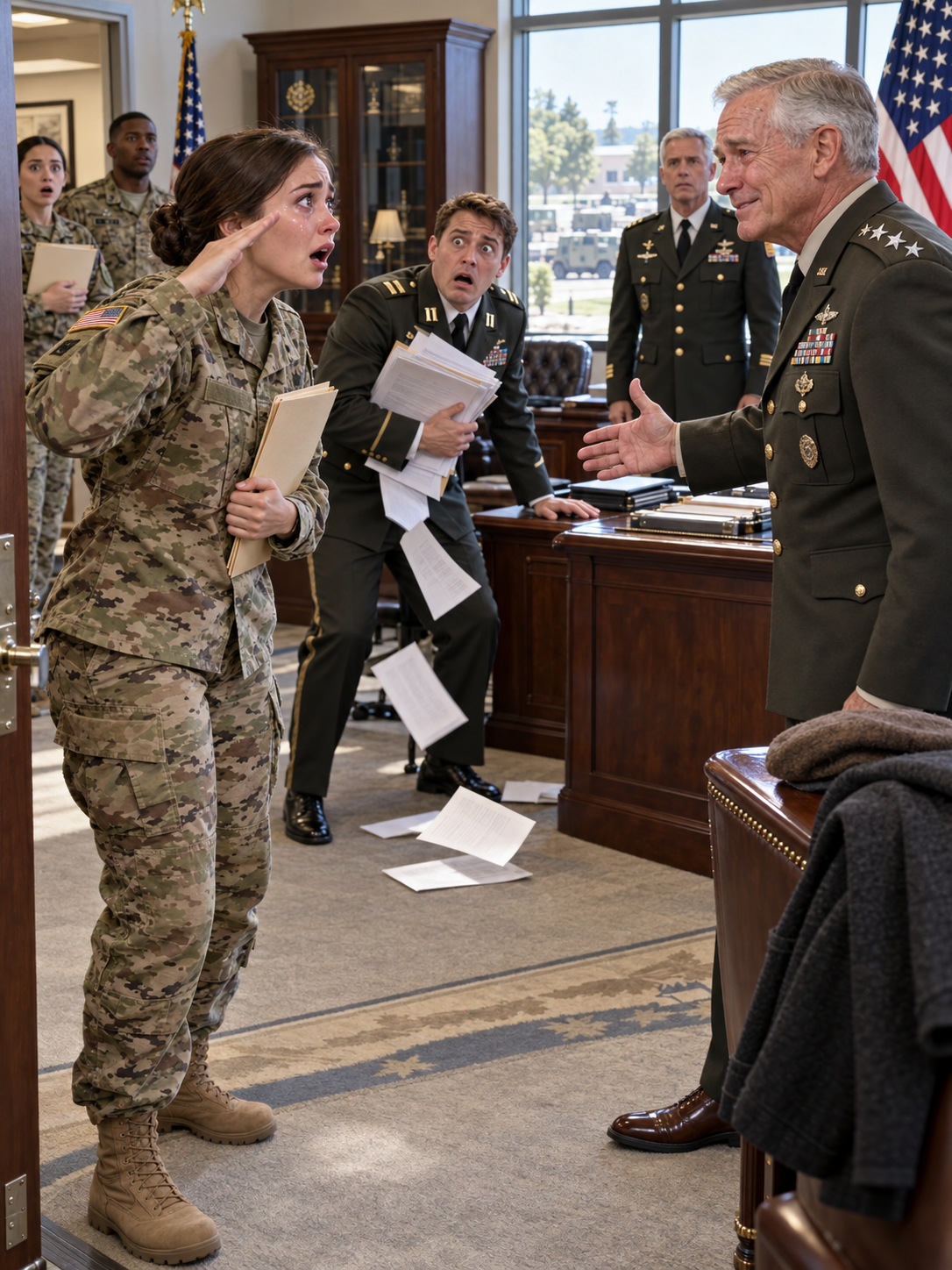
I thought I was buying dinner for an older Army veteran whose card had been declined in front of a crowded diner. I never asked his rank, never took his number, and never expected to see him again. Three weeks later, after a new captain had turned my unit into a place where everyone feared paperwork more than failure, I was ordered to report to battalion headquarters. When the office door opened, the same man was waiting for me—only this time, three silver stars were resting on his shoulders.
### Part 1
By the time I pulled into the Cedar Creek Diner that Tuesday night, I was too tired to be hungry and too irritated to drive straight home. My name is Claire Bennett, and at twenty-eight I was an Army specialist assigned to a logistics support battalion at Fort Liberty, North Carolina, where my job mostly involved making sure equipment existed where a computer claimed it existed. That particular day, thirty-two replacement parts had arrived without matching paperwork, a generator had failed during inspection, and somebody had misplaced a vehicle packet that I distinctly remembered placing on a sergeant’s desk before lunch. I wanted coffee, something sweet, and forty minutes during which nobody said the words “serial number.”
Cedar Creek sat about ten minutes outside the gate in a squat brick building with a glowing red sign, scratched wooden booths, and windows that always seemed slightly fogged from the kitchen. The place smelled like bacon grease, cinnamon, coffee, and whatever industrial cleaner the staff used on the tile after the dinner rush. Soldiers liked it because nobody cared if you came in looking exhausted, and civilians liked it because the portions belonged to an era when nobody photographed dinner before eating it. I slid into my usual booth near the back window and ordered black coffee and pecan pie from Marlene, a gray-haired waitress who had the rare ability to make silence feel like hospitality.
There were maybe ten customers scattered around the room. Two mechanics from another company were arguing quietly over football at the counter, an older couple near the entrance were sharing fries, and a man in a booth by himself was reading a newspaper with both hands spread neatly across the pages. He looked somewhere in his sixties, broad-shouldered but lean, wearing a dark windbreaker and a faded cap embroidered with a small Army veteran patch. Nothing about him demanded attention, which was probably why I forgot him almost immediately.
I was halfway through my pie when the card reader at the register made a sharp electronic chirp. Marlene said, “Let me try that again, sir,” in the gentle voice people use when they’re trying not to embarrass someone. The man from the booth stood at the counter with a white paper bag beside him, his wallet open, his back straight enough that I noticed it from across the room. He gave her the card again without looking at anybody else.
The machine rejected it a second time.
“I’m sorry,” Marlene said quietly. “It’s still coming back declined.”
The man studied the card for a moment, and something about his face changed without really changing. His expression stayed calm, but his jaw tightened while he checked the cash in his wallet, and from where I sat I could tell he was short. He glanced once toward the dining room, not like he expected help, but like he was measuring how many people had witnessed the moment. That look bothered me more than the declined card did.
I had grown up with a father who would drive twenty miles home rather than admit he had forgotten his wallet. Pride in men of a certain generation has a particular posture, and this stranger had it. Before I had enough time to talk myself out of anything, I stood, carried my coffee to the register, and set my debit card beside Marlene’s hand. “Put his dinner on mine.”
The man turned immediately. Up close, he was taller than I expected, with close-cropped gray hair beneath the cap and dark eyes that were more observant than tired. “You don’t need to do that,” he said.
“I know.”
“I can sort this out.”
“I know that too.” I nodded toward Marlene. “But your food’s getting cold.”
For a second, I thought he might refuse just because refusing would let him recover some control over the situation. Instead, he looked at me carefully while Marlene ran my card, almost as though he was trying to understand what I wanted in exchange. I signed the receipt, slid the pen back across the counter, and said, “There. Crisis over.”
The corner of his mouth moved. “You Army?”
I was still wearing my duty uniform, so it wasn’t much of a deduction. “Yes, sir.”
“What do you do?”
“Logistics.”
That finally earned the smallest smile. “The work nobody notices until something doesn’t arrive.”
“Or arrives in the wrong place with three numbers transposed and six signatures missing.”
He gave a quiet laugh. “Sounds familiar.”
I assumed he had served decades earlier, maybe supply or transportation, and I almost asked. Instead, I picked up my coffee because I didn’t want him feeling like my twenty-dollar gesture purchased an interview. He thanked Marlene, then looked back at me and said, “What’s your name?”
“Specialist Claire Bennett.”
He repeated it once. “Claire Bennett.”
There was something oddly deliberate about the way he said it, but I blamed that impression on exhaustion. He picked up his bag, adjusted the old cap, and extended his hand. His grip was firm without being performative.
“Thank you, Specialist Bennett.”
“We take care of people when we can.”
His eyes rested on mine for half a second longer. “That’s a better rule than most.”
Then he walked out into the October darkness.
I went back to my booth, finished the last two bites of pie, and opened my phone to three messages about the broken generator. Ten minutes later, the stranger had already become one of those minor encounters you expect to remember for a week and then lose beneath everything louder. I had no idea that before the month ended, hearing him say my name again would make every detail of that diner come rushing back.
And I definitely had no idea what had been hidden beneath that faded cap.
### Part 2
The following Monday, Captain Nolan Vance arrived to take charge of our section. I first saw him during morning formation, standing beside Major Keller with a fresh haircut, spotless boots, and the expression of a man who had already identified several things he disliked before anyone introduced themselves. Vance was in his early thirties, recently transferred from Texas, and the unofficial description of him reached us before lunch: extremely by the book. That phrase can describe an excellent officer, but in the Army it can also be a warning.
For the first few days, I tried to give him the benefit of the doubt. New leaders often tighten things temporarily because they need to understand what kind of organization they inherited, and logistics punishes sloppy habits harder than people realize. If a supervisor wanted better accountability, cleaner paperwork, and fewer casual shortcuts, I had no argument. By Friday, however, it was becoming clear that Captain Vance did not simply like standards; he liked catching people violating them.
Private First Class Dalton received formal counseling because he entered a maintenance timestamp seventeen minutes late. Sergeant Ortega got a written correction over a vehicle sign-out completed in blue ink instead of black, even though every signature and number was correct. Another soldier was held after shift because the spacing on a printed inventory memorandum did not match Vance’s preferred format. None of these things destroyed careers, but together they changed the atmosphere.
People stopped asking questions in front of him. Soldiers who used to bring small problems to leadership began solving them quietly among themselves because nobody wanted to become the next example. Even laughter disappeared whenever Vance entered the room, which I found more revealing than any complaint. Good leaders make people straighten up when they walk in; bad ones make people stop talking.
“You see it too,” Sergeant Mateo Ortega said one afternoon while we checked shipping seals behind the warehouse. Ortega had eight years in service and the patient expression of a man who had survived enough officers to know none of them were permanent. He scanned a barcode, waited for the handheld device to beep, then added, “Everybody’s spending more energy trying not to get documented than trying to get better.”
“He’s new,” I said.
“So were the last five captains.”
I glanced toward the office windows. “Maybe he’ll settle down.”
Ortega smiled without humor. “Maybe I’ll win the lottery.”
I stayed out of Vance’s way. I checked every report twice, then began checking them three times, which slowed me down enough that I started staying late. I changed the pen on my desk from blue to black, printed a copy of his formatting guidance, and taped it beside my monitor. If Captain Vance wanted perfection, I decided I would make myself boring enough that he had no reason to remember my name.
For ten days, it worked.
Then came the quarterly equipment accountability report.
I had submitted that report many times. The document listed controlled equipment, serial numbers, status codes, responsible sections, and enough small boxes to make anyone’s eyes blur after an hour. I finished it shortly before lunch on Wednesday, cross-checked it against the property records, and sent it through the normal review channel. Two days later, an email appeared instructing me to report to Captain Vance’s office at 1400.
There is a particular walk soldiers make toward an officer’s office when they know something is wrong but don’t know what. Your mind becomes an inventory system of its own, pulling up every conversation, form, appointment, and mistake from the previous week. By the time I knocked, I had convinced myself the missing vehicle packet from earlier that month had somehow come back to haunt me. “Enter,” Vance called.
His office smelled faintly of printer toner and coffee. My accountability report lay centered on his desk with a yellow sticky note beside it, and Vance waited until I sat before rotating the document toward me. One line had been highlighted.
“Read the serial number.”
I did.
“Now compare it with the source document.”
Two digits near the end were reversed.
My stomach tightened. “That’s my error, sir. I’ll correct it immediately.”
“That isn’t the issue.”
I looked up.
“The issue is that an inaccurate accountability document entered the review process under your name.”
“Yes, sir.”
“Do you consider controlled equipment accountability important?”
It was a question with only one acceptable answer. “Absolutely, sir.”
“Then why should this be treated casually?”
“I’m not asking for it to be treated casually. I’m saying I can correct the transcription error.”
He opened a folder beside him. “I’m issuing formal written counseling.”
For one stupid second, I thought I had misunderstood. A formal counseling statement over two transposed digits seemed wildly disproportionate for an error caught before final approval, and yet there it was, already prepared. Vance slid the page across the desk and began explaining that standards mattered only when applied consistently.
I signed acknowledgment because refusing would accomplish nothing. Eleven minutes later, I walked back into the hallway with a copy in my hand and heat crawling up the back of my neck. I had made an error, and I could accept being corrected for it, but something about seeing a routine mistake converted into permanent documentation made the floor beneath my career feel suddenly less stable.
Sergeant Ortega took one look at my face when I returned and followed me into the supply room. I handed him the counseling sheet, and his expression darkened as he read. “For this?”
“I made the mistake.”
“That wasn’t my question.”
I leaned against a metal shelving unit. “He says consistency matters.”
“Correction matters,” Ortega replied. “Consistency without judgment is just laziness wearing a uniform.”
I almost laughed, but I didn’t feel like it.
That evening, I stopped at Cedar Creek again and sat in the same booth by the window. Marlene brought coffee without asking and mentioned that the older veteran I had helped had returned the morning after I met him. “Asked about you,” she said while topping off my cup.
I looked up. “Me?”
“Just wanted to make sure he remembered your name correctly.”
Something about that stayed with me on the drive back to post.
At the time, I thought the old man was simply determined to repay twenty dollars.
I would soon learn he had been asking much bigger questions.
### Part 3
Captain Vance’s counseling statement did not ruin my week because one sheet of paper is rarely powerful enough to ruin anything by itself. What ruined my week was everything that came afterward. Reports that had previously passed review came back covered in comments about margins, wording, and formatting preferences; inspections appeared on my calendar with almost no notice; and tasks that could have been divided across four specialists somehow kept finding their way to my desk. Each individual decision was defensible, which made the pattern harder to challenge.
That was the genius of what Vance was doing, whether he intended it that way or not. Nobody could point at one dramatic abuse and say, “There, that’s the problem.” Instead, morale leaked out of the unit one small correction at a time. People became careful in all the wrong ways.
One Wednesday morning, I watched PFC Dalton stand outside Vance’s office rehearsing how to explain that his daughter’s daycare had opened twenty minutes late because of a plumbing emergency. Dalton had already called ahead, already arranged coverage, and still looked like he was preparing for court. When he finally came out, his lips were pressed into a thin line and a counseling form was folded in his hand. He said nothing as he walked past me.
That afternoon, Sergeant Ortega found me behind the warehouse checking pallet numbers. “He has a list,” he said.
“A list of what?”
“People he thinks need fixing.”
I lowered the scanner. “Did somebody tell you that?”
“Not directly.”
“Then it’s gossip.”
Ortega nodded. “Maybe. But funny thing about gossip—sometimes it’s just information without a letterhead.”
I told him I did not want to make Captain Vance into a villain because I was angry about my own counseling. Ortega agreed, which surprised me. He said the problem was bigger than whether Vance was mean, unfair, or insecure; the problem was that soldiers were beginning to hide mistakes until they could fix them privately. In logistics, hidden mistakes could become expensive ones.
Two days later, that concern became real. A junior soldier discovered a discrepancy in a shipment manifest and waited almost an hour before reporting it because he wanted to recheck everything enough times to be certain Vance could not accuse him of carelessness. The discrepancy turned out to involve equipment loaded onto the wrong outbound truck. We corrected it before the truck left post, but the delay turned what should have been a five-minute fix into a twenty-person scramble.
Major Keller was furious about the shipment. Captain Vance responded by ordering even more documentation.
That night, I sat in my apartment with the television off, listening to the heater click and wondering when discipline stopped feeling like discipline. My counseling statement lay on the kitchen table beside a bowl of unopened mail. I kept telling myself it did not matter, yet I knew enough about careers to understand how small records accumulate into larger narratives. If someone wanted to decide I was careless, there was now an official piece of paper available to help them.
On Saturday, I drove to Cedar Creek because my refrigerator contained half a carton of eggs and mustard. Marlene greeted me with, “Your mystery friend came back again.”
I stopped halfway toward my booth. “The veteran?”
“That’s the one.”
“What did he want?”
“Breakfast.”
I waited.
She smiled. “And he asked whether you came in often.”
“That’s a little weird.”
“I didn’t give him your address, if that’s what you’re worried about.”
“I would hope not.”
Marlene laughed and handed me a menu I didn’t need. “He didn’t seem strange. More like somebody trying to remember something.”
I chose not to think about it. Soldiers meet older veterans constantly around military towns, and veterans ask questions because the Army never completely leaves their vocabulary. Maybe he had grandchildren serving. Maybe he had once worked logistics. Maybe twenty dollars had simply bothered him more than it would bother me.
On Monday morning, two civilian employees arrived at our building carrying folders and visitor badges. I recognized one as someone from the installation inspector general’s office, though I did not know her name. Captain Vance spent almost forty minutes behind a closed conference-room door with them and emerged with the stiff expression of a man pretending nothing unusual had happened.
By lunch, rumors were everywhere.
Somebody claimed another section had filed a complaint against Vance before he transferred to us. Someone else said the visitors were conducting a normal records audit. Dalton insisted he had heard the battalion commander requested climate data after seeing an unusual spike in formal counselings. Sergeant Ortega refused to repeat anything he could not verify.
I tried to stay focused on work until my phone buzzed at 1530.
It was an email from battalion headquarters requesting copies of every formal counseling I had received during the previous six months.
I read it twice.
Then I walked into Ortega’s office and handed him my phone.
He raised his eyebrows. “Interesting.”
“What does that mean?”
“It means somebody above Captain Vance is paying attention.”
“Because of complaints?”
“Could be.”
The email gave no explanation, and the clerk who sent it did not respond when I asked whether they needed anything else. I forwarded the counseling statement and spent the rest of the afternoon wondering whether I had somehow become part of an investigation without knowing it. Oddly, the possibility frightened me almost as much as Vance’s paperwork had.
Thursday morning arrived cold and bright. We had just finished physical training when Sergeant Ortega approached while I was pouring terrible break-room coffee into a paper cup. He looked unusually serious.
“Bennett.”
I lowered the pot. “What?”
“Colonel Hart’s office called.”
Every loose thought in my head stopped.
“They want you at battalion headquarters at 0900.”
“Did they say why?”
“No.”
I stared at him.
Ortega took the coffee from my hand before I could spill it. “Go change.”
At 0858, I stood outside the battalion commander’s door with my heart beating harder than it ever had before a routine meeting. I checked my uniform twice, knocked once, and heard Colonel Hart tell me to enter.
When I opened the door, I saw a familiar gray-haired man sitting across from the colonel.
The faded veteran cap was gone.
In its place were three silver stars.
### Part 4
For several seconds, my brain refused to connect the man in the chair with the man whose credit card had failed at Cedar Creek. The face was identical, the posture identical, even the calm way he watched me was identical, but the uniform changed everything around him. His chest carried rows of ribbons and badges I did not have enough experience to interpret at a glance, while three stars on each shoulder required no interpretation whatsoever. I came to attention so quickly I almost struck my heel against the door.
“Specialist Bennett,” Colonel Andrew Hart said from beside the window.
“Sir.”
The older man stood. “At ease, Specialist.”
His voice did it. Suddenly I could hear the card reader chirping again, smell pecan pie and burnt coffee, and see a worn veteran cap resting low over gray hair. The memory arrived so completely that for a second I felt more embarrassed than shocked.
“Do you remember me?” he asked.
“Yes, sir.”
A tiny smile touched his face. “Good. I’d be concerned if the uniform made me look that different.”
Colonel Hart gestured toward a chair, and I sat because a lieutenant general had just told me to. His nameplate read MERCER, R. A., and the recognition followed a second later. Lieutenant General Raymond Mercer oversaw a major Army command whose responsibilities included readiness and sustainment across multiple installations, and I had seen his photograph in official publications without ever connecting that polished image to the man at a diner register.
“I owe you an explanation,” General Mercer said. “And perhaps twenty-three dollars and eighty-six cents.”
“Sir, you really don’t.”
“That answer is exactly why Colonel Hart has been listening to me talk about you for ten minutes.”
I glanced toward my battalion commander. Colonel Hart’s expression was controlled, but there was amusement somewhere behind it.
General Mercer folded his hands. “My card had been temporarily locked because of unusual travel activity. I discovered that approximately twelve minutes after leaving the diner. I could have gone back, but by then I realized I was more interested in something else.”
My stomach tightened.
“You told me you worked logistics at Fort Liberty,” he continued. “You also told me your name. I happened to be on the installation for a readiness visit that week, including a review of sustainment organizations.”
The timing suddenly felt less like coincidence.
“I asked my staff to identify your unit,” he said. “Not to reward you. I want that understood clearly.”
“Yes, sir.”
“I wanted context.”
He explained that senior leaders rarely get an honest view of organizations when everyone knows they are being observed. Calendars are cleared, floors shine brighter, problem cases disappear, and briefers suddenly know answers they struggled to find the previous week. Meeting a junior soldier outside the gate had given him something unfiltered: a name, a unit, and a tiny example of how one soldier behaved when no superior was watching.
“I expected to learn almost nothing interesting,” Mercer said. “Instead, your battalion’s data had something unusual in it.”
I knew before he said the next words.
“Formal counselings increased dramatically after Captain Nolan Vance took responsibility for your section.”
I kept my face neutral.
“An increase by itself does not prove misconduct,” he continued. “Sometimes leaders inherit problems. Sometimes standards truly have slipped. So my staff compared categories, retention indicators, complaint records, error reporting, and information already available from Captain Vance’s previous assignment.”
Colonel Hart moved away from the window. “That review uncovered enough concerns that I initiated a formal command inquiry.”
The room seemed smaller.
General Mercer reached for a thin folder on the desk. “Your transposed serial number appeared in the sample.”
I looked at the folder, then back at him.
“Tell me what happened,” he said.
I measured every word. “I submitted a quarterly equipment accountability report containing one serial number with two digits reversed. The error was identified during review. I accepted responsibility and offered to correct it immediately.”
“And then?”
“Captain Vance issued formal written counseling.”
“How was the error handled before Captain Vance arrived?”
“Usually it would be corrected, verified, and returned. If somebody had a pattern of mistakes, Sergeant Ortega or the section lead would address it.”
“Did you have a pattern?”
“No, sir.”
Mercer nodded. “Now tell me what changed in the section.”
That question was harder.
I could have complained. I could have described every late day, every unnecessary revision, every time Vance’s expression made me feel like an inconvenience. Instead, I talked about behavior I had actually observed: soldiers hesitating to report mistakes, trivial discrepancies producing permanent paperwork, corrections framed as evidence rather than coaching, and the delayed shipment discrepancy that nearly sent equipment to the wrong destination.
General Mercer never interrupted. Colonel Hart took notes once, then stopped. When I finished, Mercer remained silent long enough that I wondered whether I had said too much.
Finally, he said, “You did something important just now.”
“Sir?”
“You described effects instead of attacking the person.”
I exhaled slowly.
He opened the folder. “You are not the first soldier to describe those effects.”
My attention sharpened.
“Captain Vance had similar complaints at his previous assignment,” Mercer continued. “None individually established a pattern strongly enough to trigger significant action. Combined with what has happened here, the picture is different.”
I suddenly understood why civilian investigators had appeared.
Colonel Hart said, “The inquiry is ongoing. You are not to discuss details beyond authorized channels.”
“Yes, sir.”
General Mercer removed one sheet from the folder and slid it across the desk. My name appeared near the top beneath an official heading.
I stared at it.
It was a commendation for professional conduct and character.
“Sir—”
He raised one hand. “This is not a reward for buying dinner.”
I stopped.
“It recognizes something harder to measure,” he said. “How you conduct yourself when there is nothing obvious to gain. My staff reviewed your performance history after your name surfaced during the readiness work. Your supervisors consistently described the same pattern I saw at Cedar Creek.”
I felt my face warming.
“Reliable,” he said. “Calm under pressure. Helpful without making a production of it. Willing to own mistakes.”
I did not know where to look.
“The Army needs people who understand that standards exist for people,” Mercer said. “People do not exist for paperwork.”
Then Colonel Hart placed my counseling statement beside the commendation.
A red annotation had been added across the top.
“Pending final review,” he said, “this may not remain in your record.”
For the first time in weeks, something inside my chest loosened.
But before I could decide whether relief was safe, General Mercer closed the folder and looked directly at me.
“There’s another reason I asked you here, Specialist.”
And his expression had become serious again.
### Part 5
General Mercer did not ask me to become an informant, which was what my anxious mind invented during the three seconds before he continued. He asked whether I would be willing to participate in a confidential climate interview conducted by the inquiry team. The purpose, he explained, was not to collect complaints from people angry about discipline; it was to determine whether Captain Vance’s leadership practices were reducing readiness by discouraging honest reporting. That distinction mattered to me.
“Yes, sir,” I said.
“You can decline.”
“I understand.”
“And you should not exaggerate anything because you think somebody wants a particular answer.”
“I won’t.”
He nodded once. “Good.”
The interview happened that afternoon in a conference room I had never used before. A civilian investigator named Ms. Keating and a major from another brigade sat across from me with notebooks, bottled water, and the careful neutrality of people trained not to react. They asked about dates, documents, conversations, workload distribution, and whether I had personally heard Captain Vance threaten retaliation. When I said no, Ms. Keating simply wrote it down.
That made the process feel more credible. They were not building a villain; they were building a record. Sometimes my answers supported the concerns, and sometimes they limited them.
At one point, the major asked, “Do you believe Captain Vance wanted soldiers to hide mistakes?”
“No, sir.”
“Then why did they?”
“Because reporting a mistake felt like volunteering evidence against yourself.”
The major stopped writing.
I continued, “I think Captain Vance believes strict documentation creates discipline. But people started treating him like a prosecutor instead of a leader. Once that happened, everybody tried to make sure he never saw them imperfect.”
Ms. Keating looked up. “And what is the operational effect of that?”
“Mistakes travel farther before someone admits they exist.”
That answer apparently mattered, because she underlined something twice.
When I returned to the section, Captain Vance’s office door was closed. Nobody asked where I had been, though several people clearly wanted to. Sergeant Ortega glanced at my face and said only, “You good?”
“I’m good.”
He nodded. “Then keep working.”
For the next four days, nothing happened publicly. That silence was almost worse than open conflict because everyone knew senior people were around but nobody knew why. Captain Vance remained outwardly professional, although he suddenly began approving routine corrections without written counseling.
The change was so immediate that it became suspicious in its own way.
On Monday, Vance called me into his office.
My stomach tightened despite everything.
“Sit down, Specialist.”
His desk looked exactly as it had during the counseling meeting, but his tone did not. The sharp certainty was gone, replaced by something cautious. He folded his hands and asked, “Have you discussed your counseling statement with anyone outside this section?”
I knew instantly that the question mattered.
“I provided it to battalion headquarters after receiving an official request, sir.”
His jaw shifted.
“Did you complain about my leadership?”
“I answered questions I was directed to answer.”
“That isn’t what I asked.”
I kept my voice level. “Sir, I’m not comfortable discussing an ongoing official process outside authorized channels.”
For two full seconds, neither of us moved.
Then he leaned back. “Understood.”
I stood when dismissed and walked into the hallway feeling strangely steady. Six weeks earlier, I might have tried to explain myself until he approved of the explanation. Now I realized I did not need his approval to tell the truth carefully.
That afternoon, Captain Vance was called to battalion headquarters.
He did not return.
The official message arrived the following morning. Captain Nolan Vance had been temporarily reassigned from supervisory duties while the command review continued, and Captain Ethan Cole would assume responsibility for our section. No accusations appeared in the notice, no dramatic language, and no one was invited to celebrate. The Army, when functioning properly, handled serious problems with less theater than rumors usually demanded.
Sergeant Ortega read the message at his desk and exhaled through his nose.
“That’s it?” Dalton asked.
“That’s what?” Ortega replied.
“I don’t know. I expected something bigger.”
Ortega looked at him. “You want fireworks or a functioning section?”
Dalton considered that. “Functioning section.”
“Then go inventory the tool cages.”
Captain Cole arrived two days later carrying one notebook and a cup of gas-station coffee. He introduced himself in the maintenance bay instead of calling everyone into a formal conference room. His first sentence was, “I’m going to make mistakes, and I expect you to tell me before my mistakes become yours.”
Several soldiers exchanged glances.
Cole noticed. “That reaction worries me.”
Nobody laughed.
He spent the next week asking questions rather than issuing rules. He reviewed our workflow, sat beside junior soldiers while they demonstrated tracking systems, and once stopped me halfway through an explanation to say, “I don’t understand that acronym. Start over.”
It was astonishing how quickly admitting ignorance made people trust him.
My own counseling statement remained technically active while the review continued. I tried not to obsess over it, but every time I opened my personnel file I imagined those two transposed digits outliving the entire story behind them. Meanwhile, rumors about Vance multiplied: demotion, reprimand, transfer, resignation, even court-martial, most of which were invented by people who did not understand how administrative actions worked.
I stopped listening.
Then, late one Friday afternoon, Colonel Hart’s aide called.
“The commander needs you Monday at 1000.”
My hand tightened around the phone. “Regarding the inquiry?”
There was a pause.
“I can’t discuss that, Specialist.”
After I hung up, Sergeant Ortega looked over from his desk.
“Again?” he asked.
“Again.”
He grinned. “Maybe you should stop meeting generals in diners.”
I threw a pen at him.
He caught it.
What neither of us knew was that Monday’s meeting would force me to decide what kind of soldier I wanted to become after all of this was over.
### Part 6
Colonel Hart was alone when I arrived Monday morning. That immediately relaxed me and disappointed some irrational part of my brain that had started expecting General Mercer to appear whenever I entered an office. Hart told me to sit, opened a folder, and pushed my counseling statement across the desk. A large stamp now covered the bottom portion.
REMOVED FROM LOCAL RECORD.
I stared at it longer than necessary.
“The inquiry determined that the counseling was disproportionate to the underlying event and inconsistent with the corrective purpose of the process,” Hart said. “There was no evidence you intentionally submitted false information or demonstrated a pattern of accountability failures.”
I touched the paper with one finger. “Thank you, sir.”
“You don’t need to thank me for correcting something that shouldn’t have happened.”
That sentence landed harder than the decision itself.
Colonel Hart continued. The inquiry had found that Captain Vance consistently used formal documentation for minor, isolated discrepancies where coaching would normally have been appropriate. More importantly, interviews and operational records showed that the climate he created had contributed to delayed error reporting and reduced communication. The problem was not that he enforced standards; it was how he used those standards.
“He will not return to your section,” Hart said.
I did not ask where Vance was going.
“There’s something else.”
Of course there was.
Hart pulled another document forward. “General Mercer’s commendation has been approved for your permanent record.”
My instinct was immediate. “Sir, I still feel strange about that.”
“Why?”
“Because I bought somebody dinner.”
Hart almost smiled. “Read the citation.”
I did.
The diner was not mentioned.
Instead, the commendation referenced sustained reliability, accountability, peer support, and professionalism during periods of increased operational stress. It mentioned statements from Sergeant Ortega, a previous platoon sergeant, and one maintenance chief I had worked with the year before. General Mercer had not created a story around twenty-three dollars; he had used twenty-three dollars as a reason to look closer.
That difference changed everything.
“I thought he was rewarding one moment,” I said.
“He noticed one moment,” Hart replied. “Then people who already knew you supplied the rest.”
I looked back at the citation.
Hart leaned against his chair. “General Mercer told me something after you left his office last week. He said character is usually boring to watch because most of it happens through small choices nobody applauds.”
“That sounds like him.”
“You know him well now?”
“I once bought him meatloaf.”
Hart actually laughed.
Before dismissing me, he asked whether I had considered attending the promotion board when I became eligible. I told him I had assumed I needed more time before thinking seriously about leadership. He asked why.
“Because I’m still figuring things out.”
“Good,” he said. “Be suspicious of anyone who stops.”
That conversation followed me back to the section.
Captain Cole was standing beside Dalton’s desk when I arrived, examining an incorrect equipment status entry. Six weeks earlier, the scene would have frozen the entire room. Instead, Cole tapped the monitor and said, “Show me how this happened so we can stop it happening twice.”
Dalton explained.
Nobody received paperwork.
The error was corrected in four minutes.
That did not mean Cole was easy. The following week he made our entire section stay late because several tool kits had not been properly secured, and his lecture afterward removed any doubt that standards mattered to him. The difference was that we understood exactly what operational risk justified his reaction.
When something deserved seriousness, he was serious.
When something deserved a correction, he corrected it.
That distinction became one of the most useful leadership lessons I had ever received, mostly because I had experienced what happened when it disappeared.
About a month later, Captain Vance came back to clear personal items from his office.
Nobody expected him.
The room changed the second he walked through the door.
Conversations died. Chairs stopped moving. Even Captain Cole, who had been writing at a standing desk, looked up and watched him cross the floor.
Vance wore civilian clothes.
He did not look destroyed or furious, which somehow made the moment more uncomfortable. He simply looked tired.
He packed two books, a framed photograph, several binders, and a coffee mug into a cardboard box. Nobody approached him until he was almost finished.
Then he looked at me.
“Specialist Bennett.”
“Sir.”
He hesitated.
I expected an apology. Part of me wanted one, and another part resented myself for wanting it.
Instead, he said, “I understand your counseling was removed.”
“Yes, sir.”
A muscle moved in his cheek. “I believed I was applying standards correctly.”
I waited.
“Apparently others disagreed.”
That was as close as he came to admitting anything.
Months earlier, I might have tried to make the moment easier for him. I might have said I understood or told him not to worry about it. But understanding why somebody hurt people is not the same as pretending the damage did not matter.
So I said, “I hope your next unit is different, sir.”
His eyes shifted.
“Different how?”
I held his gaze. “I hope soldiers aren’t afraid to tell you when something goes wrong.”
For the first time since I had known him, Captain Vance had no immediate answer.
He picked up the box and left.
I watched the door close, expecting triumph.
Instead, I felt something quieter.
I realized I did not hate him.
I simply never wanted to become him.
### Part 7
Winter settled over North Carolina in the uneven way it always does, cold enough one morning to freeze puddles and warm enough two days later for soldiers to complain about sweating in jackets. Captain Vance gradually disappeared from conversation as new problems replaced old ones. Equipment still broke, shipments still arrived late, and spreadsheets still found creative ways to become wrong.
Normal problems felt strangely comforting.
I attended the promotion board in January.
Sergeant Ortega helped me prepare, although his teaching method consisted mostly of interrupting answers and saying, “Nobody asked for a speech.” Captain Cole ran mock questions about leadership, regulations, readiness, and ethical decision-making. The night before the board, I sat at Cedar Creek with flash cards spread beside a slice of pie while Marlene refilled my coffee and pretended not to read over my shoulder.
“You’re studying too hard,” she said.
“That’s generally how studying works.”
“No. You’re doing that thing where you read the same sentence six times because your brain is somewhere else.”
I closed the cards.
She pointed at me with the coffeepot. “Better.”
I had never told her the full story about General Mercer. She knew who he was because his picture had appeared in installation news after his visit, but I kept the details of the inquiry to myself. Military towns are built partly from information people are smart enough not to repeat.
Marlene sat across from me during her break. “You know what I remember about that night?”
“What?”
“You never looked around to see who noticed.”
I frowned.
“When you paid his ticket. Most people doing something nice in public check the room afterward. Even if they don’t realize they’re doing it.”
“That’s a depressing theory.”
“I’ve waited tables thirty-four years. I have depressing theories about everybody.”
I laughed.
She became serious. “You just went back to your pie.”
I thought about General Mercer’s comment that character was what people did when nobody important was watching. Maybe the more difficult lesson was that people often behaved differently because they imagined somebody important might be watching. Social media had made public generosity into a kind of performance, but Cedar Creek had no camera pointed at that register. Nobody applauded.
That was why the memory still mattered to me.
I passed the promotion board.
Sergeant Ortega reacted by saying, “Good. Now you can stop being unbearable.”
Captain Cole shook my hand and assigned me additional responsibilities within forty-eight hours, which felt suspiciously like punishment for success. I became responsible for training two junior soldiers on accountability procedures and discovered almost immediately that explaining a system required understanding it far better than using it.
One of them, Private Mason Reed, made mistakes constantly during his first month.
Small ones.
A missing digit. An incorrect code. A signature in the wrong block.
The first time he handed me a flawed worksheet, I felt an unpleasant flicker of recognition.
For half a second, Captain Vance’s voice existed inside my head.
This is inaccurate.
The issue is that it was submitted inaccurate.
I stared at the sheet.
Reed noticed my silence and stiffened. “I can redo it.”
I looked at him and realized he was waiting to learn what kind of leader I would become.
“Sit down,” I said.
His face fell.
Then I pointed at the first error. “Show me what you were trying to do here.”
We went through the worksheet together. It took fifteen minutes, and by the end he understood why two of the codes mattered and why the third mistake was mostly formatting. I made him redo the form, but I did not make him afraid of bringing me the next one.
That evening, I understood General Mercer’s real gift.
It was not the commendation.
It was not removing the counseling statement.
It was giving me a clear picture of the line between accountability and humiliation before I had authority of my own.
A few weeks later, Colonel Hart forwarded an installation-wide leadership bulletin. It contained no names, but one paragraph described the risks of excessive administrative correction and warned leaders that punitive documentation for minor errors could suppress honest reporting. The language was dry enough to make most eyes glaze over.
I read it three times.
Captain Cole appeared beside my desk. “Recognize anything?”
“I recognize government writing.”
“Coward.”
I smiled.
In March, orders came down that General Mercer would return to Fort Liberty for a logistics readiness forum. Hundreds of soldiers would attend. Senior leaders would sit in the front rows, junior troops farther back, and everything would be formal in the way Army events always were.
Sergeant Ortega nudged me during the briefing announcement.
“You going to buy him lunch again?”
“Absolutely not.”
“Could help your career.”
“I’m reporting you to the inspector general.”
At the forum, I sat six rows from the back.
General Mercer spoke for forty minutes about maintenance, supply readiness, modernization, and the problem of organizations becoming so afraid of bad news that senior leaders stop receiving truthful information. He never mentioned my unit. He never mentioned Captain Vance.
Then, near the end, he said, “A leader who punishes every small mistake eventually creates an organization where nobody reports mistakes until they are too large to hide.”
I sat very still.
Afterward, hundreds of people crowded the aisle.
I had no intention of approaching him.
Then his aide appeared beside me.
“Specialist Bennett?”
My stomach sank.
“General Mercer would like a word.”
Sergeant Ortega grinned like an idiot as I followed the aide toward the front.
The general was waiting near the stage.
And the first thing he said was, “You still owe me an argument about dinner.”
### Part 8
“I’m fairly certain you’re the one who owes me dinner, sir,” I said.
General Mercer smiled. “Twenty-three dollars and eighty-six cents, plus interest.”
“I’ll waive the interest.”
“That’s generous.”
Standing near him no longer made my brain shut down, although three stars still had a way of improving posture. He asked how the section was doing, whether Captain Cole had settled in, and whether I had gone through the promotion board. When I told him I had passed, his expression brightened in a way that felt more personal than official.
“Good,” he said. “Now the difficult part begins.”
“Leading people?”
“Discovering that people rarely behave like regulations say they should.”
I laughed.
He looked toward the soldiers leaving the auditorium. “Remember something, Bennett. The higher you go, the easier it becomes to confuse compliance with respect. They are not the same thing.”
“I learned that recently.”
“I suspected you might.”
There was no grand ceremony between us. No photograph, no dramatic handshake for an audience, and no speech about destiny. He had another meeting, I had equipment training at 1400, and within minutes we were both moving in opposite directions.
That felt appropriate.
Two Saturdays later, I returned to Cedar Creek.
Rain tapped lightly against the windows, and the diner was busy enough that the room carried the constant clatter of forks, ceramic plates, and conversations overlapping beneath old ceiling fans. I took my usual booth and ordered coffee with pecan pie.
Marlene brought both, then remained beside the table.
“What?”
She smiled. “I’ve been waiting months to tell you something.”
“That sounds threatening.”
“Remember the morning after you paid that older gentleman’s tab?”
“General Mercer.”
“Look at you using names now.”
“Marlene.”
She laughed. “Fine. He came back around seven.”
“You told me.”
“I didn’t tell you everything.”
I set down my fork.
“He sat at the counter, ordered eggs, toast, and coffee, and asked whether soldiers usually came in before morning shift.”
I felt myself smiling already.
“Then he left his credit card with me.”
I blinked. “What?”
“He told me to pay for every uniformed soldier who came through until noon.”
“How many?”
“Twenty-seven.”
I stared at her.
“Wouldn’t let me tell anybody who did it,” she continued. “He just sat there about an hour, drank his coffee, read the newspaper, and watched people come in. Then he left.”
“That sounds exactly like him.”
“There’s more.”
“Of course there is.”
Marlene lowered her voice. “One young soldier tried to pay for a civilian couple sitting near him after finding out his own breakfast was covered.”
I stopped smiling.
“Then that civilian couple bought pie for two mechanics at the counter. One of the mechanics left twenty bucks toward somebody else’s check.”
I looked around the diner.
The register stood where it always had beneath a rack of mints and handwritten receipts. Nothing about the room suggested anything remarkable had ever happened there.
Marlene shrugged. “For about three hours, people just kept doing it.”
“That actually happened?”
“I was here.”
“Why didn’t you tell me?”
“You had enough going on.”
She squeezed my shoulder and walked away.
I sat there staring into my coffee.
For months, I had thought the story began when I saw an older man embarrassed at a register and decided to cover his meal. Then I thought the story became important because that man turned out to be a lieutenant general who noticed problems inside my unit. Sitting in Cedar Creek that rainy afternoon, I finally understood that both versions were too small.
The diner had never really been about General Mercer.
The inquiry had never really been about Captain Vance.
It was about what people do with the small amount of power available to them.
I had possessed twenty-three dollars and the ability to spare somebody embarrassment.
Captain Vance had possessed administrative authority and the ability to turn mistakes into fear.
General Mercer possessed three stars and enough influence to demand that people look closer rather than simply accepting what appeared neat on paper.
Captain Cole possessed the authority to correct soldiers without convincing them they were failures.
Even Marlene had power in her own quiet way. She knew when to speak softly, when to refill coffee, when to leave somebody alone, and when a story belonged to the person living it.
Months passed.
I earned my promotion and eventually became responsible for more soldiers. Private Reed grew more confident and stopped reversing serial numbers, though he discovered entirely new categories of mistakes to keep me humble. Sergeant Ortega transferred the following year and left me a black pen taped to a farewell card with the words, “For all official emergencies.”
I kept it.
Captain Vance never returned to our unit.
I heard through ordinary Army rumor that he remained in service after receiving formal corrective action and completed a developmental assignment outside direct supervision. Maybe he changed. I hope he did, but I never contacted him and never felt the need to learn whether he became a better man.
Forgiveness was not really the question.
I could let go of anger without pretending his choices had been harmless.
That distinction mattered.
General Mercer retired several years later. When I saw the announcement, I remembered him not in dress uniform or standing behind a podium, but at Cedar Creek with a declined card in his hand and embarrassment hiding behind a straight back. Rank had disappeared from that moment completely, which was probably why it revealed so much.
People often imagine character appears during enormous decisions.
Usually, it doesn’t.
Usually, it appears when a junior soldier makes an inconvenient mistake, when an exhausted waitress has to tell someone his card was declined, when nobody important seems to be watching, or when helping another person costs just enough to require a choice.
Years later, whenever one of my soldiers walked into my office carrying bad news, I tried to remember Captain Vance before I opened my mouth.
I remembered what fear had done to our section.
Then I remembered General Mercer sitting quietly in a diner without his stars showing.
“Okay,” I would tell the soldier. “Start from the beginning. Show me what happened.”
Because the Army does need standards.
It needs accountability.
It needs discipline, accurate records, equipment where it belongs, and people willing to say when something has gone wrong.
But none of those things work without trust.
A rank can make someone salute you.
A regulation can make someone obey you.
A counseling statement can make someone fear you.
But character decides what you do once you have the power to demand all three.
I learned that lesson because one exhausted Tuesday night, an older soldier’s card was declined and I happened to have twenty-three dollars to spare.
I thought I was paying for his dinner.
It turned out he gave me something far more valuable in return.
THE END!
Disclaimer: Our stories are inspired by real-life events but are carefully rewritten for entertainment. Any resemblance to actual people or situations is purely coincidental.


