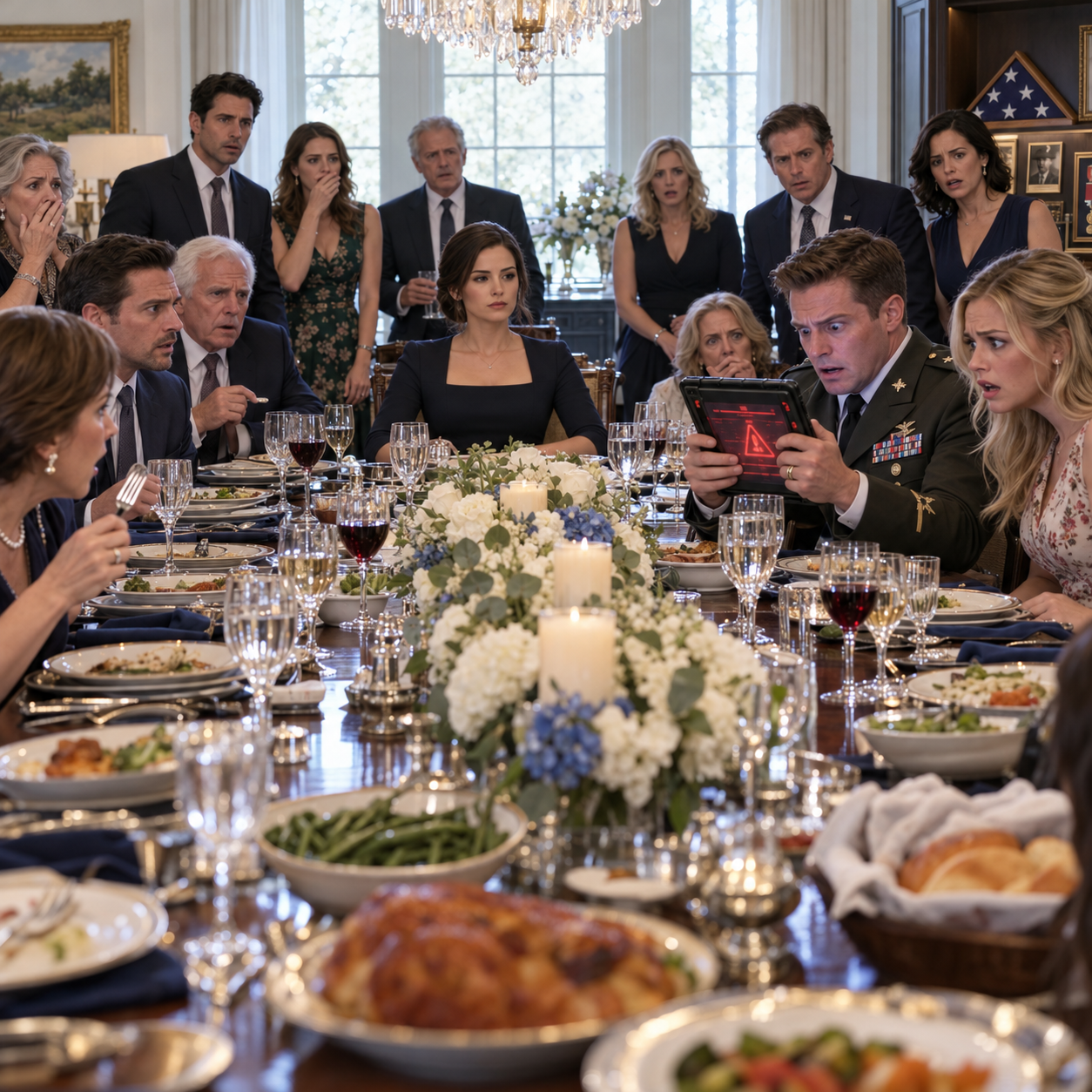
Over Sunday Dinner With 15 Relatives, My Sister’s Fiancé Flaunted His Military Phone Access. “I Can Pull Up Any Clerk’s Salary In Ten Seconds!” He Typed In My Social Security Number To Humiliate Me. Suddenly, The Screen Flashed, “TS/SCI Compartment Omega-9: Unauthorized Access. Credential Suspended.” He Looked Up At Me, All Color Draining From His Face. “Ma’am… Why Does Your File Require Pentagon Clearance?”
At my mother’s Sunday dinner, my sister’s fiancé announced he could expose my government salary in ten seconds. My father laughed and told me to stop being difficult when I begged him not to use my Social Security number. I went quiet and let him make his choice. Minutes later, his government phone locked him out, and he called me “ma’am” with a trembling voice. Three weeks afterward, an investigator showed me a document bearing my forged signature. That was when I realized the humiliation had never been the whole story.
Part 1: The Sunday Dinner Where Everyone Decided I Was Worthless
The first thing I noticed when I pulled into my parents’ driveway was that somebody had parked across the spot where I used to leave my car. It was a new black pickup with polished wheels, the kind that looked too expensive to carry anything heavier than groceries, and a small American flag decal on the rear window. I recognized it immediately as belonging to my younger sister’s fiancé, Staff Sergeant Evan Mercer, whom my father had been praising over the telephone for the better part of three months. I parked my twelve-year-old Honda on the street instead, shut off the engine, and spent a moment watching the October leaves tumble along the curb.
My name is Claire Voss, and at forty-four, I had learned not to expect much from Sunday dinners in the house where I grew up. My father, Frank, had worked thirty-six years at an automotive parts plant outside Dayton, Ohio, and he believed a person’s importance could be measured by how plainly that person explained what they did for a living. My mother, Diane, believed family peace mattered more than individual feelings, especially when those feelings belonged to the daughter least likely to complain. My younger sister, Natalie, had always been the one whose accomplishments were announced before dessert, while mine were mentioned only when someone needed a comparison.
There were fifteen relatives expected that afternoon, including my aunt June, two uncles, several cousins, and a toddler who had recently discovered the pleasure of throwing food. Natalie and Evan were getting married the following spring, and my parents had turned every family gathering into an unofficial celebration of their engagement. I had flown in from Virginia the previous evening after a demanding week, bringing a bottle of sparkling cider because my mother disliked wine at the dinner table. As I reached the porch, I checked the time on my grandmother’s old silver wristwatch, a habit I had carried through more difficult situations than anything waiting inside that house.
Aunt June opened the door before I rang the bell, wearing her familiar purple cardigan and smelling faintly of lavender soap. “There’s my favorite troublemaker,” she said, wrapping me in a hug that lasted long enough for me to feel how badly I needed it. She studied my face afterward and lowered her voice. “Your father’s been telling everybody about Evan’s promotion possibilities, so don’t take anything personally if he starts comparing the two of you.”
“I stopped taking Dad personally years ago,” I told her, which was partly true and partly something I said because she deserved a more peaceful afternoon. June gave me the look she had perfected during forty years as an elementary school librarian, the one that meant she recognized a lie but wasn’t going to embarrass its owner. She took the cider and walked me toward the kitchen, where the smell of roasted beef, onions, and cinnamon filled the warm hallway. Somewhere in the dining room, I heard my father laughing with a fullness that had become unfamiliar whenever I was the one visiting.
My mother was stirring gravy when I entered, wearing a pale blue apron Natalie had given her for Mother’s Day. She kissed my cheek, asked whether my flight had been delayed, and immediately wanted to know if I had brought appropriate clothes for the family photographs planned after dinner. I told her I had packed a blouse and a decent pair of slacks, and she looked briefly disappointed before saying it would have to do. Then Natalie appeared in the doorway wearing a cream sweater, expensive earrings, and the engagement ring she had shown me in approximately thirty photographs.
“Claire, you made it!” she cried, embracing me with such genuine enthusiasm that I almost forgot how exhausting loving her could be. Natalie was thirty-three, worked as a physical therapist at a rehabilitation clinic, and had never experienced a family celebration that didn’t eventually revolve around her. She wasn’t incapable of kindness, but she had spent her entire life benefiting from other people’s willingness to make themselves smaller. When she pulled away, she examined my plain sweater and smiled. “You look comfortable.”
In the dining room, my father stood beside Evan, who was explaining something about military personnel systems to Uncle Raymond. Evan was thirty-five, square-jawed and meticulously groomed, with the cheerful confidence of someone who had learned that speaking loudly could sometimes substitute for knowing more than everyone else. His Army-issued phone lay beside his plate, and his identification badge was clipped visibly to his belt despite the room being full of civilians. My father saw me and gestured vaguely in my direction. “Here’s Claire, everybody. She does government office work somewhere around Washington.”
I had been an Army officer for more than two decades, although my family had spent the last thirteen years describing my Defense Department assignments as paperwork. Some details of my work were classified, and I had grown accustomed to giving careful answers, but neither my service nor my rank required the complete invisibility my family had chosen for me. When I stopped discussing promotions after my father dismissed one as another meaningless government title, nobody asked what I was doing instead. Over time, their assumptions became so convenient that correcting them would have required conversations none of us seemed capable of having.
Evan extended his hand and squeezed mine with unnecessary force. “So you’re the other government employee in the family,” he said, flashing a smile toward my father. “Natalie tells me you handle administrative stuff, which probably means we’re in completely different leagues.” I returned his handshake without matching the pressure and replied, “Different responsibilities, certainly,” but he was already turning back toward his audience.
My place card sat at the far end of the dining table, directly beside the swinging door to the kitchen. Natalie had arranged the seating, and whether intentionally or not, she had placed me where I could easily retrieve napkins, refill glasses, and help my mother without interrupting anybody important. Evan sat beside my father near the head of the table, with Natalie at his other side and my uncles close enough to enjoy every story he told. Aunt June noticed my placement, picked up her card from across the room, and quietly exchanged it with the one beside mine.
Dinner began pleasantly enough, with talk of football, a neighbor’s new deck, and the outrageous price of wedding flowers. My mother served pot roast with mashed potatoes and green beans, and for a little while, I was content to listen to the familiar sounds of people passing dishes and asking for salt. Then my father asked Evan about his work, and something changed in the room. Evan straightened as though he had been waiting for a microphone to appear.
“People don’t realize how much information we handle,” he announced, tapping his government phone. “Personnel records, assignments, pay grades, promotion histories—thousands of people depending on systems guys like me know how to use.” My father leaned forward, impressed, while Evan continued describing senior officers who supposedly relied on him to solve problems nobody else could handle. I recognized several exaggerations but chose not to challenge them, because a holiday dinner was not the place to correct another soldier’s self-important account of his responsibilities.
“Now, Claire probably deals with the boring side of government,” Evan added, turning toward me with a grin. “Invoices, office supplies, maybe sorting personnel forms all day.” A few relatives chuckled, and my father nodded as though Evan had confirmed something he had always suspected. “Nothing wrong with honest work,” Dad said, “but Evan’s got real responsibility, and that’s the difference.”
I put down my fork and looked at the gravy slowly collecting around my potatoes. There were things I could have said about responsibility, sleepless nights, and decisions that followed people home even when their work could never be discussed. Instead, I asked my mother whether she needed more water, because I knew how to perform the part my family had written for me. Aunt June touched my wrist under the table, but she didn’t interrupt the conversation either.
Evan wasn’t finished. He began explaining how someone with the proper credentials could retrieve salary information, and Uncle Raymond jokingly asked whether he could find out how much their congressman earned. Evan laughed, lifted his phone, and announced, “I can pull up any clerk’s salary in ten seconds if they’re in the system.” He looked directly at me, enjoying the attention gathering around him. “Actually, Claire would be the perfect example.”
My sister laughed as though he’d suggested a harmless party trick, and my father immediately encouraged him. “Go ahead, son, let’s see what our mysterious government employee makes,” he said, slapping the table hard enough to rattle the silverware. I kept my voice steady and told Evan that accessing personnel information without an authorized purpose was a serious violation, not entertainment. His smile widened at what he apparently considered a challenge.
“Relax, Claire, I’m not stealing state secrets,” he said. “It’s just salary information, and everybody here is family.” I told him that being family didn’t give him permission to access my records, and that being able to enter a system didn’t mean he was authorized to use it however he pleased. My father rolled his eyes. “For heaven’s sake, Claire, must you make everything complicated?”
Then Evan asked for my Social Security number, and Natalie said something I would replay in my mind for months. “Mom has it in the blue wedding binder,” she announced, rising from her chair before I could object. My mother looked up sharply, her expression changing from mild discomfort to alarm, but Natalie was already opening the sideboard drawer. I watched her lift out a thick blue binder containing family information, copies of documents, and forms that my mother had been collecting for the wedding.
“Natalie, don’t,” I said, standing so quickly that my chair scraped against the hardwood floor. My sister glanced over her shoulder with an impatient little smile and told me to stop acting like the number was a national treasure. My father pointed at my empty chair. “Sit down, Claire, and let the boy demonstrate something for once.”
I remained standing for another moment, looking from my father to my sister and finally to Evan, who was waiting with his phone unlocked. I warned him one last time that his credentials could be suspended for what he was about to do, and he laughed as though I were afraid of being exposed as a low-paid secretary. Across the table, Natalie opened the binder to a page containing personal information I had never agreed to share. Then she began reading my Social Security number aloud.
Part 2: Ten Seconds That Ended a Soldier’s Carefully Constructed Reputation
I remember the sound of Natalie’s voice more clearly than the numbers themselves. She read each digit carefully, pausing between groups while Evan typed, and I watched my mother fold and unfold the same corner of her napkin without looking up. Uncle Raymond leaned forward to see the phone, while Cousin Derek made a joke about finding out whether I could afford a newer car. Nobody seemed troubled that information belonging to me was being passed around the dinner table without my consent.
“That’s enough,” I said, but Natalie waved me off because she was nearly finished. When she spoke the final digit, Evan thanked her with a theatrical flourish and angled the screen away from me. My father sat back with his arms folded, looking pleased that the evening’s difficult daughter had finally been forced to participate in a little family fun. I sat down because there was nothing more I could accomplish by arguing, and I wanted my final warning to remain unmistakably clear.
Evan typed my full name, checked the identifying information, and held his thumb over the search button. “Ladies and gentlemen,” he announced, “we’re about to discover whether the federal government is paying Claire enough to keep driving that antique Honda.” A ripple of laughter moved around the table, and Natalie slipped her hand through his arm as though she were standing beside a performer about to receive applause. Then he pressed the screen.
For several seconds, the phone displayed a spinning symbol while it processed his request. Evan frowned, tapped the screen again, and muttered something about the connection being slow. I noticed his shoulders stiffen before anyone else did, a tiny movement that told me he had seen something unexpected. The spinning symbol vanished, replaced by a red security notification that illuminated his face from below.
His expression changed so abruptly that Natalie stopped smiling. Evan brought the phone closer, read the message, and swallowed hard before turning it sideways as though changing the angle might make the words disappear. Then a second notification appeared, accompanied by a sharp electronic tone that sounded absurdly loud over the quiet dining room. I saw his thumb freeze above the glass.
“What’s happening?” my father asked, leaning toward him with a puzzled smile. Evan didn’t respond, and for the first time that afternoon, he looked less like a confident soldier than a frightened young man who had just realized he couldn’t undo something. Natalie tugged on his sleeve and asked whether the connection had failed. He stared at the screen and whispered, “No, that’s not what happened.”
He turned the phone slightly, exposing the message to the people closest to him. The red warning contained the words TS/SCI COMPARTMENT OMEGA-9, followed by UNAUTHORIZED ACCESS and CREDENTIAL SUSPENDED. Beneath that was a shorter notification stating that his session had been terminated and the attempted access recorded for security review. It was not the kind of message an ordinary employee’s salary inquiry was supposed to produce, and Evan understood that immediately.
My father squinted at the screen, trying to make sense of the abbreviations. “What’s that supposed to mean?” he asked. Evan glanced at me, then back at the phone, and explained in a strained voice that TS/SCI referred to highly restricted classified information. He shook his head as if arguing with something inside his own mind. “A normal civilian personnel record wouldn’t return anything like this.”
Natalie gave an uncomfortable laugh. “Obviously it’s a mistake, Evan. Claire does paperwork, remember?” She reached toward the phone, but he pulled it away and tried to reopen the application. Another warning appeared, telling him his account was disabled pending review, and when he attempted to authenticate again, the device refused the request.
“Don’t touch it anymore,” I said quietly. Evan’s hand stopped, and his eyes traveled slowly across the table until they met mine. Something in my voice seemed to connect with the warnings I had given him earlier, because he set the phone down with extraordinary care. Then he addressed me in a way he had never done before.
“Ma’am,” he said, his throat tightening around the word. “Why does your file require Pentagon clearance?” My father’s fork slipped from his fingers and struck his plate, producing a small metallic sound that somehow seemed louder than Evan’s question. I looked at the faces around the table, faces I had known since childhood, and realized that not one person was looking at me with the same easy contempt they had shown minutes earlier.
I couldn’t answer Evan’s question, and I wasn’t particularly interested in satisfying his curiosity. “You accessed information without authorization after I specifically warned you not to,” I said, keeping my hands folded beside my plate. “You need to stop using that device and report exactly what you did.” He shook his head and said that the system should never have allowed a lookup to reach a protected record, which was the first technically sensible thing he had said all evening.
My father recovered enough to become angry. “What is this nonsense about the Pentagon?” he demanded. “Claire, if you’ve been lying to us about your job, now would be a good time to explain yourself.” The unfairness of that accusation settled over me with surprising weight, because my sister had just disclosed private information and her fiancé had misused a federal system, yet somehow I was the person being called dishonest.
“I’ve never lied about working for the Defense Department,” I replied. “I’ve told you for years that there are things I can’t discuss.” Dad’s face reddened, and he reminded me that I had once described my work as administrative oversight, a phrase he had repeated so often that it had become my entire identity in his mind. I told him that some of my responsibilities involved security and that I was not permitted to explain the details at his dinner table.
Before he could respond, I took out my personal phone and called a number I had memorized years earlier. I identified myself, explained that a credentialed Army staff sergeant had attempted to access my protected information from a private residence, and provided my parents’ address. The person on the other end asked several brief questions, including whether the device remained in the room and whether anyone had photographed the screen. When the call ended, I placed my phone beside my water glass and told everyone that security personnel would be contacting Evan.
For a moment, the room remained absolutely still. Then Natalie rounded on me, her face flushing with anger, and asked whether I had really reported her fiancé over a harmless family joke. I reminded her that I had warned him repeatedly and that she had supplied my personal information despite being told to stop. Her eyes filled with tears, but instead of apologizing, she looked toward our mother and said, “She’s ruining everything because she can’t stand Evan being more successful than her.”
My mother finally spoke. “Natalie, that’s enough,” she said, so softly that several people didn’t hear her. Dad did, and he immediately told her not to take sides until they understood what was happening. I stared at him for several seconds before realizing he still believed the purpose of the evening was to decide whether I had embarrassed his future son-in-law.
Aunt June stood and pushed her chair away from the table. “Frank, your daughter just asked someone not to use her Social Security number, and you ordered her to sit down,” she said, her voice steady despite the color rising in her cheeks. “Whatever his phone says, that part happened right in front of you.” My father opened his mouth, but she raised one hand and told him she had spent forty years listening to adults make excuses for bullies, and she wasn’t interested in hearing another one.
Evan remained silent throughout their exchange, but I noticed him glance repeatedly at the hallway. His phone had been confiscated by its own security system, and his confidence seemed to be draining away with every passing minute. When my mother asked if someone should call his commanding officer, he answered much too quickly that nobody needed to do anything else. I wondered why the idea of another official looking at his work frightened him more than the access suspension itself.
About twenty-five minutes later, two vehicles pulled into the driveway. A woman in civilian clothes entered first, identified herself as Special Agent Iris Shaw, and explained that she needed to secure the device and document the circumstances of the attempted access. Behind her came Colonel Miriam Calder, a senior security officer I knew professionally, who looked at the table, the open binder, and Evan’s government phone before turning toward me. “Colonel Voss,” she said evenly, “are you safe?”
My father stared at her as though she had spoken in a foreign language. “Colonel?” he repeated, looking at me. I nodded, not because I wanted to impress him, but because the situation no longer allowed me to pretend he hadn’t heard correctly. “Yes, Dad,” I said. “That’s my rank.”
Evan stood so abruptly that his chair tipped against the wall. Colonel Calder instructed him to leave his phone and identification where they were, and Agent Shaw began asking him to account for his use of the personnel system. He tried to explain that he had only been entertaining the family, but Shaw interrupted to ask whether he had made any similar searches outside authorized duties. His face changed again, and this time I saw something more complicated than embarrassment.
The officers collected the device, recorded statements from the people who had witnessed the incident, and arranged for Evan to report for a formal interview. Colonel Calder carefully avoided discussing my assignment, and I followed her lead, answering only questions relevant to the security incident. Before leaving, she asked to speak with me privately beside my car, where the autumn air felt cold after the overheated dining room. She waited until the front door closed behind us before lowering her voice.
“Claire, this didn’t begin tonight,” she said. “We’ve been reviewing irregular personnel searches for several weeks, and Mercer’s name is connected to some of them.” I looked back toward the house, where my sister was visible through the dining room window, crying against Evan’s shoulder. Calder hesitated before asking one final question. “Did he choose your record himself, or did someone tell him to?”
I told her the truth: he had singled me out, and Natalie had provided my number. Calder looked down at the notes in her hand, then at the front windows, where the people who had raised me were still waiting to discover how important I might be. She told me not to discuss the investigation with my family and said an investigator would contact me the following morning. As she turned to leave, she added, “There’s something you should know. Mercer searched for you once before.”
Part 3: The Investigation Revealed Someone Had Been Watching Me
I drove back to Virginia the next morning because sitting through another breakfast at my parents’ house would have been unbearable. My mother called before I reached the highway, asking whether there was some way to persuade Colonel Calder that Evan hadn’t meant any harm. When I explained that I had no authority over the investigation, she said Natalie hadn’t slept and my father was worried about what people would think. She never asked whether I had slept or how it felt to have my personal information exposed in front of fifteen relatives.
By Monday afternoon, I was back in my apartment in Arlington, standing in the kitchen with a grocery bag in my hand and realizing I had forgotten to buy milk. It was such an ordinary mistake that I nearly laughed, although nothing about the previous twenty-four hours felt ordinary. My phone contained eleven messages from relatives, ranging from awkward congratulations about my military rank to requests for explanations I couldn’t legally provide. The only person who asked whether I was all right was Aunt June, who sent a photograph of the apple pie nobody had touched after I left.
I worked from home that Tuesday while arrangements were made for a formal interview, and the familiar routine steadied me. For all the secrecy surrounding some of my responsibilities, much of my professional life involved tedious reviews, competing priorities, and reminding highly educated adults that procedures existed for reasons. I spent an hour correcting an incomplete report and another attending a meeting where three people disagreed about a deadline. The ordinary work made the previous Sunday seem almost imaginary until Agent Shaw called and asked whether I could come to a secure interview room the following morning.
The interview began with questions about my relationship with Evan, the timing of the dinner, and whether I had ever authorized him to search for my information. I described the warnings I’d given him, Natalie’s decision to retrieve the binder, and my father’s insistence that I sit down. Agent Shaw took notes without displaying surprise, occasionally asking me to repeat exact phrases so she could compare them with other witness statements. When she asked whether Evan had ever shown an unusual interest in my assignments, I remembered an uncomfortable conversation from the previous Christmas.
We had been standing beside my parents’ fireplace when Evan asked which Defense Department offices I worked with and whether I traveled to the Pentagon. At the time, I assumed he was trying to impress me with his knowledge of military administration, so I gave him the same limited answers I gave everyone. He had laughed and said somebody with my kind of job probably didn’t need much clearance, then asked whether I knew anyone involved in personnel compliance reviews. I remembered finding the question peculiar but not important enough to pursue.
Agent Shaw looked up when I mentioned that final question. “Did he explain why he wanted to know?” she asked, and I told her he had said a friend was trying to establish a business serving military families. She asked whether I remembered the company’s name, but all I could recall was something about helping service members transition into civilian housing. I had heard countless legitimate organizations described in similar language, and nothing about the conversation had struck me as evidence of a crime.
After the interview, I went to a small coffee shop and sat by the window while commuters hurried past beneath a gray sky. I kept thinking about Evan’s sudden change of expression when Agent Shaw asked about previous searches, wondering whether my protected record had simply been an unlucky choice for his performance. His behavior at dinner had been arrogant and inappropriate, but arrogance alone didn’t explain why Colonel Calder had arrived already knowing his name. When I finally returned home, I found a message from Natalie demanding that I stop telling people Evan had done something criminal.
I called her because I wanted to know what she believed had happened. She answered with, “Claire, this is getting ridiculous,” and immediately accused me of using my rank to intimidate her fiancé. I explained that his actions had generated the security alert and that I hadn’t requested any special treatment. Natalie responded that I could have warned him in stronger language if the consequences were truly serious, and I had to put the phone down for a moment before reminding her that I had repeatedly asked him to stop.
“Everybody thought you were exaggerating,” she insisted, sounding offended that I wouldn’t accept her explanation. “You always get strange whenever someone asks about your work, and we thought this was another one of those times.” I asked whether she would have handed my Social Security number to a stranger making the same request, and she became quiet. Then she said, “Evan isn’t a stranger,” as though our relationship through her engagement somehow entitled him to information I hadn’t volunteered.
The following week, my mother told me investigators had requested records of payments made to an organization called Welcome Harbor Veterans Project. The name stirred a memory of glossy brochures on my parents’ refrigerator and my father’s enthusiastic description of a charity helping veterans find affordable housing. Evan had introduced the organization to the family the previous spring, explaining that one of his Army friends had developed a program to assist military spouses during relocations. Natalie had helped arrange its first community fundraiser, and my father had persuaded several retired coworkers to contribute.
“That sounds like a financial investigation,” I told Mom, surprised she knew about the request. She said Agent Shaw had asked whether the family kept copies of donation receipts and event invitations, including paperwork Natalie had assembled for the wedding. When I asked why wedding records would be relevant, Mom answered that Natalie had been using the same binder to organize both projects. Her voice changed as she said it, and I realized she was beginning to understand that the dinner might have exposed something much larger than one unauthorized search.
For several days, I heard nothing official. I learned through Natalie that Evan had been removed from duties involving personnel systems and instructed not to contact certain coworkers while the review continued. My father told relatives that his future son-in-law had encountered a technical problem that bureaucrats were turning into a scandal. I didn’t correct him publicly, partly because I was not authorized to discuss the investigation and partly because I had finally recognized how much effort I had spent trying to make him understand things he preferred not to believe.
During the third week, Agent Shaw contacted me again and asked whether I could review a document recovered during a separate financial inquiry. She made it clear that I wasn’t being asked to investigate anything myself, only to confirm whether I had authorized the use of my name. The document was a letter of professional endorsement on Welcome Harbor Veterans Project stationery, accompanied by a certification suggesting that the organization had received favorable security guidance from a Defense Department representative. My full name appeared beneath the endorsement, followed by a signature that looked disturbingly like my handwriting.
I had never written the letter, never reviewed the organization, and never authorized anyone to associate my professional position with its activities. The signature wasn’t perfect, but whoever had copied it had captured the peculiar upward stroke I used at the end of my surname. Agent Shaw asked whether anyone might have access to an older signed document, and I remembered the handwritten letters I’d sent my mother during overseas assignments. She kept them in a wooden box in the hallway closet, alongside school certificates, family photographs, and the cards my grandmother had given us.
I told Agent Shaw about the letters, then asked whether Evan had submitted the endorsement himself. She answered that the document had circulated among several people involved with Welcome Harbor, but she couldn’t yet discuss its complete history. When she turned to the final page, I saw that the endorsement wasn’t merely a copied letter attached to a fundraising package. It included a separate certification identifying the person who had supposedly witnessed my approval.
That witness had signed her own name in a looping handwriting I recognized instantly. I leaned closer, hoping some detail would prove I was mistaken, but the signature was unmistakable. Beneath the false endorsement, in black ink, were the words “Natalie Voss, Program Coordinator.” My sister hadn’t merely helped Evan find my Social Security number at dinner; she had been using my identity to support his project for months.
Part 4: My Sister’s Perfect Engagement Concealed a Financial Betrayal
I stared at Natalie’s signature until Agent Shaw gently asked whether I needed a break. In my mind, I could still see my little sister sitting cross-legged on our bedroom floor, carefully copying my handwriting when she wanted to forge a note excusing herself from school. Back then, I had considered it a harmless childhood skill and occasionally helped her correct the letters that didn’t look convincing. Sitting in a federal interview room twenty-five years later, I wondered how many small acts of accommodation had taught Natalie that my permission was optional.
Agent Shaw explained that investigators had to establish what Natalie knew when she signed the certification, so I should avoid discussing the document with her until they had completed their interviews. I asked whether my mother might also be implicated because she kept the original letters, but Shaw reminded me that access to someone’s handwriting didn’t automatically prove participation in fraud. She also said the endorsement appeared to have been used in materials distributed to potential donors, financial partners, and military families. That last detail disturbed me more than the signature itself.
An organization claiming government approval could persuade vulnerable people to trust it with information or money they might otherwise protect. My name had appeared on a document implying that someone in a position of authority had examined Welcome Harbor’s procedures and found them acceptable. I knew how seriously families took those assurances, especially when they were managing deployments, injuries, relocations, or the death of a service member. The thought that my sister had helped manufacture such confidence made me feel physically ill.
When I got home, I opened an old storage box and found photographs from the summer Natalie graduated college. In one picture, she was standing between our parents with her diploma held high, while I stood slightly behind them in civilian clothes after traveling twelve hours to attend the ceremony. My father had spent most of the afternoon telling people how proud he was of Natalie’s determination, and I remembered being genuinely happy for her. Now I wondered when happiness for my sister had become an obligation to surrender pieces of my own life.
The following Sunday, Aunt June called and asked whether she could visit me in Virginia. She arrived two days later carrying homemade chicken soup in insulated containers and the kind of direct concern I had rarely received from anyone else in the family. We ate at my kitchen counter while she told me that my parents’ home had been unusually quiet and Natalie was staying with a friend. Then she mentioned something that made me put down my spoon.
“Your father knew about a complaint against that veterans charity,” she said, watching me carefully. “A woman from his old church came to the house in August because she’d paid them money and couldn’t get anybody to return her calls.” I asked what kind of complaint she meant, and June explained that the woman had been promised help securing an apartment after her husband died, but the organization kept requesting additional payments. My father had assured her that Evan was a trustworthy soldier and advised her to be patient.
June looked ashamed as she admitted that she had believed him at the time. She remembered the woman’s name as Teresa Navarro, a widow whose husband had served in the Army before dying of cancer two years earlier. Teresa had reportedly paid Welcome Harbor more than nine thousand dollars toward relocation assistance and various administrative charges, only to discover that the housing placement she expected had never been confirmed. When she asked for her money back, someone told her the funds had already been committed and couldn’t be refunded.
I wanted to call Teresa immediately, but I knew better than to approach someone who might be a witness in an active investigation. Instead, I encouraged Aunt June to tell Agent Shaw what she knew and gave her the appropriate contact information. June nodded, then said she needed to tell me one more thing. My father hadn’t merely dismissed Teresa’s complaint; he had asked her not to spread rumors because Natalie and Evan were about to announce a fundraising dinner for Welcome Harbor.
“Did he know the money was missing?” I asked. June said she couldn’t be certain, but Teresa had shown him receipts and unanswered messages during her visit. I sat with that information for a long time, remembering how proudly my father had described Evan’s character and military service to everyone at dinner. He had been willing to believe the best of Evan while assuming the worst of me, even when someone else had already brought him evidence that deserved attention.
A few days later, my mother called and asked whether she could speak without my father listening. She sounded exhausted and said she’d been sorting through paperwork after investigators asked for additional records. I told her I couldn’t discuss the inquiry but would listen if she needed to explain her own actions. After a long silence, she admitted that the family information in the blue binder had never been required by the wedding venue.
“Evan told Natalie it would simplify the background paperwork for Welcome Harbor’s charity events,” Mom said. “Natalie said we could keep everything together until the wedding was over.” I asked why she’d collected Social Security numbers from relatives without asking permission, and she answered that Natalie had assured her the forms were routine. The explanation might have been understandable if my mother hadn’t ignored my explicit objections at the dinner table, and I told her so.
“I should have stopped her,” Mom whispered. I waited, expecting the familiar addition about how nobody could have known or how Natalie had only been trying to help. Instead, she said that when she had hesitated, Evan told her I was unnecessarily suspicious because I worked in a low-level office position and didn’t understand how military programs operated. My own family had accepted his description of my professional judgment over mine, and they had done so with a willingness that was becoming difficult to explain as mere ignorance.
That weekend, Natalie sent me a message asking if we could talk about the endorsement. I didn’t reply until Agent Shaw confirmed that the relevant interviews had been completed and there was no objection to a private family conversation. Natalie arrived at my apartment on Saturday wearing jeans and an oversized sweatshirt, with her engagement ring still on her finger. She looked thinner than I’d ever seen her, and for a moment I felt the old instinct to embrace her and promise we would figure everything out.
Instead, I offered her a seat and asked why she’d signed a document claiming to witness my approval. Natalie twisted the ring around her finger and admitted that Evan had told her the endorsement was a formality for a pending partnership. He said my background in government administration would make the project appear more credible and that he intended to ask my permission later. She had copied a signature from an old letter at our parents’ house because he needed the application submitted before a deadline.
“You used my name without asking me,” I said, keeping my voice controlled. Natalie stared at her hands and replied that she hadn’t thought the document would ever reach me. I asked whether she understood that this made her explanation worse rather than better, and she began crying. “I was trying to help him build something,” she said. “Everybody kept telling me what a wonderful future we were going to have.”
I asked whether she knew Welcome Harbor was collecting payments from veterans and military spouses who weren’t receiving the assistance they had been promised. Natalie insisted she hadn’t understood the financial arrangements, then admitted that several donors had complained about delayed refunds. She had asked Evan about those complaints, and he’d explained them as temporary accounting problems caused by the organization’s rapid growth. When I asked why she’d continued raising money after learning that families were demanding refunds, she looked toward the window and said, “Because I didn’t want everything to fall apart.”
I understood that answer more deeply than I wanted to. Natalie had been raised in a house where appearances mattered, uncomfortable questions were treated as disloyalty, and the person creating a problem was often blamed less than the person pointing it out. Evan hadn’t invented that family habit, but he had learned to use it. My sister had helped him because admitting he was dishonest would have threatened the wedding, the future she’d advertised, and the version of herself everyone expected her to be.
Before Natalie left, I asked one final question about the Sunday dinner. I wanted to know whether Evan had decided to search my records spontaneously or whether they had discussed doing it beforehand. She hesitated, and I saw the answer in her face before she spoke. “He said he needed to find out whether you were really connected to some security office,” she admitted. “He told me you might be able to cause problems for Welcome Harbor if you started asking questions.”
I felt the room narrow around us. Evan had known that someone connected to federal security work might recognize irregularities in his operation, and he had chosen to test my access in front of relatives he expected to support him. Natalie wiped her cheeks and added that he’d specifically asked whether our mother still kept my personal information in the blue binder. Suddenly, his challenge at dinner no longer looked like a random display of arrogance.
It had been a calculated gamble, built around the assumption that my family would help him humiliate me. My sister had known the plan, supplied the information, and watched me beg him to stop. I opened the apartment door and told her I needed distance, not another explanation. For the first time in our lives, Natalie left without my comforting her.
Part 5: The People Harmed by His Scheme Finally Had Names
Two months passed before I could look at a Sunday calendar without remembering the sound of my father’s laughter. The investigation had expanded beyond Evan’s unauthorized search, and agents were examining Welcome Harbor’s fundraising practices, financial records, and communications with military families. I received occasional requests to clarify details of the forged endorsement, but I wasn’t given access to the full case and didn’t ask for special treatment. Whatever my rank, I was a witness whose identity had been misused, and the people conducting the investigation had to do their jobs independently.
The basic outline gradually became clear through information I was legally permitted to receive. Welcome Harbor Veterans Project had begun as a small organization founded by Evan’s longtime friend, Marcus Bell, a civilian who claimed experience in military relocation services. It advertised assistance finding housing, managing benefit applications, and securing employment after military service, but its actual resources were far smaller than its promotional materials suggested. Clients were encouraged to pay upfront processing and placement fees, while donors were told that contributions funded emergency assistance for struggling families.
Evan’s involvement gave the organization a military connection it used constantly in its advertising. His access to personnel systems had also allowed him to view information unrelated to his authorized assignments, including records that could help identify service members approaching transitions and families facing changes in circumstances. Investigators were examining whether that information had been passed to Welcome Harbor without permission. I didn’t need the technical details to understand the harm: people had trusted an organization because its founders claimed access, expertise, and government approval they did not legitimately possess.
The discovery bothered me at night, when the apartment was quiet and there was nothing left to distract me. I thought about military families I had known during deployments, spouses balancing jobs and childcare while waiting for unpredictable news, and older veterans trying to understand paperwork that seemed to change every time they requested help. Those were the kinds of people Welcome Harbor had been promising to protect. Evan had stood at my parents’ dinner table boasting about the power of his credentials while people who trusted that power were struggling to recover their savings.
My father, meanwhile, continued defending him. According to Aunt June, he told several relatives that the investigation was being exaggerated because I had personal connections inside the Defense Department. He described me as resentful of Natalie’s happiness, claiming I had never approved of Evan from the beginning. When June challenged him, he replied that families were supposed to support one another during difficult times. She asked whether that principle had applied when I told Evan to put down his phone, and Dad ended the conversation.
I didn’t confront him immediately because I wanted to understand why he was so determined to protect a man whose conduct was becoming impossible to defend. The answer arrived unexpectedly in a letter my mother forwarded with a note asking whether it might be relevant. It was a copy of an invitation my father had helped distribute for Welcome Harbor’s summer fundraising luncheon. Beneath the event details was a paragraph assuring donors that the organization had been favorably reviewed by a Defense Department professional, with my name presented as supporting evidence.
My father had personally signed the accompanying message, encouraging friends and former coworkers to support what he called a trustworthy military family initiative. I read his words several times, remembering how he had dismissed my supposed office job while praising Evan’s access to government systems. When my professional identity could help raise money for Evan’s project, however, it had suddenly become valuable enough to feature in a fundraising appeal. Whether Dad understood the endorsement was forged remained uncertain, but he had been comfortable using my name without asking whether I’d approved.
I gave the letter to Agent Shaw and asked my mother why she had kept a copy. She admitted that she’d found it tucked inside a folder containing several complaints from donors, including correspondence from Teresa Navarro. My father had received those complaints before the Sunday dinner, and he had apparently been trying to resolve them privately with Evan. One letter from Teresa described a promised apartment that had never been secured and asked whether the charity had been misrepresenting its services.
Mom told me my father had believed Evan when he blamed the problems on Marcus Bell. “He said Marcus wasn’t very organized and the donations would be sorted out after the next fundraiser,” she explained. I asked whether Dad had told Teresa that her money would be returned, and Mom answered that he had promised to speak with Evan again. Then she began crying, saying she had never imagined the situation would become a criminal investigation.
I wanted to tell her that criminal investigations didn’t emerge from thin air, but she was finally listening and I didn’t want to replace the truth with another argument. I explained that families who needed housing assistance couldn’t afford to treat missing thousands of dollars as an administrative misunderstanding. She acknowledged that she had been more worried about Natalie’s wedding than about the people complaining to my father. It was the first time I’d heard her identify the choice she’d made without disguising it as an innocent mistake.
In January, the investigation became public after federal authorities announced charges against Marcus Bell and Evan Mercer relating to fraud and unauthorized access to protected information. The announcement was brief and didn’t disclose sensitive details about my work, but it identified multiple families who had suffered financial losses. I read it at my kitchen counter while my coffee went cold, relieved that the investigation had reached a stage where its basic findings no longer depended on rumors. The relief disappeared when I saw that some victims were still facing housing instability and unresolved debts.
My sister called that evening, crying so hard I could barely understand her. She said Evan had been arrested and charged, that Marcus had been making decisions Evan didn’t understand, and that everyone was treating her fiancé like a monster. I told her I couldn’t decide his guilt or innocence over the telephone and that he deserved legal representation, but I refused to make excuses for his conduct. Natalie asked whether I would provide a statement saying Evan had made the personnel search with my permission.
“No,” I said. She started explaining that the request had been misunderstood and that he might avoid some consequences if the dinner looked like a consensual demonstration. I interrupted her and reminded her that I had warned him in front of fifteen witnesses, including herself. Natalie went quiet before whispering, “You know this could ruin his life.”
I looked at the refrigerator, where Aunt June had stuck a photograph of us laughing together during her visit. “There are families who lost money they needed to keep their homes,” I told Natalie. “Evan helped create that problem, and then he tried to find out whether I could threaten his operation.” She insisted he had never intended to hurt anyone, and I asked whether she believed that made the losses less real. She didn’t answer.
Later that month, Aunt June told me Teresa Navarro had returned to the church seeking recommendations for a legal aid organization. Teresa’s husband had served nearly twenty years in the Army, and after his death, she’d struggled to manage housing expenses and care for her teenage son. Welcome Harbor had promised to help her relocate closer to her sister, who could provide childcare while Teresa returned to full-time work. Instead, Teresa had lost the money set aside for the move and spent months trying to recover payments she could barely afford to make.
I didn’t contact Teresa while the case was active, but I asked June to help her locate legitimate nonprofit legal services and made clear that I could not become involved in the investigation through an unofficial channel. June understood immediately, although she sounded disappointed that I couldn’t simply solve the situation. I told her that responsibility meant respecting boundaries even when breaking them might feel helpful. It was a lesson Evan had never understood, and one my family had consistently treated as an inconvenience.
A week later, Agent Shaw contacted me about another document recovered from Evan’s correspondence. It was an email written several weeks before the Sunday dinner, addressed to Marcus Bell and discussing the need to determine whether I had actual security authority. The message didn’t contain many words, but its meaning was unmistakable. Evan had written that my family considered me harmless and that he could use an ordinary personnel inquiry to find out whether my position was worth worrying about.
The final sentence stayed with me long after I closed the file. Evan had described my parents as people who would “make Claire cooperate if she gets difficult.” He hadn’t merely underestimated me or assumed I would surrender to pressure from a persuasive man. He had correctly identified that my own family could be relied upon to ignore my objections, and he had built his plan around it.
Part 6: My Father Finally Admitted What He Had Chosen to Ignore
I returned to Ohio in February, not because my parents had asked me to come, but because Aunt June was recovering from a knee replacement and needed someone to stay with her for a few days. She lived twenty minutes from my childhood home in a small brick bungalow with white curtains and a backyard crowded with bird feeders. I spent the mornings making breakfast, sorting her medications into the organizer she’d already labeled, and listening to her complain that the physical therapist expected her to bend a knee that had only recently been rebuilt. For the first time in months, I experienced the uncomplicated pleasure of caring for someone who appreciated the effort without treating it as proof that I had nothing more important to do.
My father learned I was in town through a cousin and called on the second evening. His voice sounded older than I remembered, and he asked whether I could stop by the house because there were things he wanted to discuss privately. I told him I could come the following afternoon, but I wouldn’t discuss confidential investigative matters or accept another lecture about loyalty. He said he understood, although the stiffness in his answer suggested he still thought boundaries were a form of punishment.
When I arrived, his pickup was parked outside the garage and the overhead door stood halfway open. I found him at his workbench beside a dismantled lawn mower, wearing a brown jacket with grease on the sleeves. He had always been most comfortable around machines, where problems could be identified, broken pieces replaced, and results tested without discussing anybody’s feelings. He looked up when I entered and gestured toward a folding chair, but I remained standing beside the shelves where he’d kept my childhood bicycle tools.
“I never knew what kind of work you were doing,” he began, rubbing his hands together despite their being clean. I told him that was true, but not particularly relevant to what had happened. He frowned and said that if he’d known I was a colonel with security responsibilities, he would have stopped Evan immediately. The admission was so revealing that neither of us spoke for several seconds.
“Dad, I was asking you to stop him before you knew any of that,” I said. “I was your daughter telling another person not to use my private information.” He looked down at the floor and muttered that he’d thought Evan was only showing off, but I reminded him that he had specifically ordered me to sit down. I asked whether he would have done the same thing if Natalie had been the one objecting, and his silence answered more clearly than anything he could have said.
He walked to the garage window and stared at the backyard. After a while, he admitted that he’d enjoyed having Evan around because the younger man seemed confident, ambitious, and interested in the same military stories my father had admired since childhood. Evan listened when Dad talked about the plant, asked his opinion about practical things, and made him feel respected in a way he’d missed since retirement. I understood the loneliness underneath that confession, but I couldn’t accept it as an excuse for sacrificing other people’s dignity.
Then I asked about Teresa Navarro. My father stiffened and said the situation had been more complicated than Aunt June understood, although he admitted Teresa had shown him receipts and complained about unanswered messages. He’d spoken with Evan afterward, received an explanation about temporary financial difficulties, and decided that pressing the matter would jeopardize an otherwise promising organization. When I asked whether he’d contacted Teresa to tell her what he’d learned, he said he’d assumed Evan would handle it.
“You were willing to let her lose her savings because you didn’t want to embarrass him,” I said. Dad objected that he hadn’t known the money was gone, only that there had been delays, and I asked why he hadn’t insisted on evidence before encouraging other people to donate. He looked toward the mower, apparently searching for some mechanical problem that might rescue him from the conversation. Finally, he said, “I wanted the wedding to happen, Claire.”
There it was, the truth that had been sitting underneath everything else. He had wanted Natalie to be happy, wanted Evan to become part of the family, and wanted the future they’d advertised to remain intact. When evidence threatened that picture, he had chosen the picture over the evidence. I realized he had done something similar to me for years, reducing my life to a comfortable assumption rather than asking questions that might require him to reconsider his opinions.
He opened a cabinet and removed an envelope containing copies of the fundraising invitations. My father’s signature appeared beneath a personal recommendation, and the same false endorsement bearing my name was referenced prominently in the materials. He admitted that Evan had told him I had reviewed the project informally, and he hadn’t bothered to check because he assumed any government paperwork I handled would be simple enough for me to approve. The fact that he hadn’t believed my work important had somehow made it easier for him to exploit my reputation.
“I should’ve asked you,” he said, putting the envelope on the workbench. I told him that was the simplest and most painful part of the entire situation. He didn’t have to understand my military career, my assignments, or the restrictions surrounding them; he only had to recognize that my name and consent belonged to me. He nodded, but then asked whether there was anything I could say that might help Evan receive a lighter sentence.
I looked at him for a long moment. He seemed genuinely ashamed of what he’d admitted, yet he still wanted me to use whatever influence I possessed to soften the consequences for the person who had violated my privacy and helped defraud military families. I asked whether he’d contacted Teresa to apologize or offered to help her recover any of her losses. He said he hadn’t known what to say.
“Then start with her,” I replied. I told him I would give truthful testimony if asked, and I would neither exaggerate Evan’s conduct nor minimize it for the family’s comfort. Dad sat down on the folding chair and covered his face with his hands, and for a moment I felt the familiar pressure to comfort him. This time, I let him manage his own discomfort.
My mother came outside as I was leaving. She held a small cardboard box containing letters I’d written during earlier deployments, the same letters someone had apparently used to imitate my signature. She said she wanted me to have them because she no longer trusted herself to keep them safe. I accepted the box but told her the real problem wasn’t where she’d stored the letters; it was that she’d allowed other people to use information belonging to me without permission.
“I know,” she whispered, and I could see that she meant it. She asked whether I would come for Easter, explaining that she’d already begun thinking about the menu and wanted an opportunity for everyone to sit down together. I told her I wasn’t ready to resume family dinners as though nothing had happened. Her eyes filled, but I didn’t change my answer.
Before driving away, I stood beside the Honda and looked toward the maple tree my father had planted shortly after I was born. I remembered him teaching me to change a tire beneath that tree, patiently explaining each step because he believed girls should know how to handle practical problems. The same father who taught me independence had spent years resenting the fact that I exercised it outside the boundaries he understood. I drove back to June’s house wondering whether he would ever recognize that contradiction.
That evening, I received a call from a security representative conducting the administrative review of my own exposure. Although I had done nothing improper, the incident had raised questions about how my identity and professional affiliation had circulated through unauthorized materials. Certain aspects of my assignment were being reassessed, and I would have to complete additional interviews and documentation before those concerns could be resolved. It was a necessary process, but it carried a professional and personal cost my family hadn’t considered.
The representative also clarified something about Evan’s earlier interest in my records. Before the Sunday dinner, he had attempted a limited directory search using identifying information he already possessed, and the result had contained restrictions he apparently found suspicious. That inquiry was among the activities investigators were reviewing, although its precise significance would be determined through the legal process. I thought about how deliberately he had provoked me at dinner and understood that humiliation had served two purposes: entertaining my family and making me look unreasonable if I objected to his search.
For several nights afterward, I slept poorly. I kept hearing my father’s instruction to sit down, Natalie’s cheerful voice reading private digits, and Evan’s laughter when I warned him that his credentials were being misused. Those sounds bothered me more than the red notification or the stunned faces afterward. The security system had responded to an unauthorized action, but the people who were supposed to love me had ignored the simplest warning of all.
When I returned to Virginia, I wrote my parents a letter explaining that I needed an indefinite break from family gatherings and that I would not discuss the case outside appropriate legal channels. I told Natalie separately that I didn’t want contact until she was prepared to acknowledge her choices without asking me to excuse them. The letters were difficult to write, but I felt a strange calm after mailing them. For once, I had made a decision without waiting to discover whether my family would approve.
Part 7: The Courtroom Exposed the Damage No Apology Could Repair
By late summer, Welcome Harbor Veterans Project existed mostly as a collection of seized records, unfinished claims, and families waiting to learn whether they would recover any money. Federal prosecutors had identified more than two dozen people who had paid for services that were misrepresented, delayed indefinitely, or never delivered. The investigation had also uncovered unauthorized use of personnel information, misleading fundraising materials, and financial transactions that moved client payments into expenses unrelated to the promised assistance. Some money had paid ordinary operating costs, but other funds had supported personal purchases and lavish promotional events that made the organization appear far more successful than it was.
Evan eventually entered a guilty plea to charges involving unauthorized access and participation in the fraudulent operation. Marcus Bell also pleaded guilty to charges arising from his role in managing Welcome Harbor’s finances and false representations. I learned those developments through official notices and public court records, not through my family, which had largely stopped contacting me after I refused to provide a favorable statement. When I received notice that I might be called upon regarding the forged endorsement and dinner incident, I spoke with the appropriate legal representatives and prepared to describe exactly what I knew.
The hearing was held in a federal courthouse where the hallways smelled faintly of floor polish and overheated coffee. I arrived early in a dark blue suit, carrying a small folder and wearing my grandmother’s watch beneath my sleeve. I had attended military proceedings and formal reviews throughout my career, yet walking into a courtroom as someone whose identity had been misused felt unexpectedly different. My professional experience could not distance me from the fact that much of the evidence involved my own family.
My parents sat several rows behind Evan’s relatives, looking smaller than they had around the dinner table. Natalie was beside them, her engagement ring gone and her hair cut to her shoulders. She looked at me when I entered, but I didn’t cross the aisle to speak with her. Aunt June sat near the back and gave me a small nod that meant more than anything the others could have said.
When the court considered the unauthorized records inquiry, I described the dinner as precisely as I remembered it. I explained Evan’s claims about his access, my repeated objections, Natalie’s disclosure of my Social Security number, and the warning that appeared after he submitted the search. I also confirmed that I had never authorized the endorsement used by Welcome Harbor or approved the organization’s activities. I answered questions carefully, neither embellishing the humiliation nor concealing the fact that my father had encouraged it.
Evan looked down throughout much of my account. When the prosecutor asked whether I had ever indicated that the records search was a joke I welcomed, I replied that I had done exactly the opposite. The courtroom was quiet enough that I could hear someone shifting papers several feet away. I realized that the truth didn’t require the dramatic performance my family had spent months trying to create around it.
Other testimony and statements revealed the wider damage. Teresa Navarro described the housing opportunity she’d been promised and the months she’d spent trying to recover the money that should have helped her move closer to her sister. She explained how she’d taken extra shifts, delayed replacing her aging car, and struggled to tell her son why they couldn’t leave the apartment they had already begun packing. Her voice remained controlled until she described watching her son put his school photographs back into a box because he no longer knew where they would be living.
Another family had paid Welcome Harbor for employment placement services after a service member’s medical retirement. A young spouse explained that the organization had repeatedly assured her a job opportunity was confirmed, encouraging the family to spend money preparing for a relocation that never happened. By the time they discovered the promises were false, they had fallen behind on rent and depleted the emergency savings they had built over several years. Hearing their accounts made the dinner table seem like a small part of a much uglier picture.
Evan’s attorney explained that his client had served honorably before becoming involved with Welcome Harbor and had initially believed the project would help military families. The court considered his service history, acceptance of responsibility, and the evidence of his conduct, including the repeated misuse of information he had been entrusted to protect. Evan addressed the court briefly, admitting that he’d abused his access and allowed financial ambition to override his responsibilities. He apologized to the affected families, though several of them looked away while he spoke.
I couldn’t know whether his remorse was sincere, and I had stopped trying to make that determination. What mattered was that the court had evidence of actual wrongdoing rather than competing family stories about whether Evan had meant to embarrass me. The judge imposed a federal prison sentence of thirty months, along with financial penalties and restitution obligations connected to the losses. Marcus received a longer sentence, reflecting his leadership of the operation and the extent of his involvement.
Restitution would not magically return everything the victims had lost. Some assets could be recovered, but other funds had been spent, and several families would still carry consequences long after the courtroom emptied. Evan’s military career was effectively over, and the administrative consequences of his conviction would follow their own procedures. The same credentials he had displayed so proudly at dinner had become central evidence of a responsibility he had violated.
Natalie had not been charged in the federal criminal case, but that didn’t mean her involvement had disappeared. Investigators had examined her role in the false endorsement and fundraising activities, and she faced civil consequences related to the representations she’d helped make. She agreed to a settlement requiring repayment of funds she had handled, corrective disclosures, and restrictions on future involvement in charitable fundraising. Her employer also reviewed her conduct after discovering she’d promoted Welcome Harbor to people connected with the rehabilitation clinic, and she eventually left that position.
When the hearing ended, my father approached me near the courthouse elevators. He looked tired, his shoulders bent beneath a jacket that no longer fit as neatly as it once had. He said he’d listened to the victims and had finally understood why I’d been so insistent that Evan stop using his government access. Then he added that he wished the family could put everything behind them now that the court had reached a decision.
I looked at him and wondered whether he would ever understand that a sentence imposed on Evan didn’t repair what had happened between us. “The people who lost their savings can’t put it behind them just because the hearing is over,” I said. “And I can’t forget that you defended him while you already knew someone was asking where her money had gone.” My father nodded slowly and admitted that he’d been more concerned about preserving Natalie’s future than protecting the people who trusted his recommendation.
He reached into his coat pocket and handed me a folded letter. I didn’t open it immediately, but he told me it contained an apology he’d spent several months trying to write. He said he was ashamed of ordering me to sit down and of treating my work as unimportant simply because he didn’t understand it. I thanked him for giving me the letter, then told him I wasn’t ready to return to the relationship we’d had before.
His eyes filled, and he asked whether I could ever forgive him. I answered that I didn’t know, and that I wasn’t going to offer forgiveness merely to make the conversation easier. He pressed his lips together and stepped aside so I could enter the elevator. It was one of the few times in my life that my father had allowed me to leave without trying to have the final word.
Outside the courthouse, Aunt June was waiting near a stone planter with two cups of coffee. She handed me one and asked whether I wanted to drive back to her house or get something to eat first. I looked across the plaza and saw Teresa Navarro standing beside a woman I assumed was her sister, both of them holding folders of court paperwork. I didn’t approach them, but I hoped the legal aid workers assisting them would help recover at least some of what had been taken.
June followed my gaze and said something I carried with me afterward. “That man wanted everybody to see how much power he had,” she murmured. “In the end, all he showed was what he’d done with it.” I held the warm coffee between my hands and watched people move down the courthouse steps. For the first time since the Sunday dinner, I felt that the story was finally becoming about the people who deserved to be heard.
Part 8: I Built a Life Where Respect Was Never Conditional
The following October, almost exactly one year after Evan entered my Social Security number into his government phone, I received an invitation to another Sunday dinner at my parents’ house. It came in my mother’s careful handwriting on cream stationery, with a handwritten note explaining that the family would be gathering to celebrate my father’s seventieth birthday. She had included a photograph of the dining room, where the old table had been polished and the chairs arranged around freshly ironed placemats. My name card stood beside my father’s place at the head of the table.
I studied the photograph for several minutes before setting it on the kitchen counter. There had been a time when moving my seat away from the kitchen door would have meant everything to me, because I believed recognition from my parents was the missing piece that would make our relationship feel whole. Now the gesture seemed both sincere and painfully inadequate. I didn’t need a better chair at the same table where my objections had been treated as entertainment.
I wrote my mother a short response thanking her for the invitation and wishing my father a happy birthday. I explained that I wouldn’t be attending and that I preferred to continue our limited contact for the time being. She called two days later, but instead of arguing, she said she understood and asked whether there was anything she could send me. I told her I didn’t need anything, and for once she accepted the answer without trying to persuade me that family obligations required a different one.
My relationship with Natalie remained more distant. After the court proceedings, she’d moved into a smaller apartment and begun working at a different rehabilitation facility, where she was rebuilding the professional reputation damaged by her involvement with Welcome Harbor. She sent occasional emails describing counseling appointments, volunteer work, and efforts to repay the money required by her settlement. I read them when I felt ready, but I rarely responded because I was no longer willing to become the person responsible for reassuring her that she was improving.
One letter arrived near Thanksgiving and was different from the others. Natalie wrote that she’d spent months telling herself she had been manipulated by Evan, which was true in some respects but incomplete. She admitted that she had ignored complaints because she wanted the wedding, used my signature because asking permission might produce an inconvenient answer, and given Evan my Social Security number knowing he intended to investigate my professional background. She no longer described any of those choices as misunderstandings.
I appreciated the absence of excuses, but I didn’t feel the sudden relief I once imagined a proper apology would bring. There were too many memories between us, too many occasions when Natalie had treated my patience as permission to take more. I wrote back that I hoped she continued making better decisions and that I wasn’t ready to rebuild our relationship. It was the first letter I’d ever sent my sister without worrying whether my words would upset her.
My own life had changed in quieter ways. The administrative review following the exposure of my identity was eventually resolved, although some duties required adjustments and additional safeguards. I remained in service, continued working with people whose competence mattered more than their ability to impress strangers, and learned to stop measuring my personal worth by whether my parents understood my career. At forty-five, I had finally accepted that the years I spent trying to earn their approval had cost me time I couldn’t recover.
I also began making room for friendships I’d neglected during the years when nearly every holiday meant traveling to Ohio. My colleague Rebecca, a civilian analyst I’d known for almost a decade, invited me to join a small supper club that met twice a month. I started hiking with friends on weekends, took a pottery class that exposed my complete lack of artistic talent, and learned how pleasant it could be to enter a room where nobody expected me to defend my existence. The ordinary details of those evenings became more valuable than any dramatic moment of recognition.
Aunt June remained the person who connected the old parts of my life with the new ones. She visited whenever her schedule allowed, bringing too much food and providing updates about relatives without pressuring me to resume contact. She told me my father had written personal apologies to Teresa Navarro and several other people he had encouraged to donate to Welcome Harbor. He had also contributed money to a legitimate veterans’ assistance fund, although June made clear that these actions did not erase the losses or his earlier choices.
I was glad he’d begun taking responsibility, but I didn’t interpret it as a reason to change my boundaries. My father was capable of learning from what happened without receiving immediate forgiveness from the daughter he’d hurt. My mother could become more careful with other people’s information without expecting me to resume the role of the agreeable child who never complained. Natalie could rebuild her life without using me as evidence that her past actions had been forgiven.
In November, several of the Welcome Harbor victims received initial restitution payments from recovered assets. The amounts were uneven and insufficient to compensate everyone fully, but legitimate legal organizations continued helping affected families pursue available remedies. Aunt June volunteered at one of those organizations after Teresa encouraged her to attend an informational meeting. Through that work, June learned more about the everyday difficulties military families faced after financial fraud, and she told me that listening to their experiences had changed the way she understood the entire case.
I sometimes wondered what my life would have looked like if Evan had stopped when I first warned him. His unauthorized searches might still have come to light through the investigation already underway, but my family’s role in his attempt to intimidate me might never have been so publicly exposed. I might have continued attending Sunday dinners, sitting near the kitchen door, tolerating jokes about government paperwork, and telling myself that refusing to argue meant I was being mature. The thought no longer comforted me.
That dinner had forced me to confront something I had spent years avoiding. I had confused endurance with loyalty, silence with peace, and occasional gestures of affection with genuine respect. My family had not needed to know the details of my assignment to treat me like a person whose privacy mattered. They had chosen not to, and no change in seating arrangements or public recognition of my rank could undo that choice.
The following spring, Aunt June visited me during a long weekend in Virginia. We spent Saturday morning at a farmers market, arguing pleasantly about whether the strawberries were worth their ridiculous price, then returned to my apartment to prepare dinner for Rebecca and two other friends. June insisted on making her famous pecan pie, while I handled the roast chicken and vegetables. By late afternoon, the kitchen smelled of rosemary and butter, and sunlight filled the living room where I’d set a table for five.
As I arranged the plates, June noticed a small framed photograph on the bookshelf. It showed me at a military ceremony several years earlier, standing beside colleagues whose faces carried the exhausted pride of people who had finished something difficult together. She asked whether I missed the time when the photograph was taken, and I told her I missed certain people more than the work itself. June studied the picture for a moment, then said she thought I looked happy.
I realized she was right. I had been happy that day, despite the pressures I hadn’t been able to explain to my family, because I was surrounded by people who knew my character through years of shared work. None of them had needed a public revelation of my rank or a security warning on a phone to recognize that I deserved consideration. They respected me when I made mistakes, when I was tired, and when my responsibilities required me to say no. That ordinary consistency had been missing from my family life for longer than I wanted to admit.
Rebecca arrived carrying flowers, followed by our friends with a bottle of sparkling cider and enough dessert to feed twice as many people. We talked about neighborhood construction, vacation plans, a terrible television series we were all watching, and the difficulties of keeping houseplants alive. Nobody asked me to explain confidential work, and nobody suggested my career was more or less important than anyone else’s. When June dropped a spoon and everyone laughed, the laughter was warm and uncomplicated, the kind that included rather than diminished the person who had caused it.
During dinner, my phone vibrated with a message from my mother. She’d found another photograph from my childhood and wanted me to have it, a picture of me at twelve years old standing beside my father beneath the maple tree. I glanced at the image and remembered that afternoon clearly, the two of us repairing an old bicycle while my mother called us inside for supper. It was a good memory, and I allowed myself to appreciate it without pretending that every memory was equally good.
I sent a brief thank-you and put my phone away. June noticed but didn’t ask whether everything was all right, because she had learned that I would tell her when I wanted to talk. We continued eating, and somebody asked for more potatoes while Rebecca began telling a story about getting hopelessly lost on a hiking trail. I found myself laughing so hard that I had to set down my fork.
Later, after the others had gone home, June helped me put the dishes into the dishwasher. She paused beside the kitchen window and looked toward the little table where my grandmother’s wristwatch lay next to my keys. “Your grandmother would have liked this place,” she said. “She always said a home should feel like somewhere you can put your shoulders down.”
I picked up the watch and turned it over in my palm. My grandmother had given it to me when I left for my first military assignment, telling me that time was the one thing nobody could give back once it had been wasted. At twenty-two, I’d assumed she meant that I should work hard and never miss an opportunity. More than two decades later, I understood that she might also have meant the hours spent waiting for someone else to recognize my worth.
June kissed my cheek and went to bed in the guest room, leaving me alone with the soft hum of the dishwasher and the evening traffic outside. I looked around the apartment at the flowers on the table, the photographs of friends on the shelves, and the extra chairs I’d bought after realizing I wanted people to visit more often. Nothing in that room depended on a military rank, a classified assignment, or the approval of my parents. It belonged to the ordinary life I’d built through decisions nobody else had made for me.
My sister’s fiancé had believed that knowing someone’s salary, personal information, or professional status gave him power over that person. He’d made the mistake of turning an unauthorized search into a public spectacle, and the resulting investigation helped expose abuses that had harmed people who deserved far better. My family had made a different mistake, assuming that love entitled them to dismiss my objections whenever those objections became inconvenient. Both kinds of arrogance had consequences, although only one had been judged in a courtroom.
I didn’t forgive Evan, and I didn’t resume the relationships with my parents and sister simply because they finally understood why they had been wrong. Their apologies belonged to them, just as the work of changing their behavior belonged to them. I could acknowledge their efforts without giving them the same access to my life they had once taken for granted. I could remember the kindness in our shared history without returning to the circumstances that had made me feel invisible.
Before turning out the lights, I fastened my grandmother’s watch around my wrist and checked that the kitchen door was locked. Tomorrow I had errands to run, a friend to meet for coffee, and a stack of work waiting for me on Monday. None of it would make an impressive story at my father’s dinner table, and that no longer mattered.
For thirteen years, I’d been the daughter seated beside the kitchen door, close enough to serve everyone and far enough away that nobody thought to listen.
Now, when I sat down at my own table, I never had to wonder whether I was welcome.
THE END!
Disclaimer: Our stories are inspired by real-life events but are carefully rewritten for entertainment. Any resemblance to actual people or situations is purely coincidental.