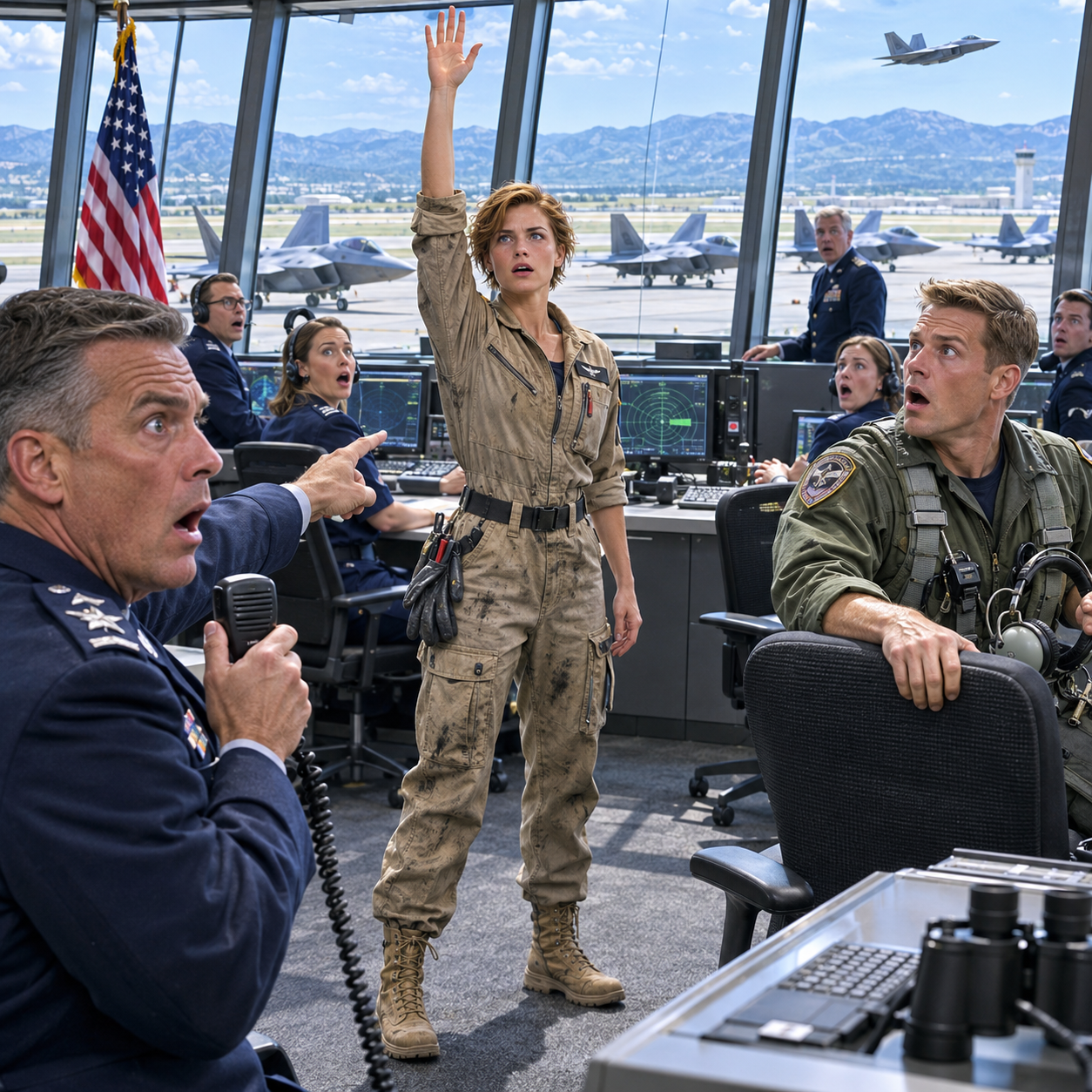
When the tower asked whether anyone at Elmendorf could fly an F-22, the men in my hangar went silent. My brother had once helped bury the warning that ended my flying career, and my father had told me to stop asking questions. I raised my hand anyway, because a passenger jet was heading toward Anchorage with no one answering its radios. Three weeks after that night, an envelope arrived without a return address. Inside was a maintenance record dated the day my wingman died.
## Part 1
The morning the storm arrived, I was lying beneath an F-22 Raptor, tracking a vibration in the left engine bay. Cold seeped through my coveralls while snow swept beneath the hangar door. Airman Jesse Pike crouched beside my boots and held a tablet under the work light. “Diagnostics say everything’s green,” he told me. “Then they’re not listening,” I said, and reached for a different wrench.
Jesse was twenty, eager, and trusted every diagnostic readout. I’d been working at Joint Base Elmendorf-Richardson for three years, long enough to hear trouble coming. I tightened the bracket, checked the surrounding lines, and had him run the test again. The vibration faded into the even hum I wanted. Jesse grinned, and I let him; in the far corner, a heater died, and somebody kicked its casing until it restarted; nobody found another broken heater particularly unusual in Alaska.
In Hangar Six, people called me Vale, because I rarely spoke above a murmur. My first name was Audra, and the name that mattered most to me had once been painted on a helmet: Lark. Nobody asked why a civilian technician knew the Raptor cockpit so well. They assumed I studied manuals. I let them keep that explanation because the real one came with a voice I still heard in my sleep.
Four years earlier, Lieutenant Simon Mercer had flown on my wing during a training mission over the Gulf of Alaska. Our weather briefing had been wrong, his air-data readings had become unreliable, and our last six minutes together had consisted of my instructions and his increasingly frightened replies. He’d gone into the water before rescue helicopters could reach him. The investigation blamed severe icing and a failed sensor, and the official summary said I had followed procedure. That should have allowed me to keep flying, but every cockpit felt crowded afterward.
My older brother, Caleb Vale, had been a quality-assurance supervisor for the contractor that serviced some of our equipment. When I pressed him about a discrepancy on Simon’s maintenance history, he told me the paperwork had been reviewed and that grieving pilots made terrible investigators. Our father, a retired colonel, told me to stop embarrassing the family. Neither had attended Simon’s memorial with me; Caleb sent flowers without a note, which somehow hurt more than nothing. I resigned my commission the following spring but couldn’t bear to leave the airplanes.
By late afternoon, the windows had become squares of white, and the base weather station was reporting dangerous crosswinds. Most of the fighter squadron was away on an exercise, leaving two Raptors on alert with crews sheltered beside the runway. I’d just signed off on the jet in front of me when our maintenance chief, Darlene Cho, called everyone to secure tools for the night. Then the building speakers asked for a medic at the alert shelter. Darlene stopped mid-sentence.
A faulty heater had been pushing carbon monoxide into the shelter, and both alert pilots had been found barely conscious. They were alive, but the hospital wouldn’t release either one to fly, and no other current Raptor pilot could reach the base through the storm. I heard it from Darlene’s radio. Someone muttered that the heater had been reported twice the previous week. Darlene glanced toward the office where completed maintenance orders were kept, then looked away.
Ten minutes later the speakers crackled again, this time with a voice from air operations. A commercial jet, Crown North Flight 682, had stopped responding on its approach to Anchorage; radar showed it maintaining altitude and track despite repeated calls. One hundred and sixty-two passengers and crew were aboard, and it was flying straight toward the city. The tower had asked every nearby aircraft for help; now the controller sounded as if she were speaking through clenched teeth. Beyond the hangar wall, a siren rose and faded into the wind.
“We need an aircraft beside that flight,” she said. “Is there anybody on the base who has flown a Raptor?” Nobody moved, because the question was absurd on a flight line full of mechanics and empty pilot rooms. Jesse looked at me only because I’d dropped my wrench. I heard Simon say my call sign as clearly as if the radio were still open, and for one humiliating moment I wanted to hide under the jet again. Instead I wiped my hands against my thighs and raised one.
“I have,” I said, too softly for the others to hear. Darlene saw my hand and frowned, and I forced myself to repeat it. “I was a Raptor pilot, before I came here.” Jesse asked whether I meant a simulator, but Darlene was already reaching for her phone. She knew nobody joked about this.
Colonel Naomi Rusk met me in the operations building with a flight surgeon and a nervous legal officer. My file confirmed the rating and more than three hundred flight hours, but it also confirmed four years without a sortie, and Rusk didn’t pretend those years didn’t matter. “I’m not asking you to pretend you’re current,” she said. “I’m asking whether you can make this airplane fly, and whether you understand the risk.” I thought of the people behind the lit windows of Flight 682 and told her yes.
The surgeon checked me while Darlene called for a launch crew, and Rusk authorized a flight she would later have to defend. On the screen behind her, the airliner’s track crept closer to Anchorage, a pale line that looked harmless until you noticed it never bent. My hands were still stained black from the engine. Then the controller announced a new detail: a request to change the flight’s course had been transmitted from the ground, but the airplane had ignored it. I was already running for the hangar when Rusk said, “Audra, if you see anything that suggests hostile control, you tell me before you do another thing.” For the first time, I wondered whether the silence in that airliner was an accident at all.
## Part 2
Darlene met me in the hangar with a stored flight suit and a freshly polished helmet. She didn’t ask about the crash, though she knew my résumé concealed something. “Jesse says you can hear an engine problem through a closed hangar door,” she said as she helped fasten a stubborn strap. “Can you still hear one from the cockpit?” “That’s what I intend to find out,” I said. She nodded and stepped aside.
The Raptor waited on the illuminated ramp, gray skin dusted with snow. Jesse stood beside it with the preflight checklist, his cheeks raw and his eyebrows white. “I checked the bracket again,” he said, then looked embarrassed. “Good,” I told him. “Ordinary things are still important tonight.” When he called me Captain, I shook my head and asked him to call me Audra.
Inside the cockpit, the air smelled of plastic, metal, and old rubber. My fingers found the switches automatically, but the familiarity made me feel worse, not better. Simon’s final transmission was there between the instrument tones: “Lark, my speed isn’t right.” For four years I’d imagined a better answer. Now the only voice I allowed myself to answer was the tower.
“Raptor Seventeen, you are approved for departure,” said Captain Tessa Wynn, the controller who had asked the question that brought me here. “You’ll have a narrow weather opening after the next plow pass; wind gusting thirty-eight knots.” I read back the clearance, made the last checks, and felt the engines gather beneath me through the seat. Rusk came onto the frequency before I moved. “You are there to identify and assist, not to make assumptions,” she said, and I promised that I understood. I could hear other people behind her, arguing over procedures none of them had expected to use tonight.
Snow hid most of the runway lights. I held the brakes, checked both engines, and pushed the throttles forward when the clearance came. The aircraft surged against the crosswind, and for a terrible second a gust made it feel as if the centerline had shifted under my feet. Training took over where courage would have been useless. When the wheels left the concrete, I realized I’d been holding my breath since the engines started.
The clouds swallowed the ground, and turbulence shook my harness. I flew by instruments, climbed carefully, and ignored the urge to look for a horizon that wasn’t there. Above the weather, moonlight opened across the clouds like light across unbroken ice, and grief caught me unexpectedly. I’d missed the sky, even after everything it had taken. Then Wynn called with a new vector, and the beauty vanished behind numbers.
Flight 682 was still at thirty-six thousand feet and had passed the last point where controllers expected it to begin descending. Crown North’s dispatcher confirmed that its last routine message had reported no emergency, and the crew’s radio silence was now being treated as a potentially serious security event. The aircraft’s autopilot appeared to be holding a course that would carry it across the Anchorage area rather than onto the airport’s approach. I accelerated toward the projected intercept, watching my fuel and the weather. We had less than twelve minutes before the airliner crossed the next control boundary.
The first thing I saw was a steady navigation light, tiny and innocent against the dark. A fuselage followed, then wings and dim passenger windows. I eased into a parallel position where I could see its flight deck safely. The captain was leaning forward, his forehead near the instrument panel; the first officer had fallen sideways in her seat. Neither reacted when I flashed my exterior lights.
“Tower, I have a visual on both crew members,” I said, trying to keep my voice level. “They appear incapacitated, and I see no one else in the cockpit.” Wynn repeated the report, and a second voice asked whether I had seen any sign of a struggle. There was no broken glass, no visible disturbance, no figure standing over them. “Not from here,” I said, “and we shouldn’t turn a medical emergency into something worse because we’re frightened.” Rusk said she was forwarding the information to the appropriate command authority.
I moved slightly aft and saw a girl with braids standing between two seats, her hands pressed against a window. She stared at my jet, her mouth open, while an adult behind her tugged her gently back down. That tiny movement told me some people were conscious, and I felt hope. I switched to the emergency frequency and began calling the airline by its flight number; nothing answered except a throb of static. I watched the girl’s window recede and thought of what it would feel like to be trapped behind that glass, unable to make the people in front steer.
I called again, explaining who I was and asking anyone near the flight deck to use a headset or hand microphone. After the fourth attempt, a stranger’s breath filled the radio, followed by a weak, disbelieving voice. “Are you the fighter beside us?” “Yes,” I said, “and I need you to tell me your name.” “Elliot Marsh,” he replied, “I’m a passenger, and somebody opened the cockpit because neither pilot will wake up.” His voice sounded young and exhausted; I could hear several people speaking at once somewhere behind him.
Elliot was a private pilot from Oregon who had flown small single-engine airplanes, but never anything with a hundred people behind him. A flight attendant had found him after he identified himself, then fitted a portable oxygen mask over his face so he could reach the flight deck. He sounded ashamed of how frightened he was, as if fear were some failure of character. I told him that fear was normal, and we’d work step by step. Then he interrupted me with a sentence that drained the warmth from the cockpit.
“It isn’t only the pilots,” he whispered. “People in the back are collapsing, and the oxygen masks are falling from the ceiling.”
## Part 3
I asked Elliot to check his own oxygen first, then find the quick-donning masks for the two pilots. He struggled to free the captain’s mask, and I waited. Somewhere behind him, a flight attendant was telling people to keep their masks on. “All right,” he said finally. “They’ve got oxygen, but neither one is waking up yet.”
“Look at the cabin-altitude indication,” I said, and described where he might find it on the overhead display. He hesitated before giving me the number, as if afraid to say it: twenty-three thousand feet. The air inside the pressurized jet had become dangerously thin, although the jet cruised normally. We had to get the airplane lower, but not by sending it blindly toward Alaska’s mountains. I asked Wynn for a verified heading and minimum safe altitude.
She answered with a route west over Cook Inlet, away from the mountains and Anchorage. The airline’s operations desk had connected an off-duty captain who knew this aircraft type, and she was standing beside Wynn to help with the specific cockpit controls. I knew an F-22, not this airliner. I relayed the heading instructions while the airline captain coached Elliot through selecting it on the autopilot. The wing of Flight 682 dipped slowly, then steadied on its new course.
“Good,” I told him, watching the city shift behind the airliner. “That turn has given us room to work.” The airline captain guided him toward a controlled descent, and I confirmed the change against my instruments as Flight 682 began leaving thirty-six thousand feet. Elliot said the passengers’ masks were hanging like white flowers above their seats. I imagined a child trying to remember which end of the tube to breathe through. “Keep your own mask on,” I reminded him, because he sounded faint.
A warning flashed across my left engine display before he answered. The indicated temperature leaped into a range that should have changed the engine’s behavior, then fell almost immediately. I knew the pattern from the workbench: an intermittent connector, vulnerable to cold, that I’d documented three weeks earlier. The repair order said a replacement was installed. Yet the numbers jumping in front of me looked exactly like the defect I’d reported.
I checked the independent engine indications, the sound, the response to a small throttle adjustment, and nearby temperatures before deciding it was probably the instrument lying. Probably was an uncomfortable word to take into the sky, with so many people depending on me. “Tower, Raptor Seventeen has an intermittent temperature indication,” I reported. “Other engine parameters are stable, and I’m continuing while monitoring.” Wynn acknowledged the call without asking me to pretend I was certain. I made a mental note to photograph that repair record when I got back, assuming I got back.
At eighteen thousand feet, Elliot shouted that the first officer had moved; I asked him to keep oxygen on her and place the microphone where she could hear me. There was a long rustle, a groan, and a woman’s voice asking why her seat was wet. “First Officer, I’m Audra Vale in the Air Force fighter beside you,” I said. “You’ve had a cabin-pressure emergency, and your passenger Elliot has been helping us descend.” She said her name was Mae Delaney, then asked for the altitude before she asked anything about herself.
Mae’s words came slowly at first, but they came in the language of someone trained to solve problems. At fifteen thousand feet, she confirmed the selected heading and descent while Elliot read her the aircraft indications. By twelve thousand, she could sit upright without help, though she kept her oxygen mask firmly in place. “I have control,” she said, and the relief nearly took the strength out of my hands. Elliot started crying quietly; Mae thanked him without interrupting.
The captain was beginning to stir as well, but Mae insisted that he remain on oxygen and out of the decision-making until he could respond reliably. That was the first choice of the night that sounded truly ordinary, and it comforted me more than any congratulation could have. Through her radio, I could hear checklist pages moving and the low chime of alerts being assessed one by one. Mae was no longer a helpless passenger in her own cockpit. We were finally talking to a pilot.
At ten thousand feet, Flight 682 leveled off over black water, and the cabin crew reported that more passengers were conscious. Mae explained that the pressurization system had shown inconsistent readings earlier in the flight, but its main warning had arrived so late that neither pilot recognized the danger in time. The captain had mentioned an earlier write-up to the gate technician in Seattle, and Mae thought the discrepancy had been cleared before departure. She wanted to know whether anyone was injured. I told her that medical crews were preparing and that every minute she remained in control improved their chances.
The practical problem now was getting her airplane onto the ground. Anchorage had deteriorating visibility, strong gusts, and accumulating ice, while the nearest acceptable alternate was beyond what Mae could safely reach with her remaining fuel. An approach controller arranged an instrument landing to the runway that crews were clearing at Ted Stevens Anchorage International Airport. I could remain nearby until the final approach, but I could not fly the landing for her. “I don’t need you to,” Mae said, and her steadier voice gave me something new to trust.
Then Wynn came back with a strained edge I recognized from her first call in the hangar. A plow truck clearing the runway had slid sideways on the ice, and its driver could not free it without help. The airport had suspended arrivals until the truck was removed, while Mae had fuel for only a short hold and one approach. “Audra,” Mae said, “please tell me there’s another strip of pavement down there.” Through a ragged break in the clouds, I saw the scattered lights of Anchorage and had no answer yet.
## Part 4
“There’s a recovery tractor moving toward the truck,” Wynn said, relaying a report from airport operations. “Give them six minutes.” Mae could hold briefly, but each circuit left less fuel for a missed approach. I asked whether the other runway could be prepared, and Wynn said snow and wind made it unusable. Between transmissions, I heard Mae breathing. She didn’t ask me to comfort her; after everything she had endured, she needed an empty runway far more than she needed my voice.
I stayed outside the airliner’s flight path while approach control assigned a safe holding pattern. Through breaks in the cloud, I watched white headlights gather around the stranded plow and turn into a tiny cluster. Rusk offered the airport another recovery vehicle. Someone found a driver, chains, and firefighters. The tower gave terse updates.
Mae’s captain regained enough awareness to read checklists, but he admitted that his concentration came and went. She asked him to stay on oxygen and handle secondary tasks while she flew, a decision he accepted without argument. Elliot had been returned to his seat, where he apparently kept asking the flight attendant whether he had touched anything he shouldn’t have. “Tell him he helped us turn away from the city,” I said. Mae promised she would, then reported that the hold was consuming fuel.
The recovery tractor finally pulled the plow free, but the runway remained closed while crews checked the surface and cleared snow. I could hear the frustration in Wynn’s acknowledgment and made myself look at my own instruments instead of the distant headlights. The left engine temperature reading flickered again, then settled into a perfectly reasonable value. A false warning was still a warning about a problem someone had failed to fix. I thought about the log I’d written and wondered who had declared the replacement complete.
“Runway inspection complete,” Wynn said at last. “Airport operations reports the surface usable, with braking conditions reduced; emergency vehicles are staged.” Mae requested the instrument approach, sounding steadier than someone recently unconscious. The airline captain on the ground reviewed the landing configuration with her while approach control passed updated winds. I remained offset and above the airliner, close enough for radio support without obstructing her approach. There was nothing dramatic left for me to do, only to stay available and avoid becoming another emergency.
At three thousand feet, the clouds thickened until Flight 682 disappeared from my view. Mae was flying by instruments now, and I could only listen as the approach controller called deviations and corrected them. “Localizer captured,” Mae reported, then confirmed the glide path. Her captain checked the landing gear and flaps, repeating each response despite his exhaustion. A little earlier, I’d been certain the two of them would never speak again, and hearing their ordinary checklist felt nearly unbearable.
The next wind report was worse, with a gust from the side near the aircraft’s limits; loose snow blew across the approach lights while the tower monitored every change in direction. Mae asked for the exact runway conditions and considered another approach, but she knew there was not enough fuel to gamble on several attempts. “We’ll go around if we lose the approach,” she told the controller. I had the urge to tell her she could do it, but she needed facts, not reassurance. Instead I reminded her that her own training was already giving her the answers.
Through a ragged opening I saw the white shape emerge near the runway lights, descending with its nose slightly into the wind. A gust tipped the wings and Mae corrected, keeping the airplane aligned while snow swept across the pavement. Her landing lights made two pale tunnels in the storm. “Five hundred,” came the call from her cockpit, followed by another wind correction. I realized my jaw was hurting because I had been clenching it since she began the approach.
The airplane touched down firmly and drifted before its wheels found a steady track. I watched spray and snow rise behind it, heard Mae call for controlled braking, and waited for the long white shape to slow. It rolled past a taxiway, then another, and finally settled beneath the amber lights of an escort truck. “Anchorage Tower, Crown North Six Eight Two is stopped on the runway,” Mae said. Only then did I let myself look away from it.
Firefighters with red lights flashing through the snow surrounded the airliner, and buses moved toward its doors as paramedics prepared to assess passengers exposed to the loss of cabin pressure. Wynn sounded as if she were swallowing tears when she told me everyone was accounted for, though several would need hospital care. I watched a line of people descend a mobile staircase in heavy coats borrowed from emergency crews, some carrying toddlers whose faces were hidden beneath emergency blankets, others holding strangers upright without knowing their names. One child stopped and looked upward, perhaps looking for me. I wished I could tell her I had seen her at the window.
My own landing was careful rather than pretty, and when I taxied back to Hangar Six the crew was waiting without ceremony. Jesse helped me out of the cockpit while Darlene held the ladder against the wind. “You kept talking to them,” she said, touching my shoulder. “So did you,” I answered, noticing the radios still clipped to everyone’s coats. Rusk met us at the door, shook my hand and ordered the Raptor grounded pending an independent engine inspection.
That order should have been routine, but I knew the inspection would also expose the discrepancy between my report and the signed completion record. I went to the maintenance office before I changed clothes, opened the digital work history, and pulled up the temperature-sensor replacement. My original description was intact, including the photograph of a connector that had never been properly seated. Beneath it was a quality approval, entered without a technician’s verification or a corresponding part number. The approving manager’s name was Caleb Vale.
## Part 5
I stared at Caleb’s name until the screen dimmed. Darlene found me there still wearing my damp flight suit and asked whether I was sick. I showed her the approval and its missing part number, then opened the original work request beside it. “That means somebody closed the job without proving it was done,” she said. “It means we stop trusting this record until someone independent looks at the airplane,” I answered.
By morning, Rusk had preserved the maintenance logs for independent review. The inspection found that the connector I’d reported was still installed and that no replacement part appeared in inventory. Caleb had approved the completed job on behalf of the contractor, without proof of repair. Investigators also examined the shelter’s unresolved heater complaints. The separate failures showed the cost of dismissing complaints.
Crown North’s passengers began appearing in the news, describing the strange fighter outside their windows. Mae called from her hospital room to thank me, then spent most of the conversation praising Elliot and the flight attendants. She was recovering, along with the captain and treated passengers. Investigators were examining the airline’s earlier pressurization reports and whether sign-offs concealed an earlier defect. I was glad they were looking, though I wished it had not taken a near catastrophe to make the paperwork matter.
Reporters learned my former call sign and discovered that I had once been a commissioned pilot. My phone filled with requests to describe what heroism felt like, a question I couldn’t answer. I had been frightened in the cockpit, and I was frightened now that my brother’s signature sat in a folder marked for investigation. Rusk warned me not to discuss evidence outside the inquiry, and I agreed. Public attention had made Simon’s name visible again, and that hurt more than I expected.
Caleb called four times before I answered. “You know what a quality approval means,” he began, not bothering to ask whether I’d made it home safely. He said paperwork was often completed after repairs and accused me of making it personal. I asked him for the serial number of the replacement sensor; he told me I was speaking like a prosecutor. “I’m speaking like the person who flew the airplane,” I said, and ended the call.
Our father appeared at my apartment two days later wearing his formal wool coat. He asked whether I intended to destroy Caleb’s career over a piece of equipment that had not failed catastrophically. I reminded him that an instrument warning was not harmless simply because an airplane landed, and that an incomplete repair record might conceal other neglected work. He looked at the floor and said families had to protect one another. “You had that chance when Simon died,” I told him, and closed the door without inviting him inside.
Three weeks after the rescue, an unmarked envelope arrived in my mailbox. The paper inside was an old inspection sheet from the week Simon died, creased from years in storage. A technician had flagged unstable air-data readings during a ground check and recommended replacing the sensor before the next flight. The recommendation had been crossed out, and someone had certified the aircraft fit for duty. The approving signature belonged to Caleb.
I took the document to Rusk rather than confront my brother with it. An independent investigator compared it with archived electronic entries and confirmed that the warning had disappeared from the official maintenance history before Simon’s final mission. A retired technician named Miriam Lott then admitted keeping a duplicate after orders to close the discrepancy without testing; she told investigators she had mailed it anonymously because she feared my family would silence her again. Investigators could not prove that grounding the jet would certainly have saved Simon in the severe weather, and I never asked them to say that. They could prove the warning should never have been buried and that repeated chances to stop the airplane from flying had been missed.
Caleb had been under pressure to meet readiness targets, the inquiry found, and approved work without verifying inspections. The contractor removed him from his position and lost part of its support contract; authorities began reviewing whether the false certifications warranted criminal charges. I was asked whether I wanted to meet him to hear an apology. I said no. My father sent a letter calling the matter tragic for everyone involved, which I never opened; on the envelope he had written, “You will understand when you have children,” as though honesty were childish.
The airliner investigation eventually identified a malfunction in its pressurization controls, compounded by an earlier discrepancy that should have been investigated before departure. The airport revised its winter recovery procedures, and the base replaced the shelter heating equipment while reviewing its maintenance backlog. None of those changes made Simon alive, or erased the risks of my emergency flight. Rusk faced her own formal review for allowing me to launch, and I answered every question truthfully. We had saved people while accepting serious risks, and both facts deserved to be recorded.
I met Elliot and Mae months later at a small gathering held by Flight 682 passengers. Elliot was embarrassed by the attention, but the girl with braids handed me a drawing of a gray airplane beside a larger white one. She had colored both cockpits bright yellow, as though the people inside had carried their own lamps through the dark. I put the drawing above my workbench, where I saw it every day. I also requested a formal flight evaluation, knowing I needed training.
On the day I submitted the request, Jesse asked if I was leaving maintenance for good. I told him I didn’t know, then asked him to listen to the Raptor idling beyond the hangar door. He heard a slight unevenness and reached for the diagnostic tablet before catching himself. “That doesn’t sound right,” he said, and I handed him my wrench. Whatever happened with the sky, I finally understood that staying had never meant standing still.
THE END!
Disclaimer: Our stories are inspired by real-life events but are carefully rewritten for entertainment. Any resemblance to actual people or situations is purely coincidental.