
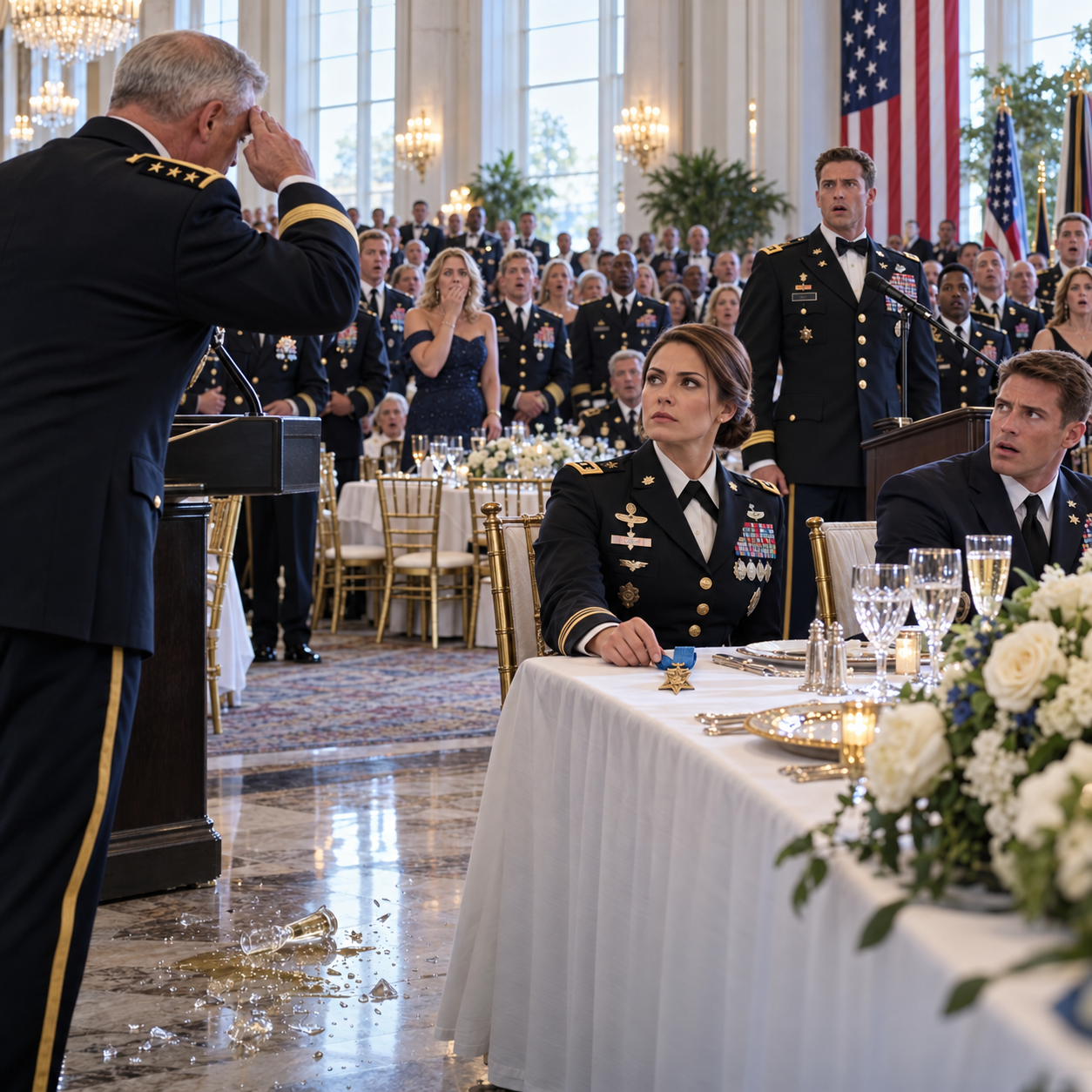
At My Brother’s Promotion Banquet, He Raised His Glass To 80 Guests. “Ghost Reaper Is Just An Urban Legend. I Would Have Crushed Them In The Field.” I Quietly Set My Medal Of Honor Pin On The Table. The Four-Star General Dropped His Champagne Glass. He Shut Down The Microphone, Turned To Me, And Snapped A Rigid Salute. “Welcome Home, Commander Reaper.” My Brother’s Whole Team Dropped To Parade Rest.
For eight years, my family told everyone I handled shipping forms and inventory at Fort Meade while my younger brother became the soldier they were proud to display. At his promotion dinner, he laughed into a microphone about a classified operator called Ghost Reaper, and our parents laughed with him. I stayed quiet until a four-star general saw what was beside my water glass and saluted me. Six months later, an Inspector General envelope arrived containing an email chain that proved my brother’s humiliation had never been the real story.
Part 1
By the time my brother started making jokes about Ghost Reaper, I had already spent three hours listening to my parents explain my own life incorrectly to strangers. My father, Robert Mercer, had perfected the introduction over the years: “Claire works logistics at Fort Meade. Mostly administrative support. Stable government job.” He always delivered the last sentence with the comforting little nod people use when describing a daughter who never quite became interesting, and my mother, Diane, would smile beside him as if stability were a consolation prize they had graciously accepted on my behalf.
I had stopped correcting them years earlier, partly because I legally could not explain most of what I did and partly because I had learned that my family rarely asked questions when they preferred the answer they had invented. My official assignments did include logistics language, readiness coordination, movement planning, and a rotating collection of harmless job descriptions that looked appropriately dull on forms. That was the point. If someone at a barbecue asked what I did, I could truthfully say I worked with supply routes and operational planning, and nobody needed to know what happened when those routes entered places where ordinary paperwork stopped mattering.
Evan, my younger brother, had never suffered from a shortage of explanations about himself. At twenty-eight, he had recently been promoted to captain and selected for a staff position at division headquarters, an accomplishment worth celebrating even without the mythology my parents built around it. They rented a ballroom at an officers club outside Washington, invited military acquaintances, defense-industry contacts, old neighbors, and anyone else who might appreciate what my father kept calling “the next chapter of the Mercer military tradition.”
I arrived thirty minutes before dinner wearing a charcoal suit and low black heels because I had come directly from an airfield and did not have the energy to change. Evan was standing beneath a chandelier with four junior officers when he saw me, and for one hopeful second I thought he might excuse himself and come over. Instead, he walked straight toward me, handed me his rental-car keys and heavy dress overcoat, and said, “Can you put these in the coat room? I’m trapped talking shop.”
One of the lieutenants looked uncomfortable. I took the coat anyway because arguing in the entrance of my brother’s promotion dinner seemed childish, and Evan grinned as if I had confirmed something for him. “Thanks, Claire. Knew the logistics specialist would come through.”
My mother heard him and laughed. “Be nice to your sister.”
It was the tone that mattered. Not stop humiliating her. Not carry your own coat. Just be nice, the way someone might correct a ten-year-old teasing an older dog.
I hung the coat, kept the keys, and returned to find my father showing a retired contractor a photograph of Evan at a training exercise. “He’s always been the adventurous one,” Dad said. “Claire likes structure. Offices, schedules, air-conditioning.”
The contractor glanced at me. “Nothing wrong with that.”
“No,” I said. “Nothing at all.”
My mother frowned slightly because she could never tell whether I was agreeing with her or making fun of her. That uncertainty was one of the few things about me she had not managed to simplify.
Dinner seating had apparently been designed with the same care as the introductions. Evan sat near the center with my parents, the senior officers, and several people from two large defense companies, while my place card was near the end beside a retired procurement manager named Mr. Larkin. The chair on my other side stayed empty, giving me enough space to watch the ballroom without having to make conversation.
That suited me. Years of entering unfamiliar rooms had taught me to notice exits, reflections in glass, who drank too quickly, who listened instead of speaking, and who looked around before laughing to make sure important people were laughing too. Evan did the last one constantly.
He was good at being impressive from a distance. He stood straight, remembered names, told concise stories, and possessed the effortless certainty that comes from being praised before you have decided whether you deserve it. His problem had always appeared five minutes later, when admiration stopped being enough and he needed someone else to look smaller.
Dessert had just been served when he rose and tapped a spoon against his champagne flute. The conversations around the ballroom softened, and my father immediately pulled out his phone to record.
Evan thanked everyone for coming, praised his commanding officers, mentioned duty and tradition, and managed to sound gracious for almost two full minutes. Then he shifted into the subject he actually wanted to discuss.
“Military organizations love legends,” he said. “Every generation invents one.”
A few people smiled politely.
Evan leaned one hand on the podium. “You hear stories around tactical commands. Pilots who supposedly landed aircraft that couldn’t fly. Snipers who never missed. Operators who walked into impossible situations and somehow came out clean.”
Something cold settled behind my ribs.
He continued. “My personal favorite is the so-called Ghost Reaper.”
Across the room, a colonel stopped lifting his coffee cup.
I looked down at my dessert plate.
The name had not been used publicly in years.
Evan laughed. “Come on. Some of you have heard it.”
A few veterans exchanged looks. Nobody answered.
He mistook silence for attention.
According to the version whispered through deployments, Ghost Reaper had been part of a joint team caught near a collapsing evacuation corridor overseas. Communications failed, the convoy was split, and what followed became one of those stories that grew less accurate every time it traveled. Some details were nonsense. Others were close enough that hearing them repeated in a ballroom made my skin feel too tight.
“Apparently this mysterious super-soldier saved an entire convoy,” Evan said. “No backup, no fear, practically invisible. Sounds great after three drinks.”
My father leaned toward me and whispered, “Listen to how confident he is.”
I stared at Evan.
What bothered me was not that he was mocking the story.
It was the wording.
He described the route as “a narrow western containment lane with a broken southern exit.”
That phrase had never appeared in any article, press release, award summary, or public briefing.
But I had written it once.
Eight years earlier.
In a restricted after-action report.
And as Evan continued speaking, I realized he had somehow read more than one sentence.
Part 2
I stopped hearing the room for several seconds. Evan’s mouth kept moving, glasses clinked somewhere near the kitchen doors, and an air-conditioning vent hummed above the windows, but all I could think about was a windowless room eight years earlier where I had written that exact phrase at four in the morning while blood dried beneath one thumbnail. “Broken southern exit” had been shorthand, not official terminology, the kind of tired wording you use when you have thirty minutes to reconstruct a map from memory before being moved to another secure site.
I watched my brother more carefully. He was not reciting the report word for word, which would have been impossible without attracting immediate attention, but he was using its bones: the sequence of failures, the direction of the blocked route, even my description of the first vehicle becoming “a cork in the bottle.” He had dressed the details in swagger and sarcasm, yet beneath the jokes was information I had never knowingly shared with him.
“You all know how these legends get built,” he said. “One messy operation, some classified paperwork, and suddenly somebody becomes a ghost.”
The colonel with the coffee cup set it down.
My mother whispered, “He’s such a natural speaker.”
Mr. Larkin, sitting beside me, did not respond. His eyes were on Evan too.
I slid my phone from my purse and checked the screen, not because I needed to read anything but because I wanted my hands doing something ordinary. There were no missed calls. No warnings. Nothing to explain how a captain with limited operational exposure had obtained language from an incident buried inside a compartmented archive.
Evan kept going.
“Honestly, Ghost Reaper is overrated,” he said. “If that person even existed, I doubt they would last sixty seconds in a modern command environment without air support and ten specialists cleaning up behind them.”
A scattered laugh moved through the younger end of the room. My father laughed loudly enough to encourage the people around him.
Then he touched my forearm.
“You should listen to your brother,” he murmured. “He understands leadership. You’ve always been too comfortable staying behind the scenes.”
The strange thing was that it did not hurt anymore. Ten years earlier, a sentence like that could have ruined my evening. Five years earlier, it might have made me angry enough to leave.
That night, it only clarified the room.
My parents did not know who I was because they had never seriously attempted to know me. They had taken the pieces I was permitted to offer and arranged them into the daughter they found easiest to explain.
Evan had done something different.
He had gone looking.
I reached into my clutch.
The small velvet case inside had not been brought for dramatic effect. Earlier that afternoon I had attended a private military memorial, and I had carried the miniature decoration because it was easier than returning it to a secure deposit box before dinner. Most days I did not carry anything connected to that chapter of my life.
I rested my fingertips on the case but did not remove it.
Not yet.
The ballroom doors opened before Evan could continue.
The conversations nearest the entrance faded first, then the quiet rolled across the room in a visible wave. General Thomas Weller entered with two aides, still in uniform, carrying a dark red presentation folder meant for Evan.
My brother immediately transformed.
The mocking smile disappeared, replaced by disciplined posture and a careful expression of respect. He stepped away from the podium, squared his shoulders, and waited while my father raised his phone higher.
General Weller had known me under circumstances neither of us discussed socially. I had not seen him in nearly four years, and I had not known he would attend.
For a moment I considered leaving.
Then Evan said, “General, sir, it’s an honor.”
Weller nodded and approached the central table.
I took out the velvet case.
I opened it below table level, hoping only to confirm that the miniature was still properly secured. The pale blue ribbon and white stars caught the chandelier light.
Mr. Larkin glanced down.
His breathing changed.
He looked at me, then at the medal, then back at my face.
“You’ve got to be kidding me,” he whispered.
I closed the case halfway.
Too late.
General Weller was five steps away when his gaze moved past Evan and landed on me.
He stopped.
Not theatrically. Not with the exaggerated shock people later claimed to remember.
He simply stopped walking.
One of his aides nearly stepped into him.
Evan was still smiling. “Sir?”
Weller looked at the velvet case beside my glass.
Then at my face.
His expression changed in a way I had seen only once before, when he had entered a medical tent overseas and realized someone he believed dead was sitting upright on a cot demanding coffee.
“Major Mercer?” he said.
The microphone carried his voice across the ballroom.
My father lowered his phone.
Evan turned toward me.
I stood because remaining seated suddenly felt ridiculous.
“Good evening, General.”
For the first time all night, nobody moved.
Weller drew himself straight and raised his hand in a crisp salute.
I returned it automatically.
The room became so quiet I could hear the faint electrical buzz from the microphone.
“Welcome home,” General Weller said.
Evan stared at him.
Then at me.
Then at the small blue ribbon beside my water glass.
His face lost color.
My mother’s mouth opened, but nothing came out.
My father stood halfway, bumping the table hard enough to shake the glasses.
“What,” he said, barely above a whisper, “is going on?”
General Weller lowered his salute.
His eyes moved from my parents to Evan, and something in his expression hardened.
“That,” he said, “is a question I’d like your son to answer too.”
Part 3
People later told me the entire ballroom stood when General Weller saluted, but I honestly do not remember that. Memory becomes selective when a room suddenly turns dangerous in a way nobody else can see. I remember my father’s phone slipping from his hand onto the tablecloth, my mother staring at the miniature decoration, and Evan’s fingers tightening around the podium as though it had become the only solid object in the building.
“General,” Evan said, forcing out a laugh, “I think there’s some misunderstanding.”
Weller looked at him. “About what?”
“My sister works administrative logistics.”
It was such an absurd sentence that Mr. Larkin closed his eyes.
Weller did not smile. “Your sister has performed duties you are neither cleared nor qualified to discuss.”
Evan’s jaw flexed. “Sir, with respect, my parents have known her entire career.”
I almost admired the confidence required to say that after spending twenty minutes proving otherwise.
My father finally found his voice. “Claire, you told us you processed movement records.”
“I told you my assignments involved logistics and operational movement,” I said. “That was true.”
“You said you worked at Fort Meade.”
“I did.”
“You let us think you had a desk job.”
“No.” I met his eyes. “I let you think what you preferred to think because correcting you would have required information I was not allowed to provide.”
My mother looked genuinely wounded, which would have been more persuasive if she had ever asked what my job actually involved. “We’re your family.”
“Yes.”
“Families don’t keep something like this secret.”
“Soldiers do when they sign agreements saying they will.”
The word soldiers seemed to strike her harder than anything else.
Behind Evan, one of the younger officers quietly stepped away from the podium. I understood why. This was no longer a family embarrassment.
General Weller turned toward Evan.
“Captain Mercer, where did you obtain the terminology you used during your remarks?”
Evan blinked. “What terminology?”
“Western containment lane. Broken southern exit.”
My pulse remained steady, but the hairs along my arms rose.
Weller had heard it too.
Evan looked at me for the first time with something other than disbelief. There was calculation in his face now.
“I don’t know,” he said. “Professional reading.”
“What publication?”
“I read constantly, sir.”
“Name one.”
Silence.
My father stepped in. “General, surely this is getting blown out of proportion. Evan was making a humorous speech.”
Weller did not look at him. “Mr. Mercer, I am speaking to an officer.”
Dad sat down.
Evan shifted his weight. “I may have heard it during a briefing.”
“What briefing?”
“I don’t remember.”
“You remembered it accurately enough to make a joke about it in front of eighty people.”
The pride that had carried my brother through the evening began collapsing visibly. “Sir, I had no idea the material was sensitive.”
That answer was worse.
Weller glanced at one of his aides. “Major Keene.”
The aide stepped forward.
“Record the relevant portion of tonight’s remarks and notify security.”
My mother whispered, “Security?”
Evan’s face sharpened. “Sir, is that necessary?”
“Yes.”
The red presentation folder remained in Weller’s left hand. Everyone had forgotten it until he looked down at it.
It contained Evan’s new assignment orders.
Weller handed it unopened to Major Keene.
“Hold this.”
Evan stared. “General?”
“Your reassignment will not proceed until the source of your information is established.”
“My promotion—”
“Your rank is not the issue at this moment.”
That sentence finally broke through his performance.
He looked toward me with naked accusation.
“You did this.”
I almost laughed, but there was nothing funny in his expression. He truly believed that because consequences had appeared after he mocked me, I must have somehow created them.
“I haven’t spoken to anyone,” I said.
“You brought that medal here.”
“I came from a memorial.”
“You just happened to have it?”
“Yes.”
He shook his head as though my calmness proved conspiracy.
Weller interrupted. “Captain Mercer, your sister did not force you to publicly describe operational details you cannot source.”
Evan swallowed.
Then my father made the mistake that changed everything.
“There’s probably a simple explanation,” he said. “Evan has used Claire’s old military papers before. They used to help each other.”
I turned toward him.
The room disappeared again.
“What papers?”
Dad looked confused by my tone. “Nothing classified.”
“What papers?”
“You left boxes at our house.”
My mother’s face went still.
Dad continued, “Old binders, notebooks, college things. Evan used some of them when he was preparing for staff school. You never wanted any of it.”
I could feel my heartbeat now.
I had left three sealed storage boxes in my parents’ basement before an overseas rotation. Most of the contents were harmless—college papers, photographs, old uniforms—but one box contained handwritten notebooks from training and early deployment years. Nothing in them should have contained classified operational information because I had been careful.
At least, I had believed I was careful.
“Who opened those boxes?” I asked.
My mother looked down.
Dad frowned. “Claire, they were sitting there for years.”
“Who opened them?”
“I did,” Evan said.
He was watching me with a new kind of fear.
“When?”
“A couple years ago.”
“You told me those boxes were untouched.”
“So?”
I stared at him.
Weller said quietly, “Captain, stop talking.”
But Evan had never been good at stopping once he felt cornered.
“You weren’t using them,” he said. “There were maps, notes, old planning exercises. It was useful material.”
“Did you photograph anything?”
He hesitated.
That was the moment I knew.
Not suspected.
Knew.
General Weller saw it too.
“Major Keene,” he said, “have security preserve Captain Mercer’s government devices.”
Evan’s face changed.
I had spent eight years believing the greatest threat to my secrets came from enemies who would pay fortunes to uncover them.
I had never once imagined I should have been protecting them from my little brother.
Part 4
Security did not drag Evan out of the ballroom in handcuffs. Real investigations rarely provide that kind of cinematic satisfaction. Two officers quietly escorted him to a private room, my parents were asked to remain available, and the guests were told that the formal presentation had been postponed because of an administrative issue.
Nothing about the phrase administrative issue matched my mother’s face.
I left through a side corridor because I did not want to become the center of eighty whispered conversations. General Weller caught up with me near the parking lot, where the night air smelled like wet pavement and cut grass.
“Claire.”
I stopped.
He looked older than I remembered. “I’m sorry.”
“For which part?”
“That nobody caught this sooner.”
I folded my arms against the cold. “We don’t know what he had.”
“We know enough to look.”
That was the sentence I carried home.
My apartment felt unusually exposed that night. I checked the door twice, made tea I did not drink, and sat at my kitchen table trying to reconstruct the contents of those basement boxes.
The first contained college material and photographs. The second held uniforms, letters, and old books. The third was the problem.
During my early years, before every digital system became as tightly controlled as it was later, I kept paper notebooks during approved training exercises. They were supposed to contain only unclassified observations, but young officers write carelessly sometimes: route geometry, timing assumptions, shorthand references that mean nothing separately and far too much when combined with information from somewhere else.
I had reviewed every notebook before storing them.
Or thought I had.
At two in the morning, my phone rang.
My mother.
I almost ignored it.
“Claire,” she said when I answered, “your father is very upset.”
There are sentences that summarize entire families.
“My father is upset?”
“Evan could lose his assignment.”
“Mom, Evan may have possessed material he should not have possessed.”
“He didn’t know.”
“He opened sealed boxes that belonged to me.”
“He thought it was old schoolwork.”
“Then why didn’t he ask?”
She hesitated.
Because asking would have risked hearing no.
“He admired you,” she said.
I closed my eyes.
“No, he didn’t.”
“Yes, he did. You never saw it because you were always away. When he was applying for advanced courses, he read everything you had written.”
“That isn’t admiration.”
“He wanted to learn.”
“Then why did he spend tonight calling me a desk clerk?”
She went quiet.
I heard my father speaking in the background.
Then Mom said, “He didn’t know about the medal.”
That answer exposed more than she understood.
This was not about learning.
Evan had admired what I could give him while despising the version of me he presented publicly.
The next morning I received instructions to meet an investigator from the Army Inspector General’s office. I spent four hours answering questions in a plain conference room where the coffee tasted burned and the blinds never opened.
They wanted dates, storage locations, people with access to my parents’ house, descriptions of notebooks, computers I had used, whether I had ever emailed Evan professional material. I answered carefully.
Then the investigator, a civilian named Nina Patel, placed a printed document on the table.
“Do you recognize this?”
It was a tactical planning paper Evan had submitted eleven months earlier.
I read the first page.
Then the second.
By the third, my stomach hurt.
The language was polished, but the structure was mine.
Not from the corridor operation.
From a graduate-level planning project I had completed years earlier for a restricted professional course.
Evan had changed examples, updated equipment references, and rewritten enough sentences to disguise direct copying. But the decision model was mine, including a strange four-column risk matrix I had created because I disliked the standard template.
“How did he get this?” I asked.
“That’s what we are establishing.”
“Was this paper important?”
Patel’s expression remained neutral. “It contributed to his selection for headquarters placement.”
I stared at the pages.
The dinner suddenly looked different.
My brother had not merely built himself up by pushing me down.
He had built part of his career out of pieces of mine.
More documents followed.
A briefing slide with my old framework.
A staff analysis containing phrases from a planning exercise.
A leadership essay that included a story about making a difficult call during a failed convoy movement.
The incident had happened to me.
Evan had rewritten it in first person.
I felt something inside me go very quiet.
“Did my father know?” I asked.
Patel did not answer immediately.
“That is under review.”
Which meant yes was possible.
I thought about all the dinners where Dad had described Evan as instinctive, strategic, unusually mature under pressure. I remembered one Thanksgiving when he had said, “Evan just sees problems differently than most officers.”
At the time, I had smiled and carved turkey.
Now I wondered whose problems Evan had been seeing.
Patel gathered the documents.
“There’s one more issue.”
I looked up.
She slid a photograph across the table.
It showed a printed page on my parents’ dining table beside my father’s reading glasses.
The page carried markings in Dad’s handwriting.
At the top, he had written:
USE THIS EXAMPLE. STRONGER THAN YOUR VERSION.
Underneath was a paragraph from one of my old notebooks.
My family had not accidentally misunderstood my career.
They had been quietly mining it.
Part 5
My father denied everything for three days. He said the note in his handwriting had been taken out of context, that he believed the material was academic, that parents had been sharing siblings’ schoolwork since the invention of paper. When investigators asked why he had never told me, he said I was “difficult about boundaries,” which might have been funny in another family.
My mother’s version was softer and therefore worse. She admitted knowing Evan used my old material but insisted she believed it was harmless because Dad said it was harmless. She had always treated his certainty like professional expertise, even though he had spent most of his career selling components to defense contractors rather than handling military information.
I listened to their explanations from a distance.
The investigation uncovered a pattern stretching back almost six years. Dad had photographed sections of my notebooks, emailed scans to Evan, and occasionally added comments about what could strengthen his applications or papers. Most of the source material turned out to be unclassified, which was a relief, but several passages contained references that should have triggered questions before anyone copied them onto a personal device.
Evan had not advanced because of stolen work alone. He was intelligent and capable when he applied himself, which somehow made the choices uglier. He had not needed to take from me.
He had simply learned that he could.
The Ghost Reaper details came from a single notebook page nobody could immediately explain.
Investigators showed me a scan.
I recognized the handwriting.
Mine.
I also recognized the date.
It had been written several months after the operation, during a mandatory reintegration period when I was sleeping badly and functioning worse. The page was not a formal report. It was a personal reconstruction I must have scribbled after waking from a nightmare, mixing feelings with physical details I should never have recorded outside approved systems.
I had forgotten it existed.
The discovery made me physically sick.
I was not blameless. I had made a mistake.
The difference was that I had not then photographed someone else’s mistake and used it for career advancement.
A week after the banquet, Evan called me.
I watched his name appear on my phone until the ringing stopped.
He called again.
On the third attempt, I answered.
“You happy now?” he asked.
No greeting.
No apology.
“What would I be happy about?”
“My headquarters assignment is suspended.”
“I know.”
“They pulled my access pending review.”
“I heard.”
“Dad’s consulting clients are asking questions.”
“That has nothing to do with me.”
He gave a bitter laugh. “Everything has to do with you now.”
I stood at my kitchen window watching a delivery driver struggle with a stack of boxes across the street.
“You copied my work.”
“I used old family material.”
“You wrote about an event that happened to me as if it happened to you.”
“It was a leadership example.”
“It was my life.”
“You weren’t using it.”
That sentence finally made me understand him.
Possession, to Evan, depended on usefulness.
If something of mine was sitting quietly—a paper, an experience, a story, even a reputation—then he considered it abandoned property.
“You mocked Ghost Reaper because you knew,” I said.
Silence.
Not long.
Maybe two seconds.
Enough.
“What are you talking about?”
“You knew the story was connected to me.”
“I knew nothing.”
“You read the notebook.”
“I read a page.”
“And?”
“I thought you were exaggerating.”
There it was.
Even with evidence in front of him, his mind had found a route that preserved the hierarchy he needed.
If I had written the account, then either it was false or I had borrowed it from someone else. The possibility that his boring older sister had done something extraordinary was so incompatible with his worldview that he preferred to believe I had invented it.
“So you decided to ridicule it publicly.”
“I was making a point about military mythology.”
“You were trying to make the story sound fake before anyone connected it to material you had used.”
His breathing changed.
I knew then that I had touched the real motive.
Evan’s staff-school paper contained concepts based partly on my notebook, and at least one mentor had apparently asked where he developed such unusual operational insight. If the Ghost Reaper story resurfaced in professional circles, someone might recognize similarities between his analysis and details from the old incident.
The joke at the dinner had not been random arrogance.
It had been preemptive.
Turn the source into a punch line.
Make the legend ridiculous.
If anyone later saw similarities, Evan could shrug and say he had been studying an old myth.
“You’re imagining things,” he said.
“No.”
“Claire—”
“You were afraid.”
He became quiet.
For once, I did not rescue him from the silence.
Finally he said, “Do you have any idea what it was like growing up behind you?”
I almost laughed.
“Behind me?”
“You were always the one Dad couldn’t explain.”
“That is not the same thing as being admired.”
“You disappeared for months. People called the house asking for you and wouldn’t identify themselves. Dad hated not knowing.”
I sat down.
That was new.
“What people?”
“I don’t know. Military people. Government people.”
“How many?”
“Enough.”
“And Dad?”
“He started saying you were just logistics because he was embarrassed.”
I looked at the dark phone screen reflected in the window.
Embarrassed.
Not worried.
Not afraid for me.
Embarrassed that his daughter had a life he could not summarize to other men.
Evan continued, his voice lower now. “When I joined, Dad told me I could be the one who did it properly. Public career. Clear promotions. Something people understood.”
The deeper problem had not begun with stolen papers.
It began with a father who could tolerate achievement only when he could display it.
Evan had spent years becoming the son Dad could explain.
And when pieces of my hidden career helped him do it, both of them decided those pieces belonged to the family.
“You still made your choices,” I said.
“I know.”
It was the first honest sentence he had spoken.
But honesty arriving after discovery is not the same as integrity.
Part 6
The formal review lasted nearly four months. Contrary to the disaster stories circulating through my extended family, nobody sent Evan to prison, nobody stripped him of his rank overnight, and there was no dramatic courtroom scene. The consequences were quieter, administrative, and devastating precisely because they were attached to documented choices rather than family emotion.
His headquarters assignment was canceled. He received a formal reprimand, lost access to several opportunities requiring higher trust, and was moved into a logistics-heavy position at a remote installation while questions about his future remained open. The irony was so obvious that nobody in the family mentioned it.
My father lost two consulting relationships after clients learned he had been involved in circulating military documents of uncertain sensitivity. He blamed “overreaction” and “bureaucracy” for weeks before finally admitting to my mother that he had known some of the material probably should not have been copied.
That confession reached me through Aunt Susan.
I did not call him.
My mother left seven voicemails asking whether we could “heal as a family.” Each one described healing as something I was supposed to provide.
Eventually, I agreed to meet my parents at their house for one reason: three remaining boxes still belonged to me.
The basement smelled exactly as it had when I was seventeen—concrete, dryer sheets, old wood, and the faint metallic odor from Dad’s shelves of tools. My boxes were stacked near the furnace.
All three had been opened.
Dad stood behind me with his hands in his pockets.
“I was going to reseal them.”
I looked at him.
He had the decency to look embarrassed.
Mom waited on the stairs. “Claire, can we please talk before you go?”
I carried the first box upstairs.
We sat at the dining table where investigators had photographed my papers months earlier. The scratch near the edge was still there from when Evan dropped a model airplane at age nine.
Dad began with an apology shaped like a defense.
“I should have asked.”
“Yes.”
“But you have to understand, from my perspective—”
“No.”
He frowned.
“You don’t get to make your perspective the center of my apology.”
Mom looked down at her hands.
Dad exhaled sharply. “Fine.”
He tried again.
“I should not have opened your things. I should not have sent Evan your work.”
“Yes.”
“I thought I was helping him.”
“I know.”
“You say that like it makes it worse.”
“It does.”
He stared at me.
If he had been greedy, I could have hated him cleanly. If he had wanted money, power, or revenge, the story would have been simpler.
But Dad had stolen from me to help the child he valued more.
Not because he hated me.
Because he believed my work was more useful attached to Evan.
Mom reached toward me, then stopped before touching my hand. “We were proud of you too.”
“No, Mom. You’re proud now.”
Her eyes filled.
I continued before guilt could soften me.
“You’re proud because a general saluted me in public. You’re proud because other people showed you I mattered.”
“That isn’t fair.”
“Was I worth defending when Evan mocked me before the general walked in?”
She said nothing.
That silence answered years of questions.
Dad rubbed his forehead.
“I didn’t know what you had done.”
“You didn’t need to know.”
He looked at me.
“You only needed to know I was your daughter.”
Nobody spoke for several seconds.
Then Mom said the sentence I think she believed would fix everything.
“We can do better.”
I believed her.
That surprised me.
I believed my parents could probably become more careful, more respectful, less openly dismissive. People can change behavior when consequences become uncomfortable enough.
But improved behavior does not restore trust.
“I hope you do,” I said.
Mom looked up hopefully.
“For yourselves.”
Her face fell.
I stood.
Dad’s voice sharpened. “So that’s it? One mistake and you’re done with us?”
“One mistake?”
He opened his mouth.
I waited.
He closed it.
I carried my boxes to the car.
Evan arrived as I was loading the last one.
He had lost weight. His hair was shorter, and the confidence he normally wore like a tailored jacket had been replaced by something watchful.
“Can we talk?”
I closed the trunk.
“For five minutes.”
He leaned against his car.
“I’m sorry.”
I waited.
“No excuses,” he said. “I copied your work. I used your experiences. I made the joke because I was afraid people would connect things.”
The apology was better than my parents’.
It was still late.
“Why did you need me to be small?” I asked.
He looked across the yard.
“Because if you were really who the notebook suggested you were, then everything Dad told me about being the serious one was garbage.”
There it was.
Not jealousy of the medal.
Fear of losing a family role.
“I spent my whole life thinking I had to beat someone who wasn’t even competing with me,” he said.
“I know.”
He looked at me. “Can we start over?”
I thought about Thanksgiving dinners, borrowed papers, the podium, the phrase broken southern exit spoken into a microphone.
“No.”
His eyes tightened.
“Maybe someday?”
“I don’t know.”
That was kinder than I felt.
I got into my car.
Three weeks later, I submitted paperwork to leave active service.
For the first time since I was twenty-two, I began building a life my family could neither explain nor borrow.
Part 7
Six months after the banquet, I lived outside Colorado Springs in a rented cabin with a cedar porch, unreliable water pressure, and a view of the mountains that changed every hour. I had joined a small aerospace risk-consulting firm run by people who cared less about war stories than whether I could identify why complex systems failed.
I liked that.
Nobody saluted me.
Nobody introduced me as anything.
On most mornings I drank coffee before sunrise, answered emails, and worked with engineers who argued passionately about testing schedules and then went home to normal lives.
Silence stopped feeling like secrecy.
It started feeling like ownership.
I had limited contact with my parents. Mom sent birthday flowers. Dad mailed a Christmas card with nothing handwritten inside except his name.
Evan sent one message after completing his first month at the remote logistics assignment.
I understand your old job better now.
I did not answer, but I did not delete it either.
Then, on a cold Tuesday morning, a courier vehicle came up the gravel road.
The driver handed me an envelope requiring identification and signature.
Inspector General.
I carried it inside.
The review had formally closed weeks earlier, so I assumed the packet contained final documentation. Instead, the first page was a letter from investigator Nina Patel asking me to review several records recently released to me because they involved my personal property.
The second page was an email.
From my father.
To Evan.
Dated four years before the banquet.
The subject line read: CLAIRE MATERIAL.
I sat down.
Dad had written:
Found another notebook. Some of this sounds like that Ghost Reaper story people talk about. Probably Claire copying things she heard at work, but the planning language is excellent. Use the concepts, not the story. You don’t want anyone asking why you know details you shouldn’t.
I read it twice.
Then again.
My coffee went cold beside me.
Evan had lied even during his apology.
He had known there might be a connection years earlier.
More emails followed.
Most were ordinary exchanges about papers and applications. Then I reached one sent three months before the promotion dinner.
Evan had written:
One of the guys at headquarters mentioned Ghost Reaper during an exercise. If that story ever gets formally opened up, some of the corridor language could overlap with my paper. Probably nothing.
Dad replied:
Distance yourself from the mythology. Everyone exaggerates those stories anyway.
I leaned back from the table.
The dinner speech had not merely been Evan panicking on his own.
My father had helped shape the strategy.
Turn the story into nonsense before anyone looked closely.
What neither of them expected was me sitting in the room.
The mysterious part of that night suddenly disappeared.
Evan had not chosen Ghost Reaper because he was drunk on attention.
He had chosen it because he was afraid.
And Dad had known why.
There was one final email.
Sent the morning of the dinner.
Dad to Evan:
Your sister will be there tonight. Don’t mention her papers. She doesn’t know we kept copies.
I stared at that sentence until the words stopped looking like language.
My father had sat beside me at dinner.
He had touched my arm.
He had told me to learn leadership from Evan.
And he had done it while knowing his son’s presentation of competence rested partly on work taken from the daughter he was belittling.
For months I had tried to understand why that moment hurt more than the theft.
Now I knew.
Contempt had been camouflage.
If Dad treated me like an unimpressive clerk, nobody would wonder why Evan’s ideas sounded like mine.
I called Nina.
She answered on the second ring.
“I received the packet.”
“I assumed you would today.”
“Did these emails change the findings?”
“They supported the existing conclusions. Your father is a civilian, so our authority is limited. The relevant organizations were notified.”
“And Evan?”
“The command has the information.”
I looked through the window at snow collecting along the porch rail.
“Thank you.”
After we hung up, I sat for a long time.
Then I called my brother.
He answered immediately.
“Claire?”
“You knew for four years.”
Silence.
He did not ask what I meant.
“I was going to tell you.”
“No, you weren’t.”
“I was ashamed.”
“You apologized to me and still lied.”
“I didn’t know Dad’s emails had been recovered.”
The stupidity of that sentence almost made me smile.
“So you were sorry only within the boundaries of the evidence.”
“That’s not what I meant.”
“It’s exactly what you meant.”
He breathed slowly.
“Are you calling to tell me we’re finished?”
“No.”
That seemed to surprise him.
“I’m calling because I finally understand something.”
“What?”
“You were never competing with me.”
He said nothing.
“You were competing with a version of me Dad invented because the real one made him uncomfortable. And every time reality threatened that version, you helped him bury it.”
“Claire—”
“I hope you build a life that doesn’t require doing that to anyone else.”
My voice did not shake.
“But you’re going to build it without me.”
I ended the call.
Then I blocked his number.
There was one call left to make.
My father answered with his usual “Hey, kiddo,” as if we had spoken yesterday.
“I got the emails,” I said.
The line became very quiet.
And for once in his life, Robert Mercer had no version of the story ready.
Part 8
My father did not deny the emails. Perhaps he finally understood that denial had become insulting, or perhaps seeing his own words on official paper exhausted the habit. He sat silently on the phone for several seconds before saying, “I convinced myself it wasn’t serious.”
“You warned Evan not to let anyone know where the material came from.”
“I know.”
“You told him to distance himself from Ghost Reaper.”
“I know.”
“You sat beside me that night and told me to learn from him.”
His breathing caught.
“I know.”
That was the closest he ever came to sounding broken.
I did not enjoy it.
People imagine revenge as a rush of satisfaction, but by then there was nothing satisfying about hearing my father finally understand himself. It felt like arriving late to a burned house after the flames were gone.
“Why?” I asked.
He gave me the longest honest answer I had ever heard from him.
“Because I understood Evan’s career. I understood ranks and assignments and promotions. I could talk about him with people.” His voice lowered. “With you, I never knew anything. Every time someone important called the house or you disappeared somewhere you couldn’t discuss, I felt like an idiot.”
“So you made me small enough to understand.”
“Yes.”
He said it without defending himself.
“And when Evan wanted what I had?”
“I told myself families shared things.”
“No. You told yourself my things belonged to the child you understood.”
He did not argue.
My mother called later that evening. Dad had apparently shown her the emails.
She cried.
I did not.
“Is there anything we can do?” she asked.
“Yes.”
“Anything.”
“Stop asking me to make you feel forgiven.”
She became silent.
“I don’t hate you,” I said. “I’m not spending my life angry. But those are not the same thing as trust.”
“We’re still your parents.”
“I know.”
“You can’t erase that.”
“I’m not trying to.”
That distinction mattered.
I did not need to pretend they had never existed. I did not need a dramatic final speech or a permanent war.
I simply stopped giving them access to parts of me they had repeatedly treated as family property.
For the next year, I saw my parents twice.
Both meetings were polite.
Mom asked about my consulting work without interrupting. Dad did not explain it to the waiter.
Those sound like small changes because they were.
Real change usually is.
Evan stayed in the Army. His career never recovered the trajectory he once expected, but it did not disappear either.
Through a mutual acquaintance, I heard he became competent at logistics.
Very competent, apparently.
The first time I heard that, I laughed so hard coffee came out my nose.
There was justice in it, though not the theatrical kind.
The work he had mocked turned out to require patience, humility, attention to invisible systems, and respect for people whose names never appeared in speeches. He could not charm a broken supply chain.
He had to learn it.
Years later, he sent a letter through our mother.
Not an email.
A real envelope.
I left it unopened on my kitchen counter for three days.
When I finally read it, there was no request for reconciliation.
He wrote about a young lieutenant on his team who had made an error and expected to be humiliated. Evan said his first instinct had been to embarrass the lieutenant in front of everyone, because that was the model of authority he had grown up admiring.
Then he stopped.
He spoke to the lieutenant privately instead.
“I’m telling you because I finally saw it,” he wrote. “I spent years thinking leadership meant making sure everyone knew where I stood. You understood something I didn’t. If people have to become smaller around you, you aren’t leading them.”
I folded the letter.
I believed him.
I still did not call.
Forgiveness is often described as a door you open so someone can return.
I think sometimes it is only a window.
You look through it, see that the other person has changed, and feel genuinely glad for them.
Then you continue living in your own house.
My life became ordinary in ways I had once thought impossible.
I bought the cabin instead of renting it. I learned which boards on the porch needed replacing before winter and which grocery store carried the coffee I liked.
At work, I eventually became a partner.
My name appeared on proposals for satellite-risk systems, emergency planning models, and infrastructure projects.
Everything I wrote belonged to me.
Nothing required a cover story.
I dated occasionally, badly at first, then less badly. A few years after leaving active service, I met Daniel, a civil engineer with a dry sense of humor and absolutely no interest in being impressed by military stories.
On our fourth date he asked what I had done before consulting.
“Government work,” I said automatically.
He nodded. “Did you like it?”
The simplicity of the question caught me off guard.
Not what rank?
Not what awards?
Not whether I had done anything exciting?
Did you like it?
“Some of it,” I said. “Some of it cost more than I understood at the time.”
He accepted that answer.
So did I.
The Medal of Honor miniature eventually went into a locked wooden box in my study. Not hidden, not displayed.
Just kept.
Sometimes visitors noticed photographs on the wall and asked about my military years.
I told them what I felt like telling them.
Nothing more.
Nothing less.
The strangest thing about that promotion dinner was that everyone remembered the salute.
My parents remembered it.
Evan remembered it.
People who had been there occasionally contacted me years later and said they would never forget the moment General Weller recognized me.
But that was never the moment that changed my life.
The salute only exposed what already existed.
My brother’s consequences did not come because I secretly outranked his expectations. They came because he had taken work that was not his, presented experience he had not lived, mishandled information, and then tried to protect himself by ridiculing the very person he had been borrowing from.
My father’s humiliation did not come because his boring daughter turned out to be decorated.
It came because the story he created to make himself comfortable eventually required deception to survive.
And my mother’s pain did not come because I refused to forgive quickly enough.
It came from realizing that silence is also a choice when someone you love is being diminished at the table beside you.
As for me, I never needed the ballroom to know who I was.
That had always been the part my family misunderstood.
Eight years of classified work had taught me that important things often happen without witnesses. People survive because someone checks a route twice, asks an inconvenient question, notices one wrong number, stays calm when everyone else begins reacting.
The loudest person is not always the strongest.
The most visible career is not always the most meaningful.
And somebody refusing to explain themselves does not mean there is nothing to explain.
Some mornings, just before sunrise, I sit on my porch with black coffee and watch the first light move over the mountains.
There are no microphones.
No chandeliers.
No generals.
No one is waiting to salute me.
That is exactly how I like it.
I spent too many years living inside other people’s version of me.
Now the quiet belongs to me.
THE END!
Disclaimer: Our stories are inspired by real-life events but are carefully rewritten for entertainment. Any resemblance to actual people or situations is purely coincidental.

