
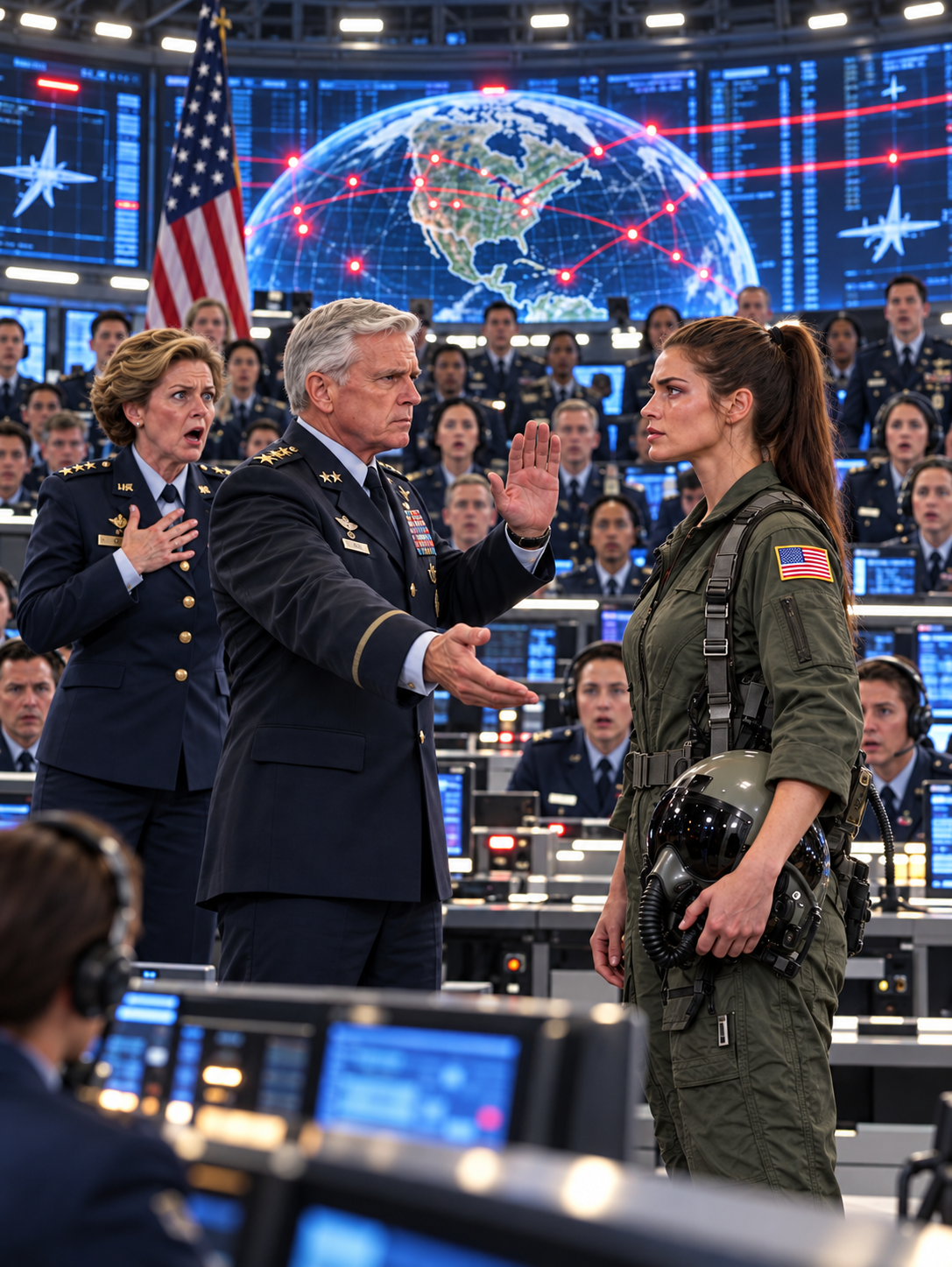
My mother spent 5 years telling everyone I had failed flight training and become a records clerk, so when I walked into her command center carrying a flight helmet during the worst air-defense crisis of her career, she ordered security to throw me out. Then a two-star general asked me for my code signature. I answered, “Nightglass Actual,” and watched my mother’s face collapse—because before that night ended, my secret assignment would expose something far worse than her contempt, leave 57 missed calls on my phone, and bring federal agents to her front door.
Part 1
The alert sirens hit first, a hard electronic howl that seemed to vibrate through my teeth as every status screen inside Falcon Ridge Air Station changed from blue and white to warning red. I stepped through the command-center doors carrying a tablet beneath one arm and a matte-black flight helmet in the other, and immediately heard my mother shout, “Then find someone competent, because I’m not losing control of restricted airspace because Operations can’t read a schedule.”
Colonel Helena Ashford had been terrifying people in uniform for longer than I had been alive, and that afternoon she looked exactly the way I remembered from childhood whenever anything failed to obey her expectations: shoulders squared, gray-streaked dark hair pinned perfectly, one hand planted against the edge of the tactical table while officers twice my age scrambled around her. She hadn’t seen me yet, which gave me several seconds to study the main display and confirm what the alert message on my tablet had already told me—the unidentified contact was real, incredibly fast, and less than four minutes from crossing an inner defense corridor.
“Mom, you need to look at this.”
She turned, and I watched nearly five years of disappointment settle across her face before she even glanced at what I was holding. “Avery, not now,” she snapped. “Find Major Dalton and tell him I want him in here immediately.”
“I can’t do that.”
Her eyes hardened. “Excuse me?”
“The contact isn’t behaving like a conventional aircraft, and Dalton isn’t going to be able to—”
“Don’t waste our time.” She stepped closer and lowered her voice, which somehow made it worse. “You are a records clerk standing in the middle of a Tier One command emergency. Put down whatever paperwork you think is important and get out before I have Security escort you.”
Several officers pretended not to hear her, and that hurt more than I wanted it to. I knew some of them; I had processed enough fabricated logistics documents under my cover assignment that they had spent years watching Colonel Ashford’s disappointing daughter move folders, carry tablets, and eat lunch alone near the back windows of the administrative building.
“Colonel,” a calm male voice said behind her. “Ask her for a code signature.”
My mother turned toward Major General Elias Mercer, the senior intelligence officer on base, as though he had suggested interrogating the furniture. “Sir?”
Mercer wasn’t looking at her. He was looking at my helmet.
That helmet was the one mistake I had never expected to make in front of my mother—not because carrying it violated protocol, but because no one at her clearance level was supposed to recognize it. Mercer did, and from the way the color drained slightly from his face, I knew he remembered exactly where he had seen one before.
“Ask Captain Ashford for her code signature.”
My mother gave a short laugh. “Captain?”
The word struck the room harder than the sirens.
I had spent five years listening to her describe me as administrative staff, sometimes with embarrassment and sometimes with thinly disguised disgust, because in the Ashford family flying was not simply a profession. It was inheritance.
My grandfather had been a military pilot. My great-grandfather had flown long before avionics looked anything like they did now, and family photographs showed generations of Ashfords beside aircraft with their arms crossed and expressions suggesting gravity itself existed only because they permitted it.
My mother had planned my career before I understood what a career was. By seventeen, I could calculate fuel loads faster than most people could split a restaurant bill; by nineteen, I was at the academy; by twenty-three, I was deep in flight training and exactly where Helena Ashford believed her daughter belonged.
Then I disappeared from the pipeline.
I told her I had failed a medical review.
It was the first direct lie I had ever told my mother, and it had been ordered by people whose existence she was not cleared to know about. There had been no failure; an evaluation team from a deeply compartmented experimental program had identified me during advanced testing and offered me a choice that was not really a choice once I understood what they were building.
I could remain visible and pursue the prestigious career my mother wanted, or I could disappear sideways into a program whose pilots technically did not exist.
I chose the sky.
Just not her version of it.
My administrative job became the official explanation for everything. A fabricated personnel history said I had accepted a quiet support assignment after failing to qualify physically, and my mother believed every word because disappointment was easier for her to accept than curiosity.
She stopped calling unless family obligations forced her to. At holiday dinners, she asked my cousins about promotions while barely asking me how work was going, and when colleagues mentioned their children’s achievements, I sometimes watched her smile before saying, “Avery chose administrative work.”
Chose.
That word had cut deeper every time.
Now she stared at General Mercer. “Sir, with respect, my daughter is assigned to records management.”
“If that were true,” he said, “I wouldn’t be asking.”
One of the warning tones changed pitch as the unidentified contact crossed another boundary on the tactical map. An operations officer called out, “Three minutes to the inner corridor,” and suddenly every person in the room remembered that while my family history was becoming complicated, something unknown was still moving toward protected airspace.
Mercer looked directly at me. “Code signature?”
I shifted the helmet beneath my arm and met his eyes.
“Nightglass Actual.”
The command center stopped breathing.
My mother stared at me as if I had spoken a language she had never heard, but several senior officers reacted immediately. One intelligence analyst straightened so quickly his chair rolled backward, while Mercer stepped between me and the two security officers who had started moving after my mother’s earlier order.
“Stand down,” he told them.
My mother’s expression changed from confusion to anger. “What exactly is going on?”
Mercer turned toward her, and his tone became almost gentle. “Colonel, step away from Captain Ashford.”
“She is my daughter.”
“Yes.”
“I know what she does.”
Mercer held her gaze for one uncomfortable second. “Apparently not.”
My mother’s face flushed. “This is my command floor, General. Until someone explains this, I am ordering her detained.”
“Your authority does not extend to Nightglass.”
Before she could answer, the center display abruptly went black.
A dark insignia appeared, followed by an identity confirmation and an authorization level that only a handful of people in the room understood. My name appeared beneath it.
ASHFORD, AVERY M.
CAPTAIN.
NIGHTGLASS OPERATIONAL AUTHORITY.
My mother read it once, then again.
For five years, I had wondered what it might feel like if she ever discovered the truth. I had imagined satisfaction, maybe anger, maybe some childish sense of victory.
Instead, watching her realize that she had never known me made my chest ache.
Mercer opened a secured compartment beneath the command console and removed a small transponder. “Captain, our conventional interceptors cannot reach that contact before it crosses the civilian corridor.”
I took it from him.
“How long?”
“Two minutes, forty seconds.”
I glanced at the tactical display.
“Then I need Sublevel Six opened now.”
My mother whispered, “There is no Sublevel Six.”
The secured elevator at the far side of the command center unlocked with a heavy mechanical click.
I looked at her for the first time since giving my code signature.
“There is for me.”
The elevator doors opened.
And as I stepped inside, the last thing I saw was my mother staring past me into a part of her own base she had never known existed.
Part 2
The elevator dropped fast enough to make my stomach lift, and by the time the doors opened, the daughter Colonel Helena Ashford thought she knew no longer mattered. Ground crews were already running across the underground hangar, white work lights reflecting from polished concrete while technicians rolled equipment away from the black aircraft waiting beneath the launch gantry.
They called the aircraft Raven One inside the program, although even that name appeared on almost nothing official. Its narrow frame looked less like something designed by an aviation company and more like something somebody had sketched after asking how much of conventional aerodynamics could be ignored before physics complained.
Chief Ortega met me at the ladder. “Target updated thirty seconds ago. Still unmanned as far as we can tell.”
“Civilian corridor?”
“Opening in ninety-eight seconds.”
I climbed.
My suit connections locked into the seat, the canopy lowered over me, and the familiar scent of composite material, oxygen lines, and warm electronics filled the cockpit. It was the smell of the only place in my adult life where I had never felt like a disappointment.
“Nightglass Actual connected.”
Telemetry spilled across my visor.
Then my mother’s voice entered the command channel.
“Avery?”
I froze for half a heartbeat.
Not Captain Ashford.
Not records.
Avery.
General Mercer must have left her microphone connected, whether deliberately or by mistake.
I could hear confusion underneath her breathing. “What are you doing?”
My hand settled over the ignition controls.
“My job.”
The magnetic launch system engaged.
The aircraft shot forward through the buried tunnel, acceleration pressing me deep into the seat before the mountainside aperture opened ahead and daylight exploded across my visor. One second I was surrounded by concrete and artificial light; the next I was climbing over steel-blue water beneath a cold afternoon sky.
“Nightglass airborne.”
The base vanished behind me.
My target indicator appeared eighty miles ahead.
The unidentified craft was faster than the first reports suggested, moving at an altitude where ordinary commercial traffic could never operate but descending gradually toward a heavily traveled civilian route. Whoever had programmed it knew exactly where gaps between conventional response times existed.
That detail bothered me immediately.
This was not random.
“Mercer, I need confirmation of the original detection sequence.”
A pause.
“Why?”
“Because this thing didn’t stumble through the grid. It threaded it.”
I heard keyboard activity from the intelligence stations.
Mercer answered twenty seconds later. “Agreed.”
That single word changed the mission.
I had launched believing I was intercepting an unknown intrusion. Now I understood somebody might have possessed inside knowledge of our defense coverage.
“Sixty seconds to corridor,” an operator announced.
I pushed Raven One harder.
The landscape beneath me became abstract—mountain ridges, water, pale geometric patches of towns. Ahead, the intruder appeared on my sensor display as a red angular symbol, then as a dark speck against the horizon.
“Visual.”
“Engagement authority granted,” Mercer said. “Keep the debris field offshore if possible.”
“That’s the plan.”
I closed from behind.
At that speed, distance vanished violently. Ten miles became five, then two, and finally the object filled part of my visor: dark, unmanned, compact, with no recognizable national markings.
Its movement was wrong.
Every time I approached the ideal position, it shifted.
Not randomly.
Reactively.
“It sees me.”
Mercer’s voice tightened. “Can it evade?”
“It’s trying.”
The intruder banked abruptly.
I followed, feeling the pressure build across my ribs while Raven One compensated around me. Warning symbols flickered at the edge of my visor, but I held position.
“Thirty seconds.”
There was no time for another approach.
I aligned the aircraft’s experimental disruption system with the intruder’s control section. The technology was designed to disable electronics without creating a catastrophic midair breakup, but at that speed and angle there were no guarantees.
“Nightglass transmitting.”
For half a second, nothing happened.
Then the intruder rolled.
Its engine signature disappeared from my display.
“Propulsion offline.”
I stayed beside it while its emergency control logic tried to stabilize the glide. The craft began descending toward empty ocean, safely away from the civilian route.
The command center erupted in voices.
“Corridor clear.”
“Contact descending.”
“No secondary tracks.”
I exhaled for the first time in what felt like minutes.
“Target neutralized. I’m staying with it until impact.”
Mercer answered, “Copy.”
The damaged craft dropped beneath me, touched the ocean at a shallow angle, skipped once across the surface, then disappeared into white spray.
I turned Raven One toward base.
That should have been the end of it.
Instead, Mercer came back over the encrypted channel.
“Nightglass, we have a problem.”
“What kind?”
“Our analysts reconstructed the intrusion route.”
I waited.
“The craft avoided three detection windows that were changed less than forty-eight hours ago.”
Cold replaced adrenaline.
“How widely distributed?”
“Restricted command personnel only.”
I knew what he meant.
Someone with access to current operational schedules had either deliberately provided the information or been compromised.
“How many people?”
“Twelve.”
“Colonel Ashford?”
Silence.
That silence answered before Mercer did.
“Yes.”
I stared through the canopy at the horizon.
My mother had spent five years believing I was the family failure, and now intelligence data had placed her inside a list connected to one of the most serious security breaches the base had ever experienced.
But anger did not equal guilt.
I knew Helena Ashford.
She could be cruel, arrogant, dismissive, obsessed with reputation, and incapable of admitting she had misjudged somebody until the evidence physically cornered her.
But treason?
No.
“Don’t confront anyone,” I said.
Mercer’s reply came carefully. “That was already my intention.”
“Especially her.”
Another pause.
“Understood.”
When I returned to Falcon Ridge, the underground hangar was quiet except for cooling machinery and the ticking of contracting metal. I climbed down from Raven One and found two intelligence officers waiting beside Chief Ortega.
Neither congratulated me.
That told me everything.
“General Mercer wants you upstairs.”
I removed my helmet.
“Is my mother still there?”
One officer nodded. “Yes.”
“Does she know?”
“No.”
The elevator ride back felt longer.
When the doors opened, command personnel were pretending to work normally, but tension had settled over the room like static. My mother stood beside the main table, her arms folded tightly across her chest.
When she saw me, she moved forward.
“Avery, I need to talk to you.”
I removed my gloves one finger at a time.
“Not here.”
Her eyes dropped to my flight suit, to the insignia she had never seen, and finally back to my face.
“I didn’t know.”
“I know.”
“I thought—”
“I know what you thought.”
Her mouth tightened.
For once, I did not rescue her from the silence.
Mercer approached us holding a secured tablet. “Captain Ashford, conference room.”
My mother immediately stepped forward. “What is this?”
Mercer looked at her.
“Colonel, remain here.”
Something in his tone made her go pale.
I followed him through the side door.
The moment it closed, he placed the tablet in front of me.
A list of twelve names filled the screen.
My mother’s was number four.
But another name caught my attention immediately.
Major Owen Dalton.
The man my mother had ordered me to find minutes before the crisis.
I looked at Mercer.
“He didn’t report to command today.”
“Where is he?”
“That,” Mercer said, “is what we need to find out.”
Then an intelligence analyst rushed through the door holding a phone.
“Sir, Dalton’s access badge just registered.”
Mercer stood.
“Where?”
The analyst swallowed.
“Inside Nightglass storage.”
Part 3
There are moments when your brain refuses information because accepting it would require rearranging too much at once, and hearing that Major Owen Dalton’s badge had appeared inside Nightglass storage was one of them. Dalton was not assigned to my program, did not possess Nightglass clearance, and according to every security rule governing the facility, should not even have known that storage area existed.
Mercer was already moving. “Lock down Sublevel Six.”
The analyst shook his head. “Security controls aren’t responding.”
That was worse.
I grabbed my helmet again and followed Mercer into the corridor while alarms changed from the broad air-defense warning to a shorter internal-security pulse. Behind us, my mother called my name, but Mercer ordered her back before she reached the secured door.
“You cannot lock me out of my own base,” she shouted.
Mercer stopped just long enough to face her. “Colonel Ashford, right now I can lock out anyone.”
Her gaze shifted to me.
For the first time, I saw something beneath the pride.
Fear.
“Avery, what is happening?”
I almost answered.
Then I remembered five years of unanswered messages, five years of family dinners where she had treated my career like a contagious embarrassment, and every time she had assumed the worst about me without asking one honest question.
“I’m working.”
The door sealed between us.
Sublevel Six had its own armed response team, but whoever had interfered with the security network had temporarily disabled several electronic locks. We took an emergency stairwell, descending through bare concrete passages lit by white strips in the ceiling.
Halfway down, Mercer received an update.
“Dalton’s badge is moving toward archive containment.”
“That makes no sense,” I said.
Archive containment held flight telemetry, test data, and mission packages. None of it was reachable from ordinary base systems.
Unless someone physically entered.
We reached the final landing and found Chief Ortega waiting with three security officers.
“No sign of forced entry.”
“Then how did he get in?” Mercer asked.
Ortega handed him a small card.
“Colonel-level maintenance override.”
My stomach dropped.
There were only a handful issued.
Mercer looked at me before asking the obvious question.
“Whose?”
Ortega hesitated.
“Colonel Ashford’s.”
I stared at the card.
My mother’s credential.
Suddenly every cruel thing she had said over the previous five years became irrelevant compared with one question.
Had I been defending her because she was innocent, or because some part of me was still the daughter who needed to believe there was a line she would never cross?
“No assumptions,” Mercer said quietly, reading my face.
“I’m not making one.”
That was not entirely true.
We entered the archive corridor.
Nothing moved.
Rows of sealed storage rooms stretched ahead beneath bright clinical lighting, the air carrying the metallic smell of cold filtration systems. One cabinet door stood open near the end.
Security approached first.
Empty.
Inside the cabinet, however, one encrypted data module was missing.
Mercer swore under his breath.
My headset clicked.
“Movement in auxiliary maintenance.”
We ran.
The maintenance tunnel connected Sublevel Six to a service elevator several hundred yards away, an old feature dating from before the Nightglass conversion. Whoever had planned the breach knew the architecture extremely well.
We found Major Dalton near the elevator.
But he was not running.
He was sitting against the wall, breathing hard, with blood from a shallow cut above his eyebrow drying down one side of his face.
“Don’t move,” Security ordered.
Dalton raised both hands.
“Thank God.”
Mercer stared at him. “Explain.”
“I came down because Colonel Ashford told me to check an inventory discrepancy.”
I felt my jaw tighten.
“When?”
“This morning.”
“My mother sent you into a compartment she doesn’t know exists?”
Dalton looked confused. “Not Nightglass. She told me there was an old emergency storage sector beneath Logistics and gave me her maintenance override because my normal badge wouldn’t work.”
Mercer asked, “Where is the data module?”
“What data module?”
One of the guards searched him.
Nothing.
Dalton continued, “Someone hit me from behind about twenty minutes ago. Took my badge.”
That explained the badge movement.
Not my mother’s override.
“Who knew she gave it to you?” I asked.
“Her aide.”
“What aide?”
Dalton wiped at his forehead.
“Captain Nolan Price.”
The name hit me because Price was not on the twelve-person list.
He did not have direct access to defense-window changes.
But as my mother’s executive aide, he saw her calendar, handled her secure packets, arranged briefings, and sometimes carried materials between offices.
He did not need direct access.
He needed hers.
Mercer was already transmitting the name upstairs.
No response.
Then another officer came over the channel.
“General, Captain Price left the installation seven minutes ago.”
Mercer’s face hardened.
“Freeze all exits.”
“He’s already outside the perimeter.”
“Vehicle?”
“Government sedan.”
“Track it.”
The answer came thirty seconds later.
“Transponder disabled.”
Mercer looked at me.
I knew exactly what he was thinking.
The airspace intrusion might never have been intended to succeed.
It may have been a distraction.
While every senior officer watched the sky, someone had entered the most protected part of Falcon Ridge and stolen classified data.
The drone had not been the attack.
It had been the magician’s hand waving while the other hand emptied the pocket.
We returned upstairs with Dalton under escort.
My mother was waiting.
The second she saw the maintenance override in Mercer’s hand, she stopped moving.
“Where did you get that?”
“Major Dalton.”
Her face changed.
“Oh God.”
Mercer asked, “You gave him this?”
“This morning. Nolan brought me an inventory report about outdated emergency communications equipment in the lower logistics sectors. I told Dalton to investigate.”
“What report?”
“In my office.”
Federal security teams searched her office.
The report was gone.
So was Captain Price’s desk computer.
My mother sat down slowly.
“I signed the authorization.”
“Yes,” Mercer said.
“I gave him access.”
“You gave Dalton access. Price appears to have manipulated where that access led.”
She looked at me.
“I didn’t know.”
The irony was so sharp it almost made me laugh.
Five years earlier, I had wanted to tell her those exact words.
I didn’t fail.
I didn’t quit.
I didn’t betray everything you raised me to become.
You just didn’t know.
Instead, I said, “Then you’ll cooperate with the investigation.”
Her head snapped up.
“You think I’m involved?”
“I think somebody used your authority to penetrate a classified program.”
“I’m your mother.”
“And thirty minutes ago you ordered security to detain me because you thought I was a clerk standing where I didn’t belong.”
Her face tightened as though I had struck her.
I hated that some part of me still cared.
Mercer intervened. “Colonel, this is no longer a family conversation.”
Within an hour, federal investigators had arrived at Falcon Ridge.
By sunset, they had isolated Price’s vehicle twenty miles away.
Empty.
At 7:13 that evening, while I sat alone in a secure briefing room drinking coffee that had gone cold, an investigator placed a photograph on the table.
It showed Captain Price entering my mother’s house three nights earlier.
He had not been there for work.
According to the time stamp, he had remained inside for almost four hours.
I stared at the photograph.
“Was my mother home?”
The investigator nodded.
My stomach twisted.
Then he placed a second photograph beside it.
Another person had entered the house forty minutes later.
Major Dalton.
The investigator folded his hands.
“Captain Ashford, we need you to tell us everything you know about your mother.”
And suddenly the hardest mission of my life had nothing to do with flying.
Part 4
Federal investigators do not care about family mythology, and by midnight I had learned how quickly decades of personal history could be reduced to dates, access logs, phone records, and signatures on a screen. I told them everything relevant about my mother, including the parts that made her look bad and the parts that made her look innocent, because protecting her reputation would have made me exactly the kind of officer she had always accused other people of being.
The four-hour meeting at her house turned out to have an ordinary explanation at first. My mother had hosted a planning dinner for six officers connected to an upcoming readiness inspection, and Price and Dalton had both attended along with four others.
But one detail did not fit.
Price had left through the front door at 9:18.
His phone remained connected to my mother’s home network until 11:47.
Investigators asked whether Helena had given him permission to stay.
She said no.
Security footage from a neighbor showed his sedan leaving at 9:19, which meant either someone else had carried his phone inside or Price had left a device behind intentionally.
Agents searched the house the next morning.
I was at Falcon Ridge reviewing flight data when my phone began vibrating.
Once.
Again.
Then repeatedly.
Mom.
I turned it face down.
The calls kept coming.
At 9:22, Mercer entered.
“They found something.”
I stood.
“What?”
“A concealed relay device behind the communications panel in your mother’s study.”
For a moment, I forgot how to breathe.
The study was where she reviewed secure schedules whenever regulations allowed remote preparation. If Price had planted a device there, he could have harvested information without my mother consciously handing him anything.
“Does that clear her?”
“No.”
Of course it didn’t.
Investigators still had to determine whether she knew.
My phone vibrated again.
Mercer glanced at it.
“You can answer.”
“No.”
“Avery.”
“I spent five years waiting for her to call me because she wanted to know me rather than correct me. She can wait one morning.”
He did not argue.
By noon, my phone showed twenty-three missed calls.
By 2:00, thirty-eight.
Then federal agents located Captain Price.
He had rented a storage unit under another name near a small regional airport. Inside, they found parts from the unmanned aircraft, duplicate access credentials, encrypted storage equipment, and enough documentation to prove the incursion had been planned months in advance.
Price was arrested trying to board a privately chartered aircraft.
The stolen Nightglass module was recovered from his luggage.
That should have solved everything.
It didn’t.
During questioning, Price claimed Colonel Helena Ashford had unknowingly helped him for nearly a year through what he called “administrative convenience.” He had learned that if he presented her with paperwork during busy periods, she often signed routine authorizations after checking only the top summary because she trusted her staff to handle details correctly.
That weakness had been enough.
Her certainty.
Her impatience.
Her belief that she could judge competence almost instantly.
The same qualities she had used against me had been used against her.
At 4:40, I finally returned to my apartment.
My phone showed fifty-seven missed calls.
Fifty-three were from my mother.
Four were from my grandmother.
I had barely removed my boots when someone knocked hard on the door.
Not Mom.
General Mercer stood outside.
“Federal team is moving on your mother’s house again.”
“Why?”
“Price gave them another location.”
My stomach tightened.
“What location?”
“Her detached garage.”
I grabbed my jacket.
The street was already full when we arrived, black government vehicles lining the curb while neighbors stood behind curtains pretending they were not staring. White floodlights illuminated my mother’s driveway even though there was still enough daylight to see clearly.
My mother stood near the porch surrounded by agents.
She looked furious.
And terrified.
“Avery!”
I stopped several yards away.
She started toward me but an investigator asked her to remain where she was.
“What are they doing?” she demanded. “They already searched everything.”
An agent emerged from the garage carrying a sealed evidence container.
Then another.
My mother’s face drained.
“What is that?”
Nobody answered immediately.
Mercer stepped closer to the lead investigator.
I heard only fragments.
“False compartment.”
“Installed behind shelving.”
“Multiple devices.”
My mother stared at me.
“I didn’t put anything there.”
I believed her.
That was the worst part.
Because believing her innocence did not erase what she had done to me.
Agents eventually determined Price had been using an old section of the garage accessed through a side door while doing favors for my mother over several months. He had volunteered to repair shelving, replace electrical fixtures, move archived boxes, and handle small jobs she had been too busy to manage.
She had trusted him because he looked competent.
She had distrusted me because she believed I was not.
The contradiction broke something in her.
By evening, she sat on the porch steps after investigators finally cleared the house.
I stood near the driveway.
“Avery,” she said quietly.
I waited.
“I’m sorry.”
Five years earlier, those words might have changed my life.
Now they landed almost weightlessly.
She rubbed both hands together and stared at the pavement. “I kept thinking if you had really done something important, you would tell me.”
“I was under orders not to.”
“I know that now.”
“No. You know the reason now. That isn’t the same thing.”
She looked up.
“I was hard on you because I thought you were throwing away everything you worked for.”
“You punished me because I made a decision you didn’t approve of.”
“I thought you had quit.”
“You never asked.”
“I did ask.”
“You interrogated me once, decided I was lying because you didn’t like the answer, and spent five years making sure I knew you were ashamed of me.”
Her eyes filled, and seeing tears there should have felt like justice.
It didn’t.
“I can fix this,” she whispered.
I shook my head.
“No, Mom. You can survive it. You can learn from it. You can become better because of it if you choose.”
I stepped toward the driveway.
“But you don’t get to rewrite five years because you finally discovered I was impressive enough for you.”
Her voice broke behind me.
“Avery, please.”
I stopped without turning.
“I needed you when you thought I was nobody.”
The street went silent.
“Now that you know who Nightglass is, you want your daughter back.”
I looked over my shoulder.
“You should have wanted her before.”
Then I walked away.
Three days later, the Air Force inspector general opened a formal command review into Colonel Helena Ashford’s leadership.
And that investigation uncovered something even I hadn’t expected.
The way she had treated me was not an exception.
It was a pattern.
Part 5
The command review lasted eleven weeks, and by the end of it, my mother’s career was no longer threatened by Captain Price’s espionage scheme. Investigators concluded she had not knowingly provided classified material, had not participated in the intrusion, and had been manipulated through the relay equipment planted inside her home.
What damaged her career was everything else.
Interviews revealed years of complaints about humiliation during briefings, officers being threatened with relief before investigations were completed, junior personnel being labeled incompetent after single mistakes, and staff members learning to hide problems because they feared becoming her next target. I recognized the pattern instantly because I had grown up inside it.
My mother believed pressure produced excellence.
Sometimes it produced silence.
And silence, the investigators wrote, had helped Price operate unnoticed.
He had understood exactly what kind of command environment protected him: one where subordinates were more afraid of looking foolish than of reporting strange details.
Price eventually pleaded guilty to multiple federal charges connected to unlawful acquisition of defense information and the attempted theft of classified program material. The unmanned aircraft had been built through intermediaries using stolen technical data, and the entire incursion was designed as a diversion so he could extract information from Nightglass storage.
Major Dalton was cleared.
He called me once afterward.
“I owe you an apology.”
“For what?”
“For believing the story.”
“What story?”
“That you were Colonel Ashford’s daughter who couldn’t make it.”
I leaned against my kitchen counter.
“Most people did.”
“I should have known better.”
“No,” I said. “You should have treated the records clerk with respect even if the story was true.”
He went quiet.
Then he laughed softly.
“Fair enough, Captain.”
That conversation stayed with me.
The dramatic version of what happened at Falcon Ridge is easy to tell.
My mother humiliated me.
I revealed I was Nightglass.
I launched a classified aircraft, stopped an intrusion, exposed a spy, and watched federal agents raid the house of the woman who had treated me like a disappointment.
But the important part came afterward.
I had spent years imagining that if my mother ever learned the truth, something inside me would finally heal.
It didn’t.
Her approval had been the wrong medicine.
Once I understood that, I stopped waiting for it.
Three months after the incident, Helena Ashford accepted early retirement rather than fight the command findings. She lost the future promotion everyone had assumed was inevitable, and the retirement ceremony she had once imagined as a packed auditorium became a small official event attended by a handful of colleagues.
I did not go.
My grandmother asked me to reconsider.
“She’s still your mother.”
“I know.”
“She regrets everything.”
“I believe her.”
Grandma studied me over coffee in her kitchen, where afternoon sunlight made bright squares across the old wooden table.
“Then why not forgive her?”
“I can forgive what happened without pretending we still have the relationship she destroyed.”
That distinction mattered.
Forgiveness, when I eventually reached something close to it, was not reunion.
It was deciding I no longer wanted to carry anger around just because she had given it to me.
My mother wrote letters.
Actual paper letters.
At first, I left them unopened in a drawer.
Eventually I read them.
She apologized for specific things rather than hiding behind phrases like “I’m sorry you felt hurt.” She wrote about the night she told my grandmother I had embarrassed the family, the promotion dinner where she introduced me as “the one who didn’t inherit the flying gene,” and the Christmas she invited my cousins but forgot to tell me the date had changed.
Reading those details hurt because they proved she remembered.
She had always remembered.
I simply had not mattered enough at the time for her to change.
Her final letter arrived nearly a year after Falcon Ridge.
There was no request for dinner.
No plea for another chance.
Just one paragraph I read twice.
“You once told me I should have wanted my daughter before I knew who Nightglass was. You were right. I spent my life believing achievement revealed character, and I used that belief to excuse cruelty. I hope wherever you fly next, you never again mistake my blindness for a measure of your worth.”
I folded the letter.
Then I placed it back in the envelope.
I did not call.
Some people will hear that and think I was cold.
Maybe I was.
But reconciliation is not a debt injured people owe simply because the person who hurt them finally understands what they did.
My life had grown around the empty space my mother created.
I had friends who knew exactly what I did and friends who never would but respected me anyway. I had Chief Ortega, who kept terrible coffee hidden in his office for post-flight debriefings, and Mercer, who had become the closest thing I had to a mentor.
I also had someone new.
Lieutenant Commander Leah Morgan worked in systems evaluation and met me six months after the incident without knowing my family history. Our first conversation lasted eleven minutes and involved an argument over flight telemetry, two vending-machine coffees, and her informing me that my landing profile was “technically beautiful and emotionally offensive.”
I liked her immediately.
Nothing dramatic happened.
No instant destiny.
No ridiculous promise that she would repair everything someone else had broken.
We simply kept choosing to spend time together.
That felt healthier.
One year after the incursion, I stood again inside the Falcon Ridge command center.
Most of the personnel had changed.
The tactical display glowed calmly.
No sirens.
No red warning symbols.
A young airman hurried through carrying three folders and nearly collided with a lieutenant colonel.
“I’m sorry, sir.”
The colonel frowned.
For one second, I saw my mother in his posture.
Then he stepped aside.
“You’re fine. What’ve you got?”
The airman explained.
The colonel listened.
Such a small thing.
I watched them and thought about how many disasters begin because somebody decides the person carrying paperwork cannot possibly know anything important.
General Mercer approached beside me.
“Thinking profound thoughts?”
“Rarely.”
He handed me a tablet.
“New assignment.”
I read the authorization.
Nightglass expansion unit.
Command pilot.
Promotion attached.
I looked up.
“You’re serious?”
“Unfortunately.”
I smiled.
“When?”
“Monday.”
I signed.
Later that afternoon, I walked alone through the underground hangar toward Raven One.
The aircraft waited beneath clean white lights, silent and dark.
My phone vibrated in my pocket.
For an instant, muscle memory made me wonder whether it was Mom.
It wasn’t.
A message from Leah.
“Dinner at seven. And if you cancel because someone invades the country again, I’m charging you for dessert.”
I laughed.
Then I climbed the ladder into the cockpit.
Before lowering the canopy, I looked once toward the observation window above the hangar.
A year earlier, I had wanted my mother standing there.
I had wanted her to see me.
To finally understand.
Now the window was empty.
And I was okay with that.
I settled into the seat, connected my helmet, and listened as the aircraft came alive around me.
“Control, Nightglass Actual.”
Mercer’s voice answered through my headset.
“Nightglass Actual, you are cleared for departure.”
The mountain doors opened.
Cold daylight flooded the launch corridor.
I smiled beneath my visor.
For most of my life, I thought being seen by my mother would prove that I had become someone worth seeing.
I had been wrong.
I had never needed her permission to become anything.
“Nightglass rolling.”
The launch system engaged.
And this time, when the sky opened in front of me, I carried nothing from the past except the lesson it had cost me to learn.
I did not look back.
THE END!
Disclaimer: Our stories are inspired by real-life events but are carefully rewritten for entertainment. Any resemblance to actual people or situations is purely coincidental.


