
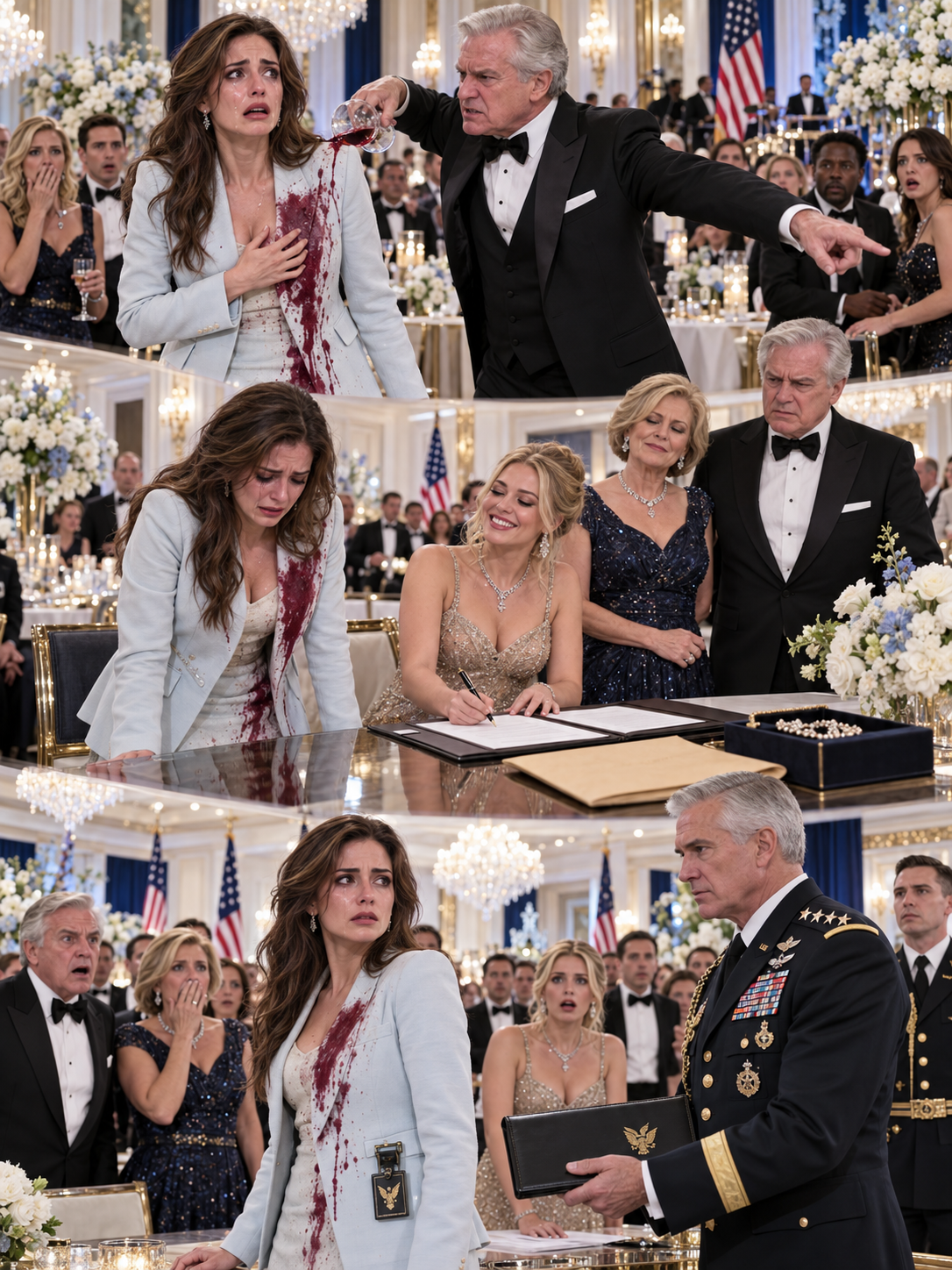
My father poured red wine down the front of my jacket at my sister’s engagement gala and ordered me to “hide in the back” because, according to him, I was only a government clerk embarrassing the family. Hours earlier, my parents had forced me to surrender my inheritance to that same sister, and she laughed while signing the papers. None of them knew what I actually did inside the Department of Defense—or why a four-star general across the ballroom was silently waiting for my authorization.
Part 1
“Get out of the photograph, Claire. You’re ruining it.”
My father’s voice cut through the music just as the photographer raised his camera in the ballroom of the Hawthorne Grand, where nearly four hundred guests had gathered for my younger sister Madison’s engagement celebration. I had barely moved when Richard Whitmore lifted the glass in his hand and deliberately tipped it forward, sending expensive red wine across the pale gray front of my jacket while my mother gasped—not in horror, but because a few drops had splashed dangerously close to her designer gown.
The wine was cold for half a second before it soaked through the fabric and warmed against my skin, carrying the sharp smell of oak and fruit directly under my nose. My father lowered the empty glass and said through clenched teeth, “Step back into the shadows where you belong; you are a civil servant, Claire, and your cheap little government salary does not belong in Madison’s engagement portraits.”
A circle of guests suddenly found the chandeliers fascinating.
My mother, Vivienne, adjusted the diamond bracelet on her wrist while Madison stood beside her fiancé, Preston Hale, with one manicured hand resting dramatically against her chest. Madison’s eyes traveled over my stained jacket before she smiled and said, “Dad’s right, and honestly, after what you signed this morning, I don’t understand why you’re still pretending you’re part of the family legacy.”
That morning.
The words dragged me straight back to my father’s study eight hours earlier, where the air had smelled of leather, bitter coffee, and the cigar Richard smoked whenever he wanted everyone else to understand that he was in control. A thick legal folder had slid across his glass desk until it stopped beside my hand, and the title on the first page had told me exactly why I had been summoned home after nearly nine months away.
Inheritance Disclaimer and Transfer Agreement.
“You’re signing over your interest in the lake property, the Whitmore residence, and the family trust allocation,” Richard had said without looking at me. “Madison needs liquidity if she’s going to enter the Hale family properly, while you have no husband, no children, and apparently no ambition beyond filing paperwork for Washington.”
My mother sat on the cream leather sofa tapping one red fingernail against the armrest. “Preston’s family moves in serious circles, Claire, so your sister cannot walk into that marriage looking poorer than her husband; you never cared about appearances anyway, which is fortunate because appearance is all Madison has ever understood how to use.”
Madison had been waiting outside the study and laughing with Preston, confident enough that she had already discussed renovating the lake house I supposedly still owned a third of. Nobody asked whether I wanted to give it up, because in the Whitmore family, my refusal had always been treated as an emotional malfunction rather than an answer.
I read every page.
That irritated my father more than an argument would have.
“Why are you wasting time?” he snapped. “You’re a records analyst or whatever ridiculous title the government gave you; don’t pretend you understand contracts better than the attorneys who drafted them.”
I nearly smiled.
For seventeen years, my parents had told anyone who asked that I worked in “federal administration,” and I had never corrected them because portions of my career genuinely could not be discussed. They knew I had joined the Navy after college, knew I had spent years moving between intelligence assignments, and knew I now worked primarily in Washington, yet they had somehow transformed those facts into a story they preferred: Claire had failed to become impressive, Claire shuffled documents, Claire was safe to belittle.
I uncapped my fountain pen.
The tiny metallic click sounded surprisingly loud.
“Before I sign,” I said, “I want you to confirm something.”
Richard sighed. “What now?”
“This ends my financial relationship with the Whitmore family completely, correct?”
My mother rolled her eyes. “Don’t be dramatic.”
“I’m not being dramatic, Mother; I’m asking a legal question.”
Richard leaned back, impatient confidence settling across his face. “Yes; once you sign, you relinquish the inheritance interests specified in the agreement, and Madison assumes them.”
I looked directly at him. “And you will never again claim that I owe this family money, property, influence, introductions, professional favors, or access because of an inheritance I might someday receive?”
For the first time, he hesitated.
Only briefly.
“Fine,” he said. “Consider whatever imaginary debt you carry paid.”
I signed.
Madison entered less than a minute later, took the folder from the desk, and kissed our father on the cheek. “Thanks for the capital, Claire; I promise I’ll put it somewhere more useful than a government pension account.”
I put the cap back on my pen and said, “I hope you remember saying that.”
Now, standing in the ballroom with wine soaking through my jacket, I watched the same sister hold up that morning’s folder like a trophy for Preston and two of his friends. “She signed everything,” Madison announced brightly, and Preston laughed before asking whether that meant “the bureaucrat” would finally stop pretending she belonged on the family property.
That was when I noticed the man seated at the farthest VIP table.
General Nathaniel Mercer had not touched his champagne.
Four stars were absent because he wore civilian evening clothes, but nobody who followed defense policy could mistake the broad-shouldered sixty-three-year-old former theater commander whose testimony had filled national broadcasts for years. Richard had spent half the evening boasting that having General Mercer at Madison’s gala proved the Whitmores were finally becoming “a truly national family.”
My father had no idea Mercer was there because of me.
His gaze met mine across the room.
No salute, no nod, no expression.
Just the steady look of a man who knew exactly what he had witnessed.
I turned toward the service corridor before my anger became visible. Behind me, my father called, “Clean yourself up and stay in the back; do not create another scene.”
The coatroom was narrow and cold, with cedar hangers lining one wall and an air vent humming overhead. I closed the door, removed my phone from the hidden pocket inside my jacket, and watched the encrypted screen illuminate with a single incoming message.
Mercer: I witnessed everything. Separate matter: financial team confirms final evidentiary threshold. Awaiting your recommendation.
My fingers went still.
For eleven months, an interagency review had been tracing irregular payments connected to Whitmore Dynamics, my father’s defense logistics corporation, and Hale Aeronautics, Preston’s family company. I had recused myself from investigative decisions involving my relatives months ago, but as deputy director for strategic procurement integrity, I had been the official who first detected the pattern and preserved the evidence before transferring it to independent investigators.
Until that evening, I had still been resisting one final recommendation.
I had told myself there might be an innocent explanation.
I had told myself blood deserved patience.
Then my father threw wine on me, my sister celebrated taking my inheritance, and the people I had protected for years demonstrated exactly what they believed family meant.
I typed four words.
Proceed without family consideration.
I stared at the message before sending it, feeling something inside me go unexpectedly quiet. I had not ordered revenge; I had done something far more dangerous to my father—I had finally stopped protecting him from the consequences of the evidence.
Mercer’s reply arrived seconds later.
Understood, Admiral.
For the first time that night, I smiled.
My family thought they had just pushed a powerless clerk into a dark room, but they had actually removed the only person still standing between them and a federal investigation that was ready to move.
Part 2
I stayed in the coatroom until the orchestra shifted into another song and the burning sensation beneath my wine-soaked jacket faded into a cold patch against my skin. When I finally stepped into the side corridor, I intended to leave quietly, but Madison and Preston were already walking toward me with the careless confidence of people who believed every hallway belonged to them.
Preston tossed something through the air.
I caught his Porsche keys less than a foot from my face.
“Get the car from the underground garage,” he said. “The valet line is ridiculous, and Madison says you’re used to doing administrative errands.”
Madison laughed. “Don’t look offended, Claire; you serve important people for a living, so think of this as practice for becoming useful around us.”
A young valet stood five feet away, frozen with embarrassment.
I crossed the distance between us and placed Preston’s keys gently into the valet’s open palm. “You don’t work for people who throw things at you,” I told him before turning toward my sister.
Madison’s smile tightened. “What is that supposed to mean?”
“It means some doors only close once.”
For perhaps two seconds, something uncertain moved behind her eyes.
Preston stepped forward instead, smelling of bourbon and expensive cologne. “Careful, clerk; marrying Madison means I’ll control businesses that supply your precious government, and someday you might find yourself asking me for favors.”
That sentence interested me far more than the insult.
“What kind of favors?”
He grinned. “The kind people in your position need from people in mine.”
Madison grabbed his arm and pulled him toward the elevator before he could say more. “Stop explaining things to her; she doesn’t understand how real power works.”
I let the elevator doors close.
Then I walked outside.
Two days later, I entered a secure conference room beneath a federal complex in northern Virginia wearing my Navy service uniform and two silver stars on my shoulders. The temperature inside was kept too low, the coffee had been sitting long enough to turn bitter, and three thick binders waited beneath fluorescent lights that made every page look brutally white.
Rear Admiral Claire Whitmore.
Deputy Director, Strategic Procurement Integrity Command.
That was the title my parents had spent years reducing to “government clerk.”
Commander Isabel Reed, my chief legal adviser, sat across from me while two Justice Department attorneys organized transaction maps on a secure monitor. None of them mentioned the gala, because everyone in that room understood the difference between personal humiliation and admissible evidence.
“We have enough for emergency preservation measures,” Reed said. “Independent investigators confirmed shell companies tied to both Whitmore Dynamics and Hale Aeronautics, plus altered subcontractor invoices and payments routed through three consulting entities.”
I opened the first binder.
Every page hurt in a different way.
There were signatures I recognized from Christmas cards, names of executives who had sat around our family table, and transfers authorized on days when my father had called me to complain that government auditors were “harassing successful Americans.” The money was not merely corporate profit; portions appeared to have been siphoned from contracts tied to military transport systems, maintenance equipment, and emergency supply programs.
“Any evidence Madison participated?” I asked.
“Not yet,” Reed said. “She benefited from some distributions, but benefiting isn’t the same as knowing.”
“And my mother?”
“Same position.”
I nodded. “Then we distinguish greed from criminal liability; nobody gets accused because I dislike them.”
That sentence seemed to release tension around the table.
General Mercer entered twenty minutes later.
Unlike the gala, he wore his uniform.
Everyone stood.
He looked toward me and said, “Admiral.”
“General.”
There was no dramatic salute, no secret conspiracy, and no command to destroy my family. Mercer chaired the Defense Procurement Security Council, which meant his role was to ensure potentially compromised contractors could not endanger active operations while courts and investigators did their jobs.
“We have a problem bigger than fraud,” he said.
A new file appeared on the secure screen.
Hale Aeronautics had supplied components for several restricted projects, and investigators had discovered unauthorized access attempts originating from an executive credential registered to Preston. Nobody yet knew whether the access had been intentional, negligent, or manipulated by someone else.
For the first time since the gala, my anger disappeared completely.
This was no longer about inheritance.
“Lock down every affected credential,” I said. “Suspend access under standard security protocol and isolate every contract touched by that account.”
Mercer nodded.
One of the Justice attorneys cleared his throat. “A federal judge is reviewing the asset-preservation application this afternoon; if approved, personal and corporate accounts linked to the suspected transactions can be temporarily frozen pending proceedings.”
I closed the binder.
“Do it by the book.”
By the following morning, my phone had accumulated thirty-seven missed calls from Richard Whitmore.
I ignored the first thirty-six.
The thirty-seventh arrived while I was standing beside the window of my office, watching gray clouds collect above the Potomac. I answered because I needed to hear exactly what he knew.
“What did you do?” my father screamed without greeting me.
I moved the phone slightly away from my ear. “Good morning to you too.”
“My operating accounts are frozen, my personal accounts are restricted, and federal agents are inside Whitmore Dynamics; Preston says Hale Aeronautics has been suspended from three defense programs, so don’t stand there pretending this has nothing to do with you.”
Interesting.
He had connected me to the investigation faster than expected.
“Why would it have anything to do with me?” I asked. “According to you, I file paperwork.”
Silence.
Then came the first crack.
“What exactly do you do?”
I looked at the two stars resting on the uniform jacket hanging beside my office door.
“You never cared enough to ask.”
His breathing changed.
“Claire, listen to me carefully; whatever childish anger you have about the gala—”
“This investigation began almost a year ago.”
Another silence.
Longer this time.
I could almost hear his mind searching backward through conversations, wondering what he might have revealed while dismissing me as harmless.
“You knew?”
“I knew enough to remove myself from decisions involving you and allow independent investigators to work.”
“You let this happen to your own father?”
“No, Dad; you apparently let this happen to yourself.”
He began shouting about loyalty, reputation, family blood, and everything he had sacrificed to give me opportunities. I listened until he said one sentence that made my hand tighten around the phone.
“Madison has nothing to do with this.”
“I didn’t say she did.”
He stopped.
I slowly sat down.
“Why did you immediately defend Madison?”
Richard hung up.
Ten minutes later, Commander Reed entered carrying a sealed evidence envelope.
Her expression told me something had changed.
“We searched the accounting archive authorized this morning,” she said. “Claire, there’s a document you need to see because it involves the inheritance agreement you signed.”
The room seemed to narrow around me.
Reed slid one photocopied page across the desk.
At the bottom was my signature.
At the top was a transaction authorization dated six months before I had ever signed anything.
Someone had been using my name long before the gala.
Part 3
The forged document sat between us beneath the white office light, and for several seconds I could hear nothing except the ventilation system whispering through the ceiling. My signature looked close enough to fool someone who had only seen it a few times, but whoever copied it had missed the slight upward break I always made before the last letter of Whitmore.
“What did this authorize?” I asked.
Commander Reed turned the page.
A holding company called Westbridge Family Management had borrowed against my expected interest in two family properties and used the proceeds as collateral for a private financing package connected to Hale Aeronautics. The amount was $6.8 million.
My throat went dry.
“Who submitted it?”
“Your father’s office transmitted the package, but the internal approval trail ends with Madison’s personal financial manager.”
I looked toward the window.
A year earlier, Madison had called me crying because a charity board had rejected her application, and I had spent an hour reassuring her that one embarrassing setback did not define her. Four months later, she had asked for a scanned copy of an old trust statement because she claimed Mother needed it for “estate housekeeping.”
Now I understood why.
“Is this enough to charge her?”
“Not alone.”
“Then we keep digging.”
Reed studied me. “You don’t have to stay involved even at this level.”
“I’m not involved in prosecution; I’m reviewing the security implications because my identity was used in a contractor financing chain, and once that review is transferred, I’m stepping away completely.”
She gave a small nod.
That afternoon, I received a text from Madison.
We need to talk without Dad.
I nearly deleted it.
Instead, I agreed to meet her in a public café three blocks from Union Station, where the smell of roasted coffee mixed with wet pavement drifting through the opening door. Madison arrived wearing sunglasses despite the cloudy afternoon and carried a handbag that cost more than the first car I had ever owned.
She sat without ordering anything.
“What did you tell them?” she asked.
“Who?”
“The FBI.”
“That question suggests you believe there’s something to tell.”
Her fingers tightened around the strap of her bag.
“Dad handles everything.”
“So does your financial manager apparently.”
The color left her face.
I did not mention the forged signature.
Not yet.
Madison glanced around before leaning toward me. “Claire, Preston is losing his mind; his board suspended him yesterday, his company attorneys won’t tell him what investigators found, and Dad keeps saying you caused this because you’ve always been jealous.”
I actually laughed once.
“Jealous of what?”
Her expression hardened. “My life.”
I looked at her diamond ring, then at the dark circles poorly concealed beneath her makeup. “Madison, your fiancé threw his car keys at my face forty-eight hours ago.”
“He was drunk.”
“And you laughed.”
She looked away.
There it was.
Not remorse.
Embarrassment.
“I need you to stop whatever you started,” she whispered.
“I didn’t start it.”
“Then use your connections.”
“For what?”
“To help us.”
“Why?”
She stared at me as if the question itself were cruel.
“Because I’m your sister.”
I felt something inside me finally detach.
“Were you my sister when you celebrated taking my inheritance?”
“That was different.”
“How?”
“Dad said you didn’t need it.”
I leaned back.
“And you believed him because believing him made you richer.”
Madison’s jaw trembled, though whether from anger or fear I could not tell. “You always act like you’re morally superior just because you wear a uniform.”
“You didn’t even know I still wore one.”
That stopped her.
I removed my access wallet from my coat only long enough to pay at the counter, but when it opened, the edge of my military identification became visible. Madison’s eyes dropped to it.
She read the rank.
Rear Admiral.
Her lips parted.
“You’re an admiral?”
I closed the wallet.
“What did you think I did?”
“Dad said you worked in records.”
“I spent years letting you believe whatever version of me made you comfortable.”
She sat perfectly still.
Then she whispered, “Does Dad know?”
“He called yesterday and asked what I do, so I suspect he is beginning to understand.”
Her eyes suddenly filled.
For one dangerous second, the older-sister instinct buried inside me tried to awaken.
Then Madison said, “If you’re really that powerful, you can fix this.”
And it died again.
“No.”
Her face collapsed into fury.
“You’d destroy us over a house?”
“This isn’t about the house.”
“What else could it possibly be about?”
I looked at her carefully.
That was when I knew she had either convinced herself the financial scheme was normal or she genuinely did not understand how much investigators had discovered.
“Go home, Madison.”
She slammed her palm onto the table. “You’re going to regret humiliating me.”
“No; I regretted protecting you.”
I left her sitting there.
Three days later, Whitmore Dynamics held an emergency board meeting under the observation of outside counsel and federal monitors. I had no intention of attending until the Defense Department requested that I brief the board on contract suspensions because multiple programs depended on determining whether the company could continue operating under independent management.
I entered through a side door wearing a plain charcoal suit.
Richard was already shouting.
“You cannot suspend fifty years of contracts based on accounting technicalities!”
Preston sat beside him looking gray and exhausted, while Madison occupied a chair against the wall with my mother. Neither woman looked at me when I entered.
Then General Mercer walked in.
The room changed instantly.
Richard straightened.
Preston actually stood.
“General,” my father said, almost breathless. “Thank God; you understand what Whitmore Dynamics means to national readiness, so tell these people this madness has gone far enough.”
Mercer ignored him.
He walked the length of the table toward me.
Every eye followed.
“Admiral Whitmore,” he said, “the court approved the expanded preservation order this morning, and the department has accepted your recommendation to protect essential workers while suspending compromised leadership.”
The silence that followed was extraordinary.
Richard slowly turned toward me.
“Admiral?”
I opened my briefing folder.
“The employees did not commit your alleged crimes, Dad, so payroll and protected operational accounts will remain available under court supervision; your personal assets and identified executive accounts remain restricted.”
His chair scraped backward.
“You did this.”
“No, I preserved the first evidence and then removed myself from the investigation.”
“You betrayed me.”
I looked at the man who had poured wine onto me because he thought I embarrassed him.
“No; I finally stopped betraying myself for you.”
Preston suddenly stood. “General Mercer, I’m family.”
Mercer looked at him blankly.
Preston swallowed. “Our grandfathers were cousins.”
“I know.”
“Then help me.”
General Mercer’s expression never changed. “Family relationships do not override federal law.”
Preston sank back into his chair.
A federal attorney then distributed the latest evidence summary.
Madison made a strange sound beside the wall.
I turned.
She was staring at one specific line.
Authorized collateral submission: Madison Whitmore.
My sister had just learned that investigators knew about the forged transaction.
And judging from the terror on her face, she knew exactly who had signed it.
Part 4
Madison disappeared before the board meeting officially ended.
I found out later that she had driven straight to our parents’ estate, packed two suitcases, and attempted to move into Preston’s penthouse only to discover that the property was already covered by the preservation order. By evening, she had called me nineteen times.
I answered the twentieth.
“Claire, Dad made me do it.”
No greeting.
No denial.
I stood alone in my kitchen holding a mug of tea that had already gone cold. “Do what?”
Her breathing hitched.
“The paperwork.”
“What paperwork, Madison?”
“Stop doing that.”
“Doing what?”
“Talking like an interrogator.”
“I’m giving you a chance to say the truth in your own words.”
She began crying.
For years, tears had been Madison’s emergency exit whenever a conversation became uncomfortable; our mother would rush in, our father would blame me for upsetting her, and whatever Madison had done would disappear beneath the larger offense of my supposed cruelty.
That system no longer existed.
“Dad said the trust assets belonged to the family anyway,” she whispered. “He said your share was wasted because you were never going to marry anybody important or build anything, and Preston needed financing before a major acquisition.”
“So you authorized documents using my name?”
“Dad said the attorneys would fix everything later.”
“Did you imitate my signature?”
Silence.
“Madison.”
“Yes.”
The word was almost inaudible.
I closed my eyes.
“Tell your attorney exactly what you just told me.”
Her crying stopped.
“You recorded this?”
“No.”
“Then why would I tell them?”
That answer removed whatever sympathy remained.
“Because it is the truth.”
She laughed bitterly. “There you go again with honor and truth; those things are easy to worship when you’re sitting inside the Pentagon with generals protecting you.”
“You forged my signature before you knew any of that.”
Another silence.
Then her voice became cold.
“If I go down, I’m taking Dad with me.”
I set the untouched tea beside the sink.
“That decision is between you, your attorney, and the government.”
“What about us?”
“There hasn’t been an us for a long time, Madison; I was simply the last person willing to admit it.”
I ended the call.
Within two weeks, Madison entered into a cooperation agreement through counsel and turned over messages, internal emails, and financial records that significantly expanded the case against Richard and several executives. Preston’s own board terminated him after investigators produced evidence that he had approved false certifications connected to defense subcontracting.
My mother never faced criminal charges.
She had enjoyed the money, ignored obvious warning signs, and pressured me into surrendering property, but investigators found no evidence she had knowingly participated in the fraud. Legally, Vivienne remained free.
Financially, her life collapsed anyway.
The mansion had been heavily leveraged.
Several luxury properties were tied to loans under review.
The trust was tangled inside years of questionable transactions.
One rainy Thursday afternoon, security called my office and told me Richard and Vivienne Whitmore were downstairs asking to see me.
“Do they have an appointment?”
“No, Admiral.”
I should have refused.
Instead, I allowed ten minutes.
When they entered, I barely recognized them.
My father wore a wrinkled navy suit that had once fit him perfectly but now sagged at the shoulders, while my mother’s hair was pulled into an uneven knot and her hands shook around the strap of an ordinary canvas bag. Neither person looked ruined because they were poor; they looked ruined because the identity they had built around being wealthy had disappeared.
Richard did not kneel.
I was grateful for that.
He sat across from my desk and stared at the two stars displayed beside a framed photograph from one of my former commands.
“How long?” he asked.
“How long what?”
“How long have you been an admiral?”
“Almost four years.”
His face twisted.
“You let me call you a clerk.”
“You called me many things.”
“You could have corrected me.”
“I tried when I was younger; eventually I realized you weren’t misunderstanding me, Dad, you were choosing the version that made it easiest to disrespect me.”
My mother began crying quietly.
“Claire, please,” she said. “We made mistakes.”
“Which mistakes?”
Her mouth opened.
Nothing came out.
I waited.
That silence told me more than an apology could have.
Richard leaned forward. “Madison has turned against me, Preston is finished, attorneys are billing us into the ground, and the government is selling pieces of the company; you’ve made your point.”
“I don’t have a point.”
“Then stop it.”
“I cannot stop a federal case.”
“You have influence.”
“So you want me to misuse my office to protect you from an investigation into misuse of federal money?”
His face reddened.
“I’m your father.”
“And the law does not recognize that as a defense.”
My mother reached toward me.
I moved my hand away before she could touch it.
Her expression broke.
“Do you hate us?”
I considered the question.
“No.”
That seemed to give her hope.
I continued, “Hating you would require carrying you around inside me every day, and I am done doing that.”
She covered her mouth.
Richard stood abruptly.
“After everything we gave you?”
I looked around my office.
The commendations on the wall.
The photograph of sailors standing beneath brutal desert sunlight.
The folded flag from my grandfather’s funeral.
“You gave me a childhood in which love depended on usefulness,” I said. “Other people taught me loyalty.”
He stared at me for a long moment.
Then he whispered, “You’re really going to let us lose everything.”
“You are going to lose whatever the courts determine came from fraud, debt, or unlawful transactions; whatever remains legally yours is yours.”
“And the inheritance?”
“I signed it away.”
His face tightened.
I almost smiled at the irony.
“You insisted on that part, remember?”
They left five minutes later.
I never invited them back.
Months passed before the criminal and civil proceedings reached their final phase, and the government preserved the healthy portions of Whitmore Dynamics by removing compromised executives rather than destroying thousands of innocent jobs. Several assets tied directly to fraudulent proceeds were eventually forfeited, while legitimate property was sold or reorganized through ordinary legal channels to satisfy debt and judgments.
Madison pleaded guilty to a financial offense related to the forged authorization and received a sentence shaped partly by her cooperation.
Preston fought everything.
He lost.
My father fought even harder.
He lost more.
Then Victor Grant, the independent attorney overseeing portions of the asset disposition, called me with unexpected news.
“There is one asset the government cannot take,” he said.
“What asset?”
“Your grandfather’s lakeside cabin.”
I frowned.
“I signed my interest away.”
“You signed away what your father told you belonged to the family trust.”
My pulse slowed.
Victor continued, “But your grandfather transferred the cabin to you separately before his death; your parents never told you, and they apparently spent years pretending it remained inside the trust.”
For the second time in less than a year, my family had put an inheritance document in front of me.
This one carried my grandfather’s real signature.
And this time, the property had always been mine.
Part 5
I drove to the lake alone in early October.
The cabin stood exactly as I remembered it from childhood, small and weathered beneath tall maples whose leaves had turned copper and red, with a crooked wooden dock extending into water so still it reflected the entire sky. When I unlocked the front door, I smelled cedar, dust, and the faint mineral scent of the old stone fireplace my grandfather used every winter.
Nothing inside looked expensive.
That made it perfect.
My grandfather had never cared about the Whitmore obsession with status, and when I was fifteen, he once told me while repairing a fishing reel that people who needed everyone to see their wealth usually feared there was nothing worth seeing underneath. I had forgotten that sentence until I stood inside the cabin and found his handwriting on a note preserved with the deed.
Claire—Keep one place in this world where nobody gets to tell you who you are.
I sat on the floor.
And for the first time since the gala, I cried.
Not because Richard had lost his company.
Not because Madison had betrayed me.
Not even because my mother had chosen comfort over protecting her daughter.
I cried because the man who understood me best had quietly given me something my family had spent years convincing me I did not deserve: a place that belonged to me without conditions.
I kept the cabin.
Almost everything else changed.
Whitmore Dynamics survived under independent leadership and eventually rebranded, preserving thousands of employees who had nothing to do with Richard’s decisions. Hale Aeronautics lost key defense eligibility and was broken apart through restructuring, while Preston disappeared from the social pages that had once treated every party he attended like a national event.
Madison finished her sentence and wrote me several letters.
I read the first.
She apologized for forging my signature, admitted she had spent most of her life competing with a version of me invented by our parents, and said losing everything had forced her to understand how little she had actually built for herself. She asked whether we could someday begin again.
I did not answer.
Six months later, another letter arrived.
Then another.
Eventually they stopped.
I never celebrated her suffering, but I also never confused regret with repair.
My mother sent birthday cards.
I returned none.
My father sent nothing.
That suited me.
Two years after the investigation concluded, I stood on a reviewing platform at Naval Support Headquarters beneath a hard blue autumn sky while a military band played across the courtyard. The wind tugged against my white dress uniform, carrying the smell of cut grass, polished leather, and the ocean from beyond the base.
I was receiving a service award I had tried unsuccessfully to decline.
General Mercer, now retired, stood among the invited guests.
Commander Reed sat several rows behind him.
And beside them were dozens of people who had worked under me, argued with me, challenged my decisions, covered my blind spots, and earned my trust without once demanding access to my bank account or family name.
As the ceremony ended, applause rolled through the courtyard.
That was when I saw my parents.
They stood outside the security boundary.
Older.
Smaller.
Ordinary.
My mother wore a plain gray coat, and my father stood beside her with both hands buried inside his pockets. I later learned they lived in a modest rental outside Richmond after legitimate debts, legal costs, and asset dispositions consumed most of what remained of their old life.
For a moment, Richard and I looked directly at each other.
Years earlier, that look would have pulled me toward him.
I would have wondered whether he approved of my uniform, whether he finally understood my career, whether seeing a general shake my hand had made him proud.
I felt none of those things now.
There was no triumph.
No revenge.
Only distance.
General Mercer stepped beside me.
“You all right?”
“Yes.”
“You want security to move them?”
I looked at my parents once more.
“No; they’re not bothering me.”
That was the truth.
They no longer had enough emotional power to bother me.
My mother raised one hand.
I did not raise mine.
The band began another march, and I turned away.
Later that afternoon, I drove back to the lake cabin and changed out of my uniform. I made coffee in my grandfather’s battered metal pot, carried the mug onto the dock, and watched sunlight break into white fragments across the water.
My phone buzzed.
A message from Isabel Reed appeared.
Congratulations, Admiral. Also, you owe me dinner because I won our bet that you’d finally accept an award without complaining for at least thirty seconds.
I laughed.
Years earlier, nobody in my family would have recognized that sound.
Maybe I hadn’t either.
I typed back: Thirty seconds was generous. Pick the restaurant.
There was no dramatic romance waiting to rescue me and no sudden reunion designed to prove I had finally become lovable. I already had colleagues who became friends, a career I respected, a home nobody could bargain away, and enough peace to understand that being alone was entirely different from being abandoned.
The strange thing was that I eventually became grateful for the inheritance papers my parents forced me to sign.
Not because losing money made me noble.
Not because betrayal secretly benefited me.
But because that morning had forced me to answer a question I had avoided my entire life: What remained between us once money, obligation, guilt, and the promise of future approval were removed?
Nothing.
And nothing was finally honest.
A year later, Madison sent one last envelope to the cabin.
There was no request for money.
No demand that I call.
Just three handwritten sentences.
I understand why you left. I am building a life that does not require taking from someone else. I hope yours is peaceful.
I folded the letter and placed it inside a drawer.
I still did not answer.
Forgiveness, I had learned, did not require reopening a door.
Sometimes forgiveness simply meant hearing a name without feeling your pulse accelerate.
Sometimes it meant remembering what happened without needing anyone else to admit how badly it hurt.
And sometimes it meant sitting beside a quiet lake on a cold October morning, drinking terrible coffee from your grandfather’s old mug, knowing that nobody on earth possessed enough money, blood connection, or social status to purchase control over you again.
Several months later, I received confirmation that the final restitution process connected to the procurement case had closed. A significant portion of recovered funds went back into affected federal programs and lawful victim restitution mechanisms, while additional charitable contributions made through separate private settlements supported veterans’ rehabilitation organizations.
I visited one of those rehabilitation centers during a routine departmental event.
A young former service member with a prosthetic leg shook my hand and told me the center had helped him learn to walk confidently enough to carry his daughter upstairs again. He knew nothing about my family, the gala, the wine, the inheritance papers, or the night my father ordered me to hide in the shadows.
He simply said, “Thank you for fighting for programs like this.”
That sentence meant more to me than every compliment my father had withheld.
I drove home understanding something I should have learned much earlier.
Richard had believed power meant forcing people to obey.
Madison had believed power meant possessing what someone else wanted.
Preston had believed power meant money, contracts, cars, and famous connections.
My mother had believed power meant staying close to whoever controlled the room.
They were all wrong.
Power was being able to walk away from the room entirely.
Power was knowing exactly what you could do and refusing to abuse it.
Power was allowing evidence, law, and consequences to stand without corrupting them for revenge.
Most of all, power was finally refusing to bargain for love from people who only valued obedience.
Years ago, my father poured wine over me and ordered me to disappear into the back of a ballroom because he thought I was an embarrassment.
He had no idea that I walked into that darkness carrying the one thing he had never managed to buy.
A life built on my own terms.
And when I finally stepped out of his shadow, I discovered I had never belonged there in the first place.
THE END!
Disclaimer: Our stories are inspired by real-life events but are carefully rewritten for entertainment. Any resemblance to actual people or situations is purely coincidental.


