I had been in the briefing theater since before sunrise, checking every number twice, when Colonel Grant Hollis handed me his coat like I was staff support and warned me, “Don’t embarrass me in there. Stay in your lane.” I said nothing because correcting him would have been easy. Twenty minutes later, the first slide appeared, my name sat beneath the words Joint Task Force Commander, and the man who had spent the morning putting me in my place suddenly realized exactly whose operation he was supporting.
### Part 1
At 4:30 that morning, the joint headquarters briefing theater was cold enough that I could feel it through the soles of my shoes. The room smelled like floor wax, stale coffee, and electronics that had been running all night, while the giant screen at the front glowed a dull gray above rows of crooked chairs. I stood alone in the doorway for several seconds, listening to the projector hum, because I have always believed an empty room tells you things people hide once they start filling it.
My name is Colonel Evelyn Mercer, and for twenty-two years I have had the same habit before an important operation: arrive before almost everyone, touch the equipment myself, and check the important things twice. I placed my battered black binder beside the podium, logged into the classified system, confirmed the briefing package, then walked the room straightening chairs that nobody would have noticed were crooked. The wall clock was forty-three seconds behind my watch, and I wrote that down too, because people laugh at forty-three seconds until aircraft are moving, crews are waiting, and forty-three seconds becomes somebody else’s problem.
Around five, a custodian pushed a squeaking cart through the back doors and gave me the quiet nod one early riser gives another. For a while it was only us, the buzz of fluorescent lights, and the little mechanical clicks of equipment waking up. Those minutes were my favorite part of the morning because nobody cared about my rank, nobody wanted anything from me, and I could simply do careful work without being watched.
By seven, officers began arriving in twos and threes, carrying folders, coffee cups, and the guarded expressions people wear when a three-star general is going to ask questions. Majors drifted toward the middle tables, captains found seats near the walls, and Major Jenna Park, the current operations officer, set up her control station with the calm efficiency of someone who had learned that rushing creates mistakes. She gave me a polite nod, clearly assumed I was part of the headquarters support staff, and went back to her console.
I didn’t correct her because there was nothing to correct yet. My rank was visible if someone actually looked, but my uniform was plain, I had no entourage, and my command sergeant major was still outside handling a security issue. People see what they expect to see, and sometimes I have found it useful not to interrupt them.
Command Sergeant Major Daniel Ruiz had argued with me about that exact habit on the drive in. “One of these days, ma’am, somebody’s going to say something so stupid I won’t be able to keep my face straight,” he had said, glancing at me from the passenger seat. “You could make everybody’s life easier by walking into rooms like a colonel instead of letting the work introduce you.”
“The work usually does a better job,” I told him.
Daniel made the low sound through his nose that meant he disagreed but knew arguing was pointless. We had served together long enough that most of our disagreements had become traditions, and this was one of them. “Someday the work’s going to introduce you five minutes too late,” he said, “and I’m going to have to watch somebody dig a hole deep enough to qualify as engineering.”
At 7:10, Colonel Grant Hollis arrived.
I heard him before I saw him, laughing somewhere outside the theater with the kind of easy volume that belongs to men accustomed to rooms making space for them. He commanded the aviation task force assigned to support my joint operation, but we had never met face-to-face because all our coordination had happened through secure calls and message traffic. Apparently, Grant had spent more time reading the operational paragraphs than the signature blocks.
He was around forty-eight, broad-shouldered, silver beginning at his temples, with a perfectly pressed uniform and the confidence of a man whose career had rewarded confidence often enough that he had stopped checking whether he had earned it in every new room. His aide, Captain Caleb Dunn, followed half a step behind carrying two folders and wearing the careful neutral expression of a young officer who had learned to anticipate another man’s temper. Grant scanned the room, saw me standing beside the podium with my worn binder, and completed an entire biography about me in roughly half a second.
He took off his garrison coat, crossed directly toward me, and held it out without really looking at my face. “Hang this somewhere it won’t wrinkle,” he said. “And find out where the actual briefer is. I’d like to know who’s wasting everybody’s morning.”
For one second, I simply looked at the coat.
Then I took it.
Captain Dunn’s eyes flicked toward my collar and then away so quickly I couldn’t tell whether he had noticed something or merely sensed danger he couldn’t identify. Grant had already turned, greeting another officer as if I had disappeared the moment the coat left his hand. I laid it carefully across the back of an unused chair because I saw no reason to punish fabric for the personality of the man wearing it.
People have asked me since why I didn’t correct him right there. The answer is less noble than they probably expect: when someone underestimates me, I learn things about them that rank would prevent me from seeing. A man who treats the woman he believes controls slides with respect is showing character; a man who treats a colonel with respect may simply be protecting his career.
Grant had just given me information for free.
I returned to the podium and opened my binder to the first tab. I knew every slide, every number, every decision point, and every contingency, but I read them again anyway. I have a reason for that habit, and that reason has a name I rarely say aloud.
Sergeant First Class Nathan Cole.
Thirteen years earlier, when I was a major, Nathan had gone on a personnel recovery mission under a plan that too many people had pushed too quickly. I had said, “We need more time,” twice in two different rooms, and twice senior leaders had told me there was no time to spare. Most of our people came home.
Nathan didn’t.
He was thirty-three, calm under pressure, respected by everyone, and funny enough to mock my checklists without ever sounding disrespectful. Once he held up two laminated cards and said, “Ma’am, did you seriously make us a checklist for checking the other checklist?” The whole team laughed, including me, and Nathan grinned before adding, “Someday somebody’s going to explain to you that checking things twice is a condition.”
After he died, I replayed that operation more times than I could count, searching for the place where another check would have changed the ending. Eventually, I had to accept the uglier truth: sometimes careful people still lose good people. But I also made myself a promise that if time ever mattered again, I would never be the senior person in the room telling someone beneath me that carefulness was inconvenient.
That was why I kept checking.
That was why I had stayed in the Army long enough to earn enough rank that when I said, “Slow down,” people had to listen.
And that was why, when Grant Hollis found me again in the corridor fifteen minutes before the general arrived, what he said struck something much deeper than my pride.
He stepped close and lowered his voice. “Listen, I don’t know exactly what your job is around here, but this is a command-level brief. Stay in your lane, don’t act out of line, and don’t embarrass me in that room.”
Behind him stood Captain Dunn and two aviation majors, all suddenly interested in anything except us. Grant glanced toward the theater doors, then gave me the patient look of a man explaining gravity to a child. “If you have a question, hold it. If you have a comment, keep it to yourself. General Hale doesn’t tolerate people who don’t understand where they belong.”
I stared at him for a moment.
“Understood,” I said.
His expression relaxed.
He thought I had accepted his authority.
What I had actually accepted was that the next twenty minutes were going to teach him something neither of us could prevent anymore.
### Part 2
Lieutenant General Marcus Hale entered the theater at 7:45, and every chair scraped backward as the room stood. I had known Marcus for eleven years, going back to a miserable week overseas when he had been a colonel and I had been the major at a folding table saying, “We need more time,” while almost everyone else was arguing for speed. He had been one of the few people who listened.
His eyes swept the room automatically, reading posture, faces, empty chairs, coffee cups, and all the tiny signs commanders learn to notice without appearing to notice anything. When his gaze reached me near the side wall, it warmed by barely a degree. Nobody else would have recognized it, but to me it meant, I see you. Get to work.
Grant didn’t notice.
He was sitting at the center table with his folder squared perfectly in front of him, his coffee positioned near his right hand, wearing the composed expression of someone who expected to contribute authority to the room merely by occupying it. Captain Dunn stood behind him, while Major Park brought up the briefing package and cleared her throat.
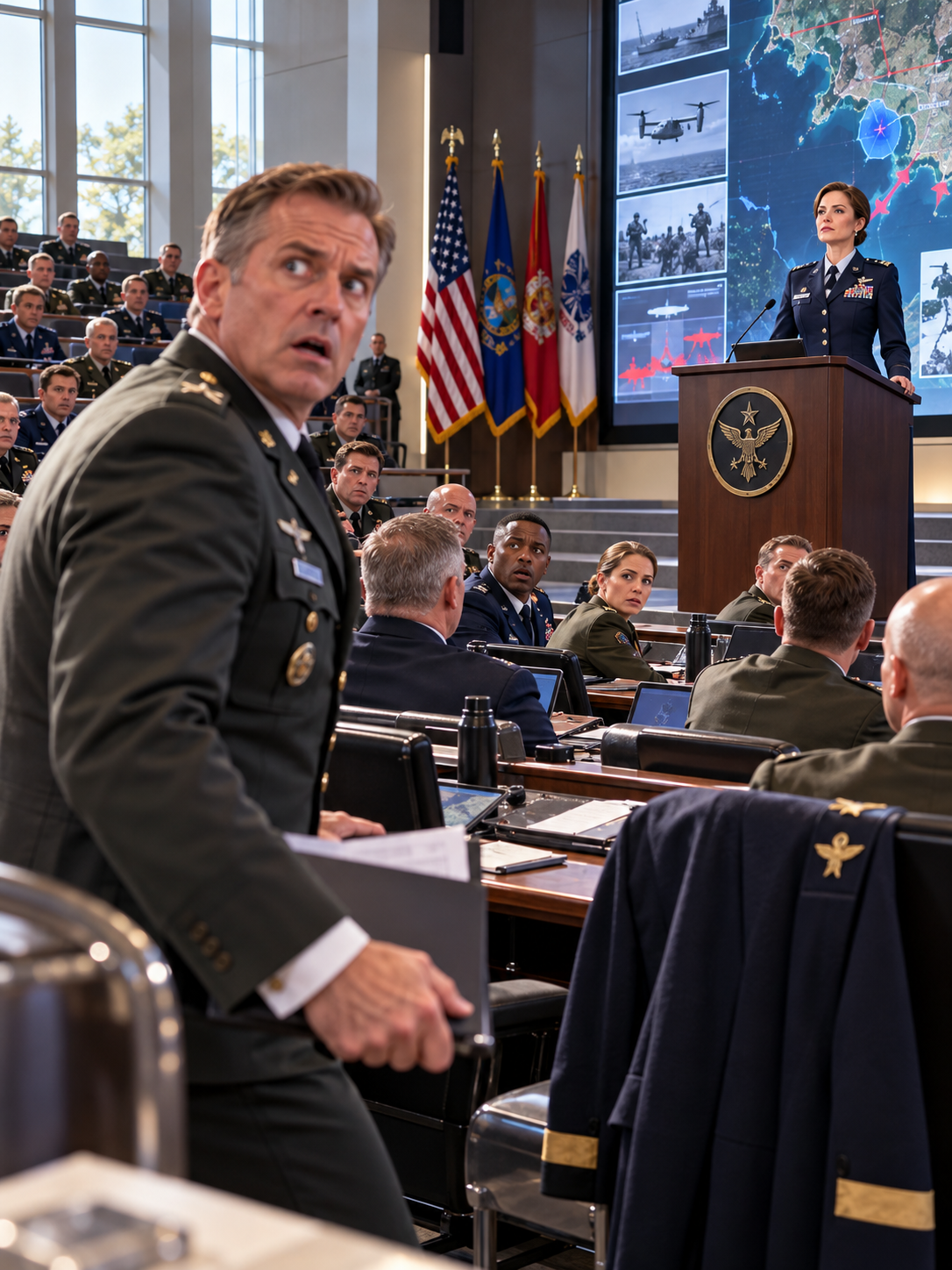
“Attention in the theater. Commander’s decision brief for the joint recovery operation. Briefing officer and Joint Task Force Commander, Colonel Evelyn Mercer.”
The first slide appeared.
There was no dramatic animation, no oversized rank, no flashing reveal designed to humiliate anyone. It was simply the title slide, the operation designation, the command relationship, and underneath it my name exactly where it had been for weeks in the documentation Grant apparently had not studied carefully enough.
Colonel Evelyn Mercer
Commander, Joint Task Force
The room didn’t gasp.
Real military rooms rarely do.
Instead, dozens of tiny movements stopped at once. A pen froze above a notebook, someone halfway through lifting a coffee cup paused, and somewhere behind me I heard the faint shift of a chair as people recalculated what they thought they knew.
I stepped behind the podium and placed both hands beside the binder.
“Good morning, sir,” I said to General Hale.
I did not look at Grant.
Partly because I wanted the moment to stay about the mission, and partly because I wasn’t completely certain my face would behave if I saw his. But I heard the change in the room anyway, that quiet collective rearrangement that happens when a fact appears and everyone realizes their assumptions are suddenly useless.
I began the briefing.
The situation came first, then the mission, commander’s intent, phases, timeline, support relationships, decision points, and the places where several organizations had to move as if they were pieces of the same machine. I kept my language plain because complicated plans become more dangerous when leaders try to make them sound impressive. Every time mattered, every transition mattered, and every assumption had somebody’s life hanging somewhere behind it.
As I spoke, the room settled.
That is the closest thing a briefer gets to applause while the work is still happening: the moment people stop hunting for holes because the answers keep appearing before the questions fully form. General Hale interrupted twice, both times with precise questions, and both times I answered without having to search my notes.
Then we reached aviation.
Grant’s portion.
The second wave had a narrow launch window, and its timing affected everything downstream. His planners had built a solid sequence, but during final review the night before, I had noticed a small coordination risk that required the aviation commander to understand his sequence rather than merely approve it.
I turned slightly toward him. “Colonel Hollis, would you walk the general through your second-wave launch sequence?”
It was an ordinary question.
I made sure it sounded like one.
Grant opened his folder.
For the first time that morning, his confidence did not immediately produce an answer.
He turned one page, then another. “Sir, the second wave launches after the initial package clears the corridor, approximately—”
He stopped.
General Hale leaned forward slightly. “Approximately isn’t the number I’m asking for, Colonel.”
Grant looked down again.
The silence gained weight.
I could feel the room waiting, and what bothered me most was that some people were not waiting for the answer. They were waiting for revenge.
Word about the corridor had apparently traveled.
Headquarters gossip moves faster than classified traffic when humiliation is involved, and I could almost feel officers around the room hoping I would let Grant stand there until his own arrogance crushed him. The opportunity was perfect.
I could have done nothing.
That was all it would have taken.
I knew the exact timing, and he didn’t have it immediately available. General Hale would have kept asking, Grant would have gotten more flustered, and everyone in the room would have understood that the man who told me to stay quiet had failed to prepare for his own section of my brief.
It would have been fair.
That was exactly the problem.
Thirteen years earlier, I had stood in a different room watching senior officers choose pride, speed, and appearance over the uncomfortable thing that actually served the mission. Nathan Cole’s empty seat had taught me that when lives are attached to a decision, emotional satisfaction is an expensive luxury.
“Sir, I can take that,” I said.
General Hale looked at me.
“The second wave launches at 0200, with the first aircraft crossing the release point four minutes later. Colonel Hollis’s planners built sufficient margin into the sequence, and their logic on the spacing is sound.”
I watched something change in Grant’s face.
Not relief exactly.
Shock.
I had just been handed the easiest chance imaginable to destroy him in the same room where he had tried to make me small, and instead I had credited his staff.
I continued. “Colonel Hollis, once they’re beyond the release point, can you walk us through how your crews maintain separation?”
That question I knew he could answer.
His voice came rough on the first word but strengthened almost immediately. “Yes, ma’am.”
Then he stood, found his footing, and became what his record said he was: a good aviation commander.
He explained the sequence clearly, answered Hale’s next question without hesitation, and by the end of his section there was no trace of the man fumbling for a page. Whatever else Grant Hollis was, he knew aircraft and he knew his crews. I had no interest in damaging that competence merely because part of me wanted payment for a corridor conversation.
At the back wall, Daniel Ruiz caught my eye.
He gave me the smallest nod.
Not congratulations.
Recognition.
He had known me through three commands and enough ugly mornings to understand exactly what I had just given up. The room had wanted a spectacle, and I had chosen an operation.
I finished the brief thirty minutes later with one recommendation stated in one clean paragraph. “Sir, I recommend approval of the operation on the timeline presented, with aviation launch authority delegated through the joint task force and no changes to second-wave sequencing without coordination through this headquarters.”
General Hale studied the final slide for several seconds.
“Approved as briefed,” he said.
Nobody moved.
Then he looked around the theater. “Colonel Mercer has the lead. Every supporting command follows her timeline, and I do not want daylight between these headquarters. Not a sliver.”
That was when I finally looked at Grant.
Understanding arrived across his face in pieces.
First, the command relationship.
Then the corridor.
Then, judging by the sudden tightening around his mouth, the memory of his coat.
He had handed his coat to the commander of the operation and told her to find the actual briefer.
Captain Dunn leaned toward him, pale enough that I almost felt sorry for the young man. “Sir,” he whispered, “do you want me to—”
“No,” Grant said quietly.
He didn’t take his eyes off me.
“Stand down.”
And for the first time that morning, he was giving the correct order to the correct person.
### Part 3
When the brief ended, people stood slowly, gathering folders while pretending not to stare at Grant. I packed my binder exactly the way I always did, sliding the notes beneath the tabs and checking that nothing had been left on the podium. The strangest thing about finally being recognized in a room that underestimated you is how ordinary everything still feels afterward.
Major Park approached first. “Ma’am, I’ll have the revised command matrix distributed within twenty minutes.”
“Thank you,” I said.
Her eyes held mine a fraction longer than they had before the brief. She was embarrassed, although she had done nothing wrong, and I wasn’t interested in making her carry embarrassment that belonged to someone else. “Your setup was solid this morning, Major. Keep the same format for the execution update.”
The relief in her face was subtle.
“Yes, ma’am.”
General Hale left with his staff, the aviation majors disappeared with almost suspicious speed, and Captain Dunn lingered near the doorway until Grant gave him a small gesture to go. Daniel remained along the back wall, deliberately busy with his phone in the universal language of senior enlisted advisers pretending not to witness something their commander should handle alone.
Grant waited until the theater was nearly empty.
Then he walked toward me.
Without the room around him, he seemed different, though I couldn’t decide whether he had actually changed or had simply stopped performing the version of himself the room usually rewarded. He stopped a few feet away and stood almost at attention.
“Colonel Mercer.”
“Colonel Hollis.”
He inhaled slowly. “This morning, in the corridor, what I said—”
He stopped.
I knew what came next because I had heard variations of it my entire career. I didn’t realize who you were. You have to understand how it looked. We were all under pressure. The apology would arrive wrapped in enough explanation that he could keep a small piece of innocence for himself.
“You mistook me,” I said.
His mouth closed.
“It happens more often than you’d think.”
Grant looked at me, unsure whether I was mocking him.
I wasn’t.
“And sometimes,” I continued, “being underestimated tells me useful things. What I need from you isn’t an apology.”
He frowned slightly.
“I need your task force ready on the timeline I briefed. I need your crews drilled on the second wave until nobody reaches for a folder when somebody asks what happens at 0200. Can you give me that?”
The shame in his face changed shape.
It became something more useful.
“Yes, ma’am,” he said. “I can.”
“Then we’re square.”
He stared at me for a second, as if punishment would have been easier to understand.
Maybe it would have.
Punishment creates a clean relationship: one person owes, one person collects, and eventually both sides can complain about the terms. Being handed responsibility after you have embarrassed yourself forces you to decide what kind of person you are going to be next.
Grant nodded once.
“Understood.”
Before I could leave, Captain Dunn caught me in the corridor.
He was twenty-eight at most, young enough that his face still betrayed everything he was trying not to show. “Ma’am, may I say something?”
“Go ahead.”
“I should have said something earlier.”
I knew immediately what he meant.
“In the corridor,” he said. “I knew the way he was speaking to you wasn’t right. I saw your rank before he finished, and I still didn’t say anything.”
“You are a captain,” I replied. “He is a colonel. I don’t expect you to start correcting senior officers in hallways.”
“But I could’ve—”
“You could have made the scene worse and probably accomplished nothing.”
His jaw tightened because young officers often mistake guilt for responsibility. I had done the same at his age.
“Captain, don’t spend this morning wishing you’d been more dramatic. Spend it remembering exactly how uncomfortable silence felt. Twenty years from now, if you’re wearing eagles and some young officer beside you suddenly goes quiet because of your temper, remember today before you open your mouth.”
He looked down once, then back at me.
“Yes, ma’am.”
That answer mattered more to me than an apology from Grant.
Daniel caught up with me near a window overlooking the flight line. Outside, rows of aircraft sat under pale morning sunlight, motionless now, though soon they would be carrying people into a place where nothing about our personalities mattered.
For several minutes, Daniel and I said nothing.
He knew my rhythms well enough not to fill silence merely because silence existed.
Finally he said, “Nathan would’ve liked that.”
I kept looking through the glass.
Daniel folded his arms. “The part where you didn’t end Hollis in front of everybody. Nathan would’ve called you soft first, just to annoy you.”
A laugh tried to reach me and failed somewhere in my chest.
“He would’ve been very proud of himself too,” Daniel added.
“Naturally.”
That was all I could manage.
Nathan Cole had been gone thirteen years, but grief has no respect for calendars. Some days thirteen years is a lifetime; other days you hear a dead man’s name in a hallway and suddenly an empty aircraft seat is close enough to touch.
“I would’ve traded the entire morning,” I said quietly.
Daniel didn’t ask what I meant.
He already knew.
The briefing, the general’s approval, Grant’s stunned face, the satisfaction of being right without having to announce it—I would have traded every second to fill one empty seat thirteen years earlier. That trade wasn’t available, so I did the only thing left to me.
The next thing.
And I tried to do it well.
Over the following days, preparations accelerated.
Grant surprised me.
He did not overcompensate with flattery, which would have irritated me, and he didn’t become defensive, which I had half expected. Instead, his updates became shorter, cleaner, and better.
“Second-wave crews completed rehearsal. No timing deviations.”
“Maintenance status green.”
“Weather risk unchanged.”
No explanations about himself.
No effort to remind me he was experienced.
He simply gave me what I needed.
Three days before execution, we held a synchronization meeting at 0500. Grant arrived before I did.
When I entered, he was standing beside the aviation timeline with his sleeves rolled and his planners around him. He looked over, gave me a professional nod, and said, “Ma’am, we found twelve seconds we didn’t like between two handoffs, so we rebuilt that portion.”
Twelve seconds.
I looked at the revised sequence.
It was better.
“Good catch.”
Grant nodded.
That was the whole exchange, but as I walked toward my seat, Daniel leaned close enough for only me to hear.
“Careful, ma’am.”
“What?”
“I think you’re creating another person who checks things twice.”
I almost smiled.
“Terrible habit.”
“Absolutely destructive.”
For the first time since the briefing, something inside me loosened.
Then an operations officer entered with an updated report, laid it in front of me, and pointed to one line.
The room changed immediately.
Our timeline was suddenly under pressure.
Someone higher wanted the operation moved six hours earlier.
Thirteen years disappeared in a heartbeat.
And once again, somebody was about to tell me there was no time.
### Part 4
The request came from outside our task force and arrived dressed in polite language. “Accelerated execution recommended,” the message said, followed by several paragraphs explaining why moving early might improve conditions. But when you have spent enough years in headquarters, you learn that recommended sometimes means somebody has already emotionally committed to an answer and is waiting for you to make it official.
I read the message twice.
Then I looked at Grant. “Can aviation safely move six hours?”
Every eye in the room shifted toward him.
The old Grant Hollis, the man I had met in the corridor, might have answered quickly just to prove he could. This Grant looked down at the timeline, turned one page, and stayed silent long enough to make everyone slightly uncomfortable.
Finally he said, “Not with the confidence I have right now.”
I felt Nathan Cole’s memory settle beside me.
“Explain.”
“We can physically launch,” Grant said. “That isn’t the same thing as saying we’re ready. Maintenance loses one recovery window, crews lose rest, and the second-wave sequence becomes compressed. Give me three hours and I can tell you whether six hours early is a real option instead of an optimistic one.”
Nobody spoke.
I nodded.
“You have three hours.”
A staff officer cleared his throat. “Ma’am, higher headquarters may want an answer sooner.”
“Then higher headquarters can hear that the answer is we’re checking.”
The room remained very still.
Thirteen years earlier, I had been a major asking for time I did not have the authority to protect. Now I was the colonel holding the clock.
That, more than any promotion ceremony, was the moment I understood why I had stayed.
Three hours later, Grant returned with his answer.
“No, ma’am.”
There was no hesitation.
“We can launch early, but risk climbs for no operational gain I can defend.”
“Recommendation?”
“Keep the original timeline.”
I looked around the room. “Anyone have evidence that changes that?”
Nobody did.
“Then the timeline holds.”
The pressure came back twice over the next several hours, and twice I gave the same answer. Not stubbornly, not emotionally, and not because I wanted to prove some point about my past. I simply had something now that Major Evelyn Mercer had not possessed thirteen years earlier: enough authority to force impatience to defend itself with facts.
The operation launched on schedule.
At 1:20 in the morning, I sat inside the operations center beneath cold white lights while monitors washed everyone’s faces in shades of blue and gray. Coffee had gone stale hours earlier, chairs squeaked, keyboards clicked, and the room carried that particular tension of people who had already done everything they could and now had to watch other people execute it.
Waiting is the part of command nobody prepares you for.
Planning gives you tasks.
Execution eventually gives you decisions.
But there are stretches in between when the people you sent are moving through darkness and your hands have nothing useful left to do.
At 0200 exactly, Grant’s voice came across the net.
“Second wave launching.”
I looked automatically at the clock.
On time.
His reports continued, calm and precise. Position, timing, status, no extra commentary.
I listened to the man who had once failed to remember his own second-wave timing carry an actual second wave through a hard night without missing a beat.
Daniel stood several feet behind me.
At one point, our eyes met.
Neither of us said Nathan’s name.
We didn’t need to.
Hours later, the first confirmation came that the people we had gone to recover were moving toward safety. Nobody celebrated because too much still had to happen, but shoulders lowered slightly around the room and someone finally remembered the untouched tray of sandwiches sitting near the back wall.
Grant remained on the net.
No dramatics.
No speeches.
No attempt to be the hero of the radio.
Just work.
When the final aircraft returned and the last person we had gone for was confirmed safe, I sat still for several seconds longer than necessary. The room around me began to breathe again, people speaking louder now, chairs rolling back, somebody quietly laughing from pure exhaustion.
Daniel came beside me.
“Ma’am?”
“I’m fine.”
“I didn’t ask.”
I looked at him.
He lifted one eyebrow.
That was Daniel’s way of telling me I was becoming annoying.
I stood. “Everyone accounted for?”
“Everyone we’re supposed to have.”
The words hit harder than they should have.
Everyone we’re supposed to have.
Thirteen years earlier, that sentence had not been true.
I stepped into the corridor before anyone could see my face change.
The hallway was empty and brutally bright after the dim operations floor. I pressed my hands against the cool edge of a windowsill and stared into darkness beyond the glass.
A minute later, the door opened.
I expected Daniel.
Instead, Grant stepped out.
For a moment, neither of us spoke.
“All aircraft recovered,” he said.
“I heard.”
“One maintenance issue on return. Nothing major.”
“Good.”
Grant looked back through the glass door toward the operations center. “My crews did well.”
“They did.”
He nodded.
Then he said, “Nine days ago, you could’ve buried me in that briefing room.”
I didn’t answer.
“You knew the number I didn’t,” he continued. “You knew exactly what I had said to you. Everybody wanted you to let me fall, and you didn’t.”
“This isn’t about that night.”
“I know.”
He looked tired now, stripped of the polish he had worn the morning we met.
“I think that’s why I’m saying it tonight.”
I waited.
Grant rubbed one hand over his face. “I spent years thinking confidence meant knowing what to say fast. Turns out half the job is knowing when to shut up long enough to check.”
“That’s an expensive lesson.”
“Could’ve been more expensive.”
His eyes met mine.
We both knew what he meant.
Tonight, it hadn’t been.
Tonight everyone had come home.
“I’m glad you were there,” I said.
He seemed surprised.
“So am I.”
That was as close as either of us came to discussing the corridor.
We didn’t need closure delivered in a speech.
We had aircraft on the ground and people alive who had not been safe several hours earlier. Compared with that, my pride felt almost embarrassingly small.
Before Grant returned inside, he paused.
“For what it’s worth, Colonel, I’d fly your timeline again.”
I looked at him.
“Any day,” he added.
This time I let myself accept the compliment without checking whether there was some hidden cost attached.
“It’s worth something,” I said.
Grant nodded once and walked back through the door.
I remained beside the window.
Somewhere inside the operations center, someone finally opened the sandwich tray.
And for one strange second, with exhaustion pressing against every bone in my body, I could almost hear Nathan Cole laughing about my checklists again.
### Part 5
The joint task force began winding down several days later. Officers returned to their original commands, temporary workstations disappeared, classified boards were erased, and rooms that had held twenty-four-hour operations slowly became ordinary conference rooms again. I have always found that part unsettling, how quickly a place forgets the intensity of what happened inside it.
Grant stopped by my office on his final afternoon.
He didn’t stand at attention this time.
He leaned lightly against the doorway and said, “You heading out tomorrow?”
“At five.”
“Of course you are.”
I looked up from my binder. “What’s that supposed to mean?”
“It means normal people leave at normal hours.”
“I’ve heard rumors about those people.”
Grant smiled, and it was the first uncomplicated expression I had seen from him since the morning we met.
“For what it’s worth,” he said, “I meant what I told you after the mission.”
“I know.”
“If you’re building the timeline, I’d fly it again.”
“And I meant my answer.”
He nodded.
No handshake stretched into symbolism.
No dramatic apology.
No sudden friendship.
Grant Hollis was not my friend, and I didn’t need him to become one.
What we had was more useful for the work: trust earned after failure.
Before leaving, he looked at the battered binder on my desk. “Do you actually check everything twice?”
“Usually.”
“Everything?”
“Important things.”
He shook his head. “That sounds exhausting.”
“It is.”
Then he glanced toward the binder again.
“But it works.”
“Sometimes.”
That was the only honest answer.
After he left, Daniel appeared five minutes later carrying two coffees and an expression that suggested he had been waiting to make a comment. “So, are we adopting him?”
“No.”
“Mentoring him?”
“No.”
“Putting his picture in the family Christmas card?”
I stared at him.
Daniel handed me a coffee. “You used to have a sense of humor.”
“I delegated it.”
“To the wrong person, apparently.”
We packed the final materials in comfortable silence.
Near sunset, we walked past the briefing theater where everything had started. The doors were open, and a new group of officers was setting up for something entirely unrelated.
I stopped in the doorway.
Same rows of chairs.
Same podium.
Same projector.
The wall clock had been fixed.
Daniel noticed me looking.
“You actually reported that clock?”
“It was forty-three seconds off.”
“Terrifying.”
“You’re welcome.”
He laughed, then walked ahead while I remained there another moment.
Rooms forget.
People don’t.
I remembered Grant handing me his coat as casually as if I were a hanger.
I remembered him warning me, “Don’t act out of line.”
I remembered the first slide appearing and the exact sound of his hand going still against the table.
Years ago, a younger version of me might have believed that was the victory.
She would have imagined the satisfying story ending right there, with the arrogant man humiliated and the underestimated woman revealed as the most important person in the room. People love that kind of ending because it balances the emotional ledger neatly.
But the older I get, the less interested I am in neat emotional ledgers.
Grant’s humiliation did not bring Nathan home.
My rank did not bring Nathan home.
The successful operation did not erase the one that had gone wrong thirteen years earlier.
Nothing fills an empty seat retroactively.
That truth hurt for a long time because I thought healing meant eventually discovering something large enough to replace what had been lost. I don’t believe that anymore.
Some losses stay empty.
You simply learn not to build your entire life around the empty space.
Nathan’s death taught me to check.
It taught me to protect time.
It taught me never to confuse urgency with courage.
And on that morning with Grant, it taught me one more thing I probably should have understood sooner: being underestimated does not give you permission to become cruel when the room finally realizes its mistake.
I could have crushed him.
That sentence is true.
I had the rank, witnesses, facts, and perfect opportunity.
Another sentence is also true.
Crushing him would have made the operation weaker.
A humiliated commander spends energy defending himself.
A respected commander can spend that same energy protecting his people.
I needed Grant useful more than I needed him ashamed.
That choice did not make what he said acceptable.
Mercy is not pretending disrespect never happened, and professionalism is not allowing people to mistreat you indefinitely. If Grant had repeated the behavior, undermined the mission, or treated junior personnel the same way after being shown exactly what he was doing, I would have handled it differently and without hesitation.
But people are more complicated than their worst fifteen minutes.
Grant made an assumption.
Then he was confronted by the full size of that assumption.
What mattered to me afterward was what he did next.
He crossed the empty theater instead of escaping it.
He came to me without being summoned.
He prepared harder.
He told me when the accelerated timeline was unsafe even though saying no carried professional risk.
And when people were depending on him, he delivered.
That is not forgiveness in the sentimental sense.
I never forgot the corridor.
I simply stopped needing the corridor to hurt him.
There is a difference.
Daniel and I left headquarters before sunrise the following morning. My binder sat between us, its corners worn soft from years of hands, coffee stains, airplanes, tents, offices, and briefing rooms.
After several miles, Daniel looked out the windshield and said, “You know what Nathan would’ve said about this whole thing?”
“I am absolutely certain you’re going to tell me.”
“He’d say you turned one bad colonel into another checklist addict.”
“That does sound like him.”
“He’d also say you made the story too serious.”
I smiled despite myself.
The highway ahead was nearly empty.
Morning light was beginning to spread across the horizon, clean and white over fields and buildings that knew nothing about us. Somewhere behind us, Grant’s aviation task force was returning to its normal chain of command, General Hale had already moved on to the next crisis, and the theater where my name had stunned a room was probably being used by somebody else.
That is the truth about almost every important moment in a career.
The room moves on.
The work moves on.
You have to decide what you carry.
I carried Nathan’s name.
I carried Daniel’s friendship.
I carried a binder full of things I checked twice.
I did not carry Grant’s coat.
And I did not carry the insult either.
If somebody ever tells you to “stay in your lane” because they have decided, without looking closely, that you are smaller than you are, remember this: you do not owe them your smallness. But when the truth eventually enters the room—and if your work is real, eventually it will—you do not owe them your cruelty either.
Do the work until the room has no choice but to understand who you are.
Then resist the temptation to collect humiliation as payment.
Not because the person who underestimated you deserves protection from consequences.
Because your dignity does not grow by shrinking somebody else’s.
That morning, Grant Hollis learned who I was when my name appeared on a slide.
I learned something about myself when I reached the slide that could have destroyed him and chose instead to keep him standing.
Nine days later, his crews brought our people home.
That was the part that mattered.
That was the only part that ever really mattered.
And when Daniel and I drove toward the next command, the next cold room, the next wall clock that would probably be wrong, I rested one hand on the old binder beside me and understood something that had taken thirteen years to become simple.
I could not go back and fill Nathan Cole’s empty seat.
But every time I slowed a rushed plan, checked a number again, protected somebody’s dignity, or kept a capable person useful instead of satisfying my anger, I was doing the next closest thing the world allowed.
I was making sure there were fewer empty seats waiting on the next flight home.
THE END!
Disclaimer: Our stories are inspired by real-life events but are carefully rewritten for entertainment. Any resemblance to actual people or situations is purely coincidental.