I’m Erin Caldwell, 41, and for most of my life my mother introduced me as the daughter who “wanted to be a flight attendant and aimed a little too high.” I let the joke survive through flight school, deployments, medals, and years of serving as a Navy fighter pilot because correcting her always seemed more exhausting than staying quiet. Then, during one ordinary Sunday gathering, her closest friend suddenly recognized my face—and realized my “little flying job” had once determined whether her own son came home alive.
### Part 1
The first fighter jet I ever saw came screaming over an airfield when I was eight years old, and I felt the sound in my ribs before my ears understood what it was. My father, Thomas Caldwell, had lifted me onto his shoulders so I could see over the crowd, and while almost everyone around us covered their ears, I grabbed fistfuls of his hair and laughed so hard my stomach hurt. The aircraft banked against a bright summer sky, sunlight flashing across its wings, and something inside me locked onto it with the certainty children sometimes have before adults teach them to doubt themselves. On the drive home, Dad kept looking at me in the rearview mirror until he finally said, “Some people spend their whole lives searching for the thing that makes them feel the way you looked today. You found yours at eight. Don’t lose it.”
My mother, Judith, turned from the passenger seat with the patient smile she used when she believed reality would eventually correct me for her. “It’s a phase,” she said. “Girls have horse phases, music phases, airplane phases. Erin will grow into something sensible.” Dad didn’t argue then, but that winter he brought home a wooden model airplane kit, and we spent three nights building it at the kitchen table while Mom worried aloud about glue getting on her good placemats. By twelve, I had nine aircraft hanging from fishing line above my bed, turning slowly whenever the heat came on, and I could identify silhouettes faster than most kids could identify professional athletes.
Judith wasn’t a cruel woman, which somehow made everything harder to explain. She delivered casseroles when neighbors were sick, remembered birthdays, volunteered at church drives, and could make a stranger feel welcome within five minutes of entering our house. But she had built an imaginary daughter long before I became old enough to contradict her, and instead of becoming angry when the real Erin refused to match that picture, she simply kept describing the imaginary one. My older brother Grant made things easy for her—excellent grades, business school, a respectable financial career, a polished wife, a house Mom could describe without needing extra context—while anything about me required explanations she never wanted to learn.
When neighbors asked what I was doing in high school, she would smile and say, “Still obsessed with airplanes,” as if discussing a childhood blanket I had refused to surrender. Dad would occasionally put down his fork and say, “She isn’t obsessed, Judith. She knows what she wants.” Mom would laugh, refill someone’s coffee, and move the conversation toward Grant’s internships or promotions. Somewhere during those years, I made a decision that would quietly govern most of my adult life: correcting her cost more than tolerating her, so I stopped spending the energy.
When I left for the Naval Academy, Dad drove me to the airport. Mom hugged me on the porch that morning and told me to call when I landed and not let anyone cut my hair too short, which was almost funny considering that three years earlier she had thrown Grant a backyard celebration complete with catered food and a cake decorated in his school colors. In the airport garage, Dad gripped my shoulders and said, “You don’t have to make your mother proud. That’s her responsibility, not yours. You go become who you already know you are.” I carried those words through every brutal morning when my body wanted to quit before my mind did.
Years later, when I earned my wings, Mom actually attended the ceremony, and I was grateful enough for that to ignore everything else. She wore a cream blouse and stood in the hot sun while I tried not to tremble as she pinned the wings above my pocket, but instead of saying she was proud of me, she whispered, “Careful, sweetheart, don’t snag my blouse.” Afterward, when another family asked what I would be flying, she waved one hand and said, “Oh, airplanes, you know,” then pivoted immediately to Grant’s newest promotion. Dad found me later near the refreshments, squeezed my shoulder, and asked the question she never did: “How does it feel?”
There is a photograph from that ceremony that explains my family better than anything I could say. I am twenty-four, standing in uniform with new gold wings catching the sunlight, grinning so hard my cheeks hurt; Dad is beside me, slightly blurry because he stepped into the frame late, staring directly at those wings as though they are the most extraordinary objects on earth. Mom is on my other side, smoothing the blouse she thought I had nearly damaged and looking straight into the camera. Two parents, one daughter, two completely different realities.
By the time I entered my first fleet squadron, I had learned how to give Mom headlines instead of stories. “I’ll be away awhile” replaced “deployment.” “Work was busy” replaced things I had no interest in explaining to someone who would nod politely and ask Grant about his kitchen renovation ten seconds later. I built another family in the Navy—pilots, maintainers, chiefs, young officers, people who understood why your hands shook after certain flights without asking you to translate yourself into language comfortable enough for dinner.
Dad remained the bridge between those worlds. Whenever Mom reduced my life to “Erin flies,” Dad would find me afterward washing dishes and quietly ask, “Where were you this time?” or “Was it difficult?” or simply, “You doing okay?” He made room for the full answer, and because he did, I could tolerate everyone else accepting the shortened one. Then, in the spring of 2021, he died, and the only person in my family who had ever insisted on knowing the complete version of me disappeared.
Within a year, I noticed the difference. Grant became the centerpiece of every gathering, while I became a decorative footnote. “My son is a partner at his firm,” Mom would say proudly, and if someone glanced at me she would add, “Erin flies,” in the same tone another parent might say their daughter enjoyed gardening. Then, at a backyard gathering, she found the joke that would follow me for years.
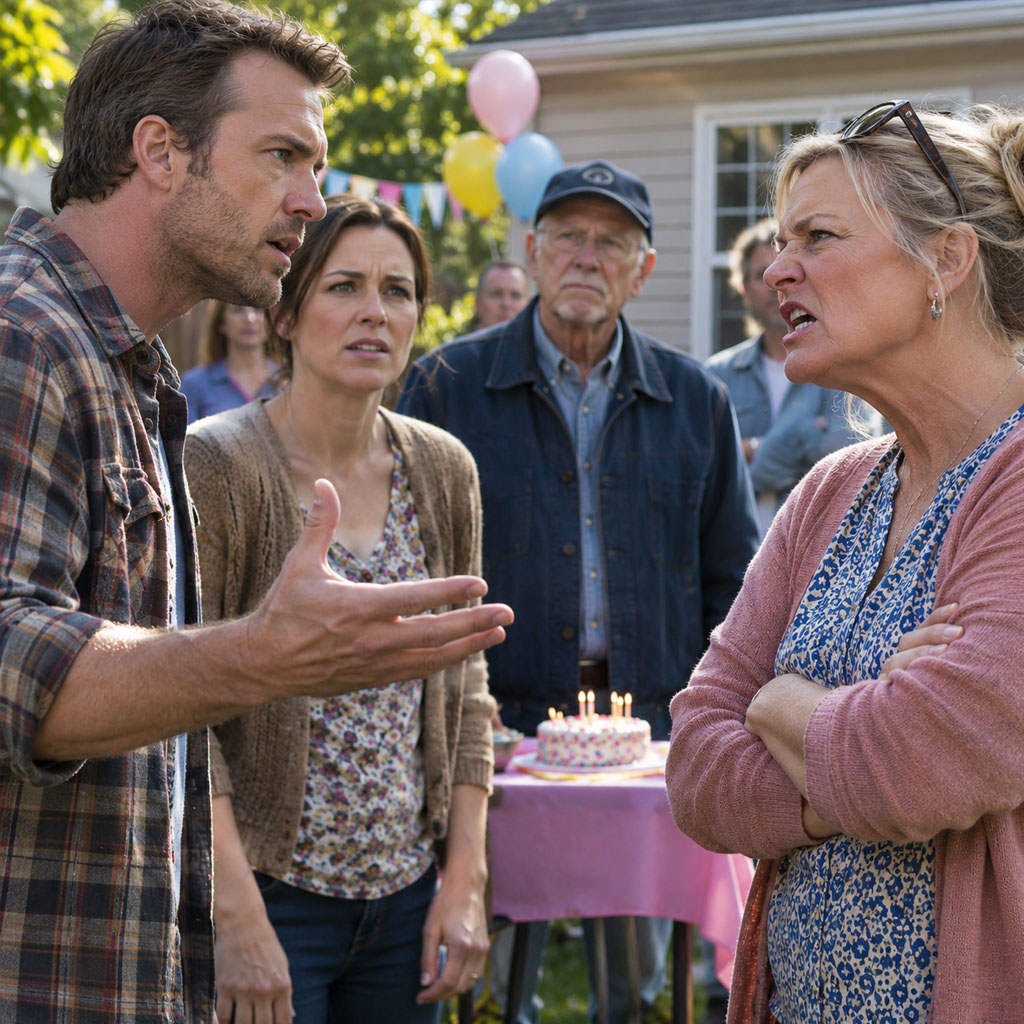
A cousin asked what I did, and Mom laughed. “Erin wanted to be a flight attendant when she was younger, but she aimed a little high and ended up in the cockpit instead.”
Everyone laughed.
Mom turned toward me, delighted with herself. “Isn’t that right, sweetheart?”
I smiled because that was easier. “Not exactly.”
Nobody heard me because they were still laughing.
I told myself it didn’t matter. I had flown missions my mother would never understand, earned decorations I kept in a drawer, led people who trusted me with their lives, and built a career that did not become less real because a woman holding potato salad misunderstood it. But the joke spread through her circle because people repeat whatever gets a laugh, and soon women who had known me since childhood were repeating the line back to me.
By forty-one, I had become very skilled at carrying insults so gently they barely felt like weight.
Then I came home on eleven days of leave, repaired a broken lamp for my mother, and carried it onto her sunroom terrace one Sunday afternoon.
I thought I was delivering a lamp.
I had no idea I was walking into the room where twenty-five years of silence were finally going to stop protecting everyone except me.
### Part 2
Mom’s book club met on the second Sunday of every month, ten women surrounded by wicker furniture, sweating glasses of iced coffee, paperbacks with bent corners, and enough cookies to feed a small wedding. I hadn’t planned to stay, but once I put the repaired lamp on a side table, Mom insisted I sit down because having me there gave her another conversational prop. The autumn sunlight was bright and clean through the terrace windows, chrysanthemums crowded the railing, and I knew nearly every woman by face even though most of them knew me only through stories my mother had selected for them.
That month’s novel involved a middle-aged woman abandoning a dull life and reinventing herself, which naturally gave my mother the perfect opening. “Speaking of women reinventing themselves,” she said, lifting her glass toward me, “you all remember Erin.” A few women smiled before the punchline even arrived because they had heard it before. Mom laughed and announced, “Calm down, she’s just a pilot. She wanted to be a flight attendant and aimed a little too high.”
The laughter was warm, almost affectionate, which made it worse. Cruelty is easier to fight when it arrives looking cruel; this came disguised as family humor, surrounded by good cookies and people who would have been horrified to learn they were hurting me. I set down my glass carefully and said, “That’s not really what happened, Mom.” Same quiet correction, same familiar surrender.
Then I noticed Helen Mercer.
Helen had been my mother’s closest friend for nearly twenty years, a soft-spoken woman with reading glasses hanging from a silver chain and a habit of bringing pecan cookies everybody stole before lunch. Half a second earlier she had been smiling, but now the color seemed to drain straight out of her face. Her coffee stopped halfway to her mouth, her eyes locked on mine, and when she lowered the cup, it landed crooked against the saucer with a sharp little click.
“Helen?” Mom asked.
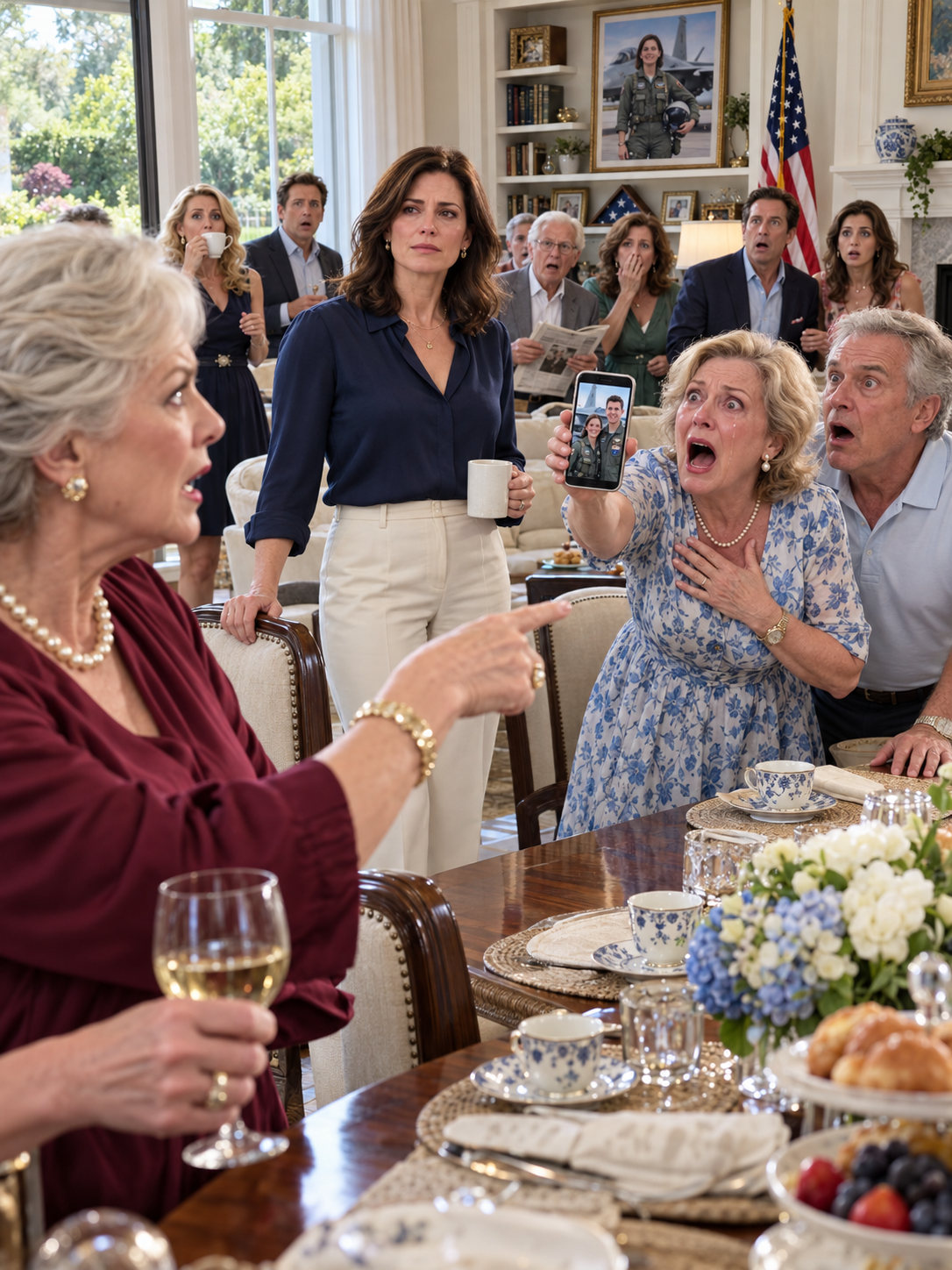
Helen reached across the table, grabbed my mother just above the wrist, and pulled her arm toward her as if stopping her from stepping into traffic. “Judith,” she said, voice barely above a whisper. “She’s on the news.”
Mom laughed automatically. “Oh, don’t be dramatic. Everyone ends up online somewhere.”
“No.” Helen didn’t release her. “Judith, I mean I saw her. Two nights ago.”
Something changed in the room. One woman lowered her book; another stopped stirring her coffee, and for the first time in years, my mother’s joke existed in a silence she had not chosen. Helen kept staring at me with wet eyes and the stunned expression of someone recognizing a person from a photograph taken somewhere that should have had nothing to do with her ordinary life.
I knew before I reached my car what Helen had seen.
Two weeks earlier, a national television program had aired a feature about naval aviation. I had participated in a brief interview because the Navy had cleared footage from an operation I had flown years earlier, and I assumed the segment would disappear into the endless stream of late-night military documentaries. I certainly never imagined my mother’s book club would see it.
In 2015, I had been thirty, a lieutenant flying a strike fighter as a section lead. During one mission, Marines on the ground became trapped under hostile fire while evacuation aircraft tried to reach them, and my section remained overhead longer than our fuel calculations made comfortable. There is no cinematic version of what happened that feels truthful to me; there were radio calls, instruments, numbers, breathing, decisions, and the particular mental narrowing that training creates when fear becomes useless.
I stayed longer than planned.
The Marines got out.
I made it back.
Later, I received the Distinguished Flying Cross and additional recognition for actions during that deployment. I had stood through ceremonies, smiled for photographs, and placed the medals away afterward because my father had been proud enough for both of us and because trying to explain them to my mother had always felt ridiculous. If I mentioned anything significant, she treated it as though I were fishing for praise, so eventually I stopped presenting her with opportunities to misunderstand me.
That evening, while I sat at my kitchen table thinking about Helen’s face, Helen was at her own house replaying the television segment.
I know because she told me later.
Her son, Caleb Mercer, had been a twenty-year-old Marine corporal in 2015. Helen had spent that deployment sleeping badly, keeping her phone beside her pillow, learning how quickly a mother can manufacture disaster from an unexpected knock or unfamiliar number. Caleb had written home after one especially difficult operation, and although he had never known the pilot’s identity, he described an aircraft that remained overhead when everyone below believed it should already have turned back.
Helen still had the letter.
She found it in a shoebox in her hallway closet and unfolded paper that had softened along the creases after eleven years. Caleb had written that his unit had been pinned down and that they could hear the aircraft working above them even when they could not see it; he said everyone knew the pilot was giving up something—time, fuel, margin—to keep them alive long enough for evacuation.
At the bottom, Caleb had written one sentence Helen never forgot.
We owe that pilot everything, and we’ll probably never know her name.
Now Helen knew the name.
Erin Caldwell.
The daughter her closest friend had spent years calling “just a pilot.”
That night I called Captain Nadia Pierce, one of my former commanding officers and the rare person who could listen to a complicated problem without rushing to make it simple. I told her about the terrace, my mother’s joke, Helen turning gray, and those four words.
“She’s on the news.”
Nadia listened until I finished, then said, “You’ve spent half your life letting people be wrong about you because you decided correcting them was too expensive.”
“That sounds about right.”
“It wasn’t cheaper, Erin. You just deferred the bill.”
I stared at the repaired-tools drawer across my kitchen.
She continued, “You keep calling silence peace. It isn’t always peace. Sometimes silence is just an empty runway with every light switched off because you’re afraid somebody might complain about the brightness.”
That image hit me harder than anything angry would have.
“You don’t need to light up the entire coast,” Nadia said. “Just stop turning your lights off every time someone might see you.”
After we hung up, I sat alone listening to the refrigerator hum and decided I was finished making myself invisible for other people’s comfort. I wasn’t going to confront my mother with medals or demand an apology; dramatic scenes had never changed her. I would do something much smaller.
I would stop helping her be wrong.
Three days later, Helen called.
“I want to show Judith something,” she said. “But I want you there, even if it’s only by phone.”
I looked out my window for a long time before answering.
Then I said, “Okay.”
And for the first time in twenty-five years, I knew my mother was about to hear the full version of my life in a room where I wasn’t going to rescue her from it.
### Part 3
The next gathering at Mom’s house was smaller, six women around her dining table instead of ten on the terrace. I was back near my squadron and joined by speakerphone, which somehow made the whole thing easier because I couldn’t see my mother’s face and instinctively soften whatever truth reached it. Helen had placed her tablet beside a plate of cookies, and after the usual coffee and polite conversation, she cleared her throat.
“Erin, can I ask you where you were during the spring of 2015?”
I answered exactly the way I would during a debrief. “I was a lieutenant assigned to a Navy strike-fighter squadron.”
“And there was an operation involving Marines?”
“Yes.”
“Would you explain what happened?”
I could hear my mother shifting in her chair before I began. “A group on the ground was having trouble getting clear. We remained overhead until evacuation support reached them. I stayed longer than I would have during training because the situation required it, then returned to the carrier.”
That was it.
No dramatic language. No heroic version.
Helen said, “Thank you.”
Then she played the television segment.
Even through the phone speaker, I recognized the compressed cockpit audio immediately—the clipped radio transmissions, electronic tones, controlled breathing, younger voices sounding calm because sounding calm is part of the job. Then came the narrator explaining the operation, identifying me, and mentioning the decoration I later received. Finally my own younger voice filled my mother’s dining room, saying anyone in the squadron would have done what I did.
Nobody moved.
I could hear that silence through a phone.
A spoon touched porcelain. Someone whispered, “Oh my God.”
Another woman said simply, “Erin?”
My mother finally spoke. “There must be some misunderstanding. Erin flies people around. She…”
Her sentence collapsed halfway out.
Helen let the video end before saying anything. Then she took a breath.
“My Caleb was down there.”
Whatever air remained in that room disappeared.
“He was one of the Marines,” Helen continued. “He came home, Judith. Eleven years ago he wrote me that somebody stayed overhead when they should have left, and that staying gave them enough time to get out. He didn’t know who the pilot was. None of them did.”
Mom didn’t speak.
Helen’s voice cracked now, but she kept going. “I have carried a thank-you around for eleven years without knowing where to put it. Your daughter is where it belongs.”
One of the women asked me, gently, “Why didn’t you ever tell anyone?”
The answer came before I could clean it up.
“Because telling it never changed how I was heard.”
Nobody interrupted.
“I corrected things for years,” I said. “Quietly, because I didn’t want arguments. People laughed anyway, so eventually I stopped correcting them. I told myself that was humility or keeping the peace, but really I think I gave up on being understood.”
Saying those words felt stranger than hearing the military citation. I had spent years accepting my mother’s small version of me as the social price of loving her, and only while explaining it to six women sitting around her table did I understand that I had trained everyone else to accept the same version.
Mom remained silent.
And for once, I did not fill that silence.
The following weeks changed her social world in ways I did not engineer. Nobody shunned her, because these weren’t cruel people, but friends began asking questions she had never prepared answers for. “How did you never mention Erin’s decoration?” one woman asked over coffee. Another apparently said, “Judith, why did we all believe she flew charter planes?”
Mom had no comfortable explanation because the truthful answer was embarrassingly simple.
She had preferred the smaller story.
Grant called me a few days later. “This whole thing is getting blown out of proportion.”
“Which thing?”
“Mom’s joke. Everybody knew you were in the Navy.”
“You knew the label,” I said. “You didn’t know me.”
“Oh, come on, Erin.”
“No, you come on. For twenty years, Mom could describe you in detail and describe me in one joke. You never corrected her because that arrangement worked great for you.”
Grant went quiet.
I expected defensiveness, but instead he surprised me.
“Yeah,” he said. “I guess it did.”
It was possibly the most honest thing my brother had ever said about us.
He had not deliberately hurt me. Grant had simply grown up inside a system where being the understandable child earned applause, while being the complicated one earned edits, and he never had a reason to question an arrangement that always favored him. Realizing that did not make me forgive the years he benefited from it, but it stopped me from wasting energy turning him into a villain more convenient than the truth.
Mom called three weeks after Helen’s presentation.
“People keep asking me questions,” she began. “I don’t know what I’m supposed to say. Maybe you could give me a few sentences.”
There it was.
She wanted a script.
The old Erin would have written one—accurate but modest, easy to repeat, designed to restore her mother’s comfort without forcing her to confront how she had created the problem. I nearly did it automatically.
Instead I said, “No.”
“What?”
“I’m not writing you a script.”
“I’m trying to get this right.”
“Then tell the truth.”
“What truth do you want me to tell?”
“That your daughter is a Navy pilot. That I’ve flown fighter aircraft. That I’ve served overseas. If you don’t understand the details, say you don’t understand them. But stop inventing a smaller version because it’s easier to explain.”
Her voice sharpened. “You’re enjoying this.”
“No, Mom. I spent twenty-five years not enjoying the opposite. The difference is I’m not fixing your discomfort anymore.”
She hung up soon afterward.
A week passed.
Then one rainy evening, someone knocked on my door.
When I opened it, my mother stood there in a damp coat, holding her purse with both hands. She had driven the entire distance herself, something she almost never did when I was the destination.
“Can I come in?” she asked.
I stepped aside.
She sat in my living room without removing her coat. For almost a minute, she stared at her hands.
Then she said, “I think I made you small because I didn’t know how to understand you.”
I felt my entire body become still.
“Grant was easy,” she continued. “I could explain Grant in one sentence. You needed a paragraph, and your father learned the paragraph. I let him do that for both of us.”
Her eyes lifted to mine.
“Then he died, and I still didn’t learn it.”
I could have comforted her.
Instead I let the truth remain uncomfortable.
Because after twenty-five years, my mother had finally started speaking the right language—and I needed to know whether she meant it when nobody was there to applaud.
### Part 4
“You don’t have to understand my job,” I told her. “That was never the requirement.”
Mom looked confused, almost offended by the simplicity.
“You just have to stop lying about it,” I continued. “Tell people what you actually know. If you don’t understand something, say you don’t understand it. But stop turning me into a joke because learning the truth takes longer.”
She nodded slowly.
There was no dramatic apology, and I was grateful for that. A theatrical apology would have felt too much like every polished social performance I had watched her give my entire life; instead, she stayed for dinner, ate the pot roast I had planned to stretch across three nights, and asked questions that were clumsy but sincere.
“Are you scared when you fly?”
“Yes.”
She blinked. “Really?”
“Fear doesn’t disappear because you’re trained. Training just gives you something useful to do while you’re afraid.”
She absorbed that.
Later she asked a question about combat that crossed a line I wasn’t willing to discuss, and instead of answering, I said, “That isn’t something I’m going to talk about over dinner.”
For the first time, she simply said, “Okay.”
No teasing. No accusation that I was being difficult. No attempt to make my boundary about her.
That “okay” meant nearly as much as the apology she still hadn’t quite learned how to say.
I didn’t forgive her that night. Forgiveness, at least for me, is not a switch someone earns by finally admitting what they spent decades refusing to see. I accepted that she had begun changing, and I allowed the possibility that our relationship could become something different, but I was done confusing hope with proof.
The event that mattered most happened two days later.
My phone rang from an unfamiliar number.
“Commander Caldwell?”
“Yes.”
“This is Caleb Mercer.”
Helen’s son.
His voice was low and steady, but after introducing himself he stopped twice before continuing. “I’ve been trying to say something for eleven years.”
My throat tightened.
“My mom called me crying last week. She told me she finally figured out who you were.”
“You don’t owe me anything,” I said automatically.
“I know,” Caleb replied. “That doesn’t mean I don’t need to say it.”
So I stayed quiet.
He told me that the men on the ground had known somebody above them was staying longer than expected. They could hear the aircraft, hear the timing change, hear enough over the radios to understand somebody was spending precious margin on them. Caleb said he remembered thinking the person in that cockpit would probably remain faceless forever.
“I got to come home,” he said. “I got married. I have two kids. I coached my daughter’s soccer team last Saturday. All these boring little things that make up a life—I got them.”
His voice broke.
“And for eleven years, there was a person somewhere who helped give me that life, and I didn’t know her name.”
I had received official praise before. I had stood at attention while citations were read and shaken hands with senior officers while cameras clicked. None of it landed like one Marine telling me he had coached his daughter’s soccer team.
“I’m glad you got the boring things,” I said.
Caleb laughed through whatever emotion he was fighting. “They’re the best things.”
Then he added, “My mom says she owes you an eleven-year hug.”
“She can collect whenever she wants.”
When the call ended, I sat alone for a long time with my phone in my hand.
My mother’s book club had returned a fact to me.
Caleb returned the reason behind it.
Months later, Mom attempted her first public correction while I was actually present. We were at a small neighborhood gathering when someone asked, “Judith, what does Erin do again?”
I watched the familiar joke rise onto her face.
Then she stopped herself.
“My daughter is a Navy pilot,” she said carefully. “She flies fighter aircraft, and she… well, she received a very significant decoration for something she did overseas. I don’t understand all of it yet, but it mattered.”
Her wording was awkward.
It was also true.
She glanced at me afterward, searching my expression like a student waiting to learn whether she had solved a difficult problem correctly. I gave her a small nod.
That was not forgiveness either.
But it was evidence.
Several months later, my squadron scheduled a family day alongside a formal recognition ceremony. For twenty-five years I had protected myself from disappointment by expecting as little as possible from my mother, but this time I invited her.
“You don’t have to come,” I told her.
“When is it?”
I gave her the date.
“What should I wear?”
The question startled me.
Then came another. “How do I address your commanding officer?”
“Captain is fine.”
“Is there anything I shouldn’t do?”
I nearly laughed but realized she was serious.
“Just be yourself.”
She paused. “That hasn’t always worked very well.”
It was the first time I ever heard my mother make a joke that placed herself—not me—at the center of the correction.
On the morning of the ceremony, I stood on the flight line in dress uniform while families filled folding chairs beneath a hard blue sky. An American flag snapped in the wind near the hangar, maintenance crews moved in the distance, and the parked aircraft threw long shadows across the concrete.
I kept checking the gate.
Mom had disappointed me enough times that hope still felt like touching a hot surface to see whether it had cooled.
Then her car appeared.
She was early.
She stepped onto the flight line wearing the same kind of careful ceremony dress she had worn when I earned my wings decades earlier. But this time, when she saw the aircraft, she didn’t complain about the noise, the wind, the walk, or her hair.
She simply stopped beneath the enormous tail of a fighter and looked up.
Then she looked across the pavement at me.
And from fifty yards away, I saw my mother put one hand against her chest.
For the first time, she wasn’t trying to make my world smaller.
She was trying to understand how large it had always been.
### Part 5
During the ceremony, they read a shortened citation describing part of my service history. I stood at attention beneath the white daylight and listened the way I always listened—by mentally separating the words from myself so I could endure them without feeling self-conscious. But halfway through, I looked toward the families and saw Mom with one hand covering her mouth, tears already bright in her eyes.
She didn’t whisper to the woman beside her.
She didn’t make a joke.
She listened.
Afterward, tables were set up with coffee and cake while families moved between sailors and aircraft. I introduced Mom to my current commanding officer, Captain Daniel Reeves, and even though I had promised myself I was finished expecting anything from her, some old part of me still braced for the punchline.
Mom extended her hand.
“This is my daughter,” she said. “She commands the squadron.”
Then she stopped.
“I’m still learning how to say that without getting in the way of it.”
Captain Reeves glanced at me, understood more than Mom probably realized, and said, “Ma’am, your daughter is one of the finest officers I’ve worked with.”
Mom shook her head.
“No. Don’t give me credit I didn’t earn. She became this because she was determined to become it. Her father saw her clearly. I took far too long.”
My throat tightened, but I said nothing.
Mom turned toward me. “I’m sorry, Erin. I know saying it today doesn’t erase twenty-five years.”
“No,” I said. “It doesn’t.”
She flinched slightly, but I continued.
“And I don’t want us pretending it does.”
She nodded.
That mattered more than if she had begged me to forgive her.
We walked along the flight line together. Mom asked the actual names of aircraft instead of calling them all “planes,” listened to the differences, repeated unfamiliar terms under her breath, and introduced herself to two junior pilots without telling either of them a single embarrassing story about me. Beneath the canopy rail of one aircraft was my name and rank, painted there as it had been for years.
Mom stopped.
She reached up and lightly touched my name with two fingers.
“So this has been here all this time?”
“For a while.”
“And I never saw it.”
“No.”
Her hand dropped.
That sentence contained our entire relationship.
Later, when most of the crowd had moved toward the hangar, we stood quietly beside the aircraft. The smell of fuel and warm concrete drifted across the ramp, and somewhere behind us somebody dropped a metal tool with a sharp clang.
“I stopped waiting for you to be proud of me years ago,” I said.
Mom looked down.
“That isn’t meant to punish you. It’s just true. I couldn’t keep building my life around waiting for you to see it. I found people who already did.”
“I know.”
“I had Dad. Then I had my squadron. Friends. People who knew the whole paragraph.”
Her eyes filled again.
“I’m glad.”
I believed her.
“But hearing you tell the truth now still matters,” I said. “It doesn’t fix the past. It doesn’t automatically restore everything. What matters is whether you keep doing it when nobody important is watching.”
She nodded.
“I can do that.”
“We’ll see.”
Those two words surprised her, but I meant them without cruelty.
I was no longer handing out forgiveness in advance.
A few minutes later, Helen Mercer appeared at the edge of the flight line.
She wasn’t alone.
Beside her walked a tall man in his early thirties with close-cropped hair and a cautious expression I recognized immediately from his voice.
Caleb.
Helen reached me first and wrapped both arms around me with enough force to push air from my lungs.
“Eleven years,” she whispered into my shoulder.
I held her.
“You can take all eleven.”
When she finally released me, Caleb stepped forward and offered his hand. We shook once, formally, until both of us realized the gesture was absurd given everything between us.
Then he hugged me.
“Thank you,” he said.
I had promised myself I wouldn’t deflect it.
So I didn’t.
“You’re welcome.”
Three simple words.
Behind Caleb stood my mother, watching the grown man whose life had continued because of an afternoon she had reduced for years to a joke about her daughter aiming too high. I watched understanding move across her face in stages—not pride exactly, something more painful and more useful.
Perspective.
Caleb introduced his wife and showed us a photograph of his two children. One was missing a front tooth; the other wore an oversized soccer jersey and held a trophy nearly as tall as her torso.
Mom stared at the picture longer than anyone else.
That evening, after everyone left, she found me beside the hangar doors.
“Your father would have loved today.”
“Yeah.”
“He knew.”
“Yeah.”
“I wish I’d listened.”
I looked at her.
“I wish you had too.”
There was a time when I would have softened that sentence immediately.
I didn’t anymore.
Mom nodded, accepted the discomfort, and stood beside me while the wind moved across the emptying flight line.
Our relationship after that did not become perfect. I never returned to the old version where I called every week, managed her feelings, and translated my life into something she could repeat at parties. She learned that access to me now depended on honesty, and I learned that loving someone does not require giving them unlimited permission to misunderstand you.
Grant changed too, slowly. He began asking actual questions instead of waiting for Mom to provide my biography, and although we never became inseparable siblings, we eventually became something better than the roles we had inherited. He was no longer the golden son performing success beside the family disappointment, and I was no longer the strange sister whose life required a punchline.
One Sunday almost a year later, I visited Mom during another book-club afternoon.
Someone new to the group pointed toward me and asked, “Judith, is this your daughter?”
I watched Mom’s face carefully.
She smiled.
“This is Erin.”
Nothing else.
No résumé.
No medal.
No joke.
No attempt to turn me into something she could own.
Just my name.
Later, when I was leaving, Mom walked me to the driveway.
“Was that okay?” she asked.
“It was perfect.”
Because that was the truth I had taken forty-one years to understand: I never needed my mother to make me sound impressive. I needed her to stop making me smaller.
I had spent decades believing silence was generosity, but silence had never protected me. It protected the people who preferred the easier story. My life existed at its full size whether my mother acknowledged it or not, just as those aircraft had crossed the sky whether she chose to leave the air-conditioned car or step outside and look up.
I still think about Dad lifting me onto his shoulders when I was eight, asking if I could feel the engines in my chest.
He recognized me before I had language for myself.
Mom took much longer.
She lost years she cannot recover, and I will never pretend one good ceremony erased them. I care about her, and I accept the woman she is trying to become, but forgiveness for me has become less about declaring the past finished and more about refusing to let it control the present.
She tells the truth now.
I keep my boundaries.
And when either of us slips, we deal with what actually happened instead of rewriting it into something easier.
That is enough.
If somebody you love keeps telling a smaller story about you than the life you are actually living, you do not owe them a smaller life to make their story accurate. You do not have to scream, destroy the relationship, or prove yourself with medals laid across a table. Sometimes the most powerful thing you can do is stop helping them misunderstand you.
Tell the truth once.
Stop turning off your own lights.
Then go live where you are already seen.
The people who genuinely love you may eventually learn how to look.
And if they never do, your sky is still yours.
THE END!
Disclaimer: Our stories are inspired by real-life events but are carefully rewritten for entertainment. Any resemblance to actual people or situations is purely coincidental.