300 feet beneath the Atlantic, my submarine finally felt like mine. The watch answered before I finished asking, the reactor plant hummed beneath my boots, and 140 lives moved together inside a steel hull surrounded by crushing black water. But only weeks earlier, before anyone knew my face, a chief had pointed at a ladder and ordered me out of that same control room. He thought I was an unwanted visitor. He had no idea whose boat he was standing on—or what I would do once he discovered the truth.
### Part 1
At 0500, the pier looked like something carved out of darkness.
The submarine sat low against the water, black hull glistening beneath cold white dock lights, lines creaking against the pier while gulls screamed somewhere beyond the security fence. I stood at the brow wearing plain Navy coveralls, a canvas bag over one shoulder and a small notebook in my hand.
No ribbons.
No polished insignia catching the light.
Nothing that announced Commander Evelyn Mercer.
Nothing that said I would be taking command of USS Resolute before the week was over.
That was intentional.
I had learned long ago that people behave differently when they know the captain is watching.
They stand straighter. They clean faster. They suddenly remember procedures they ignored yesterday.
I didn’t want the photograph.
I wanted the boat.
The nineteen-year-old topside watch gave me my first clue about what kind of crew I had inherited.
“Ma’am, hold up.”
Seaman Daniel Cruz stepped into my path.
His voice was respectful, but his body had gone rigid with nerves.
“I’m sorry. I don’t have you on the authorized boarding list.”
I could almost see the argument happening behind his eyes.
Stranger.
Older than most visitors.
Confident.
Maybe important.
Maybe someone who could make his morning miserable.
The easy choice was to wave me through.
He didn’t.
“Good,” I said.
His eyebrows moved.
“Ma’am?”
I opened my notebook, removed the folded orders tucked inside, and showed him only enough.
His face changed instantly.
“Captain, I—”
“Don’t announce me.”
He swallowed.
“Yes, ma’am.”
“And Cruz?”
“Ma’am?”
“You did exactly what you were supposed to do.”
The relief on his face almost made me smile.
Almost.
I went below.
Resolute smelled like every submarine I had loved since the force first became home to me: hydraulic fluid, steel, machinery, coffee, warm electronics, human beings living too close together, and that faint metallic breath of recycled air.
I walked aft first.
The engine room had always been where I understood the world best.
At twenty-three, I had been a nuclear-trained machinist’s mate standing watches around machinery that could punish carelessness faster than arrogance could explain itself.
I put my palm against a valve handwheel as I passed.
Cold metal.
Familiar shape.
For one second, the weight of command stopped being theoretical.
One hundred forty sailors.
Their spouses.
Their parents.
Their children.
Every name on the roster I had memorized belonged to somebody who expected me to bring that sailor home.
I had wanted command for nearly my entire adult life.
Standing alone in that compartment before dawn, I discovered wanting something and being unafraid of it were completely different things.
The fear was useful.
A captain who stops fearing what the ocean can take has no business ordering a submarine beneath it.
I continued forward.
Torpedo room.
Passageways.
Mess.
Radio.
Then control.
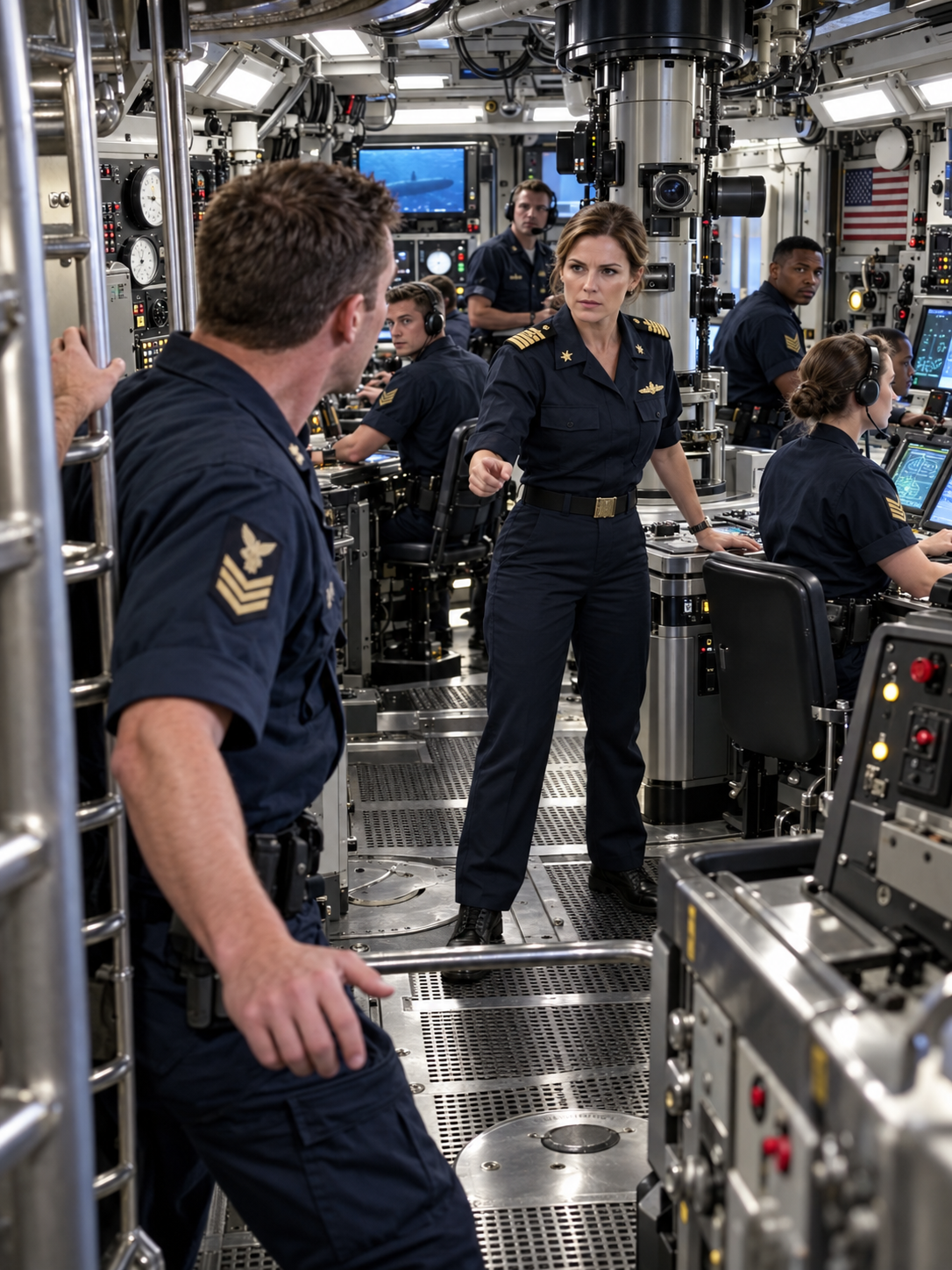
The room was alive with preparation.
They were rigging for dive.
Voices moved in controlled bursts. Checklists changed hands. Sailors leaned over panels. Someone called out a status report. Someone answered immediately.
At the ballast control panel stood Chief Petty Officer Nolan Briggs.
I knew him before he knew me.
Forty-one.
Chief of the Watch.
Strong evaluations.
Excellent technical record.
One disciplinary counseling seven years earlier, nothing recent.
Divorced.
One daughter.
Repeatedly praised for running one of the sharpest watch teams in the squadron.
I had read every page.
Watching him work for five seconds told me the paperwork had not exaggerated.
Briggs was fast.
Precise.
Alert.
He corrected one response without raising his voice, shifted another sailor’s attention with two words, and never lost track of the evolution happening around him.
Then he noticed me.
His eyes swept over the coveralls.
The notebook.
The absence of visible rank.
And I watched him perform a calculation I had seen men perform my entire career.
He didn’t recognize me.
Therefore, I wasn’t important.
Therefore, he didn’t have to be careful.
“We’re rigging for dive,” he said.
I moved farther out of the traffic flow.
He looked at me again.
“I don’t care who sent you. You’re in the way.”
I said nothing.
His mouth tightened.
“Off my deck plates.”
The control room changed.
Not visibly.
Submariners are professionals. Nobody spun around like an audience in a courtroom drama.
But everybody heard it.
“Chief,” someone near the chart table started.
Briggs lifted a hand.
“I’ve got it.”
Then he pointed toward the ladder.
“Up. Now.”
I rested one hand on the rail beside the periscope stand.
“I’m clear of your watch.”
“You’re also not supposed to be here.”
His voice hardened.
“This isn’t a tour. Ladder’s behind you.”
A young sailor at the chart table became perfectly still.
I noticed him.
I notice stillness.
You learn to notice it after surviving places where one person going suddenly quiet can mean the difference between routine and catastrophe.
Briggs saw a stranger.
The younger sailors saw a chief demonstrating what happened to strangers.
And suddenly I wasn’t thinking about that control room anymore.
I was twenty-three again.
Different ship.
Different plates.
Cold seawater climbing over my boots.
An alarm screaming through an engineering space.
A ruptured line filling a place we could not simply abandon.
And another chief looking at me as though my being a young woman in the wrong moment was somehow a larger emergency than the water pouring into the compartment.
“Get back,” he had shouted.
“Let the real watchstanders work.”
I had ignored him.
The isolation valve had been mine.
I fought it shut with cold water hammering my arms.
When the flow finally stopped, my hands were shaking so badly I could barely close them.
That night, Senior Chief Maren Holt found me sitting beside a tool locker.
She wasn’t comforting.
Maren Holt never wasted time pretending comfort and respect were the same thing.
“Everybody in that space decided who you were today,” she told me.
Then she stared straight through me.
“Now you decide.”
I said nothing.
“Stay on the plates, Mercer.”
Those four words changed my life.
She later pushed me toward a commission.
Years after that, when submarines opened wider opportunities for women, she told me the force needed officers who had once been the person somebody tried to push aside.
I made myself a promise because of her.
If I ever held authority, I would never decide someone’s worth by their clothes, age, title, accent, connections, or the speed with which everyone else had dismissed them.
Now, two decades later, Chief Nolan Briggs was testing that promise without knowing it existed.
“You hear me?” he asked.
I looked directly at him.
“I hear you.”
“Then go.”
Before I could answer, movement behind the periscope caught my attention.
Master Chief Walter Kane, Resolute’s Chief of the Boat, had turned around.
He looked at Briggs.
Then at me.
Then back at Briggs.
His expression didn’t change much.
He had been a submariner for thirty years. Men like Kane didn’t waste emotion where observation would do.
But I saw recognition enter his eyes.
My photograph had been on the wardroom bulkhead for weeks.
Kane crossed the control room.
He didn’t hurry.
He didn’t need to.
The entire room seemed to feel him coming.
He stopped in front of me.
Then he said one word.
“Captain.”
Chief Briggs’s hands stopped moving.
Master Chief Kane continued as if the air had not suddenly become twice as heavy.
“We’re ready for your turnover whenever you are, ma’am.”
Nobody spoke.
Briggs stared at me.
I watched the truth assemble itself behind his eyes.
The plain coveralls.
The notebook.
The woman he had ordered off his plates.
The word captain.
And before he had time to recover, boots sounded on the ladder above us.
Captain Nathan Caldwell, the squadron commodore, descended into control in full service uniform.
He stepped off the last rung, saw me standing beside the periscope, and smiled.
“Commander Mercer. I knew you’d be aboard before everybody else.”
Briggs’s face lost every trace of color.
And in that moment, surrounded by a silent control room and an admiral-level career opportunity standing ten feet away, I realized the entire crew was waiting to see whether their new captain would destroy a chief on her first morning.
### Part 2
Captain Caldwell looked around control with the calm expression of a man who missed very little and enjoyed pretending he had missed more than he actually had.
“How’s the boat look?” he asked.
“Good, sir.”
I glanced toward the ballast panel.
“Chief Briggs has the rig running clean.”
Briggs looked at me.
That was the first thing I gave him after he discovered who I was.
Not protection.
Truth.
His watch had been excellent.
The fact that he had insulted me didn’t make his dive preparation suddenly sloppy, and if I changed my evaluation of his competence because my pride was bleeding, I would be guilty of exactly the kind of thinking I despised.
Caldwell’s eyes moved toward Briggs.
“So I’ve heard.”
Then back to me.
There was the smallest pause.
“Word travels quickly in submarines.”
He knew.
Of course he knew.
Master Chief Kane probably hadn’t said anything. He wouldn’t have needed to. A room that small could transmit humiliation without electronics.
Caldwell folded his arms.
“How do you want to handle it?”
There it was.
Permission.
Public.
Complete.
A chief had ordered the incoming commanding officer out of control.
I could relieve Briggs immediately.
No one would call it unreasonable.
Some would call it decisive leadership.
Others would say I had established authority exactly when a new captain needed to establish it.
And the most dangerous part was that I wanted to.
For perhaps five bright seconds, I imagined it.
“Chief Briggs, you’re relieved.”
That was all it would take.
His reputation would collapse before breakfast.
His division would know.
The chief’s mess would know.
The squadron would know.
By dinner, sailors on other submarines would be telling the story.
The image pleased something ugly and wounded inside me.
That was precisely why I didn’t trust it.
Over the years I had developed a private rule.
Any punishment I was excited to give needed to be examined twice.
Maybe three times.
I looked at Briggs.
He stood stiffly beside the panel, but he wasn’t hiding.
He had made the mistake in public and was waiting for the consequence in public.
Then I saw Cruz near the sound-powered phone.
The same nineteen-year-old who had stopped me at the brow.
He wasn’t watching Briggs.
He was watching me.
That changed everything.
Senior leaders spend too much time imagining their real audience is other senior leaders.
The commodore.
The flag officer.
The promotion board.
The people who write evaluations.
But the decisions that last longest usually travel downward.
Young sailors watch.
They collect pieces of us without asking permission.
Years later, when they finally hold authority, they repeat what they remember.
At nineteen, I had watched chiefs decide what leadership meant before I knew I was studying them.
Some lessons had taken years to remove from myself.
Others had built me.
Cruz was about to learn what power did when it suddenly discovered it had every advantage.
That mattered more to me than impressing Caldwell.
“Sir,” I said, “I’d like to complete turnover and handle the watch matter at my level afterward.”
Caldwell studied me.
The control room became so quiet I could hear ventilation air moving overhead.
“That’s a conversation for the chief and me,” I continued. “Not for the control room.”
Caldwell held my eyes.
Then one corner of his mouth shifted.
“Your boat, Commander.”
Two words.
He meant them.
The turnover happened later that morning.
Orders were read.
The outgoing captain and I stood before the crew.
I said the words generations of commanding officers had said before me.
“I relieve you, sir.”
He answered.
“I stand relieved.”
And suddenly USS Resolute was mine.
Not emotionally.
Not ceremonially.
Legally.
Operationally.
Mine to command.
Mine to lose.
Mine to bring home.
That weight was heavier than any satisfaction Briggs’s humiliation could have given me.
When the time came to get underway, I watched the crew work.
No speeches.
No grand demonstrations.
I wanted them looking at the boat, not me.
Briggs ran his watch with almost painful precision.
Every acknowledgment clipped.
Every verification repeated.
Every hand where it belonged.
He was working like a man who could feel a blade suspended over the back of his neck.
I hated that.
Fear makes people careful for a while.
Then it makes them secretive.
A crew afraid of its captain learns to hide errors instead of exposing them early.
On land, that destroys organizations.
At depth, it kills people.
When all reports were correct, I gave the order.
“This is the captain. I have the con.”
The deck tilted gently.
The surface disappeared.
Steel, machinery and 140 human beings slipped beneath the sea.
Only after we were stable and the watch had changed did I send for Briggs.
He met me in the passageway outside control.
No audience.
No commodore.
No cheering crew.
He came to attention.
“Captain.”
“Stand at ease.”
He barely moved.
He drew a breath.
“I threw the commanding officer off her own deck plates.”
I waited.
“There’s no excuse.”
Still I waited.
“I don’t intend to make one.”
That helped him more than he realized.
A man willing to stand inside the exact shape of his mistake can usually be rebuilt.
A man who immediately starts carving exits into it usually cannot.
“Chief,” I said, “you still don’t understand what you did wrong.”
His jaw tightened.
“Ma’am?”
“You think the problem is that I turned out to be your commanding officer.”
He looked confused.
“Isn’t it?”
“No.”
I leaned one shoulder lightly against the bulkhead.
“If I had been a civilian technician, would you have spoken to me that way?”
He didn’t answer.
“A brand-new seaman?”
Silence.
“Somebody from squadron staff you didn’t recognize?”
His eyes lowered.
“I don’t know.”
“Yes, you do.”
His face tightened.
“I probably would have.”
“That’s the problem.”
He looked back at me.
“The rank is an accident, Chief. It’s just the accident that made you discover the habit.”
I saw the words hit.
“You looked at coveralls,” I continued, “and decided who counted.”
“I was trying to clear control for the dive.”
“I know.”
“Short timeline.”
“I know that too.”
“I had people where they shouldn’t be.”
“Chief.”
He stopped.
“You’re explaining why contempt was efficient.”
That silenced him.
I stepped closer.
“You are excellent at that panel. I watched you before you noticed me. Your people trust your calls. You run one of the cleanest rigs I’ve seen.”
His eyes moved toward me, surprised.
“I’m not saying that to make you feel better. I’m saying it because it’s why you’re still Chief of the Watch.”
His throat shifted.
I continued.
“A submarine survives because 140 people do small things correctly when nobody important is watching. I cannot inspect every valve. I cannot personally verify every breaker, every lineup, every calculation. I have to trust the watch.”
“Yes, ma’am.”
“And the watch has to trust you.”
“Yes, ma’am.”
“If you decide who matters based on a coat, then I have to ask what else you decide too quickly when you’re sure nobody important is looking.”
That was the sentence that truly reached him.
This wasn’t about manners anymore.
It was about judgment.
The one currency submarines cannot fake.
“You could relieve me,” Briggs said quietly.
“I could.”
“For less than this.”
“Yes.”
“Why aren’t you?”
Because eighteen years earlier, I had once desperately wanted someone to judge me by the work instead of the story they had already written about me.
Because Senior Chief Maren Holt had done exactly that.
Because I had promised her—and myself—that if authority ever landed in my hands, I would remember what it felt like to have none.
But I didn’t tell Briggs all of that yet.
Instead I said, “Because relieving you would be easier.”
His eyebrows moved.
“And easy isn’t always useful.”
I handed him a written counseling.
His face tightened when he saw it.
“This happened,” I said. “It’s documented. You are not walking away clean.”
“No, ma’am.”
“If it happens again, we’re done.”
“Understood.”
“You won’t get another conversation.”
“Understood.”
Then I gave him the part I knew would either save him or make the whole effort pointless.
“But I’m keeping you here.”
He looked at me for several seconds.
“I don’t understand.”
“You will.”
I pointed toward control.
“Run the best watch team on this submarine. Judge people the same way you judge equipment. You don’t ignore a gauge because you don’t like its face. You read it. You verify it. You respect what the evidence tells you.”
Briggs’s expression changed.
Not relief.
Something heavier.
Obligation.
“Read people the same way,” I said.
His voice was quieter when he answered.
“Aye, Captain.”
He started to turn.
“Chief.”
He stopped.
“I came up through engineering.”
He looked back.
“I was a machinist’s mate.”
Surprise crossed his face.
“There was a flooding casualty when I was young. Another chief told me to move aside and let the real watchstanders handle it.”
Briggs went still.
“I stayed. I shut the isolation valve. We survived.”
He didn’t breathe for a second.
“I’ve remembered that man’s face my whole career.”
I let the silence hold us both.
“This morning,” I said, “I saw you becoming him.”
Briggs looked as if I had struck him.
Then I finished the sentence.
“And I decided you were worth stopping.”
He left without another word.
I thought the hardest part was over.
I was wrong.
Because within hours, the story spread through the entire submarine—and the crew began judging not Chief Briggs, but me.
### Part 3
A submarine has no real privacy.
It has doors.
Curtains.
Ranks.
Procedures.
But not privacy.
One hundred forty people sealed inside steel will know who argued, who cried, who received bad news from home, who forgot a qualification question, who burned the coffee and who got called into the captain’s passageway before the next meal.
By dinner, everyone aboard Resolute knew what had happened.
The new captain had boarded unannounced.
Chief Briggs had ordered her out of control.
Master Chief Kane had called her “Captain.”
The commodore had appeared.
And Briggs was still wearing his anchors.
That last part became the real story.
I sensed it in the mess.
Conversation dipped when I entered, then carefully returned.
Sailors found reasons not to stare.
A petty officer almost dropped his fork when I asked whether anyone was using the empty seat beside him.
I sat down anyway.
The food was submarine food—hot, heavy and far better than it had any right to be hundreds of feet underwater.
I listened more than I spoke.
Afterward, Kane found me with two mugs of coffee.
He handed me one.
I tasted it.
Burnt.
Watery.
Almost impressive in its contradiction.
“Master Chief,” I said, “how does the Navy consistently produce coffee that’s both too strong and too weak?”
“National security secret, Captain.”
We sat.
Kane turned his mug between his palms.
“Permission to speak freely?”
“You weren’t planning not to.”
That almost made him smile.
“Half of me wanted to see you take Briggs apart.”
“I suspected.”
“He earned it.”
“He earned a consequence.”
“That’s a very captain answer.”
“You’re the one who asked to speak freely.”
He nodded.
“Other half of me has been wearing anchors long enough to know what happens when a CO opens command by publicly hanging a chief.”
I waited.
“The chiefs stop taking risks.”
“Meaning?”
“They stop bringing you ugly truth.”
Exactly.
Kane looked toward the passageway.
“A boat full of chiefs who only tell the captain what she wants to hear is a coffin with a reactor.”
I took another drink.
Still terrible.
“The mess is talking?”
“The mess is always talking.”
“What are they saying?”
He considered lying to me for about half a second, then remembered I would know.
“They’re saying you could have ended him.”
“True.”
“They’re saying you didn’t.”
“Also true.”
“They’re trying to figure out what that means.”
“What do you think it means?”
Kane stared into his coffee.
“I think mercy’s less entertaining than revenge.”
Then he looked at me.
“But it’s harder to argue with afterward.”
Captain Caldwell found me before he transferred off.
He stopped outside my stateroom.
“I handed you a clean reason to relieve Briggs.”
“Yes, sir.”
“You knew that.”
“Yes.”
“And you knew no one would have blamed you.”
“Yes.”
He studied me.
“Most first-time COs would’ve taken it.”
I said nothing.
“I might’ve even written that they established authority quickly.”
“Would you have believed it?”
His eyes sharpened.
“Maybe.”
Then he surprised me.
“I got thrown off a set of plates once.”
I looked at him.
“1993. Young seaman. Different world. I snapped at a man who was blocking access during maintenance. Didn’t recognize him. Didn’t know he was an officer.”
A faint smile appeared.
“Difference is, the officer wasn’t the important part.”
I waited.
“He corrected me privately. Made sure I understood that.”
Caldwell put one hand on the ladder.
“I’ve thought about him for more than thirty years.”
Then he nodded toward control.
“You passed a test this morning, Mercer.”
“I didn’t do it for the test.”
“That’s why you passed.”
He climbed out of the submarine.
Hours later, Resolute settled deeper.
The sea pressed against the hull with pressure no human body could survive for a second.
Inside, sailors checked gauges, called contacts, calculated trim and complained about dessert like people living anywhere else.
That ordinary sound of competence was why I loved boats.
The ocean didn’t care about our personalities.
It cared whether we were right.
Chief Briggs avoided me for most of the next day except when duty required otherwise.
That was fine.
I hadn’t spared him so we could become friends.
Then, near the chart table after watch turnover, he approached carrying something.
My notebook.
I had lost track of it during the morning confusion.
The cover was scuffed.
The pages had been carefully dried.
Briggs held it out.
“Captain.”
I took it.
“Thank you.”
His eyes stayed on the deck.
Normally, I would have told a chief to look at me.
I didn’t.
Dignity sometimes survives in tiny hiding places.
I wasn’t going to drag his out just because I could.
“Anything else?”
“No, ma’am.”
“Good night, Chief.”
“Aye, Captain.”
He walked away.
Three weeks passed.
Life aboard Resolute fell into the strange rhythm submariners understand: watch, eat, train, sleep, wake without knowing whether the surface had sunrise or midnight waiting for us.
Briggs kept his position.
His section remained excellent.
But I watched him.
Not because I was waiting for failure.
Because I needed evidence.
People become careful after punishment.
That means nothing.
The real question is who they are after the fear fades.
One afternoon, we embarked a civilian technician named Owen Parker for a systems evaluation.
He was young, nervous and clearly overwhelmed by submarine traffic.
During a busy evolution, Parker stopped in exactly the wrong place.
A petty officer carrying equipment nearly collided with him.
“Move!” the sailor snapped. “You can’t just stand—”
Briggs appeared.
My body went still.
He could not see me watching from farther aft.
He placed one hand on the petty officer’s shoulder.
“Easy.”
Then to Parker:
“Sir, come with me.”
No contempt.
No humiliation.
He moved the technician safely out of the passageway, explained where he could stand, then returned to the petty officer.
Briggs didn’t correct him publicly.
He took him aside.
I couldn’t hear the conversation.
I didn’t need to.
I recognized the geography.
Private correction.
Exact standard.
No audience invited to enjoy another man’s embarrassment.
I felt something loosen inside my chest.
The lesson had moved.
It wasn’t living between Briggs and me anymore.
It had traveled.
That night, Cruz found me in the mess.
He hovered beside the table until I looked up.
“Something wrong, Cruz?”
“No, ma’am.”
He shifted his weight.
“Then sit.”
He sat.
For several seconds he stared at his hands.
Finally he said, “I wanted to thank you.”
“For what?”
He looked miserable.
“I don’t know exactly.”
That made me put down my mug.
He had watched the morning.
He couldn’t name what it had taught him yet.
That was okay.
Some lessons arrive years before the language for them.
“You stopped me at the brow,” I said.
“Yes, ma’am.”
“Why?”
“Because you weren’t on the list.”
“Even though you thought I might be important.”
“Yes, ma’am.”
“Good.”
I leaned forward.
“Keep doing that.”
He looked confused.
“Read the gauge, Cruz. Not the coat.”
“Ma’am?”
“A gauge tells you what it actually says. A coat makes you invent a story about the person wearing it.”
He nodded slowly.
“Be as squared away with the person you think can’t help you as you are with the commodore.”
He smiled nervously.
“I’ll try, Captain.”
“Don’t try.”
His smile disappeared.
“Do it.”
“Aye, Captain.”
He left.
I thought about Maren Holt.
About the flooding space.
About the chief who had once looked at me and decided I was a problem before he had even measured the problem in front of him.
That night I wrote Holt a letter.
I told her everything.
The coveralls.
Briggs.
The reveal.
My decision.
Cruz.
The technician.
Weeks later, when we surfaced long enough to receive traffic, her reply arrived.
Four lines.
Maren Holt had never used five words when three would survive.
The final line read:
“You stayed on the plates. Now keep other people on theirs. That’s the whole job, boss.”
I printed it.
Then I taped it inside my stateroom beside an old photograph of myself at twenty-three.
For the first time in years, I could look at that young machinist’s mate without seeing only the water around her boots.
But Chief Briggs wasn’t finished with the lesson.
Neither was I.
A week later, he requested permission to speak to me privately—and what he admitted changed the way I understood that entire first morning.
### Part 4
Briggs arrived at my stateroom at 2130.
“Captain, permission to speak freely?”
“Granted.”
He remained standing.
I pointed at the chair.
He sat like a man accepting a sentence.
For several seconds he said nothing.
Then:
“I’ve been angry.”
I waited.
“Not at you.”
“That would’ve been easier.”
His eyes flicked toward mine.
“Yes, ma’am.”
I leaned back.
“Go on.”
“I’ve spent weeks trying to figure out where to put it.”
His hands were clasped tightly between his knees.
“First few days, I thought I was angry because I got embarrassed.”
“Reasonable.”
“Then I thought maybe I was angry because you kept me. That didn’t make sense either.”
“Why not?”
“Because I’m grateful.”
He said the word reluctantly.
“Still didn’t stop the anger.”
I let silence do its job.
Finally he said, “I’m angry because you were right.”
That is rarely what people mean when they say those words.
He continued before I could answer.
“I’ve been thinking about how many times I might’ve done that before.”
My attention sharpened.
“Done what?”
“Decided.”
He looked at the deck.
“Tech reps. Junior sailors. New guys. Civilians. People who looked lost.”
He swallowed.
“I keep remembering faces.”
There it was.
Not guilt over being caught.
Recognition.
“The thing that keeps getting me,” he said, “is that if you hadn’t been the CO, nobody would’ve corrected me.”
I said nothing.
“I would’ve slept fine that night.”
“Probably.”
“I would’ve thought I was efficient.”
“Probably.”
His jaw tightened.
“How many men retire after thirty years without ever finding out they’re that guy?”
I understood the question too well.
“More than you want to know.”
He looked up.
“You could’ve relieved me.”
“We’ve covered that.”
“No. I mean—”
He stopped.
“You could’ve made yourself feel better.”
That surprised me.
Briggs saw it.
“I would’ve understood.”
“Would you?”
“Eventually.”
I considered him.
“Maybe that’s why I didn’t.”
He frowned.
I looked toward the photograph on my bulkhead.
Young me.
Cold metal.
Engine room.
Chin lifted in the stubborn way it used to lift when I was scared.
“I spent a lot of years believing the chief who tried to move me during that flooding casualty owed me something.”
Briggs followed my gaze.
“What?”
“Justice. Apology. Humiliation. I changed the name depending on the year.”
I smiled without humor.
“But most of what I wanted was for him to feel as small as he made me feel.”
Briggs stayed quiet.
“The problem with carrying an old debt is eventually you start looking for somebody convenient to collect it from.”
His expression shifted.
“You almost collected it from me.”
“Yes.”
I had never said that aloud before.
The truth sounded uglier outside my head.
“I had the commodore standing there. The crew was waiting. You had handed me every legitimate reason.”
I looked at him.
“And for five seconds, Chief, I wanted it.”
Briggs didn’t look offended.
He looked relieved.
Maybe knowing I had felt the temptation made the choice more real.
“What stopped you?”
“Cruz.”
“The topside watch?”
“Yes.”
He frowned.
“Why?”
“Because he was nineteen and watching.”
I explained.
Not all of it.
But enough.
How young sailors study people with authority.
How they repeat lessons years later.
How the decision wasn’t just about Briggs.
It was about every sailor who might one day remember what a captain did when she safely possessed the advantage.
Briggs rubbed one hand across his jaw.
“I didn’t think about that.”
“Most leaders don’t.”
I nodded toward the photograph.
“At twenty-three, I thought I was learning valves and casualty procedures.”
A small laugh escaped me.
“I was also learning how power behaved.”
Briggs looked at the photo again.
“What happened to the chief?”
“The one who tried to move me?”
“Yes.”
“Nothing dramatic.”
That surprised him.
“He transferred eventually. Probably retired.”
“Did you ever tell him?”
“No.”
“Why?”
“Because by the time I had enough rank to make him listen, I no longer needed him to.”
Briggs absorbed that.
Then he asked, “What about Senior Chief Holt?”
A real smile touched my face.
“She retired years ago.”
“She the one who told you to stay?”
“Yes.”
“She must be proud.”
“She’d deny it with unusual aggression.”
Briggs almost laughed.
The tension in the room shifted.
Not vanished.
Changed.
“Chief,” I said, “I didn’t keep you because I wanted gratitude.”
“I know.”
“I kept you because I thought the man at that panel was bigger than the mistake.”
His eyes lowered.
“Don’t prove me wrong.”
“I won’t.”
“That’s not a promise you make once.”
He looked up.
“No, ma’am.”
“It’s one you make every time someone annoys you when you’re tired.”
“I understand.”
“Every time you’re on a short clock.”
“Yes, ma’am.”
“Every time somebody looks like they shouldn’t be in your space.”
“Yes, ma’am.”
“That’s where character lives. Not in speeches.”
Briggs stood.
At the door he stopped.
“Captain?”
“Yes?”
“I don’t think you gave me mercy.”
That caught me off guard.
“What did I give you?”
“A job.”
I waited.
“Not Navy job.”
He shook his head.
“Work to do on myself.”
Then he left.
Months passed.
Resolute changed in ways no readiness report could quantify.
Sailors brought me problems earlier.
Chiefs disagreed with me openly when they had evidence.
Junior watchstanders asked questions they once might have hidden because nobody wanted to be the person who didn’t know.
Our drills improved.
Our mistakes became smaller because people reported them before pride had time to enlarge them.
Briggs became one of my most reliable chiefs.
Not softer.
That mattered.
I hadn’t wanted softness.
A submarine does not need people afraid to raise their voices during danger.
Briggs was still demanding.
Still fast.
Still impatient with laziness.
But impatience was no longer allowed to dress itself as contempt.
One night during a casualty drill, a nervous junior sailor hesitated over a report.
I watched Briggs turn toward him.
Months earlier, I knew what would have happened.
The kid would have been crushed by the speed of Briggs’s frustration.
Instead Briggs said, “Slow it down. Tell me what the gauge says.”
The sailor breathed.
Read it.
Caught his own error.
Corrected it.
Briggs nodded.
“Good. Again.”
That moment probably meant nothing to anyone else.
To me, it was the entire story.
Later, I stood alone near the periscope stand and put one hand on the rail.
Resolute was deep.
Quiet.
Alive.
For the first time since taking command, I allowed myself to feel the weight without immediately turning it into work.
This was my boat.
Not because the orders said so.
Because the crew had started trusting what kind of deck it was.
Fair.
Demanding.
Unforgiving about standards.
Uninterested in humiliation.
I thought we had finally put that first morning behind us.
Then Master Chief Kane appeared beside me with a message.
“Captain, squadron’s sending an inspection team aboard next week.”
“Anything unusual?”
“One name.”
He handed me the message.
I read the senior inspector’s name.
Then read it again.
My hands went cold.
The officer leading the inspection was the same man who had been standing in that flooded engineering space years earlier—the chief who had told me to step aside and let the real watchstanders work.
### Part 5
Rear Admiral Thomas Garrett came aboard Resolute at 0615.
Time does strange things to faces.
The chief I remembered from the flooding space had been broad-shouldered, dark-haired and loud enough to cut through alarms.
The admiral climbing down my ladder had silver at his temples now.
He wore stars.
He carried himself like a man accustomed to rooms changing when he entered them.
But I recognized him immediately.
My body recognized him before my mind finished confirming it.
For half a second, I smelled seawater.
Heard alarms.
Felt cold water against my arms.
Twenty-three again.
“Captain Mercer.”
His hand came toward me.
“Admiral.”
We shook.
His eyes stayed on my face longer than politeness required.
Then something shifted.
Recognition.
“Have we served together before?”
“Yes, sir.”
His expression tightened slightly.
“Where?”
“Carrier engineering department. Years ago.”
I watched the memory move.
Not fully.
Not yet.
“Of course.”
He looked away.
“Long time.”
“It was.”
The inspection began.
If anyone aboard noticed tension between us, they were professional enough not to show it.
Garrett’s team examined logs, training records, qualification progress and maintenance practices.
They questioned sailors.
They observed drills.
They moved through the submarine with clipboards and practiced skepticism.
Briggs ran the control room during one major scenario.
He was exceptional.
A junior sailor made a small reporting error.
I saw Garrett glance sharply toward him.
Before the admiral could speak, Briggs handled it.
“Again, sailor. Give me the indication, not what you expected the indication to be.”
The sailor corrected himself.
Briggs continued.
No humiliation.
No panic.
Just standard.
Garrett noticed.
So did I.
Afterward, the admiral asked to speak with me privately.
We went to the wardroom.
The door closed.
For several seconds, he stood looking at the table.
Then he said, “I remember you.”
I said nothing.
“Flooding casualty.”
“Yes, sir.”
“You were the machinist’s mate.”
“Yes.”
His face changed.
“And I told you to get back.”
There it was.
No dramatic music.
No gasps.
Just an old fact finally crawling into daylight.
“Yes, sir.”
Garrett sat.
I remained standing until he gestured toward the opposite chair.
“I’ve thought about that day.”
“Have you?”
It came out colder than I intended.
He noticed.
“I deserved that.”
“I wasn’t trying to punish you.”
“No.”
He gave a tired smile.
“You never needed much help making someone feel the exact size of what they said.”
I almost laughed.
Almost.
He looked at his hands.
“You shut the valve.”
“I did.”
“You were right.”
“Yes.”
“I was wrong.”
There was a time when those three words would have been worth almost anything to me.
Now they landed quietly.
No triumph.
No relief.
Just acknowledgment.
“I owe you an apology.”
I looked at him.
“For telling me to move?”
“For seeing you and deciding what you were before I bothered to find out.”
That was different.
Garrett exhaled.
“I was good at the technical part of being a chief. Very good.”
“So is Chief Briggs.”
His eyes lifted.
I told him the story.
Not dramatically.
Just the facts.
My early boarding.
Briggs.
The control room.
The reveal.
The decision.
The counseling.
The months after.
When I finished, Garrett leaned back.
“You could’ve ended him.”
“Yes.”
“Why didn’t you?”
I looked through the small wardroom opening toward the passageway beyond.
“Because once, someone decided I was worth keeping on the plates.”
“Maren Holt.”
My eyes snapped toward him.
Garrett smiled sadly.
“I remember her.”
“Then you remember she wasn’t subtle.”
“No.”
His smile grew.
“She told me afterward that if I ever talked over another qualified watchstander during a casualty, she’d personally use me as a temporary pipe patch.”
That sounded exactly like Holt.
For the first time, I laughed.
Garrett did too.
Then the laughter faded.
“I never apologized to you.”
“No.”
“Why didn’t you find me?”
I studied him.
That question might once have angered me.
Now it simply seemed strange.
“Because the person who hurt me doesn’t get to decide when I heal.”
He absorbed that.
“I waited for years for you to become part of the answer.”
I shook my head.
“Eventually I realized you weren’t.”
He looked down.
“Fair.”
“And Admiral?”
“Yes?”
“I forgive the fact that you were wrong.”
His eyes lifted.
“But?”
“But you don’t get credit for the career I built after it.”
He nodded slowly.
“I understand.”
That was all I needed from him.
Not friendship.
Not reconciliation.
Not some sentimental scene where two people erase twenty years because one of them finally found the right words.
The apology mattered.
But it arrived too late to become a bridge.
It became a fact.
Nothing more.
The inspection ended two days later.
Resolute received an excellent evaluation.
Garrett departed.
At the ladder he paused.
“Captain Mercer.”
“Sir?”
“You built a good boat.”
I looked toward the control room.
“No, sir.”
He raised an eyebrow.
“They built one.”
Then I added, “I just try not to get in the way.”
He smiled.
“That’s harder than it sounds.”
“Yes, sir.”
He climbed out.
Briggs approached me later.
“Heard the admiral knew you.”
“He did.”
“Old story?”
“Very.”
He nodded.
I could see curiosity fighting discipline.
I saved him the battle.
“He was the chief from the flooding casualty.”
Briggs’s mouth opened.
Then closed.
“The one who—”
“Yes.”
“And he came aboard your boat.”
“Apparently the Navy appreciates irony.”
Briggs stared at the ladder.
“What did you do?”
“Ran the inspection.”
“No, Captain. I mean with him.”
I understood.
“Nothing.”
He frowned.
“He apologized.”
“And?”
“I accepted that he apologized.”
Briggs waited.
“That’s it?”
“That’s it.”
He studied me for several seconds.
“You forgave him?”
“I don’t need to hate him anymore.”
That was the most accurate answer.
“But forgiveness isn’t restoration, Chief.”
He nodded slowly.
“Some doors close because they should.”
We stood in silence.
Then Briggs said, “I think I’m starting to understand.”
“You’ve got another twenty years.”
He smiled.
“Plenty of time to screw it up.”
“Chief.”
“Sorry, Captain.”
Months after my first morning aboard, I stood on the periscope stand at depth.
The boat was quiet in the way only submarines become quiet.
Not silent.
Never silent.
The plant hummed.
Ventilation breathed.
Relays clicked.
Shoes moved across deck plates.
Somewhere forward, someone laughed.
The ocean pressed against us with enough force to crush every human being aboard if the hull failed.
Yet inside that impossible pressure, 140 people trusted one another.
That is what a submarine really is.
Not steel.
Not weapons.
Not technology.
Trust under pressure.
Briggs stood at his station.
Cruz was farther forward now, more qualified, more confident.
The watch answered cleanly.
I placed my hand on the rail.
For a moment I saw every version of myself at once.
Twenty-three, cold to the elbows, refusing to leave the flooding space.
Forty-two, wearing plain coveralls while a chief pointed toward a ladder.
A new captain holding the power to destroy a man and discovering that revenge was much easier than command.
A woman sitting across from an admiral and realizing an apology could be accepted without reopening a door.
And then I saw only the present.
My boat.
My watch.
My responsibility.
Chief Briggs called out a report.
“Captain, depth steady.”
I checked the instruments.
“Very well.”
He turned toward a young sailor who had just entered control.
The sailor looked uncertain.
New.
Probably convinced everyone could see how nervous he was.
Briggs pointed toward a safe position near the panel.
“Come here. You can watch from this side.”
The sailor moved closer.
Briggs explained what the watch was doing.
Patiently.
No contempt.
No calculation about whether the young man mattered.
I looked away before Briggs caught me noticing.
Some victories become smaller when you applaud them.
Some deserve to become habits instead.
I lowered my gaze to the notebook in my hand.
Inside the front cover, I had taped Maren Holt’s four-line letter.
The final sentence was beginning to fade along the fold.
“You stayed on the plates. Now you keep other people on theirs.”
That was the whole job.
Not winning every argument.
Not making everyone who wronged you pay.
Not proving your rank.
Not waiting for a room full of people to discover they underestimated you.
The world loves the moment of reveal because reveals are satisfying.
The person who dismissed you discovers your title.
The arrogant boss learns who owns the company.
The rude stranger discovers who signed the contract.
The chief learns the woman he threw out is the captain.
People cheer because power changes hands.
But power changing hands isn’t justice.
It is only opportunity.
The real question begins afterward.
What do you become in the five seconds after you finally have every right to hurt the person who hurt you?
I know what revenge would have given me.
A story.
A frightened chief.
A crew that learned the captain could destroy them when embarrassed.
Instead, I had Briggs.
A man who had looked honestly at his worst reflex and changed it.
I had Cruz.
A young sailor learning that authority is measured most clearly by how it treats people who cannot return the favor.
I had a crew that brought me ugly truths because they believed the deck was fair.
And I had myself.
Not healed completely.
People pretend old injuries vanish when we finally understand them.
Mine never did.
I still remember the flooding space.
I still remember the chief’s voice.
I still remember how badly I once wanted him to feel small.
But memory no longer holds the con.
I do.
“Captain?”
Briggs’s voice brought me back.
“Chief?”
“We’re ready for the next evolution.”
I looked around control.
Every station manned.
Every report ready.
Every sailor exactly where they belonged.
“Very well.”
I closed the notebook.
“Proceed.”
The watch answered.
Resolute moved deeper into the dark.
And nobody on my boat had to prove they belonged on the plates before we bothered to learn their name.
THE END!
Disclaimer: Our stories are inspired by real-life events but are carefully rewritten for entertainment. Any resemblance to actual people or situations is purely coincidental.