A Lieutenant Took The Radio While I Was Mid-Call. “Go Stand By The Trucks, Ma’am. Let The Professionals Work.” His Platoon Grinned. He Keyed Up, Loud. The Black Hawk Was Two Minutes Out. Whatever The Pilot Said Made His Hand Drop. “Sir, You Need To Hear This.”
The lieutenant ripped the radio from my hand in front of forty soldiers and ordered me to stand beside the trucks. Nobody defended me, and several men laughed as though my nineteen years in uniform meant nothing. I obeyed, even after hearing him transmit the wrong coordinates to an approaching helicopter. Fourteen years earlier, I’d lost my closest friend during a rescue in Afghanistan. When the pilot finally heard my voice, he asked a question that made everyone go silent—and brought back a secret I’d buried with the dead.
## Part 1: The Lieutenant Who Thought Experience Was a Liability
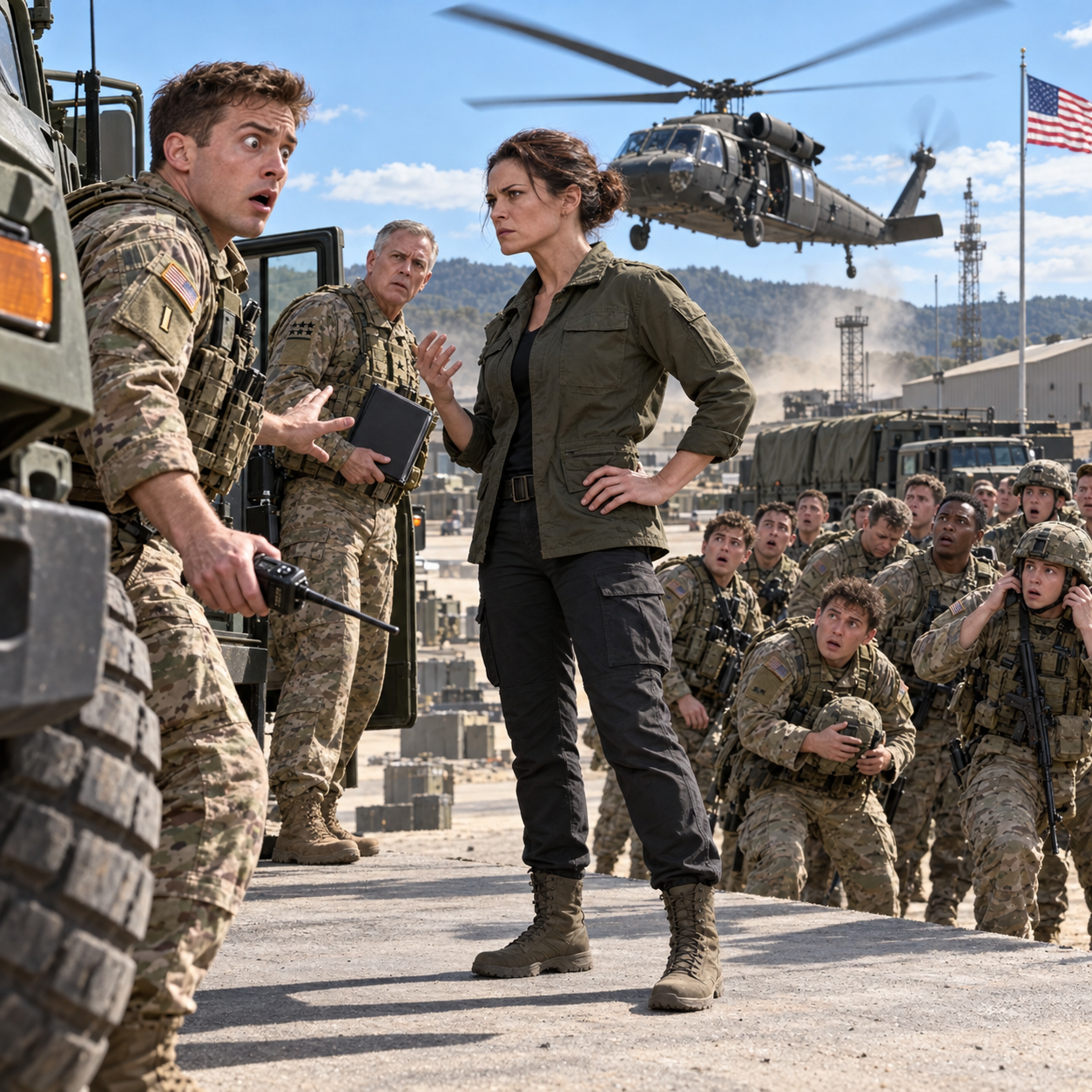
The radio cord snapped against my wrist hard enough to leave a red mark, and First Lieutenant Grant Mercer didn’t bother pretending it was an accident. He pulled the handset out of my fingers, stepped between me and the casualty collection point, and said, “Go stand by the trucks, Sergeant. Let the people assigned to this mission do their jobs.” Forty soldiers were scattered across the training area, and enough of them heard his voice that the laughter traveled in little waves through the clearing. I looked at the silver bars on his chest, then at the radio in his hand, and said, “Roger, sir.”
My name is Mara Keene, and at thirty-eight I had already spent nineteen years in the Army, most of them learning the difference between a mistake that embarrassed somebody and a mistake that buried somebody. My civilian job was flying medical emergencies out of Southern California, where every landing zone was somebody’s driveway, highway shoulder, or patch of darkness that looked safe until the helicopter got close. I had treated people in burning vehicles, brought children through respiratory emergencies, and watched good soldiers die with their hands wrapped around mine. None of that mattered to the young officer standing in front of me, because I was a reservist temporarily attached to his platoon, and he had decided what that meant before I introduced myself.
The October sun hung over Fort Irwin like a white-hot coin, bleaching the Mojave Desert until the distant mountains seemed painted onto the horizon. Three tan Humvees sat beside a narrow dirt track, their engines ticking as they cooled, and the air smelled of diesel, heated rubber, and creosote. Near the middle of the clearing, Private First Class Wesley Price lay on a litter with a simulated thigh injury, chewing gum while two soldiers secured his straps. It was supposed to be a routine medical evacuation exercise, the kind that taught young leaders to communicate accurately before anyone’s life depended on their words.
I walked toward the trucks because obeying a lawful order was easier than staging an argument that would make the lieutenant more determined to prove himself. Behind me, Mercer keyed the radio and repeated the evacuation request, this time louder and faster than I had delivered it. His voice stayed steady until he reached the grid coordinates, and then he reversed the final two digits of the location’s northing. My stomach tightened as I pictured the map: ninety meters might sound insignificant on a parade ground, but beyond our designated landing zone lay a dry wash full of loose shale and a sloping bank.
I turned and raised my voice just enough to carry. “Lieutenant, verify the grid. The last two digits are reversed.” Mercer lifted one finger without looking back, the universal gesture for someone important telling someone inconvenient to stop talking. “I’ve got it, Sergeant,” he replied, and another soldier smiled as though he’d delivered a clever punch line. I studied the horizon, where the distant beating of rotor blades had begun to press through the desert air.
Private First Class June Navarro appeared beside the nearest truck, gripping her helmet with both hands. She was twenty years old, from a small town outside Albuquerque, and she’d spent the previous eleven days trying desperately to become the soldier she imagined everyone expected her to be. “Sergeant, I heard it too,” she whispered, staring toward Mercer. I nodded and said, “Then remember what you heard, and don’t let anybody tell you later that you didn’t.”
She looked frightened by that answer, perhaps because she understood I was talking about more than a training score. On paper, today’s casualty was simulated, but the helicopter approaching us was real, with a real crew making decisions based partly on what they heard over the radio. The pilots were supposed to verify the marked landing zone visually and abort if anything looked wrong, yet I had seen how quickly a simple communications error could multiply when everyone assumed somebody else had already checked. I was not going to let an officer’s pride turn an avoidable mistake into an investigation involving folded flags.
Eleven days earlier, when I’d arrived at the training site carrying my medical bag, Mercer had looked at my name tape before giving my face a brief inspection. “You’re the Reserve medic?” he asked, as though the Army had delivered a substitute teacher instead of another noncommissioned officer. I introduced myself properly, but he interrupted before I’d finished describing my assignment. “We have our own procedures here, Sergeant, so follow the platoon and try not to complicate things.”
I had heard variations of that sentence from men and women who mistook familiarity for competence. During the first briefing, Mercer placed me behind the younger soldiers, far enough from the maps that I had to stand to read the casualty routes. On the third night, when a private twisted his ankle during a navigation exercise, I stabilized it under a red flashlight while Mercer asked whether I thought I could manage without an ambulance. I answered his question, helped the private to his feet, and returned to my place without reminding anyone that I routinely practiced medicine inside aircraft moving faster than most highway traffic.
Two nights later, I found June struggling with a simulated hemorrhage-control drill beside a parked Humvee. Her hands were trembling, and she was applying gauze in a way that looked convincing until you understood how pressure actually controlled bleeding. I knelt beside her, demonstrated the technique, and made her practice until she could repeat it without watching my hands. “Why didn’t anybody teach us that?” she asked, and I told her, “Somebody should have.”
Sergeant First Class Elias Redd, the platoon sergeant, witnessed that exchange from the edge of the shadows. Redd was a quiet, broad-shouldered man who had served seventeen years and possessed the useful habit of listening before deciding what he thought. The following evening, he sat beside me outside the temporary barracks and handed me a paper cup of coffee that tasted faintly of burned plastic. “Mercer thinks you’re here to make him look inexperienced,” he said, and I answered, “He doesn’t need me for that.”
Redd almost smiled, but his expression became serious when he mentioned the upcoming evacuation exercise. “Real helicopter, real crew, simulated casualty, and a whole lot of officers watching his performance,” he said, turning his cup between his palms. I asked whether Mercer had ever directed an aircraft into a landing zone under anything more complicated than classroom conditions, and Redd shook his head. “He passed the rehearsals,” he replied, which was not quite the same answer.
That night I unfolded the laminated communications card issued for the exercise and checked the landing zone coordinates twice. I had been doing that with aircraft information for fourteen years, ever since a dark mountainside in Afghanistan taught me that numbers could become the last thing a wounded soldier ever heard. Some memories faded into impressions: a smell, a face, a sound carried by the wind. Others remained painfully exact, and mine had six minutes attached to it.
Back in the desert clearing, the helicopter appeared above the eastern ridge, dark against the white sky. Mercer stood beneath it with the radio, telling the crew that the landing zone was clear while Sergeant Redd moved closer to him. I saw the aircraft adjust its approach and heard a question from the pilot about the ground marking, followed by Mercer’s impatient confirmation of the same incorrect coordinates. That was the moment I stopped worrying about whether correcting him would damage my career.
I moved to Major Rebecca Quinn, the exercise safety officer, who was standing beside a folding table with a clipboard and a separate radio. “Ma’am, the transmitted grid does not match the approved landing zone,” I said, opening my own card and pointing to the numbers. She compared the entries, her expression changing as she called the aircraft on the safety frequency and ordered the approach suspended. The helicopter climbed away from the wash, holding at a safe distance while the pilots checked the location against their mission information.
Quinn demanded a complete readback, and Mercer finally repeated the correct coordinates, his face darkening as he heard the discrepancy. He began explaining that I had interrupted his procedure, but the pilot cut across the conversation and requested the identity of the senior medic who had flagged the error. Quinn handed me the safety radio, and I gave my name and rank without thinking anything of it. There was a pause long enough for me to hear the rotor blades through the headset, and then the pilot spoke again in a voice that seemed suddenly older.
“Sergeant First Class Keene, I need to ask you something,” he said. “Were you a medic on a mountain ridge in eastern Afghanistan in May 2012?”
The desert, the soldiers, and the lieutenant standing ten feet away seemed to disappear. Nobody at Fort Irwin knew that story, and I had spent fourteen years making sure it stayed that way.
## Part 2: The Voice That Came Back After Fourteen Years
I had not heard that question in fourteen years, but I knew exactly which ridge the pilot meant. My fingers tightened around the radio until the plastic edges pressed into my palm, and for one terrible second I was twenty-four again, crouching on cold stones with somebody else’s blood soaking through my sleeves. Major Quinn watched my face, waiting for an answer, while Mercer stood beside her looking irritated that the conversation had moved beyond his control. I swallowed and said, “Yes, sir. I was there.”
The pilot did not immediately reply, and I heard another voice inside the cockpit asking whether the ground unit was ready to resume. He answered that the approach would remain suspended until the landing zone had been positively verified, then returned to our frequency. “This is Chief Warrant Officer Four Caleb Rowan,” he said. “I was the copilot of Dustoff Three-One that night, and I remember the voice that talked us toward that ridge.”
My knees felt strangely uncertain beneath me. I remembered a young aviator on a nearly unreadable radio channel, his words breaking apart beneath gunfire and rotor noise, asking me to identify a place he could land without killing everyone aboard. I remembered answering him even while another man lay dying against my chest, and I remembered the helicopter appearing out of the blackness much later than I had prayed it would. I had never known the copilot’s name, but I had hated those six lost minutes for so long that hearing his voice felt like meeting a witness to my worst failure.
“Sir, we’re in the middle of an exercise,” I managed. Rowan answered with the calm of somebody who understood the danger of saying the wrong thing over an open frequency. “Understood, Sergeant. Secure your people first, and we’ll speak afterward.” He then asked Quinn to confirm the approved landing zone markings before the aircrew considered another approach, returning the conversation to the work that needed doing.
Quinn directed the platoon to hold its positions while her safety team reviewed the coordinates. Mercer protested that the aircraft had never been in immediate danger because the crew maintained visual separation from the terrain, but she stopped him with a look. “That’s one reason we have professional pilots, Lieutenant,” she said. “It does not excuse sending them the wrong information.”
A captain from the evaluation team checked the radio traffic and the laminated cards, while another walked the intended landing area to inspect the visual markers. June stood beside the casualty litter, no longer chewing at her lower lip but watching Mercer with the troubled expression of someone seeing an authority figure become smaller. Redd quietly took the lieutenant’s radio and assumed control of the soldiers until Quinn could determine whether the lane would continue. Mercer looked toward me, and I recognized the anger gathering behind his eyes.
He waited until the evaluators moved away before approaching the truck where I’d been told to stand. “You could have corrected me privately,” he said, keeping his voice low enough that he might later deny the conversation. I looked at him for a moment, remembering how he’d raised one finger when I had tried to correct him in exactly that manner. “I attempted to, sir, before the aircraft came into view.”
He crossed his arms, glancing toward Quinn. “You’re making a routine communications mistake look like a major safety incident.” I answered that the safety officer would decide how to classify it, and he leaned closer. “Don’t use your deployment history to turn people against me, Sergeant. Whatever that pilot thinks he remembers, it has nothing to do with my training lane.”
I could have told him that I’d never wanted anyone to remember what happened in Afghanistan. Instead, I picked up my medical bag from the truck bumper and checked the simulated patient’s paperwork, because there was still a training exercise underway and a young soldier watching everything we did. Mercer walked off without another word, his boots striking the gravel harder than necessary. June appeared a minute later and asked whether officers were allowed to speak to senior sergeants that way, and I told her, “People are allowed to speak. They’re also responsible for what they say.”
Quinn eventually suspended the exercise rather than attempt to restart a lane whose radio traffic and coordination had become compromised. The helicopter returned to its designated aviation support area, and the evaluators gathered the soldiers for a review that was considerably quieter than the briefing Mercer had given that morning. Nobody laughed when Quinn explained what had happened with the coordinates. She emphasized that the aircraft crew’s checks had worked, but also that the safety system had required an intervention after a warning from an experienced medic was disregarded.
Mercer stood at attention while the captain read out the sequence of events. First the correct coordinates had been transmitted, then Mercer had interrupted the operator, then the coordinates had been repeated incorrectly, and finally two separate warnings had been made before Quinn halted the approach. Those details mattered because they removed the comfortable possibility of describing the problem as a single slip of the tongue. A mistake was one thing; refusing to hear the correction was another.
After the review, Redd found me cleaning dust from the buckles on my medical bag. “You know that pilot?” he asked, and I shook my head before explaining that we’d worked the same evacuation mission many years earlier. He studied me with an expression I couldn’t read, then said, “You didn’t mention you were in Afghanistan.” I told him it had never seemed necessary, and he answered, “Maybe it shouldn’t be necessary for people to know your worst day before they trust you on an ordinary one.”
The aviation team sent word that Rowan had requested a meeting once the aircraft was secured and the required flight paperwork was complete. Quinn offered to accompany me, partly because she wanted to discuss the current incident with the pilot and partly because she’d noticed what his question had done to me. We drove across the installation in a dusty government pickup, passing training vehicles, fuel trucks, and soldiers walking toward the dining facility beneath the sinking afternoon sun. I kept my medical bag at my feet, although there was no reason to bring it.
Rowan was waiting near the aviation support building when we arrived. He had silver in his close-cropped hair, sun-weathered skin, and a narrow face that looked familiar only after he spoke. Fourteen years had changed his appearance, just as it had changed mine, but there was something in the careful way he watched me that reminded me of the young man trying to understand my fractured radio transmissions. He introduced himself to Quinn, exchanged the necessary information about the landing zone, and then asked whether we could sit somewhere away from the others.
We found a small room beside the operations office, with a rectangular table, a humming air conditioner, and a window overlooking the parked aircraft. Rowan set a worn black notebook on the table but did not open it immediately. “I’ve wondered what happened to you after that deployment,” he said, folding his hands together. “Your name appeared in our mission paperwork, and I tried to reach your medical unit later, but by then everyone had rotated home or moved somewhere else.”
I stared at the notebook. “If this is about Staff Sergeant Nathan Callahan, I don’t have anything new to tell you.” Rowan’s expression softened at the name, and he took a moment before speaking. “Actually, Sergeant, I’ve wanted to tell you something about him.”
I had not said Nate’s name aloud in months. He had been my friend, my squad leader, and the person who could make me laugh on days when I couldn’t remember why I’d volunteered for the Army in the first place. He died on that ridge at twenty-nine, leaving a mother in Queens who sent homemade bread across oceans and a wife who had been expecting him home before Christmas. Every May, I opened his mother’s number on my phone, stared at it for several minutes, and found another reason not to call.
Rowan opened the notebook, revealing pages of compact handwriting, old grid references, flight times, and observations recorded in pencil. He turned to a page dated May 2012, held it flat with his hand, and pointed to a series of entries beside the mission call sign. “I kept these notes because the official debrief never matched what I remembered happening,” he said. “Especially the six minutes we spent holding outside the landing zone.”
I felt something cold move through my stomach. “We lost six minutes because I couldn’t get you down to the right place,” I said, repeating the conclusion that had followed me into every helicopter I’d entered since. Rowan looked at me with unmistakable confusion, then turned the notebook so I could read it.
“No, Mara,” he said quietly. “That’s what the ground command told the investigators afterward, but it isn’t why we held.”
He placed his finger beside an entry marked HOLD—GROUND COMMAND, and I realized the explanation I’d lived with for fourteen years might never have been true.
## Part 3: The Six Minutes I Believed Had Killed My Friend
For fourteen years, I’d remembered the night Nate Callahan died as a collection of sounds. The first gunshots had cracked through the mountains just after one in the morning, followed by men shouting into radios and boots scraping against loose stone. We were moving along a narrow trail in Afghanistan’s Sharan Valley, thirty-one soldiers trying to reach a position before sunrise. There was no moon, and the green world inside my night-vision goggles offered little warning before the darkness opened around us.
I had been a twenty-four-year-old sergeant serving as a platoon medic, eleven months into a deployment that had already aged me in ways I couldn’t explain to people back home. Nate was the squad leader everyone trusted when the situation became ugly, a stocky New Yorker with an uneven smile and an irritating talent for finding something funny at exactly the wrong moment. His mother mailed him homemade bread wrapped in enough plastic to survive a flood, and he shared it with anyone who sat beside him during breakfast. He used to joke that she was feeding the entire war one loaf at a time.
We had become friends during the long stretches between missions, when there was little to do except clean equipment, write home, and pretend we weren’t counting the days until we could leave. Nate had taught me to play poker with a battered deck missing two queens, and I’d once stitched a cut above his eyebrow after he walked into a metal bracket while laughing at his own joke. He called me Doc even when I reminded him I wasn’t a physician. Whenever I worried aloud about making a mistake, he said, “You can’t control everything that happens out here, Mara. Just don’t stop doing the next right thing.”
On the ridge, the first casualty was our radio operator, Ricky Delgado, who took a round through his upper arm and fell behind a boulder. I secured the bleeding and made sure he could still breathe, then moved toward a second soldier whose leg had been badly injured. Nate was directing his squad toward cover when another burst of gunfire struck the trail. I heard somebody yell his name and turned to see him lying beside a low stone wall, one hand pressed beneath the edge of his body armor.
I knew how bad the injury was before he finished his first sentence. His breathing sounded wrong, and blood was spreading beneath him in a way that made my training narrow into a series of immediate decisions. I worked to control the injury, relieved pressure building inside his chest, and called for help while he tried to remain conscious. He caught my sleeve and whispered, “Take care of the others, Doc.”
“You’re one of the others,” I told him, pressing the dressing firmly into place. He gave me half a smile and tried to say something else, but pain interrupted him. Gunfire struck the rocks above us, showering grit across my helmet, and I shifted my body to protect his head. Somewhere beyond the bend, the platoon leader was trying to reorganize the soldiers while the radio operator struggled to reach his equipment with an injured arm.
I crawled to Ricky, took the handset, and sent the evacuation request while keeping Nate within reach. I gave the grid coordinates, the number of casualties, the priority of treatment, and the terrain around the proposed pickup point. The first response estimated that an aircraft could reach our area in approximately seventeen minutes, and I remember thinking seventeen minutes sounded both impossibly long and like the most beautiful promise anyone had ever made. Nate was still breathing beside me, and I told him help was coming.
The next several minutes blurred into movements I could perform without remembering afterward. I moved between Nate and another wounded soldier, adjusted dressings, checked airways, and helped two infantrymen pull the litter into better cover. Ricky kept the radio functioning with one good arm while I answered questions whenever the aircraft called. In the darkness, the sound of distant rotors eventually reached us, faint enough that I wondered whether exhaustion had invented it.
Then a young pilot spoke over the radio. “Ground, this is Dustoff Three-One. We’re operating with minimal illumination, and we’ve received reports of fire along your northern approach.” I identified the proposed landing area and described the terrain, explaining that the open shelf lay above the trail rather than down in the narrow valley. He asked for a readback, and I provided the information again while Nate’s hand tightened around two of my fingers. I remember that small pressure more clearly than I remember the gunfire.
The helicopter approached the area but did not descend. A ground command transmission ordered the aircraft to hold outside the landing zone, followed by overlapping reports about friendly soldiers moving through the lower ravine. I heard enough to understand that the approach had become complicated, but not enough to know who was controlling it or why. At the time, all I could understand was that a helicopter had arrived and my friend was still dying on the ground.
I kept calling for an updated landing estimate, growing more frantic beneath the careful voice I used over the radio. At one point, I suggested an alternate pickup area because I believed changing the landing location might bring the aircraft in faster. The pilot asked me to hold while he coordinated with ground command, and the response took so long that I wondered whether he could hear me anymore. When permission finally came for the helicopter to approach from the west, six additional minutes had disappeared.
Nate stopped answering my questions during that delay. I checked for signs of circulation, continued treating him, and talked to him about his mother’s bread because I couldn’t bear the silence gathering around us. I told him his wife would be furious if he let me win our unfinished poker game by default, and I promised to keep his cards until he could collect them. He never opened his eyes again.
The helicopter eventually landed on the upper shelf, where soldiers rushed wounded men toward the cabin beneath the rotor wash. I helped load the casualties and climbed aboard with Nate, refusing to release his hand until a flight medic told me she needed room to work. There was nothing dramatic about the moment he was pronounced dead; the crew continued caring for the other patients because they had no choice. I sat with my back against the aircraft wall, listening to the engines, while a corner of his identification tag pressed into my palm.
Afterward, the mission became a blur of forms, interviews, memorial arrangements, and people telling me I had done everything possible. I had given several coordinates during the rescue, and the six-minute hold became inseparable in my mind from the moment I suggested an alternative. Nobody ever explained what had happened on the other frequencies, and I never demanded an explanation because I believed I already knew. If I had been clearer, faster, better, I thought Nate might have reached the flight medic while he could still be saved.
I returned to America carrying his final belongings in a sealed bag that somebody else eventually sent to his family. A casualty assistance officer handled the official conversations, and I told myself Nate’s mother didn’t need to hear from the medic who had failed him. I saved Rose Callahan’s phone number anyway, copied it when I bought new phones, and never once pressed the button to call. Shame can masquerade as respect for somebody else’s grief, especially when you let it settle long enough.
Now, in the small operations room at Fort Irwin, Rowan watched me study his notebook. Beside the mission time were three separate entries: aircraft established outside the landing zone, ground command ordered a hold, and ground command eventually authorized the western approach. My alternate-grid suggestion appeared afterward, not before the original hold order. I traced the entries with one finger, unable to make them fit the version of the night I’d carried all these years.
“Who told you the delay came from your coordinates?” Rowan asked. I told him nobody had said it directly, but the post-mission briefing had described problems identifying a suitable landing area and I’d assumed those problems were mine. He drew a slow breath, then took a folded photocopy from the back of the notebook. “Because somebody wrote exactly that into the official report,” he said, “and it wasn’t what our crew reported.”
The document was an extract from a ground-unit after-action summary, and my name appeared beside a sentence I’d never seen before. It stated that the evacuation had been delayed by six minutes because the assigned medic failed to establish a reliable landing zone.
For the first time since Nate’s death, I was looking at my guilt written in somebody else’s handwriting.
## Part 4: The Report That Turned a Warning Into a Failure
The photocopy had been folded so many times that the creases had nearly erased the words along its center. Under the heading for medical evacuation coordination, a paragraph stated that the ground unit had experienced a delay caused by inadequate location information from the medical team. There was no mention of the ground command’s hold order, the danger along the northern approach, or the friendly soldiers moving through the ravine. I read the paragraph twice before asking Rowan where he had obtained it.
“During the original review,” he answered. “Our aviation unit received a copy when we compared the ground account with our flight debrief.” He explained that the aircrew had questioned the description because their recorded mission times and handwritten notes showed that the aircraft had received a usable location before the hold began. Their written correction had been forwarded through the appropriate channels, but nobody had ever confirmed that the ground report was amended. “I kept copies because it bothered me,” he admitted, running a finger over the edge of the notebook.
I stared at the sentence accusing the medical team. “Why didn’t anybody tell me?” I asked, and Rowan lowered his eyes. He said the report belonged to another unit, that the debrief had moved through officers he didn’t know, and that the war kept sending everyone into the next mission before the last one was properly understood. None of those answers satisfied him any more than they satisfied me. “I should have tried harder,” he said, without asking me to excuse him.
Major Quinn had listened quietly, but now she leaned forward. “Are you saying the official ground report contradicts the aviation crew’s account?” Rowan confirmed that it did, while carefully explaining that his notebook alone couldn’t establish every detail of the operation. He could document what his crew had received and when they had been ordered to wait, but determining why the report changed would require the original ground logs and statements from people who were there. I was grateful for that distinction because I’d already spent fourteen years living inside an assumption presented as a fact.
Quinn asked whether the historical documents had any connection to today’s training procedures. Rowan hesitated, then explained that the old mission had appeared in several leadership discussions over the years as an example of evacuation delays caused by unclear ground communications. He had encountered a version during an aviation safety briefing and objected to the summary, though he couldn’t say how widely it had circulated. The possibility that my friend’s death had become a lesson taught incorrectly made me feel angrier than Mercer’s treatment had.
On the drive back, Quinn asked whether I wanted her to contact my unit commander about the old report. I told her I needed time to understand what it actually meant, and she agreed not to treat an incomplete historical account as settled evidence. Then she said something that made me turn toward her. “The lieutenant’s training packet contains an old evacuation case study about a six-minute delay, and I want to look at it again.”
The following morning, she brought me into a portable classroom where the exercise evaluators had arranged their paperwork across three folding tables. A projector displayed the evaluation schedule, and the room smelled of stale coffee and printer toner. Captain Thomas Avery, the officer responsible for assessing the medical evacuation lane, handed Quinn a folder containing the briefing materials used before the exercise. Several pages described radio procedures, casualty priorities, and the importance of transmitting information quickly under pressure.
Near the back, a case study carried a familiar date and location. The incident had been anonymized for training, but there was no mistaking the mountain operation or the six-minute evacuation delay attributed to uncertain landing zone information. Its lesson emphasized the importance of decisive leadership when supporting personnel could not provide clear directions. I stood beside the table with my hands at my sides, reading a simplified version of the worst night of my life turned into a warning about people like me.
Avery noticed my expression and asked whether I recognized the incident. I told him I’d been the medic involved, and his face changed almost as dramatically as Mercer’s had when the pilot first mentioned Afghanistan. He admitted that he’d inherited the case study from an older training package and had never examined the underlying reports. “We don’t teach officers to ignore corrections,” he said quickly, but I pointed to the discussion questions printed beneath the summary.
One asked how a platoon leader should take control when a medical specialist’s uncertainty threatened to delay evacuation. Another instructed the evaluator to assess whether the leader maintained decisive control of radio communications despite competing input. Neither question explicitly permitted an officer to disregard safety information, but both assumed that the medical specialist was the source of the problem. The exercise rewarded speed and command presence, and Mercer had been given an example where hesitation by an experienced medic was portrayed as dangerous.
Redd arrived during the discussion and read the material without commenting until he reached the same paragraph. “I’ve heard the lieutenant refer to this,” he said, setting the folder down. “He told me the purpose of the lane was to show that an officer couldn’t let support personnel slow down tactical decisions.” Avery’s mouth tightened, and he asked whether Redd had challenged that interpretation. Redd said he had, but Mercer had pointed to the training notes and insisted he understood the intended lesson.
I remembered the night Mercer ordered me to sit at the back of the briefing, the way he interrupted whenever I offered a practical correction, and the confidence with which he’d taken the radio from my hand. Until that moment, I’d assumed his behavior was ordinary arrogance mixed with a fear of looking weak in front of his soldiers. Now I understood he had been carrying an example that validated what he already wanted to believe. Worse, that example had been built around a false explanation of Nate’s death.
Quinn ordered the historical case study withdrawn from use until it could be reviewed against the source documents. She also instructed Avery to preserve the current exercise records, including radio traffic, original mission cards, evaluator notes, and witness statements. The current safety incident and the old Afghanistan report would require separate reviews, she said, because one couldn’t be used as proof of misconduct in the other. I respected her insistence on keeping the evidence straight even while I wished somebody had applied the same care fourteen years earlier.
That afternoon, the soldiers completed individual statements about the aborted landing. June wrote that she had heard me warn Mercer about the coordinates before the aircraft reached the approach area, and Redd confirmed the same sequence. The communications records supported their observations, showing Mercer’s incorrect grid followed by Quinn’s order to suspend the approach. For a brief moment, I believed the facts would speak clearly enough that nobody could twist them.
Then June appeared outside the medical tent, pale beneath her desert tan. She held a folded piece of paper and asked whether she could speak to me away from the others. When we reached the rear of the nearest truck, she unfolded an incident summary that Mercer had prepared for the platoon’s records and pointed to a sentence describing the radio interruption.
It claimed that I’d continued transmitting after being ordered to stop, creating confusion that forced Mercer to assume control of the evacuation request. The report made no mention of my warning about the incorrect grid, and it described the approach suspension as an unnecessary precaution prompted by inconsistent information from the medical staff. June said Mercer had asked her to sign as a witness and warned that contradicting the platoon leader could make her next evaluation difficult.
I stared at the report, feeling an old, terrible recognition settle over me. Fourteen years earlier, somebody had described a medic’s correct information as an obstacle, and the explanation had hardened into the official story. Now another officer was trying to do something painfully similar, with a young soldier standing between the truth and her future.
June’s voice shook when she asked, “Sergeant, what happens if I refuse to sign?”
I folded the paper carefully and handed it back. “We make sure you’re not the only one telling the truth,” I said.
## Part 5: The Young Soldier Who Refused to Lie
June stood beside the truck with her statement trembling between her fingers, waiting for me to tell her that courage would make everything turn out well. I wanted to give her that reassurance, but I’d served long enough to know that telling the truth could cost a person something, even when the rules were supposed to protect them. I asked whether she had changed her original account, and she shook her head. “No, Sergeant. I told him I’d already submitted it.”
“Good,” I said, taking care not to touch the paper again. “Keep your copy, and we’ll speak to Major Quinn together.” June looked toward the training area, where Mercer was talking to two other officers as though nothing unusual had happened. She followed me across the gravel with her shoulders straight, although I could hear the nervousness in her breathing.
Quinn read Mercer’s account without interrupting us, then compared it with June’s statement and the communications transcript. She asked exactly what Mercer had said when requesting June’s signature, and June repeated his words as closely as she could remember them. Quinn wrote the information down, arranged for June to give a separate statement to an investigating officer, and told her that any further pressure concerning her testimony needed to be reported immediately. When June left, Quinn kept the unsigned document on the table and looked at me with an expression I understood too well.
“I was hoping this would remain a training correction,” she said. I watched her place the report inside an evidence folder, and I answered, “I was hoping he would listen the first time I told him the grid was wrong.” She closed the folder slowly. “He’s made that option harder for himself.”
By the following afternoon, Mercer’s battalion commander, Lieutenant Colonel Diane Foster, had arrived to review the incident. She interviewed the pilot, the safety team, the evaluators, and the soldiers who had heard the exchange, carefully separating the mistake itself from what happened afterward. The helicopter crew reported that their own checks had prevented an unsafe approach, and the official radio record confirmed my initial correct transmission. Foster explained that the investigation would determine whether Mercer’s later account was a misunderstanding, careless reporting, or an intentional attempt to conceal the sequence of events.
I sat across from her in a temporary office while a recorder captured my statement. She asked why I had walked away after Mercer took the radio, and I explained that he’d given me a direct order while another qualified soldier remained responsible for the transmission. “Was there a point when you believed you needed to intervene despite that order?” she asked. I described hearing the incorrect coordinates, attempting a verbal correction, and going immediately to the safety officer when Mercer refused to listen.
Foster considered my answer before asking why I hadn’t challenged Mercer’s treatment of me during the previous eleven days. That question was harder because there was no neat sentence that made my choice entirely right. I told her I’d believed I could work around his arrogance while still caring for his soldiers, and that I’d underestimated how readily he would reject information that threatened his control. “I should have brought the pattern to Sergeant Redd sooner,” I admitted, and for once I let the silence afterward remain uncomfortable.
Later, Redd found me sitting behind the barracks with my boots resting on a concrete step. “You did tell me something was wrong,” he said, lowering himself beside me. I reminded him that I hadn’t filed a formal complaint, and he answered that he’d also seen enough to recognize a problem without demanding paperwork from the person being dismissed. We sat quietly for a while, listening to a generator labor through the afternoon heat. “He didn’t become this officer yesterday,” Redd finally said. “We kept explaining away the small things until there was a big one.”
The next morning, Foster temporarily removed Mercer from responsibility for the training lane while the command reviewed his conduct. Another lieutenant assumed the platoon’s administrative duties, and Redd took charge of preparing the soldiers for the remaining exercises. Mercer walked past me outside the dining facility without speaking, but his expression suggested he had finally understood that the larger threat to his career was not an experienced sergeant’s resentment. It was the written record of his own decisions.
I might have felt satisfied if the investigation had ended there. Instead, the old report from Afghanistan kept turning over in my mind, and I spent the next evening studying the copies Rowan had provided with Quinn’s permission. The flight information showed a hold initiated by ground command, but the ground after-action summary assigned the delay to inaccurate medical coordination. One document did not automatically prove the other deliberately false, yet their disagreement was far too important to dismiss as a clerical detail.
Rowan called me that night after speaking with a former aviation operations officer who remembered the incident. The officer confirmed that his unit had raised questions about the original ground report and had sent supporting flight information through official channels. He also remembered a report that friendly soldiers had entered the planned approach area shortly before the helicopter arrived. “The ground commander needed time to clear that area,” Rowan explained. “Our crew couldn’t safely descend until we knew where those soldiers were.”
I asked why a reasonable safety hold would have been described as a medic’s failure. Rowan didn’t pretend to know the answer, but he pointed out that the ground maneuver had not unfolded according to its original plan. A section of soldiers had been redirected to assist casualties near the ravine, putting them across part of the planned arrival route and forcing the command team to coordinate a safer approach. “Whether the decision was right or wrong, it changed the evacuation,” he said. “Your coordinates weren’t the reason we waited.”
Then he mentioned something else: Ricky Delgado, the radio operator I’d treated that night, was alive and living outside Tucson. Rowan had located him through a veterans’ association and, with Ricky’s permission, passed along his number. I stared at the contact information for several minutes, wondering what it would mean to speak to someone who had occupied the same darkness I had. Finally, I called.
Ricky answered on the fourth ring. His voice was deeper than I remembered, but I recognized the rhythm of his speech almost immediately. He asked about my life, my work, and whether I still corrected people who called me a doctor, and for a few minutes we sounded like old friends who had simply lost touch. Then he became quiet and asked, “Mara, is this about what happened to Nate?”
I told him about Rowan’s notebook and the accusation in the ground report. Ricky didn’t answer right away, and I heard a door close somewhere behind him. “I knew that report was wrong,” he said at last. “I said something during the review, but they told me the timeline had already been reconciled.”
My mouth went dry. I asked what he had told them, and Ricky said he’d remembered the captain ordering the aircraft to hold while another section moved below the landing shelf. He had been working the radio despite his injury, and he’d heard my first coordinates repeated correctly. The delay, he insisted, was not the result of anyone struggling to establish our location.
“There’s something else,” he said after another silence. “The next morning, I wrote down everything I remembered because I was afraid I’d forget it.” He explained that he’d kept those notes for his own medical and service records, tucked inside a box he’d carried from one home to another. “I still have them, Mara, including what I heard Nate tell you before the helicopter got there.”
I gripped the phone more tightly. “What do you mean?”
Ricky’s answer made me close my eyes. “You were so busy trying to keep him alive that I don’t think you understood what he was asking you to do.”
## Part 6: What My Friend Had Really Asked of Me
Ricky didn’t tell me the rest of the story over the phone. He said some things were better explained in person, and I understood because I had spent fourteen years avoiding an ordinary conversation for the same reason. We arranged to meet the following weekend in Victorville, after the training assignment ended and before he returned to Arizona. When I hung up, I sat at my kitchen table staring at Nate’s name in an old notebook until the morning light began touching the windows.
I drove home from Fort Irwin three days later, passing the long desert roads that had become familiar during my years as a flight paramedic. The lieutenant’s investigation remained open, and Quinn had promised to contact me if another statement was required. She had also helped Rowan direct his historical concerns to the appropriate Army records office, although neither of us expected a fourteen-year-old report to be corrected quickly. I reminded myself that the truth about Nate existed regardless of how long the paperwork took to acknowledge it.
Ricky arrived at a small diner near my home carrying a brown cardboard box under one arm. He was thirty-four now, with a neatly trimmed beard, a slight limp, and a permanent stiffness in the shoulder I’d treated on the ridge. We recognized one another immediately, but neither of us knew whether to shake hands or embrace. He solved the problem by putting the box down and pulling me into a hug that lasted just long enough for both of us to become uncomfortable.
Over breakfast, he told me about the job he held repairing industrial equipment, his two daughters, and the years of physical therapy it had taken to make his damaged arm useful again. I told him about flying medical emergencies and the strange satisfaction of discovering I was happiest working in cramped spaces at inconvenient hours. We spoke around Afghanistan rather than about it, passing the salt, watching waitresses refill coffee cups, and allowing the ordinary details of adult life to fill the space between two people who had once expected not to survive the same night. When the breakfast plates were cleared, Ricky opened the box.
Inside were old photographs, a damaged notebook, military forms, and a paperback novel Nate had loaned him before the mission. Ricky took out several yellowed pages filled with hurried handwriting, including a rough timeline he’d made the morning after the evacuation. He showed me an entry documenting my original landing coordinates, followed by a note about ground command holding the aircraft while soldiers moved beneath the approach route. The next entry recorded the time the western landing was approved.
His notes matched Rowan’s flight timeline closely enough that I had to put them down for a moment. Together they supported an explanation neither of us had been given when the original report was finalized. They did not explain who had changed the account or prove that the change was deliberate, but they established that two people on opposite ends of the radio remembered the same sequence. I had spent fourteen years believing my own memory was evidence against me, and now the parts I’d remembered most clearly were finally being supported by something outside my head.
Ricky slid another page across the table. Near the bottom, between a list of casualties and medical equipment, he’d written a sentence that made my eyes sting: Nate told Doc to go to the others—said she could help them. I remembered Nate gripping my sleeve and telling me to take care of the other soldiers, but I’d always interpreted the words as an injured man’s attempt to comfort me. Ricky explained that he had heard Nate repeat himself while I prepared the first evacuation request. “He knew you wanted to stay with him,” Ricky said. “He was asking you not to leave everybody else untreated.”
I lowered my head, hearing Nate’s strained voice as clearly as though we were back beneath that stone wall. After his injury, I had treated two other soldiers while continuing to check on him, and I’d spent years remembering those movements as moments when I abandoned my closest friend. Ricky had watched me keep the other casualties alive, then return to Nate before the helicopter arrived. “You didn’t leave him,” he said. “You kept coming back, even when he was telling you to help the others.”
I asked whether Ricky believed the six-minute hold had changed Nate’s chances, and he answered with a care I appreciated. He couldn’t know what would have happened if the helicopter had landed earlier, any more than I could. Nate’s injuries were extremely serious, and the medical records described problems that might have been unsurvivable even with faster evacuation. “Maybe six minutes could’ve mattered,” Ricky said, “but that’s different from saying you caused those six minutes.”
For a long time I had refused to consider that distinction because uncertainty seemed like an excuse I hadn’t earned. I wanted somebody to identify the exact moment when Nate could have been saved, and because no one could, I’d chosen the moment that hurt me most. Ricky reached across the table and tapped the notebook with one finger. “We were in a firefight on a mountain,” he said. “You were doing three jobs while bleeding men were scattered all over the place. Don’t turn everything that went wrong into something you did.”
That afternoon, Ricky gave me copies of his notes and agreed to submit a sworn statement for the historical review. Rowan also supplied his aviation debrief and the supporting information available through official channels, allowing the records staff to compare documents from both sides of the evacuation. Weeks later, the review confirmed that a ground command hold had occurred and that the existing training summary had incorrectly attributed the delay to medical uncertainty. The office could not determine every decision made that night, but it recommended correcting the instructional material and attaching clarifying information to the archived account.
The current inquiry was moving as well. Quinn called to tell me that the radio evidence and witness statements supported the finding that Mercer had dismissed a valid warning before transmitting an incorrect grid. The command had also identified serious discrepancies between his initial written account and the confirmed sequence of events, including the omission of my warning and the misrepresentation of why the safety officer suspended the approach. The decision about his administrative consequences remained with Foster, but he would not resume command of the platoon’s field exercises while the matter was under review.
A few days later, Foster asked whether I would speak to the soldiers before their final medical evacuation rehearsal. I almost declined, remembering the laughter in the clearing and the way my wrist had stung when Mercer took the radio. Then I thought about June Navarro, who’d risked her standing in the platoon by refusing to sign a false account, and about younger soldiers who might one day be told that a quiet warning mattered less than the rank of the person ignoring it. I agreed to teach the practical lesson, provided it was treated as training rather than a ceremony honoring me.
That evening, I spread Ricky’s notes beside Rowan’s photocopies and read through the reconstructed timeline once more. The six-minute hold had not been caused by my failure to give an accurate grid, and the account used to teach officers otherwise was being corrected. I felt relief, but it came mixed with anger over the years I’d spent punishing myself and the fact that Nate remained dead regardless of what the records said. I wanted to call Rose Callahan, but the old fear rose in me as soon as I opened her contact information.
I imagined her answering, hearing my name, and remembering the young woman who had been beside her son when he died. I imagined explaining that a report had been wrong, that a pilot and radio operator remembered something different, and that none of it could return a single afternoon she should have had with him. Then I remembered Nate’s words about doing the next right thing, and for once I didn’t use the fact that something was difficult as a reason to avoid it. I pressed the call button.
Rose answered in a cautious voice, and I introduced myself before she could ask who was calling. There was a silence in which I heard a television playing somewhere behind her, followed by the faint sound of a chair moving across a kitchen floor. I began to apologize for taking so long, but she interrupted me with a sentence I had never imagined hearing.
“Mara Keene,” she said softly. “I’ve been wondering when you were finally going to call me.”
## Part 7: The Mother Who Had Waited Fourteen Years
I had rehearsed that phone call a hundred times without ever making it, but none of my imagined conversations began with Rose Callahan recognizing my name before I finished speaking. She asked whether I was still in California, whether I was healthy, and whether the Army had finally let me get some sleep. Her questions were so ordinary that they hurt more than anger would have. When she asked how long it had been since we’d last spoken, I told her the truth.
“Fourteen years,” she repeated, and I heard the weight of every one of them. I apologized for staying away, explaining that I’d believed my mistakes during the evacuation had cost Nate his life. Rose listened without interrupting, then told me she had wondered whether I blamed her family for not reaching out. We had spent more than a decade imagining one another’s reasons for being silent, neither of us knowing how much of that silence came from fear.
I told her about Rowan, Ricky, and the military records that challenged the account of the evacuation delay. When I mentioned the six minutes, Rose went quiet and asked me to explain what had happened as carefully as I could. The casualty assistance officer had told her that hostile conditions complicated the rescue, but the family had never received a detailed explanation of the ground command hold. She’d accepted that war was unpredictable because nobody had offered her anything more specific.
“Would you come see me?” she asked after I’d finished. I looked at the calendar hanging beside my refrigerator, already thinking about my work schedule and the expense of flying across the country. Then I remembered how often I’d used those same ordinary obstacles to explain why I couldn’t make one difficult phone call. I told her I would come as soon as I had several days off.
Three weeks later, I stood outside a narrow brick house in Queens holding a small overnight bag and a cardboard box containing the photographs and belongings I’d kept from my deployment. The neighborhood smelled of wet pavement, coffee, and bread from a nearby bakery, and a delivery truck was double-parked beneath the yellow leaves of a street tree. Rose opened the door before I reached the bell. She was smaller than I remembered from Nate’s photographs, with silver hair pulled back loosely and the unmistakable lines of a woman who had spent years learning how to continue living after losing something irreplaceable.
For a moment we simply looked at one another. Then she stepped forward, put both arms around me, and held on with a strength I hadn’t expected. I stood stiffly at first, unable to decide what I was permitted to feel, before finally embracing her in return. When she released me, she wiped her eyes and said, “Come inside before the whole neighborhood starts wondering who died.”
I laughed once, helplessly, because the joke sounded so much like Nate that I could almost hear him delivering it. Rose led me into a kitchen crowded with family photographs, old ceramic dishes, and a refrigerator covered in handwritten reminders. A framed picture of Nate in civilian clothes sat beside the window, his head tilted slightly toward the camera as though he’d been caught in the middle of an argument. He looked younger than I remembered, which startled me until I realized the photograph hadn’t changed, but I had.
Over coffee, Rose told me about the years after his death, including the day his wife Lauren packed away his clothes because she couldn’t bear to see them hanging in the closet. Lauren eventually remarried and moved to Pennsylvania, though she still called Rose on Nate’s birthday. Rose spoke without bitterness, pleased that her daughter-in-law had found happiness again while accepting that her own grief hadn’t followed the same timetable. I listened and realized how much life I’d allowed to pass between us because I was afraid of one conversation.
Then Rose asked me to tell her what Nate had been like when nobody was looking. I talked about the bad card games, his terrible singing, the way he could identify every soldier by their footsteps outside the barracks, and the ridiculous lengths he went to hide his mother’s bread from people who had already eaten their share. She laughed until she had to set down her coffee, then began crying so suddenly that I reached across the table without thinking. We sat with our hands together until she was ready to hear about the ridge.
I described the attack without unnecessary details, concentrating on what Nate had said and how he had continued thinking about his soldiers even after he was injured. I told her that I had been with him, that he had not been abandoned, and that the last words I remembered were about caring for the others. Rose listened with both hands wrapped around her cup. When I finished, she whispered, “That’s exactly what he would have worried about.”
I showed her the documents, explaining which facts were supported, which remained uncertain, and why the old report could not be trusted as a complete description of the rescue. She studied the timeline and asked questions about the helicopter, the other soldiers, and whether Nate could have survived if the aircraft had arrived earlier. I refused to pretend that the corrected record could answer the last question. “I don’t know,” I told her, “and I’m sorry I spent so many years acting as though I did.”
Rose looked toward his photograph for a long time. “You thought being guilty was the same as remembering him,” she said, and I felt the truth of it settle heavily inside me. I told her I had been afraid she would blame me, and she answered that she’d been angry about many things over the years, including my silence. “I wish you’d called sooner, Mara,” she said. “I wanted to know the woman he trusted when he couldn’t come home.”
I took the battered deck of cards from my box and placed it on the table. Two queens were still missing, and a small mark on the back of the ace of spades showed where Nate had once bent the corner during a game he insisted he hadn’t cheated at. Rose turned the cards over carefully, smiling through tears when I explained how he’d taught me to play. She asked if I would teach her the version we’d played, and for the next hour we sat in her kitchen arguing over rules that neither of us could prove were correct.
Before leaving, I helped Rose prepare a request for the corrected historical records and a written explanation of the evacuation findings. We agreed that Nate’s family deserved an accurate account, even if the Army could no longer reconstruct every choice made that night. At the airport, she handed me a small container of bread she’d baked that morning, wrapped in plastic the way she used to prepare Nate’s care packages. “You’re allowed to come back before another fourteen years pass,” she said, and I promised her I would.
When I landed in California, a message from Major Quinn was waiting on my phone. The revised training materials had been approved, and the battalion was preparing to conduct another medical evacuation exercise with new procedures for coordinate verification and safety intervention. Foster had also completed the administrative review of Mercer’s conduct, and Quinn wanted to discuss the outcome with me before the platoon resumed training. I read the message twice, then opened Rose’s contact information and sent her a photograph of the bread sitting on my kitchen counter.
For the first time in fourteen years, I did not feel that remembering Nate required me to remain alone with him.
## Part 8: The Radio Call That Finally Changed Everything
The next time I returned to Fort Irwin, the desert looked almost exactly as it had on the morning Mercer took the radio from my hand. The same mountains rose beyond the training area, the same dust settled along the vehicles, and the wind still carried the faint metallic smell of military equipment warming beneath the sun. But the briefing room was different. Soldiers sat around the tables with their communication cards open, and the first slide displayed a simple instruction that had been missing from the earlier evaluation: every critical location transmission would receive a verified readback.
Major Quinn introduced the revised procedure without mentioning me or turning the lesson into a celebration of what I’d done. The training package now explained how incorrect coordinates, unclear authority, and ignored corrections could combine into serious risk even when individual safety systems functioned as designed. It also included a corrected summary of the 2012 evacuation, identifying the documented ground command hold and acknowledging that the previous instructional version had inaccurately attributed the delay to the medical team. The original historical record had received a supplemental clarification, although investigators had not claimed to resolve every question about the operation.
I sat at the back beside Rowan and watched young soldiers take notes. He’d arranged to attend the training review because he wanted the new procedures to be tested rather than simply announced. When Quinn finished, he leaned toward me and said, “I wish we’d made people listen to our report fourteen years ago.” I told him I wished that too, but that his decision to keep the notes had finally made a difference.
Lieutenant Colonel Foster spoke with me privately before the practical exercise. Her review had confirmed that Mercer disregarded a valid correction and submitted a materially inaccurate account of the incident after the fact. She explained that he’d received formal administrative action, an adverse evaluation entry, and removal from his platoon leadership assignment, with additional training and reassignment decisions controlled by his chain of command. His career wasn’t automatically over, but the consequences would follow him longer than the embarrassment of one unsuccessful training lane.
I asked whether June Navarro had experienced any retaliation for refusing to sign his version. Foster said June’s independent statement had been properly preserved, her supervisors had been instructed to report any pressure, and the command had made clear that giving truthful safety information was not disloyalty. I was relieved, although I knew a policy could not prevent every unpleasant conversation that followed an incident like this. What mattered was that June no longer had to choose between an official falsehood and standing entirely alone.
Mercer found me later outside the equipment building. Without the soldiers gathered around him, he looked younger, his shoulders less rigid and his eyes tired. He asked if we could speak privately, and I agreed to hear him while remaining beside the open doorway. “I owe you an apology, Sergeant,” he began, staring at the concrete rather than meeting my eyes.
He said he’d been afraid of failing his first major evaluation and believed that taking control of the radio would demonstrate confidence. He admitted that he had recognized the coordinate mistake only after Quinn stopped the approach, and that his written account had been an attempt to protect his reputation before he understood how much worse it would make things. I listened without interrupting, noticing how different his voice sounded when he wasn’t performing for an audience. “I was wrong to dismiss you,” he said. “And I was wrong to put that responsibility on everyone else.”
I considered the apology before answering. “You didn’t just embarrass me, sir. You taught forty soldiers that ignoring an experienced person was acceptable when that person made you uncomfortable.” He nodded, and I continued, “You also put Private Navarro in a position where she thought telling the truth might damage her future. That matters more to me than what you said about my service.”
Mercer asked whether I believed he could become a good officer someday. It was the kind of question I would once have rushed to answer kindly, eager to finish an uncomfortable conversation and let everybody leave feeling better. Instead, I told him that his future depended on what he did when somebody corrected him again, especially when nobody important was watching. He thanked me for speaking with him, and we parted without a handshake or a promise to forget what happened.
The practical exercise began that afternoon, with June assigned to assist with the casualty evacuation communications under Redd’s supervision. I stood beside her with my medical bag while she checked the map, compared the grid to the marked landing zone, and prepared the initial request. She looked nervous, but there was determination beneath it that I hadn’t seen during our first week together. “Ready, Sergeant?” she asked, and I told her to take her time and make every number count.
June transmitted the request, and the responding aircrew repeated the location back to her. She compared the readback with her card, confirmed the match, and continued through the required information in a calm, steady voice. When a simulated change to the landing zone was introduced, she stopped the sequence, verified the new location, and made sure the information was understood before proceeding. Nobody laughed at the pause, and nobody criticized her for taking the seconds needed to do the work correctly.
The aircraft eventually approached the approved landing zone beneath a brilliant afternoon sky. Dust rose around the soldiers as they waited at the designated safe positions, and I watched June follow the crew’s instructions without losing track of her own responsibilities. When the exercise ended, Rowan stepped down from the aircraft and greeted the ground team. He congratulated June on her communication, then turned toward me with a small smile.
“That was a much better day,” he said. I looked at the soldiers gathering their equipment and thought about how easily the first exercise could have ended with everyone blaming the nearest convenient person. “It was,” I answered, “because this time the people responsible for making decisions actually listened.”
A month later, I received a copy of the supplemental historical report sent to Nate’s family. It included the corrected evacuation timeline, the corroborating flight and ground communications evidence, and an acknowledgment that the earlier training interpretation had been unsupported by the documented sequence of events. It did not restore Nate’s life, erase the judgment I’d lived under, or identify one person who could be held responsible for everything that happened on that ridge. It did, however, remove a false accusation from the story that would be taught to the next generation of soldiers.
Rose called when her copy arrived. She’d read it slowly, she said, stopping several times to look at Nate’s photograph before continuing. She was grateful that somebody had finally taken the trouble to explain what could be established, but she remained angry that it had taken fourteen years. I told her she had every right to feel both things.
We began speaking on Sundays, sometimes for an hour and sometimes only long enough to discuss the weather, her neighbors, or the strange things my flight crew encountered during quieter shifts. Lauren joined one call to thank me for helping clarify the circumstances of Nate’s death, and we talked about her children without pretending the conversation was easy. I learned that grief didn’t need to disappear for ordinary affection to find room beside it. I also learned that an honest relationship with the people Nate loved was worth more than the punishment I’d appointed myself to serve.
Back at my civilian air-medical base, I returned to the work I’d always loved. One evening, a younger flight medic named Allison sat beside me before a mission and asked why I checked every coordinate twice, even when the dispatch computer had already confirmed the location. I explained that computers, radios, and people were useful precisely because they could verify one another, and that I had seen what happened when confidence replaced that process. She nodded, checked the information again, and read it back without being asked.
As the helicopter lifted into the evening sky, the lights of the desert highway appeared beneath us, winding through the darkness like a loose ribbon. I thought of Nate, of Rose standing in her kitchen, of Ricky’s damaged notebook, and of the pilot who had carried a question across fourteen years without knowing what it would mean to me. I still missed my friend, and certain sounds could still pull me back toward the ridge, but I no longer believed that carrying his memory required accepting blame for things I had not done. I knew I had made decisions under terrible conditions, saved the people I could, and loved someone I couldn’t save.
Before we approached the landing site, Allison turned toward me and asked, “Can you confirm that location one more time?”
I checked the numbers, gave her the correct readback, and looked toward the lights waiting below us. Fourteen years earlier, I would have heard that question as another opportunity to make a mistake; now I understood it as something much more valuable. It meant another person wanted to get the answer right, and I was finally willing to trust my own voice when I gave it.
THE END!
Disclaimer: Our stories are inspired by real-life events but are carefully rewritten for entertainment. Any resemblance to actual people or situations is purely coincidental.