Part 2: My Family Demanded Money While I Finally Chose My Son
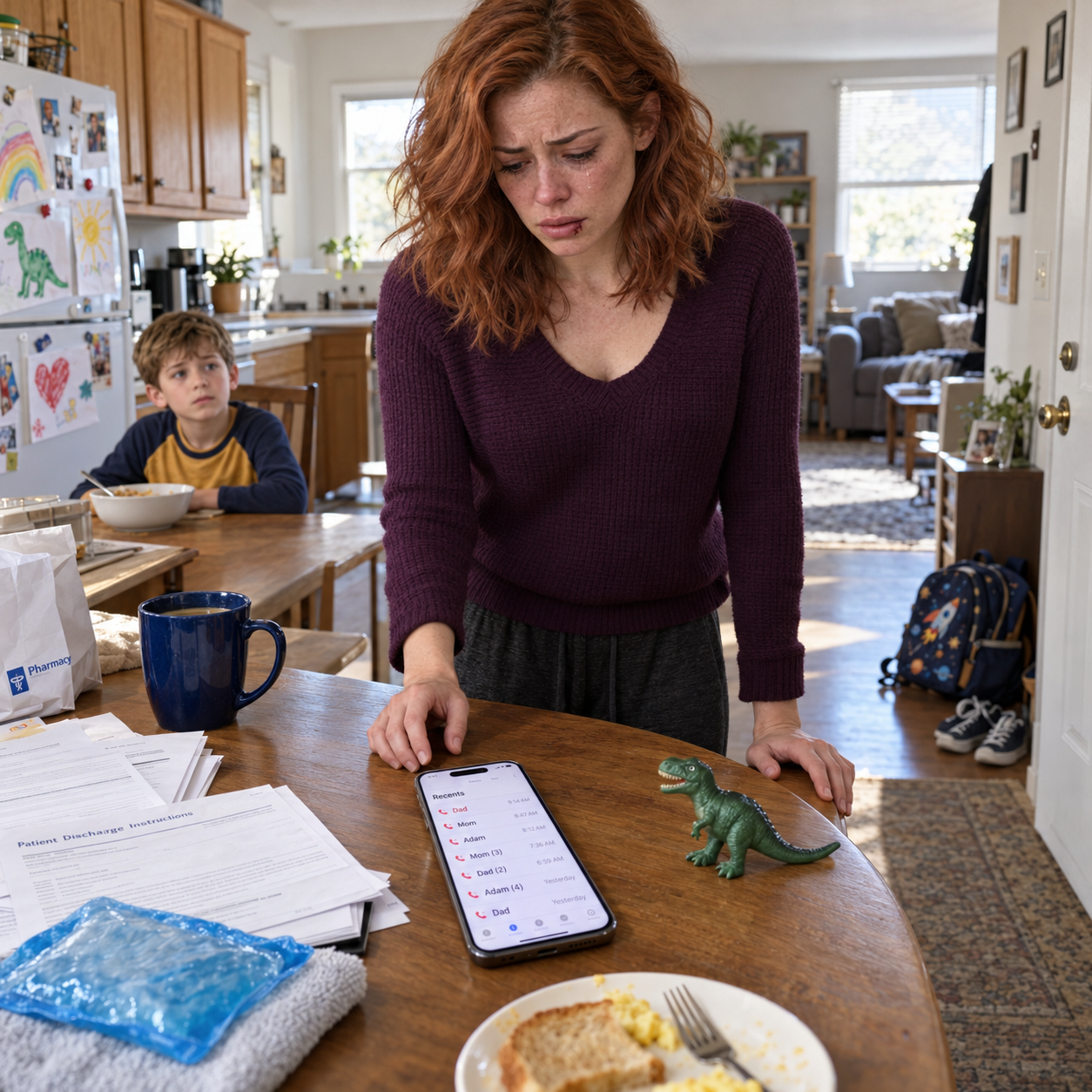
The following morning brought fourteen messages, almost all from Adam. “The payment didn’t go through,” he wrote, followed by, “I’ve got utilities coming up too,” and finally, “Emily, don’t make this complicated. I’ll make it up next month.” Mom contributed a message to the family group saying she wished I’d communicated my financial difficulties earlier because Adam was extremely stressed. Nobody had asked whether Daniel could sleep through the night.
I opened my banking app and reviewed twelve months of transfers, each one made at the expense of something Daniel and I could have used. There were weekends we’d stayed home, repairs I’d postponed, and a small vacation I’d promised my son but never booked. I canceled the future transfers and removed Adam’s mortgage account from my saved payment list. Then I called my insurance company about our wrecked car, arranged follow-up appointments, and started dealing with the problems that actually belonged to me.
A week later, my mother appeared outside our apartment carrying a pharmacy bag and a container of soup. She walked past me before I invited her inside, glanced toward Daniel building a Lego police station, and placed everything on the kitchen counter. “You should’ve explained how serious the accident was,” she said, smoothing the handles of the paper bag. I showed her the hospital message on my phone, but she only nodded and said, “Well, we were distracted with the birthday.”
For several minutes she talked about how exhausting the celebration had been, how Adam’s daughter was growing, and how my father had been worried about the overdue payment. When she finally mentioned Daniel, she asked whether he was back at school yet, without asking how he felt. Then she looked directly at me and said, “You understand Adam’s depending on you, don’t you?” I answered, “He’s thirty-six, Mom, and he has a job.”
Her expression tightened. “Having a job doesn’t mean someone isn’t struggling,” she replied, and I told her I understood that better than she realized. She asked whether I intended to punish Adam over a missed telephone call, but Daniel came into the kitchen before I answered. He held up his Lego police station and asked Grandma whether police officers always caught bad drivers, and she told him to ask me because she and I were discussing something important. I walked her to the door ten minutes later.
Adam arrived that Saturday without calling. I stepped into the hallway and closed the apartment door behind me while he explained that the lender had contacted him and another payment would soon be due. When I told him I was finished paying, he rubbed his forehead and asked, “So because we didn’t respond to a text fast enough, you’re going to put my house at risk?” I reminded him that Daniel had been strapped into an overturned car while he was posting restaurant photographs.
He looked uncomfortable for perhaps two seconds. Then he said, “You know how our family works, Emily. We’re not good with emotional stuff,” as though that explained everything. I asked why being uncomfortable with emotions had never stopped him from asking me for money, and he shifted his weight toward the stairwell. “You’re making me sound like some kind of criminal,” he muttered, before reminding me that I might need the family’s help someday.
That evening, my parents sent a long message expressing disappointment and requesting reassurance about future financial support. I responded once: “I will not make another mortgage payment for Adam. Daniel and I needed you after the accident, and you weren’t there. Please stop contacting me about his bills.” I muted the conversation, took Daniel’s dinosaur from the kitchen counter, and placed it beside his bed. For once, I let an approaching payment deadline remain someone else’s responsibility.
Friday arrived, and I sent nothing. Dad left a short voicemail insisting we needed to discuss my behavior, while Adam warned that the lender was becoming impatient. I spent the afternoon with Daniel at the park, where he climbed halfway up the playground ladder before asking me to stand underneath him. I stayed there until he was ready to climb down, and when we walked home, I noticed I hadn’t checked my phone in hours.
Part 3: My Brother Tried Turning My Identity Into His Financial Lifeline
Two weeks after I stopped paying, an unfamiliar number appeared while Daniel and I were baking cookies. I let it go to voicemail, assuming it was another relative trying to intervene, but the caller identified himself as Officer Dalton from Oak Hill Police Department. He was contacting me because Adam had listed me as his emergency contact following an arrest. I returned the call the next morning, already suspicious of what kind of help my brother might want.
Officer Dalton explained that Adam had been arrested for driving under the influence after striking a parked vehicle. Nobody had been injured, but dashcam footage documented the incident, and it was his second offense. Adam had asked whether I could help arrange his release, and the officer was simply passing along that request. I told him I wasn’t able to assist and asked that my parents be contacted instead.
By afternoon, Mom had texted, “You couldn’t even help your brother this once?” I read it while Daniel colored at the dining table, and I considered writing a detailed explanation of everything Adam had received from us. Instead, I put the phone away and asked Daniel what color he wanted for the spaceship in his drawing. He chose purple and spent the next ten minutes explaining why astronauts would need a dinosaur on Mars.
A few days later, a thick envelope arrived from Adam’s mortgage lender. Inside was a request for me to become a cosigner, accompanied by paperwork containing my full name, address, and employment information. A handwritten note from Adam described the arrangement as a formality that would help him avoid further financial trouble. He had prepared the documents without mentioning them to me, apparently confident that I would eventually sign.
I called the lender and spoke with a woman named Mrs. Keller, who confirmed that I had no existing legal obligation on Adam’s mortgage. She told me the cosigner request had been initiated but remained incomplete, and she agreed to flag the account after I stated that I’d never authorized the arrangement. I asked her to send written confirmation that I wasn’t attached to the loan. When I hung up, I placed every page in a folder alongside my payment records.
That night, Dad wrote, “You’re tearing this family apart with your selfishness.” I stared at the message for a long time, remembering how he’d once told me Adam needed more help because I had always been capable of managing on my own. I had accepted that explanation through job changes, divorce, childbirth, and years of single motherhood. Now my parents were treating my refusal to assume another person’s mortgage as a betrayal greater than leaving their grandson’s emergency unanswered.
Then a credit-monitoring alert arrived, reporting a suspicious loan application using my personal information. The application listed an unfamiliar address and an old telephone number Adam had used for years, while the employment details closely resembled those in the mortgage paperwork. The lender had paused the application for identity verification, so no money had been issued and no debt had appeared on my credit report. Even so, someone had attempted to borrow money while claiming to be me.
I spent the next day reviewing documents, making calls, and remembering something I’d dismissed months earlier. Adam had asked Mom for copies of old family paperwork while trying to refinance, and she’d casually mentioned keeping scanned copies of my documents from when I’d helped them with a loan years ago. I had never given either of them permission to use that information for another application. I froze my credit, submitted an identity-theft report, notified the lender, and kept the documentation in case investigators needed it.
The next morning, I received a terse email from Adam saying he’d only been exploring options and hadn’t actually gotten any money. That answer confirmed he’d known about the application, although he avoided explaining how he’d obtained my information. I forwarded the email to the investigator handling my report and replied that he was not authorized to use my identity for any financial purpose. I didn’t argue about his intentions; the application and his admission were enough.
Later that week, Daniel brought home a drawing of our apartment with a bright yellow sun above it. Two stick figures stood beneath a tree, and his teacher had helped him write, “I love my mom because she keeps me safe.” I taped it to the refrigerator, where it covered an old calendar reminder for Adam’s mortgage. Daniel watched me smooth its corners and asked whether we could put another drawing beside it tomorrow.
Part 4: When My Brother Lost His House, We Finally Found Peace
By winter, Adam’s financial problems had reached beyond what my parents could conceal. He had fallen behind on several payments, and Dad had withdrawn money from his retirement savings to prevent the mortgage from deteriorating further. My mother called from unfamiliar numbers, sometimes pleading and sometimes accusing, while Adam continued sending emails blaming me for abandoning him at the worst possible time. None of them acknowledged that he’d tried to use my identity without permission.
One afternoon, Mom left a voicemail saying Dad’s health was suffering from the stress and that I should reconsider what I was doing to the family. I called her back, partly because I wanted to hear her voice without the familiar accusations, and asked whether she’d received Daniel’s school photograph. She said she had, then immediately began explaining that Adam’s legal expenses and mortgage arrears were more serious than she’d realized. I asked why she was calling me instead of helping Adam work out a repayment plan with his lender.
“Because you can help,” she answered, as though there were no other possible reason. I reminded her that Adam had been receiving my financial help for a year before the accident and that he’d since submitted an unauthorized loan application in my name. Her voice softened as she said, “He was desperate, Emily,” and I agreed that he probably was. I told her desperation didn’t give him the right to jeopardize Daniel’s future, and she ended the call without answering.
Eventually, the mortgage moved through the foreclosure process. Adam received notices, struggled to make arrangements, and finally lost the house after the lender completed the required proceedings. By then, my parents had exhausted much of their emergency savings trying to keep him afloat, and Adam had moved into their home temporarily. I learned the details through a mutual acquaintance, not because anyone had finally decided to be honest with me.
A final email from Adam accused me of destroying his chance to provide a stable home for his daughter. I opened the folder containing the loan application, the cosigner request, and twelve months of payments, then read his message again. He’d received more than a year of assistance, but somewhere along the way, he’d started treating that assistance as an entitlement. I replied that he needed to communicate with his lender and attorney, because I wouldn’t participate in another financial arrangement with him.
My parents continued helping Adam find a smaller rental, although their relationship with him became strained. Dad took additional work to rebuild the savings he’d withdrawn, and Mom stopped volunteering details about Adam’s successes to relatives. Their explanations to family friends described our disagreement as a misunderstanding over money, leaving out the hospital message and the identity-theft attempt. I didn’t launch a campaign to correct the story, but I gave the truth and documentation to the people who had a legitimate reason to know.
I also began therapy, which proved considerably harder than canceling a bank transfer. We talked about the accident, Daniel’s nightmares, and the guilt that returned whenever I imagined my parents struggling. Eventually, we talked about how I had confused being needed with being loved and how often I’d sacrificed my own security to avoid disappointing them. My therapist never told me what relationship I should have with my family, but she helped me recognize that I could care about people without accepting responsibility for their choices.
By February, Daniel had returned to sleeping through the night and was thriving at school. His teacher wrote that he’d become more confident and was helping younger students adjust to classroom routines. I printed the email and tucked it into the same drawer where I kept our travel brochures, because I’d finally saved enough to plan a summer trip. For the first time in years, there was money left after paying our bills, and I didn’t feel compelled to explain that to anyone.
One afternoon at the grocery store, a woman who knew my parents stopped me near the frozen foods. She mentioned that Dad had said our family was experiencing difficulties and hoped everything would work out. I told her Daniel was doing well and thanked her for asking, and she smiled before returning to her shopping. Driving home, I realized I no longer needed strangers to understand my parents’ behavior before I could feel comfortable with my own decisions.
My family never offered the apology I’d once wanted so badly. Adam faced the consequences of his DUI and financial decisions, while the attempted loan application remained documented with the appropriate authorities. My parents occasionally sent holiday cards, but I didn’t resume financial support or allow them to use Daniel as a messenger. When he asked about visiting them, I told him we could discuss it when he felt ready and when I could trust that his safety and feelings would be respected.
On the anniversary of the accident, Daniel found the little green dinosaur in a box of toys beneath his bed. He carried it into the living room and asked whether I remembered the birthday party where he’d gotten it. I said I did, expecting him to mention the crash, but he smiled and told me he’d been saving it because it was his favorite. Then he climbed onto the couch, tucked himself beneath our shared blanket, and asked if we could watch a movie.
We lit a small candle on the coffee table that evening, something Daniel suggested to celebrate being safe for an entire year. He chose a movie about astronauts, and halfway through it, he fell asleep with his head against my shoulder. Outside, traffic moved along the street, ordinary cars carrying ordinary people home. I watched their headlights pass across the curtains and realized how much our lives had changed without becoming perfect.
My parents still had their disappointments, my brother still had debts to face, and I still had mornings when guilt whispered that I should call and offer help. But the bank account was mine again, our home was peaceful, and my son no longer had to compete with anyone else’s emergencies for my attention. I put the dinosaur on the shelf beside his drawing, switched off the living room light, and carried Daniel gently to bed. When he reached for my hand in his sleep, I stayed until his fingers relaxed.
The End .
All characters and events in this story are fictional, created for storytelling and entertainment purposes. Thank you sincerely for reading. Your feedback and support are invaluable and motivate me to continue sharing more stories with you.