
Part 2: Six Days Of Small Insults Reveal A Larger Betrayal
By the following morning, the house smelled of burnt toast, coffee, and somebody’s heavily perfumed lotion. I was wiping juice from the counter when Paige asked whether there were any eggs. “There’s cereal, toast, and fruit,” I said. She glanced at the pantry and answered, “Bryn said you were wonderful about feeding a crowd.”
That sentence stayed with me longer than it deserved. During breakfast, a cousin named Cora mentioned that she’d been surprised I wanted everyone together so soon after moving. “That’s what Bryn told us,” she said, stirring her coffee. “She said you were lonely in the new place and wanted to make it feel like a family home.” Bryn interrupted from the doorway, asking Cora to help unload the coolers.
I didn’t challenge her then. Instead, I started paying closer attention to the difference between what my guests believed and what I’d actually agreed to. Several seemed uncomfortable asking where things belonged, while others treated every room as communal property. By evening, someone had opened a bottle of wine I’d saved for my housewarming dinner with Harriet.
The next three days passed in a steady procession of small indignities. A teenager broke the ceramic soap dish in the upstairs bathroom and left the pieces in the sink. Someone scratched my dining table while moving chairs, and the pullout mattress developed a dark wine stain. Paige took my husband’s framed photograph off a side table because she wanted somewhere to put her water glass.
“That’s my husband, Martin,” I said when I saw her holding the frame by one corner. “He’s been gone six years.” Paige glanced at the photograph and set it on a bookshelf. “Of course, honey. I was only making a little room.” I carried Martin’s picture back to the den without answering.
Bryn seemed happiest when directing everyone else’s movements. She organized a shopping trip, arranged an afternoon at the lake, and discussed another family dinner without once asking whether I wanted to participate. When I declined to prepare breakfast on the fourth morning, she looked at the cereal boxes I’d placed on the counter. “People were counting on a real meal, Roberta,” she said.
“Then someone can make one,” I replied. She stared at me as though I’d spoken in a foreign language, then turned toward the dining room and asked whether anyone wanted pancakes. I heard drawers opening, pans clattering, and somebody complaining that the kitchen didn’t have the right skillet. For once, I sat on the porch and finished my coffee while it was hot.
Elliot texted that afternoon, asking how the visit was going. I typed, “There are nineteen people staying here, and I’m sleeping in the den,” then erased it. Instead, I wrote, “We’re managing.” His reply was a thumbs-up emoji, and I put the phone aside, annoyed at myself for making the situation easier for him to ignore.
On the fifth evening, Cora found me photographing a gouge along the dining table’s edge. She looked at the camera, then at my yellow pad. “Are you keeping track of everything?” she asked. “I’m keeping track of my house,” I answered. She hesitated before saying, “I thought Bryn asked you before inviting everybody.”
“She called when you were two hours away.” Cora lowered her eyes, then took out her phone and showed me the family group message that had started the trip. Bryn had written, “Roberta wants everyone together at her new place. She’s got the rooms, and she’s happy to host the whole week.” Below it were cheerful replies about free lodging, shared meals, and bringing extra relatives.
I asked Cora to send me a screenshot. She did, looking embarrassed, and then quietly apologized for assuming I’d volunteered. I thanked her and returned to my notebook, where I added another page of notes. Until that moment, I’d believed Bryn had simply taken advantage of an opportunity; now I knew she’d created the opportunity herself.
The following morning, I called a local property attorney named Margaret Ellis. I explained that the guests had entered with my permission, but that the invitation had been obtained through a last-minute announcement and false promises made to other people. Margaret advised me not to improvise eviction threats or assume I could charge retroactively for a stay I’d allowed. She did explain how to withdraw permission for future lodging, document property damage, and request assistance if the guests refused to leave.
After the call, I visited the library and printed short-term lodging agreement forms Harriet had helped me prepare. Each listed a proposed rate of seventy-five dollars per adult per night for any continued stay, a two-hundred-dollar refundable deposit per occupied room, quiet hours, and responsibility for documented damage. The forms made clear that nobody owed those proposed lodging charges unless they voluntarily agreed to new terms. Anyone unwilling to accept them would need to arrange other accommodations.
I also contacted the county housing office about the number of overnight occupants. A code enforcement officer named Daniel Wendell explained that rules concerning overcrowding, emergency exits, and paid short-term accommodations differed depending on the property’s use. He couldn’t settle a family disagreement, but he offered to visit and explain the applicable safety concerns.
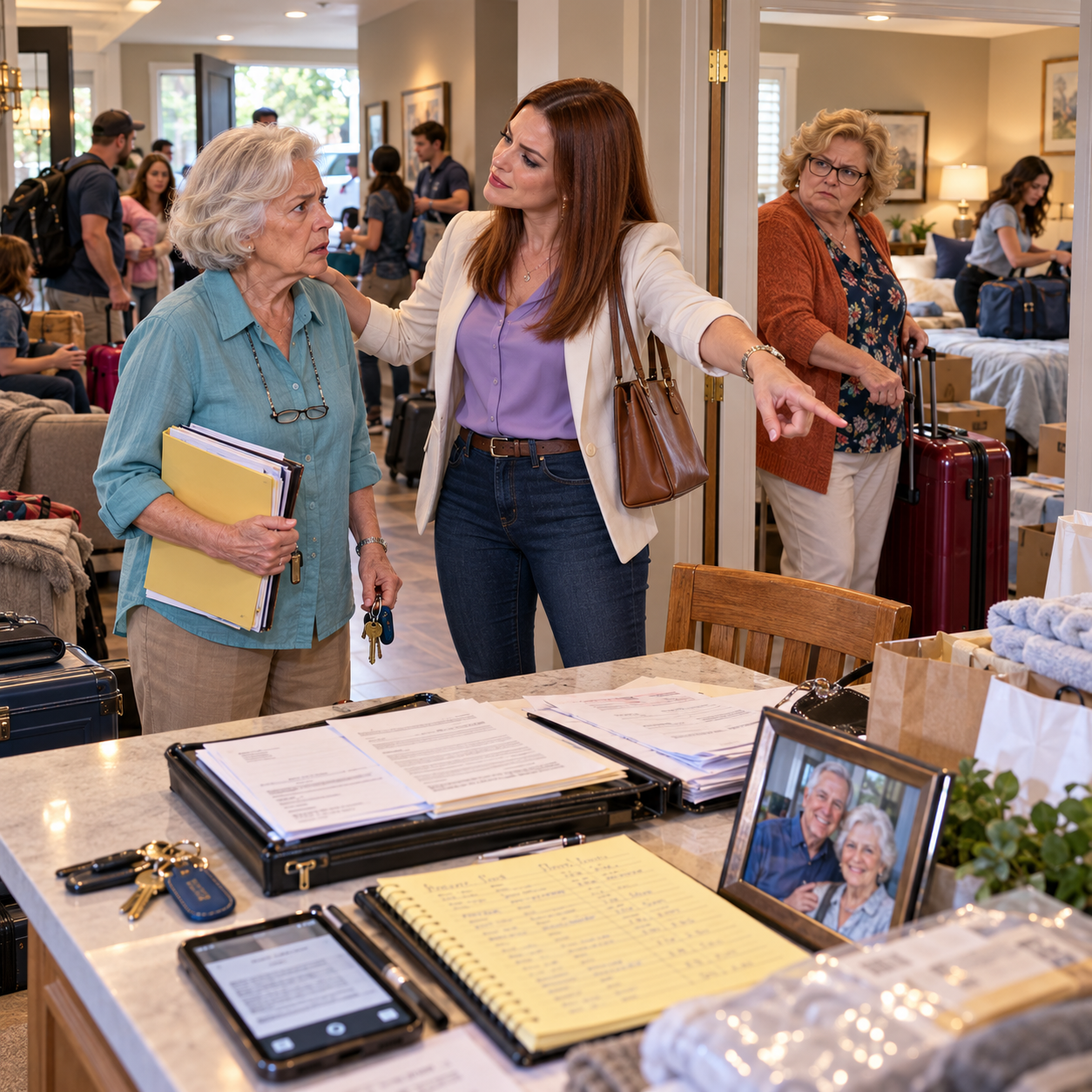
That evening, while the television blared and several cousins played cards in my living room, I arranged folders around the dining table. Inside each were the proposed terms, the house rules, and a printed notice that the open-ended invitation was ending. Beside each folder I placed a pen. Then I went upstairs, retrieved Martin’s photograph, and put it on the kitchen counter where everyone would see it the following morning.
Part 3: A Stack Of Agreements Turns An Invasion Into A Choice
At eight fifteen on Thursday morning, Bryn came downstairs wearing a faded college sweatshirt and carrying an empty coffee mug. She noticed the folders immediately. “What’s all this?” she asked, lifting one and turning it over. I poured coffee into my blue ceramic mug and told her the household arrangements were changing.
She read the first paragraph, then looked at the proposed seventy-five-dollar nightly rate. “You’re charging family to stay here?” Her voice carried far enough that Paige appeared in the hallway. “I’m giving everyone a choice about any further stay,” I said. “You can agree to the terms, or you can make arrangements to leave today.”
Bryn placed the papers flat on the table. “Roberta, don’t be ridiculous. We came here because you said you wanted company.” I reached into my notebook and unfolded the screenshot Cora had sent me. “I never said that,” I replied, sliding the printed message toward her. “You told eighteen other people I had invited them before you even called me.”
Paige stepped closer and read the message over Bryn’s shoulder. For the first time since arriving, she seemed uncertain where to direct her criticism. “Bryn, you said she’d asked for a family week,” she murmured. Bryn brushed the paper away and said she’d only wanted everyone to spend time together. “You were always telling us you wanted more family around,” she added.
“I wanted dinner with my grandchildren sometimes. I wanted someone to ask how I was doing. I didn’t ask nineteen people to take over my house.” I kept my voice level, although my hand tightened around the coffee mug. Bryn’s expression shifted as she realized several relatives were listening from the stairs.
At 9:20, Officer Wendell knocked. He wore a county identification badge and carried a clipboard, and I introduced him before asking whether he’d explain the occupancy concerns we’d discussed. He looked over the bedrooms and the arrangements for sleeping in the den, then spoke plainly about emergency access, fire safety, and potential restrictions if the house were operated as paid lodging. He also made clear that he wasn’t there to collect money, enforce my proposed contract, or order my relatives out.
“But it’s her house,” Paige said, pointing toward me. “Can’t she decide who stays?” Wendell nodded. “The homeowner can set reasonable conditions for guests and withdraw permission to stay, subject to applicable law. If there’s a dispute about somebody refusing to leave, that’s a separate legal matter.” He handed me written information and departed without making a spectacle of the visit.
Bryn remained beside the table, holding the agreement between two fingers. “You called the county on your own family?” she asked. “I called because nineteen people are sleeping in a three-bedroom house, and nobody asked whether I could accommodate them.” She shook her head, her cheeks reddening. “You’re making me look terrible in front of everyone.”
Cora spoke from the kitchen doorway. “Bryn, you told us Roberta invited us. You could’ve just asked her first.” Bryn turned sharply toward her cousin, then stopped herself. For a moment, she looked less angry than cornered, as though every convenient assumption she’d made had finally been spoken aloud.
She took out her phone and called Elliot. I could hear his voice faintly from where I stood, asking what was happening. Bryn told him I was demanding money, bringing officials into the house, and humiliating his relatives. When she handed me the phone, he asked, “Mom, can’t everybody just calm down and finish the visit?”
“Elliot, did you know there were nineteen people sleeping here?” I asked. He said he thought Bryn was bringing a few relatives for a short visit. I told him about the group message, my bedroom, and the six nights I’d spent on the pullout sofa. He didn’t interrupt, and when I finished, he asked whether I could send him the screenshot.
I sent it while we were still connected. There was a long pause, followed by the faint sound of him moving away from wherever he was standing. “Bryn told me you wanted this,” he said quietly. “I know,” I answered. “That’s the problem.”
Several relatives began packing before lunch. Cora apologized again and offered to help clean, while two cousins who’d initially agreed to the new terms decided they would rather rent rooms elsewhere. Paige carried her suitcase downstairs with stiff movements, then stopped beside the front door. “I didn’t know you hadn’t invited us, Roberta,” she said, without meeting my eyes.
“I believe you,” I told her. She glanced toward Bryn, who was pulling luggage from the hallway closet, but said nothing else. By twelve thirty, the driveway was crowded with open trunks and suitcases. The teenagers were subdued, and one little boy asked his mother why they couldn’t stay longer.
Bryn was the last to leave. She passed me near the staircase, her overnight bag against her hip and her car keys clenched in one hand. “I hope you’re happy with what you’ve done,” she said. I looked at the mark her suitcase had left along the baseboard. “I hope next time you’ll ask before making plans in somebody else’s home.”
She walked out without answering. At 1:40, the last vehicle disappeared down the road, taking the kayak, the coolers, and nineteen unexpected guests with it. I closed the front door and stood in the entryway, noticing how much larger the hallway looked without luggage. Then I picked up my camera and began inspecting the rooms.
Part 4: What My Son Finally Learned About Love And Boundaries
The house needed more than fresh sheets. I found a cracked soap dish, scratches on the dining table, a wine-stained mattress, and my good kitchen scissors inside a bathroom cabinet. One guest had left a half-eaten granola bar on a windowsill, and another had spilled something sticky beneath the kitchen trash can. I photographed the damage, saved the receipts, and hired a cleaning service rather than spend another week repairing the consequences of Bryn’s invitation.
I sent Bryn an email documenting the damaged items and requesting reimbursement for the actual costs, not the proposed lodging fees nobody had agreed to pay. She didn’t respond. Margaret advised me to preserve the photographs and receipts but cautioned that recovering modest amounts might cost more time and money than it was worth. I decided I could absorb some losses without pretending the damage hadn’t happened.
Elliot called that evening. He sounded tired and asked whether I was willing to talk about Bryn. “I will, but I won’t have the same conversation we’ve had for five years,” I told him. He said Bryn felt publicly embarrassed, and I acknowledged that being confronted in front of relatives must have been painful. Then I asked whether he’d considered how it felt to spend the first week in my new home sleeping beside a box of winter coats.
He didn’t answer immediately. Finally, he said, “I should’ve asked more questions.” I looked around the kitchen at the freshly cleaned counters. “Yes, Elliot. You should have.”
The next morning, two women from the cleaning service arrived with buckets, supplies, and a vacuum that sounded like a lawn mower. I made them sandwiches while they worked and stayed out of their way. When they finished, the house smelled of clean tile and cedar instead of old food and damp towels. That evening, I lit the lavender candle I’d purchased for my first night there.
A week later, my neighbor Bev knocked with a loaf of banana bread. She was a retired teacher with silver hair and gardening gloves sticking out of her coat pocket. “I saw quite a lot of cars over here,” she said, smiling gently. “Thought you might appreciate a quieter kind of company.”
We sat on the back porch for nearly two hours, discussing rose bushes, stubborn adult children, and the difficulty of growing tomatoes in our neighborhood’s clay soil. Bev asked about my husband after noticing his photograph through the kitchen window. I told her Martin had always wanted a porch like this one. She listened without interrupting, and when she left, she took only her empty plate and the promise that we’d visit a local nursery together.
Bryn texted twice during the following week. The first message asked whether I intended to keep “punishing the family,” and the second said we needed to talk. I didn’t reply immediately, because I wanted to be sure I wasn’t responding out of exhaustion or anger. Eventually I wrote that I was willing to discuss the matter privately if she could acknowledge that she’d invited people without my consent and misrepresented my wishes.
She answered that she’d only been trying to create a nice family memory. I looked at the message for a while before setting down the phone. Perhaps that was how she’d justified it to herself, but a pleasant memory for eighteen people had required taking something from the nineteenth. I didn’t send another message.
The following weekend, Elliot and I met at a small steakhouse halfway between our homes. He arrived ten minutes early, wearing the blue button-down shirt I’d given him for his last birthday. We ordered dinner and talked about his work, the grandchildren’s school, and my garden plans before he finally mentioned Bryn. “She’s not a bad person, Mom,” he said, cutting a piece of steak into smaller pieces than necessary.
“I know she has good qualities,” I answered. “I’ve seen them.” He looked up, apparently relieved, until I continued. “But being generous with other people’s time, money, and homes isn’t kindness. It’s easy to promise something when somebody else has to provide it.”
Elliot set down his knife. “I told her that,” he said. “She thinks you could’ve handled it privately.” I reminded him that I’d tried to ask about the arrangements before the visitors arrived, and again during the visit, only to have my concerns brushed aside. “I could’ve spoken up sooner,” I admitted. “That part belongs to me. I kept hoping people would notice what I needed without having to say it.”
He rubbed his thumb along the edge of his water glass. “You did that at our house, too.” I nodded. For years I’d treated every request as something I had to satisfy, and they had mistaken my constant availability for a permanent arrangement. It hadn’t been fair to any of us, including Elliot’s children, who deserved to understand that their grandmother had a life of her own.
Before we left, Elliot asked whether he and the grandchildren could visit the following Sunday. “Just the three of us,” he added. I smiled and told him Sunday afternoon would be lovely, provided he called first. He laughed quietly and said, “I can do that.”
The next week, I met with Margaret again to review my estate documents. I’d originally left the house to Elliot with very few conditions, assuming the family would always treat my home as mine while I was alive. After discussing the practical difficulties of vague inheritance restrictions, we revised the documents to make my wishes clearer and ensure that no future transfer could be treated as a present entitlement. I also arranged for an independent executor, someone who would follow written instructions rather than family pressure.
On Sunday, Elliot arrived carrying a bag of groceries, and the grandchildren helped me plant tulip bulbs along the back fence. My youngest granddaughter asked whether she could sleep over sometime, and I told her we could plan a weekend together when she didn’t have school activities. She nodded, entirely satisfied by an answer that wasn’t an immediate yes. Elliot watched us from the porch, then came down the steps to help dig.
After they left, I washed three muddy garden tools and set them beside the back door. The maple had turned completely orange, and its leaves scattered across the lawn whenever the wind came through. I prepared a simple dinner of chicken, rice, and carrots, carrying one plate to the kitchen table. For the first time since I’d moved in, there was no extra meal to prepare, no unannounced guest to accommodate, and no reason to feel guilty about either.
Martin’s photograph stood on the windowsill beside the lavender candle. I could almost hear him teasing me about measuring the garden beds twice before planting anything. He’d always said that a good home wasn’t measured by how many people could fit inside it, but by whether the people living there felt comfortable being themselves. I understood that better at seventy-one than I had at forty.
That evening, I turned on the porch light and opened the windows to let in the cool October air. Somewhere down the street, a dog barked, and I heard Bev laughing while speaking to someone across the fence. I looked around my kitchen, at the dish towels in their proper drawer and the clear countertops I’d chosen for myself. Then I locked the front door, not to keep my family out forever, but because I finally understood that loving them didn’t mean giving everyone a key.
The End .
All characters and events in this story are fictional, created for storytelling and entertainment purposes. Thank you sincerely for reading. Your feedback and support are invaluable and motivate me to continue sharing more stories with you.


