### Part 2: The Video Reveals What My Daughter Was Punished For Asking
Sophie went into surgery that night. I spent the hours in a waiting room beside a vending machine, staring at a paper cup of coffee that had gone cold before I remembered to drink it. When Dr. Patel finally returned, she explained that Sophie’s jaw had been stabilized and that recovery would require careful follow-up, restricted foods, and patience. She told me the treatment had gone as planned, and I thanked her until she gently said I didn’t need to keep thanking her.
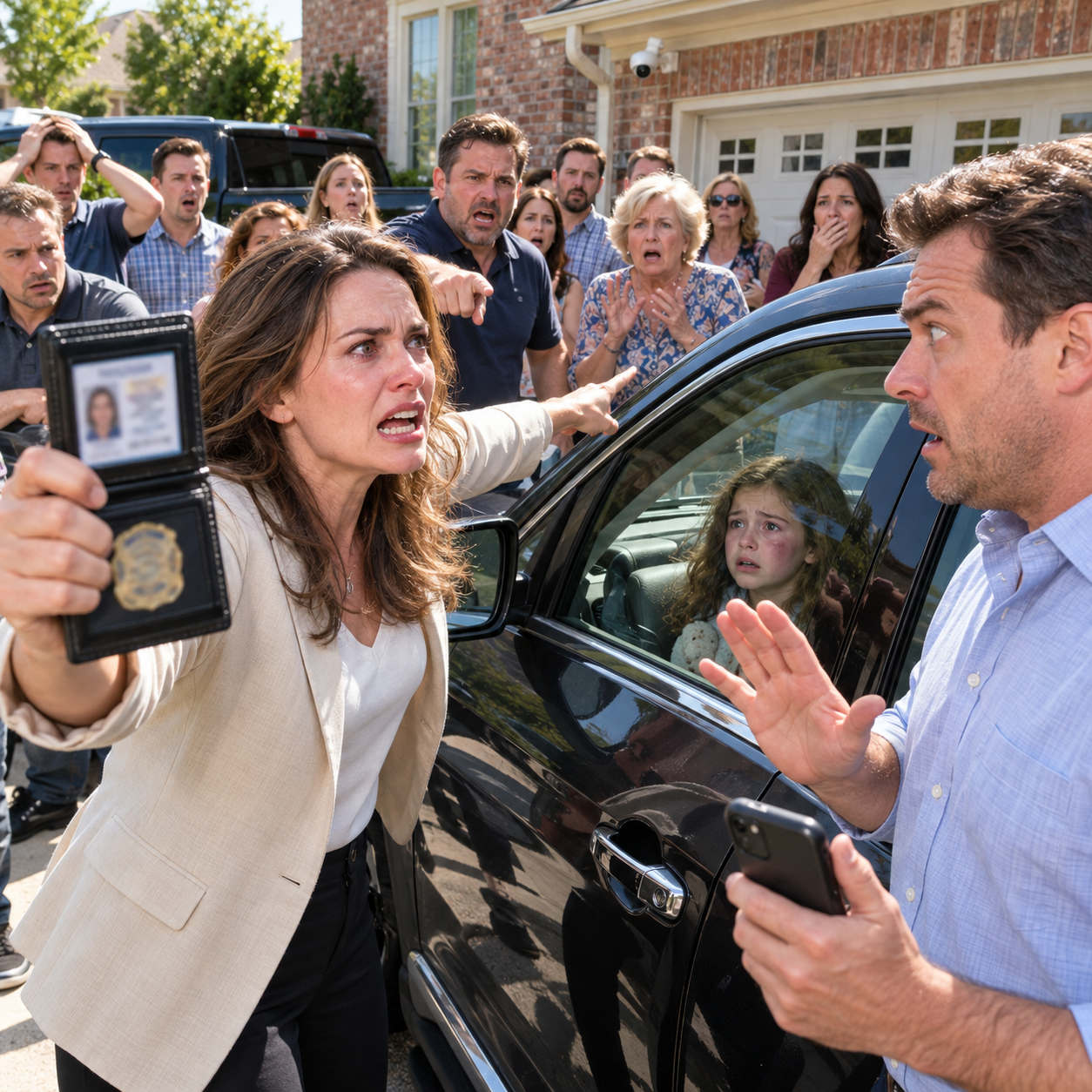
By morning, a hospital social worker and an investigator had spoken with me. I described what I had personally seen, including the relatives surrounding my SUV, but refused to guess about the minutes before I arrived. The investigator took copies of Grant’s messages, while Leah requested that the original phone recording and the house’s security footage be preserved. Two days later, Owen provided investigators with a copy of the video Grant had shared in a family message thread.
I watched the recording in Leah’s office, with an investigator present. Grant had started filming Sophie because she was crying and asking to call me. His voice could be heard telling her that she was embarrassing him, while Sophie stood near the fireplace, holding a small stuffed rabbit against her chest. “I just want Mom,” she kept saying, her words uneven from crying.
Caleb entered the frame and ordered her to stop. Sophie backed away, still asking for me, and he raised his hand and struck her across the face. She lost her balance against the stone hearth, and the camera jerked as Grant reacted. Instead of immediately helping her, he made a nervous, ugly little laugh and said something about her finally learning to behave.
I pushed the laptop away when the recording reached the sound of Sophie crying in pain. Leah stopped the video, allowing me a moment before asking whether I wanted water. I shook my head and looked at the stuffed rabbit resting on the frozen screen. Sophie had carried that rabbit since preschool, and I had repaired its torn ear just the previous week.
The recording continued after the injury, capturing Caleb arguing that Sophie was fine and Owen insisting she needed medical attention. Diane could be heard urging everyone not to involve outsiders before they understood what had happened. Nobody called for an ambulance. Grant had kept recording, apparently believing he was collecting proof that I encouraged Sophie to disobey him.
The medical records established the seriousness of the injury, while timestamps on the recording helped investigators reconstruct the delay in obtaining care. Exterior security footage confirmed that eleven relatives had surrounded my vehicle and that Grant had stood between me and the driver’s door. Their explanations began changing after they learned both recordings had been preserved. Some claimed they were only trying to talk; others admitted they wanted me to stay until the family agreed on what to tell the hospital.
Diane sent me a long message explaining that Caleb had been under financial pressure and that Grant had become overwhelmed by the divorce. She wrote about the family business, their reputation, and how much damage a criminal investigation could cause. I understood she was frightened for her sons, but her message contained remarkably little about Sophie. I replied only that all communication concerning the incident should go through our attorneys.
Owen eventually provided a formal statement. He admitted that he’d initially gone along with the family’s demand to delay calling me, even though he knew Sophie needed help. When he saw her struggling to speak, he’d slipped into the kitchen and called despite Grant’s instructions. The relatives had followed us outside, he said, because Caleb believed they could persuade me not to report what had happened.
His statement cost him his place in the family’s comfortable hierarchy. Caleb accused him of betrayal, and Grant stopped returning his calls. Owen wrote me a letter apologizing for hesitating before calling and for standing near the SUV instead of helping immediately. I couldn’t offer him forgiveness on Sophie’s behalf, but I sent a short response thanking him for telling investigators the truth.
Meanwhile, Sophie was learning to communicate around her healing jaw. She used a little whiteboard for longer thoughts, decorating its corners with stars and crooked flowers. One afternoon, while I was helping her change into clean pajamas, she wrote, “Was Uncle Caleb mad because I wanted you?” I sat beside her and explained that grown-ups were responsible for controlling their own actions, no matter how upset a child became.
She studied my face before writing another question. “Dad laughed. Was I funny?” I had prepared myself for questions about pain, school, and when she could eat pizza again, but not that one. I told her she hadn’t done anything funny or wrong and that her father should have helped her. She held the whiteboard against her chest for a long time before asking me to stay until she fell asleep.
Leah filed for emergency custody protections, supported by the hospital records, recordings, and witness statements. Grant’s attorney argued that Caleb had acted unexpectedly and that Grant shouldn’t lose parenting time because of another adult’s behavior. The court also had to consider Grant’s own conduct: filming his distressed daughter, failing to obtain prompt care, and participating in the effort to stop me from leaving. Temporary orders suspended his unsupervised parenting time and prohibited Caleb from having contact with Sophie.
Grant called my attorney’s office requesting a conversation. Leah advised against a private meeting, but arranged for his concerns to be addressed through the court process. His written statement emphasized that he hadn’t personally struck Sophie and that he loved her. Both assertions could be true, I realized, without changing the fact that he’d failed to protect her.
At Sophie’s first counseling appointment, she brought the stuffed rabbit and refused to enter the room without me. Her therapist invited me to sit nearby while Sophie colored a picture of our kitchen table. When the appointment ended, Sophie asked whether adults were allowed to cry when they made mistakes. I told her they were, but crying didn’t erase the need to put things right.
### Part 3: The Courts Set Boundaries While My Daughter Learns to Heal
The months that followed were far quieter than the afternoon in Grant’s driveway, but they demanded more from us. Sophie attended medical appointments and counseling sessions, and I reorganized my work schedule around her recovery. Some nights she slept peacefully; on others, she woke frightened and asked whether Caleb knew where we lived. I installed an additional outdoor camera and followed the safety recommendations Leah and the investigators provided.
As her jaw healed, Sophie became increasingly frustrated with her restricted diet. She missed crunchy cereal, apples, and the peanut butter crackers she used to pack for school. We invented ridiculous names for smoothies, and she kept a calendar of foods she hoped to try again. On difficult mornings, she sometimes snapped at me, then immediately apologized, expecting me to be angry. I began making a point of showing her that disagreement didn’t threaten our relationship.
Caleb was formally charged in connection with the assault. Facing the video, medical evidence, and witness testimony, he ultimately entered a guilty plea. His sentence included court-imposed consequences and conditions designed to prevent further contact with Sophie. The family business also removed him from his management role, a decision that caused considerable conflict among relatives who had once considered him indispensable.
Diane struggled longer than anyone else to accept what had happened. During formal questioning, she acknowledged seeing Caleb strike Sophie, although she continued insisting he hadn’t intended such serious injuries. Later, she sent a handwritten letter saying she had been afraid her family would fall apart if outsiders became involved. I kept the letter for my records, but didn’t respond because her fear did not excuse the decision to delay Sophie’s care.
Grant’s custody case was different from Caleb’s criminal proceedings. He wasn’t being judged for throwing the blow, but for what he had done before and afterward as Sophie’s father. During a hearing, he admitted that he had filmed Sophie to demonstrate what he considered unreasonable behavior. His attorney encouraged him to answer directly when asked why he hadn’t immediately taken her for medical treatment.
Grant stared at the table before answering. “I thought Caleb would calm down, and I didn’t want another argument in front of everybody.” Asked about the driveway, he acknowledged that he’d wanted to prevent me from leaving before they had discussed what would be reported. He began crying as he described seeing Sophie in the hospital photographs. I believed he was ashamed, but shame and the ability to protect a child were not the same thing.
The court established longer-term custody and safety orders granting me primary residential custody and requiring professional supervision for any contact Grant had with Sophie. Her therapist’s recommendations and emotional readiness would guide how that contact developed. Caleb remained prohibited from contacting her, and Grant was required to demonstrate that he could respect safety boundaries. The orders were practical rather than triumphant, but they gave Sophie protection that no family agreement had provided.
Several weeks afterward, Owen asked whether he could visit us. After discussing it with Leah and confirming Sophie was comfortable, I invited him for a short afternoon visit. He arrived carrying a children’s astronomy book and stood awkwardly in our entryway while Sophie considered him. When she finally said hello, he crouched to her level and told her he was sorry he hadn’t helped sooner.
Sophie looked at the book, then asked him why he’d been scared of Uncle Caleb. Owen took a moment before answering that Caleb had always made him feel as though disagreeing meant losing his family. “But that’s something I should have handled,” he told her. “You were the kid. I was supposed to help.” Sophie accepted the book without offering a response, and Owen didn’t ask her to.
Grant’s first supervised visit happened months later. Sophie agreed to attend after several conversations with her therapist, and I didn’t press her for details afterward. She told me they had played a board game and that Grant had apologized for not taking care of her. When I asked how she felt, she shrugged and said she was glad someone else had been there. I thanked her for telling me and left the subject alone.
There were moments when I missed the ordinary life we’d had before the injury, even though I knew that life hadn’t been as safe as I’d imagined. I missed uncomplicated school pickups and weekends that didn’t require checking court orders. I missed being able to hear Sophie ask about her father without wondering whether she was afraid of the answer. Still, I learned not to turn every difficult feeling into a problem that needed solving immediately.
One afternoon, Sophie came home upset because another child had taken her favorite marker at school. She told me she’d asked for it back and hadn’t apologized when the other girl complained. I asked whether she’d been kind about it, and Sophie said she’d used her regular voice, not her angry one. Then she smiled, visibly pleased with herself.
By late autumn, Dr. Patel cleared Sophie to return gradually to normal foods. On the way home from the appointment, she asked whether we could buy apples, and she insisted on choosing them herself. She picked three red ones and carried the bag through the grocery store as though it contained something precious. At home, she washed an apple, waited while I cut it into thin slices, and sat down at the kitchen table.
She took a careful bite, chewed slowly, and looked at me with surprise. “It doesn’t hurt,” she said, touching her jaw as though checking whether she could trust the feeling. I watched her take another bite and remembered the hospital bed, the whiteboard, and all the nights she’d been afraid to speak. Instead of making a celebration out of it, I sat down beside her with my own apple.
After a while, Sophie asked whether she would ever have to return to the house with the stone fireplace. I told her the court’s orders meant she would not be sent back there, and that any future changes would have to be considered with her safety first. She nodded, thought about it, and asked whether she was still allowed to miss her dad sometimes. I told her she could miss him as much as she wanted and that loving someone didn’t mean accepting whatever they did.
She finished her apple slices and asked for another. I reached for the knife, and she stopped me with a small, confident gesture. “I can do it, Mom,” she said, selecting a piece she’d already cut in half. Watching her eat, I understood that no court order could give her back the afternoon she’d lost, but every ordinary day offered another chance to show her what safety felt like.
The legal consequences had changed the adults around her, but Sophie’s recovery belonged to Sophie. She was learning to say no, to express anger, to ask for comfort, and to expect that the people who loved her would listen. When she leaned against me later that evening, her stuffed rabbit tucked beneath one arm, I held her close without asking her to be brave. For once, she didn’t apologize for needing me.
The End .
All characters and events in this story are fictional, created for storytelling and entertainment purposes. Thank you sincerely for reading. Your feedback and support are invaluable and motivate me to continue sharing more stories with you.