
### Part 2: Every Packed Box Exposed the Life They Tried Erasing
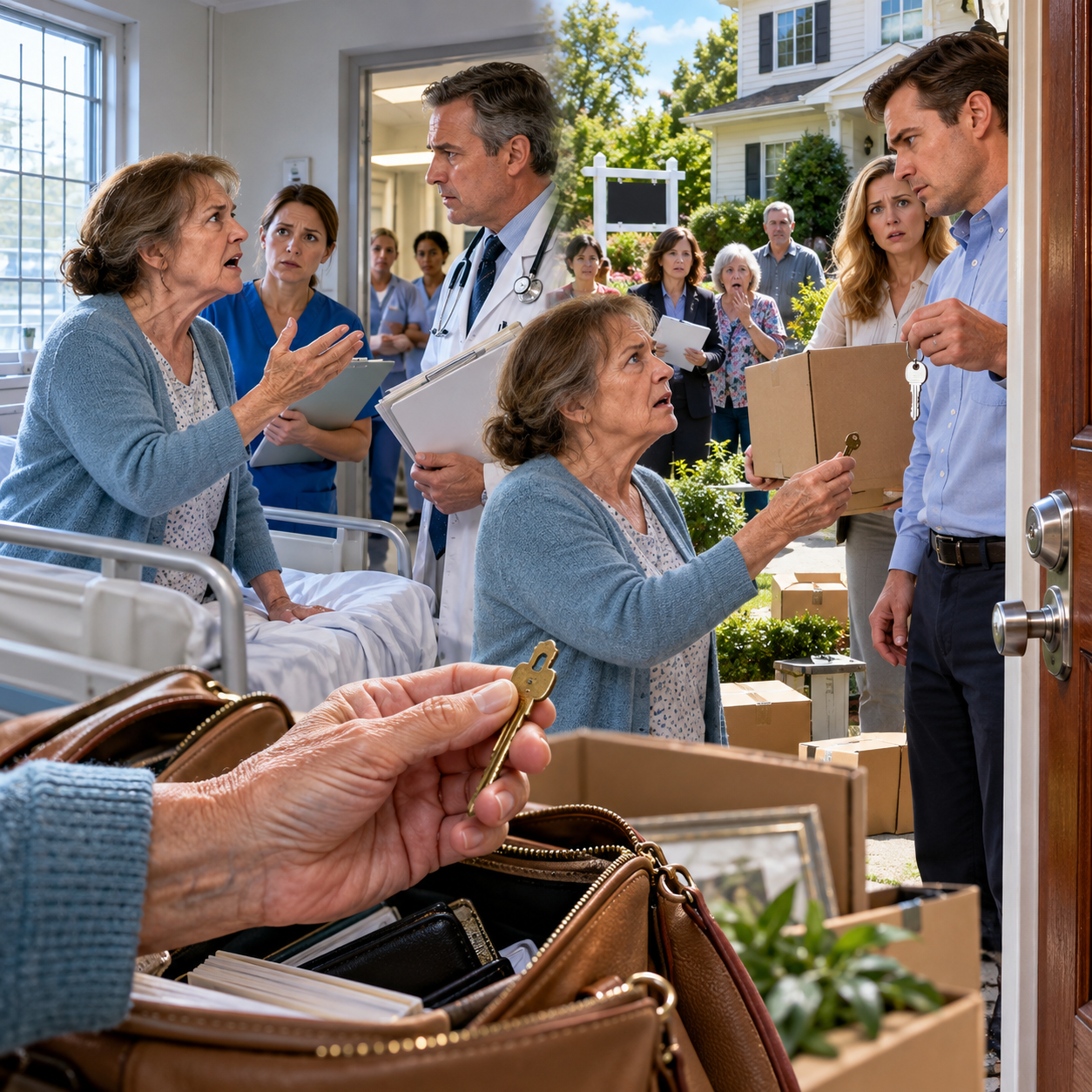
Inside, my house looked as though someone had begun dismantling it.
Harold’s grandmother’s dining table was gone. My mother’s china cabinet stood empty, and the shelves where I’d kept forty years of first editions held three cheap paperbacks.
Emma appeared from the kitchen wearing yellow rubber gloves.
“Maggie! You’re home!”
She smiled and set a cardboard box beside the door.
“Where are my books?” I asked.
David answered before she could speak.
“Mom, you decided to donate them. Remember?”
I looked at Emma. Her smile remained fixed, but her fingers tightened around the box.
“Oh,” I whispered. “I suppose I forgot.”
Upstairs, my bedroom had become a warehouse.
Boxes lined the walls, labeled in Emma’s careful handwriting.
BOOKS—SELL.
CHINA—STORAGE.
JEWELRY—APPRAISE.
LINENS—DONATE.
My grandmother’s pearls were missing. So were Harold’s watch and the diamond earrings he’d given me on our twentieth anniversary.
Then I saw a box beside the closet.
PHOTOS—TRASH.
Inside lay our wedding pictures, David’s baby photographs, Jennifer’s graduation portrait, and hundreds of moments Harold and I had spent a lifetime preserving.
I pulled out a picture of David at seven, grinning beneath a crooked paper birthday crown.
The boy who once cried when I left him at summer camp had grown into a man who could throw away photographs of his own childhood.
My telephone vibrated.
A message from Nancy at Premier Real Estate asked whether buyers could tour the property that afternoon.
I photographed every box, then called William. He instructed me to preserve everything and avoid signing documents.
When David came upstairs, I was sitting on the bed holding an old photograph.
“Sweetheart, where did that fifteen thousand dollars go?”
His expression stiffened.
“Mom, Emma’s been helping with your bills. You keep forgetting what you’ve spent.”
“Of course,” I said softly. “I’m lucky to have you.”
He kissed my forehead.
I waited until he left before wiping the spot with my sleeve.
My next call was to Detective Sarah Martinez.
Fifteen years earlier, Sarah had sat in my English classroom, a shy girl who rarely spoke above a whisper. Now she worked major investigations.
She arrived carrying two coffees, pretending she was visiting an old teacher.
I showed her the toxicology report, property listing, and photographs.
“Mrs. Collins,” she said, “this needs a formal investigation.”
“Then start with Dr. Peterson.”
Three months earlier, David had persuaded me to abandon my longtime physician for Dr. Peterson, a supposed specialist in elderly patients. Yet the guardianship petition described symptoms dating back six months.
Sarah frowned.
“Medical records shouldn’t describe examinations that never happened.”
That evening, David returned with Chinese takeout.
He found Sarah sitting beside me.
“Mom’s been having good days and bad days,” he explained pleasantly. “The doctors suspect early dementia.”
Sarah met his eyes.
“Has anyone confirmed that diagnosis?”
“We’re still working through everything.”
After he disappeared into the kitchen, Sarah leaned toward me.
“He’s rehearsed that story.”
“Then perhaps we should find out who wrote it.”
At three the following morning, I made a reckless decision.
I entered Dr. Peterson’s office building after hours while Sarah, who had refused to participate in an unlawful search, waited nearby because she feared for my safety.
Inside his office, a framed newspaper article praised his work helping families through difficult guardianship decisions.
In a filing cabinet, I found something worse.
My medical folder contained detailed assessments supposedly written months before my first appointment.
Every page described confusion, paranoia, and deteriorating judgment.
Then I discovered an invoice addressed to David Collins.
Professional consultation: $15,000.
Guardianship documentation and testimony: $25,000.
Additional services: $10,000.
Fifty thousand dollars to manufacture the medical evidence that could destroy my independence.
I photographed the documents. Footsteps suddenly sounded outside.
Keys rattled.
I escaped through a window onto the fire escape, clutching the framed newspaper clipping against my chest. My knees trembled all the way down.
Back in Sarah’s car, I showed her the photographs.
She stared at the invoice.
“You shouldn’t have gone inside,” she said. “And we can’t build a prosecution around an unauthorized search.”
“Then get the records legally.”
“We will.”
As she started the engine, my telephone flashed with a message from Jennifer, my daughter in Portland.
Mom, please call me. David has done something like this before.
I read it twice.
For the first time, I wondered whether stealing my house was only part of what my son intended.
### Part 3: A Hidden Medical Trail Revealed Their Previous Elderly Victims
At six the next morning, David called while I sat in Sarah’s guest bedroom.
“Mom, where are you? I came by the house.”
“I’m staying with Sarah, sweetheart. I couldn’t work those new door locks.”
He sighed with exaggerated sympathy.
“Let me pick you up.”
“Actually, David, I’ve been thinking about Arizona. Perhaps you and Emma are right.”
The silence changed.
“Really?”
“Yes. But before moving, I want to update my will and arrange for you both to inherit the house.”
He became suddenly attentive.
“I can arrange an attorney.”
“Emma mentioned someone who understands elderly clients with memory problems.”
“Richard Blackwood,” David answered immediately.
I hadn’t supplied a name.
“That sounds wonderful,” I said.
An appointment was arranged for two that afternoon.
When I hung up, Sarah was staring at me.
“He already knew which lawyer you meant.”
“Then he probably knows what documents that lawyer intends to put in front of me.”
Before our next move, I called Jennifer.
She answered from Portland airport.
“Mom, I’m coming home. There’s something I should have told you years ago.”
Her voice cracked.
“Three years ago, David helped Emma place her grandmother, Eleanor, in memory care. She supposedly developed sudden dementia.”
I gripped the telephone.
“What happened to her?”
“She died six months later. Emma inherited two hundred thousand dollars and her house.”
Jennifer swallowed audibly.
“I thought something was wrong. David threatened me when I questioned it. He said he’d use my drinking history to have my children taken away.”
Jennifer had fought hard for five years of sobriety. David knew precisely where to hurt her.
“Why didn’t you tell me?”
“I was scared. And I couldn’t prove anything.”
Then she said something I would never forget.
“When David called about your hospitalization, he didn’t ask whether I wanted to visit you. He asked how you’d divided your will.”
I closed my eyes.
I remembered Emma’s cookies. The missing money. The fabricated medical reports.
The possibility that my own son had intended more than theft made my stomach turn.
William began tracing Dr. Peterson’s previous guardianship cases while Sarah brought the evidence to investigators authorized to obtain warrants and financial records.
The results were chilling.
Peterson had signed death certificates for seven elderly patients who died within six months of dementia diagnoses. All seven had relatives who inherited substantial assets.
Three families had used Richard Blackwood.
Sarah also uncovered four elderly women connected to Emma, including Eleanor, her great-aunt Ruth, another older relative named Margaret, and a family friend named Dorothy.
Together, their estates had been worth nearly eight hundred thousand dollars.
“That doesn’t prove murder,” Sarah cautioned.
“No,” I answered. “But eleven suspicious stories deserve more than eleven closed files.”
Investigators began examining medication records, forged signatures, bank transfers, and the movement of inherited property. The evidence emerging from those lawful searches supported a much broader conspiracy.
By early afternoon, the authorities had approved a controlled recording operation at Blackwood’s office.
Sarah explained the risks.
“Your safety comes first. If anything feels wrong, we end the meeting.”
I looked at the photograph of Harold I’d taken from the trash box.
“My son thinks I’m going there to sign away my future.”
“That’s what worries me.”
“Sarah, I spent forty years watching frightened teenagers make terrible choices because they thought nobody could see through them. David has spent months counting on that same blindness.”
At one forty-five, I sat in an unmarked car outside Blackwood’s downtown office building. A recording device was concealed in my purse. Investigators waited nearby.
David and Emma arrived together, smiling as though they were taking me to a birthday lunch.
Emma embraced me.
“We’re so proud of you, Maggie. You’re making the right decision.”
“Your grandmother must have been proud of you, too,” I said.
Her arms stiffened.
“What?”
“Nothing, dear. Just thinking about family.”
We entered the building.
During the drive, David and Emma had spoken freely, believing the woman beside them could barely remember yesterday. Unknown to them, the authorized recording had captured their conversation about Peterson’s reports, Blackwood’s documents, and how this situation compared with earlier cases.
I didn’t know that yet.
I only knew that when the elevator opened onto Blackwood’s marble reception area, my son placed a hand on my back and guided me toward the conference room.
The same gentle gesture he’d used when helping me cross icy sidewalks after Harold died.
Only now, he wasn’t protecting me from falling.
He was guiding me toward the paperwork that would complete his betrayal.
### Part 4: One Recorded Confession Exposed the Truth and Reclaimed My Life
Richard Blackwood looked exactly like a man who expected everyone to trust him.
Silver hair. Expensive gray suit. A polished conference table overlooking the city.
“Mrs. Collins,” he said, extending his hand. “Your son tells me you’re ready to make important decisions about your future.”
“I’m certainly ready to make some decisions.”
He smiled and opened a leather folder.
The first document transferred financial authority to David and Emma.
The second was a new will leaving them everything.
The third granted them control over my medical care.
I read the pages slowly.
“These are quite extensive.”
Blackwood leaned forward.
“Given your recent difficulties, we want to make things easier.”
Emma took my hand.
“We only want to protect you, Mom.”
I looked at her perfectly manicured fingers.
“Those cookies you made were lovely.”
Her smile twitched.
“I’m glad you liked them.”
“What did you put in them? They always tasted slightly bitter.”
David shifted in his chair.
“Mom, we should concentrate on the paperwork.”
“Of course.” I turned toward Emma. “Did your grandmother teach you to bake?”
Emma went pale.
“Grandma Eleanor?”
“Yes. Such a shame she died so suddenly.”
Blackwood closed his pen.
“Mrs. Collins, perhaps we should focus.”
“And Aunt Ruth,” I continued. “And Margaret. And Dorothy. Four elderly women, all suffering sudden memory problems before their estates passed into your hands.”
Nobody moved.
David spoke through clenched teeth.
“Mom, you’re getting confused again.”
I reached into my handbag and placed Dr. Peterson’s newspaper clipping on the table.
“Am I?”
Then I looked directly at Blackwood.
“How much did David pay for these documents? Was it included in the fifty thousand dollars Peterson charged him?”
Blackwood’s expression hardened.
“Where did you get that information?”
“From the paperwork your associates were foolish enough to leave behind.”
Emma stood abruptly.
“We’re leaving. She’s having another episode.”
A voice came from the doorway.
“Sit down, Mrs. Collins.”
Detective Sarah Martinez entered, followed by two investigators.
David’s face drained of color.
“What’s going on?”
Sarah displayed her badge.
“David Collins, Emma Collins, and Richard Blackwood, we have warrants connected to an investigation involving fraud, elder abuse, and suspected homicide.”
Blackwood began protesting. Emma covered her mouth.
David looked at me with an expression I’d never seen on his face.
Hatred.
“You ruined everything,” he whispered.
I stood.
“No, David. You did.”
Then he said the words that would change the investigation forever.
“You were supposed to die, Mom.”
The room fell silent.
He seemed unable to stop himself.
“That last batch of cookies had enough medication to stop your heart. If you hadn’t missed dinner that night—”
He stopped.
Too late.
I remembered the evening before my hospitalization. My book club had run late. Instead of going home for dinner and eating Emma’s freshly delivered cookies, I’d stopped for a sandwich.
The earlier doses had left me confused and vulnerable.
The final batch, according to David’s own admission, had been intended to kill me.
Sarah quietly informed him that his statement had been recorded.
As officers led my son away, he turned one final time.
“Mom, please.”
For one terrible instant, I heard the frightened little boy who used to call for me during thunderstorms.
But then I looked at the empty place where my wedding ring had been stored before Emma packed my jewelry away.
I didn’t follow him.
The following months were filled with investigators, court hearings, recovered financial records, and victims’ families who had waited years for someone to take their suspicions seriously.
Dr. Peterson’s forged medical reports and financial dealings linked the cases. Blackwood’s documents showed how property had been transferred. Evidence gathered during the investigation established that the conspiracy had claimed eleven elderly victims.
Six months later, I sat beside Jennifer in a federal courtroom as David, Emma, Peterson, and Blackwood received life sentences without parole following convictions that included murder, conspiracy, elder abuse, and fraud.
I had imagined feeling triumphant.
Instead, I cried.
Not because my son was going to prison, but because I finally understood that I would never again see the boy I’d thought I’d raised.
Jennifer held my hand throughout the sentencing.
Outside the courthouse, a reporter approached.
“Mrs. Collins, how does it feel to have your life back?”
I considered the question.
My house had been saved from sale, and the guardianship order had been overturned. Much of my property had been recovered, although some heirlooms and books were gone forever.
“My life isn’t something they could return in a box,” I answered. “But I’m grateful I still have the chance to live it.”
On my sixty-sixth birthday, Jennifer helped me hang Harold’s photograph above the restored dining table. Helen brought flowers, Sarah visited with a birthday card, and William arrived carrying the last documents confirming that my property was legally secure.
That evening, after everyone left, I walked from room to room.
The house was quiet.
For a moment, I could almost hear Harold laughing in the kitchen, Jennifer practicing piano, and David running down the staircase with muddy shoes.
I didn’t try to silence those memories.
The good years had been real, even if the man my son became had betrayed everything we’d taught him.
I eventually began working with an elder-abuse prevention task force. I spoke at conferences and helped families recognize suspicious guardianship petitions, unexplained financial transfers, and sudden changes in an older relative’s medical history.
But my most important work happened closer to home.
Every Sunday, Jennifer and her children came for dinner. We ate around the table Harold’s grandmother had once owned, told stories, and filled the rooms with the ordinary noise of people who loved one another.
One Sunday, my youngest granddaughter noticed the new front-door lock.
“Grandma, why did you change it?”
I looked at Jennifer, then at the little girl waiting for my answer.
“Because sometimes,” I told her, “you have to make certain the right people can come inside.”
She thought about that.
“Do I get a key?”
I smiled and pressed a shiny brass key into her palm.
“Of course you do, sweetheart.”
Then I opened the door and welcomed my family home.
THE END.
All characters and events in this story are fictional, created for storytelling and entertainment purposes. Thank you sincerely for reading. Your feedback and support are invaluable and motivate me to continue sharing more stories with you.


