
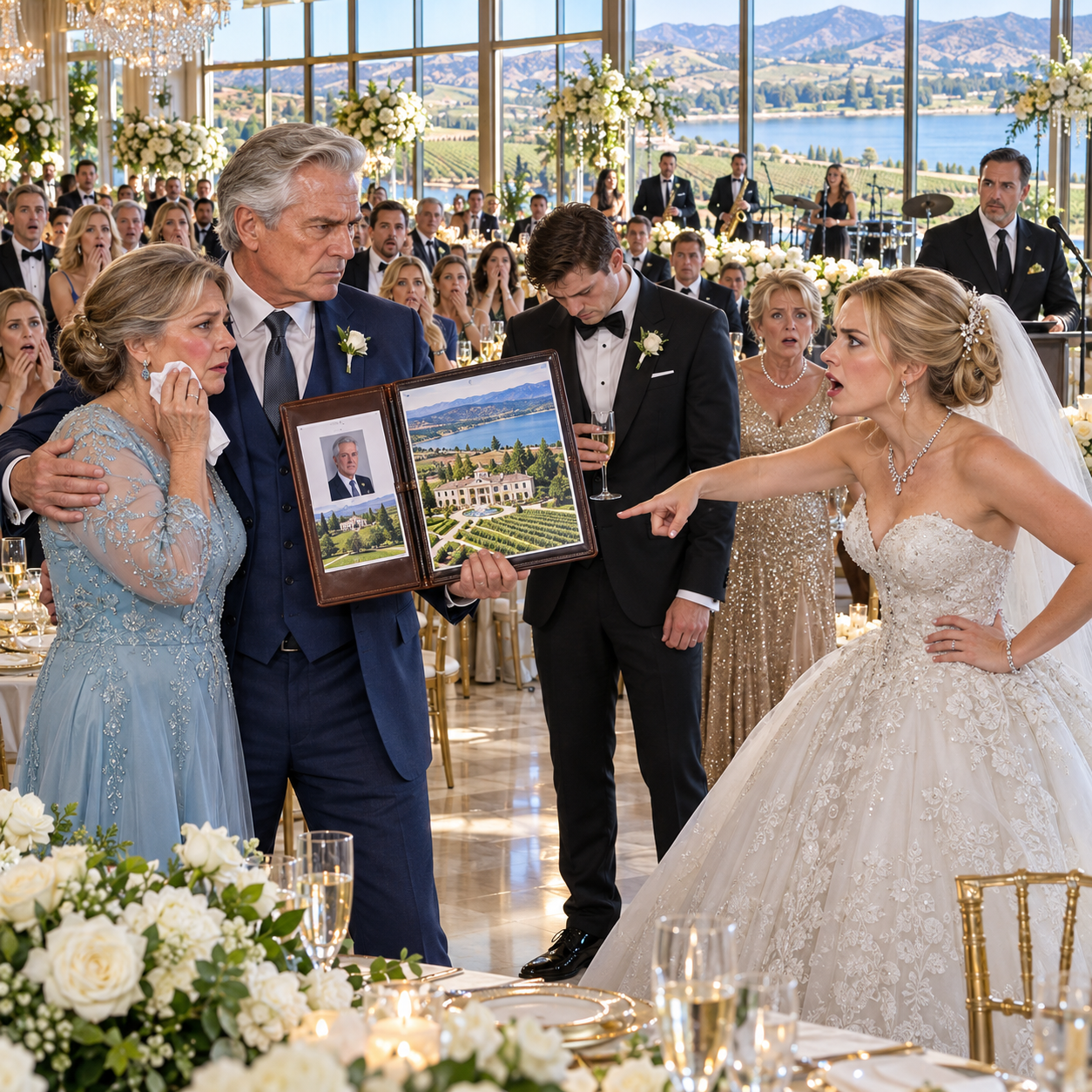
### Part 2: A Hospital Report Destroyed the Fortune They Expected to Inherit
At Niagara Health’s emergency department in St. Catharines, Kathy sat on an examination bed while a young doctor cleaned the cut beneath her eye. Her right ear was ringing, and she winced whenever anyone spoke too loudly. The doctor suspected a damaged eardrum and recommended further hearing tests.
“How did this happen?” he asked.
“My son’s wife struck her during their wedding reception,” I answered. “Please document everything.”
A nurse photographed the injuries. The doctor recorded the bruising, stitched the cut, and entered Kathy’s account into her medical chart. I held her hand throughout the examination, remembering how she had held mine during every difficult year of our marriage.
My phone rang before the doctor finished.
It was Caleb, calling from Toronto Pearson Airport.
“Dad, something’s wrong with our cards!” he shouted. “Our first-class tickets to the Maldives have been canceled. Shelby’s furious. You need to fix this!”
“Have you asked about your mother?”
Silence.
“Dad, this was a stupid argument. You’re destroying our honeymoon!”
I stared at the hospital curtain. “There is no mistake, Caleb. I canceled your flights. Your credit cards are closed, your trust distributions are suspended, and you no longer have permission to occupy the Yorkville condominium.”
“You can’t take away my home!”
“That condominium belongs to my company. You never owned it.”
He cursed and hung up.
Around midnight, my security team sent footage from the condominium entrance. Caleb stood outside in the rain, repeatedly pressing his thumb against the electronic lock. Shelby’s wedding dress dragged across the wet pavement as the keypad flashed ACCESS DENIED.
They eventually found a roadside motel.
By morning, Shelby had published a tearful video accusing Kathy of attacking her. She claimed she had merely defended herself against an unstable mother-in-law. The recording gathered two million views, and thousands of strangers condemned my wife.
Then I found a comment from Caleb’s verified account.
He publicly supported Shelby.
I showed Kathy the screen. She read it, removed her glasses, and placed them carefully beside her tea.
“He really believes her,” she whispered.
“No,” I answered. “He knows what happened. He’s choosing her anyway.”
That morning, Kathy finally told me everything that had happened before the reception.
An hour before the ceremony, she had entered Shelby’s bridal suite carrying a velvet box containing her mother’s pearl earrings. She wanted to welcome our new daughter-in-law with something meaningful.
Instead, she found Shelby laughing with three bridesmaids beside a vanity scattered with suspicious white powder and a rolled banknote.
Shelby was discussing a loophole her lawyer believed existed in the marriage agreement. She planned to remain married for a year, divorce Caleb, and claim part of the fifty-million-dollar family trust she imagined he controlled.
“She called him her meal ticket,” Kathy told me. “She said we’d do anything for her approval.”
Kathy had quietly closed the jewelry box and asked Shelby to reconsider the wedding. She even offered to help cancel the ceremony discreetly, without exposing what she had witnessed.
Shelby refused.
Later, when Kathy approached her again near the dance floor, Shelby struck her.
“She was afraid I’d tell you,” Kathy said.
I kissed her forehead. “You should never have had to face her alone.”
The following Monday, Shelby, Caleb, and their attorney arrived at my lawyer’s office in downtown Toronto. Shelby wore an elegant cream blazer and smiled as though the meeting were a formality.
Their lawyer demanded ten million dollars for Shelby, another forty million for the couple, and full restoration of Caleb’s financial privileges. Otherwise, they threatened a lawsuit and an aggressive media campaign.
My attorney, Mr. Phillips, opened a thin folder.
“There’s been a fundamental misunderstanding,” he said. “Caleb is a discretionary beneficiary of the Wallace family trust. He has no automatic entitlement to its assets.”
Caleb leaned forward. “What does that mean?”
“It means your parents control distributions. You cannot demand fifty million dollars because you claim to be worth that amount.”
Shelby stopped smiling.
Mr. Phillips continued. The trust also contained a provision concerning serious harm inflicted upon its founders by a beneficiary or that beneficiary’s spouse. The documented assault had triggered a review resulting in Caleb’s permanent exclusion.
“The hospital records and witness statements are already in the file,” he added.
Shelby’s lawyer studied the documents. Slowly, he closed his briefcase.
Shelby turned toward Caleb.
“You told me that money was yours.”
“I thought it was.”
“You have nothing?”
Caleb couldn’t answer.
Shelby stood so abruptly that her chair scraped across the floor.
“You’re nothing,” she hissed.
Then she walked out.
Caleb followed her.
For the first time, I saw my son understand that the woman he had chosen over his mother had been counting money she never possessed.
But Shelby wasn’t finished.
And neither was her father.
### Part 3: Hidden Recordings Exposed the Bride’s Lies and Dangerous Desperation
Richard Daniels had spent years presenting himself as one of Ontario’s most successful transportation businessmen. His Oakville lakefront home, private club membership, and expensive cars created an impressive picture.
His company’s financial statements told another story.
When Caleb announced the engagement, I had hired a retired forensic accountant to examine publicly available business records and investigate Richard’s financial position. The report revealed that Hamilton Freight had been struggling for five years. Richard owed approximately nine and a half million dollars across several lenders.
Through a separate investment company, I had purchased those troubled loans.
Richard never knew.
Two days after the wedding, his controller called to tell him that a creditor had initiated default proceedings. Richard stormed into his Hamilton office, demanded an explanation, and called the number listed on the notice.
My phone rang.
“Who the hell is doing this to my company?” he shouted.
“Hello, Richard.”
There was a long silence.
“Jerry?”
“Yes. We need to discuss your outstanding debt.”
He arrived at my office the following morning. His expensive suit was wrinkled, and the arrogance I’d seen at the wedding had disappeared.
“I need six months,” he pleaded. “I can restructure everything.”
I placed a written proposal before him. I would consider restructuring the debt over ten years if Shelby publicly corrected her accusations, withdrew her false claims, and agreed to resolve her marriage and financial demands lawfully.
“Your daughter needs to tell the truth,” I said.
Richard studied the papers.
“You’re asking me to choose between my daughter and my company.”
“I’m asking your daughter to accept responsibility.”
He left carrying the proposal, but Shelby had already chosen another strategy.
That evening, two Niagara Regional Police detectives appeared at our Burlington home. Detective Griffin explained that Shelby had accused my security employees of threatening her at the motel. She also repeated her allegation that Kathy had attacked first.
I invited the detectives inside.
“Would you like to see the wedding video?”
Morris Supply used extensive security systems, and the estate had inherited the same standards. Four cameras covered the ballroom, with synchronized audio.
I handed Detective Griffin a silver flash drive.
On my study television, Kathy stood near the dance floor, speaking quietly. Shelby approached, struck her, and shouted for her to leave. Caleb remained motionless while I retrieved Kathy’s glasses.
Then the footage captured something even more revealing.
Shelby leaned toward Marilyn and whispered that she would accuse Kathy of attacking first and sue our family for millions.
Detective Griffin replayed the recording.
“She discussed the false allegation almost immediately,” he observed.
“Yes,” I said. “And my wife is still having trouble hearing.”
The detectives took the recording for their investigation.
The next morning, one of Shelby’s bridesmaids, Jenna, contacted the police. She confirmed what she had witnessed in the bridal suite and provided messages discussing Shelby’s plan to obtain money through marriage.
Investigators also examined the drug-related allegations.
Shelby was arrested at an Oakville yacht club while having lunch with friends.
I wasn’t there. Detective Griffin later told me that when the officers approached, Shelby protested loudly, insisting that her family was important. Her companions quietly moved away as she was escorted outside.
Caleb had arrived at the club hoping to reconcile with her.
Instead, he watched her leave in a police car.
One of Shelby’s friends handed him her handbag. Her unlocked phone contained a conversation that destroyed whatever illusions he still had.
For six months, Shelby had been exchanging intimate messages with Austin, one of the groomsmen.
She mocked Caleb, discussed the marriage agreement, and described her plan to divorce him after securing the money. She and Austin had even discussed buying a condominium in Lisbon.
One photograph showed Shelby posing in her wedding dress.
The caption read, “Putting on my work clothes.”
Caleb called Logan, an old roommate he had abandoned because Shelby considered him beneath their social circle.
Logan collected him in a battered Corolla and drove him home.
That night, heavy rain struck our windows. Around eleven, the security monitor beside my desk illuminated.
Caleb stood outside our front gate.
His suit was soaked, his hair plastered against his forehead. He looked directly into the camera.
“Dad, I know everything. She was using me. I found the messages.”
I didn’t answer.
He pressed both hands against the gate.
“I was afraid of losing her. I froze when she hit Mom. I know I should’ve helped her.”
His voice cracked.
“Please, Dad. I don’t want your money. I just want to come home.”
Kathy entered the study carrying two cups of tea. The dressing on her cheek had been replaced by a narrow strip of medical tape.
She watched our son sink to his knees in the rain.
For a moment, neither of us spoke.
Then I pressed the intercom.
“Caleb, an apology that comes after the money disappears is difficult to trust.”
“Dad, please.”
“You watched your mother get hurt. You defended the woman who hurt her. That’s something you must learn to live with.”
I released the button.
Kathy put her hand on my shoulder. She didn’t ask me to open the gate.
Outside, Caleb eventually stood and walked away.
I remained at the monitor long after he disappeared.
It would have been easier to forgive him immediately.
But I had spent twenty-eight years protecting my son from consequences, and I could no longer pretend that protection had made him a good man.
### Part 4: The Final Verdict Left a Father Facing Impossible Choices
Richard never fulfilled the conditions of my restructuring proposal.
His lawyers challenged the debt proceedings, but the company’s financial problems were far deeper than he had admitted. Eventually, a court-appointed receiver took control of Hamilton Freight.
Richard was escorted from the office carrying a cardboard box filled with photographs, documents, and the small possessions collected over decades.
The forensic examination uncovered another problem.
For five years, Richard had concealed income and transferred funds through an undeclared offshore account. The receiver referred the findings to the Canada Revenue Agency.
His Oakville home was subsequently sold through enforcement proceedings. Marilyn left carrying her belongings in bags, watched from behind curtains by neighbors who once attended her elaborate dinner parties.
I had no desire to keep their property.
After the creditors’ accounts were settled, I directed a substantial personal donation to a Hamilton shelter supporting older women escaping abusive households. The shelter named its main gathering hall in honor of Kathy’s mother.
Kathy cried when she saw the announcement.
Not because of the money.
Because her mother’s name would now be associated with safety rather than the humiliation that had started everything.
Five weeks after the wedding, Shelby’s case reached a courtroom in St. Catharines.
Kathy wore a navy suit and her mother’s pearl earrings. The scar on her cheek had begun to fade, but an audiology examination had confirmed permanent hearing loss in her right ear.
Shelby sat beside her lawyer looking pale and exhausted.
Her defense focused on wedding stress, family tension, and the suggestion that Kathy had provoked her. But the courtroom fell silent when the Crown played the ballroom recording.
The sound of the slap echoed through the speakers.
Then came Shelby’s threat to falsely accuse Kathy.
I watched Caleb sitting several rows behind us. For once, he didn’t look away.
When Kathy testified, she spoke calmly about the bridal suite, the confrontation, and the moment Shelby struck her.
“Why did you approach the bride?” the defense lawyer asked.
“Because I believed she was about to hurt my son,” Kathy answered.
“Did you insult her?”
“I asked her to leave quietly rather than destroy the wedding in public.”
The lawyer paused.
“That’s all?”
Kathy looked straight at him.
“That is all.”
The court considered the medical records, video evidence, witness statements, and Shelby’s subsequent false allegations. The judge described her actions as deliberate and her treatment of Kathy as particularly cruel.
Shelby received a custodial sentence of two years less a day, followed by three years of probation, together with restitution and other court-ordered restrictions.
She began crying as officers led her away.
“Daddy!” she called toward the gallery.
Richard sat in the back row, wearing a coat that hung loosely from his shoulders.
He didn’t rise.
He stared at his shoes.
I remembered another man standing in another room five weeks earlier, refusing to look at the person who needed him.
Outside the courtroom, two Canada Revenue Agency investigators and an RCMP officer approached Richard. Their investigation into his concealed income and offshore transfers had progressed, and they informed him of the tax-related charges he now faced.
Richard turned toward me.
“Jerry, please. I’ll cooperate. I’ll sign whatever you want.”
I looked at him for a long moment.
“You smiled while my wife was bleeding on that ballroom floor,” I said. “You could have helped her. You chose not to.”
Marilyn stood beside the elevators, clutching her handbag. She watched her husband being escorted away and reached for a telephone, but there was nobody left she trusted enough to call.
Kathy slipped her arm through mine.
We walked into the cold October sunshine without looking back.
The legal matters continued for months. Austin’s messages became evidence, and he lost the comfortable position he had enjoyed among Shelby’s wealthy friends. Caleb’s marriage ended, although the paperwork took longer than either of us expected.
Eventually, the headlines faded.
People found other scandals to discuss.
And Kathy and I returned to our quiet house.
We revised our family trust so that most of our estate would eventually support trade scholarships, apprenticeships, and interest-free business loans for young people willing to build something with their hands.
I thought about my first warehouse, my used forklift, and the long shifts that had allowed me to create a company.
I wanted our money to give other families opportunities, not turn another generation into people who believed kindness could be purchased.
Two autumns passed.
Kathy resumed reading on the porch, usually with her good ear turned toward the garden. The scar beneath her cheekbone became a thin, pale line. Sometimes I caught her touching it while she thought nobody was watching.
She never spoke bitterly about Caleb.
But she stopped making excuses for him.
Then, one afternoon, a delivery truck appeared at our front gate.
The driver climbed down wearing faded work clothes and steel-toed boots. He looked leaner than I remembered, his hands rough, his shoulders carrying the tiredness of someone accustomed to early mornings and physical labor.
It was Caleb.
He had found work in a distribution yard in Sudbury. He wasn’t working for Morris Supply, wasn’t using our family connections, and wasn’t collecting a salary from a company owned by his father.
He was earning an ordinary wage under a supervisor who knew him only as another employee.
Caleb lifted a heavy cardboard box from the truck and carried it to our gate. He placed it carefully beside the intercom.
Then he looked toward the security camera.
He didn’t ring.
He didn’t ask for money or forgiveness.
He simply nodded once, returned to the truck, and drove away.
I watched the recording twice before going outside.
Inside the box was an old wooden picture frame, repaired and polished. It held a photograph from Caleb’s childhood: Kathy and me standing beside him at the Canada Day fireworks, our young son grinning from my shoulders.
Beneath it lay a handwritten note.
Mom and Dad,
I found this in a box of my old things. The frame was broken, so I fixed it.
I’m not asking you to let me back into your lives. I’m not asking for anything.
I just wanted you to know I finally understand that everything you gave me came from years of work and sacrifice. I treated it like something I was owed.
More importantly, I treated your love that way.
I’m sorry.
Caleb.
I read those words several times.
When I returned to the porch, Kathy was waiting.
“He looks like you did at twenty,” she said softly.
“He does.”
She studied the repaired picture frame in my hands.
“Do you think he’s changing?”
I looked down the empty driveway.
“I think he’s trying.”
Kathy took the photograph from me and held it against her chest.
For the first time in two years, I saw something in her expression that I had almost forgotten.
Not forgiveness.
Not yet.
Hope.
We placed the photograph on the mantel that evening. I didn’t call Caleb, and Kathy didn’t ask me to. Some wounds require more than an apology, and some broken relationships cannot be repaired merely because someone has finally learned what they destroyed.
But I no longer believed the future had to resemble the past.
Perhaps one day Caleb and I would meet at a Tim Hortons somewhere between Burlington and Sudbury. Perhaps we’d sit across from each other with two coffees and talk about his work, the weather, and what it means to become a man other people can depend upon.
And perhaps, when Kathy was ready, he would have the chance to look his mother in the eyes and apologize without expecting anything in return.
I don’t know whether that day will come.
What I do know is that closing my son’s accounts was the hardest decision I ever made as a father. Yet allowing him to face life without my wealth may have been the first thing I did that truly gave him a chance to grow.
Money can build a company, buy a beautiful home, and illuminate a ballroom with a thousand lights.
It cannot purchase character.
And it cannot replace the simple courage of standing beside someone you love when the rest of the world turns against them.
That afternoon at the wedding, my son believed keeping the peace meant remaining silent.
But peace purchased with another person’s dignity is not peace.
It’s surrender.
Kathy came to stand beside me at the window. I put my arm around her shoulders, and together we watched the last sunlight settle across our garden.
For thirty-nine years, she had been my home.
And when the moment came to choose between protecting our fortune and protecting her dignity, there had never really been a choice at all.
THE END.
All characters and events in this story are fictional, created for storytelling and entertainment purposes. Thank you sincerely for reading. Your feedback and support are invaluable and motivate me to continue sharing more stories with you.


