
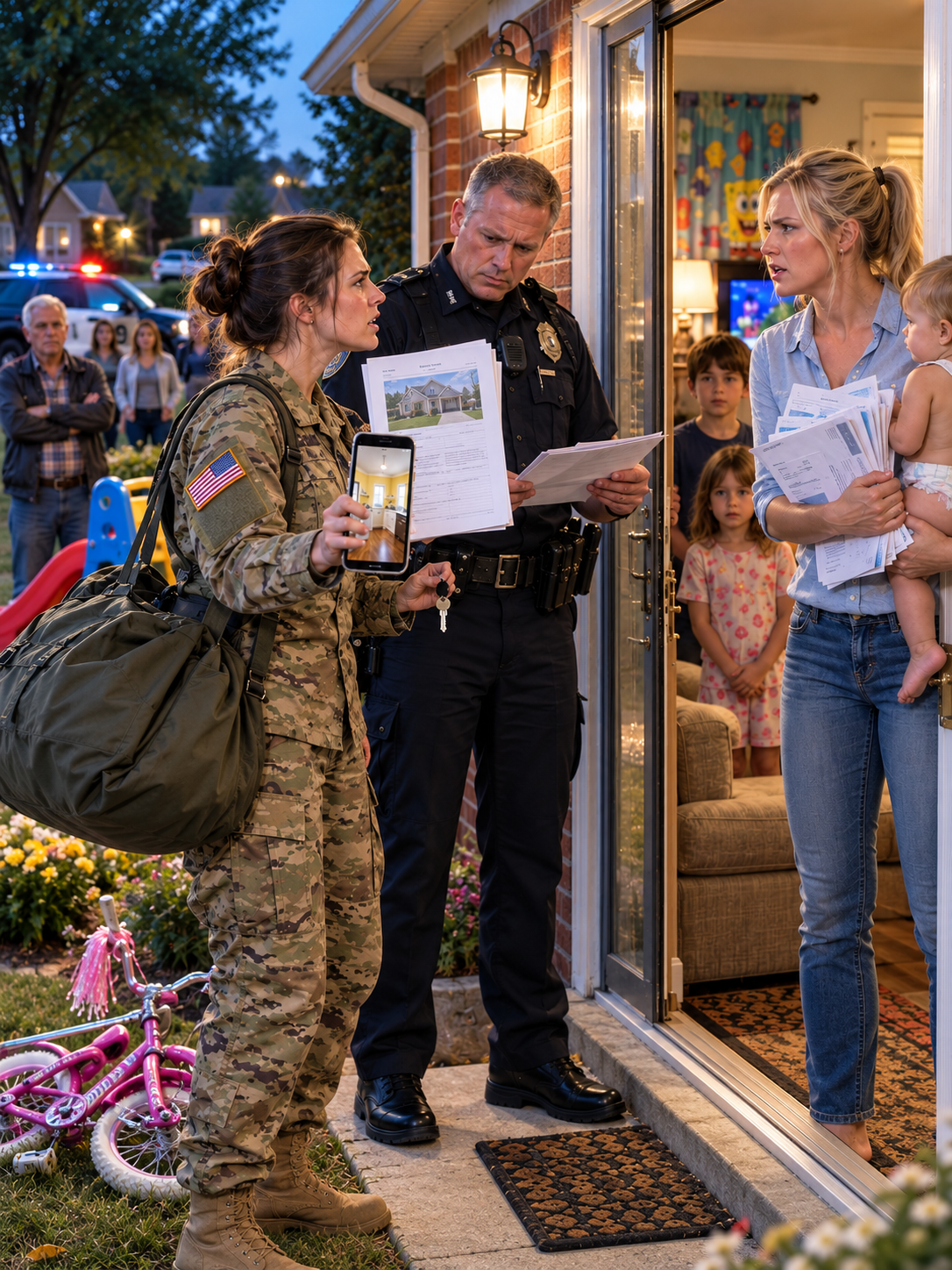
### Part 2: Hidden debts and cruel lies expose my brother’s deception
Tuesday arrived without a confession from Davey. Instead, Officer Starns called to inform me that Brooke had filed a harassment complaint, claiming I was driving past her house and frightening her children. I hadn’t gone near the property since speaking to Mr. Ogle. The officer sounded uncomfortable as he suggested I find an attorney. Within an hour, I was sitting across from Captain Imhof at the military legal assistance office, explaining how my brother had turned my own home into a place I wasn’t allowed to approach.
She listened without interrupting, then slid a legal pad across her desk. “First, we revoke his power of attorney immediately,” she said, preparing documents for my bank, the county, and the post office. Next came a detainer warrant in Montgomery County General Sessions Court, with a hearing scheduled for August 31. She warned that ownership and possession were separate questions, and even a rightful owner had to follow the law. Before I left, she looked directly at me and said, “Sergeant, don’t go near that house again.”
The next morning, a postal clerk revealed Davey had redirected my mail to a post office box the previous November. My stomach sank when I checked my electric account and found a $1,040 overdue balance, with disconnection approaching. My debit card had expired in February, and the replacement had disappeared into the mailbox Davey controlled. He’d been collecting the notices while his family used electricity under my name. I paid the balance immediately because three children were living through a Tennessee summer, and I refused to let them suffer for their father’s dishonesty.
That evening, my mother called from Knoxville. “Davey says you offered him the house, Sarah,” she began, sounding more disappointed than concerned. I explained everything, but she interrupted with the words I’d heard my entire life. “He’s got three children, honey, and you’re single. You’ve got the base to stay on, so can’t you help your brother until he gets himself together?” I stared at the lodging room wall, wondering when being unmarried had made my home less important than his comfort.
An hour later, three soldiers from my section appeared outside my door carrying a pepperoni pizza. “We heard things were rough, Sergeant,” one said, offering his couch if I needed somewhere to sleep. They didn’t ask embarrassing questions or expect gratitude; they simply handed me dinner and left. I ate four slices standing beside the window, unexpectedly fighting tears. The people I commanded had shown me more consideration in five minutes than my own family had shown me in months.
Thursday morning, Davey published a Facebook post accusing me of trying to throw three innocent children onto the street. He described himself as the devoted older brother who had always supported me and asked everyone to pray for his family. By the following day, strangers were calling me heartless, and someone had even questioned my honor as a soldier. My first sergeant summoned me privately, not to reprimand me, but to ask whether I was all right. I wanted to publish my deed and every mortgage statement, but I refused to turn my military career into ammunition for a family argument.
Then I called Davey’s warehouse, hoping someone could leave him a message. The woman in human resources hesitated before explaining that my brother hadn’t worked there since November 21 of the previous year. I thanked her, hung up, and remembered his freshly pressed warehouse shirt at Waffle House. He’d lost his job two weeks after I deployed. For nine months, he’d been pretending to go to work while his wife believed he was earning a paycheck.
The following Monday, I watched from a distance as Davey left my house in that same navy polo. I followed him to a gas station, where he parked behind the building, rested his head against the truck window, and spent hours scrolling through his phone. He bought a hot dog around noon, drove to the public library later that afternoon, and finally returned home at five like an exhausted employee finishing his shift. Watching him walk through my front door, I cried for the first time since returning from Poland. My brother hadn’t simply stolen a house; he’d trapped himself inside a lie so enormous that admitting the truth terrified him more than losing everything.
### Part 3: His wife discovers the truth behind their perfect family life
On Tuesday afternoon, I visited the grocery store pharmacy where Brooke worked. She stiffened when she recognized me, but I asked for five minutes somewhere private, promising to leave afterward. We sat inside her minivan, surrounded by children’s snack wrappers and car seats, while I spread documents across the center console. First came my 2021 closing papers, then years of mortgage statements, the limited power of attorney, and a photograph of me painting the kitchen yellow. Brooke examined each page in silence until her fingers began trembling.
“He told me he bought this house in 2020,” she whispered. “He said you were a tenant he let stay because you had nowhere else to go.” I watched her struggle to continue, remembering the insult she’d thrown at me on the porch. “He called you a stray, Sarah. He said he was helping some Army girl who couldn’t take care of herself.” She pressed the photograph of my kitchen against her knees, staring at the yellow walls she’d believed her husband had painted.
Then she opened her banking app and showed me a series of transfers. Every month since February, she’d sent Davey $900 labeled “mortgage,” believing her income was helping pay for their home. I explained that the actual mortgage was $1,238 and had always been withdrawn from my checking account. Davey had never contributed a payment. When I told her he’d also been unemployed since November, her expression crumpled. “He irons that shirt every morning,” she whispered. “I watch him iron it.”
Brooke confronted him that evening, and shortly after eleven, my phone lit up with her first text message. Davey was accusing me of lying and trying to destroy their marriage. Another message followed, admitting she had three children and nowhere else to take them. I answered that I wouldn’t put her children on the street, but Davey couldn’t continue living in my house. She didn’t reply, and I spent the night wondering whether I’d just made an enemy or finally reached someone who understood.
The following evening, Brooke called from my backyard porch swing. She asked whether I’d really painted the kitchen, and when I confirmed it, her voice cracked. Davey had shown her those same photographs when he proposed in 2022, claiming he’d painted the walls himself because yellow was his favorite color. She’d thought it was one of the sweetest things a man had ever done for her. Now she realized he’d used pictures of my home to make himself appear dependable when she’d been struggling through a divorce.
We talked for nearly an hour. Brooke explained how Davey had welcomed her older children, Colton and Georgie, and convinced her that his sister hated their family. I told her I’d spent years inviting them for holidays, only to hear excuses, and that three wooden Christmas gifts were still tucked inside my deployment bag. Neither of us had ever disliked the other; we’d been carefully separated by the same man. “I don’t know what’s real anymore,” she admitted, the porch swing creaking behind her. “I don’t know which parts of my marriage were ever true.”
Thursday brought another warning. Brooke texted that Davey had printed a document claiming I’d agreed to sell him my house before deploying. He intended to present it at Monday’s hearing as a rent-to-own contract. Captain Imhof asked whether I’d ever signed anything besides the limited power of attorney, and I assured her I hadn’t. “Then let him bring it,” she answered, though I could hear the caution beneath her confidence. An invented agreement was dangerous, especially when my brother had already spent months constructing evidence around his story.
On Sunday, I drove through my neighborhood and spotted nine-year-old Colton sitting near the curb, dropping pebbles into a storm drain. He recognized me as the Army lady and asked whether the house really belonged to me. When I nodded, he looked toward the maple tree and said quietly, “I like it here. It’s got a good tree.” Then he mentioned that his mother cried in the shower because she thought nobody could hear her. I swallowed hard and told him the grown-ups were working things out, wishing I could protect him from every disappointment still waiting ahead.
Early Monday morning, I buttoned my Army service uniform inside the lodging bathroom. I’d worn it before senior officers without hesitation, yet my hands shook as I straightened the collar. Captain Imhof met me outside the courthouse with two folders and a thermos of coffee, reminding me to remain calm regardless of Davey’s accusations. In the hallway, my brother approached wearing an ill-fitting sport coat and said we could still settle everything privately. I looked into his eyes and answered, “You told the whole neighborhood I moved to Germany, Davey. You made your wife believe my life belonged to you, and there’s nothing left to settle in secret.”
### Part 4: One courageous witness ends the betrayal and restores my home
Our case was called shortly after ten. The courtroom smelled of old paper and overworked air conditioning, and Davey stood opposite me clutching a manila folder. Captain Imhof submitted my deed, closing documents, and payment history, establishing that I’d purchased the property and continued paying for it throughout my deployment. The judge turned to my brother and asked what evidence supported his claim. Davey straightened his sport coat, opened the folder, and announced that we had a private rent-to-own agreement.
He handed the judge two typed pages describing payments toward an eventual purchase. At the bottom was my name, supposedly agreeing by email to the arrangement in October 2025. The judge adjusted his reading glasses and asked who had prepared the document. “My sister and I worked it out together,” Davey replied confidently. When the judge requested the original email, Davey suddenly couldn’t remember where to find it.
A movement from the second row caught my attention. Brooke stood wearing her blue pharmacy uniform, holding a folder of her children’s school records against her chest. “Your Honor,” she said, her voice shaking, “I’m his wife, and I watched him type that agreement on my laptop last Thursday night.” Davey spun toward her, his face draining of color, while she continued explaining that the document was still recorded in her printer history. Every person in the courtroom seemed to stop breathing.
The judge studied Brooke, then turned back toward Davey. He made clear that the document raised serious questions and granted possession of the property to me, subject to the court’s procedures and the ten-day period he’d described. Davey gathered his papers without looking at either of us. As he walked out, I remembered the boy who once helped me fix a broken bicycle, and I wondered when he’d decided other people’s lives were simply things he could borrow. I had won my house, but the victory felt heavier than I’d imagined.
Outside, Brooke sat alone on a hallway bench, staring at the floor. Her husband had just abandoned her to face the consequences of his lies, and she had three children who still needed somewhere to sleep. I sat beside her and took a newly prepared house key from my pocket. “You and the kids can stay for sixty days,” I said, explaining that we’d arrange the locks and temporary occupancy properly. “Davey has ten days to leave, and after that he isn’t coming back.”
Brooke stared at me in disbelief. “After what I said to you on that porch, why would you help us?” I remembered her frightened children and the look on Colton’s face when he’d mentioned his mother crying. “Because you believed what your husband told you,” I answered. “You didn’t know me, and I’m not going to punish your children for something he did.” She closed her hand around the key, and for several moments neither of us spoke.
Davey moved into our mother’s spare bedroom in Knoxville nine days later, taking his clothes, truck, and the sport coat he’d worn to court. Our mother stopped calling me for almost a month, and when she finally reached out, she avoided mentioning what had happened. I filed a small-claims case against Davey for the overdue electricity and lock expenses, winning a default judgment when he failed to appear. I never received the money, but I stopped measuring justice by whether my brother finally paid his debts.
Brooke found a two-bedroom apartment near her children’s school after fifty-two days. She filed for divorce that same week and quietly paid September’s electric bill without being asked. During those weeks, I learned something unexpected about her: she was capable, hardworking, and far stronger than the frightened woman I’d first met behind my storm door. Davey had convinced her she needed him to survive, but once the lies disappeared, she began building a life that didn’t depend on his promises.
On moving day, I returned to find Brooke standing on my porch while the children waited in her minivan. Georgie’s pink bicycle was fastened to the roof rack, its streamers fluttering in the breeze. Brooke handed me the key and glanced toward the spot where the bike had spent the summer. “You know,” she said with a faint, embarrassed smile, “I once told you we don’t take in strays.”
“I remember,” I replied, reaching into my bag. I’d brought the three wooden toys from Poland, still wrapped in the Christmas market paper, and I asked her to give them to the children. Brooke stared at the little wooden dog, its tail wagging when I pulled the string, before accepting the gifts with trembling hands. “You really bought these before you’d even met us?” she asked. I nodded, and she covered her mouth as tears filled her eyes.
She hugged me before leaving, something neither of us would have imagined on that first terrible Friday night. As the minivan disappeared around the corner, I stood beneath my maple tree, looking at the yellow patch of dead grass where Georgie’s bicycle had rested. The house was finally quiet again. I walked inside, turned the key in my own lock, and stepped into the kitchen I’d painted with my own hands.
For months, Davey had claimed that yellow room, the mortgage, the photographs, and even the story of my life as his own. But the walls were still yellow, the old stepladder still stood in the garage, and the little marks from my paintbrush remained near the ceiling. I ran my fingertips across one of them, remembering the summer afternoon I’d stood there laughing at my own terrible painting skills. I’d spent eleven years wearing a uniform to protect things that mattered, and now I understood that protecting my own peace mattered, too.
I hadn’t come home to the family reunion I’d imagined. I’d come home to betrayal, a locked door, and a stranger who believed I was worthless. But I’d also discovered a sister-in-law who chose the truth when it cost her everything she’d believed about her marriage, and three children who deserved better than the lies surrounding them.
My brother had taken my house for nine months. He hadn’t taken my ability to decide what kind of person I wanted to be.
And when I closed the front door that evening, it wasn’t to keep someone out.
It was because, at last, I was home.
THE END.
All characters and events in this story are fictional, created for storytelling and entertainment purposes. Thank you sincerely for reading. Your feedback and support are invaluable and motivate me to continue sharing more stories with you.


