
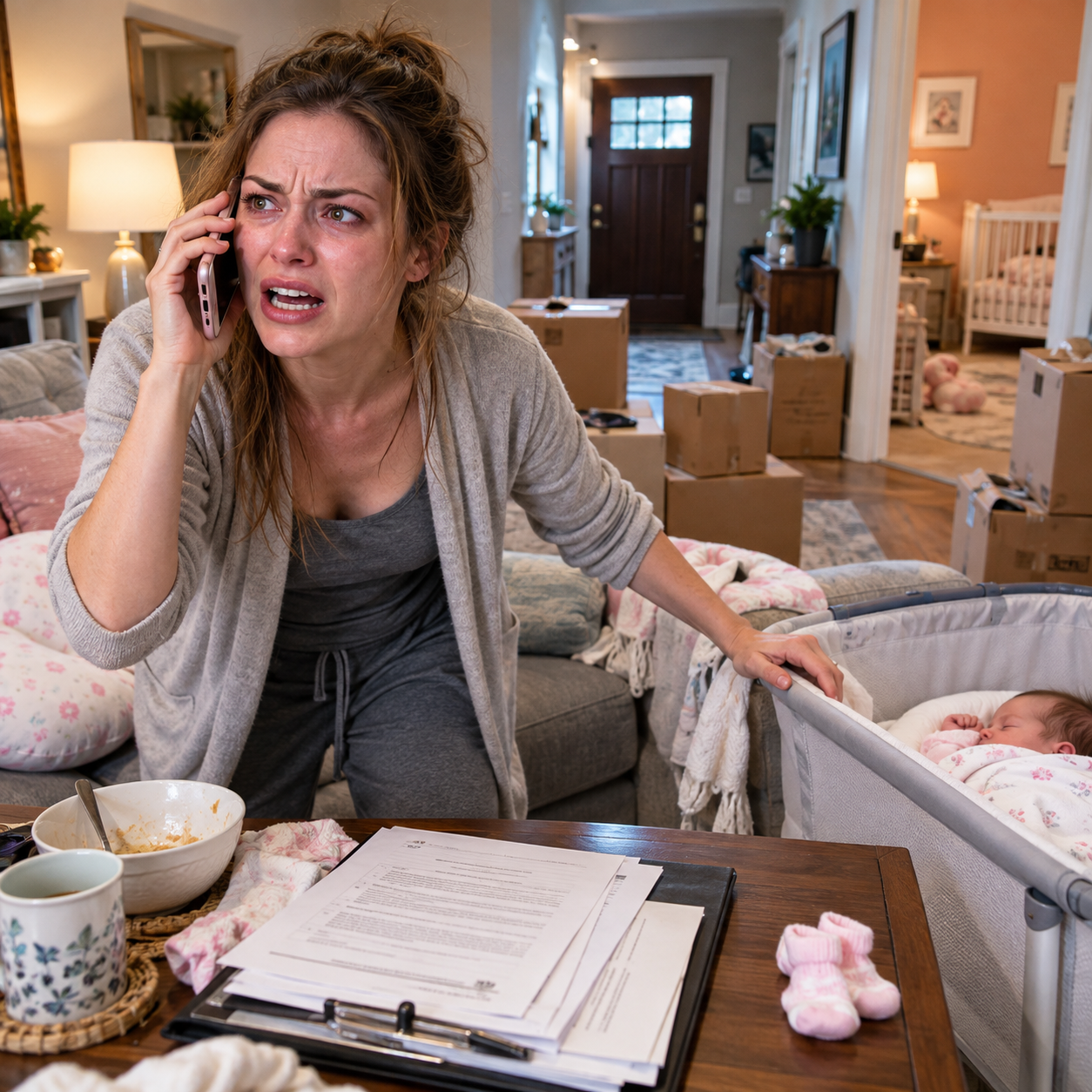
Part 2: New locks force old family patterns into the open
By eleven-thirty, a locksmith named Marvin was kneeling beneath my porch light replacing the final deadbolt while rain tapped softly against his jacket. I had meant to rekey the house after closing but Nora’s early arrival had swallowed every unfinished task, and Marilyn knew the previous owners had left an extra key in a ceramic planter during my inspection. Marvin handed me three bright new keys on a silver ring and said, “Nobody gets in unless you give them one.” He meant it as ordinary locksmith advice, but I carried that sentence upstairs with me.
My attorney, Denise Harper, arrived the next morning in a navy raincoat and sensible shoes, carrying a leather portfolio instead of the dramatic briefcase my sleep-deprived imagination had somehow pictured. She reviewed the deed at my kitchen table, confirmed that nobody else had tenancy rights, and told me I did not have to debate my ownership with anyone. “You can choose to talk,” she said, closing the folder, “but you don’t have to negotiate the premise that this is your house.”
At nine-thirty my friend Martin arrived with coffee, a breakfast sandwich, and the tact not to comment on my unwashed hair. He was a family therapist I had worked beside for years, and he had met Marilyn twice, which was apparently enough. “Do you want me to speak?” he asked.
“No. I want witnesses who won’t let me convince myself afterward that I imagined what happened.”
Martin nodded. “That I can do.”
At 10:12, Paul’s gray SUV pulled to the curb, followed by Jason’s minivan. Marilyn stepped out first wearing pressed slacks and a camel coat, dressed as if she were arriving to supervise movers. Paul opened the rear hatch, revealing suitcases, plastic storage bins, and two rolled sleeping bags. My brother climbed from the van behind them, then Beth, whose expression looked less determined than exhausted.
Marilyn came up the walk and reached immediately for the doorknob. The new lock stopped her with a dull metallic click. She tried it again, frowned, and then knocked.
I opened the door but did not step aside. Nora was sleeping in a wrap against my chest. “Hi.”
Marilyn glanced at the lock. “Why doesn’t my key work?”
“Because I changed the locks.”
Her eyes lifted to mine, and for the first time that morning, the plan seemed to leave her face. Then she looked past me and spotted Denise at the kitchen table and Martin standing near the bookcase. “What is this?”
“People I asked to be here.”
Denise approached and introduced herself. She did not threaten anyone or raise her voice; she simply explained that I was the sole owner, that I had not granted permission for anyone to move in, and that belongings could not be brought onto the property against my wishes. Her calmness seemed to bother Marilyn more than hostility would have, because there was nothing in Denise’s tone to fight.
Marilyn stared at me. “You called a lawyer on your own mother?”
“I called a lawyer because you told four people they were moving into my home after I told you no.”
“Your brother is standing ten feet away.”
“I know.”
Jason rubbed both hands over his face. “Mom, I told you we should have called Rachel ourselves.”
Marilyn turned sharply. “You said you had nowhere to go.”
“I said our lease ended Friday.”
“And what exactly is the difference?”
“The difference,” Beth said quietly from beside the van, “is that my sister offered us her basement for a month.”
Everyone looked at her. Marilyn’s mouth tightened.
I said, “You had another place?”
Beth pushed loose hair behind one ear. “It’s smaller, and it’s in Eugene, so Jason would have a long commute. Your mom said it was ridiculous when you had all this space.”
Jason stared at the wet sidewalk. “She said you’d already agreed.”
Marilyn’s expression hardened, though I saw embarrassment underneath it now. “I said Rachel would understand once everything was arranged.”
“That isn’t the same thing,” Paul murmured.
She turned on him. “Whose side are you on?”
Paul looked tired rather than afraid. “I’m on the side of not unloading those boxes where we weren’t invited.”
I had spent years imagining that setting a boundary with Marilyn would produce some enormous explosion. Instead the moment felt painfully domestic: rainwater gathering on the porch rail, Nora breathing against my collarbone, Jason’s twins waving through the minivan window because they did not understand why the adults were standing outside. There was nothing cinematic about it, only a family finally being forced to say plainly what everyone had spent years softening.
Marilyn looked at Nora and then back at me. “I was trying to take care of everyone.”
“I believe you.”
The answer surprised her.
I continued, “I think you were afraid Jason was failing, and you wanted to fix it before anybody had to feel embarrassed. I think you looked at my extra rooms and decided the solution was obvious. But you skipped the part where I am a person who gets to choose what happens in my own home.”
“You’re making me sound controlling.”
“I’m describing what happened yesterday.”
She folded her arms. “Someday your daughter will grow up and you’ll understand how it feels when your child treats you like an outsider.”
I touched Nora’s back through the wrap. “I hope if she grows up and tells me no, I listen before she needs a lawyer to make me hear it.”
Marilyn’s face changed at that. Not dramatically, but enough. Her lips pressed together and her eyes shifted toward the street, where the twins had begun fogging the minivan window with their breath. Behind her, Jason looked at me with a mixture of shame and gratitude.
“I’m sorry,” he said. “I should’ve called you.”
“Yes,” I said. “You should have.”
He gave one short nod. No excuses.
Beth came up the walkway and set down a casserole dish she had been carrying. “I made this for you yesterday. Before all this.” She hesitated. “Can I leave it?”
I smiled for the first time that morning. “The casserole can stay.”
A laugh escaped her before she covered it with her hand. Even Paul smiled.
Marilyn did not. She looked from me to Denise, then to the locked door. “So that’s it?”
“For today, yes.”
Paul touched her elbow. “Come on, Marilyn.”
She resisted for half a second, then let him guide her toward the SUV. Jason and Beth returned to their van, and before climbing in, Jason said they would take Beth’s sister’s basement and figure something else out from there. When the cars finally pulled away, I remained beneath the porch roof until both disappeared around the corner.
Martin came beside me but said nothing.
I looked down at Nora’s sleeping face and then at the new key in my hand.
For the first time, saying no had not cost me my home.
It had kept it.
Part 3: A quieter visit begins a different kind of family
The next week passed without contact from Marilyn. Jason texted twice, once to apologize again and once to send a picture of the twins building a blanket fort in Beth’s sister’s basement. He had arranged extra shifts at work and found an apartment available the following month. Beth added a message beneath the photo: Honestly, this is cramped, but everybody is sleeping and nobody is fighting. We’re okay.
I stared at that sentence longer than I expected. We’re okay. My mother had treated their housing problem as if catastrophe would follow unless she personally solved it, yet the people actually living through it were adapting. There were inconveniences, longer drives, toys underfoot, and two preschoolers sharing a pullout couch, but there was also something Marilyn’s plan had erased from the beginning: Jason and Beth’s right to manage their own lives.
On Thursday evening, after Nora’s feeding, I called my mother. She answered on the fourth ring.
“Hello.”
“Hi, Mom.”
Her voice was careful. “Is everything all right with the baby?”
“She’s fine.”
Another pause. I could picture Marilyn at her kitchen table, shoulders squared, waiting to see what kind of conversation this would become.
“I’m not calling to argue about last week,” I said. “I’m calling because I still want you to know your granddaughter.”
Marilyn did not answer immediately.
“I meant what I said,” I continued. “I love you. But visits have to be visits. Plans involving my house have to include me before they become plans. If I say no, I need you to hear no without turning it into a referendum on whether I love this family.”
“You embarrassed me in front of everyone.”
“I know it felt that way.”
“It didn’t feel that way. You had a lawyer waiting.”
“Because after I said no, you came anyway with suitcases.”
She was quiet again, and this time I let the silence belong to her. For most of my life, I had rushed to fill those gaps before she could, offering explanations, concessions, softened language. Nora shifted against my shoulder and made a tiny sigh.
Finally Marilyn said, “I honestly thought I was helping.”
“I know.”
“I thought you needed help too.”
“Then ask me what help looks like.”
That seemed to land somewhere. When she spoke again, some of the authority had drained from her voice. “What does it look like?”
I glanced around the living room. Burp cloths covered one arm of the couch, a bottle waited in the drying rack, and three unopened moving boxes still sat beneath the stairs. “Come by yourself next Saturday afternoon. Bring nothing I have to organize. Hold your granddaughter while I take a shower. Maybe make tea.”
A faint breath moved through the receiver. “I can do that.”
When Saturday arrived, Marilyn pulled up at two minutes past one carrying a covered pot. She stopped on the porch rather than trying the handle. That small detail mattered more than I expected.
I opened the door with Nora against my shoulder.
Marilyn lifted the pot slightly. “Chicken soup. I remember you liked it after you were sick in college.”
“I did.”
“I almost brought three containers.”
“Of course you did.”
Her mouth twitched. “I left two at home.”
I stepped aside. “Come in.”
She entered slowly, as if the house had changed shape since her last visit. Maybe it had. The yellow nursery remained Nora’s, the office contained my desk and two stubborn boxes of books, and nobody’s luggage blocked the hallway. Marilyn set the soup in the kitchen, washed her hands without being asked, and then stood in front of me looking suddenly uncertain.
“Can I hold her?”
The question was so ordinary that it nearly undid me.
“Yes.”
I placed Nora in her arms, supporting the baby’s head until Marilyn adjusted her grip. My mother had always been capable with babies, and within seconds Nora settled against her chest. Marilyn’s face softened into an expression I remembered from childhood only in fragments, before responsibility and worry had hardened into management.
“She has your ears,” she whispered.
“Poor kid.”
“She’ll grow into them.”
I laughed, and Marilyn did too. There was no apology grand enough to erase what had happened, and I no longer wanted one. I wanted evidence of change in smaller units: a knock instead of an attempted entrance, a question instead of an announcement, one pot of soup instead of three.
I showered for twelve uninterrupted minutes while she rocked Nora in the living room. When I returned, Marilyn was humming an old song my grandmother used to sing, though she seemed unaware she was doing it. I stood in the hallway listening until she noticed me.
“What?”
“Nothing.”
She looked suspicious. “You’re doing that therapist thing.”
“I’m really not.”
“You get a face.”
“I inherited it from you.”
That earned another reluctant smile.
Later, over tea, she asked about Jason. I told her what he had told me: new apartment, extra shifts, twins adjusting well. Marilyn began, “I could call his manager and—” then stopped herself.
I raised an eyebrow.
She sighed. “I heard it.”
“Good.”
“This is going to be annoying.”
“For both of us.”
She stirred her tea. “Your grandmother used to do this to me.”
I had not expected that. “Do what?”
“Decide things. She once enrolled you and Jason in swimming lessons without telling me because she thought I was being irresponsible.” Marilyn stared into her cup. “I was furious for months.”
“Did you ever tell her?”
“No. There would’ve been no point.”
I leaned back in my chair. “Maybe that’s where the habit came from.”
“Maybe.” She looked toward Nora sleeping nearby. “That isn’t an excuse.”
“No.”
Another small silence settled between us, but this one did not feel like a contest.
Marilyn left before dinner. At the doorway, she slipped on her coat and glanced at the new deadbolt.
“Are you ever giving me a key again?”
I considered pretending not to understand the joke inside the question. Instead I smiled. “Not anytime soon.”
She nodded. “Fair enough.”
Then she kissed Nora’s forehead, hugged me carefully around the baby, and walked to her car.
Our relationship did not become easy after that. Marilyn still offered advice as if it were a weather warning, and I still sometimes found myself explaining choices that required no explanation. Jason still called her when he was overwhelmed, and she still occasionally tried to recruit me into solving problems that belonged to him.
But things changed in ways I could measure.
She began asking, “Is Saturday good?” instead of saying, “I’ll come Saturday.” Jason started calling me directly when he needed something. Beth and I became closer once neither of us was being used as a piece in someone else’s family plan. Even Paul became a little more willing to say, “Marilyn, let them handle it,” before retreating behind his newspaper.
Months later, on a rainy evening, I sat on the nursery floor while Nora crawled toward a basket of toys. Above her changing table hung the framed deed from my closing—not because property ownership was the most important thing in my life, but because what it represented was larger than a house. I had spent years believing adulthood meant becoming strong enough to endure other people’s decisions gracefully.
I know better now.
Sometimes adulthood means making the decision yourself.
Sometimes love means opening the door.
And sometimes it means keeping it locked until the person on the other side learns to knock.
The End .
All characters and events in this story are fictional, created for storytelling and entertainment purposes. Thank you sincerely for reading. Your feedback and support are invaluable and motivate me to continue sharing more stories with you.

