
Part 2: A stranger’s kindness makes old family patterns impossible to ignore
Dinner arrived in beautifully timed courses I could barely taste. Grant’s elderly aunt asked whether I was “with the bride or groom,” and when I said I was the bride’s sister, she blinked toward the central tables and then back at me. “Well,” she said carefully, “families do things differently now.”
Across the room, Mom laughed at something Adrienne said. Dad noticed me once and lifted his eyebrows as if asking whether everything was fine, and because I had spent a lifetime answering that question before it was spoken, I nodded. He smiled and turned back to the conversation.
The man seated two chairs away from me introduced himself as Owen Mercer. He was about forty, with a slightly crooked tie and the relaxed posture of someone who wasn’t trying to impress anybody at a formal event. He had been Grant’s college roommate, he explained, and had arrived late after a delayed flight.
“So you’re Grant’s mysterious friend from Boston,” I said.
“Mysterious sounds much better than chronically overbooked.”
That got the first sincere laugh out of me all day.
Owen didn’t ask why the bride’s sister had been seated beside the kitchen. He must have noticed because everyone noticed, but he talked instead about Grant burning pasta in their first apartment and the summer they had tried to build a deck without knowing what a joist was. There was something merciful about being treated as a normal person rather than a problem someone had to politely ignore.
After dinner, Mom appeared behind my chair and touched my shoulder. “Honey, you’re doing okay, right?”
I glanced toward Table Three, where my unused place setting had finally been cleared. “Why wouldn’t I be?”
Her mouth moved before she answered. “Adrienne was worried that sitting with all the couples might make you uncomfortable.”
I almost admired the speed of it.
“Because I’m single?”
“That’s not what I said.”
“Then why move me yesterday?”
Mom looked toward the dance floor. “Today isn’t the day, Claire.”
There it was—the family phrase that had closed a hundred conversations. Not now. Don’t spoil this. Be gracious. I had spent most of my life waiting for the mysterious future day when my feelings would be convenient, and somehow that day never appeared.
“I’m not starting anything,” I said.
“I know.” She squeezed my shoulder. “That’s why we can always count on you.”
She meant it as praise.
Twenty minutes later, the maid of honor called all unmarried women toward the dance floor for the bouquet toss. Several cousins pulled one another forward, laughing, while I stayed near a tall window at the edge of the room with a glass of sparkling water. I wasn’t hiding, exactly; I simply had no interest in participating in a ritual that would give Mom material for six months.
Adrienne climbed onto the small stage with her bouquet. She glanced over one shoulder at the women gathered behind her, then turned farther until she found me by the window. For one beat, her eyes stayed on mine.
She smiled.
Not warmly.
She drew her arm back and threw.
The bouquet didn’t arc toward the women on the dance floor. It came sideways across the room, hard enough that the white flowers spun together, heading directly toward my face. I had enough time to lift one hand before Owen stepped from my right and caught the stems in front of me.
A few people laughed, assuming it was part of the joke. Others didn’t.
Grant stared at Adrienne.
Owen looked down at the bouquet, then at me. “I think these have become evidence.”
A surprised laugh escaped me.
He lowered his voice. “Want to pretend you came with me until people find something else to stare at?”
There was no swagger in it, no attempt to turn himself into a rescuer. He was simply offering me a doorway out of a ridiculous moment, and for once I walked through one instead of insisting I was fine.
“Absolutely,” I said.
He offered his arm with exaggerated formality, and I took it.
We escaped through the side doors onto the stone terrace. October air swept across the lawn, carrying the smell of damp leaves and woodsmoke from an outdoor heater, and Owen set the bouquet on an empty cocktail table as though disarming something. “Does she usually weaponize floral arrangements?”
“Only for milestone occasions.”
He studied my face, deciding whether I was joking. “That was intentional.”
I stared across the dark field. “Yes.”
“You sound very certain.”
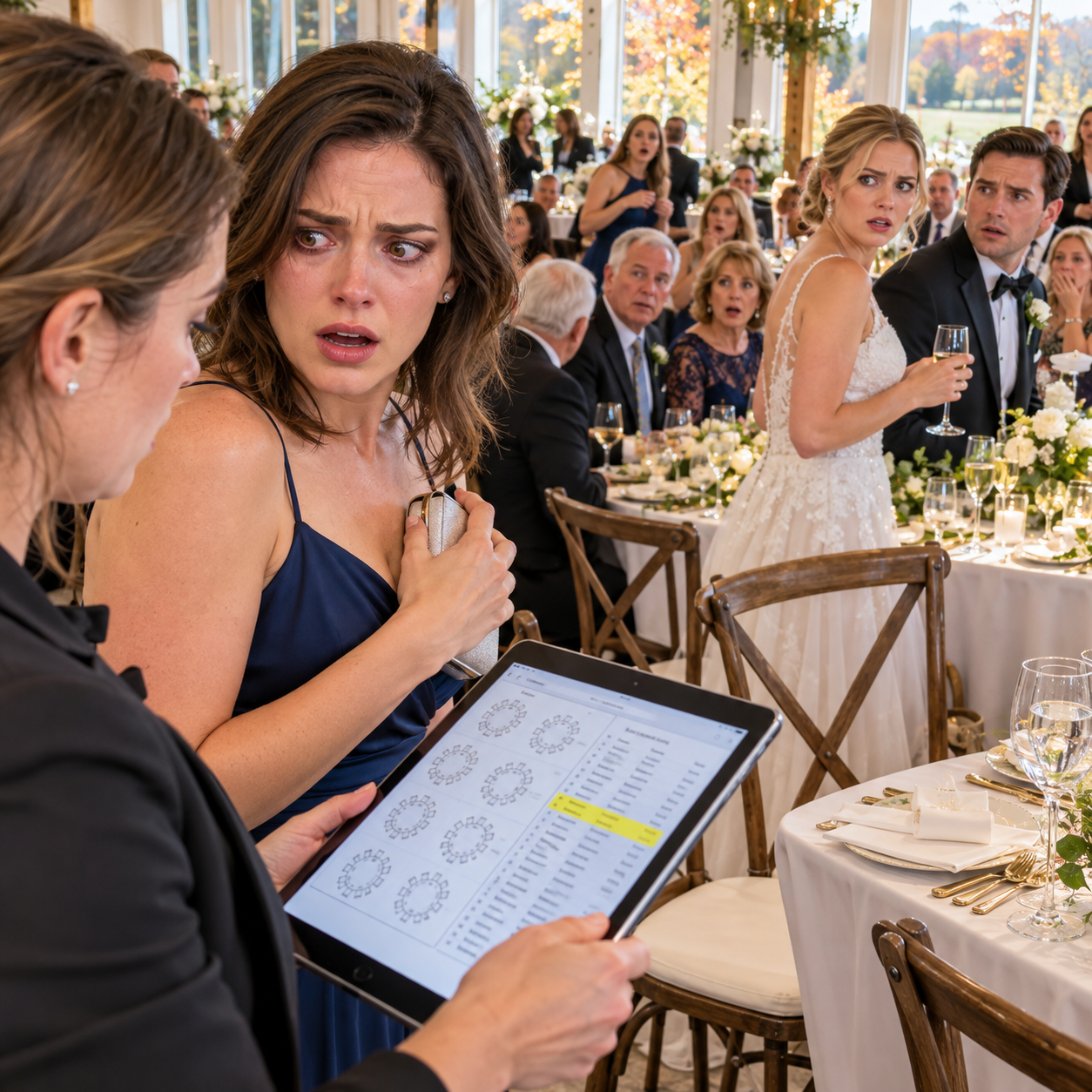
“I saw the seating spreadsheet.”
The whole story came out after that, not dramatically and not all at once. I told him about the bridal party, the fourth row, the altered seating chart, and the years of jokes that were only funny if I agreed not to be hurt. Owen listened without interrupting until I finally said, “She isn’t a monster. That’s the confusing part.”
“Most people who hurt us aren’t.”
I looked at him.
He pushed his hands into his pockets. “Sometimes they’re scared, or jealous, or used to getting away with something because everybody around them prefers peace.”
Through the windows, I could see Mom moving toward Adrienne. Dad followed more slowly, and Grant stood apart from all of them with his arms folded. For the first time that evening, my family didn’t look polished; they looked like four people having a difficult conversation.
Owen followed my gaze. “Do you want to go back inside?”
“I think I need to.”
When I returned, Adrienne was near the bar with Grant. Her cheeks were flushed, and a tiny muscle worked near her jaw as I approached.
“Can we talk?” she asked.
“Yes.”
She looked at Owen. “Privately.”
He stepped away before I could answer.
Adrienne folded her arms. “Grant thinks I threw the bouquet at you.”
“You did.”
“Oh, come on.”
“You looked directly at me first.”
“I was teasing you.”
“From thirty feet away with wired peonies?”
Her lips pressed together.
I had never seen my sister speechless because I had never made her finish a conversation without providing her exit. This time I waited.
Finally she said, “You always do that.”
“Do what?”
“Make me sound awful by being so calm.”
The accusation was so unexpected that I almost laughed again. “Adrienne, I don’t make you anything.”
Her eyes filled, which angered me more than shouting would have. “You have always been the competent one. The dependable one. Dad bragged about your career for years. Mom calls you whenever anything goes wrong. Even Grant asks your opinion about money because apparently you’re the sensible sister.”
I stared at her. “And you think that means I’ve had more?”
“I think you don’t understand what it’s like to feel compared to you.”
For a moment, I could see the machinery underneath thirty years of sisterhood. She had believed she was competing with me at the same time I believed I was disappearing behind her.
Then I thought about Table Nineteen.
“Feeling compared to me doesn’t explain moving my seat.”
Her face changed.
“No,” she said quietly. “It doesn’t.”
Part 3: I finally stop shrinking and ask for something real
We didn’t solve anything at the wedding. That would have been too easy and, looking back, probably dishonest. I told Adrienne I loved her, but I was leaving early, and when she started to say, “Claire, please,” I shook my head.
“Not because I want to punish you,” I said. “I just don’t want to spend another hour pretending tonight felt normal.”
Grant approached then, his expression tired. He looked at me before looking at his wife. “She’s right.”
Adrienne turned toward him. “Seriously?”
“I saw the throw.” He spoke gently. “And I saw you change the seating chart yesterday.”
That stopped both of us.
Grant rubbed a hand across the back of his neck. “The coordinator emailed because she thought Claire had been duplicated between two tables. You told her the family-table assignment was old.”
Adrienne stared at the floor.
I didn’t need any more proof, but hearing it from him mattered. It meant the story couldn’t be rewritten tomorrow into an accident, a misunderstanding, or another example of Claire being too sensitive.
I collected my purse and coat. Owen was waiting near the entrance, and when he saw me, he lifted my coat slightly.
“Escaping?”
“Leaving.”
“Good distinction.”
Outside, the parking field was damp beneath my heels, and music from the barn softened with every step. Owen offered me a ride because his hotel was near my neighborhood, and after a moment’s hesitation I accepted.
For the first twenty minutes we talked about nothing important. He complained about rental-car navigation systems; I told him accounting conferences had better snacks than urban-planning conferences, which he insisted was impossible to prove. Eventually, as highway lights moved across the windshield, he said, “Can I ask you something slightly intrusive?”
“Apparently tonight is the night for it.”
“Why did you stay so long?”
I knew he didn’t mean the reception.
I turned toward the window. “Because if I’m easy enough to deal with, nobody can accuse me of being the problem.”
“And has that worked?”
“No.”
The answer came so quickly that we both smiled.
Adrienne texted two days into her honeymoon.
Can we talk when we’re home? Really talk. No Mom.
I read it three times before replying.
Yes. But I don’t want an apology that explains why I shouldn’t be hurt.
Her response took almost an hour.
Okay.
Three weeks later, she came to my condo carrying a bakery box and no makeup. She stood in my kitchen while I made coffee, looking at the framed photographs on my refrigerator as though she had never seen them before.
“I moved your seat because I was angry at you,” she said.
I put the coffee pot down.
Adrienne stared at the counter. “At the rehearsal dinner, Dad told Grant’s father you were the person he trusted most with financial decisions. Then Mom said something about how she’d never worry about you because you always land on your feet.”
I waited.
“And all I heard was that you’re the responsible daughter and I’m the expensive one having a wedding everybody has to manage.”
“So you moved me away from the family.”
“Yes.”
She didn’t decorate it. That mattered.
“The bouquet?”
Her mouth twisted. “By then I’d seen you talking to Owen. You looked like you were having a good time, and I was angry that you weren’t miserable.”
I leaned back in my chair.
Adrienne covered her face for a second. “That sounds horrible.”
“It is horrible.”
“I know.”
We sat with that.
Then she told me something I hadn’t known. Growing up, Mom had compared us in private too, but in reverse: Claire is easier. Claire doesn’t need so much. Claire never causes scenes. Why can’t you be more like Claire about this? The comments that had made me feel invisible had made Adrienne feel defective, and instead of questioning the system, we had each spent years believing the other sister had received the better half of our parents’ love.
“That explains some things,” I said. “It doesn’t excuse them.”
“I know.”
She cried then, quietly, without reaching for me. I let her.
My own apology came later and was smaller. I admitted there had been times I had judged her need for attention rather than seeing the insecurity underneath it, times when being the “reliable” sister had become a private form of superiority. But I didn’t apologize for the wedding, for noticing, or for finally refusing to swallow what happened.
We agreed on something that would once have sounded absurdly formal between sisters: if either of us was angry, we would say it instead of staging it through jokes, seating arrangements, family messengers, or strategic silence. Mom resisted this new arrangement more than anyone. The first time she tried to tell me Adrienne was “having a hard week” and perhaps I could call first, I said, “If Adrienne needs me, she knows my number.”
Mom blinked.
Then she said, “You’re different lately.”
“I think I’m less helpful in ways nobody asked me to be.”
She didn’t laugh, but Dad did from across the kitchen.
Owen came back to Philadelphia for work in November. He texted one afternoon: Coffee? No projectiles promised.
I met him at a small café near Rittenhouse Square.
There was no dramatic romance waiting to reward me for surviving my sister’s wedding. There was coffee, then dinner two weeks later, then several months of slowly discovering that Owen snored, hated olives, called his mother every Sunday, and listened carefully when I said something mattered. I discovered I liked him very much.
Adrienne and I took longer.
We missed each other’s birthdays once because we were both being stubborn about who should call first. We argued at Christmas after she made a joke about my job and I told her immediately that I didn’t like it; she became defensive, disappeared into the pantry for five minutes, then came back and said, “You’re right. That was the old thing.”
The old thing.
That was what we began calling it.
A year after the wedding, Adrienne and Grant hosted an anniversary dinner at their house. Nothing extravagant—pasta, salad, a grocery-store cake, our parents, Grant’s sister, and me. When I arrived, Adrienne had placed my name card beside hers.
I picked it up and looked at her.
She shrugged. “Family table.”
There were a hundred clever things I could have said. Instead I sat down.
Later that evening, Adrienne brought out her wedding album. We turned pages of photographs I had avoided seeing for months, and eventually reached the bouquet toss. The photographer had captured the exact second Owen’s hand closed around the stems, my face startled behind them, and Adrienne in the background staring straight toward me.
Nobody spoke for a moment.
Then Adrienne touched the corner of the photograph.
“I hate that version of me,” she said.
I looked at my sister. “You don’t have to hate her. You just can’t let her run things anymore.”
Her eyes lifted to mine.
“Fair,” she said.
On the next page was a candid photograph taken outside the reception doors. Owen and I were standing beneath the terrace lights, both laughing at something beyond the frame, and I barely recognized myself because my shoulders weren’t drawn inward and my hands weren’t clasped nervously in front of me. I looked comfortable occupying space.
Adrienne studied the picture too.
“You look happy there.”
“I was.”
She gave me a small, regretful smile. “At least one good thing came out of my terrible aim.”
“Your aim was excellent.”
She laughed so hard she had to put down her wine.
I laughed with her, not because the past had become harmless, and not because forgiveness had erased what happened. I laughed because the truth no longer required either of us to shrink.
For most of my life, I thought belonging meant earning a place by being useful, quiet, accommodating, and easy to overlook. I know better now. A family seat isn’t valuable because somebody finally pulls out the chair for you; it’s valuable because you can sit there without having to disappear.
And if there isn’t room for the whole of you, sometimes the healthiest thing you can do is stand up and leave.
The End .
All characters and events in this story are fictional, created for storytelling and entertainment purposes. Thank you sincerely for reading. Your feedback and support are invaluable and motivate me to continue sharing more stories with you.

