
## Part 2: His Grand Celebration Turns Into a Humiliation He Cannot Control
Liam stood behind me in our bedroom mirror, adjusting his dark suit jacket while I closed the secure report. “You don’t have to go,” he said, studying my reflection. “Dad invited you because he wants to embarrass you.” I slipped the device into my evening clutch and turned toward him. “Then let’s not give him the satisfaction of seeing us afraid to walk into a room.”
The Oakridge Country Club looked like something designed to impress people who were already rich. Crystal chandeliers glittered above polished marble, white roses overflowed from silver arrangements, and waiters carried champagne between groups of defense executives and investors. Nearly fifty guests had gathered, including three legislative aides connected to the Armed Services Committee. Near the entrance, Reginald stood beneath a portrait of the club’s founder, receiving congratulations as though the Pentagon had already deposited eighty million dollars into his account.
He spotted us immediately. “Emma! Surprised they let you out of the security booth tonight.” Several nearby guests laughed uncertainly. Reginald slapped Liam’s shoulder and added, “Don’t worry, sweetheart. Nobody expects you to understand what we’re discussing.” Liam opened his mouth, but I gently touched his elbow. I could feel Reginald watching, disappointed that I hadn’t reacted.
We were seated near the center of the ballroom. Across from us sat two senior Apex executives whose signatures appeared throughout the contractor’s technical submissions. One avoided my eyes after Reginald introduced me as his son’s “little security guard.” The other laughed much too loudly. Neither knew I had spent the previous afternoon reviewing laboratory photographs of their company’s defective components.
The investigation had uncovered substitutions in equipment intended for dangerous operational environments. Heat-resistant composite materials had been replaced with cheaper civilian-grade alternatives, and thermal-shielded relays had been exchanged for commercially rated components. Testing at Aberdeen Proving Ground showed that those substitutions could fail under extreme temperatures, leaving deployed operators without critical systems. Financial records indicated an additional twelve-percent margin generated by the changes.
Those weren’t harmless accounting decisions. They were choices that could endanger American service members. My operational detachment had spent eight months evaluating Project Vanguard’s field requirements, and the investigators’ findings matched serious discrepancies already flagged by our technical specialists. The independent procurement review had concluded that Apex’s submission failed mandatory standards. Federal investigators were also examining whether the substitutions had been deliberately concealed.
I looked across the ballroom at Reginald, who was accepting another handshake with his familiar broad grin. He had spent years measuring human worth through money. Yet the evidence suggested he had knowingly risked the lives of people who might someday depend on his products.
Dessert had not yet arrived when Reginald stood and tapped his knife against a champagne glass. The conversations stopped. He spread his arms beneath the chandelier and smiled toward the congressional guests. “At Apex, we understand that success requires ambition, discipline, and the courage to make difficult decisions.”
His gaze shifted toward me.
“Of course, some people are perfectly content locking parking-lot gates and wandering around with flashlights. Not everyone has the vision to build something important.” Laughter rolled through the front tables. One woman lowered her eyes to her napkin, and Liam’s chair scraped sharply against the floor.
“That’s enough,” Liam said, standing. “Apologize to Emma. Right now.”
Reginald’s smile vanished. “Sit down, Liam.”
“No. You’ve humiliated my wife for four years. It stops tonight.”
Reginald’s face darkened. He turned toward the two private security guards beside the arched entrance and crooked his finger. “If my son won’t teach his wife some manners, perhaps the club staff can. Escort her out.”
The guards hesitated, glancing between us. Liam stepped protectively forward, but I rested my hand on his wrist. “It’s all right,” I murmured. Then I set my water glass down and looked directly at Reginald. “You might want those gentlemen to stay where they are. You’re going to have enough trouble carrying your own documents tonight.”
He opened his mouth to answer.
The ballroom’s mahogany doors swung inward.
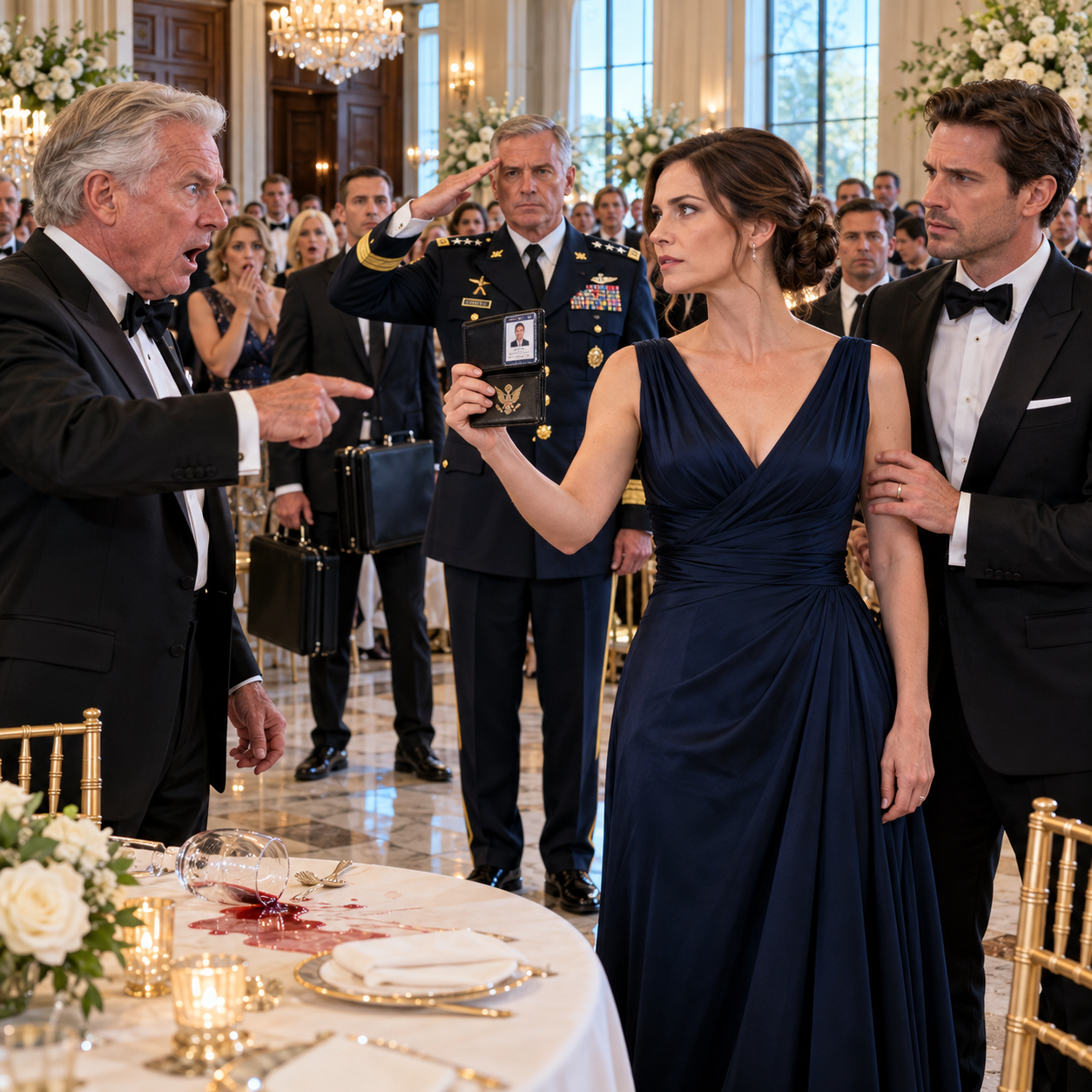
A senior Army officer entered, accompanied by two Army Criminal Investigation Division agents and two plainclothes federal representatives carrying secured briefcases. His dress uniform displayed combat decorations and a brigadier general’s silver star.
Reginald instantly recovered his smile. “General Martin Vance! What an extraordinary honor!” He hurried forward with his hand extended. “Please, join us at the head table. Everyone, this is the Pentagon representative I’ve been telling you about!”
General Vance did not accept his handshake.
He walked straight past him.
And stopped in front of me.
## Part 3: A General Reveals My Identity and Exposes the Dangerous Fraud
For several seconds, no one moved. Reginald remained near the center aisle, his outstretched hand slowly falling to his side. General Vance stood before our table while the federal agents positioned themselves nearby. I rose from my chair, and Liam moved beside me, his hand resting gently against my back.
“Lieutenant Colonel Carter,” General Vance said in a voice that carried across the silent room. “The Procurement Integrity Board has completed its review of Project Vanguard. Your operational evaluation has been accepted, and the investigative findings are ready for formal presentation.”
A spoon clattered against a plate somewhere behind us. Reginald blinked, looking from the general to me as though he had misunderstood a foreign language. “Colonel?” he repeated. “No, there must be some mistake. Emma works commercial security.”
I opened my clutch, removed my military identification, and placed it on the white tablecloth. “I’m Lieutenant Colonel Emma Carter, Reginald. I command a Delta Force operational element assigned under Joint Special Operations Command. My detachment has been responsible for evaluating Project Vanguard’s operational suitability for the past eight months.”
Reginald took a step backward. His champagne glass slipped from his fingers, spilling across the cream-colored carpet. One of the waiters instinctively moved forward with a towel, but stopped when an agent opened a secured portfolio and placed a series of official audit documents on the nearby table.
“That can’t be possible,” Reginald whispered. “You work at that warehouse. I saw it myself.”
“You saw a building,” I answered. “You never asked what happened inside.”
General Vance turned toward the gathering. “Ladies and gentlemen, the Department of Defense has completed a technical and procurement-integrity investigation involving equipment submitted by Apex Armaments and Logistics.” A nervous murmur traveled through the ballroom. One of Reginald’s executives pushed his chair away from the table, but a federal representative quietly requested that the relevant company officers remain available to receive legal documents.
An investigator opened the findings. He explained that the submitted transport prototypes contained unauthorized substitutions involving protective composites and heat-sensitive electrical systems. Laboratory examinations at Aberdeen Proving Ground had revealed components unable to withstand required environmental conditions. A series of procurement records showed that the cheaper alternatives had not been accurately disclosed in Apex’s certifications.
Reginald gripped the back of a chair. “Those are engineering decisions. I don’t personally inspect every component in my factories.”
“Nobody is suggesting that you do,” the investigator replied. “We’re examining who authorized the substitutions and who certified the final equipment as compliant.”
General Vance placed another document beside the portfolio. “Project Vanguard will not be awarded to Apex. The company’s eligibility for additional federal contracts has been suspended pending formal proceedings, and federal investigators have initiated action to preserve its executive and procurement records.”
Reginald stared at the papers as though refusing to read them might make them disappear. Around him, the businessmen who had spent the evening competing for his attention began looking at one another in alarm. His closest investor quietly pocketed his phone. The lobbying partner he had once tried to introduce to Liam stood near the far wall, her face carefully expressionless.
“Emma,” Reginald said, suddenly lowering his voice. “Whatever misunderstanding occurred, we can resolve this privately. You know this company supports hundreds of families.”
I felt Liam’s hand tighten against mine. “Those families deserved leadership that didn’t put their livelihoods at risk,” I replied.
Reginald glanced at his son, searching for an ally. “Liam, tell her. I’m your father. Your grandfather helped build this company. Surely you understand what happens if they destroy everything we’ve worked for.”
Liam stepped away from the table. His face was pale, but his voice remained steady. “You spent four years humiliating my wife because you thought her work was beneath you. Now you want her to use that same work to protect you from the consequences of yours.”
His father’s shoulders sagged. “I’m asking you to choose your family.”
“Emma is my family,” Liam answered.
The room fell silent again.
I turned toward Reginald. “My oath doesn’t disappear because we’re related by marriage. These systems were intended for people serving in dangerous places. A failed relay could leave an operator without communications or vital information. They deserve better than equipment selected to increase someone’s profit.”
Reginald looked down. For the first time since I’d met him, he seemed incapable of finding something cruel to say.
The federal agents served the necessary document-preservation notices and requested cooperation with the investigation. No one shouted. No one needed to. The business empire Reginald had spent decades celebrating was unraveling under the weight of paper records and technical findings.
But as Liam and I prepared to leave, Reginald caught my arm lightly.
“Emma,” he whispered, glancing toward the investigators, “please tell me they don’t have the original purchasing authorizations.”
I looked at his trembling hand.
Until that moment, he had been pretending not to know what had happened.
Now I understood exactly what he was afraid they would find.
## Part 4: The Final Evidence Destroys His Empire and Reveals True Loyalty
I stepped away from Reginald and studied his face. “Why are you asking about the original authorizations?” I said quietly. His eyes moved toward Liam, then back to me. “It was a complicated supply-chain decision. People make mistakes.” Behind him, federal investigators were collecting acknowledgments from the company’s executive officers. I recognized the familiar look of a man realizing that the documents he considered routine paperwork might become the strongest evidence against him.
Liam heard every word. “Did you know about the substitutions, Dad?” Reginald loosened his bow tie and swallowed. “I approved budgets, Liam. I didn’t tell anyone to compromise safety.” My husband waited for him to say something more, but his father only stared at the carpet. Finally Liam reached for my hand. We walked out beneath the country club’s enormous chandeliers without looking back.
Three weeks later, the investigation uncovered the truth Reginald had tried to conceal. An internal purchasing authorization, signed electronically from his executive account and corroborated by related correspondence, approved the substitution of lower-cost components despite engineering concerns. One message showed that a technical specialist had questioned whether the replacements could satisfy military testing requirements. The response from Reginald’s office instructed the procurement team to preserve the projected twelve-percent cost advantage.
The documents did not merely show that he had failed to supervise his employees. They connected him directly to decisions he had publicly blamed on unnamed engineers. The investigators now had evidence explaining why the equipment had been altered and why concerns had not been properly addressed.
When Liam learned what the records contained through the subsequent proceedings, he sat at our kitchen table for nearly an hour without speaking. An untouched cup of coffee cooled beside his elbow. “He always told me that our family’s name meant responsibility,” Liam finally said, staring at his hands. “I spent my childhood believing that.”
I sat beside him. “You believed what a son should have been able to believe.”
He looked toward the window, where the morning sun caught the leaves above our fence. “I kept thinking that if I built something worthwhile on my own, he’d eventually respect me. Maybe I was still trying to earn something he should’ve given freely.” His voice broke on the last word, and I moved closer. We stayed there together until the coffee went cold.
Over the next six months, Apex’s federal business collapsed. Contract cancellations, fraud-related financial exposure, and the loss of procurement eligibility left the company struggling to operate. Its board removed Reginald from executive leadership, and a court-supervised restructuring led to the sale of its remaining manufacturing assets. The criminal investigation continued through the proper legal channels, while Reginald’s once-powerful position disappeared almost overnight.
His name no longer opened doors in Washington. Former associates stopped inviting him to their private dinners, and the people who had once applauded his speeches became difficult to reach. He remained at the McLean estate, spending long afternoons on the manicured lawn where he had once hosted elaborate parties. Liam received several messages asking him to reconsider family trust arrangements, but he declined them all.
“I don’t want his money deciding what kind of man I become,” he told me one evening, signing the papers that formally separated his professional finances from the family business.
Meanwhile, Liam’s architecture practice began flourishing. His team won a major commission to design a regional Veterans Medical Center in Richmond, a project he had pursued long before anyone knew what I did for a living. When he brought the plans home, he spread them across our dining table and pointed to the wide entrance, the accessible gardens, and the family waiting areas. “I want the people who come here to feel that somebody thought about what they actually need,” he said.
I studied the drawings and smiled. “That’s what you’ve always done.”
Last night, we ate dinner on our screened porch in Alexandria. Summer crickets hummed beyond the railing, and two simple plates of roasted chicken sat between us on the cedar table. My phone remained silent beside my glass of water. For once, nothing demanded my attention beyond the small, ordinary happiness in front of me.
Liam looked at me across the table. “Do you ever wish you’d told him sooner?”
I considered the birthday dinners, the humiliating jokes, the coat dropped into my arms, and the night his father ordered security guards to remove me from the ballroom. Then I remembered Liam standing beside me before he knew the full nature of my command, defending me when he believed his words were the only protection he could offer.
“No,” I said. “Because I learned something important about you.”
He raised an eyebrow. “What’s that?”
“You chose me when everyone around you thought I had nothing worth choosing.”
Liam reached across the table and took my hand. “I didn’t choose your rank, Emma. I chose you.”
I looked at our wedding rings, worn smooth by years of ordinary living. Reginald had possessed wealth, influence, and opportunities most people could only dream about, yet he had mistaken those things for character. My husband had walked away from all of them rather than betray what he believed was right.
I had spent much of my career learning when to speak, when to act, and when silence could protect something important. But the greatest lesson came from the man sitting across from me.
Reginald thought respect belonged to people with impressive titles. He never realized that his son had already given me something far more valuable—love that required no proof of status.
And when Liam reached over to turn off the porch light, I knew the only victory that truly mattered had nothing to do with an eighty-million-dollar contract.
It was the life we had protected together.
THE END.
All characters and events in this story are fictional, created for storytelling and entertainment purposes. Thank you sincerely for reading. Your feedback and support are invaluable and motivate me to continue sharing more stories with you.


