Chapter 2
The lake beyond Briarwood Manor was black beneath the September sky. Music drifted through the ballroom doors behind me, cheerful and absurd, while my shoulder throbbed where the box had struck me.
I stood under the terrace lights and forced myself to think like an accountant.
What did I actually know?
I knew I had paid $42,000.
I knew Mom had attempted to add another $7,300 without permission.
I knew Dad had somehow bought a bass boat during the same year he claimed money was tight.
And I knew Seth’s mother believed she had contributed to something.
I pulled out my phone.
Monica answered on the fourth ring.
“Holly?”
I could hear road noise.
“Are you coming to the party?”
“We just left the airport. Maybe twenty minutes away. Is Seth okay?”
“He’s fine. Everyone’s fine.”
I swallowed.
“When you arrive, would you come to the front desk before entering the ballroom? There’s something I think you need to see.”
She went silent.
Then she asked, very softly, “Is this about money?”
My stomach tightened.
“Why would you ask that?”
“Because people don’t make calls like this during engagement parties unless something is wrong.”
“I’ll explain when you get here.”
Dominic was behind the front desk when I walked into the lobby.
“I heard what happened,” he said.
Apparently, the ballroom microphones fed into the staff speakers.
“I’m not approving the extra charges.”
He nodded.
“The band stops at ten. No champagne tower. And the premium liquor?”
“Whatever has already been served should be charged to whoever ordered it.”
“That would be your mother.”
“Then charge my mother.”
He wrote it down.
“Anything else?”
“Yes. Print the payment history for the event.”
Dominic looked at me for a moment, then turned toward his computer.
At 8:58, Monica and Walter Lawson entered the lobby.
Walter walked with a cane. Monica came directly toward me, saw the bruise forming above my dress, and frowned.
“What happened?”
“Please look at this first.”
Dominic placed the ledger on the counter.
Four payments.
$10,500 each.
All from me.
Monica read the page twice.
Walter put on his glasses and read it once.
Then we heard Amanda’s voice through the ceiling speakers.
“I want to thank the two people who made tonight possible—Mom and Dad.”
Applause erupted.
“Every flower, every light, every beautiful detail is because of them.”
Monica slowly looked up.
Walter removed his glasses.
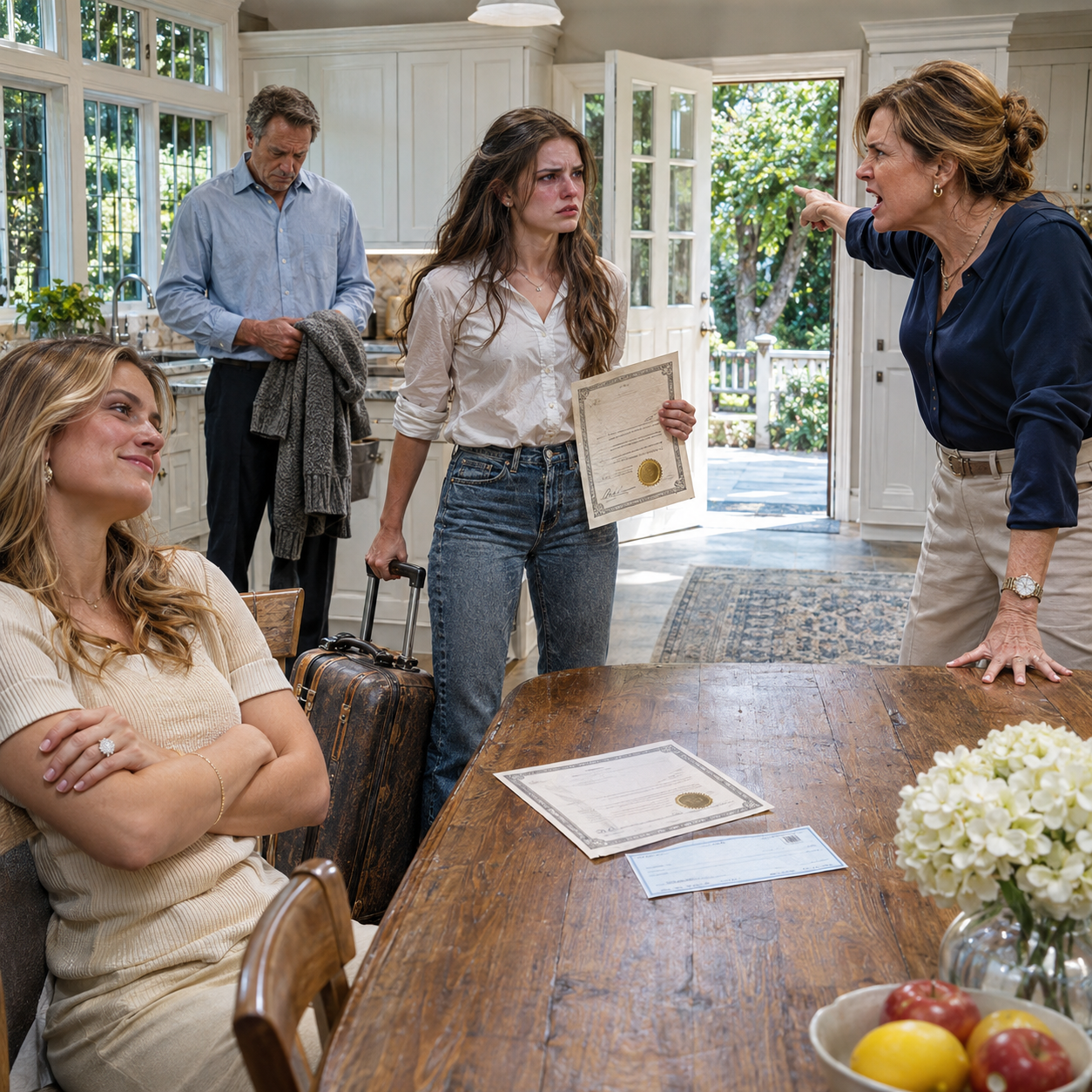
“Dominic,” Monica said, “would you please ask Amanda to come out here?”
Amanda appeared a minute later, smiling as she rounded the corner.
The smile disappeared when she saw me.
Then she noticed the Lawsons.
“Monica! Walter! You’re here.”
Monica did not move.
“I have one question, sweetheart. Who paid for this party?”
Amanda’s eyes flicked toward me.
“My parents.”
“Only your parents?”
“And you guys, obviously.”
I felt the floor shift beneath me.
Monica folded her arms.
“Our half?”
Amanda nodded.
I turned toward Monica.
“What half?”
Walter answered.
“Your father called me in February. He said the party would cost about forty thousand dollars and asked whether we would split it. I wrote him a check for twenty thousand.”
For several seconds, nobody spoke.
Twenty thousand dollars.
In March.
The same spring Dad bought the boat.
Walter tapped the ledger.
“But this says you paid everything.”
Amanda’s face went pale.
Then she said the worst possible thing.
“That money wasn’t for the party.”
Monica stared at her.
“What?”
“Dad said you were helping with the wedding. Some of it went toward my dress.”
“Your dress?”
Amanda crossed her arms.
“It’s custom.”
“How much?”
“Nine thousand.”
The silence that followed was so complete that I could hear the muted bass from the ballroom.
I looked at my sister.
“You knew.”
She frowned.
“Knew what?”
“You knew I paid for this party. You knew Dad took twenty thousand dollars from Seth’s parents supposedly for the same party. And you still stood in there thanking Mom and Dad.”
“You’re twisting everything.”
“I’m repeating what happened.”
Amanda leaned closer.
“They have money, Holly. Twenty thousand dollars isn’t going to ruin them.”
Walter’s expression hardened.
“That isn’t the point.”
Before Amanda could answer, Mom and Dad came around the corner.
Mom was smiling until she saw the ledger.
Dad saw it next.
The color disappeared from his face.
Walter looked directly at him.
“Where is my twenty thousand dollars, Randy?”
Dad gave a weak chuckle.
“Come on, Walter. We’re celebrating. We can sort this out later.”
“You called me about money for this event. That means you made it business.”
Mom stepped forward.
“It’s a misunderstanding. Holly contributed some, and we decided your contribution could be better used toward wedding expenses.”
“I contributed some?” I said.
Mom glanced at me.
“Holly, not now.”
“No. Now.”
Something in my voice stopped everyone.
“I paid all forty-two thousand dollars.”
Mom’s lips tightened.
“You offered.”
“You promised to repay me.”
“This is family.”
“That didn’t stop you from taking money from two families.”
Dad’s face hardened.
“Watch yourself.”
For most of my life, those two words would have worked.
That night, they didn’t.
I picked up the payment ledger.
“I’m going back inside.”
Mom’s eyes widened.
“You wouldn’t dare.”
I looked at Monica.
“Would you walk in with me?”
She took my arm.
“Absolutely.”
Chapter 3
The ballroom quieted when we entered.
One hundred and fifty guests turned toward us as Monica walked beside me, Walter followed with his cane, and my parents came behind us looking as though they had just discovered the floor beneath them was thinner than they thought.
I went to the head table and picked up the microphone.
“Good evening. I’m Holly.”
My voice carried cleanly across the room.
“The embarrassment.”
A few people shifted uncomfortably.
Amanda stood near the cake table, rigid with fury.
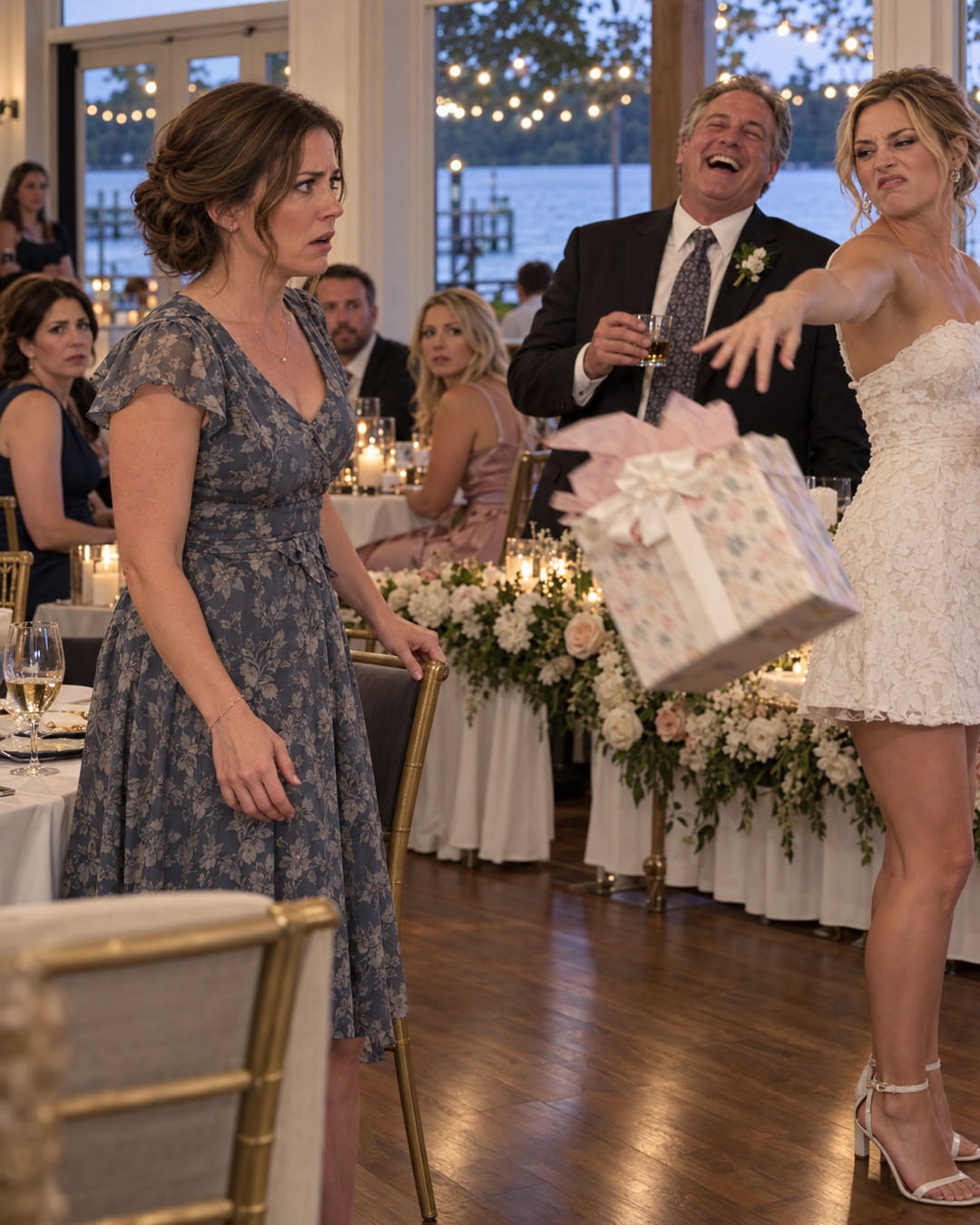
“I’ll be brief. Earlier tonight, my sister threw my gift at me, my mother accused me of causing a scene, and my father asked what I could possibly do about it.”
Dad moved forward.
“Holly, enough.”
“You asked me a question.”
He stopped.
“So I’m answering.”
I held up the ledger.
“I am the contract holder for tonight’s event. I paid the venue forty-two thousand dollars from my personal savings.”
Whispers moved through the room.
Mom stepped forward.
“She’s upset. She’s confused.”
“No,” I said. “I’m an accountant. Confusion about payments is one of the few things I’m paid not to have.”
Then I pulled out my phone.
Months earlier, after Mom visited my apartment, she had left me a voicemail.
I had saved it.
Of course I had.
I held my phone near the microphone and pressed play.
Mom’s recorded voice filled the ballroom.
She reminded me not to mention money to the Lawsons. As far as anyone knew, she said, Mom and Dad were hosting. That was how things needed to appear for Amanda.
When the recording ended, the silence was unbearable.
I had imagined exposing the lie would feel satisfying.
It didn’t.
It felt like finally setting down something heavy after carrying it too far.
Walter stepped forward.
“My wife and I also gave Randy twenty thousand dollars because he told us he needed help paying for this party.”
The whispers stopped.
Walter turned toward Dad.
“I expect it returned by the end of next month.”
Dad swallowed.
“We’re going to be family.”
“Not yet,” Walter said.
Seth had not spoken.
He sat at the head table staring at Amanda.
Finally, he stood.
“The dress,” he said.
Amanda shook her head.
“Seth—”
“You told me your parents bought it.”
“They did.”
“With my parents’ money?”
She said nothing.
“Did you know Holly paid for tonight?”
Amanda’s eyes filled, but no tears fell.
“I knew she was helping.”
“She didn’t help,” Seth said. “She paid.”
A chair scraped at the back of the ballroom.
Grandma Pearl stood beside table nineteen.
My father visibly flinched when she spoke.
“Randall.”
Her voice wasn’t loud, but thirty years of managing a school office had taught her how to make people listen.
“I raised you better than this.”
“Mom—”
“No. You’ll hear me.”
Grandma steadied herself against the table.
“I watched this family take from that girl because she was responsible enough to survive it. When she was fourteen, her mother took every dollar she’d saved and spent it on Amanda.”
Mom stared at her.
“You knew?”
“I knew. And I said nothing because I told myself Holly was strong.”
Grandma looked at me.
“I was wrong. Being strong enough to survive something doesn’t make the thing right.”
My throat tightened.
That hurt more than the silver box had.
Mom looked around at the guests.
“This is a private family issue.”
Grandma snorted softly.
“You made it public when you humiliated your daughter in front of everybody.”
I lowered the microphone.
Then I remembered the contract.
“Dominic?”
He appeared near the doorway.
“What time does our original agreement end?”
“Ten o’clock.”
I checked the clock.
“Then we have about half an hour. The original bar, food, and band are paid through ten. The extra premium liquor, champagne tower, and additional band hour were not approved by me.”
Mom stared.
“You’re canceling the toast?”
“I’m refusing to pay for something I didn’t order.”
Dominic approached Dad with the additional bill.
“The premium bar already served comes to thirty-one hundred dollars. The remaining upgrades would add forty-two hundred.”
Dad reached for his wallet.
For the first time all night, he no longer looked amused.
He handed Dominic a card.
Dominic returned moments later.
“I’m sorry, sir. It was declined.”
Dad’s face darkened.
“Run it again.”
Dominic did.
Declined again.
No one laughed.
I didn’t feel victorious either.
I just felt exhausted.
Seth took out his own card.
“I’ll cover what’s already been served. Cancel everything else.”
Then he faced the room.
“Thank you all for coming. We’re ending early.”
People collected purses and jackets quietly.
Several stopped beside me.
One woman from Mom’s church squeezed my hand.
Seth’s college roommate whispered, “I’m sorry.”
Amanda left through the terrace doors without looking at me. Mom followed her.
Dad stayed in the center of the dance floor, holding his useless credit card.
Before leaving, Monica found the silver box at Grandma’s table.
She opened it and looked at the engraved cake knife and server.
“This is beautiful.”
“I thought she’d keep it forever.”
Monica closed the box.
“You should.”
I looked toward the terrace doors.
“I don’t think I want it.”
“Keep it anyway,” she said. “Not everything has to remain what it was purchased to be.”
The next morning, I woke to forty-one notifications.
Mom had called eleven times.
Dad had sent two messages.
The first said I had humiliated the family.
The second asked where he was supposed to find twenty thousand dollars in thirty days.
I stared at that message for several minutes.
Then I typed:
Sell the boat.
And sent it.
Chapter 4
Walter did not forget the debt.
Twelve days later, his attorney sent my father a formal letter.
Suddenly, Dad discovered that money could be found when the person asking for it was someone he couldn’t guilt into silence.
He sold the bass boat for fourteen thousand dollars and borrowed the remaining six thousand against his truck.
Mom called me crying.
“Your father loved that boat.”
“I loved my house savings.”
“You’re going to punish us forever?”
“I’m not punishing you. I’m asking you to repay what you promised.”
That week, I sent my parents a letter of my own.
It was written on my business letterhead.
I attached copies of all four venue payments and the messages in which Mom had promised every cent would be returned once Dad’s settlement arrived.
Total balance: $42,000.
I requested a repayment plan within thirty days.
Mom called immediately.
“A business letter? To your own parents?”
“You treated me like a bank.”
Silence.
Then she said something I had never expected to hear.
“I didn’t think you’d ever actually say no.”
The words were almost a whisper.
I closed my eyes.
“That was the whole arrangement, wasn’t it?”
She didn’t answer.
Two weeks later, a repayment agreement arrived.
Three hundred dollars a month, plus a larger payment once Dad’s settlement came through.
The first check arrived in November.
In the memo line, Dad had written one word.
Sorry.
I sat in my car outside the post office and cried.
Not because $300 repaired anything.
It didn’t.
But I had spent my whole life wondering whether my parents even understood that I had been hurt.
That single word told me my father finally did.
Amanda’s life unraveled more quickly.
Two weeks after the party, Seth postponed the wedding.
Then more financial problems surfaced.
Amanda had hidden more than eleven thousand dollars in credit-card debt. She still owed thousands on the designer gown. She had repeatedly assured Seth that everything was paid.
In December, he ended the engagement.
Amanda called me that evening.
Her sobbing was so hard I could barely understand her.
“He’s gone.”
“I’m sorry.”
“Are you?”
“Yes.”
“You ruined everything.”
I was standing in the back office of the bakery whose books I managed. Warm bread scented the room.
“No, Amanda.”
“You could have let it go.”
That sentence almost made me laugh, though nothing was funny.
“I always let things go.”
“Exactly!”
“That’s the problem.”
She became quiet.
“I kept saving you from consequences because I thought that was love. Mom did it too. Dad did it. Everybody kept protecting you from the cost of your own choices.”
“You think you’re better than me.”
“No. I think we were both taught something harmful. You were taught someone would always rescue you. I was taught it should always be me.”
She hung up.
For weeks afterward, I kept remembering the little girl who once squeezed my hand on the way to kindergarten and asked if monsters lived inside the school.
I wished I could answer her now.
The monster was never hiding under a bed or behind a classroom door.
Sometimes the monster was the belief that somebody else would always pay.
Amanda moved back in with our parents after New Year’s. She returned the wedding dress for a partial refund and used the money to settle what she could.
Then she got a customer-service job with a health insurance company.
Mom told me she hated it.
Mom also told me she had not been late once.
One Sunday afternoon, I visited Grandma Pearl.
She was at her kitchen table recording grocery expenses in the same spiral notebooks she had used for decades.
I placed the silver gift box beside her.
She pushed a plate of shortbread toward me.
“You’re too thin.”
“I’m not.”
“You are in grandmother measurements.”
Then she pulled out her checkbook.
The check was already written.
$800.
I stared at it.
“Grandma.”
She tapped the paper.
“For a gift that should have been appreciated.”
“I can’t take this.”
“You can.”
“I don’t need the money.”
“Neither did Amanda. That wasn’t the point.”
I looked at her.
Grandma’s expression softened.
“Every dollar has a name, remember?”
I smiled through sudden tears.
“That one has yours.”
I held the check for a long time.
Then I asked the question that had stayed with me since the party.
“Why didn’t you say anything when I was fourteen?”
Grandma removed her glasses.
“Because your father was my son. Because I was afraid of interfering. Because I told myself you were tough enough.”
She looked straight at me.
“You were tough enough. But that never made it right.”
I didn’t cash the check.
I framed it.
It sits beside my business license to this day.
Chapter 5
It took fourteen months, but I bought my house.
Two bedrooms. One bathroom. A porch with a board that dipped slightly on the left side. The kitchen had exactly what I had imagined all those years—a window above the sink looking toward a dogwood tree.
My down payment was smaller than it might have been.
I didn’t care.
The money I spent on Amanda’s party had purchased a painful education, and the repayment checks arriving every month were slowly rebuilding the account.
More importantly, I had stopped measuring love by how much I was willing to surrender.
The first gathering I hosted at the house was Grandma Pearl’s 83rd birthday.
Twelve people came.
We used folding chairs. The bakery owner gave me a lemon cake and refused payment.
Dad showed up carrying a toolbox.
He noticed the loose porch board, repaired it without saying anything, then acted as if it had happened by itself.
Mom arrived with a casserole.
At the kitchen doorway, she stopped.
“Is it okay if I put this in your oven?”
Such a small question.
I turned toward the window because I didn’t want her to see my eyes fill.
She had asked permission.
Maybe other families wouldn’t understand why that mattered.
I did.
Amanda didn’t come.
But she sent Grandma a birthday card.
At the bottom, beneath the printed message, she had written another line.
Holly, your house looks beautiful in the pictures.
That was all.
No apology.
No invitation.
No miracle.
But it was the first kind thing she had said to me in more than a year.
Sometimes healing isn’t a grand reconciliation.
Sometimes it is simply the first brick laid where a bridge used to be.
When it was time to cut the birthday cake, I opened my kitchen drawer and removed the sterling silver knife and server.
Amanda’s and Seth’s names were still engraved on the handles.
So was the engagement date.
I had considered having the engraving removed.
In the end, I decided against it.
Some objects carry scars the way people do. Erasing the marks doesn’t erase what happened, and sometimes remembering where you have been helps you recognize how far you’ve come.
I handed the knife to Grandma.
She examined the engraving and smiled.
“$800,” she said.
Then she looked at me.
“Worth every penny.”
Everyone laughed softly.
Grandma cut the first slice of lemon cake.
For thirty-five years, I had been the person who served everyone else first. I had carried plates, covered bills, fixed problems, excused insults, and convinced myself that being needed was the same as being valued.
Grandma slid the first slice onto a plate.
Then she handed it to me.
“You first,” she said.
I looked down at the cake.
Something inside me broke open—not painfully this time, but gently.
Dad sat on the porch beside the board he had repaired. Mom was arranging napkins and asking where I wanted them. Grandma stood in my kitchen holding a cake server that had once been thrown at me in contempt.
And for once, nobody was asking me to give anything away.
I took the plate.
“Thank you.”
Grandma smiled.
Two ordinary words.
Maybe that was what I had wanted all along.
Not repayment.
Not revenge.
Not even an apology grand enough to make up for everything.
I wanted my life to belong to me without having to justify it.
I wanted generosity to be something I chose, not something people demanded.
I wanted love to stop arriving with an invoice.
My father once asked what I could possibly do after everything had already been spent.
He was right about one thing.
The money was gone.
But my future wasn’t.
Neither was my dignity.
And the moment I stopped allowing the people I loved to spend me like loose change was the moment I finally understood something Grandma Pearl had tried to teach me years before.
Every dollar needs a name.
So does every boundary.
And sometimes the most important name you can put on either one is your own.
THE END.
⚠️ All characters and events are fictional. Do not imitate or apply them in real life. 😌😌😌