
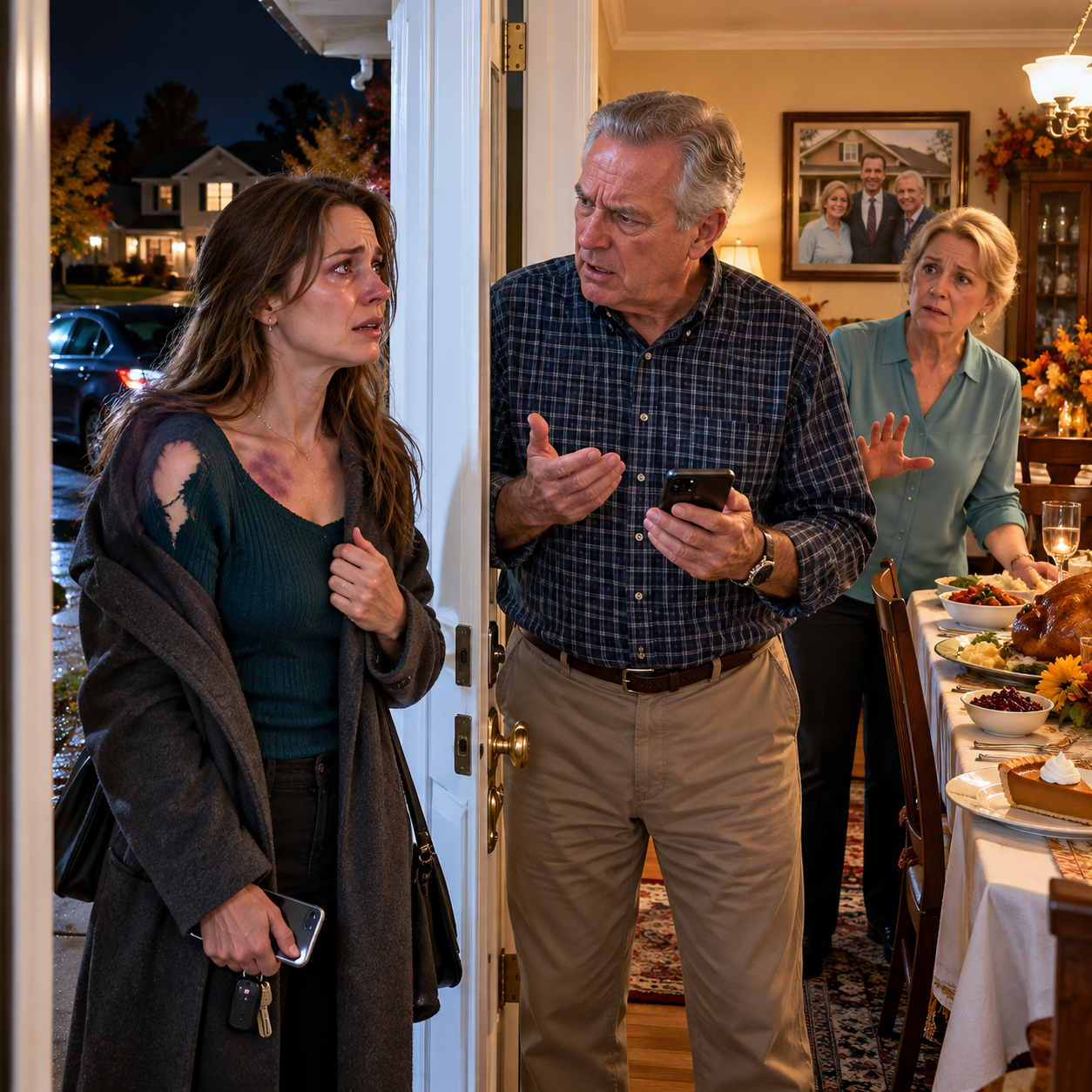
## Part 2: A Forgotten Warning Reveals the Hidden Cost of Generosity
Felicia answered on the third ring.
“Renata?”
I could hear a television in the background and the faint clink of dishes. When I told her where I was, she switched off the television without asking me to repeat myself. I described the hallway, the broken lamp, and the conversation at my parents’ door.
“Can you drive safely?” she asked.
“I think so.”
“Come to my place in Dublin. I’ll text the address. And Renata? You don’t need to call Marcus tonight.”
Her townhouse was near a small park, with a porch light that illuminated the wet sidewalk. Felicia opened the door wearing jeans and a gray sweatshirt, her silver-streaked hair tied loosely behind her head. She took one look at my collarbone and moved aside.
“I’ve got tea and a first-aid kit,” she said. “Whichever you want first.”
She examined the bruise without touching it, offered to help me find medical care, and asked permission before photographing the injury for my records. At the kitchen table, she wrote down the sequence of events while I spoke. When I struggled to remember whether Marcus had been standing directly in front of me or slightly to the side, she told me not to guess.
“Write down what you’re certain of. Leave the rest alone.”
Afterward, she poured fresh tea and sat opposite me.
“Marcus has done versions of this before,” she said.
I looked at her. “With his ex-girlfriend?”
Felicia nodded. “He co-signed her apartment lease. Later, whenever they argued, he reminded her whose signature helped her get approved.”
She explained that Marcus had also supported their mother financially and used those contributions to influence decisions about her care. He’d sometimes been genuinely generous, Felicia admitted. That was what made the pattern difficult for others to recognize.
“He believes providing something gives him authority over what happens next,” she said. “He probably thinks that’s responsibility.”
I remembered Marcus telling my father, during the housewarming party, that he wanted everyone to feel secure. I remembered the champagne toast and how proudly Derek had called him family.
“Did you know about my parents’ house?” I asked.
“Not the details. Did they ever see the deed?”
“I don’t know.”
Felicia’s expression tightened. “Then you need to find out.”
We discussed Derek’s promised investment next. She asked whether Marcus had transferred any money, signed a financing agreement, or even provided a letter confirming the $200,000.
“No. He just keeps saying it’s happening.”
Felicia turned her teacup slowly between her hands.
“Then Derek may have built his future around something that doesn’t legally exist.”
I slept in her guest room with my phone turned facedown on the dresser. By morning, Marcus had sent twenty-two messages. The first demanded to know where I was; later ones promised that we could work things out if I stopped involving other people.
One message said, “I think you need to consider very carefully what you’re doing to your family.”
I saved screenshots of every message.
Before I left, Felicia gave me the number of Patricia Delvecchio, a family law attorney she trusted. She didn’t suggest that I file for divorce immediately or tell me how my marriage should end. She simply said, “Talk to someone who can explain what belongs to whom. Decisions are easier when you know what you’re deciding.”
My closest friend, Simone, called that afternoon. She’d noticed months earlier that I’d stopped joining our Saturday breakfasts whenever Marcus was home.
“Are you safe where you are?” she asked.
“Yes.”
“Do you need clothes? A place to stay?”
I gripped the phone a little tighter. “I need someone who isn’t going to ask me to consider a mortgage before deciding whether I feel safe.”
“You’ve got that,” she answered. “I’ll bring your work laptop and anything else you need.”
Four days after Thanksgiving, I sat across from Patricia in an office that smelled of coffee and freshly printed paper. I brought photographs of my injury, my password-protected journal, Marcus’s messages, and copies of whatever financial documents I could access legitimately.
Patricia read quietly, making notes in the margins. She asked about the hallway incident, our shared accounts, my employment, and the circumstances of my parents’ purchase. Then she opened the property records she’d obtained.
“Renata, your parents aren’t listed as owners.”
I leaned toward the document.
Marcus’s name appeared as the titleholder. My parents had been contributing toward the mortgage and maintaining the property, but their names weren’t on the deed.
“That doesn’t automatically mean they can be removed without a legal process,” Patricia explained. “We’ll need to examine the occupancy agreement, payment history, and any representations made when the house was purchased. But they should understand what the ownership documents actually say.”
I thought of my mother kneeling in the garden, planting flowers she expected to watch grow for twenty years.
“What about Derek’s investment?”
Patricia flipped to another page. “From what you’ve shown me, there’s no written commitment or completed transfer. We can’t treat a verbal expectation as an established asset.”
We spent another hour discussing the complexities of separating marital property and the importance of preserving communications. Patricia advised me to avoid making major financial decisions until we understood the full picture. She recommended keeping future discussions about the legal and financial issues documented.
Before leaving, I asked something that had bothered me since Felicia’s kitchen.
“Do you think Marcus planned all of this?”
Patricia closed the folder.
“That’s not something I can establish from these documents. My job is to determine what rights and obligations exist, not to diagnose his motives.”
Outside, cold rain tapped against the parking garage entrance. I opened my phone and looked at Marcus’s latest message.
“Your parents wouldn’t have that house without me.”
For the first time, I had the paperwork to understand precisely what he meant.
## Part 3: The Property Records Force My Family to Face Reality
Two weeks later, I called my father and asked him and Mom to sit down together.
“We’re sitting,” he said, although I could hear him dragging a chair across the kitchen floor. “Have you talked to Marcus?”
“Not directly. Dad, I need to explain something about the house.”
He immediately asked whether Marcus intended to stop helping with the mortgage. I told him what Patricia had found, carefully distinguishing the legal ownership from the contributions my parents had made.
When I said their names weren’t on the deed, my mother asked me to repeat it.
“That can’t be right. Dwight signed papers.”
“He may have signed occupancy or payment documents, Mom. We need to look at what they actually were.”
Dad said Marcus had explained that refinancing would put everything in their names later. He’d believed him, especially after Marcus provided the money that made the purchase possible.
Mom began crying quietly.
“But this is our home. We’ve paid every month.”
“I know. That’s why you need your own attorney to review everything.”
Dad cleared his throat. “Couldn’t you just talk to Marcus? Ask him to straighten it out?”
I looked across Felicia’s guest room at the suitcase I’d been living out of since Thanksgiving.
“I’m not going back to my marriage to make him cooperate.”
Neither parent answered immediately. Then Mom asked, “Are you all right, Renata?”
It was the question I’d wanted her to ask at the front door.
“I’m staying somewhere safe,” I said.
“I should have asked that night.”
“Yes, Mom. You should have.”
We stayed on the phone a little longer, discussing documents and the name of a lawyer Patricia had recommended for their housing questions. Before we hung up, Dad admitted he hadn’t realized the arrangement left so much outside their control.
The following afternoon, Derek called while I was leaving work.
“Do you understand what you’re doing to me?” he asked.
I stopped beside my car. “Hello to you, too.”
“Marcus won’t answer my calls. The investment is supposed to move forward in January, and suddenly everybody’s acting like I’m the problem.”
“Derek, has Marcus signed an agreement?”
“You know he promised.”
“That’s not what I asked.”
He exhaled sharply. “He said we’d get to the paperwork.”
“Have you received any money?”
“No, but that doesn’t mean—”
“It means you shouldn’t commit yourself financially until you have something enforceable.”
He accused me of ruining an opportunity he’d spent two years developing. I understood why he was frightened. He had turned down other partnerships because he expected Marcus’s backing, and his confidence was now tied to whether a man he admired returned his calls.
But then he said, “Marriage gets difficult, Renata. You don’t throw everything away because you had one argument.”
I looked down at the faint yellow edge of the bruise still visible above my blouse.
“It wasn’t one argument.”
“Well, nobody told me otherwise.”
“You never asked.”
Derek stayed quiet for several seconds before ending the call. I stood beside my car until the parking lot lights came on, then drove to Simone’s apartment for dinner.
The formal divorce process began in January. Marcus retained an attorney, and the conversations that once took place through family pressure became exchanges of financial disclosures and formal correspondence. Patricia worked through our marital assets while my parents sought separate legal advice concerning the Westerville house.
Marcus called me once in early February while I was reviewing construction schedules. I stepped into an empty conference room because I assumed it concerned an account or missing document.
“I never wanted us to end up here,” he said.
I watched traffic moving along the road below my office window.
“I know that’s what you’re saying.”
“I’ve tried to take care of everyone, Renata. You let Felicia and other people turn that into something ugly.”
“You checked my messages without permission. You questioned my coworkers. I couldn’t disagree with you without hearing about my family’s debts.”
“I was afraid of losing you.”
His voice sounded tired rather than angry. For a moment, I remembered the man who once drove across town during a snowstorm because my car battery had died.
“Maybe you were,” I said. “But I was becoming afraid of disagreeing with you.”
He asked whether we could meet privately.
I told him future legal discussions needed to go through our attorneys. When he began explaining why that was unnecessary, I ended the call and returned to my meeting.
Spring brought legal bills, uncomfortable conversations, and no easy solutions. My parents remained in their home while their attorney examined their payment history, occupancy arrangements, and possible avenues for protecting their interests. Nothing had been resolved simply by discovering the deed, but at least they were no longer relying on assumptions.
One Saturday in March, Mom called while pruning her roses.
“I used to think Marcus gave us a miracle,” she said.
I waited.
“Now I think we accepted something without understanding what it could cost.”
She didn’t ask me to comfort her.
That was new.
## Part 4: The Final Choice Reveals What Love Should Never Cost
By late spring, the financial reviews had clarified several things. Marcus’s ownership of the Westerville property was documented, while my parents’ long-standing payments and occupancy required separate consideration. Their lawyer was negotiating a practical arrangement that would address those contributions and give them a path toward more independent housing security.
There would be no magical transfer of ownership. My parents had to review their finances, consider refinancing possibilities, and acknowledge that the home they’d treated as permanently theirs had never been secured that way on paper. They kept living there while the legal discussions continued, but for the first time, Dad insisted on reading every document before signing.
Derek’s promised $200,000 never materialized.
Marcus declined to provide a firm written commitment, citing changes in his business priorities. Derek eventually pursued a smaller commercial opportunity with a different partner, one who insisted they agree on funding terms before making plans. He didn’t apologize immediately. For months, our conversations remained limited to birthdays, practical family matters, and occasional updates about Mom.
In June, I met my parents at their house for coffee.
The kitchen looked nearly the same as it had on Thanksgiving, except Mom had replaced the old curtains with pale green ones. Dad carried three mugs to the table, setting mine beside the chair I’d used since they moved in. He remained standing for a moment, turning the handle of his mug toward himself.
“That night you came here,” he began, “I saw your sweater.”
I looked up.
“I knew something bad had happened. I told myself you’d argued and needed time to settle down.”
Mom reached for his hand.
“I didn’t want to ask the question,” he continued, “because I thought the answer might mean we’d lose the house.”
I could hear a lawn mower starting somewhere down the street.
“You were more afraid of losing the house than of what had happened to me.”
He nodded slowly.
“Yes.”
It wasn’t the answer I wanted. It was the first completely honest one he’d given me.
Mom wiped her eyes with a napkin. “We should have opened the door and taken care of you. Whatever happened afterward, we should have done that first.”
I looked around the kitchen—the refrigerator covered with grocery coupons, the framed family photographs, the little crack in the floor tile Dad kept promising to repair.
“I needed you to believe me,” I said.
“I believe you now,” Mom answered.
I wasn’t ready to pretend that erased Thanksgiving night. But when she asked whether I wanted to stay for lunch, I said yes.
The legal proceedings concerning my marriage continued through the summer. The lawyers worked through financial records, property questions, and proposed settlement terms without the dramatic courtroom confrontation Derek once seemed to expect. I didn’t obtain a perfect resolution, and Marcus didn’t suddenly confess that his generosity had been a way to control people.
What changed was more practical.
The documents began defining obligations instead of his personal promises. My parents continued working with their attorney toward a more secure housing arrangement. Derek stopped expecting money that had never been committed in writing. And I no longer had to negotiate my independence at a family dinner table.
One August evening, Derek appeared at my new apartment in Columbus’s Short North neighborhood carrying a paper bag from a bakery.
“I brought those cinnamon rolls you like,” he said.
I let him inside.
We ate at the small kitchen counter, talking about his new investment partner and the difficulties of working on a smaller budget. Eventually, Derek pushed his empty plate aside.
“I thought Marcus believed in me,” he said. “I guess I wanted that to be true so badly that I stopped paying attention.”
“He might have believed in you.”
Derek looked at me.
“Believing in someone and giving them $200,000 are different things.”
He nodded, then glanced toward my window.
“I said some terrible things to you.”
“You did.”
“I was angry because I thought you were taking something away from me.”
I waited while he struggled with his next sentence.
“But it wasn’t yours to give me. And it wasn’t yours to protect.”
That was enough for me to ask whether he wanted another cinnamon roll.
My divorce was still moving through its final procedures when September arrived. I had learned not to measure progress by how quickly the legal system worked. Patricia kept me informed, Simone brought dinner when paperwork exhausted me, and Felicia remained in my life without expecting me to repay her kindness.
On the first cool Saturday of autumn, I visited my parents again.
Dad was outside repairing a loose gate hinge. He asked me to hold the gate steady while he tightened the screws, and we worked together for several minutes without talking. When he finished, he tested the latch twice.
“Your mother wants us all here for Thanksgiving this year,” he said.
I glanced at him.
“No pressure,” he added quickly. “She just asked me to mention it.”
I considered the yard, the porch, and the house that had once seemed like proof Marcus loved my family.
“I’ll think about it.”
Dad nodded. “That’s fair.”
There was a time when he would have kept talking until I agreed. Instead, he put his screwdriver away and asked whether I wanted coffee.
By the following Thanksgiving, I chose to come for dinner. The housing matter was still being handled, and my family relationships remained imperfect, but nobody asked me to make Marcus comfortable or protect an imaginary financial future. Derek helped set the table, Mom prepared the sweet potatoes, and Dad saved the chair beside him.
When I arrived, he opened the front door.
For one brief moment, I remembered the previous year: the torn sleeve, the bruise, and his question about the money.
Dad looked at me carefully.
“How are you doing, sweetheart?”
I smiled a little.
“I’m doing better.”
He stepped back, leaving the doorway open.
“Come in, then.”
That winter, I spent my mornings in an apartment I’d chosen without anyone else’s approval. Sunlight crossed the kitchen floor, and I sometimes walked to the neighborhood coffee shop with a book, staying as long as I pleased. Nobody demanded to see my calendar or questioned why a colleague had called.
I still loved my parents, though our relationship required patience. I still believed Marcus had helped them in tangible ways, and I no longer felt compelled to deny that fact to acknowledge the harm in our marriage. Both things could be true without obligating me to return.
The most important thing I recovered wasn’t property, money, or even the certainty that my family understood me. It was the ability to make ordinary decisions without calculating which person might punish me for them.
On Thanksgiving night, I’d gone searching for somewhere safe and found a family frightened of losing what my husband provided. Nearly a year later, I understood that I could love them without surrendering myself to preserve their comfort.
And when my father finally opened his door and asked about me before anything else, I understood something about forgiveness, too.
It doesn’t mean pretending the past was harmless.
Sometimes it means leaving room for people to become better, while making sure they no longer have the power to decide whether you’re safe.
The End .
All characters and events in this story are fictional, created for storytelling and entertainment purposes. Thank you sincerely for reading. Your feedback and support are invaluable and motivate me to continue sharing more stories with you.


