
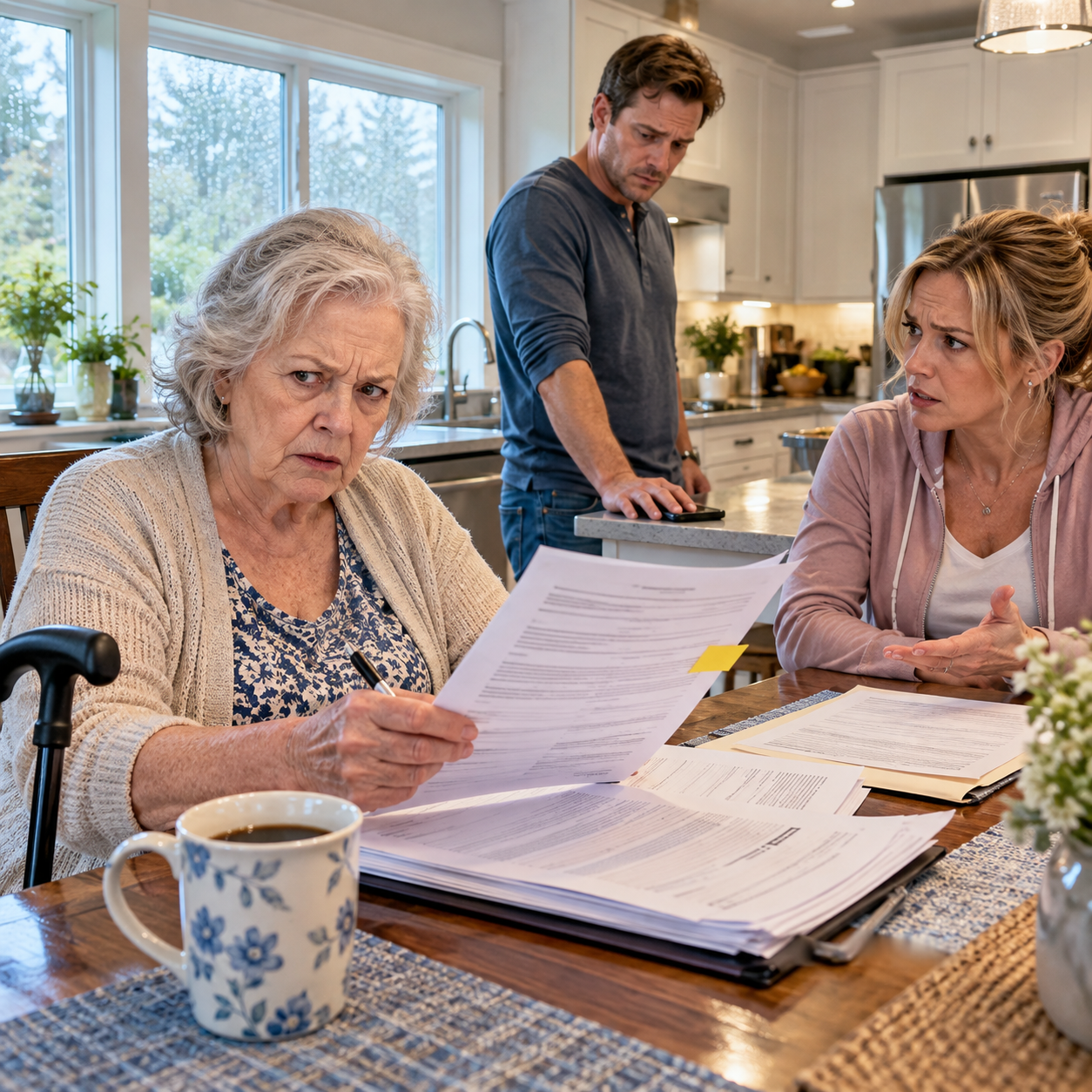
Part 2: The Number Came First, Then My Son Invented Reasons
I didn’t call Evan.
Age teaches you that information behaves better when you don’t chase it around the room shouting.
Instead, I called the bank.
The representative confirmed that a transfer attempt had been made through credentials previously associated with Evan’s limited account access.
Years earlier, after my husband died, I had authorized Evan to pay a few household bills if I was traveling or ill.
Two days before Mother’s Day, I had revoked that access.
I had done it because the bank sent me an alert saying someone had asked how to extend existing permissions to my retirement investments.
I hadn’t known who made the inquiry.
Now I had a strong suspicion.
Monday morning, Evan called.
“You embarrassed me with the bank.”
That was his opening sentence.
I sat beside the window overlooking Cedar Hills’ courtyard, where two women were arguing cheerfully about tomato plants.
“I embarrassed you?”
“They treated me like I was stealing.”
“Were you transferring sixty-three thousand dollars?”
Silence.
Then: “You owe us money, Mom.”
I pressed the phone more firmly against my ear.
“For what?”
“Living expenses. Care. Transportation. Things around the house.”
“How did you arrive at exactly sixty-three thousand?”
“We calculated it.”
“Send me the calculation.”
Another pause.
“Claire has the spreadsheet.”
It reached my email forty minutes later.
The document was impressive in the way bad evidence sometimes is. Categories, dates, subtotals, neat borders.
Groceries.
Utilities.
Medical transportation.
Home modifications.
Mobility equipment.
Caregiving time.
I opened my banking folder.
For two years I had transferred $600 each month into Evan and Claire’s household account. Every single transfer was missing from their spreadsheet.
My prescription costs appeared under their expenses even though I paid them through my own pharmacy account.
The transportation charges included rides covered by my insurance.
Then I saw it.
Specialized mobility equipment: $14,280.
I stared at the description.
My specialized mobility equipment consisted of a cane, a shower bench, and compression socks.
But I remembered a winter afternoon when Evan had opened a long black case in his garage.
Inside was a commercial drain inspection camera.
He had grinned like a boy with a new bicycle.
“Business is finally growing,” he’d told me.
I called him.
“Evan, what fourteen-thousand-dollar mobility device did you buy for me?”
He didn’t answer immediately.
“The equipment line?”
“Yes.”
“That included modifications.”
“What modifications?”
“The railing.”
“Sam installed the railing. I bought the lumber.”
“No, I mean—the bathroom work.”
“There was no bathroom work.”
His voice sharpened.
“Mom, I don’t remember every receipt.”
“I remember the drain camera.”
Nothing.
I continued.
“The black one you bought for the company.”
“That gets used around the house sometimes.”
“For my knee?”
“Oh, come on.”
There was the real Evan, finally—tired, cornered, ashamed, and angry at me for making him feel those things.
I hung up.
Claire arrived at Cedar Hills Wednesday afternoon carrying the spreadsheet in a leather folder.
“I don’t want a fight,” she said.
People usually say that after bringing ammunition.
We sat in a quiet visitors’ room.
“I know Evan isn’t perfect,” she began. “But you have no idea how much pressure he’s under.”
“I have some idea.”
“He says your expenses kept us from saving anything.”
I placed twenty-four printed bank statements between us.
Claire frowned.
“What are these?”
“My monthly household contributions.”
She went through them slowly.
Six hundred.
Six hundred.
Six hundred.
Month after month.
“He told me he paid everything,” she said.
“I know.”
Then I gave her my pharmacy statements and transportation records.
Finally, I slid the spreadsheet toward her and tapped the mobility equipment charge.
“That’s his drain camera.”
Claire looked at me.
“No.”
“Yes.”
“He told me the company leased it.”
“Call him.”
She hesitated.
Then she did.
“Evan, where did the money for the inspection camera come from?”
I couldn’t hear his words clearly, only the pitch of his voice.
Claire’s expression changed.
“What do you mean, why am I asking?”
She listened.
“No. Don’t change the subject.”
Another pause.
“You told me the business was doing fine.”
She lowered the phone.
For several seconds she stared at the carpet.
Then she whispered, “He asked why you were showing me things.”
Not whether they were true.
Why I was showing her.
Claire closed her eyes.
“I told you that you were draining us.”
“You did.”
“I believed him.”
“I believe you.”
Her eyes opened.
That surprised her.
Then I added, “Believing him doesn’t erase what you said to me.”
She nodded once.
No defense.
The following afternoon, I received a voicemail from a commercial finance company.
The representative said my name had been listed as an expected funding source connected to Evan’s business loan.
That was when the pieces stopped looking accidental.
The overdue notifications.
The prepared nursing-home packet.
The financial authorization.
The exact sixty-three thousand dollars.
My son hadn’t calculated what I owed him.
He had calculated what he needed from me.
Part 3: His Business Debt Exposed Why He Needed Me Gone
Evan called Friday evening.
His voice was different.
Smaller.
“Mom, can we stop doing this through Claire?”
“I didn’t start doing anything through Claire. She came to me.”
“I need a loan.”
Not reimbursement anymore.
A loan.
“How much?”
He gave a humorless laugh.
“You know how much.”
“Sixty-three thousand.”
“If I get through this quarter, I can recover.”
“And if you don’t?”
“I will.”
Rain began against my window again, soft and steady.
Then Evan said something that clarified our relationship better than any bank statement could.
“If you help me, you can come home.”
I rested my hand on the cane beside my chair.
“Come home?”
“We can forget all of this.”
“So my room is available if I finance your company?”
“That isn’t what I meant.”
“Then explain what you meant.”
He breathed heavily into the phone.
“Mom, I’m trying to fix this.”
“No. You’re trying to purchase your way backward.”
“I made mistakes.”
“You tried to access my retirement account three hours after I left your house.”
“I panicked.”
“You listed me with your lender.”
“I was going to tell you.”
“When?”
No answer.
I asked him one last question.
“If I never give you another dollar, am I still welcome as your mother?”
I could hear a truck passing on his end.
Then breathing.
Nothing else.
“Come to Cedar Hills tomorrow,” I said. “We’ll talk in person.”
Saturday afternoon, Evan arrived carrying another folder.
Claire followed him but sat in a separate chair.
That told me more than either of them did.
Evan placed a revised expense sheet on the table.
The total had fallen dramatically.
Beside it was a one-page loan agreement.
And, once again, an uncapped pen.
I almost laughed.
Instead, I opened my purse.
“I went through every legitimate expense.”
I handed him a check for $347.
He stared at it.
“What is this?”
“The pharmacy copay you covered when my card malfunctioned, plus the lumber you purchased before I reimbursed Sam for the labor.”
“You can’t be serious.”
“I’m painfully serious.”
He pushed the check away.
“You’re sitting on money while my company could collapse.”
“My retirement account is not sitting anywhere. It is paying for the rest of my life.”
“I’m your son.”
“Yes.”
“Doesn’t that mean anything?”
“It means more than money. That appears to be our disagreement.”
He stood and paced toward the window.
Claire spoke for the first time.
“Tell her.”
Evan turned.
“Not now.”
“Yes. Now.”
“Claire.”
“You told my parents she was bankrupting us. You told your cousins. You told me we couldn’t buy a house because your mother consumed every extra dollar.”
Evan rubbed both hands across his face.
“Can we please not do this here?”
“This is exactly where we do it.”
He looked at me.
For a moment, I saw how exhausted he was.
Not evil.
Not heartless.
Just a forty-two-year-old man who had expanded too quickly, borrowed too much, hidden the losses, and decided his mother’s savings were easier to face than his own failure.
“I lost two commercial contracts,” he said.
Claire stared at him.
“When?”
“February.”
“You told me March was our best month.”
“I was trying to turn it around.”
He sat.
“The camera, the equipment, the newer truck—I financed too much. Then payroll hit. Then taxes.”
His fingers tightened around the revised spreadsheet.
“I knew Mom wouldn’t invest in the business. She’d already said no years ago.”
“So you created expenses she supposedly owed you?” Claire asked.
“I convinced myself they were real.”
“No,” I said quietly. “You convinced yourself you deserved the money.”
He looked at me then.
That landed.
“I thought if you moved somewhere permanent,” he said, “your expenses would be predictable. And if I could get enough access to stabilize the company—”
“You could explain afterward.”
His eyes lowered.
“Yes.”
Claire leaned back as though she needed distance from the word.
“And you let me blame her.”
Evan swallowed.
“Yes.”
“You watched me hand her those papers.”
“Yes.”
“You watched me tell her she couldn’t stay.”
His answer barely carried across the table.
“Yes.”
Nobody shouted.
That made it harder.
Evan pushed the loan agreement toward me.
“At least consider part of it.”
I slid it back.
“No.”
“Mom—”
“I am not financing my membership in this family.”
His mouth tightened.
“That’s dramatic.”
“No. Dramatic was handing your recovering mother nursing-home papers on Mother’s Day because your lender wanted money.”
He flinched.
I continued more softly.
“You can lose a business and still be my son. You can disappoint me and still be my son. You can even take years rebuilding my trust and still be my son.”
I touched the agreement.
“But I will not pay for the privilege.”
Part 4: I Chose My Own Home And Changed Our Family Terms
Evan left alone.
Claire remained seated after the door closed.
“I don’t expect you to forgive me,” she said.
“That’s useful, because I’m not ready.”
She almost smiled.
Fair enough.
I completed rehabilitation seven weeks after I arrived at Cedar Hills.
By then, my knee bent farther than it had before surgery, which deprived me of at least three excuses I had planned to use for the rest of my life.
More importantly, I found an apartment.
First floor.
Two bedrooms.
Wide hallway.
A bakery half a block away.
A bus stop outside.
Mine.
Sam helped me move.
He carried in the last box, examined the kitchen cabinet, and said, “That hinge bothers me.”
“You’ve been here nine minutes.”
“Long enough.”
He repaired it before lunch.
Evan handled his business without my retirement account. He sold the expensive inspection camera, returned one truck, renegotiated debt, and reduced his payroll.
The company survived.
Smaller, but alive.
That mattered to me because I never wanted him ruined.
I only wanted him to stop treating me as his emergency fund.
Claire came to my apartment in October.
No flowers.
No gift.
No performance.
She stood just inside the doorway and said, “I owe you an apology without an explanation attached.”
“That would be new.”
“I deserved that.”
She clasped her hands.
“I’m sorry I helped pressure you. I’m sorry I spoke about you like you weren’t capable of deciding where to live. And I’m especially sorry I believed something ugly about you because it was convenient for me.”
I studied her face.
“What was convenient about it?”
She looked embarrassed.
“If you were the reason we were struggling, then Evan and I weren’t.”
That was the first thing she had said that made complete sense.
We drank tea.
It was uncomfortable.
It was also real.
Evan took longer.
Christmas passed with a card.
My birthday brought a phone call.
We talked about weather, my knee, his son’s baseball team, anything except money.
Trust returned by teaspoons.
The next Mother’s Day, I made coffee in my own kitchen.
At nine-thirty, someone knocked.
Through the peephole, I saw Evan standing alone.
No folder.
No envelope large enough to hide paperwork.
He held a greeting card in both hands.
I opened the door but didn’t invite him in immediately.
“Happy Mother’s Day,” he said.
“Thank you.”
He handed me the card.
I opened it while he waited.
Inside, beneath the printed message, he had written three sentences.
I miss being your son without asking you for anything.
I’m sorry I made your home in our family feel conditional.
I’d like to earn back whatever you’re willing to give me.
I read it twice.
Then I looked at him.
“You want coffee?”
His eyes grew wet, though he blinked quickly.
“Yeah.”
“Black?”
“You always make mine too strong.”
“My house.”
That finally made him smile.
I stepped aside.
Opening that door did not mean forgetting what had happened. Evan never regained access to my accounts. I never loaned him the sixty-three thousand dollars. I never moved back into his house.
And I never apologized for protecting myself.
What changed was simpler.
My son learned that love did not entitle him to my savings.
I learned that saying no did not make me less of a mother.
And when we sat across from each other that Mother’s Day, there was no pen on the table.
Nothing required my signature.
The End .
All characters and events in this story are fictional, created for storytelling and entertainment purposes. Thank you sincerely for reading. Your feedback and support are invaluable and motivate me to continue sharing more stories with you.

