
Part 2: Dinner Became A Demand For My Mother’s Four Hundred Thousand
Sandra had cooked roast chicken, rosemary potatoes and green beans with almonds. It was the sort of dinner designed to look effortless while requiring an entire afternoon.
My father poured wine.
For twenty minutes we talked about harmless things.
My work.
Their neighbors.
A plumbing problem.
Then Sandra placed her fork beside her plate.
“Alice, there’s something practical we need to discuss.”
Dad stared into his wine.
That was the first sign the conversation had been rehearsed.
Sandra folded her napkin neatly.
“Your father told me Caroline left you a substantial amount of money.”
I looked at him.
He rubbed one thumb along the stem of his glass.
“How substantial?” I asked.
Sandra answered.
“About four hundred thousand.”
Dad still would not look at me.
I leaned back slightly.
“Why are we discussing my mother’s estate?”
Sandra exhaled through her nose, patient and almost maternal.
“Because keeping that kind of money untouched while family members are carrying financial pressure doesn’t make much sense.”
“What financial pressure?”
My father finally spoke.
“We refinanced the house.”
I waited.
He continued.
“There were renovations. Some investment issues. Things didn’t work out the way we expected.”
Sandra added, “And we’re not asking you to throw money away. We’d use it responsibly.”
The word asking did not match her tone.
“How much?”
She glanced at Dad.
“Most of it.”
I thought I had misunderstood.
“Most?”
“We could put the mortgage in a much stronger position,” Sandra said. “Your father is approaching retirement. This house will eventually be part of your inheritance anyway.”
I looked around.
At the chandelier Sandra had chosen.
At the marble floor that had replaced my mother’s scratched hardwood.
At the bracelet on Sandra’s wrist.
I recognized it.
My grandfather had given that bracelet to Mom on her fortieth birthday.
“Where did you get that?”
Sandra touched it automatically.
“This?”
“Yes.”
She looked toward Dad before answering.
“It was in a jewelry box upstairs. Your father said I could have it.”
Dad cleared his throat.
“Alice, that’s not what we’re discussing.”
“No,” I said. “I suppose it isn’t.”
Sandra’s composure thinned.
“I know you have feelings about me. I’ve accepted that. But at some point, we have to stop treating me like an outsider.”
“I haven’t said anything about you.”
“You don’t have to.”
Dad leaned forward.
“Enough.”
He said it to me.
Not to her.
Sandra picked up her glass.
“Four hundred thousand dollars sitting in an account while your father worries about money is difficult for me to understand.”
“It came from Mom’s family.”
“It came to you,” she replied. “You’re choosing what happens to it now.”
My father put both hands on the table.
“Sandra is my wife. That makes her part of this family.”
I waited for whatever came after that.
He did not disappoint me.
“Your mother would have wanted you to help the people I love.”
For several seconds, I studied his face.
This was a man who had missed his dying wife’s chemotherapy appointments to meet another woman. Now he was borrowing that wife’s memory to finance the life he had built with her replacement.
I could have said all of that.
Instead I asked, “Are you in danger of losing the house?”
“No,” Dad said quickly.
Sandra answered at the same time.
“Not yet.”
They exchanged a glance.
There it was.
Not ruin, exactly.
Fear.
My father had invested part of his retirement savings with a friend whose business had collapsed. The renovations had cost more than expected. Their adjustable mortgage had become expensive. Sandra had recently reduced her work hours after her company restructured.
They were not destitute.
They were frightened.
That made their behavior easier to understand.
It did not make it acceptable.
“What happens if I say no?” I asked.
Sandra’s eyes narrowed slightly.
“Why would you?”
“That’s not an answer.”
Dad pushed his plate away.
“Alice, don’t make this ugly.”
The sentence nearly made me laugh.
Instead, I folded my napkin.
“I need time.”
Sandra looked relieved, as if she had heard surrender.
“Of course. We don’t expect an answer tonight.”
She reached across the table but stopped before touching my hand.
“We just want you to think about what’s fair.”
I drove home with the radio off.
At my apartment, I opened the small fireproof box where I kept important papers.
My mother’s death certificate.
Her final birthday card to me.
The basic inheritance statement I had received years earlier.
At the bottom was a business card.
Gerald Harmon
Harmon, Pike & Associates
I turned it over.
On the back, in my mother’s handwriting, were six words.
Call Gerald before you sign anything.
I sat on the floor beside the open box until nearly midnight.
At 8:03 the next morning, I called his office.
His assistant transferred me immediately.
“Mr. Harmon?”
“Alice.”
He recognized my voice.
“I think my father wants Mom’s money.”
There was a pause, followed by the faint sound of a drawer opening.
“Has anyone given you paperwork?”
“No.”
“Have you promised anything?”
“No.”
“Good.”
Paper moved on his end of the line.
Then his voice changed. Not dramatically. It simply became more precise.
“Your mother prepared for this possibility.”
I gripped the phone tighter.
“What does that mean?”
“It means I think it’s time you saw everything she left with me.”
Part 3: Her Lawyer Opened The File She Prepared Before Dying
Mr. Harmon’s office looked almost exactly as it had when I was a child.
The same dark shelves.
The same landscape photograph behind his desk.
Even the brass clock on the bookcase seemed unchanged.
He had aged, though. His hair was nearly white now, and he moved carefully when he stood to greet me.
“You look like Caroline,” he said.
People had told me that before.
From him, it hurt differently.
He invited me to sit and placed a thick file between us.
“Your mother began revising her estate plan approximately eighteen months before her death.”
I stared at the folder.
“Before Dad knew she was dying?”
“Before anyone knew precisely how much time she had.”
He opened it.
There were trust documents, bank records, letters from accountants and pages covered in my mother’s signatures.
Mr. Harmon pointed to several sections.
The money had come from my maternal grandparents. My mother had received it through family assets and investments years before she became ill.
She had transferred the funds into a trust created exclusively for me.
My father was not a beneficiary.
Neither was any future spouse of his.
More importantly, the trust could not be reassigned to satisfy another family member’s debt.
Any withdrawal above ten thousand dollars required my written authorization and a mandatory seventy-two-hour review period with the trustee.
“She requested that provision herself,” Mr. Harmon said.
“Why?”
He removed his glasses.
“She said you were generous when frightened.”
I looked up.
He gave me a gentle expression.
“Her exact concern was that someone might create an emergency and persuade you that saying no made you disloyal.”
That sounded so much like my mother I almost heard her voice.
Mr. Harmon reached into the back of the folder.
“There’s something else.”
He placed a cream-colored envelope in front of me.
Alice was written across it.
Mom’s handwriting.
Not a photocopy.
Not a scan.
Ink pressed into paper by her hand.
I traced the first letter with my thumb.
“When did she write this?”
“Several months before she died.”
“Did Dad know?”
“No.”
I opened it.
The first page explained the trust.
The second explained why she had separated the money from the marriage.
She did not insult my father.
That somehow made the letter more painful.
Caroline wrote that marriages sometimes survived betrayal and sometimes did not. Illness changed people. Fear exposed weaknesses. She hoped my father would find his way back to being the man she had once trusted.
But hope, she wrote, was not a financial strategy.
I had to stop reading.
Mr. Harmon looked toward the window.
He gave me privacy without leaving.
Eventually, I continued.
The final pages had almost nothing to do with money.
Mom wrote about the summer I was sixteen and insisted on driving along the coast even though she kept one hand hovering near the emergency brake.
She remembered me bringing her tea before we knew the tiredness in her face was cancer.
She remembered finding me asleep beside her hospital bed with a college textbook open across my chest.
Then came the sentence that undid years of careful control.
You have spent too much of your young life learning how to carry other people. I want the rest of it to teach you how to carry yourself.
I covered my mouth.
My shoulders shook before any sound came out.
Mr. Harmon pushed a tissue box within reach.
Mom told me to finish school.
To travel.
To choose work that interested me rather than work that made everyone else comfortable.
To love generously without becoming financially responsible for every person who claimed to love me back.
Near the end she had written:
If your father ever asks for this money, remember that I left him what belonged to our marriage. What came from my parents belongs to you. You are not taking anything from him by keeping what I gave you.
She signed only Caroline.
I cried until my face hurt.
When I could speak again, I asked Mr. Harmon for one thing.
“Can they challenge this?”
“They can challenge almost anything if they’re willing to spend enough money,” he said. “But succeeding is another matter.”
He tapped the documents.
“Your mother was competent when these were executed. Her doctors documented it. Two independent witnesses were present. The trust has been administered properly for years.”
He closed the folder.
“She was thorough.”
Of course she was.
“What should I do?”
“Legally?”
“Personally.”
Mr. Harmon smiled faintly.
“That answer isn’t in my job description.”
I laughed through my tears.
It was the first time I had laughed in his office.
He prepared copies of the relevant trust provisions and sealed them in an envelope.
Before I left, he handed me my mother’s original letter separately.
“This belongs with you now.”
I pressed the envelope against my chest.
For eight years, I had thought my mother had left me money because she knew she was dying.
That afternoon, I finally understood.
She had left me boundaries.
Part 4: My Mother’s Quiet Protection Finally Answered Them Both
I did not call my father.
I drove to his house.
Sandra opened the door wearing my mother’s bracelet again.
Her smile appeared automatically.
“Alice. We weren’t expecting you.”
“I know.”
Dad was in the kitchen reading something on his tablet.
He looked up.
“You decide?”
I placed Mr. Harmon’s envelope on the counter.
“Mom already did.”
Neither of them moved at first.
Then Dad picked it up.
He read the first page standing.
By the second, he pulled out a chair.
Sandra remained beside him.
“What is this?” she asked.
“A trust,” he said quietly.
She reached for the pages.
He did not give them to her.
His eyes traveled lower.
I watched the muscles in his jaw tighten.
“She did this before—”
“Before she died,” I said.
“How long before?”
“Eighteen months.”
Sandra crossed her arms.
“So she deliberately excluded your father.”
“No.”
Dad spoke before I could.
Both Sandra and I looked at him.
He was reading another paragraph.
“She separated her parents’ assets.”
His voice sounded different now.
Older.
Sandra bent over his shoulder.
“This doesn’t mean Alice can’t choose to help us.”
Dad kept reading.
I answered.
“I’m not giving you the money.”
Sandra straightened.
“We’re talking about your father’s home.”
“It’s his home because Mom spent almost twenty years helping him build it.”
“That’s unfair.”
“Maybe.”
I was surprised by how calm I felt.
“But I’m not deciding this based on fairness to you.”
Dad lowered the pages.
“Did she write you something?”
I hesitated.
“Yes.”
His eyes went to my purse.
“What did she say about me?”
There were a hundred answers available.
I chose the one closest to the truth.
“Less than you probably think.”
That hurt him.
I saw it.
Sandra touched his shoulder.
“Robert, we don’t have to stand here and be judged in our own house.”
He barely reacted.
His attention remained on the documents.
“She knew about us.”
It was not really a question.
“Yes.”
His hand tightened around the page.
“How much?”
“Enough.”
He looked down.
For once, Sandra had nothing ready to say.
Dad walked to the window overlooking the backyard.
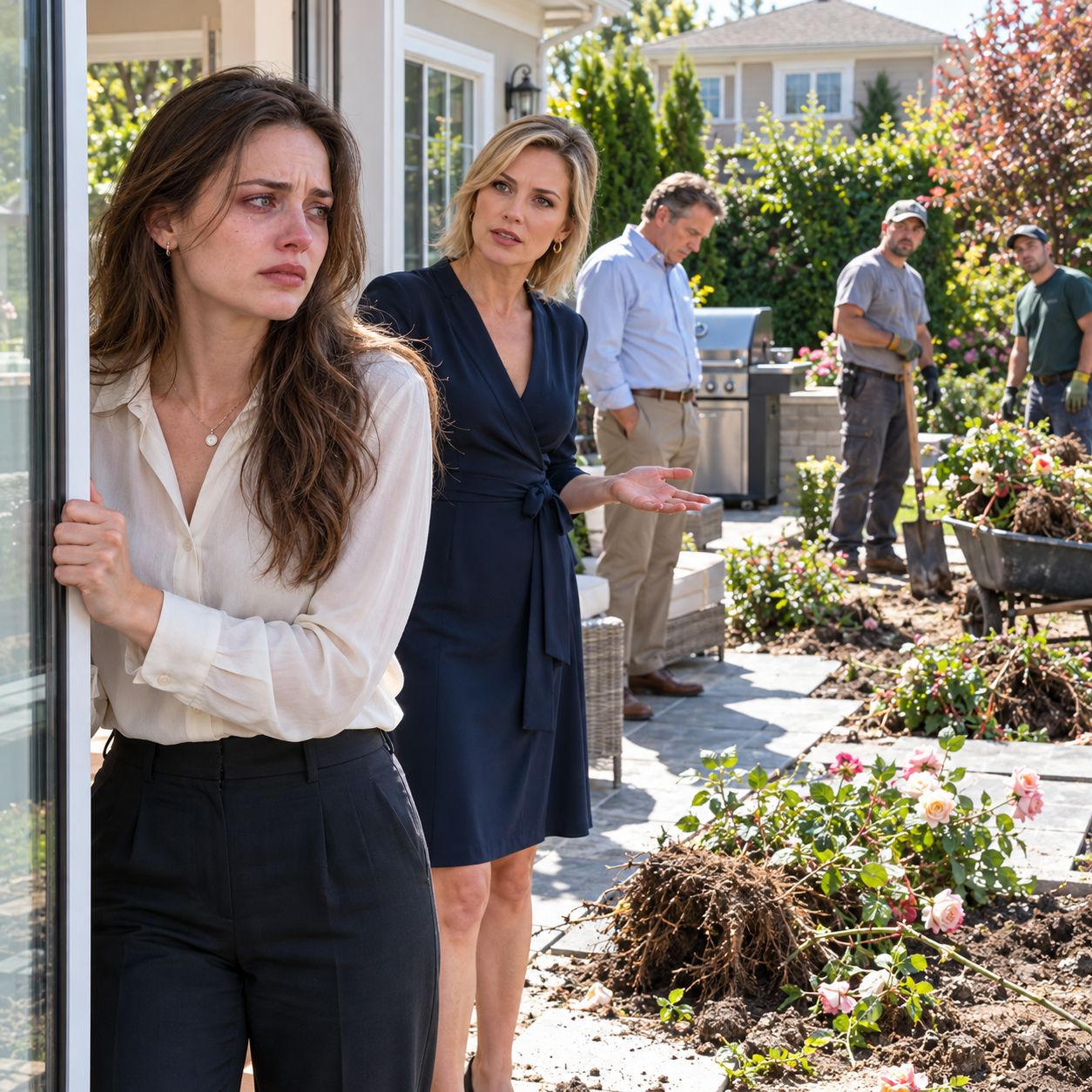
The roses were gone. In their place were gray stones, arranged neatly around a modern fire pit nobody seemed to use.
“I told myself she didn’t know,” he said.
Sandra’s face changed.
“Robert.”
He lifted one hand.
“Not now.”
He rubbed at his eyes.
“When she got sick, I couldn’t…” He stopped. “Every conversation in this house was about blood tests or medication or whether she could keep food down. I hated coming home.”
I said nothing.
He turned.
“I know how that sounds.”
“Then don’t make me explain it to you.”
His eyes filled.
“I was a coward.”
Sandra looked toward me.
“He made mistakes, Alice.”
“I know.”
“People make them when they’re scared.”
“I know that too.”
She seemed unsettled by the absence of a fight.
“So that’s it? You walk away with four hundred thousand dollars while we deal with everything alone?”
I looked at her bracelet.
“No. I walk away with what my mother decided to give me.”
Then I looked at Dad.
“And you deal with the choices you made.”
He sat again.
For the first time in my life, I saw my father cry without trying to hide it.
Not loudly.
He pressed his fingers against his eyes and bent forward over the papers.
Maybe he was mourning Mom.
Maybe he was mourning the version of himself she had once loved.
Maybe he was only frightened about money.
I never asked.
Sandra placed a hand on his back.
I picked up my purse.
At the doorway, Dad said my name.
I turned.
“I’m sorry.”
There was no defense after it.
No request.
Just those two words.
I believed he meant them in that moment.
I also knew they did not require me to return.
“I hope you are,” I said.
Then I left.
I have not been inside that house since.
My father and I exchange birthday messages now. Occasionally he calls. We talk for ten minutes about weather, work, or somebody we both knew years ago.
Sandra and I do not speak.
The trust remains intact.
I eventually used part of it to return to graduate school, something I had postponed while caring for Mom. I kept working while I studied because I discovered I liked knowing my life could stand on more than inherited money.
The spring after graduation, I booked a trip to Portugal.
Mom had once taped a photograph of Lisbon above her desk and said she wanted to see the yellow trams before she got too old to climb hills.
She never made it.
I did.
One evening, I sat at a small outdoor table overlooking the Tagus River with her letter folded inside my bag.
The paper was beginning to soften along the creases.
I read the last paragraph again.
My mother had not been able to control cancer.
She had not been able to control my father.
She could not prevent grief, betrayal, loneliness or the years I would spend trying to understand why the people we love sometimes choose the easiest path instead of the decent one.
But she had controlled what she could.
A signature.
A trust.
A letter.
A boundary waiting eight years for me to need it.
For most of my twenties, I thought the greatest thing my mother left me was financial security.
I was wrong.
She left me permission to stop proving my love through sacrifice.
And when my father and Sandra finally asked me to surrender what Caroline had protected, my mother had already given them her answer.
The End .
All characters and events in this story are fictional, created for storytelling and entertainment purposes. Thank you sincerely for reading. Your feedback and support are invaluable and motivate me to continue sharing more stories with you.

